A Transition-Based Dependency Parser
Using a Dynamic Parsing Strategy
Francesco Sartorio
Department of Information Engineering University of Padua, Italy
Giorgio Satta
Department of Information Engineering University of Padua, Italy
Joakim Nivre
Department of Linguistics and Philology Uppsala University, Sweden [email protected]
Abstract
We present a novel transition-based, greedy dependency parser which implements a flexible mix of bottom-up and top-down strategies. The new strategy allows the parser to postpone difficult decisions until the relevant information becomes available. The novel parser has a∼12% error reduc-tion in unlabeled attachment score over an arc-eager parser, with a slow-down factor of 2.8.
1 Introduction
Dependency-based methods for syntactic parsing have become increasingly popular during the last decade or so. This development is probably due to many factors, such as the increased availability of dependency treebanks and the perceived use-fulness of dependency structures as an interface to downstream applications, but a very important reason is also the high efficiency offered by de-pendency parsers, enabling web-scale parsing with high throughput. The most efficient parsers are greedy transition-based parsers, which only explore a single derivation for each input and relies on a locally trained classifier for predicting the next parser action given a compact representation of the derivation history, as pioneered by Yamada and Matsumoto (2003), Nivre (2003), Attardi (2006), and others. However, while these parsers are cap-able of processing tens of thousands of tokens per second with the right choice of classifiers, they are also known to perform slightly below the state-of-the-art because of search errors and subsequent error propagation (McDonald and Nivre, 2007), and recent research on transition-based depend-ency parsing has therefore explored different ways of improving their accuracy.
The most common approach is to use beam search instead of greedy decoding, in combination
with a globally trained model that tries to minim-ize the loss over the entire sentence instead of a locally trained classifier that tries to maximize the accuracy of single decisions (given no previous er-rors), as first proposed by Zhang and Clark (2008). With these methods, transition-based parsers have reached state-of-the-art accuracy for a number of languages (Zhang and Nivre, 2011; Bohnet and Nivre, 2012). However, the drawback with this ap-proach is that parsing speed is proportional to the size of the beam, which means that the most accur-ate transition-based parsers are not nearly as fast as the original greedy transition-based parsers. An-other line of research tries to retain the efficiency of greedy classifier-based parsing by instead improv-ing the way in which classifiers are learned from data. While the classical approach limits training data to parser states that result from oracle predic-tions (derived from a treebank), these novel ap-proaches allow the classifier to explore states that result from its own (sometimes erroneous) predic-tions (Choi and Palmer, 2011; Goldberg and Nivre, 2012).
In this paper, we explore an orthogonal approach to improving the accuracy of transition-based pars-ers, without sacrificing their advantage in efficiency, by introducing a new type of transition system. While all previous transition systems assume a static parsing strategy with respect to top-down and bottom-up processing, our new system allows a dynamic strategy for ordering parsing decisions. This has the advantage that the parser can postpone difficult decisions until the relevant information be-comes available, in a way that is not possible in existing transition systems. A second advantage of dynamic parsing is that we can extend the feature inventory of previous systems. Our experiments show that these advantages lead to significant im-provements in parsing accuracy, compared to a baseline parser that uses the arc-eager transition system of Nivre (2003), which is one of the most
widely used static transition systems.
2 Static vs. Dynamic Parsing
The notions of bottom-up and top-down parsing strategies do not have a general mathematical defin-ition; they are instead specified, often only inform-ally, for individual families of grammar formal-isms. In the context of dependency parsing, a pars-ing strategy is called purelybottom-up if every dependency h → dis constructed only after all
dependencies of the formd → ihave been
con-structed. Hereh→ddenotes a dependency with hthe head node anddthe dependent node. In
con-trast, a parsing strategy is called purelytop-down
ifh→dis constructed before any dependency of
the formd→i.
If we consider transition-based dependency pars-ing (Nivre, 2008), the purely bottom-up strategy is implemented by the arc-standard model of Nivre (2004). After building a dependencyh→ d, this
model immediately removes from its stack noded,
preventing further attachment of dependents to this node. A second popular parser, the arc-eager model of Nivre (2003), instead adopts a mixed strategy. In this model, a dependencyh→dis constructed
using a purely bottom-up strategy if it represents a left-arc, that is, if the dependentdis placed to the
left of the headhin the input string. In contrast, if h →drepresents a right-arc (defined symmetric-ally), then this dependency is constructed before any right-arcd→i(top-down) but after any
left-arcd→i(bottom-up).
What is important to notice about the above transition-based parsers is that the adopted pars-ing strategies arestatic. By this we mean that each dependency is constructed according to somefixed criterion, depending on structural conditions such as the fact that the dependency represents a left or a right arc. This should be contrasted withdynamic
parsing strategies in which several parsing options aresimultaneouslyavailable for the dependencies being constructed.
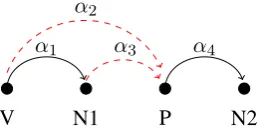
In the context of left-to-right, transition-based parsers, dynamic strategies are attractive for sev-eral reasons. One argument is related to the well-known PP-attachment problem, illustrated in Fig-ure 1. Here we have to choose whether to attach node P as a dependent of V (arc α2) or else as a dependent of N1 (arcα3). The purely bottom-up arc-standard model has to take a decision as soon as N1 is placed into the stack. This is so
V N1 P N2
α1
α2
[image:2.595.352.481.65.131.2]α3 α4
Figure 1: PP-attachment example, with dashed arcs identifying two alternative choices.
because the construction ofα1 excludesα3 from the search space, while the alternative decision of shifting P into the stack excludesα2. This is bad, because the information about the correct attach-ment could come from the lexical content of node P. The arc-eager model performs slightly better, since it can delay the decision up to the point in whichα1 has been constructed and P is read from the buffer. However, at this point it must make a commitment and either constructα3 or pop N1 from the stack (implicitly committing to α2) before N2 is read from the buffer. In contrast with this scenario, in the next sections we implement a dynamic parsing strategy that allows a transition system to decide between the attachmentsα2andα3after it has seen all of the four nodes V, N1, P and N2.
Other additional advantages of dynamic parsing strategies with respect to static strategies are re-lated to the increase in the feature inventory that we apply to parser states, and to the increase of spurious ambiguity. However, these arguments are more technical than the PP-attachment argument above, and will be discussed later.
3 Dependency Parser
In this section we present a novel transition-based parser for projective dependency trees, implement-ing a dynamic parsimplement-ing strategy.
3.1 Preliminaries
For non-negative integersiandjwithi≤j, we
write[i, j]to denote the set{i, i+ 1, . . . , j}. When i > j,[i, j]is the empty set.
We represent an input sentence as a stringw=
w0· · ·wn, n ≥ 1, where token w0 is a special root symbol and, for eachi ∈ [1, n], tokenwi = (i, ai, ti)encodes a lexical elementaiand a part-of-speech tagtiassociated with thei-th word in the sentence.
Adependency treeforwis a directed, ordered
w4
w2 w5 w7
w1 w3 w6
Figure 2: A dependency tree with left spine hw4, w2, w1iand right spinehw4, w7i.
[0, n]}is the set of nodes, andAw ⊆ Vw×Vwis the set of arcs. Arc(wi, wj)encodes a dependency
wi → wj. A sample dependency tree (excluding
w0) is displayed in Figure 2. If(wi, wj)∈Aw for
j < i, we say thatwj is a left child ofwi; a right child is defined in a symmetrical way.
The left spine of Tw is an ordered sequence hu1, . . . , upiwithp≥1andui ∈Vwfori∈[1, p], consisting of all nodes in a descending path from the root ofTw taking the leftmost child node at each step. More formally,u1is the root node ofTw anduiis the leftmost child ofui−1, fori∈[2, p]. The right spine ofTw is defined symmetrically; see again Figure 2. Note that the left and the right spines share the root node and no other node.
3.2 Basic Idea
Transition-based dependency parsers use a stack data structure, where each stack element is associ-ated with a tree spanning some (contiguous) sub-string of the input w. The parser can combine two treesT andT0through attachment operations,
called left-arc or right-arc, under the condition that
T andT0 appear at the two topmost positions in the stack. Crucially, only the roots ofT andT0 are
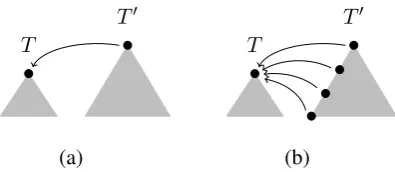
available for attachment; see Figure 3(a).
In contrast, a stack element in our parser records theentireleft spine and right spine of the associated tree. This allows us to extend the inventory of the attachment operations of the parser by including the attachment of treeTas a dependent of any node
in the left or in the right spine of a second treeT0,
provided that this does not violate projectivity.1
See Figure 3(b) for an example.
The new parser implements a mix of bottom-up and top-down strategies, since after any of the at-tachments in Figure 3(b) is performed, additional dependencies can still be created for the root ofT.
Furthermore, the new parsing strategy is clearly
dy-1A dependency tree forwis projective if every subtree has a contiguous yield inw.
T
T0
T
T0
[image:3.595.81.284.62.135.2](a) (b)
Figure 3: Left-arc attachment ofT toT0 in case of (a) standard transition-based parsers and (b) our parser.
namic, due to the free choice in the timing for these attachments. The new strategy is more powerful than the strategy of the arc-eager model, since we can use top-down parsing at left arcs, which is not allowed in arc-eager parsing, and we do not have the restrictions of parsing right arcs(h→d)before the attachment of right dependents at noded.
To conclude this section, let us resume our dis-cussion of the PP-attachment example in Figure 1. We observe that the new parsing strategy allows the construction of a treeT0consisting of the only
de-pendency V→N1 and a treeT, placed at the right
ofT0, consisting of the only dependency P→N2.
Since the right spine of T0 consists of nodes V and N1, we can freely choose between attachment V→P and attachment N1 →P. Note that this is done after we have seen node N2, as desired.
3.3 Transition-based Parser
We assume the reader is familiar with the formal framework of transition-based dependency parsing originally introduced by Nivre (2003); see Nivre (2008) for an introduction. To keep the notation at a simple level, we only discuss here the unlabeled version of our parser; however, a labeled extension is used in§5 for our experiments.
Our transition-based parser uses a stack data structure to store partial parses for the input string
w. We represent the stack as an ordered sequence σ = [σd, . . . , σ1],d≥0, of stack elements, with the topmost element placed at the right. Whend= 0, we have the empty stackσ = []. Sometimes we
use the vertical bar to denote the append operator forσ, and writeσ=σ0|σ1to indicate thatσ1is the topmost element ofσ.
Astack elementis a pair
σk= (huk,1, . . . , uk,pi,hvk,1, . . . , vk,qi)
[image:3.595.317.515.63.149.2]hvk,1, . . . , vk,qiare the left and the right spines, re-spectively, of the tree associated withσk. Recall
thatuk,1 =vk,1, since the root node of the associ-ated tree is shared by the two spines.
The parser also uses abuffer to store the por-tion of the input string still to be processed. We represent the buffer as an ordered sequenceβ = [wi, . . . , wn], i ≥ 0, of tokens from w, with the first element placed at the left. Note thatβalways
represents a (non-necessarily proper) suffix ofw.
When i > n, we have the empty bufferβ = [].
Sometimes we use the vertical bar to denote the append operator forβ, and writeβ =wi|β0to
in-dicate thatwiis the first token ofβ; consequently, we haveβ0 = [wi+1, . . . , wn].
When processingw, the parser reaches several
states, technically called configurations. A con-figuration of the parser relative to w is a triple
c = (σ, β, A), where σ and β are a stack and
a buffer, respectively, and A ⊆ Vw ×Vw is a set of arcs. The initial configuration for w is
([],[w0, . . . , wn],∅). The set of terminal config-urations consists of all configconfig-urations of the form ([σ1],[], A), whereσ1is associated with a tree
hav-ing rootw0, that is,u1,1=v1,1 =w0, andAis any set of arcs.
The core of a transition-based parser is the set of its transitions. Eachtransitionis a binary rela-tion defined over the set of configurarela-tions of the parser. Since the set of configurations is infinite, a transition is infinite as well, when viewed as a set. However, transitions can always be specified by some finite means. Our parser uses three types of transitions, defined in what follows.
• SHIFT, or sh for short. This transition
re-moves the first node from the buffer and pushes into the stack a new element, consist-ing of the left and right spines of the associ-ated tree. More formally
(σ, wi|β, A)`sh (σ|(hwii,hwii), β, A)
• LEFT-ARCk, k ≥ 1, or lakfor short. Let h be thek-th node in the left spine of the
top-most tree in the stack, and letdbe the root
node of the second topmost tree in the stack. This transition creates a new arch→d.
Fur-thermore, the two topmost stack elements are replaced by a new element associated with the tree resulting from theh→dattachment. The
transition does not advance with the reading
of the buffer. More formally
(σ0|σ2|σ1, β, A)`lak (σ0|σla, β, A∪ {h→d})
where
σ1 = (hu1,1, . . . , u1,pi,hv1,1, . . . , v1,qi),
σ2 = (hu2,1, . . . , u2,ri,hv2,1, . . . , v2,si),
σla = (hu1,1, . . . , u1,k, u2,1, . . . , u2,ri, hv1,1, . . . , v1,qi),
and where we have seth=u1,kandd=u2,1.
• RIGHT-ARCk,k ≥1, orrak for short. This transition is defined symmetrically with re-spect tolak. We have
(σ0|σ2|σ1, β, A)`rak (σ0|σra, β, A∪ {h→d})
whereσ1 andσ2are as in thelakcase,
σra = (hu2,1, . . . , u2,ri,
hv2,1, . . . , v2,k, v1,1, . . . , v1,qi),
and we have seth=v2,kandd=v1,1.
Transitions lak and rak are parametric in k, wherekis bounded by the length of the input string
and not by a fixed constant (but see also the experi-mental findings in§5). Thus our system uses an un-bounded number of transition relations, which has an apparent disadvantage for learning algorithms. We will get back to this problem in§4.3.
Acomplete computationrelative towis a
se-quence of configurationsc1, c2, . . . , ct,t≥1, such thatc1 and ctare initial and final configurations, respectively, and for eachi∈[2, t],ciis produced by the application of some transition toci−1. It is not difficult to see that the transition-based parser specified above is sound, meaning that the set of arcs constructed in any complete computation on
wis always a dependency tree forw. The parser
is also complete, meaning that every (projective) dependency tree forwis constructed by some
com-plete computation onw. A mathematical proof of
this statement is beyond the scope of this paper, and will not be provided here.
3.4 Deterministic Parsing Algorithm
Algorithm 1Parsing Algorithm
Input: stringw=w0· · ·wn, functionscore()
Output: dependency treeTw
c= (σ, β, A)←([],[w0, . . . , wn],∅)
while|σ|>1∨ |β|>0do
while|σ|<2do updatecwithsh
p←length of left spine ofσ1
s←length of right spine ofσ2 T ← {lak | k∈[1, p]} ∪
{rak | k∈[1, s]} ∪ {sh}
bestT ←argmaxt∈T score(t, c) updatecwithbestT
return Tw = (Vw, A)
for w. We present here an algorithm that runs
the parser in pseudo-deterministic mode, greed-ily choosing at each configuration the transition that maximizes some score function. Algorithm 1 takes as input a stringw and a scoring function
score()defined over parser transitions and parser configurations. The scoring function will be the subject of§4 and is not discussed here. The output of the parser is a dependency tree forw.
At each iteration the algorithm checks whether there are at least two elements in the stack and, if this is not the case, it shifts elements from the buffer to the stack. Then the algorithm uses the function
score()to evaluate all transitions that can be ap-plied under the current configurationc= (σ, β, A), and it applies the transition with the highest score, updating the current configuration.
To parse a sentence of lengthn(excluding the root tokenw0) the algorithm applies exactly2n+ 1 transitions. In the worst case, each transition ap-plication involves1 +p+stransition evaluations. We therefore conclude that the algorithm always reaches a configuration with an empty buffer and a stack which contains only one element. Then the al-gorithm stops, returning the dependency tree whose arc set is defined as in the current configuration.
4 Model and Training
In this section we introduce the adopted learning algorithm and discuss the model parameters.
4.1 Learning Algorithm
We use a linear model for the score function in Algorithm 1, and definescore(t, c) = ~ω·φ(t, c).
Here~ωis a weight vector and functionφprovides
Algorithm 2Learning Algorithm
Input: pair(w=w0· · ·wn, Ag), vector~ω
Output: vector~ω
c= (σ, β, A)←([],[w0, . . . , wn],∅)
while|σ|>1∨ |β|>0do
while|σ|<2do updatecwith SHIFT
p←length of left spine ofσ1
s←length of right spine ofσ2 T ← {lak | k∈[1, p]} ∪
{rak | k∈[1, s]} ∪ {sh}
bestT ←argmaxt∈T score(t, c)
bestCorrectT ←
argmaxt∈T ∧isCorrect(t) score(t, c)
ifbestT 6=bestCorrectT then ~
ω←~ω−φ(bestT, c) +φ(bestCorrectT, c) updatecwithbestCorrectT
a feature vector representation for a transitiont
ap-plying to a configurationc. The functionφwill be discussed at length in§4.3. The vector~ωis trained
using the perceptron algorithm in combination with the averaging method to avoid overfitting; see Fre-und and Schapire (1999) and Collins and Duffy (2002) for details.
The training data set consists of pairs(w, Ag),
where w is a sentence andAg is the set of arcs
of the gold (desired) dependency tree forw. At
training time, each pair(w, Ag)is processed using
the learning algorithm described as Algorithm 2. The algorithm is based on the notions of correct and incorrect transitions, discussed at length in§4.2.
Algorithm 2 parseswfollowing Algorithm 1 and
using the current~ω, until the highest score
selec-ted transitionbestT is incorrect according toAg.
When this happens,~ωis updated by decreasing the
weights of the features associated with the incorrect
bestT and by increasing the weights of the features
associated with the transitionbestCorrectThaving
the highest score among all possible correct trans-itions. After each update, the learning algorithm resumes parsing from the current configuration by applying bestCorrectT, and moves on using the
updated weights.
4.2 Correct and Incorrect Transitions
σ2 σ1 b1 (a)
σ2 σ1 b1
(b)
σ2 σ1 · · ·
bi (c)
σ2 σ1 · · ·
[image:6.595.98.264.60.180.2]bi (d)
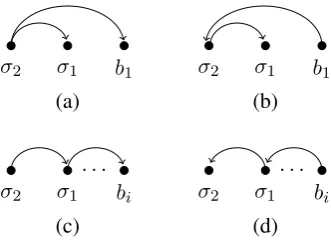
Figure 4: Graphical representation of configura-tions; drawn arcs are inAg but have not yet been
added to the configuration. Transitionshis
incor-rect for configuration (a) and (b); shandra1 are correct for (c);shandla1are correct for (d).
leading to the gold tree is considered as correct. In this paper we depart from such a methodology, and follow Goldberg and Nivre (2012) in allowing more than one correct transition for each configuration, as explained in detail below.
Let(w, Ag)be a pair in the training set. In§3.3
we have mentioned that there is always a complete computation onwthat results in the construction
of the setAg. In general, there might be more than
one computation forAg. This means that the parser
showsspurious ambiguity.
Observe that all complete computations forAg
share the same initial configurationcI,w and final configurationcF,Ag. Consider now the setC(w)of
all configurations cthat are reachable fromcI,w, meaning that there exists a sequence of transitions that takes the parser fromcI,wtoc. A configuration
c ∈ C(w)is correctfor Ag ifcF,Ag is reachable
fromc; otherwise,cisincorrectforAg.
Letc∈ C(w)be a correct configuration forAg.
A transition t is correct for c and Ag if c `t c0
andc0 is correct forAg; otherwise,t is incorrect
forcandAg. The next lemma provides a
charac-terization of correct and incorrect transitions; see Figure 4 for examples. We use this characterization in the implementation of predicateisCorrect()in Algorithm 2.
Lemma 1 Let(w, Ag)be a pair in the training set
and letc ∈ C(w)withc = (σ, β, A)be a correct configuration forAg. Let alsov1,k,k∈ [1, q], be the nodes in the right spine ofσ1.
(i) lakandrakare incorrect forcandAg if and
only if they create a new arc(h→d)6∈Ag;
(ii) shis incorrect forcandAg if and only if the
following conditions are both satisfied: (a) there exists an arc(h →d)inAg such
thathis inσandd=v1,1;
(b) there is no arc (h0 → d0) in Ag with
h0 =v1,k,k∈[1, q], andd0 inβ. 2
PROOF(SKETCH) To prove part (i) we focus on transition rak; a similar argument applies to lak. The ‘if’ statement in part (i) is self-evident.
‘Only if’. Assuming that transitionrakcreates a new arc(h→d)∈Ag, we argue that from
con-figurationc0 withc `rak c0 we can still reach the
final configuration associated withAg. We have
h = v2,k andd = u1,1. The tree fragments inσ with rootsv2,k+1andu1,1must be adjacent siblings in the tree associated withAg, sincecis a correct
configuration for Ag and (v2,k → u1,1) ∈ Ag.
This means that each of the nodesv2,k+1, . . . , v2,s in the right spine inσ2incmust have already ac-quired all of its right dependents, since the tree is projective. Therefore it is safe for transitionrakto eliminate the nodesv2,k+1, . . . , v2,sfrom the right spine inσ2.
We now deal with part (ii). Let c `sh c0,c0 =
(σ0, β0, A).
‘If’. Assuming (ii)a and (ii)b, we argue thatc0 is
incorrect. Nodedis the head ofσ20. Arc(h→d)is not inA, and the only way we could create(h→d) fromc0 is by reaching a new configuration withd
in the topmost stack symbol, which amounts to say thatσ01can be reduced by a correct transition. Node his in someσi0,i >2, by (ii)a. Then reduction of σ10 implies that the root ofσ01is reachable from the
root ofσ20, which contradicts (ii)b.
‘Only if’. Assuming (ii)a is not satisfied, we argue thatshis correct forcandAg. There must
be an arc(h→d)not inAwithd=v1,1andhis some tokenwi inβ. From stackσ0 =σ00|σ02|σ01it is always possible to construct(h→d)consuming the substring of β up to wi and ending up with stackσ00|σred, whereσredis a stack element with
rootwi. From there, the parser can move on to the final configurationcF,Ag. A similar argument
applies if we assume that (ii)b is not satisfied. From condition (i) in Lemma 1 and from the fact that there are no cycles inAg, it follows that there
for the same configuration; see Figures 4(c,d) for examples. It follows that for a correct configuration there might be at most 2 correct transitions. In our training experiments for English in§5 we observe 2 correct transitions for 42% of the reached configur-ations. This nondeterminism is a byproduct of the adopted dynamic parsing strategy, and eventually leads to the spurious ambiguity of the parser.
As already mentioned, we do not impose any ca-nonical form on complete computations that would hardwire a preference for some correct transition and get rid of spurious ambiguity. Following Gold-berg and Nivre (2012), we instead regard spurious ambiguity as an additional resource of our pars-ing strategy. Our main goal is that the trainpars-ing algorithm learns to prefer ashtransition in a
con-figuration that does not provide enough information for the choice of the correct arc. In the context of dependency parsing, the strategy of delaying arc construction when the current configuration is not informative is called the easy-first strategy, and has been first explored by Goldberg and Elhadad (2010).
4.3 Feature Extraction
In existing transition-based parsers a set of atomic features is statically defined and extracted from each configuration. These features are then com-bined together into complex features, according to some feature template, and joined with the avail-able transition types. This is not possible in our system, since the number of transitionslakandrak is not bounded by a constant. Furthermore, it is not meaningful to associate transitionslakandrak, for anyk ≥ 1, always with the same features, since the constructed arcs impinge on nodes at differ-ent depths in the involved spines. It seems indeed more significant to extract information that is local to the arch→dbeing constructed by each
trans-ition, such as for instance the grandparent and the great grandparent nodes ofd. This is possible if we introduce a higher level of abstraction than in existing transition-based parsers. We remark here that this abstraction also makes the feature repres-entation more similar to the ones typically found in graph-based parsers, which are centered on arcs or subgraphs of the dependency tree.
We index the nodes in the stack σ relative to
the head node of the arc being constructed, in case of the transitionslak orrak, or else relative to the root node of σ1, in case of the transition
sh. More precisely, letc = (σ, β, A) be a con-figuration and let t be a transition. We define
the context of c and t as the tuple C(c,t) = (s3, s2, s1, q1, q2, gp, gg), whose components are placeholders for word tokens inσor inβ. All these
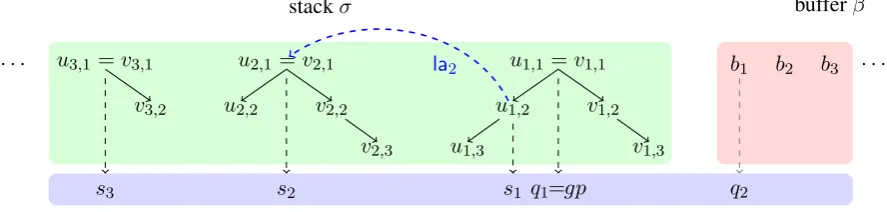
placeholders are specified in Table 1, for eachcand t. Figure 5 shows an example of feature extraction
for the displayed configurationc= (σ, β, A)and the transitionla2. In this case we haves3 =u3,1,
s2 = u2,1,s1 = u1,2,q1 = gp = u1,1,q2 = b1;
gg=nonebecause the head ofgpis not available
inc.
Note that in Table 1 placeholders are dynamic-ally assigned in such a way thats1ands2refer to the nodes in the constructed arch→d, andgp,gg
refer to the grandparent and the great grandparent nodes, respectively, ofd. Furthermore, the node
assigned tos3 is the parent node ofs2, if such a node is defined; otherwise, the node assigned to
s3is the root of the tree fragment in the stack un-derneathσ2. Symmetrically, placeholdersq1and
q2refer to the parent and grandparent nodes ofs1, respectively, when these nodes are defined; other-wise, these placeholders get assigned tokens from the buffer. See again Figure 5.
Finally, from the placeholders inC(c,t)we ex-tract a standard set of atomic features and their complex combinations, to define the functionφ.
Our feature template is an extended version of the feature template of Zhang and Nivre (2011), ori-ginally developed for the arc-eager model. The extension is obtained by adding top-down features for left-arcs (based on placeholders gp and gg),
and by adding right child features for the first stack element. The latter group of features is usually ex-ploited for the arc-standard model, but is undefined for the arc-eager model.
5 Experimental Assessment
Performance evaluation is carried out on the Penn Treebank (Marcus et al., 1993) converted to Stan-ford basic dependencies (De Marneffe et al., 2006). We use sections 2-21 for training, 22 as develop-ment set, and 23 as test set. The part-of-speech tags are assigned by an automatic tagger with ac-curacy97.1%. The tagger used on the training set
is trained on the same data set by using four-way jackknifing, while the tagger used on the develop-ment and test sets is trained on all the training set. We train an arc-labeled version of our parser.
context sh lak rak
placeholder k= 1 k= 2 k >2 k= 1 k= 2 k >2
s1 u1,1 =v1,1 u1,k u1,1=v1,1
s2 u2,1 =v2,1 u2,1=v2,1 v2,k s3 u3,1 =v3,1 u3,1=v3,1 u3,1=v3,1 v2,k−1
q1 b1 b1 u1,k−1 b1
q2 b2 b2 b1 u1,k−2 b2
gp none none u1,k−1 none v2,k−1
gg none none none u1,k−2 none none v2,k−2
Table 1: Definition ofC(c,t) = (s3, s2, s1, q1, q2, gp, gg), forc= (σ0|σ3|σ2|σ1, b1|b2|β, A)andt of type
shorlak,rak,k≥1. Symbolsuj,kandvj,kare thek-th nodes in the left and right spines, respectively, of stack elementσj, withuj,1 =vj,1 being the shared root ofσj;noneis an artificial element used when some context’s placeholder is not available.
· · ·
stackσ
u3,1=v3,1
v3,2
u2,1=v2,1
u2,2 v2,2
v2,3
u1,1 =v1,1
u1,2 v1,2
u1,3 v1,3
la2
bufferβ
b1 b2 b3 · · ·
context extracted forla2
[image:8.595.130.470.62.156.2]s3 s2 s1 q1=gp q2
Figure 5: Extraction of atomic features for contextC(c,la2) = (s3, s2, s1, q1, q2, gp, gg),c= (σ, β, A).
parser iter UAS LAS UEM
arc-standard 23 90.02 87.69 38.33
arc-eager 12 90.18 87.83 40.02
this work 30 91.33 89.16 42.38
arc-standard + easy-first 21 90.49 88.22 39.61 arc-standard + spine 27 90.44 88.23 40.27
Table 2: Accuracy on test set, excluding punc-tuation, for unlabeled attachment score (UAS), labeled attachment score (LAS), unlabeled exact match (UEM).
the accuracy of our parser against our implementa-tion of the arc-eager and arc-standard parsers. For the arc-eager parser, we use the feature template of Zhang and Nivre (2011). The same template is adapted to the arc-standard parser, by removing the top-down parent features and by adding the right child features for the first stack element. It turns out that our feature template, described in§4.3, is the exact merge of the templates used for the arc-eager and the arc-standard parsers.
We train all parsers up to 30 iterations, and for each parser we select the weight vector~ωfrom the
iteration with the best accuracy on the development set. All our parsers attach the root node at the end of the parsing process, following the ‘None’
ap-proach discussed by Ballesteros and Nivre (2013). Punctuation is excluded in all evaluation metrics. Considering UAS, our parser provides an improve-ment of 1.15 over the arc-eager parser and an im-provement of 1.31 over the arc-standard parser, that is an error reduction of∼12% and∼13%, respect-ively. Considering LAS, we achieve improvements of 1.33 and 1.47, with an error reduction of∼11% and∼12%, over the arc-eager and the arc-standard parsers, respectively.
We speculate that the observed improvement of our parser can be ascribed to two distinct com-ponents. The first component is the left-/right-spine representation for stack elements, introduced in§3.3. The second component is the easy-first strategy, implemented on the basis of the spurious ambiguity of our parser and the definition of cor-rect/incorrect transitions in§4.2. In this perspective, we observe that our parser can indeed be viewed as an arc-standard modelaugmentedwith (i) the spine representation, and (ii) the easy-first strategy. More specifically, (i) generalizes thela/ratransitions to
[image:8.595.76.520.236.342.2]on the spurious ambiguity of the parser to enlarge the search space.
The two components above are mutually inde-pendent, meaning that we can individually imple-ment each component on top of an arc-standard model. More precisely, the arc-standard + spine model uses the transitionslak/rak but retains the definition of canonical computation, defined by ap-plying eachlak/raktransition as soon as possible. On the other hand, the arc-standard + easy-first model retains the originalla/ra transitions but is trained allowing any correct transition at each con-figuration. In this case the characterization of cor-rect and incorcor-rect configurations in Lemma 1 has been adapted to transitions la/ra, taking into
ac-count the bottom-up constraint.
With the purpose of incremental comparison, we report accuracy results for the two ‘incremental’ models in the last two lines of Table 2. Analyzing these results, and comparing with the plain arc-standard, we see that the spine representation and the easy-first strategy individually improve accur-acy. Moreover, their combination into our model (third line of Table 2) works very well, with an overall improvement larger than the sum of the individual contributions.
We now turn to a computational analysis. At each iteration our parser evaluates a number of transitions bounded byγ+ 1, withγthe maximum
value of the sum of the lengths of the left spine inσ1 and of the right spine inσ2. Quantityγis bounded by the length nof the input sentence. Since the
parser applies exactly 2n+ 1 transitions, worst case running time isO(n2). We have computed
the average value of γ on our English data set,
resulting in2.98 (variance2.15) for training set,
and2.95(variance1.96) for development set. We
conclude that, in the expected case, running time is O(n), with a slow down constant which is rather
small, in comparison to standard transition-based parsers. Accordingly, when running our parser against our implementation of the arc-eager and arc-standard models, we measured a slow-down of 2.8 and 2.2, respectively. Besides the change in representation, this slow-down is also due to the increase in the number of features in our system. We have also checked the worst case value ofγ in
our data set. Interestingly, we have seen that for strings of length smaller than 40 this value linearly grows withn, and for longer strings the growth
stops, with a maximum worst case observed value
of 22.
6 Concluding Remarks
We have presented a novel transition-based parser using a dynamic parsing strategy, which achieves a∼12% error reduction in unlabeled attachment score over the static arc-eager strategy and even more over the (equally static) arc-standard strategy, when evaluated on English.
The idea of representing the right spine of a tree within the stack elements of a shift-reduce device is quite old in parsing, predating empirical approaches. It has been mainly exploited to solve the PP-attachment problem, motivated by psycho-linguistic models. The same representation is also adopted in applications of discourse parsing, where right spines are usually called right frontiers; see for instance Subba and Di Eugenio (2009). In the context of transition-based dependency parsers, right spines have also been exploited by Kitagawa and Tanaka-Ishii (2010) to decide where to attach the next word from the buffer. In this paper we have generalized their approach by introducing the symmetrical notion of left spine, and by allowing attachment of full trees rather than attachment of a single word.2
Since one can regard a spine as a stack in it-self, whose elements are tree nodes, our model is reminiscent of the embedded pushdown automata of Schabes and Vijay-Shanker (1990), used to parse tree adjoining grammars (Joshi and Schabes, 1997) and exploiting a stack of stacks. However, by im-posing projectivity, we do not use the extra-power of the latter class.
An interesting line of future research is to com-bine our dynamic parsing strategy with a training method that allows the parser to explore transitions that apply to incorrect configurations, as in Gold-berg and Nivre (2012).
Acknowledgments
We wish to thank Liang Huang and Marco Kuhl-mann for discussion related to the ideas reported in this paper, and the anonymous reviewers for their useful suggestions. The second author has been partially supported by MIUR under project PRIN No. 2010LYA9RH 006.
References
Giuseppe Attardi. 2006. Experiments with a multil-anguage non-projective dependency parser. In Pro-ceedings of the 10th Conference on Computational Natural Language Learning (CoNLL), pages 166– 170.
Miguel Ballesteros and Joakim Nivre. 2013. Going to the roots of dependency parsing. Computational Linguistics, 39(1):5–13.
Bernd Bohnet and Joakim Nivre. 2012. A transition-based system for joint part-of-speech tagging and labeled non-projective dependency parsing. In Pro-ceedings of the 2012 Joint Conference on Empirical Methods in Natural Language Processing and Com-putational Natural Language Learning, pages 1455– 1465.
Jinho D. Choi and Martha Palmer. 2011. Getting the most out of transition-based dependency parsing. In Proceedings of the 49th Annual Meeting of the Asso-ciation for Computational Linguistics (ACL), pages 687–692.
Michael Collins and Nigel Duffy. 2002. New ranking algorithms for parsing and tagging: Kernels over dis-crete structures, and the voted perceptron. In Pro-ceedings of the 40th Annual Meeting of the Asso-ciation for Computational Linguistics (ACL), pages 263–270, Philadephia, Pennsylvania.
Marie-Catherine De Marneffe, Bill MacCartney, and Christopher D. Manning. 2006. Generating typed dependency parses from phrase structure parses. In Proceedings of the 5th International Conference on Language Resources and Evaluation (LREC), volume 6, pages 449–454.
Yoav Freund and Robert E. Schapire. 1999. Large margin classification using the perceptron algorithm. Machine Learning, 37(3):277–296, December.
Yoav Goldberg and Michael Elhadad. 2010. An ef-ficient algorithm for easy-first non-directional de-pendency parsing. In Proceedings of Human Lan-guage Technologies: The 2010 Annual Conference of the North American Chapter of the Association for Computational Linguistics (NAACL), pages 742– 750, Los Angeles, USA.
Yoav Goldberg and Joakim Nivre. 2012. A dynamic or-acle for arc-eager dependency parsing. In Proceed-ings of the 24th International Conference on Com-putational Linguistics (COLING), pages 959–976.
Aravind K. Joshi and Yves Schabes. 1997. Tree-Adjoining Grammars. In Grzegorz Rozenberg and Arto Salomaa, editors, Handbook of Formal Lan-guages, volume 3, pages 69–123. Springer.
Kotaro Kitagawa and Kumiko Tanaka-Ishii. 2010. Tree-based deterministic dependency parsing — an application to Nivre’s method —. InProceedings of
the 48th Annual Meeting of the Association for Com-putational Linguistics (ACL) Short Papers, pages 189–193.
Mitchell P. Marcus, Beatrice Santorini, and Mary Ann Marcinkiewicz. 1993. Building a large annotated corpus of English: The Penn Treebank. Computa-tional Linguistics, 19:313–330.
Ryan McDonald and Joakim Nivre. 2007. Character-izing the errors of data-driven dependency parsing models. InProceedings of the 2007 Joint Confer-ence on Empirical Methods in Natural Language Processing and Computational Natural Language Learning (EMNLP-CoNLL), pages 122–131.
Joakim Nivre. 2003. An efficient algorithm for pro-jective dependency parsing. In Proceedings of the Eighth International Workshop on Parsing Techno-logies (IWPT), pages 149–160, Nancy, France.
Joakim Nivre. 2004. Incrementality in deterministic dependency parsing. In Workshop on Incremental Parsing: Bringing Engineering and Cognition To-gether, pages 50–57, Barcelona, Spain.
Joakim Nivre. 2008. Algorithms for deterministic in-cremental dependency parsing. Computational Lin-guistics, 34(4):513–553.
Yves Schabes and K. Vijay-Shanker. 1990. Determ-inistic left to right parsing of tree adjoining lan-guages. In Proceedings of the 28th annual meet-ing of the Association for Computational Lmeet-inguistics (ACL), pages 276–283, Pittsburgh, Pennsylvania.
Rajen Subba and Barbara Di Eugenio. 2009. An effect-ive discourse parser that uses rich linguistic inform-ation. InProceedings of Human Language Techno-logies: The 2009 Annual Conference of the North American Chapter of the Association for Computa-tional Linguistics, pages 566–574.
Hiroyasu Yamada and Yuji Matsumoto. 2003. Stat-istical dependency analysis with support vector ma-chines. In Proceedings of the 8th International Workshop on Parsing Technologies (IWPT), pages 195–206.
Yue Zhang and Stephen Clark. 2008. A tale of two parsers: Investigating and combining graph-based and transition-based dependency parsing. In Pro-ceedings of the Conference on Empirical Methods in Natural Language Processing (EMNLP), pages 562– 571.