Household air pollution and lung function in Indian adults: a cross-sectional study
1
2
Mona Dave 1, Anand S Ahankari 1, 2, Puja R Myles 1, Perianayagam Arokiasamy 3,
3
Uttamacharya 3, Pranali Khobragade 3, Kevin Mortimer 4, Andrew W Fogarty 1
4
5
6
Affiliations
7
8
1 Division of Epidemiology and Public Health, University of Nottingham, Clinical Science 9
Building, Nottingham, NG5 1PB 10
11
2 Halo Medical Foundation, India 12
13
3 International Institute for Population Sciences, India 14
15
4 Liverpool School of Tropical Medicine, Liverpool, UK 16
17
18
Corresponding author
19
20
Dr Andrew Fogarty, Division of Epidemiology and Public Health, University of Nottingham, 21
Clinical Science Building, Nottingham, NG5 1PB 22
24
25
26
Key words
27
28
India, air pollution, cooking, lung function 29
30
31
Word count: 1000 words (text), 99 words (summary) 32
References (10), Tables (1)
33
Running head: indoor pollution and lung function 34
Summary
36
Exposure to air pollution produced by cooking is common in developing countries, and 37
represents a potentially avoidable cause of lung disease. Cross-sectional data were 38
collected by the WHO-SAGE study in India between 2007 and 2010. Exposure to biomass 39
cooking was also associated with a decrease in FEV1 in one second (-70ml; 95% CI: -111
40
to -30) and FEV1/FVC ratio (-0.025; 95% CI: -0.035 to –0.015) compared to those who
41
were not exposed. These associations were predominantly observed in males (p <0.05 for 42
interaction analyses). Intervention studies using non-biomass fuels in India are required to 43
ascertain potential respiratory health benefits. 44
45
Background
46
Three billion people around the world use dirty-burning fuels to provide energy for their 47
day-to-day cooking, heating and lighting needs 1. Four million people die every year from
48
diseases caused by household air pollution from the burning of these fuels in or around 49
the home environment. The major adverse health effects attributed to household air 50
pollution are pneumonia in children and cardiovascular and chronic pulmonary diseases in 51
adults. The Global Burden of Disease Study estimated that household air pollution is the 52
second highest risk factor for the total burden of disease in India. However, there are few 53
population-based studies of the association between exposure to household air pollution 54
and lung function in India. There is a particular need for information about household air 55
pollution and the risk of chronic lung disease in rural India which is where 68% of the 1.3 56
billion population live and most are dependent on the use of biomass fuels for cooking 2.
57
58
Methods
59
We used cross-sectional data that were collected from India as part of the World Health 60
Organization’s Study on Global Ageing and Adult Health (WHO-SAGE 3) to test the
61
hypotheses that exposures to biomass fuel, poor ventilation or cooking in a communal 62
living space are associated with decreased lung function. Data were used from ‘Wave 1’ 63
collected in India by 2007 4 5. Briefly, study participants were randomly selected and data
64
were collected on a range of health and well-being indicators at both individual and 65
household levels, from adults aged ≥18 years. Forced Expiratory Volume in one second 66
(FEV1) and Forced Vital Capacity (FVC) were measured using a Medical International
67
Research SpiroDoc Diagnostic Portable Spirometer. Measurements were taken with the 68
participant sitting down, and after one trial involving maximal inhalation and exhalation, 69
analysis. Linear regression was used to investigate the associations adjusting for potential 71
confounding factors using robust standard errors to allow for clustering by household 72
using Stata Statistical software (v13.1, Texas, USA). The study received approval from an 73
Ethics Committee and all participants gave informed consent. 74
75
Results
76
The response rate was 92% for the individual questionnaires and 88% for the household 77
level questionnaires. Of the 12128 individuals surveyed, 7639 (63%) provided lung 78
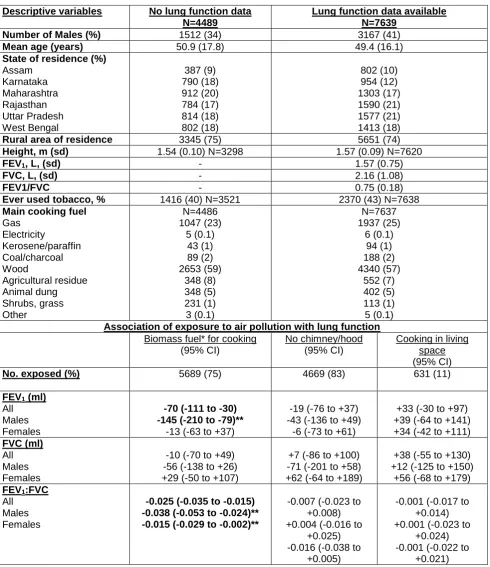
function data for analysis (Table). The population is predominantly rural (74%), and female 79
(61%), with the commonest cooking fuels being wood (58%) and gas (25%). 12% of the 80
population cooked in the living space and 82% had no hood or chimney to vent emissions. 81
82
The use of biomass fuels (Table 1) was associated with a decrease in FEV1 in one second
83
(-70ml; 95% CI: -111 to -30) and FEV1/FVC ratio (-0.025; 95% CI: -0.035 to – 0.015)
84
compared to those who used electricity or gas. This association was predominantly 85
observed in males (p <0.05 for interaction for both analyses). There was no association 86
between the use of biomass fuels and FVC. There was no association between the 87
presence of ventilation or cooking in the living space with lung function. 88
89
Discussion
90
This large study conducted in six Indian States found that exposure to biomass fuel is 91
associated with a decrease in lung function with an obstructive pattern that is larger in 92
males than females. These data are broadly consistent with another study from 93
Maharashtra State, India, which reported the association between cooking fuels and 94
respiratory health in 1156 individuals 6. In this study a higher risk of respiratory symptoms
95
was observed in females who used agro-waste compared to baseline, and lower FEV1 and
96
FVC in women who lived in houses that used agro-waste and wood, and men who lived in 97
wood-using houses. A study of 760 non-smoking women from Maharashtra State reported 98
higher prevalences of chronic bronchitis and lower peak expiratory flow rates in those who 99
cooked using biomass fuels compared to those who did not 7.
100
101
Data from outside India are consistent with our data. In rural women who live in Mexico, 102
the use of biomass fuels was associated with increased rates of phlegm production and 103
reduced FEV1/FVC ratio compared with gas cooking 8. An intervention study in Guatemala
104
but not lung function after 18 months 9. The introduction of a biomass stove intervention in
106
rural Mexico was associated with fewer respiratory symptoms and lower decline in lung 107
function over the following year 10.
108
109
The strengths of our data are the systematic data collection with lung function from a 110
relatively large population of adults in six Indian States. The high proportion of individuals 111
who live in a rural community is informative, as these constitute a difficult to reach 112
population, who represent those most at risk from air pollution secondary to cooking. The 113
limitations of these data include the availability of lung function data in 63% of the sample, 114
and hence we are unable to exclude the possibility of self-selection bias such as females 115
with worse lung function not providing data. However, with the exception of a higher 116
number of females who provided lung function data compared to males, the population of 117
those who provided lung function data was similar to those who did not. We did not have 118
validated reference values of lung function in this heterogenous population, and the high 119
prevalence of exposure to biomass fuels would make definition and interpretation of 120
normal values challenging. In addition, the impact of biomass fuels on respiratory health 121
will vary across populations as the composition of biomass fuels can be expected to vary 122
according to location, as may the susceptibility of both individuals and hence populations 123
to air pollution. 124
125
In conclusion, these data demonstrate an association between the use of biomass fuels 126
and decreased lung function with an obstructive pattern. The association is greater in 127
men, which was surprising, as in Indian culture the cooking is generally done by women 128
suggesting that other lifestyle factors associated with biomass cooking may also be 129
important. This requires closer observation using prospective studies of change in lung 130
function in similar populations. 131
132
Acknowledgements
133
There was no funding for this secondary analysis of the data. PA, PK and U collected the 134
data. AF, AA, PM and MD generated the hypothesis and analysed the data. KM provided 135
critical appraisal of the analysis. All authors contributed to the drafting of the manuscript. 136
Table 1. Association between cooking fuel, ventilation and location with lung function 138
Descriptive variables No lung function data N=4489
Lung function data available N=7639
Number of Males (%) 1512 (34) 3167 (41)
Mean age (years) 50.9 (17.8) 49.4 (16.1)
State of residence (%) Assam Karnataka Maharashtra Rajasthan Uttar Pradesh West Bengal 387 (9) 790 (18) 912 (20) 784 (17) 814 (18) 802 (18) 802 (10) 954 (12) 1303 (17) 1590 (21) 1577 (21) 1413 (18)
Rural area of residence 3345 (75) 5651 (74)
Height, m (sd) 1.54 (0.10) N=3298 1.57 (0.09) N=7620
FEV1, L, (sd) - 1.57 (0.75)
FVC, L, (sd) - 2.16 (1.08)
FEV1/FVC - 0.75 (0.18)
Ever used tobacco, % 1416 (40) N=3521 2370 (43) N=7638 Main cooking fuel
Gas Electricity Kerosene/paraffin Coal/charcoal Wood Agricultural residue Animal dung Shrubs, grass Other N=4486 1047 (23) 5 (0.1) 43 (1) 89 (2) 2653 (59) 348 (8) 348 (5) 231 (1) 3 (0.1) N=7637 1937 (25) 6 (0.1) 94 (1) 188 (2) 4340 (57) 552 (7) 402 (5) 113 (1) 5 (0.1) Association of exposure to air pollution with lung function
Biomass fuel* for cooking (95% CI)
No chimney/hood (95% CI)
Cooking in living space (95% CI)
No. exposed (%) 5689 (75) 4669 (83) 631 (11)
FEV1 (ml) All Males Females
-70 (-111 to -30) -145 (-210 to -79)**
-13 (-63 to +37)
-19 (-76 to +37) -43 (-136 to +49)
-6 (-73 to +61)
+33 (-30 to +97) +39 (-64 to +141) +34 (-42 to +111) FVC (ml)
All Males Females
-10 (-70 to +49) -56 (-138 to +26) +29 (-50 to +107)
+7 (-86 to +100) -71 (-201 to +58) +62 (-64 to +189)
+38 (-55 to +130) +12 (-125 to +150)
+56 (-68 to +179) FEV1:FVC
All Males Females
-0.025 (-0.035 to -0.015) -0.038 (-0.053 to -0.024)** -0.015 (-0.029 to -0.002)**
-0.007 (-0.023 to +0.008) +0.004 (-0.016 to
+0.025) -0.016 (-0.038 to
+0.005)
-0.001 (-0.017 to +0.014) +0.001 (-0.023 to
+0.024) -0.001 (-0.022 to
+0.021) Bold = p <0.05
139
* Biomass fuel defined as all fuel except gas and electricity. 140
** p < 0.05 for interaction between sex and exposure. 141
CI = confidence intervals 142
Biomass fuels compared with gas and electricity as reference group. 143
Linear regression model beta co-efficients adjusted for age in categories, sex, Indian State 144
of residence, height and tobacco usage with robust standard errors used to allow for 145
clustering by household 146
References
148
1. Gordon S, Bruce N, Grigg J, Hibberd P, Muki O, Lam K-B, et al. Respiratory risks from 149
household air pollution in low and middle income countries. Lancet Respiratory Medicine
150
2014;2:823-60. 151
2. World Bank. http://data.worldbank.org/indicator/SP.RUR.TOTL.ZS (accessed 18/02/2016). 152
2014. 153
3. World Health Organisation. WHO Study on global AGEing and adult health (SAGE): World 154
Health Organisation, 2015. 155
4. World Health Organisation. SAGE longitudinal multi-country study: World Health Organisation, 156
2015. 157
5. Arokiasamy P, Parasuraman S, Sekher TV, Lhungdim. H. Study on Global AGEing and adult 158
health (SAGE) Wave 1: India National Report: International Institute for Population 159
Sciences, 2013:1-254. 160
6. Ingale L, Dube K, Sarode D, Attarde S, Ingle S. Monitoring and respiratory health assessment of 161
the population exposed to cooking fuel emmissions in a rural area of Jalgaon District, India. 162
Asia-Pacific Journal Public Health 2011;25:463-75. 163
7. Sukhsohale N, Narlawar U, Phatak M. Indoor air pollution from biomass combustion and its 164
adverse health effects in central India: an exposure-response study. Ind J Community Med
165
2013;38:162-67. 166
8. Regalado J, Perez-Padilla R, Sansores R, Ramirez J, Brauer M, Pare P, et al. The effect of 167
biomass burning on respiratory sym,ptoms and lung function in rural Mexican women. Am J
168
Resp Crit Care Med 2006;174:901-05. 169
9. Smith-Sivertsen T, Diaz E, Pope D, Lie R, Diaz A, McCracken J, et al. Effect of reducing indoor 170
air pollution on women's respiratory symptoms and lung function: The RESPIRE 171
Randomised Trial, Guatamala. Am J Epidem 2009;170:211-20. 172
10. Romieu I, Riojas-Rodriguez H, Marron-Mares A, Schilmann A, Perez-Padilla R, Masera O. 173
Improved biomass stove intervention in rural Mexico. Am J Resp Crit Care Med
174
2009;180:649-56. 175
176