Generalized Geometric Quantum Speed Limits
Diego Paiva Pires,1,*Marco Cianciaruso,2,3,4,† Lucas C. Céleri,5,‡ Gerardo Adesso,2,§ and Diogo O. Soares-Pinto1,∥ 1Instituto de Física de São Carlos, Universidade de São Paulo,
CP 369, 13560-970 São Carlos, São Paulo, Brazil
2School of Mathematical Sciences, The University of Nottingham, University Park, Nottingham NG7 2RD, United Kingdom
3Dipartimento di Fisica“E. R. Caianiello,”Università degli Studi di Salerno, Via Giovanni Paolo II, I-84084 Fisciano (SA), Italy
4INFN, Sezione di Napoli, Gruppo Collegato di Salerno, I-84084 Fisciano (SA), Italy 5
Instituto de Física, Universidade Federal de Goiás, 74.001-970 Goiânia, Goiás, Brazil
(Received 21 July 2015; revised manuscript received 11 March 2016; published 2 June 2016)
The attempt to gain a theoretical understanding of the concept of time in quantum mechanics has triggered significant progress towards the search for faster and more efficient quantum technologies. One of such advances consists in the interpretation of the time-energy uncertainty relations as lower bounds for the minimal evolution time between two distinguishable states of a quantum system, also known as quantum speed limits. We investigate how the nonuniqueness of a bona fide measure of distinguishability defined on the quantum-state space affects the quantum speed limits and can be exploited in order to derive improved bounds. Specifically, we establish an infinite family of quantum speed limits valid for unitary and nonunitary evolutions, based on an elegant information geometric formalism. Our work unifies and generalizes existing results on quantum speed limits and provides instances of novel bounds that are tighter than any established one based on the conventional quantum Fisher information. We illustrate our findings with relevant examples, demonstrating the importance of choosing different information metrics for open system dynamics, as well as clarifying the roles of classical populations versus quantum coherences, in the determination and saturation of the speed limits. Our results can find applications in the optimization and control of quantum technologies such as quantum computation and metrology, and might provide new insights in fundamental investigations of quantum thermodynamics.
DOI:10.1103/PhysRevX.6.021031 Subject Areas: Quantum Physics, Quantum Information
I. INTRODUCTION
Quantum mechanics relies on counterintuitive features that challenge our merely classical perception of nature. One of the most fundamental quantum aspects lies in the impossibility of knowing simultaneously and with certainty two incompatible properties of a quantum system [1]. Contrarily to the well-understood uncertainty relation between any two noncommuting observables, the time-energy uncertainty relation still represents a controversial issue [2], although the last decades witnessed several attempts towards its explanation [3]. This effort led to the interpretation of the time-energy uncertainty relation as a so-called quantum speed limit (QSL), i.e., the ultimate
bound imposed by quantum mechanics on the minimal evolution time between two distinguishable states of a system [4–41]. QSLs have been widely investigated within the quantum-information setting since their understanding offers a route to design faster and optimized information-processing devices [42], thus attracting constant interest in quantum optimal control, quantum metrology [43], and quantum computation and communication[44]. Interestingly, it has been recently recognized that QSLs also play a fundamental role in quantum thermodynamics[45].
In a seminal work, Mandelstam and Tamm (MT) [4] reported a QSL for a quantum system that evolves between two distinguishable pure states, jψð0Þi and jψðτÞi, via a unitary dynamics generated by a time-independent HamiltonianH. The ensuing lower bound on the evolution time is given by τ≥ℏarccosðjhψðτÞjψð0ÞijÞ=ΔE, where ðΔEÞ2¼ hH2i−hHi2 is the variance of the energy of the system with respect to the initial state. Several years later, Anandan and Aharanov[7]extended the MT bound to time-dependent Hamiltonians by using a geometric approach that exploits the Fubini-Study metric defined on the space of quantum pure states. Specifically, they simply used the fact that the geodesic length between two distinguishable pure states according to the Fubini-Study *[email protected]
†[email protected] ‡[email protected]
§
metric, i.e., their Bures angle, is a lower bound to the length of any path connecting the same states. Over half a century after the MT result, Margolus and Levitin (ML) [16] provided a different QSL on the time evolution of a closed system whose Hamiltonian is time independent and evolv-ing between two orthogonal pure states. This bound reads as τ≥πℏ=ð2EÞ, where E¼ hHi is the mean energy. Although the ML bound is tight, it does not recover the MT one whatsoever. Therefore, the quantum speed limit for unitary dynamics, when restricting to orthogonal pure states, can be made tighter by combining these two independent results asτ≥maxfπℏ=ð2ΔEÞ;πℏ=ð2EÞg[17].
All these results attracted considerable interest in the subject. Giovannettiet al.[18]extended the ML QSL to the case of arbitrary mixed states and also showed that entanglement can speed up the dynamical evolution of a closed composite system. A plethora of other extensions and applications of QSLs for unitary processes has been investigated in Refs. [5,6,8–15,19–30]. For example, in Ref. [29] some of us show that the rate of change of the distinguishability between the initial and the evolved state of a closed quantum system can provide a lower bound for an indicator of quantum coherence based on the Wigner-Yanase information between the evolved state and the Hamiltonian generating the evolution.
Since any information-processing device is inevitably subject to environmental noise, QSLs have also been investigated in the nonunitary realm. Taddei et al. [31] and del Campoet al.[32]were the first to extend the MT bound to any physical process, whether it was unitary or not. Specifically, Ref. [31] exploits the quantum Fisher information metric on the whole quantum state space and represents a natural extension of the idea used in Ref.[7], whereas Ref.[32]exploits the relative purity. Then, Deffner and Lutz [33] extended the ML bound to open quantum systems by adopting again a geometric approach using the Bures angle. These authors have also introduced a new sort of bound, which is tighter than both the ML and MT ones, and shown that non-Markovianity can speed up the quantum evolution. Some other works then provided a QSL for open system dynamics by using the relative purity, whose usefulness ranges from thermalization phenomena [34] to the relativistic effects on the QSL [35]. Further developments include the role of entanglement in QSL for open dynamics [36–38], QSL in the one-dimensional perfect quantum state transfer [44], and the experimental realizability of measuring QSLs through interferometry devices [39]. Finally, a subtle connection was recently highlighted between QSLs and the maximum interaction speed in quantum spin systems[40], with implications for quantum error correction and the relaxation time of many-body systems [41].
Distinguishing between two states of a system being described by a probabilistic model stands as the paradig-matic task of information theory. Information geometry, in
particular, applies methods of differential geometry in order to achieve this task[46]. The set of states of both classical and quantum systems is indeed a Riemannian manifold, that is, the set of probability distributions over the system phase space and the set of density operators over the system Hilbert space, respectively. Therefore, it seems natural to use any of the possible Riemannian metrics defined on such sets of states in order to distinguish any two of its points. However, it is also natural to assume that for a Riemannian metric to be bona fide in quantifying the distinguishability between two states, it must be contractive under the physical maps that represent the mathematical counterpart of noise, i.e., stochastic maps in the classical settings and completely positive trace-preserving maps in quantum. Interestingly, Čencov’s theorem states that the Fisher information metric is the only Riemannian metric on the set of probability distributions that is contractive under stochastic maps[47], thus leaving us with only one choice of bona fide Riemannian geometric measure of distinguish-ability within the classical setting. On the contrary, it turns out that the quantum Fisher information metric[48,49]is not the only contractive Riemannian metric on the set of density operators, but rather there exists an infinite family of such metrics [50], as characterized by the Morozova, Čencov, and Petz theorem[51,52].
In this paper, we construct a new fundamental family of geometric QSLs (see Fig. 1), which is in one-to-one correspondence with the family of contractive Riemannian metrics characterized by the Morozova,Čencov, and Petz theorem. We demonstrate how such nonuniqueness of a bona fide measure of distinguishability defined on the quantum-state space affects the QSLs and can be exploited in order to look for tighter bounds. Our approach is versatile enough to provide a unified picture, encompassing both unitary and nonunitary dynamics, and is easy to handle, requiring solely the spectral decomposition of the evolved state. This family of bounds is naturally tailored to the general case of initial mixed states and clearly separates the contribution of the populations of the evolved state and the coherences of its time variation, thus clarifying their individual roles in driving the evolution.
The paper is organized as follows. In Sec.II, we review the relation between statistical distinguishability and the contractive Riemannian metrics on the quantum-state space characterized by the Morozova,Čencov, and Petz theorem. SectionIIIprovides a new generalized geometric derivation of a family of QSLs, which is in one-to-one correspondence with the family of such metrics. In Sec. IV, we illustrate and compare the obtained bounds for both unitary and nonunitary evolutions. Finally, in Sec. V, we present our conclusions.
II. GEOMETRIC MEASURES OF DISTINGUISHABILITY
According to the standard formulation of quantum mechanics, any quantum system is associated with a Hilbert space H and its states are represented by the Riemannian manifoldS¼DðHÞof density operators over
H, i.e., the set of positive semidefinite and trace-one
operators over the carrier Hilbert space. A Riemannian metric overSis said to be contractive if the corresponding geodesic distanceLcontracts under physical maps, which means it satisfies the inequality LðΛðρÞ;ΛðσÞÞ≤Lðρ;σÞ
for any completely positive trace-preserving map Λ and any ρ;σ∈S. The Morozova, Čencov, and Petz theorem provides us with a characterization of such metrics in the finite-dimensional case, by constructing a one-to-one correspondence between them and the Morozova-Čencov (MC) functions, a function fðtÞ∶Rþ→Rþ which is (i) operator monotone: for any semipositive-definite oper-atorsAandBsuch thatA≤B, thenfðAÞ≤fðBÞ; (ii)
self-inversive: it fulfills the functional equationfðtÞ ¼tfð1=tÞ;
and (iii) normalized:fð1Þ ¼1. Specifically, the Morozova, Čencov, and Petz theorem states that every contractive Riemannian metricgfassigns, up to a constant factor, the following squared infinitesimal length between two neigh-boring density operatorsρandρþdρ[53]:
ds2≔gfρðdρ; dρÞ; ð1Þ
with
gf
ρðA; BÞ ¼1
4Tr½AcfðLρ;RρÞB; ð2Þ
whereAandBare any two traceless Hermitian operators, and
cfðx; yÞ≔ 1
yfðx=yÞ ð3Þ
is a symmetric function,cfðx; yÞ ¼cfðy; xÞ, which fulfills
cfðαx;αyÞ ¼α−1cfðx; yÞ, withfðtÞbeing a MC function,
and finally Lρ;Rρ∶BðHÞ→BðHÞ are two linear super-operators defined on the setBðHÞof linear operators over
Has follows:LρA¼ρAandRρA¼Aρ. We stress again that each contractive Riemannian metric is arbitrary up to a constant factor. In accordance with Ref. [54], we have chosen the factor1=4in order to make the entire family of contractive Riemannian metrics collapse to the classical Fisher information metric whenρand dρcommute.
In order to make Eq. (1) more explicit, we can write the density operator ρ in its spectral decomposition, ρ¼Pjpjjjihjj, with 0< pj≤1 and
P
jpj¼1, and
get[54]
ds2¼1
4
X
j
ðdρjjÞ2
pj þ2
X
j<l
cfðp
j; plÞjdρjlj2
; ð4Þ
wheredρjl≔hjjdρjli, and we note that the summation is
constrained to the requirement pj>0. Equation (4) is
[image:3.612.67.278.49.191.2]crucial since it clearly identifies two separate contributions to any contractive Riemannian metric. The first term, which is common to all the family, depends only on the
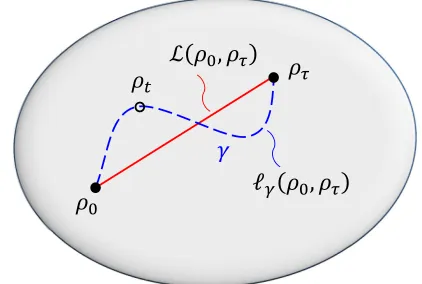
FIG. 1. Illustration of geometric quantum speed limits. The dashed blue curve is the path γ in the quantum-state space representing a generic evolution between an initial stateρ0and a final stateρτ, parametrized by timet∈½0;τ. Given a metric on the quantum-state space, the length of this path is denoted by
lγðρ0;ρτÞ. The solid red curve denotes the geodesic connecting
ρ0 to ρτ, whose length is given by Lðρ0;ρτÞ. Quantum speed limits originate from the fact that the geodesic amounts to the path of shortest length among all physical evolutions between the given initial and final states: Lðρ0;ρτÞ≤lγðρ0;ρτÞ∀γ. Such inequality can be interpreted as follows. For any given physical evolutionγfromρ0toρτ, and according to any valid metric, the maximum distance between the initial ρ0 and the final state
populationspjofρand can be seen as the classical Fisher
information metric at the probability distribution pj. The second term, which is responsible for the nonuniqueness of a contractive Riemmanian metric on the quantum-state space, is instead only due to the coherences of dρ with respect to the eigenbasis of ρ and is a purely quantum contribution expressing the noncommutativity between the operators ρ and ρþdρ. Finally, for all the contractive Riemannian metrics that can be naturally extended to the boundary of pure states, such that fð0Þ≠0, the Fubini-Study metric always appears to be such an extension up to a constant factor, so the nonuniqueness of a contractive Riemannian geometry can only be witnessed when con-sidering quantum mixed states. This is the reason only the mixed states will be relevant in our analysis, whose aim is exactly to investigate the freedom in the choice of several inequivalent bona fide measures of indistinguishability in order to get tighter QSLs.
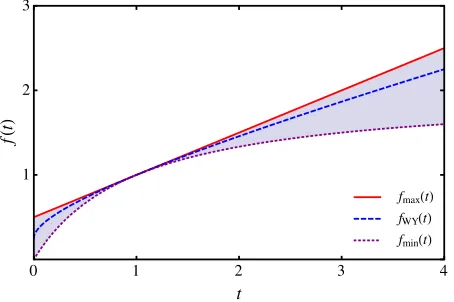
As pointed out by Kubo and Ando[55], among the MC functions, there exists a minimal one,fminðtÞ ¼2t=ð1þtÞ,
and a maximal one, fmaxðtÞ ¼ ð1þtÞ=2, such that a
generic MC function fðtÞ must satisfy fminðtÞ≤fðtÞ≤ fmaxðtÞ. Interestingly, the maximal MC function is the one
corresponding to the celebrated quantum Fisher informa-tion metric, whereas the Wigner-Yanase informainforma-tion metric corresponds to an intermediate MC function, fWYðtÞ ¼
ð1=4Þðpffiffitþ1Þ2, as illustrated in Fig.2.
Each of these metrics plays a fundamental role in quantum information theory since the corresponding geo-desic length L, being, by construction, contractive under
quantum stochastic maps, represents a bona fide measure of distinguishability over the quantum-state space. However, finding such geodesic distance is unfortunately a very hard task in general. In fact, analytic expressions are known only for the geodesic distance related to the quantum Fisher information metric[56],
LQFðρ;σÞ ¼arccos½pFffiffiffiffiffiffiffiffiffiffiffiffiffiffiffiðρ;σÞ; ð5Þ
whereFðρ;σÞ ¼ ðTr½ppffiffiffiffiffiffiffiffiffiffiffiffiffiffiffiffiρffiffiffiσpffiffiffiρÞ2is the Uhlmann fidelity, and for the one related to the Wigner-Yanase information metric [50],
LWYðρ;σÞ ¼arccos½Aðρ;σÞ; ð6Þ
whereAðρ;σÞ ¼TrðpffiffiffiρpffiffiffiσÞis known as quantum affinity.
III. GENERALIZED GEOMETRIC QUANTUM SPEED LIMITS
We are now ready to present our main result, that is, a family of geometric QSLs that hold for any physical process and are in one-to-one correspondence with the contractive Riemannian metrics defined on the set of quantum states. The most general dynamical evolution of an initial state ρ0 can be written in the Kraus decom-position as ρλ¼Eλ½ρ0 ¼PjKjλρ0Kλj†, where fKλjg are operators satisfyingPjKλj†Kλj¼Iand depending on a set λ¼ fλ1;λ2;…;λrg of r parameters that are encoded into
the input stateρ0, in such a way thatρλdepends analytically on each parameterλμ(μ¼1;…; r). In the unitary case, the evolution is given, in particular, by Eλ½ρ0 ¼Uλρ0U†λ, whereUλ is a multiparameter family of unitary operators, fulfillingUλU†λ¼U†λUλ¼I. In this case, the observables
Hλμ¼−iℏUλ∂μU†λ, with ∂μ≡ ∂=∂λμ, are the generators driving the dynamics.
Consider a dynamical evolution ρλ in which the set of parameters λ is changed analytically from the initial configuration λI to the final one λF. Geometrically, this
evolution draws a path γ in the quantum-state space connectingρλI and ρλF whose length is given by the line integrallfγ ¼Rγds and depends on the chosen metricgf
(see Fig.1). Sinceγis an arbitrary path betweenρλIandρλF, its length need not be the shortest one, which is instead given by the geodesic lengthLfðρ
λI;ρλFÞbetweenρλI and ρλF. Therefore, the latter represents a lower bound for the length of the path drawn by the above dynamical evolution. This observation will play a crucial role in the imminent derivation of our family of QSLs, in analogy with Refs.[7] and[31].
Since the density operator ρλ evolves analytically with respect to the parametersλ, we can write
fmaxt
fWYt
fmint
0 1 2 3 4
1 2 3
t
f
[image:4.612.63.290.435.586.2]t
FIG. 2. The family of MC functions is upper bounded by a maximal one, fmaxðtÞ ¼ ð1þtÞ=2, corresponding to the
quan-tum Fisher information metric (red solid line), and lower bounded by a minimal one,fminðtÞ ¼2t=ð1þtÞ(purple dotted line). Any
MC functionfðtÞsatisfiesfminðtÞ≤fðtÞ≤fmaxðtÞ; i.e., its graph
falls into the shaded area, as shown in the particular case of the MC functionfWYðtÞ ¼ ð1=4Þð
ffiffi
t
p
dρλ ¼X
r
μ¼1
∂μρλdλμ: ð7Þ
Letρλ¼Pjpjjjihjj be the spectral decomposition ofρλ, with 0< pj≤1 and
P
jpj¼1. We note that both the
eigenvaluespjand eigenstatesjjiofρλmay depend on the
set of parametersλ, i.e.,pj≡pjðλÞandjji≡jjðλÞi, so that
∂μρλ¼
X
j
fð∂μpjÞjjihjj þpj½ð∂μjjiÞhjj þ jjið∂μhjjÞg;
ð8Þ
and thus
hjj∂μρλjli ¼δjl∂μpjþ ðpl−pjÞhjj∂μjli; ð9Þ
where we used the identity ð∂μhjjÞjli ¼−hjj∂μjli.
Combining Eqs. (7)and(9), we get
hjjdρλjli ¼X
r
μ¼1
½δjl∂μpjþiðpj−plÞAμjldλμ; ð10Þ
where we defineAμjl≡ihjj∂μjli. By using Eq.(10), in the case of j¼l we get
jhjjdρλjjij2¼ X
r
μ;ν¼1
∂μpj∂νpjdλμdλν; ð11Þ
whereas in the case ofj≠l, by using the fact that dρλ is Hermitian, we obtain
jhjjdρλjlij2¼ X
r
μ;ν¼1
ðpj−plÞ2AjlμAνljdλμdλν: ð12Þ
Finally, by substituting Eqs.(11)and(12)into Eq.(4), the squared infinitesimal length ds2 betweenρλ andρλþdρλ
according to any contractive Riemannian metric gf
becomes
ds2¼ X
r
μ;ν¼1
gfμνdλμdλν; ð13Þ
where
gfμν¼FμνþQfμν; ð14Þ
with
Fμν ¼14
X
j
∂μpj∂νpj
pj ; ð15Þ
and
Qf
μν¼1 2
X
j<l
cfðp
j; plÞðpj−plÞ2AμjlAνlj; ð16Þ
referring to, respectively, the contribution of the popula-tions ofρλ and of the coherences ofdρλ to the contractive Riemannian metric tensorgfμν. Herein, we restrict ourselves to the case where the parameters λ are time dependent, λμ¼λμðtÞ, forμ¼1;…; r, and choose the parametrization
t∈½0;τ→λðtÞ such that λI ¼λð0Þ and λF ¼λðτÞ,
where τ is the evolution time. Now, since the geodesic distanceLfðρ
0;ρτÞbetween the initial stateρ0and the final stateρτ defines a lower bound to the lengthlfγ of the pathγ followed by the evolved stateρtwhen going fromρ0toρτ,
we have
Lfðρ
0;ρτÞ≤lfγðρ0;ρτÞ; ð17Þ
where
lf
γðρ0;ρτÞ≔
Z τ
0
ds dt
dt¼ Z τ
0 dt
ffiffiffiffiffiffiffiffiffiffiffiffiffiffiffiffiffiffiffiffiffiffiffiffiffiffiffiffiffiffi Xr
μ;ν¼1
gfμνdλμ
dt dλν
dt v
u u
t :
ð18Þ
Equation (17) represents the anticipated infinite family of generalized geometric QSLs and is the central result of this paper. Any possible contractive Riemannian metricgf
on the quantum-state space, and so any possible bona fide geometric quantifier of distinguishability between quantum states, gives rise to a different QSL. More precisely, we have that both the geodesic distance appearing in the left-hand side and the quantitylfγðρ0;ρτÞin the right-hand side of Eq.(17)depend on the chosen contractive Riemannian metric, specified by a MC function f. In particular, by restricting to the celebrated quantum Fisher information metric, we recover the QSL introduced in Ref.[31].
It is intuitively clear that the contractive Riemannian metric whose geodesic is most tailored to the given dynamical evolution is the one that gives rise to the tightest lower bound to the evolution time as expressed in Eq.(17). In order to determine how much a certain geometric QSL is saturated, i.e., itstightness, we consider the relative difference
δf
γ ≔l
f
γðρ0;ρτÞ−Lfðρ0;ρτÞ
Lfðρ0;ρτÞ ; ð19Þ
which quantifies how much the dynamical evolution γ differs from a geodesic with respect to the considered metric gf.
dynamicsγ. Formally, labeling byf⋆γ the optimal metric for the dynamics γ, the tightest possible geometric QSL is therefore defined by
Lf⋆γðρ
0;ρτÞ≤lf ⋆
γ
γ ðρ0;ρτÞ; with f⋆γ such that inf
f δ f
γ ≡δf ⋆
γ
γ ;
ð20Þ
where the minimization is over all MC functionsf. Finding this minimum is, however, a formidable prob-lem, which is made all the more difficult by the fact that the quantum Fisher information metric and the Wigner-Yanase information metric are the only contractive Riemannian metrics whose geodesic lengths are analytically known for general dynamics (as previously remarked).
Nevertheless, in this paper, we move the first steps forward towards addressing such a general problem, by restricting the optimization in Eq.(20)primarily over these two paradigmatic and physically significant examples of contractive Riemannian metrics, namely, the quantum Fisher information and the Wigner-Yanase skew informa-tion. Quite remarkably, this restriction will be enough to reveal how the choice of the quantum Fisher information metric, though ubiquitous in the existing literature, is only a special case that does not always provide the tightest lower bound. On the contrary, we show how the Wigner-Yanase skew information metric can systematically produce tighter bounds in a number of situations of practical relevance for quantum information and quantum technologies, in par-ticular, in open system evolutions.
IV. EXAMPLES
In this section, we apply our general formalism to present and analyze QSLs based primarily on the quantum Fisher information and the Wigner-Yanase skew information in a selection of unitary and nonunitary physical processes. This will serve the purpose of illustrating how the choice of a particular bona fide geometric measure of distinguishability on the quantum-state space affects the QSLs, therefore providing guidance to exploit the freedom in this choice to obtain the tightest bounds in practical scenarios.
A. Unitary dynamics
We start by restricting ourselves to a closed quantum system so that our initial state ρ0 undergoes a unitary evolution ρλ¼Uλρ0U†λ. Since the eigenvalues pj of a unitarily evolving state are constant, ∂μpj¼0, we have
thatFμν¼0, and thusgfμν¼Qfμν, along the curveγdrawn by the evolved stateρλ. In other words, the coherences of
dρλ drive the evolution of a closed quantum system. Moreover, one can easily see that Aμjl ¼ ð1=ℏÞhjjΔHλμjli,
where ΔHλμ¼Hλμ−hHλμi, hHλμi ¼TrðρλHλμÞ, and Hλμ¼
−iℏUλ∂μU†λ are the generators of the dynamics, so
gfμν¼ 1 2ℏ2
X
j<l
cfðp
j; plÞðpj−plÞ2hjjΔHλμjlihljΔHλνjji:
ð21Þ
In the following subsections, we focus on, respectively, the quantum Fisher information metric and the Wigner-Yanase information metric.
1. Quantum Fisher information metric
The quantum Fisher information metric corresponds to the MC functionfðtÞ ¼ ð1þtÞ=2, socfðx; yÞ ¼2=ðxþyÞ
and Eq.(21) becomes
gQFμν ¼ 1 2ℏ2
X
j;l
ðpj−plÞ2
pjþpl
hjjΔHλμjlihljΔHλνjji: ð22Þ
Moreover, by using the following straightforward inequality,
ðpj−plÞ2
pjþpl
≤pjþpl; ð23Þ
we get
gQFμν ≤ 1 2ℏ2
X
j;l
ðpjþplÞhjjΔHμλjlihljΔHλνjji
¼ℏ−2CðΔHλ
μ;ΔHλνÞ; ð24Þ
where CðΔHλμ;ΔHλνÞ≔ð1=2ÞTr½ρλfΔHλμ;ΔHλνg is the symmetrized covariance of ΔHλμ and ΔHλν with respect to the evolved state, which reduces to the squared variance of the operator Hλμ when μ¼ν, i.e., CðΔHλμ;ΔHλμÞ ¼
Tr½ρλðΔHλμÞ2 ¼ hðHμλÞ2i−hHλμi2. By substituting the inequality(24) into Eq.(17), we get the new bound
LQFðρ0;ρτÞ≤1 ℏ
Z τ
0 dt
ffiffiffiffiffiffiffiffiffiffiffiffiffiffiffiffiffiffiffiffiffiffiffiffiffiffiffiffiffiffiffiffiffiffiffiffiffiffiffiffiffiffiffiffiffiffiffiffiffiffiffiffiffi Xr
μ;ν¼1
CðΔHλμ;ΔHλνÞdλμ dt
dλν dt v
u u
t :
ð25Þ
Although the QSL in Eq.(25)applies to the very general
r-parameter case, let us restrict ourselves, for simplicity, to the one-parameter case whereλ¼t. Consequently, we have that Hλμ→Ht¼−iℏUt∂tU†t and that the sym-metrized covariance just reduces to the variance of the observable Ht generating the dynamics of the system.
Therefore, Eq.(25)turns into the simpler bound
τ−1LQFðρ0;ρτÞ≤ 1 ℏτ
Z τ
0 dt
ffiffiffiffiffiffiffiffiffiffiffiffiffiffiffiffiffiffiffiffiffiffiffiffiffiffi hH2ti−hHti2
q
¼ℏ−1ΔE;
where ΔE≔τ−1R0τdtpffiffiffiffiffiffiffiffiffiffiffiffiffiffiffiffiffiffiffiffiffiffiffiffiffiffihH2ti−hHti2 is the mean variance of the generator Ht. The following QSL is thus obtained:
τ≥ ℏ ΔEL
QFðρ
0;ρτÞ: ð27Þ
It is worth emphasizing that the bound in Eq.(27)applies to arbitrary initial and final mixed states and generic time-dependent generators of the dynamics. Moreover, we can immediately see that it exactly coincides with the one reported in Ref.[9]and reduces to a MT-like bound, when further restricting to the case of a time-independent gen-erator of the dynamics.
2. Wigner-Yanase information metric
The Wigner-Yanase information metric corresponds to the MC function fðtÞ ¼ ð1=4Þðptffiffiþ1Þ2, so cfðx; yÞ ¼
4=ðpffiffiffixþpffiffiffiyÞ2 and Eq. (21)becomes
gWYμν ¼ 2 ℏ2
X
j<l
pj−pl ffiffiffiffiffi pj
p þ ffiffiffiffiffi pl
p 2
hjjΔHλμjlihljΔHλνjji
¼ 1
ℏ2
X
j;l
ðpffiffiffiffiffipj−pffiffiffiffiffiplÞ2hjjΔHλμjlihljΔHλνjji
¼− 1
ℏ2Trð½
ffiffiffi
ρ p
;ΔHλμ½pffiffiffiρ;ΔHλνÞ
¼ 2
ℏ2CðΔHλμ;ΔHλνÞ; ð28Þ
where CðΔHλμ;ΔHλνÞ≔ −ð1=2ÞTrð½pρffiffiffiffiffiλ;ΔHλμ½pρffiffiffiffiffiλ;ΔHλνÞ
reduces to the skew information between the evolved state andΔHλμwhenμ¼ν,CðΔHλμ;ΔHλμÞ ¼Iðρλ;ΔHλμÞ≔
−ð1=2ÞTrð½pffiffiffiffiffiρλ;ΔHλμ2Þ[57]. By putting Eq.(28)into the bound in Eq.(17), we get
LWYðρ
0;ρτÞ≤
ffiffiffi
2 p
ℏ Z τ
0 dt
ffiffiffiffiffiffiffiffiffiffiffiffiffiffiffiffiffiffiffiffiffiffiffiffiffiffiffiffiffiffiffiffiffiffiffiffiffiffiffiffiffiffiffiffiffiffiffiffiffiffiffi Xr
μ;ν¼1
CðΔHλμ;ΔHλνÞdλμ dt
dλν dt v
u u
t :
ð29Þ
For simplicity, let us again analyze the one-parameter case, whereλ¼t,Hλμ→Ht¼−iℏUt∂tU†t andC reduces
to the skew informationIðρt; HtÞbetween the evolved state
ρt and the observable Ht generating the dynamics of the
system. Therefore, the bound in Eq. (29)turns into
τ−1LWYðρ0;ρτÞ≤ ffiffiffi
2 p
ℏ
1 τ
Z τ
0 dt
ffiffiffiffiffiffiffiffiffiffiffiffiffiffiffiffiffiffi Iðρt; HtÞ
p
¼ ffiffiffi
2 p
ℏ ffiffiffiffi I
p
; ð30Þ
where we definepffiffiffiffiI ≔τ−1R0τdt ffiffiffiffiffiffiffiffiffiffiffiffiffiffiffiffiffiffiIðρt; HtÞ
p
as the mean skew information between the evolved state and the generator of the evolution. The QSL thus becomes
τ≥ ffiffiffiℏ 2 p ffiffiffiffi
I
p LWYðρ
0;ρτÞ: ð31Þ
As reported by Luo[58], the skew informationIðρt; HtÞis upper bounded by the variance of the observable Ht,
Iðρt; HtÞ≤hH2ti−hHti2, so
ffiffiffiffi I
p
≤ΔE and
τ≥ ffiffiffiℏ 2 p ffiffiffiffi
I
p LWYðρ
0;ρτÞ≥ 1ffiffiffi 2
p ℏ
ΔEL WYðρ
0;ρτÞ: ð32Þ
The latter QSL strongly resembles the bound expressed in Eq.(27)and emerging from the quantum Fisher informa-tion metric, with the difference lying in the fact that we are now adopting the Hellinger angle instead of the Bures angle and a pffiffiffi2 factor appears in the denominator. However, when the initial and final states commute, we have that the corresponding fidelity and affinity coincide, Fðρ0;ρτÞ ¼ Aðρ0;ρτÞ, and so the Bures angle is equal to the Hellinger
angle, which implies that in this case the bound emerging from the Wigner-Yanase metric is less tight than the one corresponding to the quantum Fisher information by a factor of 1=pffiffiffi2.
The above result could be intuitively expected because of the strict hierarchy respected by the MC functions corre-sponding to the two adopted metrics. To put such an intuition on rigorous grounds, in AppendixAwe prove that the geometric QSL corresponding to the quantum Fisher information metric, as expressed directly by Eq. (17), is indeed tighter than the one corresponding to the Wigner-Yanase information metric, when consideringany single-qubit unitary dynamics. However, we leave it as an open question to assess whether this is still the case when considering higher-dimensional quantum systems, or other contractive Riemannian metrics in place of the Wigner-Yanase one.
Quite surprisingly, in the next section, we show instead that, for the realistic and more general case of nonunitary dynamics, the hierarchy of the MC functions does not automatically translate anymore into a hierarchy of tight-ness for the corresponding QSLs, not even in the case of a single qubit. This will reveal the original consequences of our analysis in practically relevant scenarios.
B. Nonunitary dynamics
We now consider two paradigmatic examples of non-unitary physical processes acting on a single qubit: dephas-ing and amplitude dampdephas-ing.
1. Parallel and transversal dephasing channels
~r¼ frsinθcosϕ; rsinθsinϕ; rcosθgis the Bloch vector, withr∈½0;1, θ∈½0;π andϕ∈½0;2π½, whileIdenotes the2×2identity matrix and~σ¼ fσ1;σ2;σ3gis the vector of Pauli matrices.
Let us now consider a noisy evolution of this state governed by a master equation of Lindblad form
∂ρðtÞ
∂t ¼ℋðρÞ þℒðρÞ; ð33Þ
where ℋðρÞ ¼−i½H;ρ describes the unitary evolution governed by a HamiltonianHwhileℒðρÞis the Liouvillian that describes the noise. We further consider the Hamiltonian H¼ ðω0=2Þσ3, where ω0 is the unitary frequency, and the Liouvillian
ℒðρÞ ¼−Γ 2
ρ−X3
i¼1
αiσiρσi
; ð34Þ
whereΓis the decoherence rate andαi≥0withPiαi¼1. We can identify two main modalities of dephasing noise. Whenα3¼1, the dephasing happens in the same basis as the one specifying the Hamiltonian of our system, a case that can be referred to as “parallel dephasing.” When insteadα1¼1, the dephasing occurs in a basis orthogonal to the one of the Hamiltonian, leading to the situation typically referred to as“transversal dephasing”[59,60]. We explore these two cases separately.
Parallel dephasing.—The parallel dephasing noise lets an initial state ρ0 evolve as ρt¼
P1
j¼0Kjρ0K†j, where
K0¼pffiffiffiffiffiffiqþ
e−iω0t=2 0
0 eiω0t=2
;
K1¼pffiffiffiffiffiffiq−
e−iω0t=2 0
0 −eiω0t=2
ð35Þ
are the Kraus operators, and q ¼ ð1qtÞ=2 with qt¼ e−Γt[61]. Notice that the Kraus operators satisfy not only
P1
j¼0K
†
jKj¼Ibut also
P1
j¼0KjK†j¼I, as such a channel
is unital. The effect of parallel dephasing is exactly the same as the one of phase flip and consists in shrinking the Bloch sphere onto the zaxis of states diagonal in the computational basis, which are instead left invariant. Moreover, ω0 describes the rotation frequency around the z axis. One can easily see that the evolved state ρt
has the following spectral decomposition:
ρt¼
X
j¼
pjjθt;ϕtijhθt;ϕtjj; ð36Þ
where p ¼ ð1=2Þð1r0ξtÞand
jθt;ϕti¼ 1
N½ðcosθ0ξtÞj0i þe
iðω0tþϕ0Þq
tsinθ0j1i;
ð37Þ
with ξt¼pffiffiffiffiffiffiffiffiffiffiffiffiffiffiffiffiffiffiffiffiffiffiffiffiffiffiffiffiffiffiffiffiffiffifficos2θ0þq2tsin2θ0 and N a normalization constant. By putting the above equations into Eqs.(15)and (16), one obtains, respectively,
F ¼r20q2tsin4θ0ðdqt=dtÞ2
4ξ2
tð1−r20ξ2tÞ
ð38Þ
and
Qf¼1
8
ω2 0q2t þ
cos2θ0ðdqt=dtÞ2
ξ2
t
r20sin2θ0cfðp
þ; p−Þ:
ð39Þ
The contractive Riemannian metricgf¼FþQfcan be
interpreted as the speed of evolution ofρt. Equation(38),
which corresponds to the contribution togfcommon to all
the MC family, is identically zero for all the initial states such thatθ0 is either 0 orπ, which are all the incoherent states lying on thezaxis of the Bloch sphere (with density matrices diagonal in the computational basis), which are indeed left unaffected by the parallel dephasing dynamics. AlthoughF is a function of the initial purityr0and of time, it does not depend on the initial azimuthal angleϕ0since the eigenvalues of the evolved statepjdo not depend onϕ0. Equation(39), which instead describes the truly quantum contribution to the speed of evolutiongf and depends on
the specific choice of the MC functionf, is identically zero for all the incoherent initial states such thatθ0is either 0 orπ. Notice that in the caseθ0¼π=2, for initial states lying in the equatorialxyplane,Qfis nonzero only when the frequency
ω0is also nonzero. Interestingly,Qfdoes not depend on the initial azimuthal angleϕ0as well, even though the eigen-states of the evolved state do depend onϕ0. In summary, the speed of evolution is obviously zero for initial states belonging to thezaxis since they are invariant under parallel dephasing; it is furthermore symmetric with respect to the initial azimuthal angleϕ0, and it arises only from the populations of the evolving state when starting from the equatorialxyplane with zero frequencyω0.
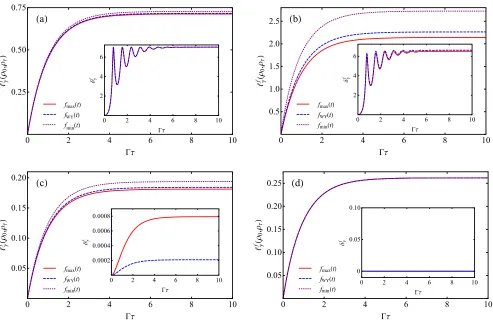
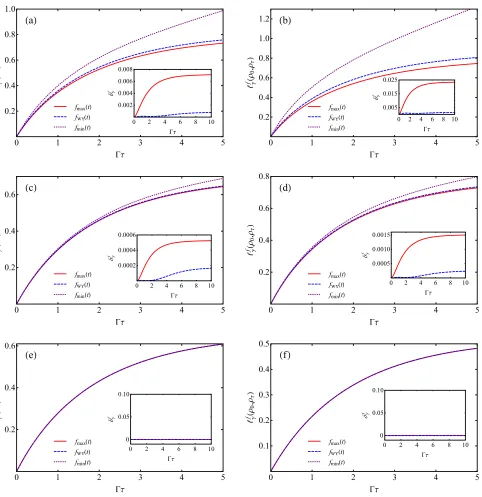
that by fixing the initial purityr0(respectively, polar angle θ0), the speed of evolution increases as we increase the initial polar angle θ0 (respectively, purity r0). In other words, the farther the initial state is from the z axis (the larger is its quantum coherence), the faster the correspond-ing evolution can be. Second, Fig. 3(d), in particular, unveils the signature of the populations of the evolved state into the speed of evolution. Indeed, according to Eq.(39), the purely quantum contributionQfto the metric
is equal to zero forθ0¼π=2andω0¼0(β¼0). Thus, the speed of evolution gf is described solely by the term F given in Eq.(38)and arising only from the populations of the evolved state. In this case, the speed of evolution remains invariant for any contractive Riemannian metric since F is common to all of them. However, it is still susceptible to changes depending on the purity and time. Let us now investigate how the QSLs in Eq.(17)behave by considering the quantum Fisher information metric and the Wigner-Yanase information metric, whose geodesic lengths are known analytically. In the insets of Fig.3, we compare the tightness parameterδfγ, as defined in Eq.(19),
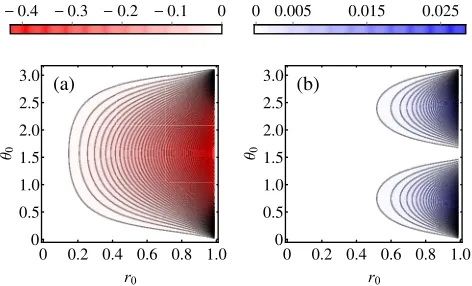
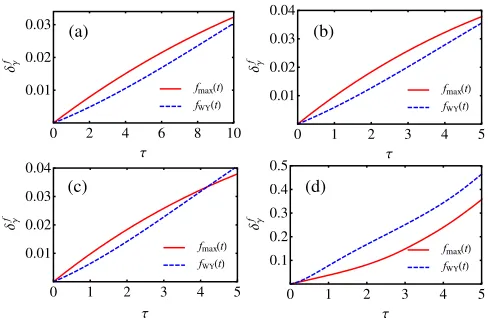
when considering these two metrics, for a parallel dephas-ing dynamical evolution. We can see that for β¼8, the dynamics does not saturate the bound for either of the two metrics, although the quantum Fisher information metric provides, in general, a slightly tighter QSL. On the other hand, whenβ¼0andθ0¼π=2, we have that the QSL is saturated for both metrics, whereas for β¼0 and θ0¼π=4, it is instead the Wigner-Yanase information metric that provides us with a slightly tighter lower bound. More generally, it is sufficient to compare the difference between the tightness indicators δQFγ −δWIγ for the two metrics in the whole parameter space of the parallel dephasing model in order to identify in which regime each of the two corresponding bounds is the tightest. This analysis is reported in Fig. 4, showing that the Wigner-Yanase information metric does lead, in general, to a tighter QSL when the frequencyω0is sufficiently small. This is in stark contrast to the case of unitary evolutions, discussed in the previous section, and constitutes a first demonstration of the usefulness of our generalized approach to speed limits in quantum dynamics.
max WY min
max WY min
max WY min
[image:9.612.61.554.44.367.2]max WY min
FIG. 3. Evolution path lengthslfγ for parallel dephasing processes by considering the contractive Riemannian metrics corresponding to the following MC functions: fQFðtÞ ¼fmaxðtÞ (red solid line), fWYðtÞ (blue dashed line), and fminðtÞ (purple dotted line) for
Transversal dephasing.—We now focus on the case of transversal dephasing noise, which lets an initial state ρ0 evolve as ρt¼ ð1=2Þ
P3
i;j¼0Sijσiρσj, where S is a 4×4
Hermitian matrix whose nonvanishing elements are given by S00¼aþb, S11¼dþf, S22¼d−f, S33 ¼a−b,
S03¼ic, andS30¼−ic, with
a¼1
2ð1þe−uÞ; ð40Þ
b¼e−u=2coshðΩu=2Þ; ð41Þ
c¼2βe −u=2
Ω sinhðΩu=2Þ; ð42Þ
d¼1
2ð1−e−uÞ; ð43Þ
f¼e −u=2
Ω sinhðΩu=2Þ; ð44Þ
whereu¼Γt,Ω¼pffiffiffiffiffiffiffiffiffiffiffiffiffiffiffi1−4β2 andβ¼ω0=Γ. It is worth-while noticing that the transversal dephasing channel is also unital; i.e., it leaves the maximally mixed state invariant. This channel has proven to be of fundamental interest within the burgeoning field of noisy quantum metrology, as shown in Chaveset al.[59,60]. More precisely, transversal dephasing noise stands as the relevant scenario whereby one can attain a precision in the estimation of the parameter ω0that scales superclassically with the number of qubits, even if such noise applies independently to each qubit (while any superclassical advantage is lost in the case of parallel dephasing noise).
By writing the spectral decomposition of the density operatorρt, we get
ρt¼
X
j¼
pjjθt;ϕtijhθt;ϕtjj; ð45Þ
wherep¼ ð1=2Þð1þr0ξ~tÞ and
jθt;ϕti ¼ 1
N½½ð2a−1Þcosθ0 ~ ξtj0i
þ ½ðbþicÞeiϕ0þfe−iϕ0sinθ
0j1i; ð46Þ
with
~ ξt¼
ffiffiffiffiffiffiffiffiffiffiffiffiffiffiffiffiffiffiffiffiffiffiffiffiffiffiffiffiffiffiffiffiffiffiffiffiffiffiffiffiffiffiffiffiffiffiffiffiffiffiffiffiffi ð2a−1Þ2cos2θ0þζ~tsin2θ0
q
; ð47Þ
~
ζt¼b2þc2þf2þ2f½bcosð2ϕ0Þ−csinð2ϕ0Þ; ð48Þ
and N a normalization constant. By putting the above equations into Eqs.(15)and(16), one obtains expressions that are too cumbersome to be reported here. However, when restricting to the relevant case of an initial plus state (which is an optimal probe state for frequency estimation), i.e.,ρ0¼ jþihþj withjþi ¼ ðj0i þ j1iÞ=pffiffiffi2, one obtains the following simple expressions:
F ¼ β4 Ω4
e−usinh2ðΩu=2Þ
ð1−e−uGÞG ; ð49Þ
Qf¼ β2
8Ge−ucfðpþ; p−Þ; ð50Þ
where
G¼ 1
Ω2½coshðΩuÞ þΩsinhðΩuÞ−4β2: ð51Þ
Let us now analyze the behavior of the QSLs in Eq.(17) corresponding to the quantum Fisher information metric and the Wigner-Yanase information metric when consid-ering the transversal dephasing dynamics. In Fig.5, we can see that, initializing such dynamics with a plus state, for small enough Γ and ω0, the Wigner-Yanase information provides a QSL that is tighter (in particular, at short times) than the one corresponding to the quantum Fisher infor-mation. One might identify, more generally, the region of parameters in which this behavior occurs by studying the trade-off between the respective tightness indicatorsδfγ for an arbitrary initial state, as in the previous case, although such a study does not add any further insight and is not reported here.
Once more, the present analysis shows that our approach applies straightforwardly to obtain novel, tighter bounds in dynamical cases of interest for quantum technologies, as 0.4 0.3 0.2 0.1 0
(a)
0 0.2 0.4 0.6 0.8 1.0 0
0.5 1.0 1.5 2.0 2.5 3.0
0 0.005 0.015 0.025
(b)
0 0.2 0.4 0.6 0.8 1.0 0
[image:10.612.57.293.46.189.2]0.5 1.0 1.5 2.0 2.5 3.0
FIG. 4. Contour plot of the difference Δδγ≡δQFγ −δWYγ
corroborated here, in particular, for the metrologically relevant case of transversal dephasing noise.
2. Amplitude damping channel
We now consider another canonical model of noise, namely, dissipation modeled by an amplitude damping channel acting on a single qubit. For the amplitude damp-ing channel, we have the followdamp-ing Kraus operators:
~
K0¼
1 0
0 ffiffiffiffiffiffiffiffiffiffiffiffi1−λt
p
; K~1¼
0 ffiffiffiffi
λt
p
0 0
; ð52Þ
with λt¼1−e−Γt, and 1=Γ is the characteristic time of
the process [61], satisfying only PjK~†jK~j¼I since this
channel is not unital. The effect of amplitude damping consists in shrinking the Bloch sphere towards the north pole, or the statej0i. In this case, it is easy to verify that the evolved state ρt¼
P
jK~jρ0K~†j¼ ð1=2ÞðIþ~rt·~σÞ has the
following spectral decomposition:
ρt¼
X
j¼
pjjθt;ϕtijhθt;ϕtjj; ð53Þ
where p ¼12ð1ϑtÞand
jθt;ϕti¼ 1ffiffiffiffiffiffiffi
N
p ½ðςtϑtÞj0i þeiϕ0r0
ffiffiffiffiffiffiffiffiffiffiffiffi
1−λt
p
sinθ0j1i;
ð54Þ
with
ϑt¼
ffiffiffiffiffiffiffiffiffiffiffiffiffiffiffiffiffiffiffiffiffiffiffiffiffiffiffi
1−ζtð1−λtÞ
p
; ð55Þ
ζt¼1−r20þλtð1−r0cosθ0Þ2; ð56Þ
ςt¼λtþr0ð1−λtÞcosθ0; ð57Þ
and N a normalization constant. By putting the above equations into Eqs.(15)and(16)one obtains, respectively,
F ¼½ζt−ð1−λtÞð1−r0cosθ0Þ22
16ϑ2
tζtð1−λtÞ
ð58Þ
and
Qf¼r20sin2θ0ð2−ςtÞ2cfðpþ; p−Þ
32ϑ2
tð1−λtÞ
: ð59Þ
As in the case of the parallel dephasing channel, neither contributionF orQfto the speed of evolutiongfdepends
on the initial azimuthal angleϕ0. However, contrarily to the parallel dephasing channel case, here the purely quantum contributionQf vanishes only for θ0¼0;π, whereas the termF vanishes in neither of these cases nor forθ0¼π=2, as expected due to the fact that now only the north pole, and not the entirezaxis of the Bloch sphere, is left invariant by the dynamics.
In Fig. 6, we compare the evolution path lengths appearing in the right-hand side of Eq. (17) and corre-sponding to the usual contractive Riemannian metrics, i.e., the quantum Fisher information metric, the Wigner-Yanase information metric, and the metric corresponding to the minimal MC function, by again changing the initial purity
r0and polar angleθ0. First, Figs.6(e)and6(f)exhibit the following behavior: fixing the initial polar angleθ0¼0, the speed of evolution decreases as we increase the initial purityr0. This feature highlights the fact that the north pole of the Bloch sphere is unaffected by the amplitude damping channel. Moreover, according to Eq. (59), the purely quantum contribution Qf vanishes identically for θ0¼0,
and the speed of evolutiongand corresponding evolution path length in Eq.(17)become independent of the choice of the MC functionf. The nontrivial contribution to the speed of evolution is, in this case, exclusively due to the term F, which depends solely on the populations pj of
the evolved state.
Let us now analyze the behavior of the QSLs in Eq.(17)corresponding to the quantum Fisher information metric and the Wigner-Yanase information metric (see AppendixCfor details). In the insets of Fig.6, we compare the tightness indicators δfγ, as defined in Eq. (19), when considering these two metrics, for the amplitude damping channel. We can see that, in this case, the Wigner-Yanase information provides a QSL that is almost saturated (in particular, at short times), whereas the quantum Fisher 0 2 4 6 8 10
0.01 0.02 0.03
0 1 2 3 4 5 0.01
0.02 0.03 0.04
0 1 2 3 4 5 0.01
0.02 0.03 0.04
0 1 2 3 4 5 0.1
0.2 0.3 0.4 0.5
(a) (b)
(c) (d)
max WY
max WY
max WY max
[image:11.612.53.297.46.205.2]WY
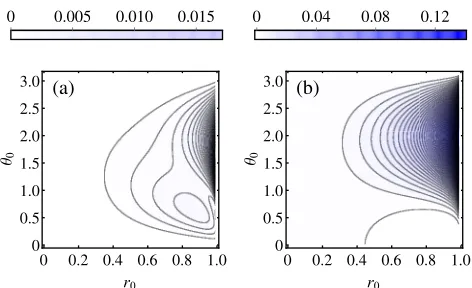
information does not, except in the case ofθ0¼0 where they both realize tight bounds. What is more, in Fig.7one can see that for almost all initial states, except for a small neighborhood of the north pole (which is the asymptotic state of the amplitude damping channel), δQF≥δWY and δWY≃0; i.e., the Wigner-Yanase information metric
provides us with a definitely tighter (and nearly saturated) QSL than the quantum Fisher information metric.
This reveals another important physical mechanism, distinct from dephasing, in which our generalized analysis leads to significantly tighter bounds than those established in previous literature, which, in this case, is clearly max
WY min
max WY min
max WY min
max WY min
max WY min
[image:12.612.71.553.43.540.2]max WY min
demonstrated in almost all the parameter space of rel-evance. This highlights the power of our general approach to reach beyond the state of the art.
V. CONCLUSIONS
Based on the fundamental connection between the geometry of quantum states and their statistical distinguish-ability, we have exploited the fact that more than one privileged Riemannian metric appears in quantum mechan-ics in order to introduce a new infinite family of geometric quantum speed limits valid for any physical process, being it unitary or not. Specifically, each bona fide geometric measure of distinguishability gives rise to a different quantum speed limit which is particularly tailored to the case of initial mixed states and such that the contributions of the populations of the evolved state and of the coher-ences of its time variation are clearly separated. This work provides a comprehensive general framework that incor-porates previous approaches to quantum speed limits and leaves room for novel insights.
By investigating paradigmatic examples of unitary and noisy physical processes and of contractive Riemannian metrics, we have seen, in fact, how the choice of the quantum Fisher information, corresponding to an extremal metric and being ubiquitous in the existing literature, is only a special case, which does not always provide the tightest lower bound in the realistic case of open system dynamics. In particular, for parallel and transversal
dephasing, as well as amplitude damping dynamics, we defined a tighter quantum speed limit by means of another important but significantly less-studied Riemannian metric, namely, the Wigner-Yanase skew information. The bound is useful in practical scenarios of noisy quantum metrology, especially in the case of transversal dephasing[59,60].
Our unifying approach provides a concrete guidance to select the most informative metric in order to derive the tightest bound for some particular dynamics of interest. We have formulated the problem as an optimization of a tightness indicator over all the infinite family of contractive quantum Riemannian metrics. The metric giving rise to the tightest bound is identified as the one whose geodesic is most tailored to the evolution under consideration [see Eq. (20)]. While such a problem can only be solved in restricted form at present, due to the fact that the quantum Fisher information and the Wigner-Yanase skew informa-tion are the only two metrics admitting known geodesics, further progress will be achievable when useful advances on the information geometry for other relevant metrics are recorded in the future.
It is important to remark that the family of speed limits provided in this paper are within the class of MT-like bounds. Following Ref.[62], it may be possible to imple-ment some adjustimple-ments to the adopted unified geometric approach in order to provide a generalized geometric interpretation to ML-like speed limits as well. This will be explored in a further study.
Our work readily suggests exploring how the nonunique-ness of a contractive Riemannian metric in the quantum-state space also affects other scenarios of relevance in quantum information processing. In several of these sce-narios, where the quantum Fisher information was adopted and privileged, our approach could lead to a more general investigation based on information geometry. For example, when considering parameter estimation, one of the para-digmatic tasks of quantum metrology, the inverse of the quantum Fisher information metric sets a lower bound to the mean-square error of any unbiased estimator for the parameters through the quantum Cramér-Rao bound [49,63]. This work inspires the quest to provide more general bounds on the sensitivity of quantum states to evolutions encoding unknown parameters, based on the infinite hierarchy of quantum Riemannian contractive geometries. It is useful to recall here that the Fisher information-based quantum Cramér-Rao bound for single-parameter estimation can only be achieved asymptotically in the limit of a large number of probes, and upon performing an optimal measurement given by projection into the eigenbasis of the symmetric logarithmic derivative, which is typically hard to implement in the experimental practice [63]. In the realistic case of a finite number of probes, corrections to the bound provide tighter estimates for the attainable estimation precision; these corrections were first investigated in Ref. [64] for the case of the 5
1 0 . 0 5
0 0 .
0 0.010 0
0 0.2 0.4 0.6 0.8 1.0 0
0.5 1.0 1.5 2.0 2.5 3.0
0 0.04 0.08 0.12
0 0.2 0.4 0.6 0.8 1.0 0
0.5 1.0 1.5 2.0 2.5 3.0
[image:13.612.57.293.43.187.2](a) (b)
FIG. 7. Contour plot of (a) the tightness indicator δWY γ of the
bound specified by the Wigner-Yanase information metric and (b) the differenceΔδγ≡δQFγ −δWYγ between the tightness
param-eter corresponding to the quantum Fisher information metric and the one corresponding to the Wigner-Yanase information metric, for the amplitude damping process as a function ofr0andθ0, for Γτ¼10. The QSL constructed with the Wigner-Yanase skew information is nearly globally optimal (asδWY
γ ≃0) and tighter
quantum Fisher information. Motivated by more recent works by Brody[65]and Brody and Graefe[66], in which the Wigner-Yanase skew information has been interpreted rather naturally as the speed of mixed quantum-state evolution, and by the analysis of the present work (which includes metrologically relevant settings such as frequency estimation under transversal dephasing[59,60]), we believe it is worth investigating finite-size corrections to the Cramér-Rao inequality based on the Wigner-Yanase infor-mation, in order to determine how tight the bound can be for practical purposes, in particular, for the estimation of parameters encoded in open system dynamics.
Furthermore, within the burgeoning field of quantum thermodynamics, our approach could provide an infinite class of generalizations of the classical thermodynamical length [67], originally based on the unique classical con-tractive Riemannian metric, to the quantum setting. Again, in the context of quantum thermodynamics, because of the close connections between geometry and entropy, it might be interesting to investigate the role played by the non-uniqueness of a contractive Riemannian geometry on the quantum-state space in the existence of many second laws of thermodynamics[68]. In the study of quantum criticality, within the condensed-matter realm, a geometric approach based on the fidelity, i.e., on the quantum Fisher information metric, proved to be fruitful [69]. Along the lines of this work, one could apply more general tools associated with any quantum Riemannian contractive metric, in order to seek further insights and sharper identification of quantum critical phenomena.
Finally, the general approach presented in this paper to pinpoint the tightest speed limits in quantum evolutions is readily useful for applications to quantum engineering and quantum control. Specifically, the present study allows one to certify that, in a particular implementation, quantum states have been driven at the ultimate speed limit[42]and their evolution cannot be sped up further: This occurs whenever saturation of one of our bounds is demonstrated. As our various examples show, this is not possible to verify only by considering the standard bound based on quantum Fisher information. For single-qubit evolutions, we showed that the latter is in fact the tightest for the idealized case of unitary dynamics, while our novel bound based on the Wigner-Yanase skew information can instead be significantly tighter in the most common instances of open dynamics, effectively yielding the optimal bound (even among all the other unverifiable Riemannian metrics) for amplitude damping dynamics, as certified by a nearly vanishing tightness indicator in such a case. Given that the Wigner-Yanase skew information is experimentally accessible [70], one can readily apply our results to current and future demonstrations to benchmark optimality of controlled quantum dynamics in the presence of such ubiquitous noise mechanisms.
In this respect, we would like to point out that an experimental investigation of the main results presented
here, for both closed and open system dynamics, can be achieved, in particular, using a highly controllable nuclear magnetic resonance setup, with no need for a complete quantum state tomography. In fact, dephasing and amplitude damping are naturally occurring sources of decoherence in such an implementation, and our results can be accessed by means of spin ensemble measurements, which constitute the conventional types of detection in such a technique[71,72]. An experimental investigation as described deserves a study on its own and will be reported elsewhere.
ACKNOWLEDGMENTS
We thank Dorje C. Brody, Tyler J. Volkoff, Frederico Brito, J. Carlos Egues, Paolo Gibilisco, and Fumio Hiai for fruitful discussions. The authors would like to acknowl-edge financial support from the Brazilian funding agencies CNPq (Grants No. 445516/2014-3, No. 401230/2014-7, No. 305086/2013-8, No. 304955/2013-2, and No. 443828/ 2014-8), CAPES (Grant No. 108/2012), the Brazilian National Institute of Science and Technology of Quantum Information (INCT/IQ), and the European Research Council (ERC StG GQCOP, Grant No. 637352).
D. P. P. and M. C. contributed equally to this work.
APPENDIX A: UNITARY DYNAMICS
In this appendix, we prove that the geometric QSL corresponding to the quantum Fisher information metric is tighter than the one corresponding to the Wigner-Yanase information metric, when considering any single-qubit unitary dynamics.
Let us consider a one-qubit stateρ0¼ ð1=2ÞðIþ~r0·~σÞ,
where~r0¼ fr0sinθ0cosϕ0; r0sinθ0sinϕ0; r0cosθ0gand
~
σ is the vector of Pauli matrices, which undergoes the generic unitary evolutionγ specified byρt¼Utρ0U†t. We want to prove that for anyρ0 andUt, the following holds
(we drop the subscriptγin the remainder of this section for simplicity),
δQF≤δWY; ðA1Þ
where δf is the tightness indicator corresponding to the
contractive Riemannian metricgf with MC functionf, as
defined in Eq.(19). In order to prove the above inequality, we just need to prove that
lQFðρ
0;ρτÞ
lWYðρ
0;ρτÞ≤
LQFðρ
0;ρτÞ
LWYðρ
0;ρτÞ
; ðA2Þ
where we denote bylfðρ
We know that
lfðρ0;ρτÞ ¼
Z τ
0
ffiffiffiffiffi gf
q
dt; ðA3Þ
where gf¼FþQf and
F ¼1 4
X2
j¼1
1
pj
dpj
dt 2
; ðA4Þ
Qf¼1
2cfðp1; p2Þðp1−p2Þ2A12A21; ðA5Þ
withpjbeing the eigenvalues of the evolved stateρt,Ajl¼
ihjjðd=dtÞjli being quantities that depend on the eigen-states jjiof the evolved stateρt, and finally
cQFðp1; p2Þ ¼ 2
p1þp2¼2; ðA6Þ
cWYðp
1; p2Þ ¼ð ffiffiffiffiffip 4 1 p þ ffiffiffiffiffi
p2
p Þ2: ðA7Þ
Since the eigenvalues p1;2¼ ð1r0Þ=2 of the unitarily
evolving one-qubit state are time independent, it immedi-ately follows that
F ¼0; ðA8Þ
cWYðp
1; p2Þ ¼ 4
1þpffiffiffiffiffiffiffiffiffiffiffiffi1−r20; ðA9Þ
so that
lQFðρ
0;ρτÞ
lWYðρ
0;ρτÞ¼
ffiffiffiffiffiffiffiffiffiffiffiffiffiffiffiffiffiffiffiffiffiffiffiffi cQFðp1; p2Þ cWYðp
1; p2Þ
s
¼
ffiffiffiffiffiffiffiffiffiffiffiffiffiffiffiffiffiffiffiffiffiffiffiffiffi
1þpffiffiffiffiffiffiffiffiffiffiffiffi1−r20
2
s
:
ðA10Þ
On the other hand, because of Eqs. (5)and(6), we have
LQFðρ
0;ρτÞ
LWYðρ
0;ρτÞ¼
arccos½pffiffiffiffiffiffiffiffiffiffiffiffiffiffiffiffiffiffiFðρ0;ρτÞ
arccos½Aðρ0;ρτÞ ; ðA11Þ
where the analytical formulas of the fidelityFðρ0;ρτÞand the affinityAðρ0;ρτÞfor any pair of one-qubit statesρ0and ρτ are the following[29,73,74]:
Fðρ0;ρτÞ ¼1
2
1þ~r0·~rτ þ
ffiffiffiffiffiffiffiffiffiffiffiffiffiffiffiffiffiffiffiffiffiffiffiffiffiffiffiffiffiffiffiffiffiffiffiffiffiffiffiffi ð1−j~r0j2Þð1−j~rτj2Þ
q
;
ðA12Þ
Aðρ0;ρτÞ ¼1
4
ϵþ
0ϵþτ þϵ−0ϵ−τ j~r~r0·~rτ 0jj~rτj
; ðA13Þ
with
ϵ
a ¼
ffiffiffiffiffiffiffiffiffiffiffiffiffiffiffi
1þ j~raj q
ffiffiffiffiffiffiffiffiffiffiffiffiffiffiffi1−j~raj q
; ðA14Þ
anda¼0;τ.
Sinceρτ ¼Uτρ0U†τ, we get
j~r0j ¼ j~rτj ¼r0; ðA15Þ
~r0·~rτ¼ j~r0jj~rτjcosðφ0;τÞ ¼r20cosðφ0;τÞ; ðA16Þ
withφ0;τbeing the angle between the vectors~r0and~rτ, so
we simply get
LQFðρ
0;ρτÞ
LWYðρ
0;ρτÞ
¼ arccos
ffiffiffiffiffiffiffiffiffiffiffiffiffiffiffiffiffiffiffiffiffiffiffiffiffiffiffiffiffiffiffiffiffiffiffiffiffiffiffiffiffiffiffiffiffiffi
1
2ð2−r20þr20cosðφ0;τÞÞ
q
arccosf12½cosðφ0;τÞð1−
ffiffiffiffiffiffiffiffiffiffiffiffi
1−r20 p
Þ þ1þpffiffiffiffiffiffiffiffiffiffiffiffi1−r20g:
ðA17Þ
Overall, by collecting Eqs.(A10)and(A17), we need to prove that
ffiffiffiffiffiffiffiffiffiffiffiffiffiffiffiffiffiffiffiffiffiffiffiffiffi
1þpffiffiffiffiffiffiffiffiffiffiffiffi1−r20
2
s
≤ arccos
ffiffiffiffiffiffiffiffiffiffiffiffiffiffiffiffiffiffiffiffiffiffiffiffiffiffiffiffiffiffiffiffiffiffiffiffiffiffiffiffiffiffiffiffiffiffi
1
2ð2−r20þr20cosðφ0;τÞÞ
q
arccosf12½cosðφ0;τÞð1−
ffiffiffiffiffiffiffiffiffiffiffiffi
1−r20 p
Þ þ1þpffiffiffiffiffiffiffiffiffiffiffiffi1−r20g:
ðA18Þ
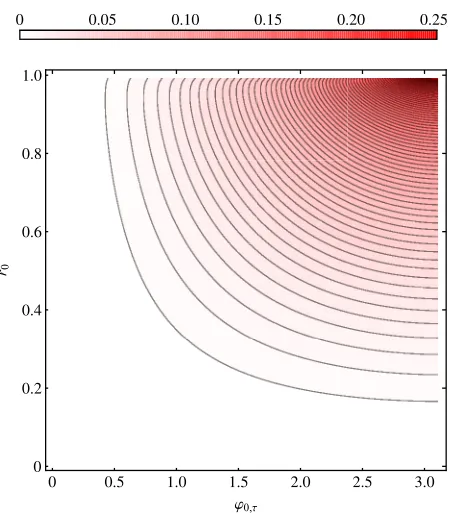
The difference between the right-hand side and left-hand side of the above inequality is represented in Fig. 8as a function ofr0∈½0;1½andφ0;τ ∈½0;π. As it can be easily
seen, this difference is always non-negative, i.e., the inequality (A2) is always satisfied. In particular, this difference is zero when either r0¼0or ~r0·~rτ ¼r20, i.e., whenφ0;τ ¼0, as can be proved by checking that
lim
~r0·~rτ→r20
arccos
ffiffiffiffiffiffiffiffiffiffiffiffiffiffiffiffiffiffiffiffiffiffiffiffiffiffiffiffiffiffiffiffiffiffiffi
1
2ð2−r20þ~r0·~rτÞ
q
arccosf12½~r0·~rτ r20 ð1−
ffiffiffiffiffiffiffiffiffiffiffiffi
1−r20 p
Þ þ1þpffiffiffiffiffiffiffiffiffiffiffiffi1−r20g
¼
ffiffiffiffiffiffiffiffiffiffiffiffiffiffiffiffiffiffiffiffiffiffiffiffiffi
1þpffiffiffiffiffiffiffiffiffiffiffiffi1−r20
2
s
: ðA19Þ
lfðρ
0;ρτÞ
lhðρ
0;ρτÞ¼
ffiffiffiffiffiffiffiffiffiffiffiffiffiffiffiffiffiffiffiffiffi cfðp1; p2Þ chðp
1; p2Þ
s
: ðA20Þ
However, we also note that this is only true in the one-qubit unitary case. If the dimensionality of the system is higher than 2, thenQfbecomes a nontrivial sum, as defined
in Eq. (16), so that the various time-independent coeffi-cientscfðpj; plÞcannot be extracted from the path integral
as we have just done above. On the other hand, Eq.(A17) seems hard to generalize to other contractive Riemannian metrics since the analytical expressions of the correspond-ing geodesic lengths are still unknown. We can thus leave the following conjecture: For any one-qubit unitary dynamics, the quantum Fisher information is the metric which provides the tightest QSL among all contractive Riemannian metrics on the quantum-state space; i.e., it is the metric solving the optimization problem in Eq. (20). Here, we have shown that the conjecture holds when the optimization is restricted to the quantum Fisher information and the Wigner-Yanase skew information metrics only.
APPENDIX B: PARALLEL AND TRANSVERSAL DEPHASING
In this appendix, we show how to compute all the quantities playing a role in Eq. (17), for the parallel and transversal dephasing dynamics, when considering the quantum Fisher information metric, the Wigner-Yanase
information metric, and the metric corresponding to the minimal MC function.
Let us start from the case of parallel dephasing and from the quantum Fisher information metric. Recall that its MC function is the maximal one, i.e., fQFðtÞ ¼fmaxðtÞ ¼
ð1þtÞ=2, implying that cfðx; yÞ ¼2=ðxþyÞ and, since
TrðρtÞ ¼pþþp−¼1, cfðpþ; p−Þ ¼2. It is possible to
provide an analytical expression for the path length corresponding to such a MC function as follows:
lQF
γ ðρ0;ρτÞ ¼1
2
ffiffiffiffiffiffiffiffiffiffiffiffiffiffiffiffiffiffiffiffiffiffiffiffiffiffiffi ð1þβ2ÞhΔZˆi
q
½Eðarcsinα;κ2Þ
−Eðarcsinðαe−ΓτÞ;κ2Þ; ðB1Þ
whereEðy;κ2Þ ¼R0ydy0pffiffiffiffiffiffiffiffiffiffiffiffiffiffiffiffiffiffiffiffiffiffiffi1−κ2sin2y0 is the elliptic inte-gral of the second kind,β¼ω0=Γ,κ2¼β2=ð1þβ2Þ, and
hΔZˆi ¼1−r20cos2θ0; α¼
ffiffiffiffiffiffiffiffiffiffiffiffiffiffiffiffiffiffiffiffi
1−1−r20 hΔZˆi s
; ðB2Þ
with hΔZˆi ¼Trðρtσz2Þ−TrðρtσzÞ2 being the variance of
the Pauli matrixσz. Specifically, when considering the case in whichω0¼0, i.e.,β¼0andκ¼0, the path length in Eq.(B1)becomes
lQF
γ ðρ0;ρτÞ ¼1
2
ffiffiffiffiffiffiffiffiffiffiffi hΔZˆi q
½arcsinα−arcsinðαe−ΓτÞ: ðB3Þ
Furthermore, the geodesic length corresponding to such a metric can be readily obtained by using Eqs. (5) and(A12), with
j~rτj ¼r0ξτ;
~r0·~rτ ¼r20½cos2θ0þqτsin2θ0cosðω0τÞ: ðB4Þ
Now considering the Wigner-Yanase information metric, we know that the corresponding MC function isfWYðtÞ ¼
ð1=4Þðpffiffitþ1Þ2 so that cfðpþ; p−Þ ¼4=ðppffiffiffiffiffiffiþþpffiffiffiffiffiffip−Þ2.
Hence, the path length corresponding to the Wigner-Yanase information metric is given by
lWY
γ ðρ0;ρτÞ ¼12
ffiffiffiffiffiffiffiffiffiffiffiffiffiffiffiffiffiffiffiffiffiffiffiffiffiffi ð1þβ2ÞhΔZˆi
q Z Γτ
0 duαe
−uΨ
uðr0;θ0;κÞ;
ðB5Þ
where
Ψuðr0;θ0;κÞ ¼
ffiffiffiffiffiffiffiffiffiffiffiffiffiffiffiffiffiffiffiffiffiffiffiffiffiffiffiffiffiffiffiffiffiffiffiffiffiffiffiffiffiffiffiffiffiffiffiffiffiffiffiffiffiffiffi Ωuðr0;θ0;κÞ þ
1−κ2α2e−2u
1−α2e−2u
s
ðB6Þ
and 0 0.05 0.10 0.15 0.20 0.25
0 0.5 1.0 1.5 2.0 2.5 3.0 0
[image:16.612.63.291.41.298.2]0.2 0.4 0.6 0.8 1.0