Pietro Liuzzo-Scorpo,1Andrea Mari,2 Vittorio Giovannetti,2 and Gerardo Adesso1 1Centre for the Mathematics and Theoretical Physics of Quantum Non-Equilibrium Systems (CQNE),
School of Mathematical Sciences, The University of Nottingham, University Park, Nottingham NG7 2RD, United Kingdom 2NEST, Scuola Normale Superiore and Istituto Nanoscienze-CNR, I-56127 Pisa, Italy
(Dated: August 30, 2017)
Given a certain amount of entanglement available as a resource, what is the most efficient way to accomplish a quantum task? We address this question in the relevant case of continuous variable quantum teleportation protocols implemented using two-mode Gaussian states with a limited degree of entanglement and energy. We first characterize the class of single-mode phase-insensitive Gaussian channels that can be simulated via a Braunstein–Kimble protocol with non-unit gain and minimum shared entanglement, showing that infinite energy is not necessary apart from the special case of the quantum limited attenuator. We also find that, apart from the identity, all phase-insensitive Gaussian channels can be simulated through a two-mode squeezed state with finite energy, albeit with a larger entanglement. We then consider the problem of teleporting single-mode coherent states with Gaussian-distributed displacement in phase space. Performing a geometrical optimization over phase-insensitive Gaussian channels, we determine the maximum average teleportation fidelity achievable with any finite entanglement and for any realistically finite variance of the input distribution.
Determining the ultimate performance of quantum tech-nologies in the presence of limited resources is essential to gauge their usefulness in the real world. Quantum teleporta-tion[1, 2] enables the “disembodied transfer” of an unknown quantum state from a sender to a remote receiver, usually named Alice and Bob, respectively. To accomplish this, they need to share a quantum resource, i.e., an entangled state, and to classically communicate. Ideally, if the resource is max-imally entangled, Bob can retrieve an exact copy of the in-put state. Unfortunately this is unrealistic, especially for con-tinuous variable systems [3–5], where maximal entanglement can be obtained only in the unphysical limit of infinite energy [2, 6]. It is thus important to identify the most efficient tele-portation schemes, which make optimal use of limited quan-tum resources to achieve the largestfidelitybetween input and output, averaged over a specified set of input states [7]. For discrete variable systems, with uniformly sampled pure input states, a relation between such optimal fidelity and the entan-glement of the resource was found in [8]. This Letter solves such a problem in a prominent continuous variable scenario.
A practical protocol for continuous variable teleportation, which employs a two-mode (finitely) squeezed state as a quan-tum resource at the price of realizing an imperfect teleporta-tion, was proposed by Braunstein and Kimble (BK) [9] and implemented in several experiments [10–12]. A characteristic feature of the BK protocol is that the input and output states are connected by a Gaussian additive noise channel [13]. Moreover, by simply introducing a non-unit classical gain in the BK protocol [10, 14–16], more general effective Gaussian channels can be “simulated” by teleportation, including quan-tum attenuators and amplifiers. A natural question emerging in this context is the following: Optimizing over all telepor-tation protocols and general resource states, how much entan-glement is necessary to simulate a given Gaussian channel? A simple lower bound is given by the entanglement of the so-called Choi state associated to the channel [6, 17–20]; such a bound is achievable using resources with infinite mean
en-ergy. As shown in fact in [6, 18, 20], any Gaussian channel can be deterministically implemented through a BK protocol exploiting the respective Choi state as a quantum resource.
In the first part of this Letter we focus on single-mode phase-insensitive Gaussian channels, which model typical sources of noise in quantum optics [21–23]. We show that almost all of them (but the quantum limited attenuator) can be implemented by teleportation with more realistic resource states, having the same entanglement as the Choi state but fi-nite mean energy. Moreover, through a non-unit gain BK tele-portation based on pure two-mode squeezed states (TMSSs) with finite energy yet with larger entanglement, one can sim-ulate all phase-insensitive Gaussian channels but the identity.
In the second part of this Letter we consider the concrete problem of teleporting an alphabet of coherent states [24] sampled from a phase-invariant Gaussian distribution with fi-nite variance. Maximizing over all phase-insensitive Gaus-sian channels, we determine the optimal average teleportation fidelity achievable as a function of the shared entanglement and input variance. Our result generalizes several previous studies partially addressing similar questions. For example in [7, 25–28] the fidelity was maximized over classical strategies (i.e., with zero shared entanglement) identifying theclassical benchmarkfor different input sets. For a fixed entanglement, the optimal average fidelity for teleporting coherent states was studied in [17, 29], albeit assuming an ideal flat distribution with unbounded variance. The optimization of the most realis-tic scenario given by a finite input variance remained hitherto unsolved, and is settled by the present Letter.
Gaussian states and Gaussian channels — An m-mode bosonic system [4, 30–32] is usually described in terms of a vector of quadrature operators ˆR =( ˆq1,p1ˆ , . . . ,qˆm,pˆm)>
sat-isfying the canonical commutation relations [ ˆRj,Rˆk] = iΩjk,
withΩ = iσ⊕ym. Here and in the rest of this Letter,1, σx, σy,
σzare the 2×2 identity and Pauli matrices respectively.
Gaussian quantum states can be defined as Gibbs ensem-bles of quadratic Hamiltonians and are fully characterized
by the first and second statistical moments of the quadra-ture operators, i.e., the displacement vector d = hRiˆ and the covariance matrix Vjk = h{Rˆj −dj,Rˆk −dk}+i, where
{·,·}+ is the anti-commutator. In order for a symmetric co-variance matrix V to describe a physical state, it has to sat-isfy the Robertson-Schr¨odinger uncertainty relationV ≥ iΩ [33]. For instance, in this notation, single-mode coherent states|αi(withα ∈ C) [24] are minimum uncertainty Gaus-sian states specified byd =
√
2 Reα,√2 Imα>andV =1. The entanglement of any two-mode Gaussian state with co-variance matrixV can be quantified by thelogarithmic neg-ativity [34–37] EN = log||ρΓ||1 = max{−log ˜ν−,0}, where ˜
ν−is the lowest symplectic eigenvalue of the covariance ma-trix ˜V =(1⊕σz)V(1⊕σz) associated to the partially
trans-posed stateρΓ. The mean energy of am-mode Gaussian state with zero first moments, i.e. the expectation value of the non-interacting quadratic Hamiltonian, can be easily computed from the covariance matrix V of the state [31]. In units of ~ωthis is given by: ¯n=(1/m)Pmk=1haˆ
†
kaˆkiρ=(TrV/m−2)/4.
Gaussian channels are completely positive trace-preserving maps which preserve the Gaussianity of quantum states [4, 21, 30, 32, 38]. They can be represented (up to additional displacements) by two matrices (X,Y), withY =Y>, which act on the displacement vector and the covariance matrix as
d→Xd, V→XV X>+Y, (1)
and satisfy the complete positivity condition Y +iXΩX> ≥ iΩ. The latter, for single-mode Gaussian channels, reduces to: Y ≥0,
√
detY ≥ |1−detX|. Moreover, single-mode Gaussian channels for which √detY ≥ |detX|+1 are entanglement-breaking [22, 23, 39, 40], i.e. when acting on one mode of any bipartite system they always produce a separable output state. These channels correspond to classical measure-and-prepare protocols, hence can be trivially simulated by Alice and Bob via classical communication only. In this Letter we will mainly focus on phase-insensitive single-mode channels defined by:
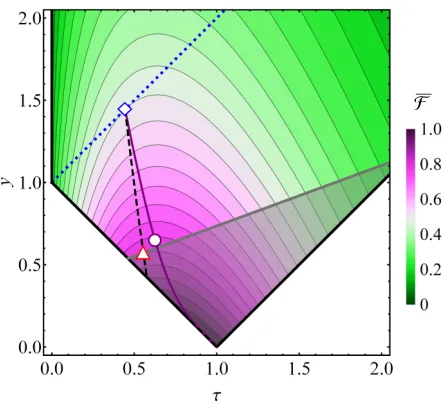
X= √τ1, Y =y1, (2) whereτandyare scalars representing transmissivity (or gain) and added noise, respectively (in the notation of [40]). In the plane (τ,y) illustrated in Fig. 1, we have thus
y≥ |1−τ| ⇔ completely positive, (3) y≥1+|τ| ⇔ entanglement-breaking. (4)
We will restrict toτ≥0, which excludes phase-contravariant channels. The channels on the lower boundary of the com-pletely positive region, i.e. with y = |1 −τ|, correspond in particular to the quantum limited attenuator (also known as pure loss channel) for 0≤τ <1, and to the quantum limited amplifier forτ >1, withτ=1 denoting the identity channel.
Continuous variable teleportation — We now briefly re-view the BK teleportation protocol [9], and we determine the induced Gaussian channel connecting input and output modes.
ℱ
FIG. 1. (Color online) Diagram of phase-insensitive single-mode Gaussian channels in the (τ,y) plane based on the parametrization (2). The white area corresponds to unphysical channels, delimited by (3). The shaded gray area corresponds to channels not acces-sible by teleportation schemes with finite entanglementEN = 2r, according to the bound (8). Channels above the (blue) dotted line are entanglement-breaking, according to (4). The colored contour plot depicts the average fidelity ¯F (12) associated to each phase-insensitive channel, for an input ensemble of coherent states with phase space varianceλ−1. Relevant channels are highlighted as
special points: (triangle) optimal teleportation scheme (13); (circle) suboptimal teleportation scheme based on a TMSS (16); (diamond) optimal measure-and-prepare strategy achieving the classical bench-mark (14). The (black) dashed and (purple) solid lines represent the channels achievable through the considered teleportation schemes by varying the entanglement parameter 0≤r<∞. The diagram is a snapshot atr=λ=0.5. All the plotted quantities are dimensionless.
Assume that Alice and Bob share a generic quantum resource consisting of a two-mode Gaussian state with zero first
mo-ments and covariance matrixVAB =
A C C> B
!
, where A,B, andCare 2×2 real matrices, and consider an unknown in-put state with displacement vector din and covariance ma-trixVin. Alice mixes the input state with her part of the re-source state through a balanced beam-splitter and measures, via homodyne detection on each mode, the two commuting quadratures ˆQ+ = ( ˆqin+qˆA)/
√
2 and ˆP− = ( ˆpin−pˆA)/
√ 2. Then, Alice classically communicates her measurement re-sults (photocurrents) to Bob who performs a displacement on his part of the shared state: ˆqB → qoutˆ = qˆB +g
√ 2Q+, ˆ
pB → pˆout = pˆB+g
√
2P−. Hereg>0 is thegainparameter
which is usually set tog =1 when teleportation is based on maximally entangled states. However, in general, a non-unit gain has been studied [10, 14–16] in the context of realistic resources. Once the protocol is completed, the displacement vector and covariance matrix of the output state can be com-puted using the methods of [3, 5, 38, 41] and are found to be:
dout=g din, Vout=g2Vin+g2σzAσz+g(σzC+C>σz)+B.
[image:2.612.330.552.49.250.2]These formulas show that the non-unit gain BK protocol in-duces a Gaussian channel with a diagonal gain matrixX=g1, and a noise matrixYwhich depends on the covariance matrix VABof the resource. If we setVABin block standard form:
A=a1, B=b1, C=−cσz., a,b,c∈R+, (6)
then also the noise matrix induced by teleportation is pro-portional to the identity and the protocol is equivalent to the phase-insensitive channel defined in (2), with parameters
τ=g2, y=g2a−2gc+b. (7)
Implementable phase-insensitive channels— Here we are interested in the inverse problem: we would like to under-stand, given an arbitrary pair (τ,y), what covariance matrix VAB can be used as a resource to simulate the
correspond-ing channel with a minimum amount of entanglement (quan-tified by the logarithmic negativity) and possibly with finite energy. A similar problem, but using a different entangle-ment measure and without focusing on the energy require-ment, has been considered in [20, 42], with fundamental im-plications for quantum communication. If we apply the chan-nel (τ,y) to one mode of a TMSS, then, in the limit of in-finite squeezing, we get the Choi state [6, 32] associated to the channel. Its entanglement can be computed [18] giving: E(Choi)N =max{0,−log[y/(1+τ)]}. Consider a resource state identified byVABhaving finite entanglementEN =2r, with
r≥0. Since the total entanglement shared between Alice and Bob cannot increase under any teleportation process, one must necessarily have 2r ≥ EN(Choi) [17, 18, 20]. The latter bound defines the accessible region (complementary to the gray area in Fig. 1) in the space of phase-insensitive channels:
y≥e−2r(1+τ). (8)
This, intersected with Eq. (3), identifies the region of Gaus-sian channels implementable with 2runits of entanglement; or equivalently, the channels that, when applied locally to one mode of a two-mode system, always lead to an output with EN ≤ 2r, generalizing the entanglement-breaking condition
(4) (dotted line in Fig. 1) which is recovered for vanishingr. The bound in Eq. (8) can be saturated by using the Choi state of the channel itself as a quantum resource [6, 20], with the gain set tog= √τ. This solution however, though elegant, is unrealistic for practical purposes because continuous vari-able Choi states have infinite energy. Here, instead, we find that there exist a realistic class of optimal resource states with minimum entanglement 2r = EN(Choi) and finite mean energy such that, withg = √τ, they can simulate all physical chan-nels at the boundary of the accessible region (where (8) holds as an equality), with the exclusion of only one point, i.e. the quantum limited attenuator. These optimal resource states, in standard form (6), are found by fixingcsuch thatEN =2r,
andasuch that (8), withygiven by (7), holds with equality:
a=b+e
−2r(τ−1)
τ , c=
b−e−2r
√
τ , b≥
τ−e−2rtanhr
τ−tanhr , (9)
where the condition given onbis necessary to ensure that the state is physical. In this class of states we choose those with minimal mean energy ¯nAB=(a+b−2)/4, given by the value
ofbwhich saturates the inequality in (9). These correspond to asymmetric squeezed thermal states with a unit symplectic eigenvalue and maximalEN among all two-mode Gaussian
states with the same marginalsa,b[36, 43]. Notice that the lower bound on the coefficientbin (9) (and hencea) diverges only at the extreme point (τ = tanhr,y =1−tanhr) corre-sponding to the quantum limited attenuator. For larger values ofτ, including the opposite extreme represented by the quan-tum limited amplifier, all channels along the boundary saturat-ing (8) can be simulated ussaturat-ing the states (9) with finite mean energy ¯nABand minimum entanglementEN =2r(see Fig. 1).
Finally, it is natural to ask how much entanglement r0 is
necessary instead to simulate a phase-insensitive channel (τ,y) exploiting the more familiar pure TMSS as a teleportation resource. This corresponds to fix: a = b = cosh 2r0 and c = sinh 2r0 [30]. From Eq. (7) we have g = √τ and, for all non-entanglement-breaking values of the noise parameter |1−τ| ≤y≤1+τ, there always exist two solutions forr0, with
r0= 1 2cosh
−1
y(1+τ)−2pτ[y2−(1−τ)2] (1−τ)2
, (10)
being the one corresponding to the smallest entanglement and indirectly the smallest energy ¯nAB=sinh2(r0) required to
sim-ulate the channel via a TMSS. Quite surprisingly, in this case the energy (and the entanglement) stays finite even for the quantum limited attenuator, and diverges only for the identity map (τ=1,y=0). However, simulation via TMSSs requires more entanglement compared to using the optimal states (9): subsitutingy=e−2r(1+τ) into (10), one gets indeedr0>r.
This concludes the first part of this Letter, whose aim was to determine optimal teleportation protocols for simulating phase-insensitive Gaussian channels with finite resources. In the following we will exploit the previous results to solve an optimization problem with significant practical implications.
Optimal teleportation fidelity— The success of a telepor-tation protocol can be quantified in terms of the fidelity be-tween input and output states, which for a pure input|ψiniis defined asF = hψin|ρout|ψini [7]. For a coherent input state |αithe latter is proportional to theQ-function [44, 45] of the output state evaluated at the input complex amplitudeα:F = hα|ρout|αi =πQout(α). Here we are interested in the realistic scenario [7, 25] in which Alice wants to teleport an unknown input coherent state|αi, with displacementαsampled from a Gaussian phase space distributionPλin(α)=(λ/π)e−λ|α|2. This prior corresponds to theP-function [24, 45] of a thermal en-semble with input mean energy ¯ningiven by the varianceλ−1. The average teleportation fidelity over the input ensemble can be expressed as the integral overlap of the two functions:
¯ Fλ=πR
Cd 2αPλ
to optimize the average fidelity over all possible Gaussian phase-insensitive teleportation schemes. This task appears prima facie quite complex; however, thanks to the previ-ous analysis, we can limit the optimization over the two-parameter space (τ,y) of accessible phase-insensitive Gaus-sian channels with the entanglement constraint (8), without delving into the specifics of the teleportation protocol. The action of any such channel on a coherent input state pro-duces, according to Eqs. (1) and (2), a thermal output state with displacementdout =(
√
2τReα,√2τImα)> and
covari-ance matrixVout =(y+τ)1. The correspondingQ-function, evaluated at the input phase space point α, is Qλout(α) = [2e−2(1−√τ)2|α|2/(y+τ+1)
]/[π(y+τ+1)]. Substituting this into Eq. (11), we get the average teleportation fidelity
¯
Fλ(τ,y)=2λ/h2(1−√τ)2+λ(1+y+τ)i . (12)
The previous expression depends nontrivially on the transmis-sivity parameterτwhile, as expected, it is monotonically de-creasing with the noise parametery(see Fig. 1 for a contour plot). For a fixed entanglementEN =2r,yis lower bounded
by (8) and so the maximum ¯Fλ must be on the line y = e−2r(1+τ), delimiting the set of implementable channels from
the unaccessible region (gray area in Fig. 1). Inserting this into (12), and optimizing with respect toτwithin the completely positive region (3), we get: τopt = max
n
tanhr,(er+λecosh2r r)2 o
. The corresponding optimal average fidelity is finally:
¯ Foptλ (r)=
λ λ+ 1−
√
tanhr2, tanhr
≥ e2r (er+λcoshr)2;
er(1+λ+tanhr)
2er+λ coshr , otherwise.
(13)
The associated optimal teleportation channel, denoted by a tri-angle in Fig. 1, can be simulated via a non-unit gain BK proto-col based on the class of resource states of Eq. (9). However, when the first case of Eq. (13) holds, the optimal channel is a quantum limited attenuator for which the needed energy di-verges as previously discussed. When instead the second case holds, which happens for sufficiently large input varianceλ−1, the optimal channel can be implemented with finite energy.
Discussion— We now discuss some implications of our general formula for the optimal average fidelity given in Eq. (13). In particular we are going to recover, as special cases, a number of results obtained in previous literature.
The first special case that we consider isr=0 (see diamond in Fig. 1), that is, no shared entanglement, for which we get:
τopt=(1+λ)−1, yopt=1+τopt, Foptλ (0)= 1+λ 2+λ, (14) yielding the maximum fidelity achievable with any measure-and-prepare strategy, i.e., the classical benchmark derived in [25]. Moreover, forr = 0 the two-mode state (9) reduces to the vacuum and the BK protocol is equivalent to a heterodyne detection at Alice’s site, followed by a repreparation of a co-herent state at Bob’s site withg =(1+λ)−1. This is exactly the optimal “cheating” strategy originally proposed in [7].
The second special case is whenλ → 0, corresponding to the teleportation of uniformly distributed coherent states (i.e., with unbounded input mean energy). In this limit we get:
τopt=1, yopt=2e−2r, F¯opt0 (r)= 1+e
−2r−1, (15)
consistently with the results obtained in Refs. [17, 29]. More-over forλ → 0 the optimal resource (9) reduces to a pure TMSS, recovering the standard BK scheme with unit gain [9]. In general, for arbitrary values ofλandr, one may com-pare the optimal teleportation strategy derived in this Letter [Eq. (13)] with a conventional BK scheme based on a pure TMSS and optimized gain g [10, 14–16]. Using Eqs. (7) and optimizing Eq. (12) with respect to τ = g2, we get: gopt=(2+λsinh 2r)/(2+λ+λcosh 2r), and
¯
FTMSSλ (r)=(sech2r+λ)/(2+λ−2 tanhr), (16)
corresponding to the circle in Fig. 1. One sees that the tele-portation based on a TMSS never achieves the optimal Gaus-sian strategy (triangle) for anyλ >0, despite approximating it well and beating the classical benchmark. Precisely, one has:
¯
Foptλ (r)≥F¯TMSSλ (r)≥F¯optλ(0), where the first inequality is satu-rated forλ→0 orr=0, while the second one only forr=0. Therefore, if one takes into account only the shared entan-glement, pure TMSSs are suboptimal for teleporting coherent states with non-uniform distribution. On the other hand, tele-portation with a TMSS may still represent an experimentally practical solution, e.g. when tanhr≥e2r/(er+λcoshr)2[see Eq. (13)], in which case the energy of the optimal state (9) diverges while it is finite for a TMSS.
Conclusions— In this Letter we determined a class of re-alistic continuous variable teleportation protocols that are op-timal for simulating phase-insensitive Gaussian channels em-ploying a minimum amount of shared entanglement. Exclud-ing the pathological case of the quantum limited attenuator, our teleportation schemes rely on feasible resource states with a finite mean energy and are thus quite appealing for practical applications in quantum communication [4, 20, 42, 46, 47].
By exploiting such effective equivalence between Gaussian channels and teleportation schemes, we considered the rele-vant task of teleporting an alphabet of single-mode coherent states sampled from a Gaussian phase space distribution with finite variance [7], via a two-mode Gaussian resource with fi-nite entanglement [36]. We determined the optimal average fidelity analytically, solving a longstanding open problem in continuous variable quantum teleportation [5, 30], and recov-ering many previous results as special cases [7, 17, 25, 29].
Acknowledgments — We thank Marco Cianciaruso for fruitful discussions in the early stages of this project, and Stefano Pirandola, Cosmo Lupo, Riccardo Laurenza, Mark Wilde, and Eneet Kaur for further discussions after our pa-per first appeared. G.A. thanks Pamela Ott for inspiring ex-changes about entanglement and its artistic depiction. We acknowledge financial support from the European Research Council (ERC) under the Starting Grant GQCOP (Grant No. 637352) and the Foundational Questions Institute under the Physics of the Observer Programme (Grant No. FQXi-RFP-1601).
[1] C. H. Bennett, G. Brassard, C. Cr´epeau, R. Jozsa, A. Peres, and W. K. Wootters, “Teleporting an unknown quantum state via dual classical and Einstein-Podolsky-Rosen channels,” Phys. Rev. Lett.70, 1895 (1993).
[2] L. Vaidman, “Teleportation of quantum states,” Phys. Rev. A 49, 1473 (1994).
[3] P. van Loock, “Quantum communication with continuous vari-ables,” Fortsch. Phys.50, 1177 (2002).
[4] S. L. Braunstein and P. van Loock, “Quantum information with continuous variables,” Rev. Mod. Phys.77, 513 (2005). [5] S. Pirandola and S. Mancini, “Quantum teleportation with
con-tinuous variables: A survey,” Laser Phys.16, 1418 (2006). [6] G. Giedke and J. I. Cirac, “Characterization of gaussian
op-erations and distillation of gaussian states,” Phys. Rev. A66, 032316 (2002).
[7] S. L. Braunstein, C. A. Fuchs, and H. J. Kimble, “Criteria for continuous-variable quantum teleportation,” J. Mod. Opt. 47, 267 (2000).
[8] M. Horodecki, P. Horodecki, and R. Horodecki, “General tele-portation channel, singlet fraction, and quasidistillation,” Phys. Rev. A60, 1888 (1999).
[9] S. L. Braunstein and H. J. Kimble, “Teleportation of continuous quantum variables,” Phys. Rev. Lett.80, 869 (1998).
[10] A. Furusawa, J. L. Sørensen, S. L. Braunstein, C. A. Fuchs, H. J. Kimble, and E. S. Polzik, “Unconditional quantum tele-portation,” Science282, 706 (1998).
[11] W. P. Bowen, N. Treps, B. C. Buchler, R. Schnabel, T. C. Ralph, H.-A. Bachor, T. Symul, and P. K. Lam, “Experimental inves-tigation of continuous-variable quantum teleportation,” Phys. Rev. A67, 032302 (2003).
[12] S. Pirandola, J. Eisert, C. Weedbrook, A. Furusawa, and S. L. Braunstein, “Advances in quantum teleportation,” Nature Pho-ton.9, 641 (2015).
[13] M. Ban, M. Sasaki, and M. Takeoka, “Continuous variable teleportation as a generalized thermalizing quantum channel,” J. Phys. A: Math. Gen.35, L401 (2002).
[14] R. E. S. Polkinghorne and T. C. Ralph, “Continuous variable entanglement swapping,” Phys. Rev. Lett.83, 2095 (1999). [15] H. F. Hofmann, T. Ide, T. Kobayashi, and A. Furusawa,
“Fi-delity and information in the quantum teleportation of continu-ous variables,” Phys. Rev. A62, 062304 (2000).
[16] T. Ide, H. F. Hofmann, A. Furusawa, and T. Kobayashi, “Gain tuning and fidelity in continuous-variable quantum teleporta-tion,” Phys. Rev. A65, 062303 (2002).
[17] A. Mari and D. Vitali, “Optimal fidelity of teleportation of coherent states and entanglement,” Phys. Rev. A 78, 062340 (2008).
[18] J. Niset, J. Fiur´aˇsek, and N. J. Cerf, “No-go theorem for gaus-sian quantum error correction,” Phys. Rev. Lett.102, 120501 (2009).
[19] A. S. Holevo, “The Choi–Jamiolkowski forms of quantum gaussian channels,” J. Math. Phys.52, 042202 (2011). [20] S. Pirandola, R. Laurenza, C. Ottaviani, and L. Banchi,
“Fun-damental limits of repeaterless quantum communications,” Na-ture Commun.8, 15043 (2017).
[21] C. M. Caves and P. D. Drummond, “Quantum limits on bosonic communication rates,” Rev. Mod. Phys.66, 481 (1994). [22] A. Mari, V. Giovannetti, and A. S. Holevo, “Quantum state
ma-jorization at the output of bosonic gaussian channels,” Nature Commun.5, 3826 (2014).
[23] V. Giovannetti, R. Garc´ıa-Patr´on, N. J. Cerf, and A. S. Holevo, “Ultimate classical communication rates of quantum optical channels,” Nature Photon.8, 796 (2014).
[24] R. J. Glauber, “Coherent and incoherent states of the radiation field,” Phys. Rev.131, 2766 (1963).
[25] K. Hammerer, M. M. Wolf, E. S. Polzik, and J. I. Cirac, “Quan-tum benchmark for storage and transmission of coherent states,” Phys. Rev. Lett.94, 150503 (2005).
[26] R. Namiki, “Simple proof of the quantum benchmark fidelity for continuous-variable quantum devices,” Phys. Rev. A 83, 042323 (2011).
[27] G. Chiribella and G. Adesso, “Quantum benchmarks for pure single-mode gaussian states,” Phys. Rev. Lett. 112, 010501 (2014).
[28] Y. Yang, G. Chiribella, and G. Adesso, “Certifying quantum-ness: Benchmarks for the optimal processing of generalized co-herent and squeezed states,” Phys. Rev. A90, 042319 (2014). [29] G. Adesso and F. Illuminati, “Equivalence between
entangle-ment and the optimal fidelity of continuous variable teleporta-tion,” Phys. Rev. Lett.95, 150503 (2005).
[30] C. Weedbrook, S. Pirandola, R. Garc´ıa-Patr´on, N. J. Cerf, T. C. Ralph, J. H. Shapiro, and S. Lloyd, “Gaussian quantum infor-mation,” Rev. Mod. Phys.84, 621 (2012).
[31] G. Adesso, S. Ragy, and A. R. Lee, “Continuous variable quan-tum information: Gaussian states and beyond,” Open Syst. Inf. Dyn.21, 1440001 (2014).
[32] A. Serafini,Quantum Continuous Variables: A Primer of The-oretical Methods(Taylor & Francis, Oxford, 2017).
[33] R. Simon, N. Mukunda, and B. Dutta, “Quantum-noise matrix for multimode systems: U(n) invariance, squeezing, and normal forms,” Phys. Rev. A49, 1567 (1994).
[34] J. Eisert,Entanglement in quantum information theory, Ph.D. thesis, University of Potsdam (2001).
[35] G. Vidal and R. F. Werner, “Computable measure of entangle-ment,” Phys. Rev. A65, 032314 (2002).
[36] G. Adesso, A. Serafini, and F. Illuminati, “Extremal entan-glement and mixedness in continuous variable systems,” Phys. Rev. A70, 022318 (2004).
[37] M. B. Plenio, “Logarithmic negativity: A full entanglement monotone that is not convex,” Phys. Rev. Lett. 95, 090503 (2005).
[38] M. M. Wolf, D. P´erez-Garc´ıa, and G. Giedke, “Quantum capac-ities of bosonic channels,” Phys. Rev. Lett.98, 130501 (2007). [39] A. S. Holevo, “Entanglement-breaking channels in infinite
di-mensions,” Probl. Inf. Trans.44, 3 (2008).
[40] J. Sch¨afer, E. Karpov, R. Garc´ıa-Patr´on, O. V. Pilyavets, and N. J. Cerf, “Equivalence relations for the classical capacity of single-mode gaussian quantum channels,” Phys. Rev. Lett.111, 030503 (2013).
[42] M. M. Wilde, M. Tomamichel, and M. Berta, “Converse bounds for private communication over quantum channels,” IEEE Trans. Inf. Theory63, 1792 (2017).
[43] G. Adesso and F. Illuminati, “Gaussian measures of entan-glement versus negativities: Ordering of two-mode gaussian states,” Phys. Rev. A72, 032334 (2005).
[44] K. Husimi, “Some formal properties of the density matrix,” Proc. Phys. Math. Soc. Jpn23, 264 (1940).
[45] C. W. Gardiner and P. Zoller,Quantum noise(Springer Verlag, Berlin, 1999).
[46] E. Kaur and M. M. Wilde, “Upper bounds on secret key agreement over lossy thermal bosonic channels,” (2017), arXiv:1706.04590v1, 1706.04590.
[47] R. Laurenza, S. L. Braunstein, and S. Pirandola, “Finite-resource teleportation stretching for continuous-variable
sys-tems,” (2017), arXiv:1706.06065v1, 1706.06065.
[48] H. M. Wiseman, S. J. Jones, and A. C. Doherty, “Steering, en-tanglement, nonlocality, and the einstein-podolsky-rosen para-dox,” Phys. Rev. Lett.98, 140402 (2007).
[49] Q. He, L. Rosales-Z´arate, G. Adesso, and M. D. Reid, “Secure continuous variable teleportation and einstein-podolsky-rosen steering,” Phys. Rev. Lett.115, 180502 (2015).
[50] I. Kogias, A. R. Lee, S. Ragy, and G. Adesso, “Quantification of gaussian quantum steering,” Phys. Rev. Lett.114, 060403 (2015).