Abstract—In this paper, we give a general overview of fuzzy research according to the results found in the ISI Web of Knowledge. We present the most cited articles in fuzzy research, the top authors, the top journals, the evolution by years and the top countries. We also provide a longer list of journals in order to be informative to the scientific community, especially for the young researchers. Note that the results given in this paper are only a general orientation because the rankings can be developed in different ways depending on the variables that we want to take into account.
Index Terms— Fuzzy, ISI Web of Knowledge, journals, citations.
I. INTRODUCTION
Fuzzy set theory appeared in 1965 [6]. Since then, it has received increasing attention by the scientific community and applied in almost all the general disciplines known in the world [1-5,7-8]. Initially, it took time for the scientific community to accept these theories but since the publication of the first books [3] in the seventies, it became more and more popular. Today, there are thousands of researchers dedicated to some particular area of fuzzy research and there are a lot of journals and conferences dedicated to these topics.
In this paper, we present a general overview of the fuzzy research according to the results found in the ISI Web of Knowledge. The ISI Web is an institution that collects the data of different journals, conferences, etc., that are officially recognized to be the most relevant in the world in their respective topics. Therefore, we believe that these results are useful for the fuzzy community because they give a general overview of the main research in fuzzy theories. However, it is worth noting that the results can be studied in different ways depending on the criteria that we follow in the development of the rankings. Note also that the results are the statistical result found in the data but as it is known, sometimes there exist other variables that are not included that are also relevant in the research.
Manuscript received March 23, 2009. This paper is partly supported by the Spanish Ministerio de Asuntos Exteriores y de Cooperación, Agencia Española de Cooperación Internacional para el Desarrollo (AECID) (project A/016239/08). We would like to thank Francisco Herrera and Enrique Herrera-Viedma for valuable comments that have improved the quality of the paper.
J.M. Merigó is with the Department of Business Administration, University of Barcelona, Av. Diagonal 690, 08034 Barcelona, Spain (corresponding author: +34-93-4021962; fax: +34-93-4039882; e-mail: jmerigo@ ub.edu).
A.M. Gil-Lafuente is with the Department of Business Administration, University of Barcelona, Av. Diagonal 690, 08034 Barcelona, Spain (e-mail: [email protected]).
This paper is organized as follows. In Section 2, we present the most cited articles. In Section 3, we give a general overview of the top authors. Section 4 presents the top journals and a longer list with journals related to fuzzy research. In Section 5 we analyze the evolution by years and in Section 6 the top countries. Section 7 summarizes the main results and conclusions of the paper.
II. MOST CITED ARTICLES WITH THE WORD “FUZZY” IN THE ISI WEB OF KNOWLEDGE
In this Section, we are going to present the most cited papers with the word “fuzzy”. Note that inside the ISI Web, we will use the Web of Science (WoS) because it considers the journals listed in the ISI Web. Other alternatives could be considered such as the ISI Proceedings but we have tried to focus only in the main journals (recognised by the ISI) and not in conferences, etc.
An interesting aspect to mention in the search process is that there may exist particular results that could produce mistakes in the “search process with the keyword FUZZY”. For example, one problem is that some articles use the word fuzzy but are not a research paper in fuzzy theories (this happens because the word FUZZY can be used with different meanings). Another problem is how to classify the Asian (or other) authors because sometimes is difficult for the search tool to identify the same author or distinguish between different authors (because sometimes the name is not written equal in different papers, etc). A further problem is all the papers in fuzzy research that does not use the word fuzzy. This problem is becoming increasingly relevant because there are a lot of new theories that may not use the word fuzzy such as in soft computing. And so on.
This paper uses the results found in the ISI Web of Knowledge the day 23-01-2007 and 28-03-2007. In the following, we present the results:
The word “fuzzy” has obtained 32525 articles. Most of them can be considered as research papers about fuzzy theories. Note that an additional problem is that there are a lot of papers about fuzzy theories that do not use the word fuzzy such as those that deal with linguistic information (some of them). For example, the papers by Zadeh about linguistic information [7] are not found by the search tool when using the word fuzzy and obviously, they are key papers in fuzzy research. Therefore, we have added a secondary list of papers that are not found in the search tool with the word fuzzy but has to be mentioned.
In this paper, we present the top 20 articles most cited in the ISI Web. Obviously, it is possible to consider longer lists with the top 50, top 100, or with sub classifications by fuzzy topic, by years, etc. Note that it is interesting to show a wide ranking
An Overview of Fuzzy Research in the ISI Web
of Knowledge
(minimum 20 articles) because when looking for some particular subfields of fuzzy theories, then, it is difficult to find a paper in this list. And this can be very useful for fuzzy researchers (specially, the new ones). Thus, we recommend for future research to develop longer lists by subject, by year, etc.
The 20 articles most cited in the Web of Science that uses the word fuzzy are:
(1) L.A. Zadeh, Fuzzy Sets, Information and Control 8 (1965) 338-353.
a. Times cited: 6483.
(2) T. Takagi, M. Sugeno, Fuzzy Identification of Systems and its Applications to Modeling and Control, IEEE Transactions on Systems, Man and Cybernetics 15 (1985) 116-132.
a. Times cited: 1642.
(3) L.A. Zadeh, Fuzzy Sets as a Basis for a Theory of Possibility, Fuzzy Sets and Systems 1 (1978) 3-28.
a. Times cited: 1588.
(4) C.C. Lee, Fuzzy Logic in Control Systems – Fuzzy Logic Controller 1, IEEE Transactions on Systems, Man and Cybernetics 20 (1990) 404-418.
a. Times cited: 1212.
(5) J.S.R. Jang, ANFIS – Adaptative Network Based Fuzzy Inference System, IEEE Transactions on Systems, Man and Cybernetics 23 (1993) 665-685.
a. Times cited: 851.
(6) E.H. Mamdani, Application of Fuzzy Algorithms for Control of Simple Dynamic Farm, Proceedings of the Institution of Electrical Engineers – London 121 (1974) 1585-1588.
a. Times cited: 599.
(7) E.H. Mamdani, S. Assilian, Experiment in Linguistic Synthesis with Fuzzy Logic Controller, International Journal of Man-Machine Studies 7 (1975) 1-13.
a. Times cited: 598.
(8) L.A. Zadeh, Similarity Relations and Fuzzy Orderings, Information Sciences 3 (1971) 177-200.
a. Times cited: 496
(9) L.A. Zadeh, Probability Measures of Fuzzy Events, Journal of Mathematical Analysis and Applications 23 (1968) 421-427.
a. Times cited: 483.
(10)J.A. Goguen, L-Fuzzy Sets, Journal of Mathematical Analysis and Applications 18 (1967) 145-174.
a. Times cited: 469.
(11)L.X. Wang, J.M. Mendel, Generating Fuzzy Rules by Learning from Examples, IEEE Transactions on Systems, Man and Cybernetics 22 (1992) 1414-1427.
a. Times cited: 468.
(12)C.L. Chang, Fuzzy Topological Spaces, Journal of Mathematical Analysis and Applications 24 (1968) 182-190.
a. Times cited: 466.
(13)L.X. Wang, J.M. Mendel, Fuzzy Basis Functions, Universal Approximation, and Ortogonal Least Squares Learning, IEEE Transactions on Neural Networks 3 (1992) 807-814.
a. Times cited: 420.
(14)H.J. Zimmermann, Fuzzy programming and linear programming with several objective functions, Fuzzy Sets and Systems 1 (1978) 45-55.
a. Times cited: 419.
(15)M. Sugeno, G.T. Kang, Structure Identification of Fuzzy Model, Fuzzy Sets and Systems 28 (1988) 15-33.
a. Times cited: 381.
(16)N.R. Pal, S.K. Pal, A Review on Image Segmentation Techniques, Pattern Recognition 26 (1993) 1277-1294.
a. Times cited: 380.
(17)A. Rosenfeld, Fuzzy Groups, Journal of Mathematical Analysis and Applications 35 (1971) 512-517.
a. Times cited: 363.
(18)K. Tanaka, M. Sugeno, Stability Analysis and Design of Fuzzy Control Systems, Fuzzy Sets and Systems 45 (1992) 135-156.
a. Times cited: 362.
(19)C.C. Lee, Fuzzy Logic in Control Systems – Fuzzy Logic Controller 2, IEEE Transactions on Systems, Man and Cybernetics 20 (1990) 419-435.
a. Times cited: 353.
(20)C.T. Lin, C.S.G. Lee, Neural Network Based Fuzzy Logic Control and Decision System, IEEE Transactions on Computers 40 (1991) 1320-1336.
a. Times cited: 344.
Obviously, the most cited paper is Zadeh’s 1965 seminal paper [6]. In the following, we present a list of articles and books highly cited in the ISI Web that are not found when using the word fuzzy but should be mentioned:
(1) T.L. Saaty, The Analytic Hierarchy Process, McGraw-Hill, New York, 1980.
a. Times cited: 2215.
(2) G.A. Shafer, Mathematical Theory of Evidence, Princeton University Press, Princeton, NY, 1976.
a. Times cited: 2045.
(3) D. Dubois, H. Prade, Fuzzy Sets and Systems: Theory and Applications, Academic Press, New York, 1980.
a. Times cited: 1759.
(4) L.A. Zadeh, Outline of a New Approach to Analysis of Complex Systems and Decision Processes, IEEE Transactions on Systems, Man and Cybernetics 3 (1973) 28-44.
a. Times cited: 1570.
(5) H.J. Zimmermann, Fuzzy Set Theory and Its Applications, Kluwer Academic Publishers, Boston, 1986.
a. Times cited: 1527.
(6) L.A. Zadeh, The Concept of a Linguistic Variable and its application to Approximate Reasoning 1, Information Sciences 8 (1975) 199-249.
a. Times cited: 1309.
(7) G.J. Klir, B. Yuan, Fuzzy Sets and Fuzzy Logic: Theory and Applications, Prentice Hall, 1995.
a. Times cited: 873.
(8) L.A. Zadeh, The Concept of a Linguistic Variable and its application to Approximate Reasoning 3, Information Sciences 9 (1975) 43-80.
(9) Z. Pawlak, Rough Sets, International Journal of Computer & Information Sciences 11 (1982) 341-356.
a. Times cited: 795.
(10)L.A. Zadeh, The Concept of a Linguistic Variable and its application to Approximate Reasoning 2, Information Sciences 8 (1975) 301-357.
a. Times cited: 765.
(11)A. Kaufmann, Introduction to the Theory of Fuzzy Subsets. Vol.1-4, Academic Press, New York, 1975.
a. Times cited: 738.
(12)A.P. Dempster, Upper and Lower Probabilities Induced by a Multivalued Mapping, Annals of Mathematical Statistics 38 (1967) 325-339.
a. Times cited: 659.
(13)T.L. Saaty, Scaling Method for Priorities in Hierarchical Structures, Journal of Mathematical Psychology 15 (1977) 234-281.
a. Times cited: 616.
(14)A. Kaufmann, M.M. Gupta, Introduction to Fuzzy Arithmetic: Theory and Applications, Van Nostrand Reinhold, New York, 1985.
a. Times cited: 607.
(15)R.R. Yager, On Ordered Weighted Averaging Aggregation Operators in Multi-Criteria Decision Making, IEEE Transactions on Systems, Man and Cybernetics 18 (1988) 183-190.
a. Times cited: 530.
III. TOP AUTHORS WITH THE WORD “FUZZY” IN THE ISI WEB OF KNOWLEDGE
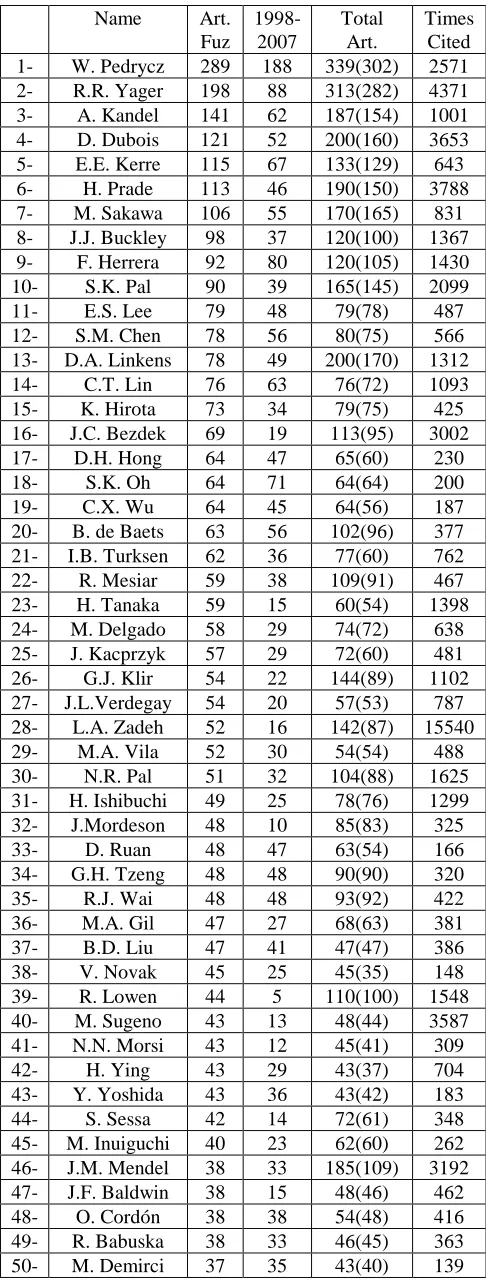
In this Section, we present the IGOWAAC operator. It is a new aggregation operator that uses induced aggregation operators, generalized means and the adequacy coefficient in the OWA operator. In the following, we show the 50 authors that has published the highest number of articles in the ISI Web. As they are researchers specialized in fuzzy theories, we accept the number of entries as correct. Note that we put a column with the articles published with the word fuzzy, the total number of articles published and the times cited in the ISI Web.
The authors are ordered according to the number of articles published with the word fuzzy. The number in parenthesis indicates the total number of publications of the author in the ISI Web and the other number (of the 2nd column) is the total number of articles. This information has been collected the 28-03-2007 and it is shown in Table 1.
As we can see, the results are more or less what we should expect about them before doing the analysis. Most of the world leading experts in fuzzy research are in the first positions such as Witold Pedrycz, Ronald Yager, Abraham Kandel, Didier Dubois, etc. Lotfi Zadeh is not found in the first position because the ranking is carried out according to the number of publications. However, if we look to the number of citations received, then, it is clear that Zadeh is the most relevant author in fuzzy research. This is clear because he has received more than 15000 citations while the second one, Ronald Yager, has about 4300 citations.
Table 1: Authors with the most number of papers with the word fuzzy in the ISI Web of Knowledge
Name Art.
Fuz
1998- 2007
Total Art.
Times Cited 1- W. Pedrycz 289 188 339(302) 2571 2- R.R. Yager 198 88 313(282) 4371 3- A. Kandel 141 62 187(154) 1001 4- D. Dubois 121 52 200(160) 3653 5- E.E. Kerre 115 67 133(129) 643 6- H. Prade 113 46 190(150) 3788 7- M. Sakawa 106 55 170(165) 831 8- J.J. Buckley 98 37 120(100) 1367 9- F. Herrera 92 80 120(105) 1430 10- S.K. Pal 90 39 165(145) 2099
11- E.S. Lee 79 48 79(78) 487
12- S.M. Chen 78 56 80(75) 566
13- D.A. Linkens 78 49 200(170) 1312
14- C.T. Lin 76 63 76(72) 1093
15- K. Hirota 73 34 79(75) 425
16- J.C. Bezdek 69 19 113(95) 3002
17- D.H. Hong 64 47 65(60) 230
18- S.K. Oh 64 71 64(64) 200
19- C.X. Wu 64 45 64(56) 187
20- B. de Baets 63 56 102(96) 377 21- I.B. Turksen 62 36 77(60) 762
22- R. Mesiar 59 38 109(91) 467
23- H. Tanaka 59 15 60(54) 1398
24- M. Delgado 58 29 74(72) 638
25- J. Kacprzyk 57 29 72(60) 481 26- G.J. Klir 54 22 144(89) 1102 27- J.L.Verdegay 54 20 57(53) 787 28- L.A. Zadeh 52 16 142(87) 15540
29- M.A. Vila 52 30 54(54) 488
30- N.R. Pal 51 32 104(88) 1625
31- H. Ishibuchi 49 25 78(76) 1299
32- J.Mordeson 48 10 85(83) 325
33- D. Ruan 48 47 63(54) 166
34- G.H. Tzeng 48 48 90(90) 320
35- R.J. Wai 48 48 93(92) 422
36- M.A. Gil 47 27 68(63) 381
37- B.D. Liu 47 41 47(47) 386
38- V. Novak 45 25 45(35) 148
39- R. Lowen 44 5 110(100) 1548
40- M. Sugeno 43 13 48(44) 3587
41- N.N. Morsi 43 12 45(41) 309
42- H. Ying 43 29 43(37) 704
43- Y. Yoshida 43 36 43(42) 183
44- S. Sessa 42 14 72(61) 348
45- M. Inuiguchi 40 23 62(60) 262 46- J.M. Mendel 38 33 185(109) 3192 47- J.F. Baldwin 38 15 48(46) 462
48- O. Cordón 38 38 54(48) 416
49- R. Babuska 38 33 46(45) 363
50- M. Demirci 37 35 43(40) 139
[image:3.595.305.548.85.729.2]indexed in the ISI Web of Knowledge. Therefore, we would like to mention that these results only want to present some of the main authors. But we would like to mention that there are a lot of very good researchers that are not included here but should be in the list according to other merits such as books published, articles published in journals not indexed in the ISI Web, articles in conferences, patents, etc. And obviously, the ranking of this list may also change if we change the merits to be taken into account.
A further interesting aspect is that these results are very general and it is possible to consider a lot of particular cases that gives different types of particular rankings.
Remark 1. For example, for identifying the young top authors, it is possible to classify the results according to the publications in the last three, five or ten years.
Remark 2. Another interesting point is to divide the authors by countries, continents or institutions. Thus, we are able to see the citizenship of the key authors and similar aspects. Remark 3. It is also interesting to develop individual classifications by countries. Thus, we can find the top 10, top 20, etc., authors in each country. Depending on the size of the country, the list should be more or less longer.
Remark 4. A further interesting aspect is to divide the analysis by topics and see the authors with the highest number of publications in fuzzy set theory, in fuzzy systems, in fuzzy mathematics, in fuzzy decision making, in fuzzy engineering, etc.
Finally, we would also like to note that in the future, we will try to extend this list in order to consider more researchers such as the top 100, and other merits.
Remark 5. Note that if we want to strictly establish a ranking, then, the citations will be probably the key aspect to consider together with the number of publications. But it is really difficult to establish this ranking because some people will consider that the degree of importance of the citations is the 60% of the total, others will say the 50%, and so on. Moreover, we will also have to consider other merits not included here and for a complete ranking, we would also need other information not included in the ISI Web of Knowledge.
IV. TOP JOURNALS WITH THE WORD “FUZZY” IN THE ISI WEB OF KNOWLEDGE
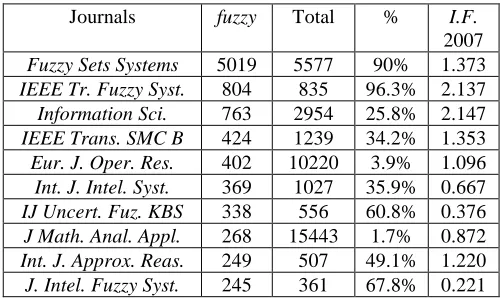
[image:4.595.301.552.84.233.2]In this Section, we present the journals with the highest number of publications with the word fuzzy. For doing so, we give the number of articles published in the journal with the word fuzzy, the total number of articles published in the journal, the percentage of articles with the word fuzzy in the journal and the impact factor for 2007.
Table 2: Journals with the highest number of papers with the word fuzzy in the ISI Web of Knowledge:
Journals fuzzy Total % I.F.
2007 Fuzzy Sets Systems 5019 5577 90% 1.373 IEEE Tr. Fuzzy Syst. 804 835 96.3% 2.137 Information Sci. 763 2954 25.8% 2.147 IEEE Trans. SMC B 424 1239 34.2% 1.353 Eur. J. Oper. Res. 402 10220 3.9% 1.096 Int. J. Intel. Syst. 369 1027 35.9% 0.667 IJ Uncert. Fuz. KBS 338 556 60.8% 0.376 J Math. Anal. Appl. 268 15443 1.7% 0.872 Int. J. Approx. Reas. 249 507 49.1% 1.220 J. Intel. Fuzzy Syst. 245 361 67.8% 0.221 As we can see, Fuzzy Sets and Systems is the journal with highest number of publications with the word “fuzzy” and together with IEEE Transactions on Fuzzy Systems, they are the two journals strictly dedicated to fuzzy research. Note that this can be proved by looking to the percentage of papers published in the journal with the word fuzzy.
However, it is worth noting that in the last years there is a really strong increase in the number of publications with the word “fuzzy” in the world. Therefore, there are a lot of new journals that are becoming more relevant in the research. Specially, we would like to mention the following ones. Note that we include their current situation in the ISI Web of Knowledge. That is, if they have impact factor or if they have been recently included in the Science Citation Index – Expanded (SCI-E).
• Applied Soft Computing (SCI – 1.537). • Artificial Intelligence (SCI – 3.008).
• Computers & Industrial Engineering (SCI – 0.554). • Comp. & Math. with Applications (SCI – 0.720). • Computers & Operations Research (SCI – 1.147). • Cybernetics and Systems (SCI – 0.655).
• Decision Support Systems (SCI – 1.119). • Expert Systems with Applications (SCI – 1.177). • Fuzzy Optimization and Decision Making (SCI-E). • IEEE Trans. Syst. Man Cybern. A (SCI – 0.868). • IEEE Trans. Syst. Man Cybern. C (SCI – 0.864). • Information Fusion (SCI-E).
• Intelligent Automation and Soft Comp. (SCI – 0.268). • Int. J. Computational Intelligence Systems (SCI-E). • Int. J. of Fuzzy Systems (SCI-E).
• Int. J. of General Systems (SCI – 0.551). • Int. J. of Production Economics (SCI – 0.995). • Int. J. of Systems Science (SCI – 0.492). • Iranian J. of Fuzzy Systems (SCI-E).
• J. Mult. Valued Logic and Soft Comp. (SCI – 0.400). • Knowledge-Based Systems (SCI – 0.574).
• Kybernetes (SCI – 0.175). • Kybernetika (SCI – 0.552).
• Mathematical and Computer Modelling (SCI – 0.527). • OMEGA – Int. J. Management Science (SCI – 1.327). • Soft Computing (SCI – 0.607).
related with fuzzy research. In the following, we present some of these journals. A more complete list is found in [4-5]. However, there are still some journals not included in [4-5] such as those ones that are not written in English (this problem is especially relevant for Chinese journals).
• Advances in Fuzzy Mathematics. • Advances in Fuzzy Sets & Systems. • Advances in Modeling A.
• Advances in Modeling D. • BUSEFAL.
• Control & Intelligent Systems
• Foundations of Computing and Decision Sciences • Fuzzy Economic Review.
• Fuzzy Information and Engineering. • Fuzzy Systems & AI Magazine. • Fuzzy Systems & Mathematics. • Intelligent Decision Technologies
• Int. J. Advanced Cybernetics and Intelligent Systems. • Int. J. Advanced Intelligence Paradigms
• Int. J. Applied Artificial Intelligence in Engineering. • Int. J. Applied Decision Sciences.
• Int. J. Applied Management Sciences.
• Int. J. Applied Mathematics and Computer Science. • Int. J. Artificial Intell. and Computational Research. • Int. J. Artificial Intelligence and Soft Computing. • Int. J. Bioinformatics and Soft Computing. • Int. J. Biomedical Soft Computing.
• Int. J. Business Intelligence and Data Mining. • Int. J. Computational Engineering Science. • Int. J. Computational Intelligence.
• Int. J. Computational Intelligence and Applications. • Int. J. Comput. Intell. and Health Care Informatics. • Int. J. Computational Intelligence and Organizations. • Int. J. Computational Intell. and Telecom. Syst.
• Int. J. Comput. Intell. Bioinformatics and Syst. Biology. • Int. J. Computational Intelligence in Control.
• Int. J. Computational Intelligence Research.
• Int. J. Computational Intell. Research & Applications. • Int. J. Computational Intelligence Studies.
• Int. J. Computational Intelligence Systems
• Int. J. Computational Intelligence Theory and Practice • Int. J. Computational Intelligence: Theory and Practice • Int. J. Computational Science
• Int. J. Computer and Inform. Science and Engineering • Int. J. Computer & Information Science
• Int. J. Computer Science
• Int. J. Computer Science and Engineering • Int. J. Fuzzy Logic and Intelligent Systems • Int. J. Fuzzy Systems and Rough Systems
• Int. J. Granular Computing, Rough Sets and Intell. Syst. • Int. J. Hybrid Computational Intelligence.
• Int. J. Hybrid Intelligent Systems. • Int. J. Information Technology.
• Int. J. Intelligent Computing and Cybernetics.
• Int. J. Intell. Syst. Account., Finance and Management. • Int. J. Operational Research.
• Int. J. Soft Computing.
• Int. J. Soft Computing and Bioinformatics. • Int. J. Soft Computing Applications.
• Int. J. on Advances in Fuzzy Systems. • Int. Review of Fuzzy Mathematics.
• J. of Adv. Comp. Intelligence and Intelligent Inform. • J. of Fuzzy Mathematics.
• J. of Japanese Society for Fuzzy Theory and Systems. • J. of Uncertain Systems.
• Mathware and Soft Computing.
• Modeling, Measurement and Control D. • New Mathematics and Natural Computation. • Notes on Intuitionistic Fuzzy Sets.
• WSEAS Transactions on Systems
• WSEAS Transactions on Systems and Control • Etc.
V. ARTICLES DIVIDED BY YEARS
[image:5.595.306.548.314.481.2]In this Section, we briefly present the number of publications with the word fuzzy divided by years. The results are shown in Figure 1.
Figure 1: Number of articles by years
As we can see, in the beginning, the number of articles published was very low. In the eighties, it started to increase but still the number of publications every year was lower than 500. The strong increase started in the nineties arriving in 2000 with more than 2000 publications each year. Since then, the increase still continue, specially because there are more and more young researchers entering this field and there are more journals indexed in the ISI Web of Knowledge. Today, the number of publications is higher than 3000 articles per year. Note also that this number is much higher if we include the ISI Proceedings. And the total number of articles published in the world each year is very difficult to know because not all the journals, conferences, etc., are available in internet but as estimation, it is easy to assume that it is higher than 10000 articles per year and probably more. Note that further research is necessary to get a good approximation about the total number of articles published each year in the world including journals, conferences, books, thesis, etc.
Annual number of articles
0 50 1000 1500 2000 2500 3000 3500
VI. ARTICLES DIVIDED BY COUNTRIES
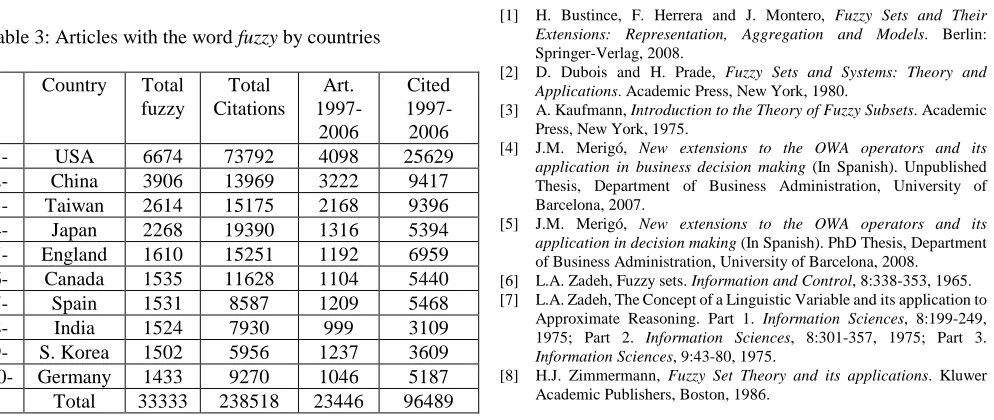
[image:6.595.55.552.125.335.2]In this Section, we present a short ranking of the top 10 countries in fuzzy research according to the ISI Web of Knowledge. We consider the total number of publications, the citations received and the results found in the period 1997-2006.
Table 3: Articles with the word fuzzy by countries Country Total
fuzzy
Total Citations
Art. 1997-
2006
Cited 1997- 2006
1- USA 6674 73792 4098 25629
2- China 3906 13969 3222 9417
3- Taiwan 2614 15175 2168 9396
4- Japan 2268 19390 1316 5394
5- England 1610 15251 1192 6959
6- Canada 1535 11628 1104 5440
7- Spain 1531 8587 1209 5468
8- India 1524 7930 999 3109
9- S. Korea 1502 5956 1237 3609
10- Germany 1433 9270 1046 5187
Total 33333 238518 23446 96489 As we can see, the USA is the most relevant country in the fuzzy community although in the last years, China is getting more relevance. Specially, if we only consider the last 3 years, then, China is already publishing more than the USA in fuzzy research.
VII. CONCLUSION
We have presented a brief overview of fuzzy research in the ISI Web of Knowledge. We have seen that this tool permits to make rankings between a wide range of options. We have focussed on detecting the most cited papers in fuzzy research, the top authors according to the number of publications, the top journals, the evolution by years and the top countries. The results are more or less clear and they are not surprising in the sense that they are in accordance with our intuition. For example, Zadeh’s 1965 seminal paper is the most cited one and at the same time, he is the most cited author. Other key authors also appear in the rankings. However, it is worth noting that the results are only a general orientation but they are not strictly a classification because then, we need to consider a lot of variables that are not included or other forms of establishing this ranking.
We have also presented the top journals and we have mentioned a lot of other journals that publish papers related with some topic of fuzzy research. Thus, we have provided a brief list of the main journals available for fuzzy research. We believe that this is useful because usually, researchers do not know all the authors, journals, etc., available because some of them are very new, etc. Specially, we believe that this information is very useful for young researchers that need to acquire the most efficient information in order to start a good research. Thus, by looking to this information and more detailed one that we believe it is going to be developed in the future, the young researchers will be able to see, very easily, a general state of the art in fuzzy research.
In future research, we expect to improve this analysis by studying more particular cases and extending it to other rankings and to other fields.
REFERENCES
[1] H. Bustince, F. Herrera and J. Montero, Fuzzy Sets and Their Extensions: Representation, Aggregation and Models. Berlin: Springer-Verlag, 2008.
[2] D. Dubois and H. Prade, Fuzzy Sets and Systems: Theory and Applications. Academic Press, New York, 1980.
[3] A. Kaufmann, Introduction to the Theory of Fuzzy Subsets. Academic Press, New York, 1975.
[4] J.M. Merigó, New extensions to the OWA operators and its application in business decision making (In Spanish). Unpublished Thesis, Department of Business Administration, University of Barcelona, 2007.
[5] J.M. Merigó, New extensions to the OWA operators and its application in decision making (In Spanish). PhD Thesis, Department of Business Administration, University of Barcelona, 2008.
[6] L.A. Zadeh, Fuzzy sets. Information and Control, 8:338-353, 1965. [7] L.A. Zadeh, The Concept of a Linguistic Variable and its application to
Approximate Reasoning. Part 1. Information Sciences, 8:199-249, 1975; Part 2. Information Sciences, 8:301-357, 1975; Part 3. Information Sciences, 9:43-80, 1975.