Unsupervised AMR-Dependency Parse Alignment
Wei-Te Chen
Department of Computer Science University of Colorado Boulder [email protected]
Martha Palmer
Department of Linguistics University of Colorado Boulder [email protected]
Abstract
In this paper, we introduce an Abstract Meaning Representation (AMR) to De-pendency Parse aligner. Alignment is a preliminary step for AMR parsing, and our aligner improves current AMR parser performance. Our aligner involves sev-eral different features, including named entity tags and semantic role labels, and uses Expectation-Maximization training. Results show that our aligner reaches an 87.1% F-Score score with the experimen-tal data, and enhances AMR parsing. 1 Introduction
Abstract Meaning Representation (AMR) (Ba-narescu et al., 2013) is a semantic representation that expresses the logical meaning of English sen-tences with rooted, directed, acylic graphs. AMR associates semantic concepts with the nodes on a graph, while the relations are the label edges between concept nodes. Meanwhile, AMR re-lies heavily on predicate-argument relations from PropBank (Palmer et al., 2005), which share several edge labels. The representation also en-codes rich information, like semantic roles (all the “ARGN” tags from PropBank), named enti-ties (NE) (“person”, “location”, etc., concepts), wiki-links (“:wiki” tags), and co-reference (reuse of variables, e.g., p). An example AMR in PEN-MAN format (Matthiessen and Bateman, 1991) is shown in Figure 1.
The design of an AMR to English sentence aligner is the first step for implementation of an AMR parser, since AMR annotation does not contain links between each AMR concept and the original span of words. The basic alignment strategy is to link the AMR tokens (either con-cepts or edge labels) with their corresponding
(j / join-01
:ARG0 (p / person :wiki -:name (p2 / name
:op1 "Pierre" :op2 "Vinken")
:age (t / temporal-quantity :quant 61 :unit (y / year)))
:ARG1 (b / board
:ARG1-of (h / have-org-role-91 :ARG0 p
:ARG2 (d2 / director
:mod (e / executive :polarity -)))) :time (d / date-entity :month 11 :day 29))
Figure 1: The AMR annotation of sentence “Pierre Vinken, 61 years old, will join the board as a nonexecutive director Nov. 29.” in PENMAN for-mat
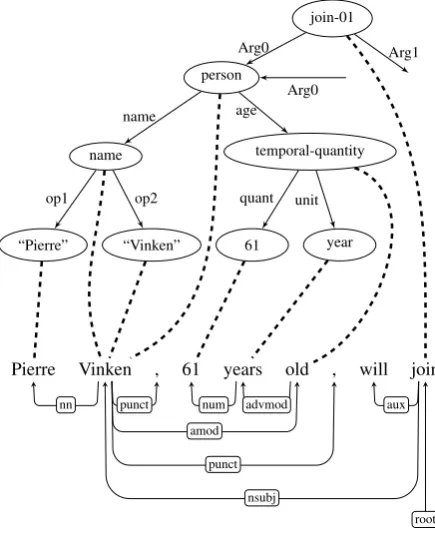
span of words. Another strategy is to find the alignment from an AMR concept to a word node in a dependency parse tree, the goal of this paper. A dependency parse tree is a good structure for attaching more information, e.g. named entity tags, lemma, and semantic role labels, etc., and provides richer syntactic information than the span of words. An alignment between an AMR concept and a dependency node represents a cor-respondence between the meaning of this concept and its child concepts and the phrase governed by the dependency node (i.e., head word). An exam-ple alignment is shown in Figure 2. For examexam-ple, the word node “Vinken” on the dependency parse side in Figure 2 links to the lexical concept of “Vinken” and, furthermore, links to the “p2/name” and the “p/person” concepts since “Vinken” is the head of the named entity “Pierre Vinken” and the head of the whole noun phrase “Pierre Vinken, 61 years old.”. In our work, we use Expectation-Maximization(EM) (Dempster et al., 1977) to train different feature probabilities, including rule-based features, lexical forms, relation labels, named entity tags, semantic role
Pierre Vinken , 61 years old , will join nn punct
amod
advmod num
punct
nsubj
aux
root
“Pierre” “Vinken” 61 year
name temporal-quantity
person
join-01
op1 op2 quant unit
name age
Arg0 Arg1
[image:2.595.75.293.63.330.2]Arg0
Figure 2: The alignment between a subgraph of an AMR (top) and a dependency parse (bottom) for the “Pierre Vinken” sentence. Dashed lines link dependency parse nodes and corresponding con-cepts.
labels, and global features, etc. Then EM process-ing incorporates all the individual probabilities and estimates the final alignments.
We will describe AMR-English sentence align-ment in general, and review related work, in Section 2. Then the descriptions of our AMR-dependency parse features and alignment model are in Section 3. Our beam-search docoder is de-scribed in Section 4. Our experimental results are presented in Section 5, followed by our conclusion and discussion of future work (Section 6).
2 AMR-English Sentence Aligner
A preliminary step for an AMR parser is aligning AMR concepts and the original spans of words. JAMR (Flanigan et al., 2014) includes a heuris-tic alignment algorithm between AMR concepts and words or phrases from the original sentence. They use a set of alignment rules, like named en-tity, fuzzy named enen-tity, data enen-tity, etc., with a greedy strategy to match the alignments. This aligner achieves a 90%F1 score on hand aligned
AMR-sentence pairs. On the other hand, the ISI Aligner (Pourdamghani et al., 2014) presents a
generative model to align AMR graphs to sen-tence strings. They propose a string-to-string alignment model which transfers the AMR ex-pression to a linearized string representation as the initial step. Their training method is based on the IBM word alignment model (Brown et al., 1993) but they modify the objective function of the alignment model. IBM Model-4 with a symmetric method reaches the highest F1 score,
83.1%. When separating the alignments into roles (edge labels) and non-roles (concepts), F1 scores
are 49.3% and 89.8%, respectively. In Werling’s AMR parser (Werling et al., 2015), they con-ceive of the alignment task as a linear program-ming relaxation of a boolean problem. The ob-jective function is to maximize the sum of ac-tion reliability. Each concept is constrained to align to exactly one token in a sentence. This ensures that only adjacent nodes or nodes that share the same title refer to the same token. They hand-annotate 100 AMR parses, and their aligner achieves an accuracy of 83.2%. By providing al-ternative alignments to their graph-based AMR parser, their aligner achieves a better Smatch score than JAMR’s aligner.
However, two transition-based parsers which parse dependency parse tree structures into AMRs, e.g., the CAMR system (Wang et al., 2015; Wang et al., 2016) and the RIGA system (Barzdins and Gosko, 2016), tie for the best results in SemEval-2016 task 8 (May, SemEval-2016). It is important to note that the JAMR aligner was not designed to align between a dependency word node and an AMR concept where its alignmentF1score is only
69.8% (see Section 5.2). In order to deal with this problem, (Chen, 2015) proposed a preliminary aligner which estimates alignments by learning the feature probabilities of lexical (surface) forms, re-lations, named entities and semantic roles jointly. Besides the objective to obtain alignment between AMR concepts and original word spans, the esti-mation of these feature probabilities is also useful for further development of the AMR parser with these initial models. In our paper, we extend their previous work by adding rule-based and global features, and adding a beam-search algorithm at decoding time.
Concepts C = hc1, c2, . . . , c|C|i, and the
corre-sponding dependency parse as a list of dependency word nodes D = hd1, d2, . . . , d|D|i. An
align-ment functionais designed to produce exactly one alignment to a dependency nodedcj for each
con-cept cj, within a single sentence. Alternatively, we can viewaas a mapping function that accepts one input variable concept cj and outputs a de-pendency node dcj with which cj is aligned. A
is the alignment set that contains all different al that cover possible alignments within C and D. Our model adopts an asymmetric alignment direc-tion, where one concept maps to exactly one de-pendency parse node, and each dede-pendency parse node can be aligned by zero to multiple concepts. We denote dependency nodedclinked by concept
casdc=a(c).cpis the parent concept of concept
c, whilecs1, cs2, ..., cskare thekchild concepts of
conceptc.
3.1 Features
3.1.1 Basic Features
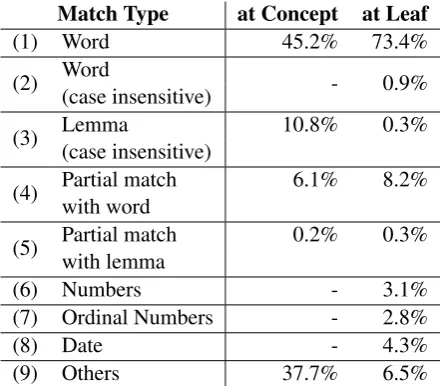
Several of the AMR concepts use the word form directly. For example, the concept “join-01” in Figure 1 would align to the dependency node “join” naturally. Similarly, the leaf concepts usu-ally align to identical terms in the dependency parse. In Figure 1, the names “Pierre” and ”Vinken” are aligned to their word forms on the dependency parse leaves. Therefore, we design a straightforward rule-based probability, Prule, which catches the appearance of the surface form.
Prule(c, dc) is defined as the probability that the matching type for a given concept c and depen-dency node dc are linked. The different types of rules, e.g., word, lemma, numbers, and date, etc., and their proportional applicability to both AMR concepts and leaves are listed in Table 1. For ex-ample, the rule “Date” type aligns concept “11” with word node “November” in Figure 1, while “Numbers” aligns concept “5” with word node “five”. Prule decides which match type to apply by following a greedy matching strategy.
3.1.2 External Features
To capture alignments for concepts which do not match any of the above basic rules, we design the following four external feature probabilities:
PLemma(c, dc) =P(c|Word(dc))
Lemma Probabilityrepresents the likelihood that a concept caligns to a dependency worddi. For
Match Type at Concept at Leaf
(1) Word 45.2% 73.4%
(2) Word(case insensitive) - 0.9%
(3) Lemma(case insensitive) 10.8% 0.3%
(4) Partial matchwith word 6.1% 8.2%
(5) Partial matchwith lemma 0.2% 0.3%
(6) Numbers - 3.1%
(7) Ordinal Numbers - 2.8%
(8) Date - 4.3%
[image:3.595.307.528.62.255.2](9) Others 37.7% 6.5%
Table 1: The rules and distribution of basic match types
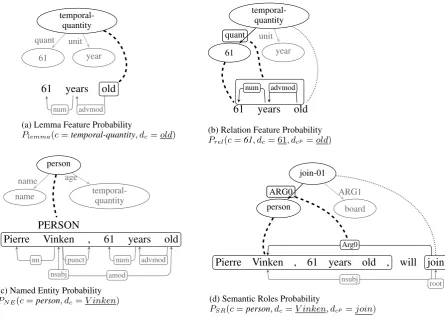
example, in Figure 3a, the conceptc=“ temporal-quantity” is highly likely to align to the word node
dc = “old” since “old” is usually the head word of a phrase expressing age (“61 years old” here). Also,have-org-role-91can align to the word node “director” since “director” appears quite often with have-org-role-91 (defined as roles in orga-nizations). Besides, some special leaf concepts, like “:polarity -” (negative), and “:mode expres-sive” (which is used to mark exclamational word), also rely on this feature rather than the basic rules.
Prel(c, dc, dcp) =P(AMRLabel(c)|Path(dc, dcp))
Relation Probabilityis the conditional probabil-ity of the AMR relation label ofc, given the parse tree path between dc and dcp, where dc and dcp
represent the dependency nodes that are aligned by c and cp, respectively. Parse tree path is the concatenation of all dependency tree and direc-tion labels through the tree path between dc and
dcp. For example, the relation probability ofc = 61, dc = 61, and dcp = old in Figure 3b is P(quant|advmod↓num↓). A parse tree path is a useful feature for extracting relations between any two tree nodes, e.g., Semantic Role Labeling (SRL) (Gildea and Jurafsky, 2002) and relation ex-traction (Bunescu and Mooney, 2005; Kambhatla, 2004; Xu et al., 2015), so we add relation proba-bility to our model.
PNE(c, dc) =P(c|NamedEntity(dc))
ORGANIZA-61 years old advmod num
temporal-quantity
61 year
quant unit
(a) Lemma Feature Probability
Plemma(c=temporal-quantity, dc=old)
61 years old advmod num
temporal-quantity
61 year
quant unit
(b) Relation Feature Probability
Prel(c=61, dc= 61, dcp=old)
Pierre Vinken , 61 years old
nn punct
amod
advmod num
nsubj PERSON
person
name temporal-quantity
name age
(c) Named Entity Probability
PNE(c=person, dc=V inken)
Pierre Vinken , 61 years old , will join nsubj
Arg0
root
join-01
person board
ARG0 ARG1
(d) Semantic Roles Probability
[image:4.595.93.539.60.379.2]PSR(c=person, dc=V inken, dcp=join)
Figure 3: The sample of feature probabilities that are used in our aligner. Dashed lines link AMR concepts (top) and corresponding dependency parse nodes (bottom), while dense dashed lines link the parent AMR concepts and its corresponding dependency parse nodes.
TION, etc.). NamedEntity(d) indicates the named entity type of the phrase withdas the head word. For example, after named entity recogni-tion (NER) tagging, the label assigned to “PER-SON” is the dependency parse tree node “Vinken”. So the named entity probability of PNE(c =
person, dc = V inken) in Figure 3c is P(person |PERSON). Since AMR contains a large amount of named entity information, we assume that a fea-ture based on an external named entity module should improve the alignment accuracy.
PSR(c, dc, dcp)
=P(AMRLabel(c)|SemanticRole(dcp, dc))
Semantic Role Probability is the conditional probability of the AMR relation label ofc, given the semantic role dc if dcp is a predicate and dc
isdcp’s argument. If a predicate-argument
struc-ture does not exist between dcp and dc, the
se-mantic role probability is omitted. For exam-ple, in Figure 3d, the semantic role probability of
PSR(c = person, dc = V inken, dcp = join)is
equal to P(ARG0|Arg0). Since AMR depends heavily on predicate-argument relations, external
predicate-argument information from an external SRL system should enhance the overall alignment accuracy.
The above four feature probabilities are learned by the EM algorithm (Section 3.2).
3.1.3 Global Feature
The above basic and external features capture lo-cal alignment information. However, to make sure that a concept is aligned to the correct phrase head word which represents the same sub-meaning, we need a global feature to calculate coverage. The design of our concept coverage feature is as fol-lows:
61 years old advmod num
temporal-quantity
61 year
[image:5.595.119.244.63.178.2]quant unit
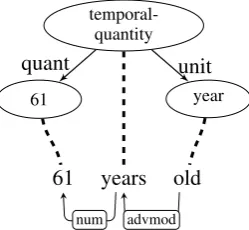
Figure 4: A sample of incorrect alignment. We use this sample to calculate its overlapping ratio (Rcc) letc=temporal-quantity
W(c) ={61, year}
Wchild(c) ={61} ∪ {61, year, old}
={61, year, old}
Wchild(c)∩W(c) ={61, year}
pen(c) =exp(−|{old}|) = 0.37 Rcc(c) = (22)×pen(c) = 0.37
RCC(c) = |Wchild|W(c)(c)∩|W(c)|×pen(c)
W(c) =dc
Wchild(c) =
[
csi∈child(c) dcsi
pen(c) =exp(−|Wchild(c)\(Wchild(c)∩W(c))|)
[image:5.595.77.281.271.480.2]where W refers to the set of words that the aligned dependency word node contains. The first term of RCC ensures the child concepts contain the largest possible subspans of the parent con-cept span. The non-covered penalty term (pen) is to prevent a child concept from aligning to a word node that contains a larger word span than the child’s parent concept. Thepenterm will in-crease exponentially if child concepts align to a larger word span. The back slash term “\” refers to set subtraction. We take Figure 4 as an example of an incorrect alignment example where the concept “temporal-quantity” aligns to “year” and the con-cept “year” aligns to “old”, the overlapping ratio of this alignment is 0.37 since it suffers a penalty. As we compare it with the correct alignment in Figure 3b, the overlapping ratio of this alignment is 0.67, which is much higher than the incorrect one.
3.2 Training with EM Algorithm
The objective function of our AMR-to-Dependency Parse aligner is listed as follows: Since our long term goal is to design a de-pendency parse to AMR parser, we define the objective function Lθ as the probability that dependency parses transfer to AMR graphs for the AMR-to-Dependency Parse aligner:
θ= argmaxLθ(AMR|DEP) (1)
Lθ(AMR|DEP) =
Y
(C,D,A)
∈S
P(C|D)
= Y
(C,D,A)
∈S X
a∈A
P(C, a|D) (2)
P(C, a|D) =
|C| Y
j=1
P(cj|dcj =a(cj), dcpj =a(cpj))
(3) whereθ= (Plemma, Prel, PNE, PSR)is the set of feature probabilities (parameters) we want to es-timate, alignment set A is the latent variable we want to observe, andSis the training sample that contains a set of tuples (C, D, A), where C and
D are a hAMR,dependency parsei pair and A is their alignment combination set. In equation (3), the probability that dependency treeD translates to AMR C with an alignment combination a is equal to the product of all probabilities that con-ceptcj inCaligns to dependency nodedcjandcpj aligns to dependency nodedcp
j.
3.2.1 Expectation-Step
The E-Step estimates all the different alignment probabilities of an input AMR and dependency parse pair by giving the product of feature prob-abilities. The alignment probability can be calcu-lated using:
P(a|C, D) =
|C| Y
j=1
P(cj|dcj, dcpj)
P|D|
l=1
P|D|
i=1P(cj|di, dl) (4)
P(cj|di, dl) =Prule(cj, di)×Plemma(cj, di)
×Prel(cj, di, dl)×PNE(cj, di)×PSR(cj, di, dl) (5)
Pruleis obtained by a simple calculation from the development set, while Plemma, Prel, PNE, and
PSRare initialized uniformly before the first round of E-step. And these feature probabilities will be updated during the M-step.
3.2.2 Maximization-Step
In the M-Step, feature probabilities are re-estimated by collecting the count of all AMR-dependency parse pairs. The count of lemma (cntlemma), relation (cntrel), named entity (cntNE), and semantic role (cntSR) features are the normalized counts that are collected from the accumulating probability of all pos-sible alignments from the E-step. Here we take the derivation of cntlemma as an example.
cntrel, cntNE,andcntSR can be obtained with similar equations:
cntlemma(c|W ord(dc);C, D) =
X
a∈A
P(c|dc, dcp)
P|D|
i=0P|lD=0|P(c|di, dl)
After we collect all counts for differ-ent features, the four feature probabilities,
Plemma, Prel, PNE,andPSR, are updated with their feature counts. Here we show the update of Plemma as an example. The rest of feature probability updates can be derived in the same way:
Plemma(c, d)
← X
C∈AMR, D∈DEP
cntlemma(c|W ord(d);C, D)
P|C|
j=1cntlemma(cj|W ord(d);C, D)
After this, we apply the newer feature probabilities to recalculate alignment probabilities in the E-step again. EM iterates the E and M-steps until conver-gence or certain criteria are met.
4 Decoding
At decoding time, we want to find the most likely alignment a for the given hC, Di. By applying Equations (4) and (5), we define the search for alignments as follows:
argmax
a P(a|C, D) = argmaxa
|C| Y
j=1
RCC(cj)
∗P(cj|di =a(cj), dl=a(cpj)) This decoding problem finds the alignmentathat maximizes the likelihood, which we define in
Sent. Token # of
NE
# of Arg.
Gold
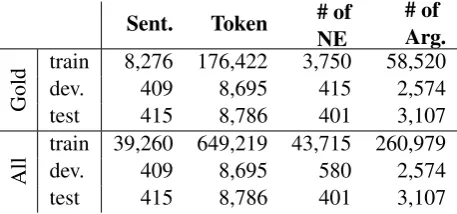
train 8,276 176,422 3,750 58,520
dev. 409 8,695 415 2,574
test 415 8,786 401 3,107
All
train 39,260 649,219 43,715 260,979
dev. 409 8,695 580 2,574
[image:6.595.308.537.62.169.2]test 415 8,786 401 3,107
Table 2: The data split of the LDC DEFT AMR corpus. Goldrefers to the sentences also appear-ing in OntoNotes 5.0 with gold annotations, while
All refers to all sentences in DEFT AMR corpus with dependency parses, named entities, and se-mantic roles generated by ClearNLP. Number of tokens, named entities, and arguments(Arg.) in each data set are also presented
Equation (5). The overlapping ratio(RCC) is in-troduced to the likelihood function to ensure that a parent concept covers a wider word span range than its child concepts. A beam search algorithm is designed to extract the target alignment without exhaustively searching all of the candidate align-ments (which has a complexity of O(|D||C|).)
The beam search starts from leaf concepts and then walks through parent concepts after their child concepts have been traversed. When we go through concept cj, we need to consider all the following likelihoods: 1) the accumulated likeli-hood for aligning to any dependency word node
dcj from all the child concepts of cj, and 2) the
product of Plemma, PNE, Prel, PSR, and RCC for cj. Instead of using during training,RCC is only applied during decoding time. The probabili-ties are obtained simply from the product of all the above likelihoods. We keep the top-|b|alignment probabilities and their aligned dependency node
dcj for each cj until we reach the root concept,
where |b|is the beam size. Finally we can trace back and find the most likely alignment.
The running time for the beam search algorithm isO(|b| ∗ |C| ∗ |D|2).
5 Experiments and Results 5.1 Experimental Data
The LDC DEFT Phase 2 AMR Annotation Re-lease 2.01consists of AMRs with English sentence 1LDC DEFT Phase 2 AMR Annotation Release 2.0,
pairs. Annotated selections from various gen-res (including newswire, discussion forum, other web logs, and television transcripts) are avail-able, for a total of 39,260 sentences. This release uses the PropBank Unification frame files (Bo-nial et al., 2014; Bo(Bo-nial et al., 2016). To gen-erate automatic dependency parses for all DEFT AMR Release data, we use ClearNLP (Choi and Mccallum, 2013) to produce dependency parses. ClearNLP also labels semantic roles and named entity tags automatically on the generated de-pendency parses. This data set is named “All”. To compare the effect of applying automatic de-pendency parses to our aligner with gold depen-dency parses, we select the sentences which ap-pear in the OntoNotes 5.02 release as well. The OntoNotes data contains TreeBanking, PropBank-ing, and Named Entity annotations. OntoNotes 5.0 also uses PropBank Unification frame files for PropBanking. This data set, containing a to-tal of 8,276 of selected AMRs and their depen-dency parses from OntoNotes, is named “Gold”. To generate the development and test set, we man-ually align the AMR concepts and dependency word nodes. Since the manual alignment is time-consuming, “Gold” and “All” data share the same development/test set. Table 2 presents the statis-tics for the experimental data.3
5.2 Experiment Results
We run EM for 50 iterations and ensure the EM model converges. Afterwards, we use our decod-ing algorithm to find the alignments that maximize the likelihood. The test set data is used to evaluate performance.
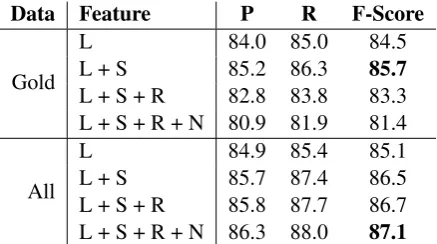
We first evaluate the performance of our system with the external features added incrementally. Ta-ble 3 indicates the results. By running with the “Gold”‘ data, the only feature that improves sig-nificantly over the baseline (rule-based and lexi-con features only) is the semantic role feature. The named entity feature actually hurts performance. On the other hand, all the features contribute to the F-Score incrementally for “All”. Again, the se-mantic role feature still has the most positive pact against other features, and a significant im-provement over the baseline.
As we compare the F1 score on training with
2LDC OntoNotes Release 5.0, Release date: October
16th, 2013 https://catalog.ldc.upenn.edu/LDC2013T19
3The manually aligned data and our aligner will be
avail-able after this paper gets accepted
Data Feature P R F-Score
Gold
L 84.0 85.0 84.5
L + S 85.2 86.3 85.7
L + S + R 82.8 83.8 83.3 L + S + R + N 80.9 81.9 81.4
All
L 84.9 85.4 85.1
L + S 85.7 87.4 86.5
[image:7.595.308.527.62.184.2]L + S + R 85.8 87.7 86.7 L + S + R + N 86.3 88.0 87.1
Table 3: Incremental Feature Contributions for different features:L: lemma;R: relation;N: NE;
S: semantic role.
“All” and “Gold” data set, training with “All” out-performs training with “Gold” data in all differ-ent feature combinations. We believe there are two reasons for this. First, the “All” data contains richer information than the “Gold” data. “All” has double the sentence size of “Gold”, and propor-tionally more named entity labels. Second, the automatic dependency parses do not hurt the per-formance of our aligner very much. We believe that our unsupervised alignment model works bet-ter with more data, even without access to gold standard dependency parses.
We then compare our aligner with three other aligners: JAMR, another version of unsupervised alignment (Chen, 2015), and ISI. To make them fit our test data, we design a heuristic method to force every unaligned concept (e.g., named entity and “‘:polarity -”’ concepts) to align to a dependency word node according to rule-based and global fea-tures (see Section 3.1). The alignment is counted as a correct match when the concept aligns to ei-ther the head word or the partial word span of a phrase. The alignments from concept relation to word span (apply in ISI) are discarded in our task. The results of the experiment are shown in Table 4. Our aligner achieves the bestF1score in both the
“All” and “Gold” data sets, as it should, since it is designed to align AMRs to dependency parses, as was the Chen aligner. Our aligner performs better than the Chen aligner by around 28% inF1 score.
We can conclude that the addition of rule-based feature, global features, and beam-search in de-coding time helps the alignment task substantially.
5.3 Apply to AMR Parsing
Data Aligner P R F-Score
Gold
Chen 2015 61.1 53.4 57.0
JAMR 78.5 62.8 69.8
ISI 78.6 71.4 74.9
Ours 85.2 86.3 85.7
All
Chen 2015 62.4 55.5 58.7
JAMR 80.2 65.9 72.4
ISI 80.4 74.9 77.6
[image:8.595.79.287.62.186.2]Ours 86.3 88.0 87.1
Table 4: Results of different alignment models
the CAMR parser with different alignments pro-duced by JAMR, ISI, and our aligner. To make the alignments fit the CAMR parser, we convert both ISI and our alignments to the original JAMR alignment format, word span to AMR concept. We get rid of the “:wiki” tag, which links the named entity to its Wikipedia page, to simplify the pars-ing task since we think the Wikify task (Mihalcea and Csomai, 2007) is basically different from the AMR parsing task. Smatch v2.0.2 is used to eval-uate AMR parsing performance (Cai and Knight, 2012). The evaluation script is obtained from the SemEval 2016 Task 8 website4.
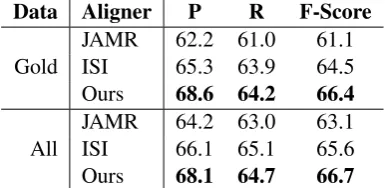
A comparison of parsing results is given in Ta-ble 5. We first train the parser with “Gold” Stan-dard dependency parses and alignments from the different aligners. Results show that our aligner improves by a 2% F1 score over the two other
aligners. Then we train the AMR Parser system with the “All” data set. The dependency parses at-tached with semantic roles and named entities gen-erated by ClearNLP are also provided to CAMR as training data. CAMR use dependency parsing results from Stanford dependency parser (Klein and Manning, 2003) by default. Our aligner still achieves slightly better performance than the other two. Modifying the AMR parser to take advantage of parse node-concept alignments could poten-tially result in greater improvement, since CAMR takes the input alignments as word span to AMR concept.
5.4 Error Analysis
To further understand the advantages and the dis-advantages of our model, we go through all incor-rect alignments and manually categorize 40% of them into different error types, with their propor-4
http://alt.qcri.org/semeval2016/task8/index.php?id=data-and-tools
Data Aligner P R F-Score
Gold JAMRISI 62.2 61.065.3 63.9 61.164.5
Ours 68.6 64.2 66.4
All JAMRISI 64.2 63.066.1 65.1 63.165.6
Ours 68.1 64.7 66.7
Table 5: Comparison of using different alignments with CAMR Parser.
tion:
Automatic Parsing Errors- 3.8%: ClearNLP has a 92.96% unlabeled attachment score on the Penn English Treebank evaluation set (Marcus et al., 1993), Section 23, for dependency parsing. There-fore, when training our aligner on the “All” data set with dependency parses, named entities, and semantic roles generated by ClearNLP, incorrect parses occasionally show up. Since NE and se-mantic roles are attached to dependency parses, incorrect dependency parses cause additional NE and semantic roles alignment errors, on top of the dependency parse alignment errors.
Long Distance Dependencies- 14.2%: Long sen-tences with long distance dependencies always bring difficulty to NLP parsing tasks. Experimen-tal results show that our model runs into troubles when nearby concepts align to dependency nodes which are far from each other. Co-reference is an example that is highly likely to align to long dis-tance dependencies, and our model can not deal with it well.
Duplicate Words - 17.4%: When two identical concepts align to different word nodes, our model is confused by duplicate words. In Figure 5, there are two “first”s in the sentence. One refers to “first 6 rounds”, and the other refers to “first po-sition”. However, our model faultily aligns both
ordinal-entity concepts to the same “first” word node. Our model did not distinguish these two ordinal-entities since the lexicon and named entity tags of the two “first”s are identical.
[image:8.595.320.513.63.157.2](a / and
:op1 (o / occupy-01 :ARG0 (p3 / person
:name (n / name
:op1 "Mingxia" :op2 "Fu")) :ARG1 (p4 / position
:ord (o3 / ordinal-entity :value 1)) :op2 (o2 / occupy-01
:ARG0 (p / person :name (n2 / name
:op1 "Bin" :op2 "Chi")) :ARG1 (p2 / position
:ord (o4 / ordinal-entity :value 3)) :mod (r / respective)
:time (r3 / round-05 :quant 6 :ARG1 (c / compete-01)
:ord (o5 / ordinal-entity :value 1)))
Figure 5: The AMR annotation of sentence “In the first 6 rounds of competition, Mingxia Fu and Bin Chi are occupying the first and third positions respectively”
E-M calculation. That causes our model to tend to align a concept with its word form instead of its head word. For example, English light verb con-structions (LVCs), e.g.,take a bath, are thought to consist of a semantically general verb and a noun that denotes an event or state. AMR representation always drops light verb and uses eventive noun as concept. Our model sometimes aligns this even-tive noun concept to its nominal word node, which is incorrect since the light verb on dependency parse covers the same sub-meaning and should be aligned.
6 Conclusion and Future Work
In this paper, we present an AMR-Dependency Parse aligner, which estimates the feature proba-bilities by running the EM algorithm. It can be used directly by AMR parser. Results show that our aligner performs better than other aligners, and improves AMR parser performance. The latent probabilities that we obtain during training, i.e., all the external feature sets, could also potentially benefit a parser. We plan to develop our own AMR parser, which will apply these external feature sets as the basic model. We also plan to continue to perfect our aligner via tuning the feature weights and learning techniques, and adding new features, like word embeddings and WordNet features.
Acknowledgments
We gratefully acknowledge the support of the Na-tional Science Foundation Grants 0910992 IIS:RI: Richer Representations for Machine Translation, and NSF IIA-0530118 PIRE (a subcontract from Johns Hopkins) for the 2014 Frederick Jelinek Memorial Workshop for Meaning Representations in Language and Speech Processing, and funding under 2016 Summer Graduate School Fellowship of University of Colorado at Boulder. Any opin-ions, findings, and conclusions or recommenda-tions expressed in this material are those of the authors and do not necessarily reflect the views of the National Science Foundation.
References
Laura Banarescu, Claire Bonial, Shu Cai, Madalina Georgescu, Kira Griffitt, Ulf Hermjakob, Kevin Knight, Philipp Koehn, Martha Palmer, and Nathan Schneider. 2013. Abstract meaning representation for sembanking.
Guntis Barzdins and Didzis Gosko. 2016. RIGA at semeval-2016 task 8: Impact of smatch extensions and character-level neural translation on AMR pars-ing accuracy. CoRR, abs/1604.01278.
Claire Bonial, Julia Bonn, Kathryn Conger, Jena D. Hwang, and Martha Palmer. 2014. Propbank: Se-mantics of new predicate types. In Nicoletta Cal-zolari (Conference Chair), Khalid Choukri, Thierry Declerck, Hrafn Loftsson, Bente Maegaard, Joseph Mariani, Asuncion Moreno, Jan Odijk, and Stelios Piperidis, editors,Proceedings of the Ninth Interna-tional Conference on Language Resources and Eval-uation (LREC’14), Reykjavik, Iceland, may. Euro-pean Language Resources Association (ELRA).
Claire Bonial, Kathryn Conger, Jena D. Hwang, Aous Mansouri, Yahya Aseri, Julia Bonn, Timothy OGor-man, and Martha Palmer. 2016. Current directions in english and arabic propbank. In Nancy Ide and James Pustejovsky, editors, The Handbook of Lin-guistic Annotation. Springer, Berlin.
Peter F. Brown, Vincent J. Della Pietra, Stephen A. Della Pietra, and Robert L. Mercer. 1993. The mathematics of statistical machine translation: Pa-rameter estimation. Comput. Linguist., 19(2):263– 311, June.
Shu Cai and Kevin Knight. 2012. Smatch: an evalu-ation metric for semantic feature structures. submit-ted.
Wei-Te Chen. 2015. Learning to map dependency parses to abstract meaning representations. In Pro-ceedings of the ACL-IJCNLP 2015 Student Research Workshop, pages 41–46, Beijing, China, July. Asso-ciation for Computational Linguistics.
Jinho D. Choi and Andrew Mccallum. 2013. Transition-based dependency parsing with selec-tional branching. InIn Proceedings of the 51st An-nual Meeting of the Association for Computational Linguistics.
A. P. Dempster, N. M. Laird, and D. B. Rubin. 1977. Maximum likelihood from incomplete data via the em algorithm. JOURNAL OF THE ROYAL STATIS-TICAL SOCIETY, SERIES B, 39(1):1–38.
J. Flanigan, S. Thomson, J. Carbonell, C. Dyer, and N. A. Smith. 2014. A discriminative graph-based parser for the abstract meaning representation. In
Proc. of ACL, Baltimore, Maryland, June. Associa-tion for ComputaAssocia-tional Linguistics.
Daniel Gildea and Daniel Jurafsky. 2002. Auto-matic labeling of semantic roles. Comput. Linguist., 28(3):245–288, September.
Nanda Kambhatla. 2004. Combining lexical, syntac-tic, and semantic features with maximum entropy models for extracting relations. InProceedings of the ACL 2004 on Interactive Poster and Demon-stration Sessions, ACLdemo ’04, Stroudsburg, PA, USA. Association for Computational Linguistics. Dan Klein and Christopher D. Manning. 2003.
Ac-curate unlexicalized parsing. InProceedings of the 41st Annual Meeting on Association for Computa-tional Linguistics - Volume 1, ACL ’03, pages 423– 430, Stroudsburg, PA, USA. Association for Com-putational Linguistics.
Mitchell P. Marcus, Mary Ann Marcinkiewicz, and Beatrice Santorini. 1993. Building a large anno-tated corpus of english: The penn treebank. Com-put. Linguist., 19(2):313–330, June.
C. Matthiessen and J.A. Bateman. 1991. Text gen-eration and systemic-functional linguistics: experi-ences from English and Japanese. Communication in artificial intelligence. Pinter.
Jonathan May. 2016. Semeval-2016 task 8: Mean-ing representation parsMean-ing. In Proceedings of the 10th International Workshop on Semantic Evalua-tion (SemEval-2016), pages 1063–1073, San Diego, California, June. Association for Computational Linguistics.
Rada Mihalcea and Andras Csomai. 2007. Wikify!: Linking documents to encyclopedic knowledge. In
Proceedings of the Sixteenth ACM Conference on
Conference on Information and Knowledge Man-agement, CIKM ’07, pages 233–242, New York, NY, USA. ACM.
Martha Palmer, Dan Guildea, and Paul Kingsbury. 2005. The Proposition Bank: An annotated cor-pus of semantic roles. Computational Linguistics, 31(1):71–105, March.
Nima Pourdamghani, Yang Gao, Ulf Hermjakob, and Kevin Knight. 2014. Aligning english strings with abstract meaning representation graphs. In Proceed-ings of the 2014 Conference on Empirical Methods in Natural Language Processing (EMNLP), pages 425–429. Association for Computational Linguis-tics.
Chuan Wang, Xue Nianwen, and Pradhan Sameer. 2015. A transition-based algorithm for amr parsing. InProceedings of the 2015 Conference of the North American Chapter of the Association for Computa-tional Linguistics: Human Language Technologies. Association for Computational Linguistics.
Chuan Wang, Nianwen Xue, Sameer Pradhan Prad-han, Xiaoman Pan, and Heng Ji. 2016. Camr at semeval-2016 task 8: An extended transition-based amr parser. InProceedings of the 10th International Workshop on Semantic Evaluation (SemEval 2016). Association for Computational Linguistics, June. Keenon Werling, Gabor Angeli, and Christopher D.
Manning. 2015. Robust subgraph generation improves abstract meaning representation parsing.
CoRR, abs/1506.03139.