Using Bilingual Knowledge and Ensemble Techniques for Unsupervised
Chinese Sentiment Analysis
Xiaojun Wan
Institute of Compute Science and Technology Peking University
Beijing 100871, China [email protected]
Abstract
It is a challenging task to identify sentiment polarity of Chinese reviews because the re-sources for Chinese sentiment analysis are limited. Instead of leveraging only monolin-gual Chinese knowledge, this study proposes a novel approach to leverage reliable English resources to improve Chinese sentiment analysis. Rather than simply projecting Eng-lish resources onto Chinese resources, our ap-proach first translates Chinese reviews into English reviews by machine translation ser-vices, and then identifies the sentiment polar-ity of English reviews by directly leveraging English resources. Furthermore, our approach performs sentiment analysis for both Chinese reviews and English reviews, and then uses ensemble methods to combine the individual analysis results. Experimental results on a dataset of 886 Chinese product reviews dem-onstrate the effectiveness of the proposed ap-proach. The individual analysis of the translated English reviews outperforms the in-dividual analysis of the original Chinese re-views, and the combination of the individual analysis results further improves the perform-ance.
1
Introduction
In recent years, sentiment analysis (including sub-jective/objective analysis, polarity identification, opinion extraction, etc.) has drawn much attention in the NLP field. In this study, the objective of sen-timent analysis is to annotate a given text for polar-ity orientation (positive/negative). Polarpolar-ity orientation identification has many useful applica-tions, including opinion summarization (Ku et al., 2006) and sentiment retrieval (Eguchi and Lavrenko, 2006).
To date, most of the research focuses on English and a variety of reliable English resources for sen-timent analysis are available, including polarity lexicon, contextual valence shifters, etc. However, the resources for other languages are limited. In particular, few reliable resources are available for Chinese sentiment analysis1 and it is not a trivial
task to manually label reliable Chinese sentiment resources.
Instead of using only the limited Chinese knowl-edge, this study aims to improve Chinese sentiment analysis by making full use of bilingual knowledge in an unsupervised way, including both Chinese resources and English resources. Generally speak-ing, there are two unsupervised scenarios for “bor-rowing” English resources for sentiment analysis in other languages: one is to generate resources in a new language by leveraging on the resources available in English via cross-lingual projections, and then perform sentiment analysis in the English language based on the generated resources, which has been investigated by Mihalcea et al. (2007); the other is to translate the texts in a new language into English texts, and then perform sentiment analysis in the English language, which has not yet been investigated.
In this study, we first translate Chinese reviews into English reviews by using machine translation services, and then identify the sentiment polarity of English reviews by directly leveraging English resources. Furthermore, ensemble methods are employed to combine the individual analysis re-sults in each language (i.e. Chinese and English) in order to obtain improved results. Given machine translation services between the selected target language and English, the proposed approach can be applied to any other languages as well.
Experiments have been performed on a dataset of 886 Chinese product reviews. Two commercial
machine translation services (i.e. Google Translate and Yahoo Babel Fish) and a baseline dictionary-based system are used for translating Chinese re-views into English rere-views. Experimental results show that the analysis of English reviews trans-lated by the commercial translation services out-performs the analysis of original Chinese reviews. Moreover, the analysis performance can be further improved by combining the individual analysis results in different languages. The results also demonstrate that our proposed approach is more effective than the approach that leverages gener-ated Chinese resources.
The rest of this paper is organized as follows: Section 2 introduces related work. The proposed approach is described in detail in Section 3. Sec-tion 4 shows the experimental results. Lastly we conclude this paper in Section 5.
2
Related Work
Polarity identification can be performed on word level, sentence level or document level. Related work for word-level polarity identification includes (Hatzivassiloglou and McKeown, 1997; Kim and Hovy. 2004; Takamura et al., 2005; Yao et al. 2006; Kaji and Kitsuregawa, 2007), and related work for sentence-level polarity identification in-cludes (Yu and Hatzivassiloglou, 2003; Kim and Hovy. 2004) Word-level or sentence-level senti-ment analysis is not the focus of this paper.
Generally speaking, document-level polarity identification methods can be categorized into un-supervised and un-supervised.
Unsupervised methods involve deriving a senti-ment metric for text without training corpus. Tur-ney (2002) predicates the sentiment orientation of a review by the average semantic orientation of the phrases in the review that contain adjectives or adverbs, which is denoted as the semantic oriented method. Kim and Hovy (2004) build three models to assign a sentiment category to a given sentence by combining the individual sentiments of senti-ment-bearing words. Hiroshi et al. (2004) use the technique of deep language analysis for machine translation to extract sentiment units in text docu-ments. Kennedy and Inkpen (2006) determine the sentiment of a customer review by counting posi-tive and negaposi-tive terms and taking into account contextual valence shifters, such as negations and intensifiers. Devitt and Ahmad (2007) explore a
computable metric of positive or negative polarity in financial news text.
Supervised methods consider the sentiment analysis task as a classification task and use la-beled corpus to train the classifier. Since the work of Pang et al. (2002), various classification models and linguistic features have been proposed to im-prove the classification performance (Pang and Lee, 2004; Mullen and Collier, 2004; Wilson et al., 2005a; Read, 2005). Most recently, McDonald et al. (2007) investigate a structured model for jointly classifying the sentiment of text at varying levels of granularity. Blitzer et al. (2007) investigate do-main adaptation for sentiment classifiers, focusing on online reviews for different types of products. Andreevskaia and Bergler (2008) present a new system consisting of the ensemble of a corpus-based classifier and a lexicon-corpus-based classifier with precision-based vote weighting.
Research work focusing on Chinese sentiment analysis includes (Tsou et al., 2005; Ye et al., 2006; Li and Sun, 2007; Wang et al., 2007). Such work represents heuristic extensions of the unsupervised or supervised methods for English sentiment analysis.
To date, the most closely related work is Mihal-cea et al. (2007), which explores cross-lingual pro-jections to generate subjectivity analysis resources in Romanian by leveraging on the tools and re-sources available in English. They have investi-gated two approaches: a lexicon-based approach based on Romanian subjectivity lexicon translated from English lexicon, and a corpus-based approach based on Romanian subjectivity-annotated corpora obtained via cross-lingual projections. In this study, we focus on unsupervised sentiment polarity iden-tification and we only investigate the lexicon-based approach in the experiments.
Other related work includes subjective/objective analysis (Hatzivassiloglon and Wiebe, 2000; Riloff and Wiebe, 2003) and opinion mining and summa-rization (Liu et al., 2005; Popescu and Etzioni. 2005; Choi et al., 2006; Ku et al., 2006; Titov and McDonald, 2008).
3
The Proposed Approach
3.1 Overview
for sentiment analysis are limited or unreliable. This study focuses on unsupervised polarity identi-fication of Chinese product reviews by using both the rich English knowledge and the limited Chi-nese knowledge.
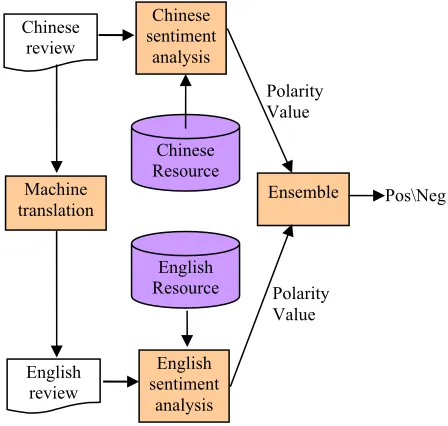
[image:3.612.73.297.361.574.2]The framework of our approach is illustrated in Figure 1. A Chinese review is translated into the corresponding English review using machine trans-lation services, and then the Chinese review and the English review are analyzed based on Chinese resources and English resources, respectively. The analysis results are then combined to obtain more accurate results under the assumption that the indi-vidual sentiment analysis can complement each other. Note that in the framework, different ma-chine translation services can be used to obtain different English reviews, and the analysis of Eng-lish reviews translated by a specific machine trans-lation service is conducted separately. For simplicity, we consider the English reviews trans-lated by different machine translation services as reviews in different languages, despite the fact that in essence, they are still in English.
Figure 1. Framework of our approach
Formally, give a review rev0 in the target
lan-guage (i.e. Chinese), the corresponding review revi in the ith language is obtained by using a transla-tion functransla-tion: revi=f iTrans(rev0), where 1≤i≤p and p is the total number of machine translation ser-vices. For each review revk in the kth language (0≤k≤p), we employ the semantic oriented ap-proach to assign a semantic orientation value
f k
SO(revk) to the review, and the polarity orientation of the review can be simply predicated based on the value by using a threshold. Given a set of se-mantic orientation values FSO={f kSO(revk) | 0≤k≤p}, the ensemble methods aim to derive a new seman-tic orientation value
f
Ensemble(
rev
0)
SO based on the
values in FSO, which can be used to better classify the review as positive or negative.
The steps of review translation, individual se-mantic orientation value computation and ensem-ble combination are described in details in the next sections, respectively.
3.2 Review Translation
Translation of a Chinese review into an English review is the first step of the proposed approach. Manual translation is time-consuming and labor-intensive, and it is not feasible to manually trans-late a large amount of Chinese product reviews in real applications. Fortunately, machine translation techniques have been well developed in the NLP field, though the translation performance is far from satisfactory. A few commercial machine translation services can be publicly accessed. In this study, the following two commercial machine translation services and one baseline system are used to translate Chinese reviews into English re-views.
Google Translate 2 (GoogleTrans): Google
Translate is one of the state-of-the-art commercial machine translation systems used today. Google Translate applies statistical learning techniques to build a translation model based on both monolin-gual text in the target language and aligned text consisting of examples of human translations be-tween the languages.
Yahoo Babel Fish3 (YahooTrans): Different
from Google Translate, Yaho Babel Fish uses SYSTRAN’s rule-based translation engine. SYSTRAN was one of the earliest developers of machine translation software. SYSTRAN applies complex sets of specific rules defined by linguists to analyze and then transfer the grammatical struc-ture of the source language into the target language.
Baseline Translate (DictTrans): We simply de-velop a translation method based only on one-to-one term translation in a large Chinese-to-English
2 http://translate.google.com/translate_t 3 http://babelfish.yahoo.com/translate_txt
Chinese review
Chinese Resource
English review Machine translation
Chinese sentiment
analysis
Ensemble
English sentiment
analysis English Resource
Polarity Value
Polarity Value
dictionary. Each term in a Chinese review is trans-lated by the first corresponding term in the Chi-nese-to-English dictionary, without any other processing steps. In this study, we use the LDC_CE_DIC2.04 constructed by LDCas the
dic-tionary for translation, which contains 128366 Chinese terms and their corresponding English terms.
The Chinese-to-English translation perform-ances of the two commercial systems are deemed much better than the weak baseline system. Google Translate has achieved very good results on the Chinese-to-English translation tracks of NIST open machine translation test (MT)5 and it ranks the first
on most tracks. In the Chinese-to-English task of MT2005, the BLEU-4 score of Google Translate is 0.3531, and the BLEU-4 score of SYSTRAN is 0.1471. We can deduce that Google Translate is better than Yahoo Babel Fish, without considering the recent improvements of the two systems.
Here are two running example of Chinese re-views and the translated English rere-views ( Human-Trans refers to human translation):
Positive Example: 优点很多,外形也很好。
HumanTrans: Many advantages and very good shape. GoogleTrans: Many advantages, the shape is also very good.
YahooTrans: Merit very many, the contour very is also good.
DictTrans: merit very many figure also very good
Negative example: 内存太小不支持红外。
HumanTrans: The memory is too small to support IR. GoogleTrans: Memory is too small not to support IR. YahooTrans:The memory too is small does not support infrared.
DictTrans: memory highest small negative not to be in favor of ir.
3.3 Individual Semantic Orientation Value Computation
For any specific language, we employ the semantic orientated approach (Kennedy and Inkpen, 2006) to compute the semantic orientation value of a re-view. The unsupervised approach is quite straight-forward and it makes use of the following sentiment lexicons: positive Lexicon ( Posi-tive_Dic) including terms expressing positive po-larity, Negative Lexicon (Negative_Dic) including terms expressing negative polarity, Negation
4 http://projects.ldc.upenn.edu/Chinese/LDC_ch.htm 5 http://www.nist.gov/speech/tests/mt/
Lexicon (Negation_Dic) including terms that are used to reverse the semantic polarity of a particular term, and Intensifier Lexicon (Intensifier_Dic)
including terms that are used to change the degree to which a term is positive or negative. In this study, we conduct our experiments within two lan-guages, and we collect and use the following popu-lar and available Chinese and English sentiment lexicons6, without any further filtering and labeling:
1) Chinese lexicons
Positive_Diccn: 3730 Chinese positive terms
were collected from the Chinese Vocabulary for Sentiment Analysis (VSA)7 released by HOWNET.
Negative_Diccn: 3116 Chinese negative terms
were collected from Chinese Vocabulary for Sen-timent Analysis (VSA) released by HOWNET.
Negation_Diccn: 13 negation terms were col-lected from related papers.
Intensifier_Diccn: 148 intensifier terms were collected from Chinese Vocabulary for Sentiment Analysis (VSA) released by HOWNET.
2) English lexicons
Positive_Dicen: 2718 English positive terms
were collected from the feature file
subjclueslen1-HLTEMNLP05.tff 8 containing the subjectivity
clues used in the work (Wilson et al., 2005a; Wil-son et al., 2005b). The clues in this file were col-lected from a number of sources. Some were culled from manually developed resources, e.g. general inquirer9 (Stone et al., 1966). Others were identi-fied automatically using both annotated and unan-notated data. A majority of the clues were collected as part of work reported in Riloff and Wiebe (2003).
Negative_Dicen: 4910 English negative terms
were collected from the same file described above. Negation_Dicen: 88 negation terms were
col-lected from the feature file valenceshifters.tff used in the work (Wilson et al., 2005a; Wilson et al., 2005b).
Intensifier_Dicen: 244 intensifier terms were collected from the feature file intensifiers2.tff used in the work (Wilson et al., 2005a; Wilson et al., 2005b).
6In this study, we focus on using a few popular resources in
both Chinese and English for comparative study, instead of trying to collect and use all available resources.
7 http://www.keenage.com/html/e_index.html 8 http://www.cs.pitt.edu/mpqa/
The semantic orientation value f k
SO(revk) for revk is computed by summing the polarity values of all words in the review, making use of both the word polarity defined in the positive and negative lexi-cons and the contextual valence shifters defined in the negation and intensifier lexicons. The algo-rithm is illustrated in Figure 2.
Input: a review revk in the kth language. Four
lexi-cons in the kth language: Positive_Dick,
Nega-tive_Dick, Negation_Dick, Intensifier_Dick, which are
either Chinese or English lexicons;
Output: Polarity Value f k
SO(revk);
Algorithm Compute_SO:
1. Tokenize review revk into sentence set S and each
sentence s∈S is tokenized into word set Ws;
2. For any word w in a sentence s∈S, compute its SO value SO(w) as follows:
1) if w∈Positive_Dick , SO(w)=PosValue;
2) If w∈Negative_Dick, SO(w)=NegValue;
3) Otherwise, SO(w)=0;
4) Within the window of q words previous to w, if there is a term w′∈Negation_Dick,
SO(w)= –SO(w);
5) Within the window of q words previous to w, if there is a term w′∈Intensifier_Dick,
SO(w) =ρ×SO(w);
3.
∑ ∑
∈ ∈
=
S s wW k
k SO
s
w SO rev
f ( ) ( );
Figure 2. The algorithm for semantic orientation value computation
In the above algorithm, PosValue and Neg-Value are the polarity values for positive words and negative words respectively. We empirically set PosValue=1 and NegValue= –2 because nega-tive words usually contribute more to the overall semantic orientation of the review than positive words, according to our empirical analysis. ρ>1 aims to intensify the polarity value and we simply set ρ=2. q is the parameter controlling the window size within which the negation terms and intensi-fier terms have influence on the polarity words and here q is set to 2 words. Note that the above pa-rameters are tuned only for Chinese sentiment analysis, and they are used for sentiment analysis in the English language without further tuning. The tokenization of Chinese reviews involves Chinese word segmentation.
Usually, if the semantic orientation value of a review is less than 0, the review is labeled as nega-tive, otherwise, the review is labeled as positive.
3.4 Ensemble Combination
After obtaining the set of semantic orientation val-ues FSO={f kSO(revk) | 0≤k≤p} by using the semantic oriented approach, where p is the number of Eng-lish translations for each Chinese review, we ex-ploit the following ensemble methods for deriving a new semantic orientation value
f
Ensemble(
rev
0)
SO :
1) Average
It is the most intuitive combination method and the new value is the average of the values in FSO:
1 ) ( )
( 0 0
+ =
∑
=p rev f rev
f
p
k
k k SO Ensemble
SO
Note that after the new value of a review is ob-tained, the polarity tag of the review is assigned in the same way as described in Section 3.3.
2) Weighted Average
This combination method improves the average combination method by associating each individual value with a weight, indicating the relative confi-dence in the value.
∑
= = p k
k k SO k Ensemble
SO rev f rev
f
0
0) ( )
( λ
where λk∈[0, 1] is the weight associated with
f k
SO(revk). The weights can be set in the following two ways:
Weighting Scheme1: The weight of f k
SO(revk) is set to the accuracy of the individual analysis in the
kth language.
Weighting Scheme2: The weight of f kSO(revk) is set to be the maximal correlation coefficient be-tween the analysis results in the kth language and the analysis results in any other language. The underlying idea is that if the analysis results in one language are highly consistent with the analysis results in another language, the results are deemed to be more reliable. Given two lists of semantic values for all reviews, we use the Pearson’s corre-lation coefficient to measure the correcorre-lation be-tween them. The weight associated with function f
k
SO(revk) is then defined as the maximal Pearson’s correlation coefficient between the reviews’ values in the kth language and the reviews’ values in any other language.
The new value is the maximum value in FSO:
{
f rev k p}
revf k k
SO Ensemble
SO ( )=max ( )|0≤ ≤
0
4) Min
The new value is the minimum value in FSO:
{
f rev k p}
revf k k
SO Ensemble
SO ( )=min ( )|0≤ ≤
0
5) Average Max&Min
The new value is the average of the maximum value and the minimum value in FSO:
{
}
{
}
2
0 | ) ( min 0
| ) ( max )
(rev0 f rev k p f rev k p
f
k k SO k
k SO Ensemble
SO
≤ ≤ +
≤ ≤ =
6) Majority Voting
This combination method relies on the final po-larity tags, instead of the semantic orientation val-ues. A review can obtain p+1 polarity tags based on the individual analysis results in the p+1 lan-guages. The polarity tag receiving more votes is chosen as the final polarity tag of the review.
4
Empirical Evaluation
4.1 Dataset and Evaluation Metrics
In order to assess the performance of the proposed approach, we collected 1000 product reviews from a popular Chinese IT product web site-IT16810.
The reviews were posted by users and they focused on such products as mp3 players, mobile phones, digital camera and laptop computers. Users usually selected for each review an icon indicating “pos-tive” or “nega“pos-tive”. The reviews were first catego-rized into positive and negative classes according to the associated icon. The polarity labels for the reviews were then checked by subjects. Finally, the dataset contained 886 product reviews with accu-rate polarity labels. All the 886 reviews were used as test set.
We used the standard precision, recall and F-measure to F-measure the performance of positive and negative class, respectively, and used the Mac-roF measure and accuracy metric to measure the overall performance of the system. The metrics are defined the same as in general text categorization.
4.2 Individual Analysis Results
In this section, we investigate the following indi-vidual sentiment analysis results in each specified language:
CN: This method uses only Chinese lexicons to analyze Chinese reviews;
10 http://www.it168.com
GoogleEN: This method uses only English lex-icons to analyze English reviews translated by
GoogleTrans;
YahooEN: This method uses only English lex-icons to analyze English reviews translated by Ya-hooTrans;
DictEN: This method uses only English lexi-cons to analyze English reviews translated by
DictTrans;
In addition to the above methods for using English resources, the lexicon-based method inves-tigated in Mihalcea et al. (2007) can also use Eng-lish resources by directly projecting EngEng-lish lexicons into Chinese lexicons. We use a large
English-to-Chinese dictionary - LDC_EC_DIC2.011 with 110834 entries for
pro-jecting English lexicons into Chinese lexicons via one-to-one translation. Based on the generated Chinese lexicons, two other individual methods are investigated in the experiments:
CN2: This method uses only the generated Chinese Resources to analyze Chinese reviews.
CN3: This method combines the original Chi-nese lexicons and the generated ChiChi-nese lexicons and uses the extended lexicons to analyze Chinese reviews.
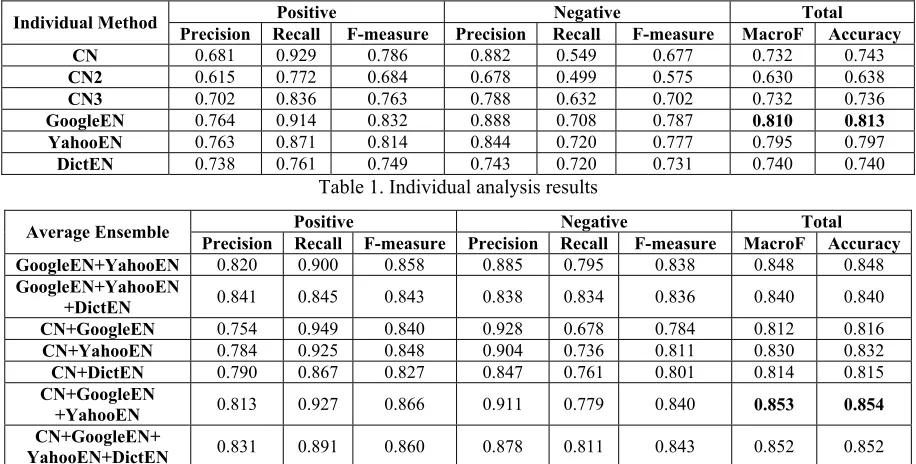
Table 1 provides the performance values of all the above individual methods. Seen from the table, the performances of GoogleEN and YahooEN are much better than the baseline CN method, and even the DictEN performs as well as CN. The re-sults demonstrate that the use of English resources for sentiment analysis of translated English re-views is an effective way for Chinese sentiment analysis. We can also see that the English senti-ment analysis performance relies positively on the translation performance, and GoogleEN performs the best while DictEN performs the worst, which is consistent with the fact the GoogleTrans is deemed the best of the three machine translation systems, while DictTrans is the weakest one.
Furthermore, the CN method outperforms the
CN2 and CN3 methods, and the CN2 method per-forms the worst, which shows that the generated Chinese lexicons do not give any contributions to the performance of Chinese sentiment analysis. We explain the results by the fact that the term-based one-to-one translation is inaccurate and the gener-ated Chinese lexicons are not reliable. Overall, the
approach through cross-lingual lexicon translation does not work well for Chinese sentiment analysis in our experiments.
4.3 Ensemble Results
In this section, we first use the simple average en-semble method to combine different individual analysis results. Table 2 provides the performance values of the average ensemble results based on different individual methods.
Seen from Tables 1 and 2, almost all of the av-erage ensembles outperforms the baseline CN
method and the corresponding individual methods, which shows that each individual methods have their own evidences for sentiment analysis, and thus fusing the evidences together can improve performance. For the methods of CN+GoogleEN, CN+YahooEN and CN+DictEN, we can see the ensemble performance is not positively relying on the translation performance: CN+YahooEN per-forms better than CN+GoogleEN, and even
CN+DictEN performs as well as CN+GoogleEN. The results show that the individual methods in the ensembles can complement each other, and even the combination of two weak individual methods can achieve good performance. However, the Dic-tEN method is not effective when the ensemble methods have already included GoogleEN and
YahooEN. Overall, the performances of the
en-semble methods rely on the performances of the most effective constituent individual methods: the methods including both GoogleEN and YahooEN
perform much better than other methods, and
CN+GoogleEN+YahooEN performs the best out of all the methods.
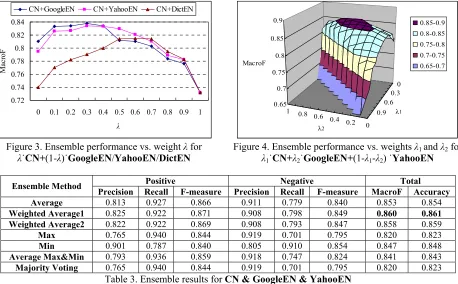
We further show the results of four typical av-erage ensembles by varying the combination weights. The combination weights are respectively specified as λ˙CN+(1-λ)˙GoogleEN, λ˙CN+(1
-λ)˙YahooEN, λ˙CN+(1-λ)˙DictEN,
λ1˙CN+λ2˙GoogleEN+(1-λ1-λ2)˙YahooEN. The results
over the MacroF metric are shown in Figures 3 and 4 respectively. We can see from the figures that
GoogleEN and YahooEN are dominant factors in the ensemble methods.
We then investigate to use other ensemble meth-ods introduced in Section 3.4 to combine the CN,
GoogleEN and YahooEN methods. Table 3 gives the comparison results. The methods of “Weighted Average1” and “Weighted Average2” are two weighted average ensembles using the two weigh-ing schemes, respectively. We can see that all the ensemble methods outperform the constituent indi-vidual method, while the two weighted average ensembles perform the best. The results further demonstrate the good effectiveness of the ensem-ble combination of individual analysis results for Chinese sentiment analysis.
Positive Negative Total
Individual Method Precision Recall F-measure Precision Recall F-measure MacroF Accuracy
CN 0.681 0.929 0.786 0.882 0.549 0.677 0.732 0.743
CN2 0.615 0.772 0.684 0.678 0.499 0.575 0.630 0.638
CN3 0.702 0.836 0.763 0.788 0.632 0.702 0.732 0.736
GoogleEN 0.764 0.914 0.832 0.888 0.708 0.787 0.810 0.813
YahooEN 0.763 0.871 0.814 0.844 0.720 0.777 0.795 0.797
[image:7.612.77.535.443.675.2]DictEN 0.738 0.761 0.749 0.743 0.720 0.731 0.740 0.740
Table 1. Individual analysis results
Positive Negative Total
Average Ensemble Precision Recall F-measure Precision Recall F-measure MacroF Accuracy
GoogleEN+YahooEN 0.820 0.900 0.858 0.885 0.795 0.838 0.848 0.848
GoogleEN+YahooEN
+DictEN 0.841 0.845 0.843 0.838 0.834 0.836 0.840 0.840
CN+GoogleEN 0.754 0.949 0.840 0.928 0.678 0.784 0.812 0.816
CN+YahooEN 0.784 0.925 0.848 0.904 0.736 0.811 0.830 0.832
CN+DictEN 0.790 0.867 0.827 0.847 0.761 0.801 0.814 0.815
CN+GoogleEN
+YahooEN 0.813 0.927 0.866 0.911 0.779 0.840 0.853 0.854
CN+GoogleEN+
YahooEN+DictEN 0.831 0.891 0.860 0.878 0.811 0.843 0.852 0.852
0.72 0.74 0.76 0.78 0.8 0.82 0.84
0 0.1 0.2 0.3 0.4 0.5 0.6 0.7 0.8 0.9 1 λ
Mac
roF
CN+GoogleEN CN+YahooEN CN+DictEN
0 0.3 0.6 0.9 0 0.2 0.4 0.6 0.8 1 0.65
0.7 0.75 0.8 0.85 0.9
MacroF
λ1
λ2
0.85-0.9 0.8-0.85 0.75-0.8 0.7-0.75 0.65-0.7
Figure 3. Ensemble performance vs. weight λfor
λ˙CN+(1-λ)˙GoogleEN/YahooEN/DictEN Figure 4. Ensemble performance vs. weights λ1˙CN+λ2˙GoogleEN+(1-λ1-λ2) ˙YahooENλ1 and λ2 for
Positive Negative Total
Ensemble Method
Precision Recall F-measure Precision Recall F-measure MacroF Accuracy
Average 0.813 0.927 0.866 0.911 0.779 0.840 0.853 0.854
Weighted Average1 0.825 0.922 0.871 0.908 0.798 0.849 0.860 0.861
Weighted Average2 0.822 0.922 0.869 0.908 0.793 0.847 0.858 0.859
Max 0.765 0.940 0.844 0.919 0.701 0.795 0.820 0.823
Min 0.901 0.787 0.840 0.805 0.910 0.854 0.847 0.848
Average Max&Min 0.793 0.936 0.859 0.918 0.747 0.824 0.841 0.843
[image:8.612.78.536.59.343.2]Majority Voting 0.765 0.940 0.844 0.919 0.701 0.795 0.820 0.823
Table 3. Ensemble results for CN & GoogleEN & YahooEN
5
Conclusion and Future Work
This paper proposes a novel approach to use Eng-lish sentiment resources for Chinese sentiment analysis by employing machine translation and ensemble techniques. Chinese reviews are trans-lated into English reviews and the analysis results of both Chinese reviews and English reviews are combined to improve the overall accuracy. Ex-perimental results demonstrate the encouraging performance of the proposed approach.
In future work, more additional English re-sources will be used to further improve the results. We will also apply the idea to supervised Chinese sentiment analysis.
Acknowledgments
This work was supported by the National Science Foundation of China (No.60703064), the Research Fund for the Doctoral Program of Higher Educa-tion of China (No.20070001059) and the NaEduca-tional High Technology Research and Development Pro-gram of China (No.2008AA01Z421). We also thank the anonymous reviewers for their useful comments.
References
A. Andreevskaia and S. Bergler. 2008. When specialists and generalists work together: overcoming domain dependence in sentiment tagging. In Proceedings of ACL-08: HLT.
J. Blitzer, M. Dredze and F. Pereira. 2007. Biographies, bollywood, boom-boxes and blenders: domain adap-tation for sentiment classification. In Proceedings of ACL2007.
Y. Choi, E. Breck, and C. Cardie. 2006. Joint extraction of entities and relations for opinion recognition. In
Proc. EMNLP.
A. Devitt and K. Ahmad. 2007. Sentiment polarity iden-tification in financial news: a cohesion-based ap-proach. In Proceedings of ACL2007.
K. Eguchi and V. Lavrenko. 2006. Sentiment retrieval using generative models. In Proceedings of EMNLP. V. Hatzivassiloglou and K. R. McKeown. 1997. Predict-ing the semantic orientation of adjectives. In Pro-ceedings of EACL.
V. Hatzivassiloglon and J. M. Wiebe. 2000. Effects of adjective orientation and gradability on sentence sub-jectivity. In Proceedings of COLING.
N. Kaji and M. Kitsuregawa. 2007. Building lexicon for sentiment analysis from massive collection of HTML documents. In Proceedings of EMNLP-CONLL. A. Kennedy and D. Inkpen. 2006. Sentiment
classifica-tion of movie reviews using contextual valence shift-ers. Computational Intelligence, 22(2):110-125. S.-M. Kim and E. Hovy. 2004. Determining the
senti-ment of opinions. In Proceedings of COLING. L.-W. Ku, Y.-T. Liang and H.-H. Chen. 2006. Opinion
extraction, summarization and tracking in news and blog corpora. In Proceedings of AAAI.
J. Li and M. Sun. 2007. Experimental study on senti-ment classification of Chinese review using machine learning techniques. In Proceeding of IEEE-NLPKE2007.
B. Liu, M. Hu and J. Cheng. 2005. Opinion observer: Analyzing and comparing opinions on the web. In
Proceedings of WWW.
R. McDonald, K. Hannan, T. Neylon, M. Wells and J. Reynar. 2007. Structured models for fine-to-coarse sentiment analysis. In Proceedings of ACL2007. R. Mihalcea, C. Banea and J. Wiebe. 2007. Learning
multilingual subjective language via cross-lingual projections. In Proceedings of ACL.
T. Mullen and N. Collier. 2004. Sentiment analysis us-ing support vector machines with diverse information sources. In Proceedings of EMNLP.
B. Pang, L. Lee and S. Vaithyanathan. 2002. Thumbs up? sentiment classification using machine learning tech-niques. In Proceedings of EMNLP.
B. Pang and L. Lee. 2004. A sentimental education: sentiment analysis using subjectivity summarization based on minimum cuts. In Proceedings of ACL.
A. –M. Popescu and O. Etzioni. 2005. Extracting prod-uct features and opinions from reviews. In Proceed-ings of EMNLP.
J. Read. 2005. Using emoticons to reduce dependency in machine learning techniques for sentiment classi-fication. In Proceedings of ACL.
E. Riloff and J. Wiebe 2003. Learning extraction pat-terns for subjective expressions. In Proceedings of EMNLP2003.
P. J. Stone, D. C. Dunphy, M. S. Smith, D. M. Ogilvie and associates. 1966. The General Inquirer: a com-puter approach to content analysis. The MIT Press. H. Takamura, T. Inui and M. Okumura. 2005.
Extract-ing semantic orientation of words usExtract-ing spin model. In Proceedings of ACL.
I. Titov and R. McDonald. 2008. A joint model of text and aspect ratings for sentiment summarization. In
Proceedings of ACL-08: HLT.
B. K. Y. Tsou, R. W. M. Yuen, O. Y. Kwong, T. B. Y. La and W. L. Wong. 2005. Polarity classification of celebrity coverage in the Chinese press. In Proceed-ings of International Conference on Intelligence Analysis.
P. Turney. 2002. Thumbs up or thumbs down? semantic orientation applied to unsupervised classification of reviews. In Proceedings of ACL.
S. Wang, Y. Wei, D. Li, W. Zhang and W. Li. 2007. A hybrid method of feature selection for Chinese text sentiment classification. In Proceeding of IEEE-FSKD2007.
T. Wilson, J. Wiebe and P. Hoffmann. 2005a. Recogniz-ing Contextual Polarity in Phrase-Level Sentiment Analysis. In Proceedings of HLT/EMNLP2005, Van-couver, Canada.
T. Wilson, P. Hoffmann, S. Somasundaran, J. Kessler, J. Wiebe, Y. Choi, C. Cardie, E. Riloff, S. Patwardhan. 2005b. OpinionFinder: a system for subjectivity analysis. In Proceedings of HLP/EMNLP on Interac-tive Demonstrations.
J. Yao, G. Wu, J. Liu and Y. Zheng. 2006. Using bilin-gual lexicon to judge sentiment orientation of Chi-nese words. In Proceedings of IEEE CIT2006. Q. Ye, W. Shi and Y. Li. 2006. Sentiment classification
for movie reviews in Chinese by improved semantic oriented approach. In Proceedings of 39th Hawaii In-ternational Conference on System Sciences.
H. Yu and V. Hatzivassiloglou. 2003. Towards answer-ing opinion questions: separatanswer-ing facts from opinions and identifying the polarity of opinion sentences. In