Proceedings of the Third Conference on Machine Translation (WMT), Volume 1: Research Papers, pages 93–100
Improving Neural Language Models with Weight Norm Initialization and
Regularization
Christian Herold∗ Yingbo Gao∗
Human Language Technology and Pattern Recognition Group Computer Science Department
RWTH Aachen University D-52056 Aachen, Germany
<surname>@i6.informatik.rwth-aachen.de
Hermann Ney
Abstract
Embedding and projection matrices are com-monly used in neural language models (NLM) as well as in other sequence processing net-works that operate on large vocabularies. We examine such matrices in fine-tuned language models and observe that a NLM learns word vectors whose norms are related to the word frequencies. We show that by initializing the weight norms with scaled log word counts, to-gether with other techniques, lower perplexi-ties can be obtained in early epochs of train-ing. We also introduce a weight norm regular-ization loss term, whose hyperparameters are tuned via a grid search. With this method, we are able to significantly improve perplexities on two word-level language modeling tasks (without dynamic evaluation): from 54.44 to 53.16 on Penn Treebank (PTB) and from 61.45 to 60.13 on WikiText-2 (WT2).
1 Introduction
A language model (LM) measures how likely a certain sequence of words is for a given language. It does so by calculating the probability of occur-rence of that sequence, which can be learned from monolingual text data. Many models in machine translation and automatic speech recognition ben-efit from the use of a LM (Corazza et al., 1995;
Peter et al.,2017).
While count-based LMs (Katz, 1987; Kneser and Ney, 1995) provided the best results in the past, substantial improvements were achieved with the introduction of neural networks in the field of language modeling (Bengio et al.,2003). Different types of architectures such as feedfor-ward neural networks (Schwenk, 2007) and re-current neural networks (Mikolov et al., 2010) have since been used for language modeling. Currently, variants of long short-term memory
∗Equal contribution. Ordering determined by coin flipping.
(LSTM) (Hochreiter and Schmidhuber,1997) net-works give the best results on popular language modeling tasks (Yang et al.,2018).
In natural language processing, words are typ-ically represented by high-dimensional one-hot vectors. To reduce dimensionality and to be able to learn relationships between words, they are mapped into a lower-dimensional, continuous em-bedding space. Mathematically, this is done by multiplying the one-hot vector with the embed-ding matrix. Similarly, to receive a probability dis-tribution over the vocabulary, a mapping from an embedding space is performed by a projection ma-trix followed by a softmax operation. These two matrices can be tied together in order to reduce the number of parameters and improve the results of NLMs (Inan et al.,2017;Press and Wolf,2017). Since the row vectors in the embedding and pro-jection matrices are effectively word vectors in a continuous space, we investigate such weight vec-tors in well-trained and fine-tuned NLMs. We ob-serve that the learned word vector generally has a greater norm for a frequent word than an in-frequent word. We then specifically examine the weight vector norm distribution and design ini-tialization and normalization strategies to improve NLMs.
Our contribution is twofold:
• We identify that word vectors learned by NLMs have a weight norm distribution that resembles logarithm of the word counts. We then correspondingly develop a weight initial-ization strategy to aid NLM training.
• We design a weight norm regularization loss term that increases the generalization ability of the model. Applying this loss term, we achieve state-of-the-art results on Penn Tree-bank (PTB) and WikiText-2 (WT2) language modeling tasks.
2 Related Work
Melis et al.(2018) investigated different NLM ar-chitectures and regularization methods with the use of a black-box hyperparameter tuner. In par-ticular, the LSTM architecture was compared to two more recent recurrent approaches, namely re-current highway networks (Zilly et al.,2017) and neural architecture search (Zoph and Le, 2017). They found that the standard LSTM architecture outperforms other models, if properly regularized.
Merity et al.(2017a) used various regularization methods such as activation regularization (Merity et al.,2017b) in a LSTM model. They also intro-duced a variant of the averaged stochastic gradient method, where the averaging trigger is not tuned by the user but relies on a non-monotonic condi-tion instead. With these and further regulariza-tion and optimizaregulariza-tion methods, improved results on PTB and WT2 were achieved.
To further improve this network architecture,
Yang et al.(2018) introduced the mixture of soft-maxes (MoS) model, claiming that the calculation of the output probabilities with a single softmax layer is a bottleneck. In their approach, several output probabilities are calculated and then com-bined via a weighted sum. The LSTM-MoS ar-chitecture provides state-of-the-art results on PTB and WT2 at the time of writing and is used as the baseline model for comparisons in this work.
Other works proposed to tie the embedding and projection matrices. Press and Wolf(2017) inves-tigated the effects of weight tying, analyzed up-date rules after tying and showed that tied matri-ces evolve in a similar way as the projection ma-trix. Inan et al.(2017) were motivated by the fact that with a classification setup over the vocabulary, inter-word information is not utilized to its full po-tential. They also provided theoretical justification on why it is appropriate to tie the above-mentioned matrices.
Besides using the word embedding matrix, there are other approaches to represent word sequences.
Zhang et al. (2015) proposed a new embedding method called fixed-sized ordinally-forgetting en-coding (FOFE), which allows them to encode variable-length sentences into fixed-length vectors almost uniquely.
Additionally, Salimans and Kingma (2016) in-troduced a weight normalization reparametriza-tion trick on weight matrices, which separates the norm and the angle of a vector. This can speed
up the convergence of stochastic gradient descent and also allows for explicit scaling of gradients in the amplitude and direction. They also discussed the connections between weight normalization and batch normalization.
On top of one-hot representations of words,Irie et al. (2015) used additional information to rep-resent word sequences. It is shown that the use of long-context bag-of-words as additional feature for language modeling can narrow the gap be-tween feed-forward NLMs and recurrent NLMs.
3 Neural Language Modeling
In NLM the probability of a word sequence
xt1=x1x2...xtis decomposed as
P(xt1) =
t
Y
j=1
P(xj|xjj−−1n+1) (1)
so that the (n−1) preceding words xjj−−1n+1 are
considered for the prediction of the next wordxj.
This is typically done by using a recurrent neural network, e.g. a stack of LSTM layers, to encode the input sequence as
ht=LSTM(ET[xt−n+1, xt−n+2, ..., xt−1]) (2)
where ET is the transposed embedding
ma-trix,[xt−n+1, xt−n+2, ..., xt−1]are the one-hot
en-coded preceding words and the LSTM() function returns the last hidden state of the last LSTM layer. The probability distribution over the next wordxt
is then calculated as
P(xt=xk|ht) = exp
(Wkht)
PV
j=1exp(Wjht)
(3)
withV being the vocabulary size,k= 1,2, ..., V, andWkbeing thek-th row vector in the projection
matrixW.
For training the neural network, the cross-entropy error criterion, which is equivalent to the maxi-mum likelihood criterion, is used. For thei-th
se-quence of wordsxti
1, the cross-entropy lossLi is
defined as
Li =−logP(xti =xyi|hti) (4)
withyibeing the true label ofxti. The total loss is
then calculated as
L= 1
N
N
X
i=1
where N is the total number of sequences. A language model is normally scored by perplexity (ppl). For a given test corpusxT1 =x1x2...xT, the
pplis calculated as
ppl=P(xT1)−T1 (6)
which is a measurement on how likely a given sen-tence is, according to the prediction of the model.
In the above formulation, we have an embedding matrix E and a projection matrix W. When the
two matrices are tied and one-hot vectors are used to represent words, the rows of these matrices are then the word vectors of the corresponding words. Particularly, we focus on the norms of the row vec-tors and study their relationship with word counts and how to regularize them.
4 Weight Norm Initialization
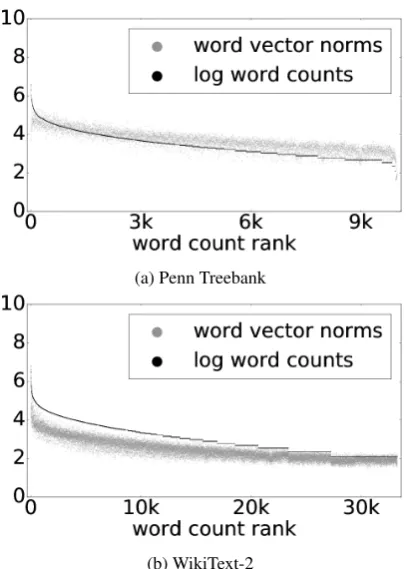
We first train models on PTB and WT2 as de-scribed in (Yang et al., 2018) and plot the norms of learned weight vectors of the embedding matrix in Figure1.
When the words are ranked by their counts and placed on the x-axis from frequent to infrequent, it can be seen that the word vector norms follow a downward trend as well. Log unigram counts are also plotted for comparison. As can be seen, the norm distribution follows a similar trend as the log counts. It is important to note, that the logit for wordxkand contexthtis calculated asWkht(see
Equation3), which can be rewritten as
Wkht=kWkk khtkcos(θ) (7)
where θ denotes the angle between Wk and ht.
Therefore, one intuition from the aforementioned observation is that, for a frequent word, the net-work tends to learn a weight vector Wk with a
greater norm to maximize likelihood. This mo-tivates our approach to initialize the weight norms with scaled log counts rather than uniformly ran-dom values in a specific range.
Because we wish to initialize the weight norms explicitly with scaled logarithm of the word counts, it is helpful to look at a weight vector’s magnitude and direction separately. For this pur-pose, we use a reparameterization technique on the weight vectors as described in (Salimans and Kingma,2016):
Wk=gk
vk
kvkk2
(8)
(a) Penn Treebank
[image:3.595.316.520.60.345.2](b) WikiText-2
Figure 1: Word vector norms of fine-tuned MoS models (Yang et al., 2018), trained on (a) Penn Treebank and (b) WikiText-2. Words are ranked by their counts in a descending order and thus fre-quent words are to the left. Actual logarithm of word counts are plotted in black, and word vec-tor norms are grey. We observe that word vecvec-tor norms loosely follow the trend of log counts.
where k = 1,2, ..., V, gk = kWkk2, andvk is
a vector proportional to Wk. Reparameterizing
the weight vectors makes it easy to implement the weight norm initialization as
gk=σlogck (9)
whereckdenotes unigram word count for wordk
and σ is a scalar applied to the log counts. We
sample each component ofvk from a continuous
uniform distribution in [−r, r], where r is a
hy-perparameter, specifying the initialization range. With this, no constraint on the weight vector di-rection is imposed during initialization.
Additionally, we adopt an adaptive gradient strategy which regularizes the gradients ingk. As
in
(∂L
∂g)
0
=
(
[1−(1−γ)τt]∂L∂g, fort≤τ
γ∂L∂g, fort > τ (10)
Tokens Vocab Size
Penn Treebank TrainValid 888k70k 10k Test 79k
WikiText-2 TrainValid 2.1M214k 33k Test 241k
Table 1: Statistics of the Penn Treebank and WikiText-2 datasets.
τ,(∂g∂L
k)
0
— the regularized gradient ingk, linearly
decays toγ(γ ≤1) times the unregularized
gradi-ent ∂L
∂gk. Otherwise, we directly use the discounted
gradient. In analogy to learning rate decay, this adaptive gradient strategy anneals the word vector norm updates in each step. The intuition for such a strategy is that after a certain amount of epochs, the weight norms should not change so drastically from the initialized scaled log counts.
5 Weight Norm Regularization
Weight regularization (WR) is a well established method to combat overfitting in neural networks, which is especially important on smaller datasets (Krogh and Hertz, 1992). The idea is to push weights in the network to zero, where gradients are not significant. Typically, WR is implemented by adding an extra term to the loss functionL0, which
penalizes the norm of all weights in the network. For example, L2-regularization is implemented as
L=L0+
λ
2
X
w
(kwk2)2 (11)
with the sum going over all weights w in the network and λ being the regularization strength.
However, this method is not perfect, as it affects
every weight in the network equally and may lead to hidden units’ weights getting stuck near zero.
In this work we add a constraint specifically on the embedding and projection matrices, whose weights are shared. Since the row vectors in both matrices are word vectors, it seems appropriate to put constraints explicitly on their norms instead of on each individual weight parameter in the matri-ces.
We propose to add a regularization term to the standard loss functionL0in the form of
Lwr =L0+ρ
v u u tXV
j=1
(kWjk2−ν)2 (12)
whereν, ρ≥0are two scalars andWj is thej-th
row vector of the projection matrixW. The L2
-norms of the row vectors are pushed towards ν,
while ρ is the regularization strength. This will
punish the row vectors for adopting norms other thanν, in the hope of reducing the effect of
over-fitting on the training data.
The choice of a soft regularization loss term in-stead of hard-fixing the weight norms in the for-ward pass is motivated by the weight norm dis-tribution shown in Figure 1. It can be seen that NLMs tend to learn non-equal weight norms for words with different counts. Therefore, hard-fixing weight norms may limit the network’s abil-ity to learn.
6 Experiments 6.1 Experiment Setup
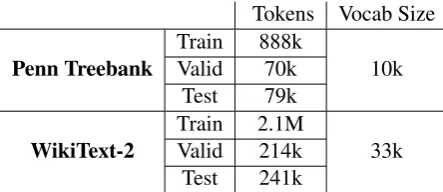
The experiments are conducted on two popular language modeling datasets. The number of to-kens and size of vocabulary for each dataset are summarized in Table1.
epoch wni Penn Treebank WikiText-2
ppl baselineppl pplreduction (%) wnippl baselineppl pplreduction (%)
1 162.18 180.72 10.26 172.19 192.19 10.41
10 85.92 92.09 6.70 95.90 100.72 4.79
20 73.36 78.94 7.07 85.14 88.21 3.48
30 71.44 73.06 2.22 81.80 82.70 1.09
[image:4.595.72.294.63.159.2]40 69.27 70.20 1.32 79.28 80.32 1.29
Table 2: Perplexity (ppl) improvement using weight norm initialization (wni) in early epochs on Penn
0 10−4 10−3 10−2 10−1 1
ρ 53.0
53.5 54.0 54.5 55.0 55.5
Pe
rp
le
xi
ty
[image:5.595.313.519.59.310.2]ν = 0.0 ν = 1.0 ν = 2.0 ν = 64.0
Figure 2: Model perplexity on the Penn Treebank test set as a function of ρ. The different
sym-bols denote different values ofν. Models not
de-picted yield higher perplexity values. The doted line marks the baseline result (withρ= 0) as
re-ported byYang et al.(2018).
The smaller one is the PTB corpus with prepro-cessing from Mikolov et al. (2010), which has a comparatively small vocabulary size of 10k. With a smaller number of sentences, this dataset is a good choice for performing optimization of hyper-parameters. The second corpus WT2, which was introduced byMerity et al.(2016), has over three times the vocabulary size of PTB.
We use the network structure introduced by
Yang et al.(2018) with the same hyper-parameter values to ensure comparability. Several regular-ization techniques are used in this setup, such as dropout and weight decay. Furthermore, the em-bedding and projection matrices are tied by de-fault. For optimization, we adopt the same strat-egy as described in (Merity et al., 2017a). That is, a conservative non-monotonic criterion is used to switch from stochastic gradient descent (SGD) to averaged stochastic gradient descent (ASGD) (Polyak and Juditsky, 1992). For more details of the network structure refer to (Yang et al.,2018).
6.2 Weight Norm Initialization
We tune the hyperparameterσ and use a value of σ = 0.5 to scale the logarithm of word counts.
Initialization range r is set to 0.1 for both the
reparametrized direction vectors and the baseline word vectors. Empirically, we set γ = 0.1 and
τ = 100for the adaptive gradient method.
Per-0 1 2 3 4 5
vector norm
0
5
10
15
pro
ba
bil
ity
[%
]
MoS
MoS with WR
(a) Penn Treebank
0 1 2 3 4 5
vector norm
0
5
10
15
20
25
pro
ba
bil
ity
[%
]
MoS
MoS with WR
(b) WikiText-2
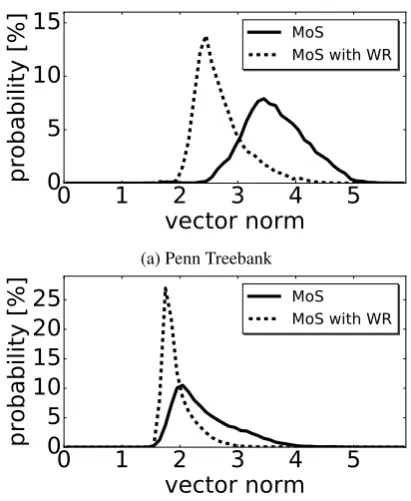
Figure 3: Weight norm distributions of the projec-tion matrices’ row vectors for the AWD-LSTM-MoS model from Yang et al. (2018) as well as for our regularized version (WR). The models are trained on the (a) Penn Treebank corpus and (b) WikiText-2 corpus with the resulting test perplex-ities shown in Table3and Table4respectively.
plexities on both PTB and WT2 in early epochs, as well as the relative perplexity improvement over baseline models are summarized in Table2.
First, we notice significant improvement after the first epoch of training using weight norm ini-tialization. About 10% of perplexity reduction is achieved on both datasets. This could be bene-ficial, when one wants to train on large datasets and/or can only train for a limited number of epochs. Second, the perplexity improvements de-cay down to around 1% after 40 epochs. This is in agreement with our expectation, because apart from reduced gradient in gk, a weight norm
[image:5.595.83.282.62.247.2]Model #Params Validation Test
Mikolov and Zweig(2012) - RNN-LDA + KN + cache 9M - 92.0
Zaremba et al.(2014) - LSTM 20M 86.2 82.7
Gal and Ghahramani(2016) - Variational LSTM (MC) 20M - 78.6
Kim et al.(2016) - CharCNN 19M - 78.9
Merity et al.(2016) - Pointer Sentinel-LSTM 21M 72.4 70.9
Grave et al.(2017) - LSTM + continuous cache pointer† - - 72.1
Inan et al.(2017) - Tied Variational LSTM + augmented loss 24M 75.7 73.2
Zilly et al.(2017) - Variational RHN 24M 75.7 73.2
Zoph and Le(2017) - NAS Cell 25M - 64.0
Melis et al.(2018) - 2-layer skip connection LSTM 24M 60.9 58.3
Merity et al.(2017a) - AWD-LSTM 24M 60.0 57.3
Yang et al.(2018) - AWD-LSTM-MoS 22M 56.54 54.44
Ours - AWD-LSTM-MoS with weight norm regularization 22M 55.03 53.16
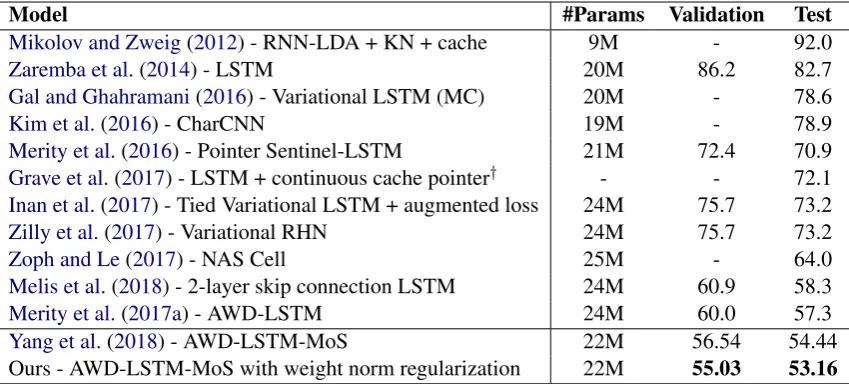
Table 3: Single model perplexity on the Penn Treebank test and validation sets. Baseline results are obtained from (Yang et al.,2018).†indicates the use of dynamic evaluation.
Model #Params Validation Test
Inan et al.(2017) - Variational LSTM + augmented loss 28M 91.5 87.0
Grave et al.(2017) - LSTM + continuous cache pointer† - - 68.9
Melis et al.(2018) - 2-layer skip connection LSTM 24M 69.1 65.9
Merity et al.(2017a) - AWD-LSTM 33M 69.1 66.0
Yang et al.(2018) - AWD-LSTM-MoS 35M 63.88 61.45
[image:6.595.87.512.62.254.2]Ours - AWD-LSTM-MoS with weight norm regularization 35M 62.67 60.13
Table 4: Single model perplexity on the WikiText-2 test and validation sets. Baseline results are obtained from (Yang et al.,2018).†indicates the use of dynamic evaluation.
6.3 Weight Norm Regularization
In order to tune the hyperparametersρandν
intro-duced in Section5, we perform a grid search over the PTB dataset, the results of which are shown in Figure2. If the norm constraintν becomes too
large, perplexity worsens significantly, as seen in the case of ν = 64. A model with a ν-value of
2 provides the best result in most cases. We
hy-pothesize that a value ofνthat is too small results
in the logit being close to zero as shown in Equa-tion7. For the regularization strengthρ, we
recog-nize thatρ= 10−3gives the best result on the PTB
test data. Larger or smaller values can hurt the performance of the system, depending also on the value ofν. It should be noted that the optimized
value of ρ is significantly larger than the scaling swd of the weight decay term, which was
opti-mized to be 1.2×10⁻⁶byMerity et al.(2017a).
The resulting weight norm distributions of the projection matrices’ row vectors are shown in Fig-ure3a and Figure 3b for models trained on PTB
and WT2 respectively. Our efforts of pushing the norms to a value ofν = 2.0resulted in a
notice-ably smaller average norm, as well as in a overall more narrow distribution.
With the tuned parameter valuesρ = 10−3 and
ν = 2.0 we improve the previous state-of-the-art
result by 1.28pplon PTB and by 1.32pplon WT2
(without considering dynamic evaluation (Krause et al., 2018), see Table 3 and Table 4). This is achieved without increasing the number of train-able parameters in the network or slowing down the training process.
7 Conclusion
correspond-ing word vectors. We study specifically the norms of these learned word vectors, the distribution of the norms, and the relationship with word counts. We show that with a simple initialization strat-egy together with a reparametrization technique, it is possible to get significantly lower perplex-ity in early epochs during training. By using a weight norm regularization loss term, we are able to obtain significant improvements on standard language modeling tasks — 2.4%pplreduction on
PTB and 2.1% on WT2.
We propose three directions to investigate fur-ther. First, in this work we use scaled logarithm of word counts to initialize the weight norms. It is a logical next step to use smoothing techniques on the word counts and study the effects of such ini-tializations. Second, we currently apply the same norm constraint on different words. Altering the loss function and regularizing the weight norms to word counts (and smoothed word counts) is worth examining as well. Finally, our focus so far is on weight norms. It is a more exciting and challeng-ing task to study the pairwise inner products, and single out the effects of angular differences.
We also plan to expand our regularization and initialization techniques to the field of neural chine translation. Embedding and projection ma-trices are also present in neural machine trans-lation networks, which could potentially benefit from our methods as well. It seems natural to use our methods on the transformer architecture intro-duced byVaswani et al.(2017), in which the em-bedding matrices at source and target sides, plus the projection matrix, are three-way tied.
Acknowledgments
This work has received funding from the Euro-pean Research Council (ERC) (under the Euro-pean Union’s Horizon 2020 research and in-novation programme, grant agreement No 694537, project ”SEQCLAS”) and the Deutsche Forschungsgemeinschaft (DFG; grant agreement NE 572/8-1, project ”CoreTec”). The GPU com-puting cluster was supported by DFG (Deutsche Forschungsgemeinschaft) under grant INST 222/1168-1 FUGG.
The work reflects only the authors’ views and
none of the funding agencies is responsible for any use that may be made of the information it con-tains.
References
Yoshua Bengio, R´ejean Ducharme, Pascal Vincent, and Christian Jauvin. 2003. A neural probabilistic lan-guage model. In Journal of machine learning re-search, volume 3, pages 1137–1155.
A. Corazza, R. De Mori, R. Gretter, R. Kuhn, and G. Satta. 1995. Language models for automatic speech recognition. InSpeech Recognition and Cod-ing, pages 157–173. Springer.
Yarin Gal and Zoubin Ghahramani. 2016. A theoret-ically grounded application of dropout in recurrent neural networks. InAdvances in neural information processing systems, pages 1019–1027.
Edouard Grave, Armand Joulin, and Nicolas Usunier. 2017. Improving neural language models with a continuous cache. In International Conference on Learning Representations.
Sepp Hochreiter and J¨urgen Schmidhuber. 1997. Long short-term memory. Neural computation, 9:1735– 80.
Hakan Inan, Khashayar Khosravi, and Richard Socher. 2017. Tying word vectors and word classifiers: A loss framework for language modeling. In Interna-tional Conference on Learning Representations. Kazuki Irie, Ralf Schl¨uter, and Hermann Ney. 2015.
Bag-of-words input for long history representation in neural network-based language models for speech recognition. InSixteenth Annual Conference of the International Speech Communication Association. Slava Katz. 1987. Estimation of probabilities from
sparse data for the language model component of a speech recognizer. InIEEE transactions on acous-tics, speech, and signal processing.
Yoon Kim, Yacine Jernite, David Sontag, and Alexan-der M Rush. 2016. Character-aware neural language models. InAAAI, pages 2741–2749.
Reinhard Kneser and Hermann Ney. 1995. Improved backing-off for m-gram language modeling. In1995 International Conference on Acoustics, Speech, and Signal Processing, pages 181–184.
Ben Krause, Emmanuel Kahembwe, Iain Murray, and Steve Renals. 2018. Dynamic evaluation of neural sequence models. In Proceedings of the 35th In-ternational Conference on Machine Learning, pages 2766–2775.
G´abor Melis, Chris Dyer, and Phil Blunsom. 2018. On the state of the art of evaluation in neural language models. In International Conference on Learning Representations.
Stephen Merity, Nitish Shirish Keskar, and Richard Socher. 2017a. Regularizing and optimizing lstm language models.arXiv preprint arXiv:1708.02182. Stephen Merity, Bryan McCann, and Richard Socher.
2017b. Revisiting activation regularization for lan-guage rnns.arXiv preprint arXiv:1708.01009. Stephen Merity, Caiming Xiong, James Bradbury, and
Richard Socher. 2016. Pointer sentinel mixture mod-els. arXiv preprint arXiv:1609.07843.
Tomas Mikolov, Martin Karafi´at, Luk´aˇs Burget, Jan ˇCernock`y, and Sanjeev Khudanpur. 2010. Recurrent neural network based language model. In11th An-nual Conference of the International Speech Commu-nication Association.
Tomas Mikolov and Geoffrey Zweig. 2012. Context dependent recurrent neural network language model. In IEEE Spoken Language Technology Workshop, pages 234–239.
Jan-Thorsten Peter, Andreas Guta, Tamer Alkhouli, Parnia Bahar, Jan Rosendahl, Nick Rossenbach, Miguel Grac¸a, and Hermann Ney. 2017. The RWTH Aachen University english-german and german-english machine translation system for WMT 2017. InProceedings of the Second Conference on Machine Translation, pages 358–365.
Boris T. Polyak and Anatoli B. Juditsky. 1992. Ac-celeration of stochastic approximation by averaging. InSIAM Journal on Control and Optimization, pages 838–855.
Ofir Press and Lior Wolf. 2017. Using the output em-bedding to improve language models. In Proceed-ings of the 15th Conference of the European Chap-ter of the Association for Computational Linguistics, pages 157–163.
Tim Salimans and Diederik P Kingma. 2016. Weight normalization: A simple reparameterization to ac-celerate training of deep neural networks. In Ad-vances in Neural Information Processing Systems, pages 901–909.
Holger Schwenk. 2007. Continuous space language models. Computer Speech & Language, 21(3):492– 518.
Ashish Vaswani, Noam Shazeer, Niki Parmar, Jakob Uszkoreit, Llion Jones, Aidan N Gomez, Łukasz Kaiser, and Illia Polosukhin. 2017. Attention is all you need. InAdvances in Neural Information Pro-cessing Systems, pages 5998–6008.
Zhilin Yang, Zihang Dai, Ruslan Salakhutdinov, and William W. Cohen. 2018. Breaking the softmax bot-tleneck: A high-rank rnn language model. In Inter-national Conference on Learning Representations.
Wojciech Zaremba, Ilya Sutskever, and Oriol Vinyals. 2014. Recurrent neural network regularization. arXiv preprint arXiv:1409.2329.
Shiliang Zhang, Hui Jiang, Mingbin Xu, Junfeng Hou, and Lirong Dai. 2015. The fixed-size ordinally-forgetting encoding method for neural network lan-guage models. In Proceedings of the 53rd Annual Meeting of the Association for Computational Lin-guistics, pages 495–500.
Julian Georg Zilly, Rupesh Kumar Srivastava, Jan Koutn´ık, and J¨urgen Schmidhuber. 2017. Recurrent highway networks. In Proceedings of the 34th In-ternational Conference on Machine Learning, pages 4189–4198.