Munich Personal RePEc Archive
Debunking Squared
Kakarot-Handtke, Egmont
University of Stuttgart, Institute of Economics and Law
22 November 2013
Online at
https://mpra.ub.uni-muenchen.de/51659/
Debunking Squared
Egmont Kakarot-Handtke*
Abstract
Steve Keen has debunked a good part of standard economics. However, he has left standing the theory of profit. This is unfortunate, because the theory of profit is the pivot of all of theoretical economics. This tightly focused paper clarifies the factual relation of profit and income, which should be helpful to put Keen’s alternative to the standard approach on sound foundations.
JELB59
Keywordsnew framework of concepts; structure-centric; consumption econ-omy; Profit Law; market clearing; budget balancing; error detection; four quadrant scheme
*Affiliation: University of Stuttgart, Institute of Economics and Law, Keplerstrasse 17, 70174
What enabled me to break away from that delusional analysis was what the Australians call ‘a good bullshit detector.’ (Keen, 2011, p. 268)
Steve Keen has, with the help of his fabulous detector, divined a lot of analytical blunder and debunked a good part of standard economics. Rightly so, because to clear the heads is the indispensable preparatory task of heterodox economics. However, Keen has left standing the theory of profit. This is unfortunate, because the theory of profit is the pivot of all of theoretical economics. What deserves the first and foremost attention is in any case the factual relation of profit and income.
Steve Keen has stated the definition of income in two prominent places as: “Total income = Wages plus Profits” (2011, pp. 366, 146) and “. . . national income resolves itself into wages and profits” (2010, p. 12). This, of course, is what we have heard often from middle-of-the-road economists but also from Keynes (1973, p. 23). This definition seems to be plain common sense, yet, like most common sense since Aristotle, it is demonstrably false (2012). Therefore, what is required for the advancement of Heterodoxy is to debunk the naive definition of total income.
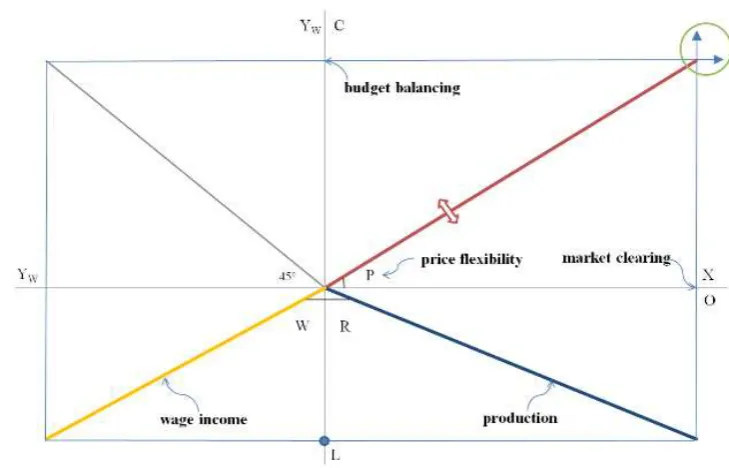
[image:3.595.120.485.404.638.2]This is done in the following with a straightforward graphical demonstration. For the rigorous formal underpinning and the full implications see (2013b). Figure 1 shows the simplest possible configuration of the pure consumption economy.
Figure 1:The price in the pure consumption economy in periodt=1 is objectively determined by the conditions of market clearing and budget balancing. Legend:Pprice,Lemployment,W wage rate,YWwage income,Cconsumption expenditure,Rproductivity,Ooutput,Xquantity bought At any given level of employmentL, the wage incomeYW that is generated in the
rateW. On the real side output follows by multiplication with the productivity. Finally, the price follows as the dependent variable under the conditions of budget balancing, i.e. C=YW, and market clearing, i.e. X =O. Note that the ray in
the southeastern quadrant is not a linear production function; the ray tracks any underlying production function. The same holds for the distribution of wage incomes in the southwestern quadrant. All these details are not needed at the moment.
It can be directly read off from the four quadrant scheme that the real wageWP is always equal to the productivityR, that is, labor gets the whole product, no matter what. If the wage rate is lowered, the market clearing price falls. If the number of working hours is increased the price remains constant, provided productivity does not change. If productivity decreases the price rises. In any case, labor gets the whole product and profit is zero, or in Walras’s terms, there is ‘ni bénéfice ni perte’, neither profit nor loss. So far, all are agreed:
The consensus to date has been that it is mathematically impossible for capitalists in the aggregate to make profits. (Keen, 2010, p. 2)
There is also explicit assent from economic methodology.
. . . since it is impossible to have an economy where everyone is making profits. Aggregate profit for an entire (closed) economy must be zero, hence if any firm is making profits, some other firm must be making losses. (Boland, 1992, p. 80)
The weak spot in the otherwise impeccable zero-profit argument is that aggregate profit has been greater than zero for most of the time in most of the known market economies up to the present. Hence Figure 1 is the first but not the last word in the theory of profit.
The crucial point is this: there exists no such thing as an immutable law of budget balancing in thesameperiod. Just the contrary. Logically, we havethreepossible cases in the next period:C2<YW2, C2=YW2, C2>YW2. The first case means
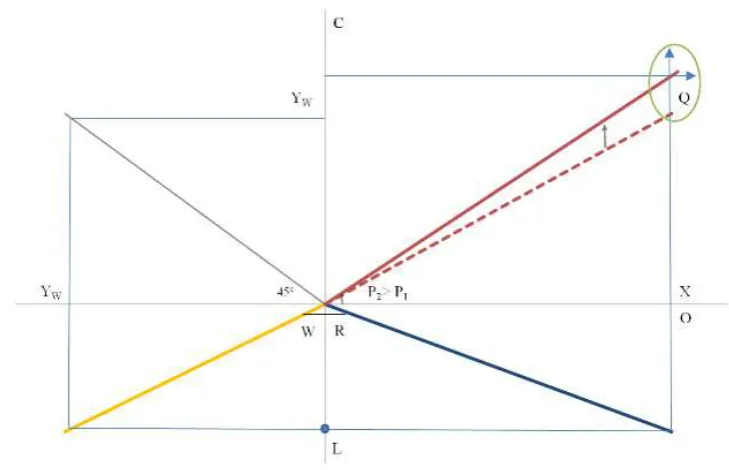
loss, the second zero profit, and the third profit. Figure 2 shows an example for the third case which has, compared to the others, the best evolutionary prospects in the real world.
Figure 2: Monetary profit in periodt=2 is objectively determined by the difference between consumption expenditure and wage income under the condition of market clearing, irrespective of what the agents optimize or, for that matter, what economists think about profit
has to be redeemed some day. This eventuality is not at issue here (for details see 2013a).
In the case of Figure 2 monetary profit is given asQ2≡C2−YW2in the northeastern
quadrant. Profit takes the form of money in the bank and remains in the business sector in the period under consideration, i.e. profit is retained (this incidentally answers the old chestnut M–C–M+, see Keen, 2011, p. 217). Due to the higher market clearing price the real wage is now lower than the productivity.
In the next period, profit is distributed and the household sector’s total income is accordingly: Y3=YW3+YD3. If profit is fully distributed we haveYD3=Q2, i.e.
distributed profit in periodt=3 is equal to profit in periodt=2. Profit in period t=3 is in the general case:Q3≡C3−YW3+YD3. This solves the long-standing
profit puzzle. The Profit Law is the first of the far reaching implications of Figure 2. Note that profit and distributed profit is not the same thing and that both arenever equal in reality. Note also that the Profit Law, when augmented with investment, foreign trade, and government, is directly testable.
References
Boland, L. A. (1992).The Principles of Economics. Some Lies my Teacher Told Me. London, New York, NY: Routledge.
Kakarot-Handtke, E. (2012). The Common Error of Common Sense: An Essential Rectification of the Accounting Approach.SSRN Working Paper Series, 2124415: 1–23. URLhttp://ssrn.com/abstract=2124415.
Kakarot-Handtke, E. (2013a). Redemption and Depression. SSRN Working Paper Series, 2343561: 1–28. URLhttp://papers.ssrn.com/sol3/papers.cfm?abstract_id=
2343561.
Kakarot-Handtke, E. (2013b). Understanding Profit and the Markets: The Canonical Model.SSRN Working Paper Series, 2298974: 1–55. URLhttp://papers.ssrn.com/ sol3/papers.cfm?abstract_id=2298974.
Keen, S. (2010). Solving the Paradox of Monetary Profits. Economics E-Journal, 4(2010-31). URLhttp://dx.doi.org/10.5018/economics-ejournal.ja.2010-31.
Keen, S. (2011).Debunking Economics. London, New York, NY: Zed Books, rev. edition.
Keynes, J. M. (1973). The General Theory of Employment Interest and Money. The Collected Writings of John Maynard Keynes Vol. VII. London, Basingstoke: Macmillan. (1936).