An Inexact Implementation of Smoothing Homotopy
Method for
Semi-Supervised Support Vector Machines
Huijuan Xiong, Feng Shi
College of Science, Huazhong Agricultural University, Wuhan, China Email: [email protected]
Received January 12, 2013; revised February 16, 2013; accepted February 25, 2013
ABSTRACT
Semi-supervised Support Vector Machines is an appealing method for using unlabeled data in classification. Smoothing homotopy method is one of feasible method for solving semi-supervised support vector machines. In this paper, an in- exact implementation of the smoothing homotopy method is considered. The numerical implementation is based on a truncated smoothing technique. By the new technique, many “non-active” data can be filtered during the computation of every iteration so that the computation cost is reduced greatly. Besides this, the global convergence can make better local minima and then result in lower test errors. Final numerical results verify the efficiency of the method.
Keywords: Semi-Supervised Classification; Support Vector Machines; Truncated Smoothing Technique; Global Convergence
1. Introduction
In the field of machine learning, it’s essential to collect a large amounts of labeled data for the purpose of train- ing learning algorithms. However, for many applica- tions, huge number of data can be cheaply collected, but manual labeling of them is often a slow, expensive and error-prone process. It’s desirable to utilize the unlabe- led data points for the implementation of the learning task. The goal of semi-supervised classification is to employ the large collection of unlabeled data jointly with a few labeled data to finish the task of classification and prediction [11,18].
Semi-supervised support vector machines (S3VMs) is an appealing method for the semi-supervised classifi- cation. In [7], K.P. Bennett et al. first formulated it as a
mixed integer programming such that some state-of- the-art softwares can handle the formulation. Since that, a large number of methods have been applied to solve the non-convex optimization problem associated with S3VMs, such as convex-concave procedures [5], non-differntiable methods [1], gradient descent method [13], continuation technique [12], branch-and-bound algorithms [7,14], and semi-definite programming [17] etc. A survey of these methods can be seen from [11,18].
As pointed out in [12], one reason for the large number of proposed algorithms for S3VMs is that the resulting optimization problem is non-convex that generates local minima. Hence, it’s necessary to find better local minima because better local minima tend to lead to higher pre-
diction accuracy. In [12], a global continuation tech- nique is presented. In [21], a similar global smoothing homotopy method is given. However, both the method is experiential and the calculations are lengthy.
The focus of this paper is giving a new efficient im- plementation of the smoothing homotopy method for the S3VMs. In Section 2, we first introduce the new S3VMs model used in [21] and list two smoothing functions called aggregate function and twice aggregate function respectively. The two smoothing functions are given to approximate the nonsmooth objective function (the de- tailed discussion of these two smoothing functions can be seen from [4]). And then the smoothing homtopy method solving S3VMs is recalled. In Section 3, the new trun- cated smoothing technique is established to give a more efficient pathfollowing implementation of the smoothing homotopy method. The new technique is based on a fact that, some “non-active” data do little effect on the value of the smooth approximation functions with their gra- dients and Hessian during the computation, as a result, these “non-active” data can be filtered by the new trun- cated technique to save the computation cost. With the inexact computation technique, only a part of original data is necessary during the computation of every itera- tion. In the last section, Two artificial data sets with six standard test data from [10] are given to show the effi- ciency of our method.
two vectors x and y in the n-dimensional real space
will be denoted by
n
R T
x y. For a matrix ARm n ,
i
A
will denote the th row of i A. For a real number , a
a denotes its absolute value. For a vector xRn, 1
x denotes its 1-norm, i.e., 1
1
n i i
x x
, xdenotes its infty-norm, i.e.,
1
max i
i n
x x
. For an index set I , I denotes the element number of it. For a
given function f R: n
R , if is smooth, itsgradient is denoted by
f
f x
, if is nondifferential, denote its subdifferential as
f
f x
.
2. Semi-Supervised Support Vector
Machines
There lies several formulations for S3VMs such as the mixed integer programming model by K.P. Bennett et al.
[7], the nonsmooth constrained optimization model by O.L. Mangasarian [5], and the smooth nonconvex pro- gramming formulation by O. Chapelle [13] and etc. Here we mention the contributions by O. Chapelle et al. in
[11-14]).
Given a dataset consisting of m labeled points and p
unlabeled points all in , where the labeled points are represented by the matrix
n
R m
m n
A R
B R
, p unlabeled
points are represented by the matrix and the labels for
p n
A are given by diagonal matrix
of 1. The linear S3VMs to find a hyperplane mm T D
x b
far away from both the labelled and unlabeled points can be formulated as follows:
T 2
1 1 2 2
,
T
1 1
1
, ,
min 2
1 1
s.t.
b
p m
i ii
i i
b C f b C f b
B b D
p m
,
(1)
where
1 1
1
, m max 0, i ,
i
f b f
b
2 2
1
, p max 0, i ,
i
f b f
b
1 ,
i
f b and f2i
,b
are loss functions corres-ponding to the labeled data and unlabeled data respec- tively and defined as follows,
T
1i , 1 ii i
f b D A b
T2i , 1 i
f b B b
where T
i
B b
denotes the absolute value of . The constraint is called balanced constraint that is used to avoid unbalanced solutions which classify all the unlabeled points in the same class.
T
i B b
For arbitrary vector , there lies an equivalent relation between its 1-norm and inf-norm in the sense
n
R
that 1 1
n 1, then the sum term of model (1)
can be substituted by the inf-norm form and model (1) can be reformulated as follows,
T 2
1 1 2 2
,
1 1
1
, ,
min 2
1 1
s.t. b
p m
T
i ii
i i
b C f b C f b
B b D
p m
(2)
where
1 1
1
, max 0, i ,
i m
f b f
b
2 2
1
, max 0, i ,
i p
f b f
b .
We rewrite the constraint into the objective as a barrier term and reformulate 2i
,
f b into its equivalent for-
mulation
T T
2 , m ,1
i
i i
in 1
f b B b B b , and
then obtain the following formulation that is our goal in the paper.
2
1 1 2 2 3
, 1
min , , ,
2
T
b b C f b C f b f b
where
1 , 1max 0, 1 ,
i
i m
f b f
b
1
2
2 , 1max 0, min 2 , , ,
i i
i p 2
f b f b f
b
1 T
2 , 1
i
i
f b B b
2 T
2 , 1
i
i
f b B b
T 23
1 1
1 1
,
p m
i i
i i
i
f b M B b D
p m
M is a barrier parameter.
If the dataset is nonlinear separable, we need construct a surface separation based on some kernel trick (detailed discussion of it can be seen from [2] and etc.). Denote
T ;A A B , assume that the surface we want to find is
,K x A ub= 0, where is usually taken as
Gaussian kernel function with the form of
, K
2
, exp
K x y xy
is the kernel parameter, . To find the nonlinear decision surface, we need to solve the fol- lowing problem:
m p
uR
T 2
1 1 ,
2 2 3
1
min , ,
2
, ,
u b f u b u u b C f u b
C f u b f u b
where
T
1 , 1max 0,1 ii i ,i m
f u b D K A A u b
2 ,f u b
T T
1
max 0,1 min i , , i ,
i p
K B A u b K B A u b
2 T 3 1 1 1 1, p i , m i
i i
i
f u b M K B A u b D
p m
2.1. Aggregate Function and Aggregate Homotopy Method
Aggregate function is an attractive smooth approximate the non- alities [6], math ith equilibrium constraints function. It has been used extensively for the
smooth min-max problem [4], variational inequ ematical programm w
(MPEC) [16], non-smooth min-max-min problem [6] and etc. In the following, we will utilize the approximate function with its modification to establish an globally convergent method, called as aggregate homotopy me- thod, for solving model (3) or (4).
In short, let x
, ,b s
n 1(or, x
u b s, , m p 1) and denote model (3) or (4)as the following unified formulation:
1
2
min
x f x f x
f x (5) where
1 1 1 1 2 2 2 1 T 1 1 1 12 2 3
2 2
2 2 3
max ,
max min , ,
1 , 2 , , i i m i i i p i i i i i i
f x f x
f x f x f x
f x x x f x
f x f x f x
f x f x f x
2 (6)
and
1
2
1 , 2 , 2 , 3
i i i
f x f x f x f x are defined as (3) or
(4).
Denote
1
2
2 min 2 , 2
i i i
f x f x f
condition of non-smooth optim know that the subdiffe
x , based on the
optimality ization theory
], we
in [9 rential of f1
x and
2
f x can be computed as follows,
1 T 1 2 2 ;1 , i i i i I xij i ij i I x
f x x A
2 j J2x
3
f x f
x (7)
f x
where
1
1 1, , : 1
i
I x i m f x f x
1
0,1 , 1
i i
i I x
2 1, , : 2
i
2
I x i p f x f x
2i 1, 2 : 2ij 2i
J x j f x f x
2
0,1 , 1
i i
i I x
20,1 , 1
i
ij ij
j J x
1 T 2 ;1 i if x B
2 1
2 2
i i
f x f
x
moreover, a point x
tion point of (5) if satisfying
can be called a stationary point or a solu 0 f x
.egate homotopy
To solve model ( by an aggr method, we first introduce the following two smoothing func-
5) tions,
1 1 1 , ln expi
f x f x t t
t
2 2
1
, , ln exp
i
i p
i m
f x t f x t t
t
where
(8)
i if x is defined as (6) and
21
22
2 , ln exp exp
i i
i f x f x
f x t t
t t . all
We c f1
x t, and f2
x t, as aggregate functionand twice a ate functio pectively. The two smoothing functions have many good properties suc s uniform approximation and etc. More details can be seen fr
ggreg n res
h a om [19].
Using above two uniformly approximations functions in (8), we define the following homotopy mapping:
0
0
, 1 x , 0
x
H x t t f x t t xx (9)
here 0 n
x R is an arbitrarily initial point and
, 1
, 2
,x x
w
x f x t f x t f x t
.
We call Equation (9) as an aggregate homoto
ntains hand
as
py equa- tion. It co two limiting problems. On the one
1
t , it has a unique solution xx0
of it ap
. O he other han , the solution pro hes to a st
n t ac d, as t0
ationary point of (5), i.e., a solution x satisfying
0 f x .
For given initial point a 0 s
x R note the zeros
point set of ggregate homotopy mapping , we de the a
0 , : 0,1
s x
H R R as
s
0,1 :
,
H x t
0 0 0
x x
H1 0 x t, R (10)
It can be proved that 0
1 0
x
H includes a smooth path
with no bifurcation points, starting from
0,1approaching to the hyperplane that lea solution of the original problem
3.
ath can be rocedure.
So tor algo-
rith n from [3,8] and
o
itial stepsize m stepsize 0
t
[21].
can be see
maximu
ds to a
Inexact Predictor-Corrector
Implementation of the Aggregate
Homotopy Method
The path-following of the homotopy p implemented by some predictor-corrector p
me detailed discussion on the predictor-correc m with the convergence
etc. In the following, we first give the framew rk of the predictor-corrector procedure in this paper, and then discuss how to make an inexact predictor-corrector im- plementation.
3.1. Predictor-Corrector Path-Following Algorithm
Parameters. in h0, hm,
minimum stepsize h, stop criteria 10 fo dure terminated, stop criteria N 0
r proce-
for Newton rector stopped, criteria
cor- 0
c
for judging corrector plane, counter Ni 0.
Data.
0, 0
1s
x t R ,
Step 0. hh0, d0
0; 1
, .Step 1. Compute a predi int 0
k
ctor po
k ,
k
x t
1) Solve the following linear eq
to obtain a unit tangent vector
uation 0 1
k ,
k
x t
1
T
d
0
DH
d
1 1
1
d d
d ; 2) hmin
hm,h
;
x k ,tk
x k ,tk
hd1;3) If tk 0 or tk 1,
2
h
h , return 2); else, go to to
Step 2;
p 2. Compute a corrector point
Ste
1
1 ,
k k
x t
1) If xk c, take d
0;1 and hmin ,
h h
;d . G 2)
2) Sol
else, take o to v 1 n
d
e equatio
;
T k
d x x
, 0,
H x t
;t tk 0
by Newton method with the stopping criteria N and go
to 3);
3) If Newton corrector fail, go to 2); else, denote the solution as
0.7
h h
1
, 1,
k k
x t , go to 4);
4) If tk11 or tk10, 2
h
h , go to 2); else, go to
5);
5) If tk 1, stop ; else d0d, k = k + 1
6) Ni Ni1 correcto
. If n number of
ewton r is l 3 o 7); else , go to 1); 7)
and the iteratio
N , go t
3
i
N
ess than 0
i
N , h1.5h; go to 1).
mputat
3. s solv
computation cost of them. we take the following ap ximate homotop
Notice that, the main co ion cost of Algorithm 1 lies in the equation er in Step 1) and 2), some inexact computation technique can be introduce to save the
pro y equation H x t
, with its Jacobian DH x t
, in place of the original H x t
,with DH x t
, during the computation of step 1) and 2).Given parameters 1
x t, 0, 2
x t, 0, denote
1, ,
M m , P
1, , p
,
1
2
1 , : 1 1 1 , ,
i
I x t M f x f x x t
1 2
2 2
2 2 2 2
1 1
,
2
2 3
,
p
, : , max , , ,
1
, ln exp ,
2
,
, ln exp
i i
i i
i P i T
i I x t
i
i I x t
i
f x f x
t t
2 , ln exp ex ,
i
f x t t
, go to 6);
I x t i P f x t f x t x t
f x
f x t x x t
t
f x t
f x t f x t
0
0
1 2
,
, 1 ,
1 , , ,
, ,
x
x x
t
H x t t f x t t x x
t f x t f x t t x x
H H
DH x t
x t
where
2
2
1 2
= 1 x , x , s
H
t f x t f x t t x
I
0
1 2
2 2
1 2
, ,
1 ,
x x
xt xt
H
,
x x f x t f x t
t
t f x t f x t
It’s proven in [20] that, only if the error
,
,H x t H x t and DH x t
, DH x t
,tly, 1
,are small enough, or equivalen x t and 2
x t,wton are chosen appropriately, the te Euler-Ne predictor-corrector also approaches to a solution of ori- omit the proofs.
approxima
ginal problem. Here we only list the main results and Denote
1 , , ,
E x t H x t H x t
and E2
x t, DH x t
, DH x t
, , d x t
, is the unit tangent vector obtained by the ap ate com- puproxim
predictor, we have the following lemma to guarantee the efficiency of the approximate tangent vector.
3.2. Lemma
For a given
x t, , if E2
x t, is small enough andsatisfies
2
2
2 ,, 2
E x t
cond DH O E x t
DH
imate unit predictor t
The approx angent vector d x t
,is effective, i.e., still makes a direction with
arclength increa
During the correction process, the following equation must be solved
, d x tsed.
, H x t
, 0F x t
(11)
T , 0, 0
d x t x t
where
0, 0
x t is an appropriate predictor point obtain-
ed from er predictor step. We adopt the fol- lowing approximate Newton method to solve (1
,
k k the form
1),
1
1 1
, , ,
k k k
k k k
x t x t F x t F x t (12)
From 0 is a regular value of where
11 k,
k
k DH x t
T
T 0
0
, ,
, ,
, ,
k
k k k
k
k k
F x t
d
H x t F x t
d x t x t
, H x t
, DH x triately, th
an is a unit tangent vector induced by , we kn w, if the step is chosen approp e equatio (11) has a solution and the approximate Newton iteration (12) is effective.
rrector d d
o n
h
3.3. Approximate Newton Co Convergence Theorem
Suppose that F x t
, 0 have solution
x t,
withnonsingular F
x t,
, there exists a neighborhood
, ,
S S x t and 10,20
0, 0
, for anyx t S , if for each k1, 2,, E
,k
t satisfying
1 ,
k k
x t and
E2 x k
1 1 2 , 2 ,
k k k
k k
E x x t F x t .
pproximate Newton iteration point se-
, ,
k k
x t from (12) is d con-
,
,tk ,E
Then the a
quence well efined and
verges to
x t .4. Numerical Results
In this section, somgiven to
cial da ets are generated first. The first one consists of 34 points generated by “rand” function, 14 of remaining 30 are seen as
e numerical examples and compari-
sons are illustrate the efficiency of our method. Two artifi tas
them are labeled and the
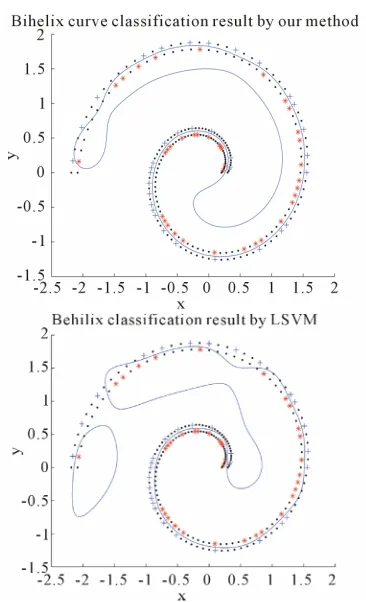
unlabeled data. The second one consists of 242 points taken from two nonlinear bihelix curves that are gene- rated by ab, where one is obtained by taking
0.2
a b , the other is by taking a0.2,b0.3,
0 :π 40 : 3π
[image:5.595.330.508.251.373.2] . We take randomly 30% of them as labeled and the remaining 70% as unlabeled. The com- parisons of our method with the LSVM method from [15] without the consideration of unlabeled data are given. Final results are illustrated in Figures 1 and 2.
Figure 1. Result on linear artificial data of LSVM and the new algorithm.
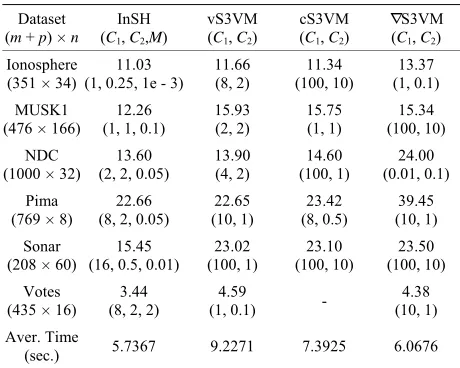
[image:5.595.330.513.407.708.2]To reveal the efficiency of our algorithm for S3VMs, comparisons of our algorithm (InSH) with some other existing algorithms for S3VMs such as the convex- concave procedure in [5] (vS3VM), the continuation method in [12] (cS3VM) and the gradient descent method in [13] ( 3VM), are given for some standard test data from [1 or the linear programming subproblem aris- ing in [5 we solve it with the Matlab function
[image:6.595.56.286.231.415.2]in optim tion toolbox. The comparison ted in the following Table 1.
Table 1. Comparison Results on test data (test error %).
S
0]. F ], iza
linprog
results are lis-
Dataset (m + p) × n
InSH (C1, C2,M)
vS3VM (C1, C2)
cS3VM (C1, C2)
∇S3VM (C1, C2)
Ionosphere (351 × 34)
11.03 (1,0.25,1e - 3)
11.66 (8,2)
11.34 (100,10)
13.37 (1,0.1) MUSK1
(476 × 166)
12.26 (1,1,0.1)
15.93 (2,2)
15.75 (1,1)
15.34 (100,10) NDC
(1000 × 32)
13.60 (2,2,0.05)
13.90 (4,2)
14.60 (100,1)
24.00 (0.01,0.1) Pima
(769 × 8)
22.66 (8,2,0.05)
22.65 (10,1)
23.42 (8,0.5)
39.45 (10,1) Sonar
(208 × 60)
15.45 (16,0.5,0.01)
23.02 (100,1)
23.10 (100,10)
23.50 (100,10) Votes 3.44 4.59
(435 × 16) (8,2,2)
(1,0.1) -
4.38 (10, A
1) ver. Time 5.7367 9.2271 7.3925 6.0676
(sec.)
-: denotes the method fails for the
s rfor er
r s Mat on W s
Core 2 Du U 1 z
pr and ega f m
n e ,
dataset.
All the computation are pe med on a comput unning the
Vista with
oftware Intel(R)
lab 7.0 (TM)
Microsoft o CP
indow .83 GH ocessor
computatio
1789 m , we tak
bytes o 0 0.
emory. Du
1
m
h ,
ring th
1e 3
e
1
h h ,
1 1e 3
, N 1e 3, c 1e 3,
3, 23 1e
, 2
C C 3,1e 2 , M
1e3,
cess e
2 are taken as th
kernel par
e one for the ameter
least test error. If ne ary, th
is mo
taken th best leads toe the leas t test error a ng
1e
exact in
1,3 e
s a
n dex
. Th et are t k
para et en as
m ers for dete r-mining the i
2 ln max t
1
1 2
2 2
ln 2 1 max p, q,1 , 1.
t m t
4 1
,1 , 1;
,
t
x t
m
where p2 1
t B
f ,
6 1 g f g 2 g
q t B B tB t B , Bf max
f1i
x
and Bg max max
A
. 2
x t, has the same ex-pression as 1
x t, where max
2
,
i f
B f x t and
max max
g
B B . 1 and 2 are taken as
1 2 1e 3
th are given to bound the error of at
HH and DH .
5. Acknowledgements
DH
The research was supported by the National Nature Sci- ence Foundation of China (No. 11001092) and the Tian- Yuan Special Funds of the National Natural Science Foundation of China (Grant No. 11226304).
REFERENCES
[1] A. Astorino and A. Fuduli, “Nonsmooth Optimization Techniques for Semi- pervised
ons on alysis and Machine I gence, Vol. 29, No. 12, 2007, pp.
doi:10.1109
Su Classification,” IEEE Transacti Pattern An ntelli-
2135-2142. /TPAMI.2007.1102
“A Tutorial on Support Vector Machines , “
[2] C. J. C. Burges,
for Pattern Recognition Data Mining and Knowledge
998, pp. 121-167. 555
Discovery, Vol. 2, No. 2, 1 doi:10.1023/A:1009715923
[3] E. L. Allgower and K. Georg, “Numerical Continuation Methods: An Introduction,” Springer-Vergal, Berlin, 1990. doi:10.1007/978-3-642-61257-2
[4] E. Polak, J. O. Royset and R. S. Womersley, “Algorithms with Adaptive Smoothing for Finite Minimax Problems,”
Journal of Optimization Theory and Application, Vol.
119, No. 3, 20
doi:10.1023/B:JOTA.0000006685.60019.3e03, pp. 459-484.
[5] G. Fung and O. Mangasarian, “Semi-Supervised Support Vector Machines for Unlabeled Data Classification,” Op- timization Methods and Software, Vol. 15, No. 1, 2001,
pp. 29-44. doi:10.1080/10556780108805809
[6] G. X., Liu, “Aggregate Homotopy Methods for Solving Sequential Max-Min Problems, Complementarity Prob- lems and Variational Inequalities,” PhD Thesis, Jilin Uni- versity, Jilin, 2003.
[7] K. Bennett and A. Demiriz, “Semi-Supervised Support Vector Machines,” In: M. S. Kearns, S. A. Solla and D. A. Cohn, Eds, Advances in Neural Information Processing Systems, MIT Press, Vol. 10, 1998, pp. 368-374.
7, pp. 281- [8] L. T. Watson, S. C. Billups and A. P. Morgan, “Algo- rithm 652 Hompack: A Suite of Codes for Globally Con- vergent Homotopy Algorithms,” ACM Transactions on Mathematical Software, Vol. 13, No. 3, 198
310. doi:10.1145/29380.214343
[9] M. M. Mkela and P. Neittaanmki, “Nonsmooth Optimiza- tin: Analysis and Algorithms with Application to Optimal Control,” Utopia Press, Singapore, 1992.
[10] P. M. Murphy and D. W. Aha, “UCI Repository of Ma- chine Learning Databases.
http://www.ics.uci.edu/ mlearn/MLRepository.html. [11] O. Chapelle, V. Sindhwani and S. S. Keerthi, “Optimiza-
tion Techniques for Semi-Supervised Support Vector Machines,” Journal of Machine Learning Research, Vol. 9, 2008, pp. 203-233.
roceedings of the Tenth
i, “Branch and
stianini, “Semi-Supervised Learning
Regularization [13] O. Chapelle and A. Zien, “Semi-Supervised Classification
by Low Density Separation,” P
Scho
International Workshop on Artificial Intelligence and Sta- tistics, Vol. 1, 2005, pp. 57-64.
[14] O. Chapelle, V. Sindwani and S. Keerth
[18]
Bound for Semi-Supervised Support Vector Machines,”
Advances in Neural Information Processing Systems 19,
Proceedings of the 2006 Conference, MIT Press, Cam- M
bridge, 2007, pp. 217-224.
[15] O. L. Mangasarian and D. R. Musicant, “Lagrangian Sup- port Vector Machines,” Journal of Machine Learning Research, Vol. 1, 2001, pp. 161-177.
[16] S. Birbil, S. C. Fang and J. Han, “Entropic Regularization Approach for Mathematical Programs with Equilibrium Constraints,” Technical Report, Industrial Engineering and Operations Research, Carolina, 2002.
[17] T. D. Bie, N. Cri
Using Semi-Definite Programming,” In: O. Chapelle, B.
lkopf and A. Zien, Eds., Semi-Supervised Learning,
MIT Press, Cambridge, 2006.
X. J. Zhu, “Semi-Supervised Learning Literature Survey,” Technical Report 1530, Computer Science, University of Wisconsin-Madison, 2005.
[19] X. S. Li and S. C. Fang, “On the Entropic
ethod for Solving Min-Max Problems with Applica- tions,” Mathematical Methods and Operations Research,
Vol. 46, No. 1, 1997, pp. 119-130. doi:10.1007/BF01199466
[20] Y. Xiao, H. J. Xiong and B. Yu, “Truncated Aggregate Homotopy Method for Nonconvex Nonlinear Program- ming,” Optimization Methods and Software, 2012, pp. 1-
ontrol Engineering,
18.
[21] H. J. Xiong and B. Yu, “Aggregate Homotopy Method for Semi-Supervised SVMs,” 2011 International Confer- ence on Electric Information and C