Munich Personal RePEc Archive
Digit Ratio Measurement Guide
Neyse, Levent and Brañas-Garza, Pablo
Kiel Institute for the World Economy, Middlesex University
Business School
5 March 2014
Digit Ratio Measurement Guide
Levent Neyse Pablo Brañas-Garza
Institute for the World Economy (IfW) [email protected]
Middlesex University London [email protected]
Abstract
Literature on Digit Ratio is rapidly growing in Economics. Quite surprisingly we observe that there is no consensus about how to make an accurate measurement in such a delicate task. Along this brief document we offer some concise guidance of how to scan the hands using digital scanners and provide a comprehensive guideline to make a reliable measurement of the 2D:4D. Furthermore, we point out the most common imaging and measurement errors. We also provide a number of hints aimed to avoid these errors that in some cases may cause systematic inaccuracies.
Keywords: 2D:4D; Digit Ratio; Measurement; Guide
Introduction
This paper is motivated by the lack of agreement about how we measure digit ratio
and also which hands to measure. 2d:4d studies in Economics have used various
methods so far. Brañas-Garza and Rustichini (2011) use photocopies of the right
hands, Garbarino et al. (2011) use scans and they measure the mean of both hands.
Turiegano & Sanchez-Pagés (2010)1 and Pearson & Schipper (2012) use the scans of
the right hand only. Recent papers have also shown that both hands –and not only the
right one- are providing valuable information about economic behavior (see
Brañas-Garza et al. 2013 and 2014). In fact, endocrinology studies claim that the left hand is a
more precise proxy of fetal exp -Cruz et al. 2012).
Since the measure depends on small units of length and is unobservable without using
a measurement tool, self-reported measurements have been argued to be invalid
(Brañas-Garza and Kovárík, 2013). The other options, like direct measurement or
1
photocopies, are also short of accuracy. Flatbed scanners appear to be the most
appropriate tools in terms of precision, practicality and costs.2
In the following we present a simple but thorough guide to measure both hands using
digital scans. We comment on the most common errors and we also provide a number
of hints aimed to avoid these issues.
Which Imaging Device?
Although there are various options (like direct measurement, photocopies or X-Ray)
digital scans are extremely useful in the measurement process. With image editing
softwares (i.e. Adobe Photoshop®) you can adjust the contrast of the images, crop,
sharpen, zoom in-out and work on it even pixel by pixel. Do you really need these?
Yes. At least for the 15% of your sample you need them. Because even if it seems like
everything went well in the scanning process, when you start to measure the ratios,
you realize slight differences between the images. These differences do not seem to
be large at the fi t ight nd y m y think th t th y “j t t nd d ”. B t
you should not forget that we are dealing not with centimeters but millimeters.
Therefore, even the slightest measurement deviation may end up being a falsely
measured digit ratio distribution in the overall dataset.
L t’ f n th t 15% f th mpl . Wh t are those differences between images? First of all, every individual has a unique body structure; therefore unique hand
shapes. Some have visible lines, some do not and also some lines are difficult to
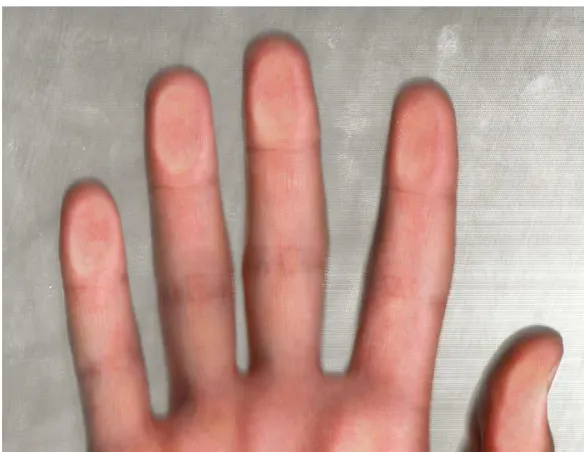
interpret (See Figure 1). With the software you can adjust the darkness and the
contrast of the image so that the lines may get clearer. “C v ” t l in Ph t h p® is
highly useful on this issue.3
Even if you make very clear instructions and check each image while scanning; there
always are scans where you cannot see the details. The participants sometimes push
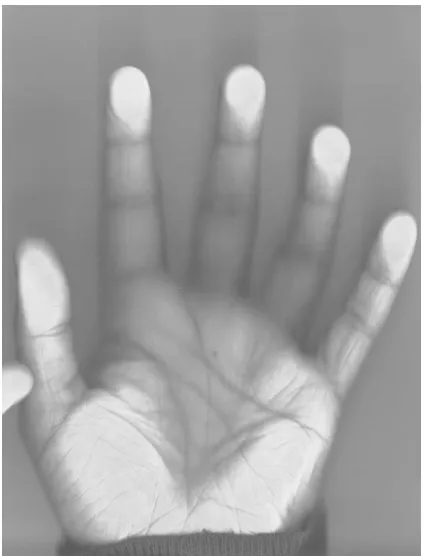
on the scanner too hard, or show their fingertips (See Figure 2) instead of their fingers
(so they create a gap between hand and the scanner). Participants also sometimes
2
Although we do not want to name any specific scanner brands, we obtained the best results by far with Epson Perfection 1660.
3
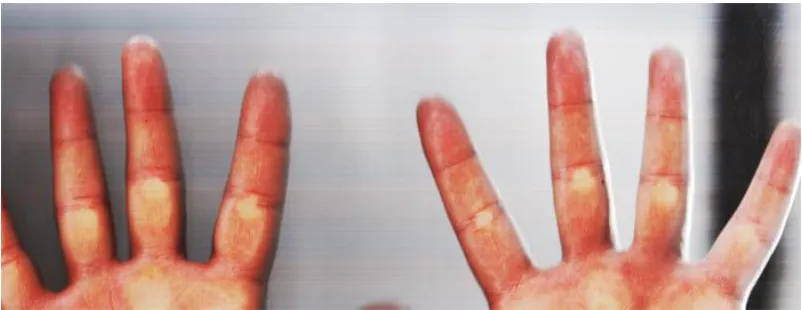
move their hands or fingers during the scan; so you find blurred images in the data
folder (See Figure 3).
Beside the other mentioned devices above, X-Rays are used to scan the hands of the
subjects (Manning et al., 2000; McIntyre, 2005). However, it is not common to have
an X-Ray machine in a non-medicine faculty or in the field. Furthermore, Institutional
Review Boards (IRB) are relatively hesitant about approving X-Rays due to radiation
exposure. Although the impact of radiation is reducible and it is way less harmful than
the other imaging techniques (i.e. tomography), ethical concern due to a slightly rising
cancer risk in excessive radiation exposure (See Gonzales & Darby 2004) is a
[image:4.595.151.443.315.541.2]substantial reason behind the rigor of IRBs.4
Figure 1: A difficult measurement: The lines are not clear.
Photocopies, on the other hand, are always tricky. The quality is usually low and even
with a digital caliper it is not that easy to make an excellent measurement. But if you
do not have an option in the field for instance or you happen to find photocopies on
your desk with such a note from a colleague “Wh t n w d b t th ?” you must
find a solution. That solution is to scan all of the photocopies and do whatever you do
with the scanning method.
4
Direct measurement with a digital caliper does not give you the option to re-measure
and it is more difficult to make an accurate measurement if the hand is not on a 2D
[image:5.595.192.404.165.443.2]surface as in the images.
Figure 2: An incorrect scan: Lines are not visible.
Scanning Hands in Practice
Check the hands first
Now we will present some information about how to proceed. At the end of the
d m nt y will find “ h k li t”.
Make sure that the participant does not wear any jewelry like a shiny ring. It may
reflect the light in the scanner and ruin the scan. In some cases the ring may leave a
mark on the skin. You can wait a bit and ask the participant to rub her/his hand a bit
after taking off the ring.
Some participants (mostly students) forget to clean some “notes” they wrote on their
Some participants may have a hand injury or a broken finger. Ask them if they had
[image:6.595.90.491.172.327.2]any injuries in the past. Exclude them from the dataset if they had.
Figure 3: An incorrect scan: Finger tips are not visible
Give Brief Information
We usually explain to the subjects what we n d: “We are trying to measure your
finger lengths. We are not taking your fingerprints. So, please do not push the scanner
with your fingertips. Just place both your hands firmly on the scanner; making sure
that the scanner can capture a clear image of your hand. And please do not move your
hand until we y .”5
ID Number
We should be extremely cautious with anonymity when measuring digit ratio. Since
you cannot work with the names in the dataset, you can give a number to each subject
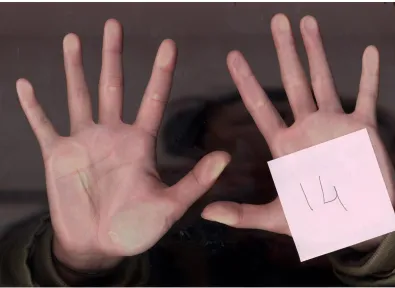
and stick this id number with a paper (i.e. Post-it) in the palm (see the example
provided in Figure 4).
5
Recall that this paper must not cover the bottom creases of fingers. With id numbers
as such M1234, F1235 you can record the gender of the participant. It is also a quite
good idea to save the file using the same id number.
Recall that putting the letter F or M in the beginning of the number is more practical
than putting it in the end. You can sort the data easier in the dataset.
Scan!
Place the both hands of the subjects on the scanner, making sure that all the fingers
are straight and visible. The hands do not have to be at the same angle so you can
place the hands as you like in order to place all the fingers on the flatbed properly.
Depending on your scanner you may want to cover the hands with a fabric cover or a
t-shirt. You do not have to close the cover of the scanner. But you will find your own
way depending on your scanner anyway. Please see previous Figure 2 and 3 to avoid
errors.
Now you can press the scan button and wait. The participants usually ask, “Wh t i
thi b t?” in those 10 seconds. And you say, “Th t di gg ting m
l ti n b tw n xp im nt l lt nd fing l ngth ”. Thi xpl n ti n i
usually enough.
Check Together
Check the image right after the scan together with the participant. So, if there is
anything wrong with the scan, you can explain the problem and re-scan. In the case
that you get a scan like shown in Figure 3 you may need to run the whole procedure
once again.
If nothing is wrong you must have a nice picture like shown in Figure 4 or Figure 5.
Save the image in two different folders in the computer just in case. .jpg, .jpeg or .pdf
are the most common file extensions that we use.
Since you are going to need to connect experimental results with the scans you can
use a unique id number in the experiment and in the scans. It is better to rename the
image right after the scan with this id number. Participant can go now. A sample of a
Figure 4: Correct Scan
[image:8.595.91.486.431.719.2]We usually clean the scanner glass after each scan with a towel or a fabric in order to
provide subjects a relatively hygienic scan.
Measurement
Digital measurements
In Photoshop© th i “ l t l” n m lly n th l ft h nd id f th n. If
n t, y n ight li k th “ y d pp t l” nd h th l t l th . Y n
switch on the toolbox f m th “wind w” m n b v th n if it is not on.
You can change the rotation of the image here: Image>Image Rotation
Zoom in the picture as much as you like. You can change the measurement units
(cm-mm-pix l t ) in “p f n ”.
Make sure that you use a unique unit for the whole sample. If you start with the pixels
do not switch it back to cm again in that sample. Since you are dealing not with
absolute values but with ratios, you can use any unit in the end.
A m nti n d b v “ v ” t l i quite handy when it is difficult to interpret the lines in the hand or the scan quality is not good enough.
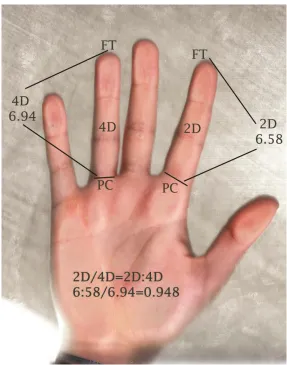
L t’ g t started with the measurement. Figure 6 provides some additional help to do the measurement:
For the ring finger take the first line in the basal crease. Click on the median of
the line, right in the middle. Then click on the fingertip carefully. Sometimes
the shadow of the finger or the fingernail can be misleading. What
Photoshop© does is to measure the distance between two reference points. On
the top of the screen; below the menu buttons you see many numbers
measuring many things. The number we see next to L1 is the number we are
looking for.
For the index finger, follow the same procedure. But this time the line is a bit
less clear in the basal crease. Try to find the best point in order to draw a
straight line up until the fingertip.
Now save these numbers. Dividing the length of index finger to the length of ring
Figure 6: Digit Ratio Measurement
Measure Once Again
After finishing the whole sample, do not touch the measurements for a day or so.
Then re-measure everything. It is a common procedure. If the measurements are
correct you will find at least 90-95% correlation between the sets of two ratios. You
can use the mean of these two ratios in the dataset as well.
Some Important Points
1- Digit Ratio is an ethnicity-related value. So focus on only one race. If your
sample is mostly Caucasians for example, you should exclude the
non-Caucasians in the dataset. You should have this information from the
participants. You can simply add the list in to the questionnaire (which you
are differences across count i ’ inf m ti n g th ing t hniq . O
research provided us various racial subgroups. For convenience we abstracted
the list as: Caucasian, African, Mid-A i n Indi , P ki t n…), E t-Asian
Chin , K , J p n…) nd Mix d. Th th bg p h
Carribean, Eskimo et cetera. So, you may want to define your own list
depending on your sample.
2- Scan both hands. Although there are many papers reporting only right hands
now you need to report the results for both hands in many journals. Scan both,
just in case. As noted before, papers have also shown that both hands –and not
only the right one- are providing valuable information about economic
behavior (see Brañas-Garza et al. 2013 and 2014).
3- Some of the files are saved too large. Especially when they are in PNG format.
Recall that when you import these files not one by one but 10 by 10 in
Photoshop© for instance. If an image is, say 75MBs, the measurement will
take more time. A high-resolution scanner is a must but you do not need to
excess 300dpi and a width of 2400 pixels.
Box 1: Check List
1- No rings, clean hands, no ring
marks on the skin.
2- Ask if the subject has had any
hand injuries before. Like a
broken finger etc.
3- Scan the hand with the id
number so that it will be easier
to integrate it in the dataset.
4- Add gender information to the
id number.
5- Save the information about
race.
6- Place the hands on scanner
firmly.
7- Cover the hands with a fabric
or a black t-shirt if necessary.
8- Check the image together with
the participant; if necessary
scan again.
References
Bosch-Domènech, A., Brañas-Garza, P., & Espín, AM. 2014. Can exposure to
prenatal sex hormones (2D:4D) predict cognitive reflection
Psycho-neuroendocrinology, forthcoming.
Brañas- z , P., K vář k, J., & N y , L. 2013. S nd-to-fourth digit ratio has a
non-monotonic impact on altruism. PLoS ONE8(4), e60419.
Brañas- z , P., & K vář k, J. 2013. Digit Ratios and Social Preferences. A
comment on Buser, unpublished.
Brañas-Garza, P., & Rustichini A. 2011. Organizing Effects of Testosterone and
Economic Behavior: Not Just Risk Taking. PLoS ONE 6(12): e29842.
de González, A. B., & Darby, S. (2004). Risk of cancer from diagnostic X-rays:
estimates for the UK and 14 other countries. The Lancet363(9406), 345-351.
Garbarino, E., Slonim, R., & Sydnor, J. 2011. Digit Ratios (2d:4d) as Predictors of
Risky Decision Making for Both Sexes. Journal of Risk and Uncertainty 42(1): 1-26.
0.1007/s11166-010-9109-6.
-Cruz E, Huguet J, Piqueras M. 2012. Second to fourth digit ratio, adult testosterone level and testosterone deficiency. British Journal of Urology
International109(2): 266- 71.
Manning, J. T., Trivers, R. L., Thornhill, R., & Singh, D. (2000). The 2nd: 4th digit
ratio and asymmetry of hand performance in Jamaican children. Laterality 5(2),
121-132.
McIntyre, M. H., Ellison, P. T., Lieberman, D. E., Demerath, E., & Towne, B. (2005).
The development of sex differences in digital formula from infancy in the Fels
Longitudinal Study. Proceedings of the Royal Society B: Biological Sciences
272(1571), 1473-1479.
Pearson, M., & Schipper, B. 2012. The Visible Hand: Finger Ratio (2D:4D) and
Competitive Bidding. Experimental Economics 15, 510-529.
Sanchez-Pagés, S., & Turiegano, E. 2010. Testosterone, Facial Symmetry and
Cooperation in the Prisoners' Dilemma. Physiology & Behavior 99(3): 355-361.