ISSN Online: 2152-7261 ISSN Print: 2152-7245
The Carbon Emissions Efficiency and Marginal
Abatement Cost in Urban of China:
Non-Parametric Directional
Distance Function Method
Jing Zhao
Jinan University, Guangzhou, China
Abstract
This paper estimates the CO2 marginal abatement cost of 286 cities in China
based on non-parametric directional distance function method for the period of 2002-2013. We compared the results according to different perspectives, such as the areas, the Gross Domestic Product (GDP) per capita and the en-vironmental and non-enen-vironmental cities. The results show that the CO2
marginal abatement cost differs obviously among cities and it’s higher in eastern area than in middle and western area which indicates that the abate-ment potential is bigger in middle and western area.
Keywords
Non-Parametric Directional Distance Function, DEA, Marginal Abatement Cost
1. Introduction
As we all know, China’s economy has made significant progress since the reform and opening up. But with the rapid economic growth, China’s carbon emissions are also growing, and now China has become one of the countries who give the biggest contribution to the carbon dioxide emissions [1]. Therefore, how to coordinate the contradiction between carbon dioxide emissions and economic development has become a major problem of sustainable development in China. China’s government has proposed that the carbon dioxide emissions of per unit of GDP should reduce by 40% - 50% by 2020 compared to emissions in 2005. However, there are many differences in the economic development and resource endowment between regions and cities due to the large size of China, so the
es-How to cite this paper: Zhao, J. (2017) The Carbon Emissions Efficiency and Mar-ginal Abatement Cost in Urban of China: Non-Parametric Directional Distance Func- tion Method. Modern Economy, 8, 386- 396.
https://doi.org/10.4236/me.2017.83028
Received: January 3, 2017 Accepted: March 4, 2017 Published: March 7, 2017
Copyright © 2017 by author and Scientific Research Publishing Inc. This work is licensed under the Creative Commons Attribution International License (CC BY 4.0).
http://creativecommons.org/licenses/by/4.0/
timation of urban marginal abatement costs can help the government to formu-late more effective carbon trading mechanism which will promote the imple-mentation of carbon reduction policies more effectively.
Many literatures about the shadow of the price have been made by scholar home and abroad and the direction distance function has become the main me-thod to estimating shadow prices. The directional distance function was pro-posed by Chung et al. whose basic idea is to include both the good output and the bad output into the model [2]. That’s to say the method not only taking the increase in output into account but also the reduction of bad output, and only when good output cannot continue to expand, mean while bad output cannot continue to shrink, the observation is at the frontier efficiency.
According to the existing literatures, there are two methods to estimate the directional distance function: Parametric method and nonparametric method. The parameterization method needs to select the appropriate model to estimate the directional distance function according to the purpose of the study. There-fore, different models will get different estimating results. Färe et al. used the parametric method to estimate the shadow price of pollutants for the first time on the basis of the Shephard output distance function [3]. Marklund et al. calcu-lated the marginal carbon abatement costs of EU member states based on the parameterized output distance function [4]. Park and Lim estimated the cost of carbon abatement for thermal power plants in Korea based on the logarithmic distance function [5]. Chen S. Y estimates the CO2 shadow prices of different
industries in China by using parametric and nonparametric methods [6]. Wei C
analyzed the cost and influence factors of carbon abatement in 104 cities of Chi-na based on the model [7]. And in his another literature, he estimate marginal CO2 abatement costs at the provincial level in China, and fitted the marginal
emission reduction cost curves based on the results [8].
Unlike parametric methods, non parametric methods based on DEA non-pa- rametric approach do not require a specific form of function and specific input and output prices, so it has been widely used in the current literatures. Chamber et al. and Chung et al. proposed the nonparametric directional distance function based on DEA first to study environmental performance and shadow prices in-cluding unintended outputs [9]. Boyd et al. and Lee et al. developed the method of calculating shadow prices for unintended outputs in the absence of technolo-gy [10] [11]. Kaneko et al. calculated the cost of SO2 emission reduction in
Chi-na’s thermal power industry based on the nonparametric directional distance function [12]. Tu Z. G used non-parametric directional distance function to calculate the shadow price of industrial sulfur dioxide in China [13]. Liu M. L et al. estimated the performance of China’s provincial carbon emissions and the cost of carbon abatement based on DEA directional distance function [14].
286 prefecture-level cities in China during 2002-2013 and provide a more prac-tical theoreprac-tical basis to a perfect carbon trading system.
2. Methodology
This paper use the DEA-based directional distance function to estimate the CO2
the carbon dioxide emission performance and shadow prices in 286 cities of China.
2.1. Output-Oriented Distance Functions
Consider a joint-production process in which a productive entity employs the input vector
(
1,)
N
k N
x = x x ∈R+ to produce the desirable output vector
(
1,)
Mk M
y = y y ∈R+ and the undesirable output vector
(
1,)
J
k J
b = b b ∈R+.
The input vector often includes both energy and non-energy inputs, and the undesirable output vector includes a variety of pollutants or/and green house gases. The joint production process can be modeled by an environmental pro-duction technology, which may be represented by an output possibility set
( ) ( )
{
, : can produce( )
,}
P x = y b x y b (1)
In the joint-production process, inputs and the desirable output are generally assumed to be strongly or freely disposable, which can be respectively expressed as follows [15]:
( )
( )
implies
x′≥x P x′ ⊇P x (2)
( )
y b, ∈P x( )
and imply y′≤ y(
y b′,)
∈P x( )
(3)The strong disposability indicates that inputs and good output can be in-creased or dein-creased without bearing any costs.
Under the circumstance of environmental regulations, the undesirable out-puts cannot be freely disposable, i.e. the productive entity has to undertake a cer- tain amount of cost to reduce the undesirable outputs. Furthermore, the unde-sirable outputs will be inevitably produced unless the entire production process is terminated. The two important assumptions, which are respectively referred to as weak disposability and null-jointness, make the production technology to be an environmental production technology (or polluting technology). Mathe-matically, the two assumptions can be respectively given by
( )
y b, ∈P x( )
and imply 0≤ ≤θ 1 ,(
θ θy b)
∈P x( )
(4)( )
( )
if y b, ∈P x and 0, b= then 0y= (5)
Distance functions are often employed to characterize the environmental production technology described above. Recently, the directional distance func-tion has received increasing attenfunc-tion in energy and environmental performance measurement mainly owing to its flexibility. Following Chung et al. [2] and Färe et al.[16], we formulate the directional output distance function as follows:
(
, , , y, b)
max{
:(
y, b)
( )
}
D x y b g −g = β y+βg b−βg ∈P x (6)
where
(
gy,−gb)
is the directional vector that indicates the direction by whichfunction that measures the largest amount by which b and y can be respectively deflated and inflated given x. The smaller of the value of β, the more efficiency the unit is. If β = 0, then the unit is on the frontier of production and is perfectly efficiency. If β > 0, it means that the good output should be expanded and the bad output should be cut. Following Minglei Liu, we use the value of β to esti-mate the CO2 emission efficiency of cities [14].
Shephard or directional distance function can also be evaluated by data enve-lopment analysis (DEA). DEA is a popular nonparametric technique for perfor-mance evaluation. In energy and environmental studies, DEA has been widely used to benchmark energy and CO2 emission performance. Following Lee and Kaneko, β, the value of directional distance function can be estimate by the fol-lowing linear program under the condition of under constant returns to scale
[11] [12]:
(
, , , ,)
k k k k y b k
D x y b g −g =Max
β
(7)s.t.
1
n
j j k j x x λ = ≤
∑
1 nj j k k y
j
y y g
λ β = ≥ +
∑
1 nj j k k b
j
b b g
λ β
=
= −
∑
0,j 1, 2, n
λ ≥ =
where λ refers to intensity column vector.
2.2. The Marginal Abatement Costs
The shadow price of the j-th bad output can be specified as Färe et al. [3]:
(
)
(
)
0 0 , , ; . , , ; j j m mD x y b g b
q p
D x y b g y
∂ ∂
= − ∂ ∂
(8)
In a perfect competitive market, the observed market price of them-th good output equals its absolute shadow price pm. Consequently, we can represent the
shadow price for the j-th bad output by the product of our normalizing price of
m-th good output and the marginal transformation rate between j-th bad output and m-th good output. The shadow price specification in Eq. (8) captures the loss value in terms of ym when cutting bj marginally on the boundary of
P(x). It reflects the trade-off relationship between bad output and tradable good output and thus can be treated as the marginal abatement cost [4] [8].
3. Variables and Data
The data covers 286 cities for the period of 2002-2013. The production of GDP (Y) requires capital stock (K), labor force (L), and energy consumption (E) as inputs and, as a byproduct, yields one undesirable output, CO2 emission (B).
2) The data on energy consumption are collected from the China Energy Sta-tistical Yearbook, including electricity consumption, gas and liquefied petroleum gas consumption, transportation consumption and heat consumption.
3) The capital stock is unavailable in any statistical yearbook, and therefore, we have to estimate this using the following perpetual inventory method [17]:
(
)
, , 1 , 1
i t i t i i t
K =I + −δ K − (9)
where Ii t, , δi and Ki t, represent gross investment, depreciation rate, and
capital stock for province i at time t, respectively. All serial data are converted to 2002 prices.
4) The data on CO2 emission at the city level are not available. Based on the
consumption in four sectors, the total CO2 emission can be calculated. The gas
and liquefied petroleum gas consumption emission and the heat emission can be calculated directly based on the criteria published by the International Panel on Climate Change (IPCC) (2007). Following Glaeser and Kahn, there is only one emission factor for each regional grid and China Power Grid is divided into North China, Northeast China, East China, Central China, Northwest and South six regional power grid and the regional grid baseline emission factor can be get from the China Energy Statistical Yearbook [18]. So we estimate the electricity emission based on the baseline and emission. Following Hongqi Li, we can esti-mate the transportation emission based on the certain proportional relationship between energy consumption intensity and carbon emission intensity of various transportation modes [19]; both values are obtained from the China City Statis-tical Yearbook and the China StatisStatis-tical Yearbook.
Table 1 lists the descriptive statistics for the variables.
Based on GDP and calculated CO2 emissions, we estimate the intensity of CO2
emissions in each city. The Figure 1 shows the carbon intensity during 2002- 2013 in eastern, central and western respectively. The result reflects that the in-tensity of carbon emissions in the eastern region is the lowest, and always lower than the national average level, while the carbon emissions intensity in central and western regions over 2002-2013 is always higher than the national average. Especially the western region, the highest carbon intensity in this area reaches 1. 63 tons/million, showing that the pressure of reducing emissions is still large. However, the energy intensity of carbon emission in China and the three regions is basically declining in the period of 2002-2013 which shows that a series of emission reduction policies implemented by the government have achieved a certain positive effect.
4. Results
Based on the DEA model, we obtain the corresponding distance function values and the shadow price of CO2 for each city and make analyses as follows.
4.1. Carbon Emission Performances
the frontier of production and the smaller the value, the better the emission per-formance is. Therefore, this paper analyzes the perper-formance of China’s cities’ CO2 emissions based on distance function values and the results are shown in
Figure 2.
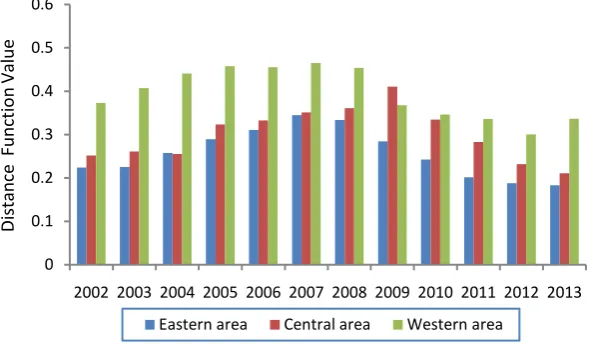
From the comparison of the three regions, the value of the distance function has a great relationship with the degree of economic development in this area. The average distance function value of the economically developed eastern re-gion in 2002-2013 is always the smallest and there are many cities on the fron-tier. For example, there are 15 cities whose distance function values are zero in
Table 1. Descriptive statistics of the variables.
Input and output
Labor force consumption Capital stock Energy GDP CO2 emission
(10,000 persons) (10,000 Ton) (100 million) (100 million) (10,000 Ton) Mean 76.64 223.25 2108.34 860.53 976.40 Std.dev. 101.00 396.78 3663.99 1310.34 1561.85
Max 1382.58 5028.05 48,779.50 17,174.13 17,681.66
Min 6.00 7.00 12.23 24.03 18.00
[image:6.595.227.523.544.716.2]Figure 1. The carbon densities in three areas of China during 2002-2013.
Figure 2. Distance function value of three areas in China during 2002-2013.
0 0.2 0.4 0.6 0.8 1 1.2 1.4 1.6 1.8
2002 2003 2004 2005 2006 2007 2008 2009 2010 2011 2012 2013
C
a
rb
o
n
D
en
si
ty(
to
n
/10,
000yu
a
n
)
Year
National average Eastern area
Central area Western area
0 0.1 0.2 0.3 0.4 0.5 0.6
2002 2003 2004 2005 2006 2007 2008 2009 2010 2011 2012 2013 Eastern area Central area Western area
Di
st
an
ce
F
un
ct
io
n V
al
2013 totally and 13 cities belong to the eastern region. In addition, throughout the study period, Suzhou and Ningde are always located on the frontier, and the distance function has always been zero. Followed by the central region, Xuchang has the highest carbon emission efficiency in this area and its distance function value the other years are all zero in addition to year of 2003 and 2013. The value of the distance function is the highest in the western region, where is relatively backward in economic development and its average distance function value during 2002-2013 is more than 0.4. This indicates that the eastern region is the most efficient in carbon emissions compared to the central and western regions. That’s to say, the central and western regions, especially the western region, have significant potential for reducing emissions.
However, the distance function values of the three regions all shows a de-creasing trade after 2006. This phenomenon indicates that in one hand China’s carbon emission reduction policy has achieved positive results and carbon emis-sions efficiency is improving; in another hand it reflects that China's carbon emission abatement space is gradually declining and the task of reducing emis-sions may become more and more difficult.
4.2. CO
2Marginal Abatement Costs
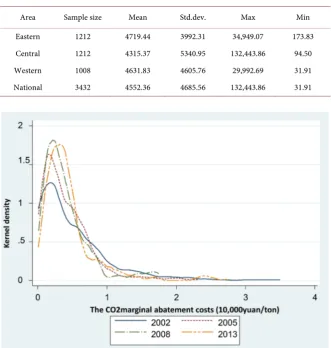
Table 2 describes the CO2 marginal abatement costs in the three regions.
Ac-cording to the mean of the marginal cost of emission reduction in the three re-gions, the eastern and western regions are all higher than the national average, while the central region is relatively low and is below the national average. The estimating of nuclear kernel density of each city’s marginal emission abatement cost can reflects its general distribution and four years’ emission reduction data are choose to estimate the nuclear kernel density. The results are shown in Fig-ure 3. From Figure 3, we find that the kernel density curve gradually shifted to the right with time. The distribution of the CO2 marginal abatement costs was
highly concentrated at 2500 yuan/ton level in 2002, while it increases to 3600 yuan/ton in 2013. This indicates that the mean and variance of the cities’ mar-ginal abatement costs have been on the increase since 2002.
Figure 4 shows the estimating results of the CO2 marginal abatement costs in
intensity shows that there is a large potential for the cities to reduce emission and the economic costs of emission reduction is relatively lower.
Table 2. Descriptive statistics of the CO2 marginal abatement costs.
Area Sample size Mean Std.dev. Max Min
Eastern 1212 4719.44 3992.31 34,949.07 173.83 Central 1212 4315.37 5340.95 132,443.86 94.50 Western 1008 4631.83 4605.76 29,992.69 31.91 National 3432 4552.36 4685.56 132,443.86 31.91
[image:8.595.210.531.527.703.2]Figure 3. Kernel density evolution of the CO2 marginal abatement costs.
Figure 4. The CO2 marginal abatement costs of three areas in China.
0 1000 2000 3000 4000 5000 6000
2002 2003 2004 2005 2006 2007 2008 2009 2010 2011 2012 2013
CO
2
m
ar
g
in
al
ab
at
em
en
t co
st
s
Year
Eastern area Central area
For the change trend, the eastern and central regions and the country's carbon marginal abatement cost tend to be the same and can be divided into three phases. The first stage is from 2002-2005.The abatement costs in the above areas are all showing a downward trend in this period and it’s much more obvious in the eastern where the average abatement cost of decreased from about 5437 yu-an/ton in 2002 to about 4363 yuyu-an/ton in 2005, with a25 percent decline rate. The second stage is from 2005 to 2008. The marginal abatement costs of the above regions are basically stable during this stage and the costs of eastern are very close to those of nation. The last stage is from 2008 to 2013. Abatement costs in this period are beginning to show a trend of growth. Although there is a short decline to 4385 yuan/ton in 2012, they have shown a more substantial growthto 5314 yuan/ton in 2013, increasing about 21%. This growing trend of abatement costs indicates that as the implementation of China's "11th Five-Year" plan and energy conservation and emission reduction policies, reducing emis-sion becomes more and more difficult in the whole nation. However, the west-ern region’s abatement cost shows a different trend and can still be divided into three stages. The first phase is from 2002-2004. In this period, the marginal ab-atement costs reduce from 5340.61 yuan/ton to 4478 yuan/ton. The second phase is 2004-2005. The cost shows a slight increase in 2005 and reach to 4738 yuan/ton. The last stage is from 2005-2013. The marginal abatement cost at this stage basically shows a stable development trend. This steady trend shows that the impact of the “energy saving and emission reduction” program in the west-ern region is relatively small compared to the eastwest-ern and central regions. Be-sides, the carbon intensity and distance function values in western region are relatively higher, indicating that the western region exists greater potential and space to implement mitigation measures.
5. Conclusions
The World Bank has made estimates that the greenhouse gases produced by energy consumption in cities of China take around 70% of the total greenhouse gas emissions in the whole China. Therefore, it’s necessary for China to control greenhouse gas emissions and implement energy-saving and emission reduction policies in cities. In this paper, we use the parameterized directional distance function to estimate the CO2 emission efficiency and marginal abatement of 286
prefecture-level cities in China covering years from 2002 to 2013 and draws con-clusions as follows.
1) There are obvious differences in CO2 emission efficiency among the three
west-ern region are less development both in economy and technology and there is still much space to improve. That means that the emission reduction potential in western region is the largest, while the eastern region is the smallest. But the ab-atement cost of the three regions shows an increasing trend year by year overall, indicating that a series of carbon emission reduction measures implemented in recent years have played a role and at the same time it means that the difficulty of continuing to reduce emissions is growing.
2) The CO2 marginal abatement costs are also very different in the three
re-gions. The marginal costs of the cities in eastern region are always higher than the national average and are basically higher than 4000 yuan/ton which means that if the government continues to reduce emissions in these regions, they will pay a higher economic cost. The central and western regions have relatively lower emission abatement costs. In particular, the costs in central region are al-ways lower than the national average except for the year of 2013 and the average abatement cost of Yangquan in Shanxi province is only 340 yuan/ton. Although there is a rising trend in the region due to the increasingly stringent environ-mental regulation in the central region, the potential of emission reduction in the cities of this area is still larger compared to those of eastern area. Moreover, the marginal abatement costs of western cities are basically stable after 2005and the differences between the western and central region are decreasing year by year. Besides, the western region still has great potential for reducing emissions.
The results obtained in this paper may provide some references for the im-plementation of carbon policy in China. The statistics show that in the first two years of the 12th five-year plan (2011-2012), China’s energy intensity fell by 2.02% and 3.62% respectively which are all smaller than the defined target about 3.7%. Based on the above analysis, a one-size-fits-all carbon reduction policy is extremely unfavorable to the economically developed cities in eastern region and the government should take into account the specific conditions of each city in formulating specific emission reduction policies. For example, there are obvious differences in emission abetment costs among the three regions so that the east-ern region where has relatively higher abatement cost should continue to main-tain the existing economic development mode to promote economy develop-ment and buy emission permits to achieve emission reduction targets at the same time using the carbon trading mechanism. While the central and western regions should continue to improve the technical level to improve energy effi-ciency and to achieve the goal of energy-saving and emission reduction.
References
[1] BP. Statistical Review of World Energy, 2011.
[2] Chung, Y.H., Färe, R. and Grosskopf, S. (1997) Productivity and Undesirable Out-puts: A Directional Distance Function Approach. Journal of Environmental Man-agement, 51, 229-240. https://doi.org/10.1006/jema.1997.0146
[4] Marklund, P.O. and Samakovlis, E. (2007) What Is Driving the EU Burden-Sharing Agreement: Efficiency or Equity? Journal of Environmental Management, 85, 317- 329. https://doi.org/10.1016/j.jenvman.2006.09.017
[5] Park, H. and Lim, J. (2009) Valuation of Marginal CO2 Abatement Options for Electric Power Plants in Korea. Energy Policy, 37, 1834-1841.
https://doi.org/10.1016/j.enpol.2009.01.007
[6] Chen, S.Y. (2010) Shadow Price of Industrial Carbon Dioxide: Parametric and Nonparametric Methods. World Economy, No. 8, 93-111.
[7] Wei, C. (2014) CO2 MarginalAbatement Costs of Urban in China and Its Influen-cing Factors. World Economy, No. 7, 115-141.
[8] Wei, C., Ni, J. and Du, L. (2012) Regional Allocation of Carbon Dioxide Abatement in China. China Economic Review, 23, 552-565.
https://doi.org/10.1016/j.chieco.2011.06.002
[9] Chambers, R.G., Chung, Y. and Färe, R. (1996) Benefit and Distance Functions.
Journal of Economic Theory, 70, 407-419. https://doi.org/10.1006/jeth.1996.0096
[10] Boyd, G., Molburg, J. and Prince, R. (1996) Alternative Methods of Marginal Ab-atement Cost Estimation: Non-Parametric Distance Functions. Argonne National Lab., IL (United States). Decision and Information Sciences Div.
[11] Lee, J.D., Park, J.B. and Kim, T.Y. (2002) Estimation of the Shadow Prices of Pollu-tants with Production/Environment Inefficiency Taken into Account: A Nonpara-metric Directional Distance Function Approach. Journal of Environmental Man-agement, 64, 365-375.https://doi.org/10.1006/jema.2001.0480
[12] Kaneko, S., Fujii, H., Sawazu, N., et al. (2010) Financial Allocation Strategy for the Regional Pollution Abatement Cost of Reducing Sulfur Dioxide Emissions in the Thermal Power Sector in China. Energy Policy, 38, 2131-2141.
https://doi.org/10.1016/j.enpol.2009.06.005
[13] Tu, Z.G. (2009) The Shadow Price of Sulfur Dioxide Emission in Industry: A New Analytical Framework. Economics Quarterly, 9, 259-282.
[14] Liu, M.L., Zhu, L. and Fan, Y. (2011) Estimation of China’s Provincial Performance of Carbon Emissions and Estimation of Marginal Emission Reductions: Based on Nonparametric Distance Function Method. Soft Science of China, No. 3, 106-114. [15] Färe, R. and Primont, D. (2012) Multi-Output Production and Duality: Theory and
Applications. Springer Science & Business Media, Berlin.
[16] Färe, R., Grosskopf, S. and Pasurka, C.A. (2007) Environmental Production Func-tions and Environmental Directional Distance FuncFunc-tions. Energy, 32, 1055-1066.
https://doi.org/10.1016/j.energy.2006.09.005
[17] Zhang, J., Wu, G.Y. and Zhang, J.P. (2007) Estimating China’s Provincial Capital Stock. Working Paper Series, China Center for Economic Studies, Fudan Universi-ty, Shanghai.
[18] Glaeser, E.L. and Kahn, M.E. (2010) The Greenness of Cities: Carbon Dioxide Emissions and Urban Development. Journal of Urban Economics, 67, 404-418.
https://doi.org/10.1016/j.jue.2009.11.006
[19] Li, H., Lu, Y., Zhang, J., et al. (2013) Trends in Road Freight Transportation Carbon Dioxide Emissions and Policies in China. Energy Policy, 57, 99-106.
Submit or recommend next manuscript to SCIRP and we will provide best service for you:
Accepting pre-submission inquiries through Email, Facebook, LinkedIn, Twitter, etc. A wide selection of journals (inclusive of 9 subjects, more than 200 journals)
Providing 24-hour high-quality service User-friendly online submission system Fair and swift peer-review system
Efficient typesetting and proofreading procedure
Display of the result of downloads and visits, as well as the number of cited articles Maximum dissemination of your research work
Submit your manuscript at: http://papersubmission.scirp.org/