ISSN Online: 2151-4844 ISSN Print: 2151-481X
Efficient Energy Performance within
Smart Grid
Khizer Ayaz, Muhammad Sohail Sulemani, Naseer Ahmed
Department of Electrical Engineering, CIIT, Abbottabad, Pakistan
Abstract
The Smart Grid, regarded as the next generation power grid, uses two-way flows of electricity and information to create a widely distributed automated energy delivery network. Energy/power plays a critical role for social, eco-nomic and industrial development. Because of industrial generalization, espe-cially in agricultural and economical activities, the energy demand has in-creased rapidly in developed countries. Generation and usage of energy has direct impact on modern power grid. In this scenario energy management is a hard task because load is dynamic and we don’t have control over it. Renewa-ble or undepleted energy resources have great applications and impact in current electric power system situation. For example it gives pollution free (green) energy which is environment and user friendly. It is cost effective; it uses nat-ural resources for its generation and hence do not waste any coal, gas etc. There are many inducements to empower energy productivity. As current smart grid is complex and non linear in operation and design, it used an optimized me-thod that provides maximum efficiency with minimum input. Our work de-picts a case study of hybrid electric aircraft for achieving high performance.
Keywords
Smart Grid (SG), Demand Response (DR), Renewable Energy, Distributed Generators (DG)
1. Introduction
TRADITIONALLY, the term grid is used for an electricity system that may support all or some of the following four operations: Electricity generation, elec-tricity transmission, elecelec-tricity distribution, and elecelec-tricity control. Energy/ power is a vital input for economic and industrial evolution [1]. The fast advan- cement of world economy, power needs rushed exceptionally, specifically among developing states. SG responds to wide ranging events and has a number of
ca-How to cite this paper: Ayaz, K., Sulema-ni, M.S. and Ahmed, N. (2017) Efficient Energy Performance within Smart Grid. Smart Grid and Renewable Energy, 8, 75- 86.
https://doi.org/10.4236/sgre.2017.83005 Received: December 26, 2016
Accepted: February 28, 2017 Published: March 3, 2017
Copyright © 2017 by authors and Scientific Research Publishing Inc. This work is licensed under the Creative Commons Attribution International License (CC BY 4.0).
http://creativecommons.org/licenses/by/4.0/
tegorization due to its wide usage in various systems as smart electrical/power grid, sharp grid and imminent grid. SG is inducted in all energy power sources and in system of power and energy generations for optimum marketing, com-merce and better management. The core prospect is to bring both the active customer participation and decision making at one grid and creating a working environment for both utilities and electricity users to address each other. DRPs in the Utility field enhance consistency via distributed generation or energy sto-rage at substations, and overall giving the automated control to the grid [2]. SG measurement and verification resources work in a system of sensors, communi-cations system, computer hardware and software. The software’s enable moni-toring, communication and analysis of the consumption of energy resource in the entire grid by comparing it with software data for gauging the performance of the resource. The energy resource has to be present in the entire grid during the process of measurement and verification [3]. Efficient energy management and distribution is empowered through DR. A series of devices function collec-tively with advanced software system for enabling DR. The software assets in-clude AMI, communication systems, computerized building systems and com-plex devices. Measurement resources play an essential role of operating and running basic SG operations. These functions include automated meter reading and conveying cost signals. Validation, measurement and authentication are ad-ditional benefits and minimal amount is required for installation [4]. SG is a ro-bust and efficient system that ensures reliability, efficiency, flexibility and deliv-ers power in a controlled and smart way lowering peak demand. Investments are done in power sector to increase growth, development and to provide utility to consumers. By improving technology the grid will become a self-healing system and incorporating energy storage devices, renewable energy, and AMI and de-mand response programs will stabilize the grid. All these features of SG make grid resilient and suitable for existing energy demands and future needs.
2. Description
2.1. Advanced Metering Infrastructure (AMI)
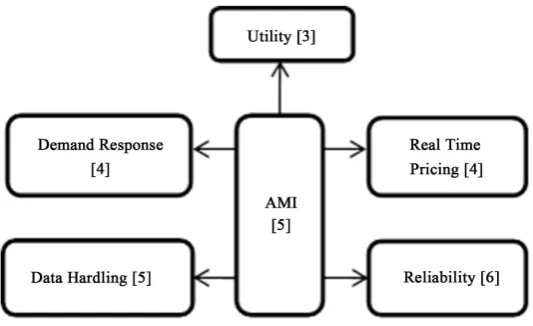
Figure 1. Advance Metering Interface (AMI).
2.2. Integration of Renewable Energy into SG
Demand of renewable has increased and 19 percent of the world electric energy share is of renewable energy out of which hydroelectric power makes 83 percent [8]. Shifting to renewable technology is necessary for green house security and to increase energy and resources security. As a result renewable energies and dis-tributed generation are getting assistance and their stakes in electricity genera-tion are increasing. Table 1 illustrates the benefits of renewable energy. The growing renewable production is the major concern for people working for de-velopment in SG system and the introduction of distributed generation to the electrical distribution system has been the key driver in the evolution of distri-buted system. However integration of renewables is not getting the desired mar-ket attention nor has participation in system management [9].
Renewable energy utilization in SG is increasing and supports the grid by im-proving power quality, reliability and reducing cost. Climate change has become a problem and to address this issue renewable energy resources are preferred and it provides grid stability [10].
2.3. Demand Response Programs (DRPs)
Table 1. Advantages and disadvantages of renewable energy.
Renewable Energy
Advantages Disadvantages Easily Regenerated [2] Weather Dependency [7] Boost Economic Growth [3] High Installation Cost [8]
Easily Available [4] Noise caused by Wind Energy [9] Support Environment [5] Fluctuation problem (Solar) [10] Low Maintenance Cost [6] Intermittency Issue (Wind) [11]
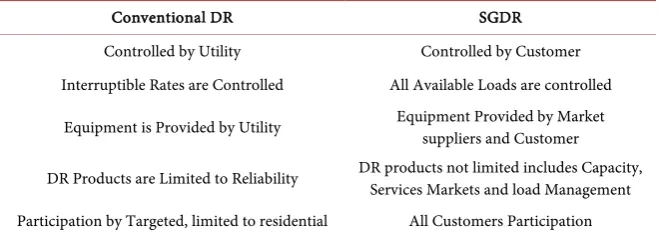
Table 2. Characteristics of traditional DR vs. SGDR [12].
Conventional DR SGDR
Controlled by Utility Controlled by Customer Interruptible Rates are Controlled All Available Loads are controlled
Equipment is Provided by Utility Equipment Provided by Market suppliers and Customer
DR Products are Limited to Reliability DR products not limited includes Capacity, Services Markets and load Management
Participation by Targeted, limited to residential All Customers Participation
2.4. System Operational Efficiencies
SG applications are designed to provide efficient electricity service and it pro-vides benefits to both consumer and utility. The benefits that result from these efficiencies include efficient real-time operations of electricity generation and additional services. Efficient use of capital investments for new infrastructures is done for the purpose of generation, transmission and distribution including effi-cient maintenance and administration. Since peak demands for electricity is quite higher than average level so SG should increase the consumption of assets. Asset utilization can assist in smoothing peak periods thus reducing the chances of emergency and producing electricity more efficiently. In distribution system SG technology can have considerable settlement to capital investments. DR schemes are synchronized with individual distribution feeders to lower peak loads thus controlling voltage efficiently [13] [14].
2.5. Grid Modernization for Increasing Efficiency
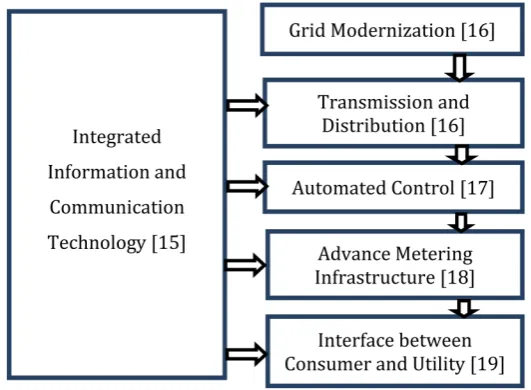
[image:4.595.210.540.241.360.2]and industry approach is needed to safeguard investment in new technologies that help achieve the benefits of the smart grid. Effective consumer protection and engagement is the basic need which will escalate the consumers demand for SG technologies and ensure utility and for the consumer [15]. Figure 2 illu-strates the characteristics of modernized grid and the relation of integrated in-formation and communication technology with modernized grid.
2.6. Concluding Remarks
SG possesses huge catalogue due to its expanded usage in various systems and is considered to be the future grid. SG technology by now has gained the key role for a well synchronized energy distribution and is inducted in all energy power sources and in system of power and energy generations for prime marketing, commerce and better management. The emission of CO2 is the concern for greenhouse and the concept of EVs along with SG has addressed the problem. The integration of renewable sources will be the next point of consideration. Sustainability plays essential role in efficiency. Operations should be sustainable and focus should be on use of clean energy and a healthier environment. SG ap-plications are intended to provide efficient electricity service and provide bene-fits to both consumer and utility.
3. Challenges in Energy Efficiency Modeling
[image:5.595.241.507.522.717.2]Energy efficiency modeling is of great concern within the field of smart grid (SG). The SG implementation needs variety of improving constraints and chal-lenges. Efficiency modeling is achieved by the implementation of optimization schemes. A massive information set is needed to assign totally different model-ing techniques on the principle of various constraints and challenges rismodel-ing in-side the field of smart grid. The definition to the optimization is that the proce-dure adopted to implement totally different techniques for locating conditions to maximize the profit or in alternative words to reduce the price of whole process.
Communication Infrastructure Complexity
The communication infrastructure of a SG is a system that is a combination of various systems and is very much complex. While modeling, analyzing and de-signing a communication infrastructure, a number of new challenges are re-quired to meet. As a way to describe emerging behavior, the communication models that are being proposed are required to have the ability of accounting for uncertainty. The numeric tools used to solve very large scale problems must have the capability to perform analysis. As a fact the power system is a non-li- near and very tightly coupled system [16] [17]. The communication infrastruc-ture will be designed specifically to degrade control system and time required to manage elastic or graciously uncertainties and inconsistencies. The complexity of a SG communications infrastructure modeling challenges are encapsulated as: It is not possible to easily simulate electrical sub-system as it is tightly intercon-nected (Required to aid multi-physics approach) [18]. While considering various factors (power flow, control, and communications) different users are required to work at the same scenario (need to support multidisciplinary approach) [19]. DG Integration Challenges
The integration of DG should be fastidiously investigated so as to attain opti-mum system performance. The DG integration could cause extra challenges in protection, reactive power management, and voltage fluctuation [19]. Moreover, the weather dependent nature of RER based DG raise the reliability concern of the system. Optimum system performance is achieved by careful investigation of DG integration. The DG is inserted within the area of enormous consumption the overloading conditions arise from low load density areas.
4. Case Study
Energy efficiency modeling is of great concern in the field of smart grid. De-pending on the type of energy management strategy selected, the energy man-agement system controls the power of each energy source devices through the reference signals (output voltage and maximum current). Efficient energy man-agement and distribution is empowered through different program and their control. For efficient energy management and distribution DR is introduced. Sustainability plays essential role in efficiency. A case study is presented here for analysis of high energy efficiency performance. A hybrid electric aircraft model is implemented for analysis, results came from model are discuss briefly. Figure 3 presents a block diagram of hybrid aircraft model, implemented in MATLAB.
Model results are analyzed and discuss. Results include: Signal generator/ builder
AC load stator current
Electromagnetic and electrical torques Armature current
Speed Characteristics
Figure 3. Block diagram of hybrid electric aircraft for high efficiency.
generally used in designing, testing, troubleshooting, and repairing electronic or electroacoustic devices, though it often has artistic uses as well.
There are many different types of signal generators with different purposes and applications and at varying levels of expense. These types include function generators, RF and microwave signal generators, pitch generators, arbitrary waveform generators, digital pattern generators and frequency generators. In general, no device is suitable for all possible applications.
Figure 4 represent power aircraft turbine signal. Signal magnitude varies with respect to time. At time 0, signal start from −5000 and grows linearly with time, at time 0.5 sec signal magnitude is 12,000 and is stable up to 2 sec, after that it decays to 10,000 than suddenly increases to 20,000 . Signal magnitude varies be-cause of dependency on too much factors and can be adjusted according to de-sired output.
A function generator is a device which produces simple repetitive waveforms. Such devices contain an electronic oscillator, a circuit that is capable of creating a repetitive waveform. (Modern devices may use digital signal processing to synthesize waveforms, followed by a digital to analog converter, or DAC, to produce an analog output). The most common waveform is a sine wave, but saw tooth, step (pulse), square, and triangular waveform oscillators are commonly available as are arbitrary waveform generators (AWGs). If the oscillator operates above the audio frequency range (>20 kHz), the generator will often include some sort of modulation function such as amplitude modulation (AM), fre-quency modulation (FM), or phase modulation (PM) as well as a second oscilla-tor that provides an audio frequency modulation waveform.
Figure 4. Signal generator for power aircraft distribution/mechanical engine (turbine).
Figure 5. AC load (stator) current.
at 2.5 section. Graph depicts that too much ripples occur in various time inter-vals, they are mainly due to dynamic load behavior and parameters configura-tion during implementing mode.
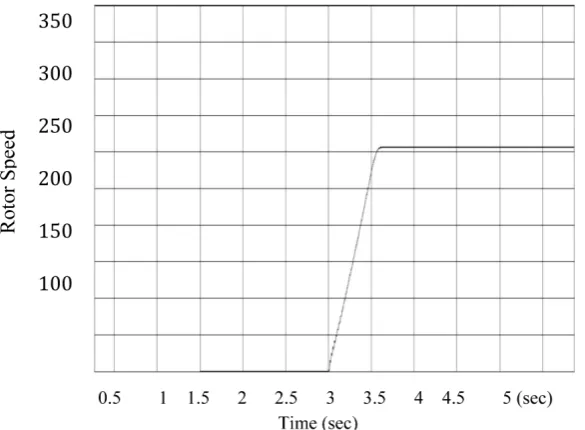
Figure 6 presents AC load rotor speed characteristics curve. From time inter-val 0 to 2.5 output rotor speed is zero due to opposition of current in inductive load and their exist no rotating field in that interval, current magnitude increases suddenly in 2.5 to 3.5 interval, rotating magnetic field produces that tends rotor to rotate and its speed increases up to certain limit in current scenario. During interval 3.5 to 5 and onwards rotor speed stabilizes as continuous current sup-plied through source.
Figure 6. AC load (rotor) speed characteristics.
Figure 7. Output characteristic of load.
Figure 8 describes electrical torque characteristic curve. Initially there is a peak at start after that speed become stabilizes so far torque is. Torque curve is straight for some time and then decay because of current reduction. It can be analyzed from torque curve that it has dynamic response, for lighter load current drawn is more and speed become increase and vice versa for heavier load.
Figure 8. Electrical torque characteristic curve.
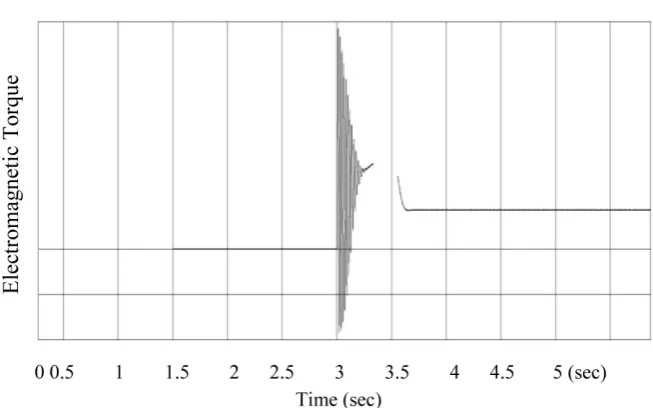
Figure 9. Output curve for electromagnetic torque.
5. Conclusion and Future Work
can be modeled as being voltage and frequency dependent instead of the passive constant impedance model used currently. All these questions will be a subject of our future research.
Acknowledgements
Authors are thankful to S. M. Ali for their fruitful comment and support throughout this paper.
References
[1] Vine, E. (2008) Breaking down the Silos: The Integration of Energy Efficiency, Re-newable Energy, Demand Response and Climate Change. Energy Efficiency, 1, 49- 63. https://doi.org/10.1007/s12053-008-9004-z
[2] Lee, T.-Y. and Chen, C.-L. (2009) Wind-Photovoltaic Capacity Coordination for a Time-of-Use Rate Industrial User. IET Renewable Power Generation, 3, 152-167.
https://doi.org/10.1049/iet-rpg:20070068
[3] Martiskainen, M. and Coburn, J. (2010) The Role of Information and Communica-tion Technologies (ICTs) in Household Energy ConsumpCommunica-tion/Prospects for the UK.
Energy Efficiency, 4, 209-221. https://doi.org/10.1007/s12053-010-9094-2
[4] Zhou, W., Lou, C., Li, Z., Lu, L. and Yang, H. (2010) Current Status of Research on Optimum Sizing of Stand-Alone Hybrid Solar-Wind Power Generation Systems.
Applied Energy, 87, 380-389. https://doi.org/10.1016/j.apenergy.2009.08.012
[5] Strupczewskim, A. (2003) Accident Risks in Nuclear-Power Plants. Applied Energy, 75, 79-86. https://doi.org/10.1016/S0306-2619(03)00021-7
[6] Skoglund, A., Leijon, M., Rehn, A., Lindahl, M. and Waters, R. (2010) Onthephysics of Power, Energy and Economics of Renewable Electric Energy Sources-Part II. Re-newable Energy, 35, 1735-1740. https://doi.org/10.1016/j.renene.2009.08.031
[7] Evans, A., Strezov, V. and Evans, T.J. (2009) Assessment of Sustainability Indicators for Renewable Energy Technologies. Renewable and Sustainable Energy Reviews, 13, 1082-108. https://doi.org/10.1016/j.rser.2008.03.008
[8] Lund, H. (2007) Renewable Energy Strategies for Sustainable Development. Energy, 32, 912-919. https://doi.org/10.1016/j.energy.2006.10.017
[9] Hepbasli, A. (2008) A Key Review on Exergetic Analysis and Assessment of Re-newable Energy Resources for a Sustainable Future. Renewable and Sustainable Energy Reviews, 12, 593-661. https://doi.org/10.1016/j.rser.2006.10.001
[10] Varun, Prakash, R. and BhatI, K. (2009) Energy, Economics and Environmental Impacts of Renewable Energy Systems. Renewable and Sustainable Energy Reviews, 13, 2716-3721. https://doi.org/10.1016/j.rser.2009.05.007
[11] Fan, Z., Kalogridis, G., Efthymiou, C., Sooriyabandara, M., Serizawa, M. and McGeehan, J. (2010) The New Frontier of Communications Research: Smart Grid and Smart Metering. Proceedings of the 1st International Conference on Energy-
Efficient Computing and Networking, Passau, 13-15 April 2010, 115-118.
https://doi.org/10.1145/1791314.1791331
[12] Woodruff, S.L. (2004) Complexity in Power Systems and Consequences for Real-Time Computing. IEEE PES Power Systems Conference and Exposition, New York, 10-13 October 2004, 1770-1775. https://doi.org/10.1109/psce.2004.1397733
[14] Soroudi, A., Ehsan, M. and Zareipour, H. (2011) A Practical Eco-Environmental Distribution Network Planning Model Including Fuel Cells and Non-Renewable Distributed Energy Resources. Renewable Energy, 36, 179-188.
https://doi.org/10.1016/j.renene.2010.06.019
[15] Kahraman, C., Kaya, I. and Cebi, S. (2009) A Comparative Analysis for Multiattri-bute Selection among Renewable Energy Alternatives Using Fuzzy Axiomatic De-sign and Fuzzy Analytic Hierarchy Process. Energy, 34, 1603-1616.
https://doi.org/10.1016/j.energy.2009.07.008
[16] Connolly, D., Lund, H., Mathiesen, B.V. and Leahy, M. (2010) A Review of Com-puter Tools for Analyzing the Integration of Renewable Energy into Various Energy Systems. Applied Energy, 87, 1059-1082.
https://doi.org/10.1016/j.apenergy.2009.09.026
[17] Sadegheih, A. (2010) A Novel Formulation of Carbone Missions Costs for Opti-malde Sign Configuration of System Transmission Planning. Renewable Energy, 35, 1091-1097. https://doi.org/10.1016/j.renene.2009.10.011
[18] Fang, X., Misra, S., Xue, G. and Yang, D. (2012) Smart Grid—The New and Im-proved Power Grid: A Survey. IEEE Communications Surveys & Tutorials, 14, 944-980. https://doi.org/10.1109/SURV.2011.101911.00087
[19] Phuangpornpitak, N. and Tia, S. (2013) Opportunities and Challenges of Integrat-ing Renewable Energy in System. Energy Procedia, 34, 282-290.
https://doi.org/10.1016/j.egypro.2013.06.756
Submit or recommend next manuscript to SCIRP and we will provide best service for you:
Accepting pre-submission inquiries through Email, Facebook, LinkedIn, Twitter, etc. A wide selection of journals (inclusive of 9 subjects, more than 200 journals)
Providing 24-hour high-quality service User-friendly online submission system Fair and swift peer-review system
Efficient typesetting and proofreading procedure
Display of the result of downloads and visits, as well as the number of cited articles Maximum dissemination of your research work