On Segmentation of Moving Objects by Integrating PCA
Method with the Adaptive Background Model
Noureldaim Emadeldeen, Mohammed Jedra, Noureldeen Zahid
Laboratory of Conception and Systems, Faculty of Sciences, Mohamed V University, Rabat, Morocco. Email: [email protected], [email protected], [email protected]
Received March 4th, 2012; revised April 1st, 2012; accepted April 12th, 2012
ABSTRACT
Tracking and segmentation of moving objects are suffering from many problems including those caused by elimination changes, noise and shadows. A modified algorithm for the adaptive background model is proposed by linking Gaussian mixture model with the method of principal component analysis PCA. This approach utilizes the advantage of the PCA method in providing the projections that capture the most relevant pixels for segmentation within the background mod-els. We report the update on both the parameters of the modified method and that of the Gaussian mixture model. The obtained results show the relatively outperform of the integrated method.
Keywords: Pixels; Gaussian Mixture Model; Principle Component Analysis; Background Model; Noise Process;
Segmentation
1. Introduction
Object segmentation is an important technique used in many systems, especially in the field of computer vision. Background subtraction which involves calculating a reference image, labels the pixels corresponding to fore-ground objects. N. Friedman and S. Russell were pro-posed a Gaussian mixture model (GMM) for the back-ground subtraction [1]. C. Stauffer and W. Grimson de-veloped an algorithm for foreground segmentation based on the Gaussian mixture model [2,3]. W. Grimson and et al used tracking information in multicamera calibration, for object detection and classification [4]. T. Bouwmans, F. ElBaf and B. Vachon surveyed the background mod-eling using mixture of Gaussians for object detection [5]. F. Zbu and K. Fujimura demonstrated a face tracking method using GMM and EM algorithm [6]. P. Kaew-TraKulPong and R. Bowden proposed a method to detect moving shadows using Gaussian mixture model. The shadow detection also reduces the effect of small repeti-tive motions in the background scene [7]. On the other hand, the binding ellipsis, due to S. Cheung and C. Ka-math is inappropriate for complex-shaped objects such as human beings. They used frame-differencing as it pro-duces minimal false foreground trails behind objects [8].
The principal component analysis is as a linear trans-formation filter. It can be used to simplify a dataset and creates new classifiers. H. Moon and P. Jonathan intro-duced a statistical pattern recognition PCA algorithm
work, we attempt to integrate the PCA method with Gaussian mixture. Accordingly, we link the Gaussian mixture with PCA to obtain the feature of the shape in the scenes and classification of each object.
The remainder of the paper is organized as follows: in the Section 2, we present adaptive background subtrac-tion algorithm based on Gaussian mixture model fol-lowed by PCA algorithm placed in the Section 3. The linkage between PCA and the adaptive model is ex-plained in the Section 4. The applications of the algo-rithm with their experimental results are presented with comments in the Section 5.
2. Gaussian Mixture Models
In the adaptive mixture of Gaussian in our work, the pixel processes is considered at time series. We consider each pixel as an independent statistical process, incorpo-rates all pixel observations. The mixture model does not distinguish components that correspond to background from those associated with foreground objects and record the observed intensity at each pixel over the previous N frames.
In the same manner as C. Stauffer and W. Grimson [3], we used the same number k of components (K = 3, 5). We consider the values of a particular pixel, with initial
0 x y0, 0
over time t and we can define the history of this particular pixel as
X1, , Xt
I
j1,j
:1 j t
, where I is the image sequence. The probability of pixels observation data X is defined as follows:
1 , *
, ,, ,
K
t k k t t k t k t
p X
W X
(1) where k t, is the weight of each component kth at time t,,
k t
W
is the mean and k t, is the covariance mixture of each component kth at time
t respectively, is aGaus-sian probability density defined as follows:
, , 1 , 1 , 2 2 , , 1 exp 2πt k t k t
T
t k t k t t k t
n k X X X
,
(2)
For simplicity we use k t, k
2I
, where I identity matrix. Next, we update the mixture of each pixel con-secutively by reading in new pixel values and update each matching mixture component. We initialize the pa-rameters W, and . They are updated for each frame in the mixture. We calculate W for each kth Gaussiancomponent in the mixture. When the current pixel value matches none of the distributions, the least probable dis-tribution is updated with the current pixel values. Then the parameters of the mixture are updated as follows:
, 1 * , 1
k t k t k t
W W M ,
(3)where the constant is a learning rate to update the components weights, Mk t, is a dummy variable with value 1 for matching models and 0 otherwise. We intro-duce the following criterion for screening the preliminary Gaussian matching distribution with Mahalanobis dis-tance less than a threshold T
1
2 , min
k
t k t
X T (4)
to collect the targeted pixels, with the update recursive equations
, 1 * , 1 *
k t p k t p k t
X , (5) and
2 2
, , 1
, , , ,
1
1 *
*
k t k t
T K
k t k t k t k t k
p
p X X
(6)where p *
Xt t, t
indicates how to accelerate the update. Thus, we can find the foreground resulted from the background and then find the best segment of the image. The non active background Gaussian is treated as foreground. In the ordering, we selected the ratios Wk k Large values of ratios are associated withdistributions which have a high weight, low variance. The first B distributions chosen under the expression:
3
, 1 arg minb bk k t
B
W T (7)where the threshold T is a prior probability estimated from the background process. Movements caused by the background (such as tree branches shaking, surface fluc-tuations, etc.) were considered to segment for the fore-ground objects.
3. Principle Component Analysis (PCA)
We used observation data X
Xi where i1, , N. First we consider each of the N frames in one color (R) such that we can define the frame vectors for fixed i with respect to the jth pixels index:, 1, ,
i i j
R r i N (8) The arithmetic average of pixels in each component for the Ni frame vector can be defined as follows:
, 1 1 Ni
i j
i
r
N
ri j (9)where ith is number of pixels in the frame i.
Next, we compute the difference i i i for the
ith image R r
i
1, , N
A
The covariance matrix of each frame vector is de-fined by: Ψ 1 1 N T i i i AA N
T (10)We compute the eigenvectors and corresponding ei-genvalues by:
V V
(11) Using Singular Value Decomposition (SVD) method, where V is the set of eigenvectors associated with the corresponding eigenvalues λ. To apply the method of PCA we need to define the projection i by applying
the translation matrix to the vectors S
T
V
Xiri
asfollows:
T
i i
S V X ri
(12) Next, we construct each frame to obtain the features of the shape. Then we can define the estimated data xˆi by:ˆi i
x V S r (13) One property of PCA is that the projection onto the principal subspace minimizes squared errors. To find the feature principal subspecies of PCA, the sequential re-construction errors are estimated from:
2
1 ˆ
N i i i X x
(14) the major advantage of the PCA method comes from its generalization ability. It reduces the feature space dimen-sion by considering the variance of the input data. This method determines which projections are referable for representing the structure of input data. Those projec-tions are selected in such a way that the maximum amount of information (i.e. maximum values of variances, where Eigenvalues represent the largest variances) is obtained in the smallest dimension of feature space.4. Extended Gaussian Mixture
Since the Gaussian mixture model does not vary greatly with illumination changes and noise, we propose in this study an algorithm based on linking PCA method with GMM.
We extend Gaussian mixture of observing pixel data
i
X from (1, 2), using the method of PCA. The estimated ˆ
x is obtained by projecting the data on the axis, then with the new data , t = 1, N, we propose to compute based on
tS such that:S S
tp X
1 , * ,ˆ ,,ˆ
K
t k k t t k t k t
p S W S
1
, , 1 , , ,
2 2 1 ˆ
, , exp
2π
ˆ
Tt k t k t n k t k t k t
S S
S(16) and again for simplicity we assume 2
, ˆ ,
ˆ
k t k tI
, where I is identity matrix. In linking PCA with GMM it is evi-dent that the integrated p S
t based on S
St byits physical structure, contains the maximum amount of information or has the minimum squared errors as com-pared to p X
t based on X
Xt of the GMM inhandling the limitation and shadow that contribute to noise in the adaptive Gaussian model.
To update each mixture of each pixel entails reading the new pixel values and select the matching components, then compute the mean obtained with ˆx and finally injecting that mean into the covariance of PCA method form (5, 6). Symbolically the update is based on:
, , 1
ˆk t 1 p *ˆk t p*xˆk t,
(17) and
2 2
, , 1 1 , , ,
ˆk t 1 p * ˆk t p* kK Sk t ˆk t T Sk t ˆk t,
(18) where p *
St ˆ ˆt, t
indicates how to acceleratethe update. In the integrated method we insert the esti- mates of the mean ˆi t, and covariance
ˆ
i t, of each component in PCA into GMM respectively. We simply select the components with largest weights and re-esti- mate with (7) as the follows:
, , 1
ˆ 1 * ˆ ˆ
k t k t k t
W W M ,
(19) And their Gaussian matching parameters must satisfy:
1
,
2 , ˆ , min
k t
k t k t
S T (20)
with the estimates the ratios Wˆk ˆk Large values of ratios are associated with distributions which have a high weight, low variance and first Gaussian distribu-tions:
ˆ B
3
, 1 ˆ arg min b ˆ
b k Wk t
B
T (21) Then for estimating the distribution of data by inte-grating PCA and mixture Gaussian, we need to perform both the appropriate partitioning of the component and the estimation of model parameters. We can perform this task successfully due to the important property of the PCA method.5. Experiment Results and Analysis
,
estimation of the mean in the feature space, and the dif-ferences between mean and each color were computed. detection: The first algorithm based on Gaussian mixture
model (GMM) and the second competing algorithm based on linking PCA with the adaptive background model.
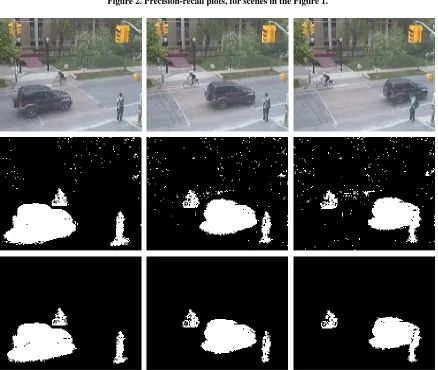
After we applied the PCA to solve the problem of Gaussian mixture and obtained improved result in the two cases, see Figure 1 and Figure 3, the performance
enhanced remarkably with the PCA-GMM proposed de-tection method.
In our experiment, each pixel is checked against the current frame of the background model by comparing it with every component in the Gaussian model under each
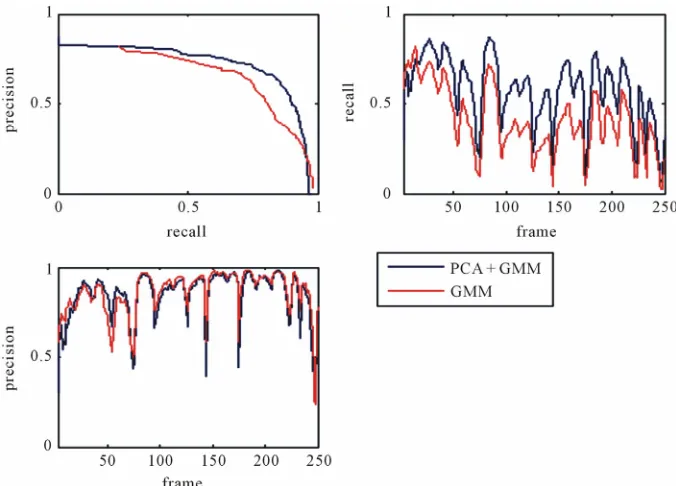
of the two algorithms. Clearly, the detection accuracy in terms of recall and precision of PCA + GMM method is consistently higher than the mixture of Gaussians approach, the GMM method, as illustrated by Figure 2 and Figure 4 that
show the perframe detection rates. For each of the GMM method and PCA-GMM method,
this process continues until a matching is found with k components (k = 3, 5). With changes in time, we used the data sequentially in the range 121 to 1000 frames and
parameters
0.0067
and
p0.005
. Consequently, the PCA + GMM method reflects more accurate detection of object results than the GMM method at each level of the proposed approach.The experiment resulted in two frame’s sequences in the different backgrounds (tree, lightness).The frame’s dimensions were 167 × 120. From Figure 1 and Figure 2,
it is obviously to observe the impact of the noise and lightness associated with GMM method.
6. Conclusion
As the appearance of scene varies with illumination changes and noise, it is difficult to separate and track objects in a dynamic scene environment. In this paper, we reported an application study based on a proposed Next we select each component of mixture model,
minimum reconstruction error over the data need to be estimated. After the selection of one color in data, the
[image:4.595.80.518.354.709.2]
Figure 2. Precision-recall plots, for scenes in the Figure 1.
[image:5.595.80.518.338.708.2]Figure 4. Precision-recall plots, for scenes in the Figure 3.
[7] P. KaewTraKulPong and R. Bowden, “An Improved Adaptive Background Mixture Model for Real-Time Tracking with Shadow Detection,” 2nd European Work-shop on Advanced Video Based Surveillance Systems (AVBS01), September 2001.
algorithm that links PCA and the Gaussian Mixture Model (GMM), to address this difficulty. The proposed algorithm has manipulated the variation to ease the seg-mentation of the foreground from the background. The study confirms that the proposed algorithm produces
relatively good results compared to GMM method. [8] S. Cheung and C. Kamath, “Robust Background Subtrac-tion with Foreground Validation for Urban Traffic Video,” EURASIP Journal on Applied Signal Processing, Vol. 14, 2005, pp. 2330-2340.
doi:10.1155/ASP.2005.2330
REFERENCES
[1] N. Friedman and S. Russell, “Image Segmentation in Video Sequences,” 13th Conference on Uncertainty in Artificial Intelligence, 1997, pp. 175-181.
[9] H. Moon and P. Jonathan, “Computational and Perform-ance Aspects of PCA-Based Face-Recognition Algo-rithms,” Perception, Vol. 30, No. 3, 2001. pp. 303-321. doi:10.1068/p2896
[2] C. Stauffer and W. Grimson, “Adaptive Background Mix-ture Models for Real-Time Tracking,” Proceedings of IEEE Computer Vision and Pattern Recognition, Vol. 2, 1999, pp. 246-252.
[10] H. Kim, D. Kim and S. Yang, “An Efficient Model Order Selection for PCA Mixture Model,” Pattern Recognition, 2003, pp. 1385-1393.
[11] B. Antoni, M. Vijay and V. Nuno, “Generalized Stauffer-Grimson Background Subtraction for Dynamic Scenes,” Journal of Machine Vision and Applications, Vol. 22, 2011, pp. 751-766.
[3] C. Stauffer and W. Grimson, “Learning Patterns of Activ-ity Using Real-Time Tracking,” IEEE Transactions on Pattern Analysis & Machine Intelligence, Vol. 22, No. 8, 2000, pp. 747-757. doi:10.1109/34.868677
[12] I. Gómez, D. Olivieri, X. Vila and S. Orozco, “Simple Human Gesture Detection and Recognition Using a Fea-ture Vector and a Real-Time Histogram Based Algo-rithm” Journal of Signal and Information Processing, Vol. 2, No. 4, 2011, pp. 279-286. doi:10.4236/jsip.2011.24040 [4] W. Grimson, C. Stauffer, R. Romano and L. Lee, “Using
Adaptive Tracking to Classify and Monitor Activities in a Site,” Proceedings of IEEE Computer Society Conference on Computer Vision and Pattern Recognition, 23-25 June 1998, pp. 22-29.
[13] Y. Sheikh and M. Shah, “Bayesian Modeling of Dynamic Scenes for Object Detection,” IEEE Transactions on Pat-tern Analysis and Machine Intelligence, Vol. 27, No. 11, 2005, pp. 1778-1792. doi:10.1109/TPAMI.2005.213 [5] T. Bouwmans, F. El Baf and B. Vachon, “Background
Modeling using Mixture of Gaussians for Foreground Detection,” Recent Patents on Computer Science, 2008, pp. 219-237.
[14] Y. Yong and W. Ya-Fei, “Moving Object Detection Based on Spatial Local Correlation,” China Academic Journal Electronic Publishing House, Opto-Electronic Engineering, Vol. 36, No. 2, 2009.
[15] R. Hassanpour, A. Shahbahrami and S. Wong, “Adap-tive Gaussian Mixture Model for Skin Color Segmenta-tion,” Proceeding of World Academic of Science Engi-neering and Technology, Vol. 31, 2008, pp. 1307-6884. [16] G. Rajkumar, K. Srinivasarho and P. Sribivasa, “Image