ISSN Online: 2153-0661 ISSN Print: 2153-0653
DOI: 10.4236/ica.2018.92004 May 30, 2018 52 Intelligent Control and Automation
Negative Imaginary Approached High
Performance Robust Resonant Controller
Design for Single-Phase Islanded Microgrid
and Its Voltage Observation on Different
Load Condition
Arnob Kumar Bairagi
1, Ahasan Habib
1, Rakib Rahman
1, Motiur Rahman
2, Moniruzzaman Jewel
3 1Department of Electrical and Electronic Engineering, Rajshahi University of Engineering & Technology, Rajshahi, Bangladesh 2Department of Electrical and Electronic Engineering, Bangladesh Army University of Engineering & Technology,Natore, Bangladesh
3Institute of Information and Technology, Jahangirnagar University, Savar, Bangladesh
Abstract
This paper presents the design of a high performance robust resonant con-troller for the islanded single-phase microgrid operation on different loads conditions. The design of the controller is done using the results of Negative Imaginary approach. The performance of the proposed controller has been found much effective to track the instantaneous reference grid voltage. The simulation work has been done with the help of MATLAB/SimPower System toolbox. This shows that the proposed controller provides effective control of voltage against the uncertain load conditions.
Keywords
Controller Design, Islanded Microgrid, Robust Voltage Control
1. Introduction
The necessity of continuous power supply to the load is increasing day by day. Due to this necessity the concept of Microgrid (MG) has come out. It is a part of distribution generation (DG) system [1]. The MG system is associated with low or medium distributed energy (DE) sources like wind turbines, PV (Photovoltaic cells), micro-turbines, fuel cells etc. This system is also related with consumer loads and energy storage systems (ESS) [2] [3].
How to cite this paper: Bairagi, A.K., Habib, A., Rahman, R., Rahman, M. and Jewel, M. (2018) Negative Imaginary Ap-proached High Performance Robust Reso-nant Controller Design for Single-Phase Islanded Microgrid and Its Voltage Obser-vation on Different Load Condition. Intel-ligent Control and Automation, 9, 52-63. https://doi.org/10.4236/ica.2018.92004
Received: April 21, 2018 Accepted: May 27, 2018 Published: May 30, 2018
Copyright © 2018 by authors and Scientific Research Publishing Inc. This work is licensed under the Creative Commons Attribution International License (CC BY 4.0).
DOI: 10.4236/ica.2018.92004 53 Intelligent Control and Automation
The Microgrid can be operated in two modes. They are the grid connected and the islanded (stand-alone) mode [3] [4]. In grid connected mode, the DG unit voltage and frequency are controlled by the central Main-grid. In this sys-tem, the main grid is connected with the microgrid with the help of PCC (Point of Common Coupling). Here all the power supply areas are served by the main grid’s determined voltage and frequency [4] [5]. In this mode, the DG units supply there real and reactive power by using dq current control strategy [6].
And the second one is Islanded (stand-alone) mode. This mode is activated when large type of disturbance like faults, voltage collapse or poor power quality in the main grid [6]. This mode is preferable for those areas where the main grid operation is not beneficial due to long transmission loss or where the continuous power supply is the most priority issue [7] [8]. During the pick power condition, the MG system provides uninterrupted power to that load.
In a microgrid system, different types of faults can be occurred during its op-eration period. But when these faults are removed, there appear sudden changes in voltage level. This sudden change in voltage can cause large variation of vol-tage level during its transient period [8] [9]. For this, proper automated control system is essential.
Various strategies have been proposed in the recent years for the control of dc microgrid. Among then the droop control, hierarchical control, proportion-al-resonant (PR) control, PID control etc. are most effective.
The most well-known control technique for microgrid is the droop control technique. This is used for voltage and frequency control [10]. It ensures proper power sharing among the DG units. As it generally uses parallel inverters so that this can provide balancing power for both the grid connected and islanded oper-ation of microgrid [11] [12]. But the main problem with this technique is that when it operates any dynamic loads then the voltage and frequency become un-stable and this limits the power sharing accuracy of the MG.
The Proportional-Integral-Derivative (PID) controller is used for both the voltage and frequency regulation of microgrid system. Besides, it is used for maintaining the power balance. This control strategy can reduce the steady-state error and can improve both transient and steady-state responses [13] [14]. The main advantage of this technique is its simplicity and ease to use. The grid oper-ator does not need high level of knowledge to design it. But the major drawbacks of this controller are that, it can’t show much robustness during the operation of load dynamics. Besides it does not have enough bandwidth for the peak time operation of microgrid [14].
DOI: 10.4236/ica.2018.92004 54 Intelligent Control and Automation
response [15].
Distributed frequency and voltage control for MG system have been proposed for better voltage and frequency deviation [16] [17]. According to this technique the controller measures number of parameters from the remote sensing block and send it back to the controller. But the main problem is that it reduces the ef-ficiency of the system for its slow control loop system and low bandwidth [18].
Another multi-level control technique called Hierarchical is being used to achieve higher BW and steady-state performance for voltage and frequency con-trol of the grid system. This strategy has three levels known as primary, second-ary and tertisecond-ary level [19] [20]. Each level has different types of controllers and they perform specific control objectives. If one level is temporary shut down due to the faults, then the other control levels can’t successfully regulate the power sharing in the microgrid.
In this paper, we have proposed a controller named resonant controller for the voltage control of single-phase microgrid system. The terms that have motivated us to design this is its simplicity, having low order transfer function matrices and this controller does not require advanced knowledge of mathematics. The stabil-ity analysis of the resonant controller for MG has been done from the results of Negative Imaginary (NI) theory [21]. The performance of the controller is simu-lated using MATLAB 2017 environment. Besides the controller performance has been observed under different load conditions, which shows that the controller provides extensive performance for the microgrid system.
The rest of the paper is organized as follows. Section 2 presents the modeling of Islanded MG. section 3 presents the design of the resonant controller. The stability of the controller has checked in section 4. And the performance of the proposed controller has been discussed in section 5.
2. Modeling of Single-Phase Islanded Microgrid
2.1. Microgrid Outline
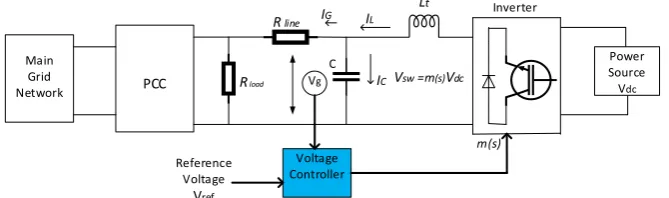
The closed-loop microgrid consists of input energy source (ES), a single stage voltage source inverter (VSI), output LC filter, line and load impedance and point of common coupling (PCC). Here, the single-phase inverter is used to convert the DC energy voltage into AC and makes it useable for the practical grid line use [22]. IGBT based VSI has been used and switching action of it is represented by Vsw=m s V
( )
∗ dc where, m s( )
∈ − +[
1, 1]
and Vdc is the DCvoltage. In Figure 1, the filtering LC circuit is used to reduce the switching rip-ple of the inverter. A single point of common coupling (PCC) is used for the ad-dition of microgrid network with the main grid network.
In the MG system the control of the VSI has done with the help of the refer-ence grid voltage. In the Figure 1, the blue box is considered as the proposed controller which creates link among the measured grid voltage Vg and
DOI: 10.4236/ica.2018.92004 55 Intelligent Control and Automation Figure 1. Single-phase microgrid system.
2.2. Single-Phase MG Mathematical Model
From Figure 1, the inductor current is given by the following equation,
L G C
I =I +I (1)
here, IG and IC are defined as the grid current and capacitor current
respec-tively. Now let us consider VL as the Inductor voltage. Then the current into
the inductor is
d dL
L I
V L
t
= (2)
or d
dL L sw G
V V
I V
t L L
−
= = (3)
But the Laplace transform of (2) is
( )
( )
L L
V s =sLI s (4)
or
( )
sw( )
G( )
LV s V s sI s
L − =
or
( )
sw( )
G( )
LV s V s
sI s
L L
= − (5)
But the product of duty ratio of inverter is the switching voltage or Vsw. And
there remains also the renewable dc voltage source Vdc. So, we can rewrite,
( )
sw dc
V =m s V (6)
In Figure 1, as the capacitor is placed parallel to the main grid, for capacitor voltage we can write,
d dVG C
C I
t = (7)
or d
d
G C
V I
t = C
or ddVG IL IG IL IG
t C C C
−
= = − (8)
here, IC defines the capacitor current. The LT of Equation (8) will be
( )
L( )
G( )
G
I s I s
sV s
C C
= − (9) Power Source Vdc Lt Vg Vg Voltage Controller PCC Reference Voltage Vref Main Grid Network C R line
R load
IL IG
IC Vsw =m(s)Vdc
Voltage Source Inverter
DOI: 10.4236/ica.2018.92004 56 Intelligent Control and Automation
From (5) and (9) we can write
[ ]
[ ]
1 1 0
0 d
1 1
d 0 0
L L
sw G
G G
I L I
V I C V V t C C − = + + − (10)
And the output of the overall system is
[ ] [
0 1]
L G G I y V V = = (11)
If we drive Equations (10) and (11) as state-space re-presentation then we get,
d
dx Ax But = + (12) y Cx Du= + (13)
That means, state matrix
1 0 1 0L A C − =
, input matrix,
1 0 B C = , output
matrix, C=
[
0 1]
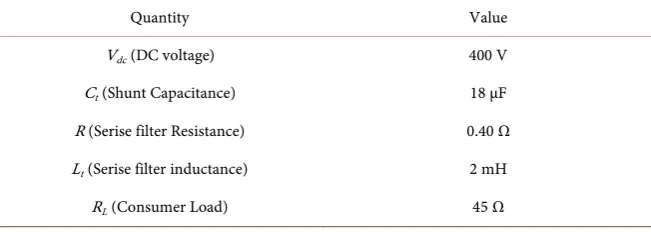
. Here, transition matrix, D=0.The different parameters have given in the Table 1.
3. Controller Design
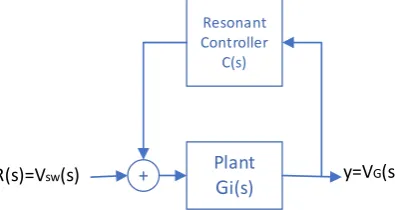
In this paper our aim is to design a controller to recompose the unwanted oscil-lation of MG when it is on its Islanded mode. For this purpose, we have pro-posed a robust positive-position feedback controller. It is designed to recompose the unwanted voltage oscillation in microgrid It is a closed-loop system shown in the following Figure 2.
From the Figure 2, it can be observed that the single phase microgrid can be compared with the SISO (Single Input Single Output) system. So, we have to de-sign such type of controller that can control a SISO system. To dede-sign it we have applied NI theory [21].
From the SNI theorem we can write
( )
2 2 22 f
f f f
s
C s k
s ζ ω s ω
= −
[image:5.595.212.538.610.733.2]+ + (14)
Table 1. Grid parameters for single phase microgrid system.
Quantity Value
Vdc (DC voltage) 400 V
Ct (Shunt Capacitance) 18 μF
R (Serise filter Resistance) 0.40 Ω
Lt (Serise filter inductance) 2 mH
DOI: 10.4236/ica.2018.92004 57 Intelligent Control and Automation Figure 2. Block diagram of closed-loop system.
where kf,
ζ
f andω
f are the controller gain, damping constant and thefrequencies respectively. But when Equation (14) is implemented as positive-real feedback controller then controller C s
( )
can be written as( )
2( )
22
f f
f f f
s
C s k
s s
φ
ζ ω ω
=
+ + (15)
here the numerator φf
( )
s is the first order polynomial and it depends on theclosed-loop nature of the system. For SISO system φf
( )
s can be considered as(
s+2ζ ωf f)
. Then Equation (15) can be written as( )
2 22 2
f f f
f f f
s
C s k
s s
ζ ω
ζ ω ω
+ =
+ + (16)
Now from Equation (14) & Equation (16) it can be written that
( )
2( )
C s = −s C s (17)
The transfer function of resonant controller is as follows,
( )
2(
2)
22 f f f
f f f
s s
C s k
s s
ζ ω
ζ ω ω
+ = −
+ + (18)
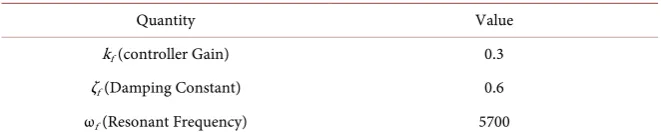
The controller parameters are given below.
In Table 2, We have chosen low gain for the proposed controller with low frequencies. And this decision has increased the controller gain and phase mar-gin. Here, the low value of the damping constant
ζ
f would introduce theun-expected phase shift while the high value of it could provide low damping in the closed-loop system.
4. Stability Checking
From the Negative Imaginary theory [21] a transfer function is said to be NI if and only if there have no poles at the origin or in the open right half plane (ORHP) and in the interval of −180 to 00 at any frequencies. From the transfer
function C s
( )
, it is defined that it has no poles at the origin. Besides, the trans-fer function of closed-loop system from Figure 2, it can be written that,( )
(
( ) ( )
( )
)
1 i cl i G s G sG s C s =
− ∗ (19)
+ PlantGi(s)
Resonant Controller
C(s)
R(s)=Vsw(s)
DOI: 10.4236/ica.2018.92004 58 Intelligent Control and Automation Table 2. Controller parameters for Single-Phase Microgrid.
Quantity Value
kf (controller Gain) 0.3
ζf (Damping Constant) 0.6
ωf (Resonant Frequency) 5700
In Equation (19) the phase shift of the system lies between −180 to 00 defined
from bode plot in Figure 3. So, this system follows the NI theory. For stability the parameters of the controller have chosen in such a way that the product of loop gain G s C si
( ) ( )
∗ is always less than one.5. Performance Evaluation
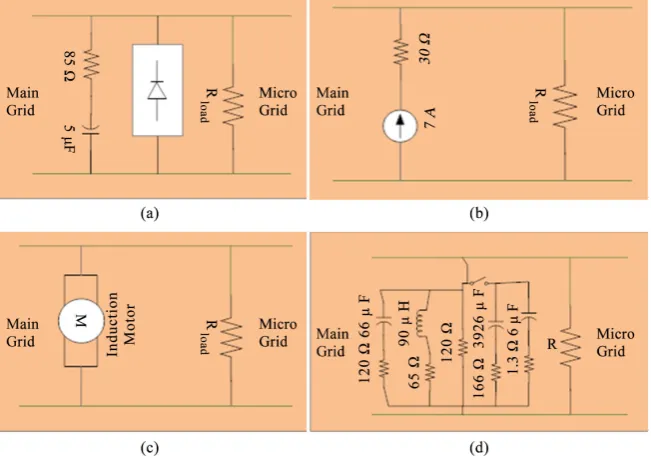
In this section, the performance of the proposed controller has observed against different load condition such as non-linear loads, unknown loads, harmonic loads, consumer loads, asynchronous load conditions and they have drawn in the above Figure 4. All this simulation is done in MATLAB environment. From the simulation results of Figures 5-9 it can say that, the proposed closed-loop resonant controller has showed maximum robustness against the open-loop un-controlled voltage.
5.1. Consumer Load
In our case study, for simulation purpose we have considered resistance (R=45Ω) as consumer load. Figure 5 shows the performance of the controller.
When the MG suddenly turns into its islanded mode, the closed-loop resonant controller takes its voltage level into a stable level.
5.2. Non-Linear Load
In this case study, here the performance of resonant controller has observed against the non-linear load like air-conditioners, televisions etc. But for our MATLAB simulation purpose here we have used diode bridge rectifier (two- phase four pulse) with RC load (R=85Ω, C=5e−6F) which is connected with
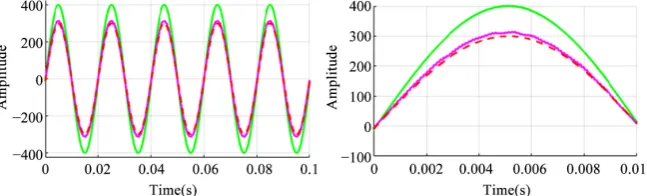
the main grid (shown in Figure 4(a)). From the performance Figure 6, it can decide that the proposed controller have showed the maximum robustness against the non-linear loads.
5.3 Unknown-Load
DOI: 10.4236/ica.2018.92004 59 Intelligent Control and Automation Figure 3. Bode plot of loop gain G s C si
( ) ( )
∗ represented by green dashed line(--); controller C s
( )
represented by red dashed line (--) and nominal plant gain( )
i
[image:8.595.212.538.310.539.2]G s represented by blue solid line (-).
Figure 4. Connecting with (a) Non-linear load; (b) Unknown load; (c) Harmonic load; (d) Asynchronous load.
[image:8.595.210.537.586.679.2]DOI: 10.4236/ica.2018.92004 60 Intelligent Control and Automation Figure 6. Voltage tracking of non-linear load. Here green solid line (- ), pink solid line (-) and red dashed line(--) represents the reference MG voltage, open-loop MG voltage and closed-loop resonant controller MG voltage.
Figure 7. Voltage tracking of unknown load. Here green solid line (- ), pink solid line (-) and red dashed line(--) represents the reference MG voltage, open-loop MG voltage and closed-loop resonant controller MG voltage.
Figure 8. Voltage tracking of Harmonic load. Here green solid line (- ), pink solid line (-) and red dashed line(--) represents the reference MG voltage, open-loop MG voltage and closed-loop resonant controller MG voltage.
Figure 9. Voltage tracking of Asynchronous load. Here green solid line (- ), pink solid line (-) and red dashed line(--) represents the reference MG voltage, open-loop MG voltage and closed-loop resonant controller MG voltage.
5.4. Harmonic Load
[image:9.595.208.537.369.458.2] [image:9.595.211.535.519.617.2]televi-DOI: 10.4236/ica.2018.92004 61 Intelligent Control and Automation
sion, rectifiers etc. cause harmonics. This harmonic voltage increases the heat of the loads and reduce the lifetime of the loads/devices. Besides, the non-linear loads produce extra current when it is connected with the electric system. Dif-ferent types of harmonics are produced by the non-linear loads. The main dis-advantage of this harmonic is that it increases the current of the system. So, there needs a voltage controller to control this unwanted voltage results out from harmonic loads. In Figure 4(c), there represents a model of 3rd harmonics load
with 30 Ω resistance and 7 A (150 hz) current source connected in series. The performance of the proposed controller is presented in Figure 8. From the re-sults, it is seen that the proposed controller has excellent damping oscillation ef-ficiency.
5.5. Asynchronous Load
For this asynchronous load simulation, here we have connected an induction load with the MG network which have shown in Figure 4(d). This induction motor is modeled as a dq stator reference frame with capacitor-start and capaci-tor-start-run respectively. This dynamic load will affect the voltage because of the variation of active and reactive power of it. The performance of the proposed controller has showed in Figure 9. For the use of proposed controller, we will see the robustness of it.
6. Conclusion
In this paper, we have proposed SISO system based resonant controller for mi-crogrid. The design of the controller has done with the results come out from robust NI theory. This controller has maintained the closed-loop stability of the MG against the open-loop stability. The experimental implementation has done in the MATLAB environment which shows us the robustness of the proposed controller successfully.
References
[1] Borazjani, P., Wahab, N.I.A., Hizam, H.B. and Soh, A.B.C. (2014) A Review on Mi-crogrid Control Techniques. 2014 IEEE Innovative Smart Grid Technologies-Asia
(ISGT ASIA), Kuala Lumpur, 749-753. https://doi.org/10.1109/ISGT-Asia.2014.6873886
[2] Yazdanian, M. and Mehrizi-Sani, A. (2014) Distributed Control Techniques in Mi-crogrids. IEEE Transactions on Smart Grid, 5, 2901-2909.
https://doi.org/10.1109/TSG.2014.2337838
[3] Le Minh, P., Vo Duc, D.H., Xuan, H.P.T. and Minh, H.N. (2017) A New Control Strategy of Power Sharing in Islanded Microgrids. 2017 International Conference on System Science and Engineering (ICSSE), Ho Chi Minh City, 175-179.
https://doi.org/10.1109/ICSSE.2017.8030860
[4] Ramezani, M. and Li, S. (2016) Voltage and Frequency Control of Islanded Micro-grid Based on Combined Direct Current Vector Control and Droop Control. 2016
DOI: 10.4236/ica.2018.92004 62 Intelligent Control and Automation [5] Hatziargyriou, N., Asano, H., Iravani, R. and Marnay, C. (2007) Microgrids. IEEE Power and Energy Magazine, 5, 78-94. https://doi.org/10.1109/MPAE.2007.376583 [6] Azim, M.I., Hossain, M.A., Hossain, M.J. and Pota, H.R. (2015) Effective Power
Sharing Approach for Islanded Microgrids. 2015 IEEE Innovative Smart Grid Technologies-Asia (ISGT ASIA), Bangkok, 1-4.
[7] Vandoorn, T.L., Renders, B., Degroote, L., Meersman, B. and Vandevelde, L. (2011) Active Load Control in Islanded Microgrids Based on the Grid Voltage. IEEE Transactions on Smart Grid, 2, 139-151. https://doi.org/10.1109/TSG.2010.2090911 [8] Sortomme, E., Mapes, G.J., Foster, B.A. and Venkata, S.S. (2008) Fault Analysis and
Protection of a Microgrid. 2008 40th North American Power Symposium, Calgary, 1-6.
[9] Hooshyar, A., El-Saadany, E.F. and Sanaye-Pasand, M. (2016) Fault Type Classifica-tion in Microgrids including Photovoltaic DGs. IEEE Transactions on Smart Grid, 7, 2218-2229. https://doi.org/10.1109/TSG.2015.2451675
[10] Raj, D.C. and Gaonkar, D.N. (2016) Frequency and Voltage Droop Control of Pa-rallel Inverters in Microgrid. 2016 2nd International Conference on Control, In-strumentation, Energy & Communication (CIEC), Kolkata, 407-411.
https://doi.org/10.1109/CIEC.2016.7513771
[11] Araújo, L.S., Narváez, D.I., Siqueira, T.G. and Villalva, M.G. (2016) Modified Droop Control for Low Voltage Single Phase Isolated Microgrids. IEEE International Con-ference on Automatica (ICA-ACCA), Curico, 1-6.
https://doi.org/10.1109/ICA-ACCA.2016.7778455
[12] El Moubarek Bouzid, A., Sicard, P., Yamane, A. and Paquin, J.N. (2016) Simulation of Droop Control Strategy for Parallel Inverters in Autonomous AC Microgrids.8th International Conference on Modelling, Identification and Control (ICMIC), Al-giers, 701-706. https://doi.org/10.1109/ICMIC.2016.7804202
[13] Kumar, B. and Bhongade, S. (2016) Load Disturbance Rejection Based PID Con-troller for Frequency Regulation of a Microgrid. Biennial International Conference on Power and Energy Systems: Towards Sustainable Energy (PESTSE), Bangalore, 1-6. https://doi.org/10.1109/PESTSE.2016.7516459
[14] Parise, G., Martirano, L., Kermani, M. and Kermani, M. (2017) Designing a Power Control Strategy in a Microgrid Using PID/Fuzzy Controller Based on Battery Energy Storage. IEEE International Conference on Environment and Electrical Engineering and 2017 IEEE Industrial and Commercial Power Systems Europe
(EEEIC/I&CPS Europe), Milan, 1-5. https://doi.org/10.1109/EEEIC.2017.7977856 [15] Harmouch, F.Z., Krami, N., Benhaddou, D., Hmina, N., Zayer, E. and Margoum,
E.H. (2016) Survey of Multiagents Systems Application in Microgrids. International Conference on Electrical and Information Technologies (ICEIT), Tangiers, 270-275. https://doi.org/10.1109/EITech.2016.7519604
[16] Liu, W., Gu, W., Sheng, W., Meng, X., Wu, Z. and Chen, W. (2014) Decentralized Multi-Agent System-Based Cooperative Frequency Control for Autonomous Mi-crogrids with Communication Constraints. IEEE Transactions on Sustainable Energy, 5, 446-456.
[17] Wu, X., Shen, C. and Iravani, R. (2016) A Distributed, Cooperative Frequency and Voltage Control for Microgrids. IEEE Transactions on Smart Grid, 1.
[18] Manshadi, S.D. and Khodayar, M.E. (2018) Expansion of Autonomous Microgrids in Active Distribution Networks. IEEE Transactions on Smart Grid, 9, 1878-1888. [19] Bidram, A. and Davoudi, A. (2012) Hierarchical Structure of Microgrids Control
DOI: 10.4236/ica.2018.92004 63 Intelligent Control and Automation https://doi.org/10.1109/TSG.2012.2197425
[20] Parhizi, S., Lotfi, H., Khodaei, A. and Bahramirad, S. (2015) State of the Art in Re-search on Microgrids: A Review. IEEE Access, 3, 890-925.
https://doi.org/10.1109/ACCESS.2015.2443119
[21] Petersen, I.R. and Lanzon, A. (2010) Feedback Control of Negative-Imaginary Sys-tems. IEEE Control Systems, 30, 54-72.https://doi.org/10.1109/MCS.2010.937676 [22] Micallef, A., Apap, M., Spiteri-Staines, C. and Guerrero, J.M. (2015) Single-Phase
Microgrid with Seamless Transition Capabilities between Modes of Operation. IEEE Transactions on Smart Grid, 6, 2736-2745.