http://www.scirp.org/journal/jamp ISSN Online: 2327-4379 ISSN Print: 2327-4352
DOI: 10.4236/jamp.2018.63053 Mar. 28, 2018 613 Journal of Applied Mathematics and Physics
Analytical Approximation to the Dynamics
of a Binary Stars System with
Time Depending Mass Variation
Gustavo V. López
*, Elkin L. López
Departamento de Física, Universidad de Guadalajara, Blvd. Marcelino García Barragan y Calzada Olímpica, Guadalajara, Mexico
Abstract
We study the classical dynamics of binary stars when there is an interchange of mass between them. Assuming that one of the stars is more massive than others, the dynamics of the lighter one is analyzed as a function of its time depending mass variation. Within our approximations and models for mass transference, we obtain a general result which establishes that if the lightest star looses mass, its period increases. If the lightest star wins mass, its period decreases.
Keywords
Binary Stars, Time Depending Mass, Period of Binary Stars
1. Introduction
A binary stars system is one of the most common systems in a Galaxy and the Universe [1] [2]. This binary system forms an effective gravitational potential which brings about five Lagrangian points in the space where gravitational force is zero [3]. One of the most important Lagrangian points is called L1 and is located between the two stars, where the equipotential called Roche-Lobe [4] [5] [6] [7] makes a cross path. If the mass of the star fulfills its lobe, there will be a transference of mass to the other star, through the Lagrange point L1. This is one of the most common mechanisms of transference of mass between two stars, and it is the one we are interested in our study. A usual situation occurs when one star has finished its nuclear cycle fuel and becomes a red giant [8]. Of course, to fully analyze this phenomenon we requires computer simulation of the whole system. However, it would be important if we had a qualitative understanding of How to cite this paper: López, G.V. and
López, E.L. (2018) Analytical Approxima-tion to the Dynamics of a Binary Stars System with Time Depending Mass Varia-tion. Journal of Applied Mathematics and Physics, 6, 613-619.
https://doi.org/10.4236/jamp.2018.63053
Received: February 27, 2018 Accepted: March 25, 2018 Published: March 28, 2018
Copyright © 2018 by authors and Scientific Research Publishing Inc. This work is licensed under the Creative Commons Attribution International License (CC BY 4.0).
DOI: 10.4236/jamp.2018.63053 614 Journal of Applied Mathematics and Physics the dynamics involved, and this is the propose of this paper. On the first part of our study, the six ordinary second order equations, which represent the dynamics of the binary system with time depending mass transference, are reduced to a 1-D non autonomous system. This non autonomous system is solved numerically, and the results are analyzed.
2. Analytical Approach
Let m t1
( )
and m t2( )
be the masses of the stars in the binary system such that( )
( )
1 2
m t >m t and m t1
( )
+m t2( )
=M0 (constant) for all the time into consideration. This means that we will only consider the transference of mass between the two stars. With respect an inertial reference system (fixed with respect the fixed Galaxies), the non relativistic motion of the system is described by Newton’s equation [9]( )
(
1 1)
1( ) ( ) (
2 )
2 1 22 1 d
d
m t m t m t
G
t = − − −
v
x x
x x (1)
and
( )
(
2 2)
1( ) ( ) (
2 )
1 2 22 1 d
d
m t m t m t
G
t = − − −
v
x x
x x
(2)
where x1 and x2 are the positions, and v1 and v2 are the velocities of the stars (vi=dxi dt). G is the gravitational constant (
11 3 2
6.6738 10 m kg s
G= × − ⋅ )
[10]. The above equations represent six second order ordinary differential equations (6-D problem), and it is not difficult to see that making the usual change of variables to center of mass (R=
(
m1 1x +m2x2)
M0) and relative (x=x2−x1) coordinates does not help to reduce the number of degree of freedom in our system due to the time depending mass variation. However, since we are assuming that m t1( )
>m t2( )
, we can select our reference system such that x1=0 (non inertial reference system), and neglect all non inertial forces (coriolis) which normally appears on this type of reference systems. In addition, our stars are assumed to be points-like mathematical elements. So, making this selection, and defining x=x2 and v=v2, one gets the following Newton’s equation of motion for the binary system( )
(
2)
1( ) ( )
22
d
ˆ, d
m t m t m t
G
t = − r
v
r
(3) where x=
(
x y z, ,)
, r=x x , and x2=r2=x2+y2+z2 . Making thedifferentiation with respect the time of m2, the Equation (3) can be written as
( )
1( ) ( )
2( )
2 2 2
d
ˆ ,
d
m t m t
m t G m t
t = − r −
v
r v
(4) where m2=dm2 dt. Let us write now this equation in spherical coordinates,
( ) ( )
( ) ( )
( )
(
rsinθ
cosϕ
, sinrθ
sinϕ
, cosrθ
)
, =x
DOI: 10.4236/jamp.2018.63053 615 Journal of Applied Mathematics and Physics term of the unitary vectors rˆ, θˆ and ϕˆ as
ˆ,
r
=
x r (6)
( )
ˆ
ˆ sin ˆ,
r rθθ rϕ θ ϕ
= + +
v r
(7) and
( )
(
)
(
( ) ( )
)
( )
( )
( )
(
)
2 2 2 ˆ 2 ˆ
sin 2 sin cos
ˆ
sin 2 sin 2 cos ,
r r r r r r
r r r
θ ϕ θ θ θ ϕ θ θ θ
ϕ θ ϕ θ ϕθ θ ϕ
= − − + + −
+ + +
a r
(8)
where the unitary vectors are
( ) ( )
( ) ( )
( )
(
)
ˆ sin cos , sin sin , cos ,
r=
θ
ϕ
θ
ϕ
θ
(9)
( )
( ) ( )
( )
(
)
ˆ cos( ) cos , cos sin , sin ,
θ
=θ
ϕ
θ
ϕ
−θ
(10)
( )
( )
(
)
ˆ sin , cos , 0 .
ϕ
= −ϕ
ϕ
(11) Using (6), (7), and (8) in (4), the following equations are obtained
( )
(
2 2 2)
1 22 sin 2 2 ,
m m
m r r r G m r
r
θ ϕ θ
− − = − −
(12)
( ) ( )
(
2)
2 2 sin cos 2 ,
m r+ r
θ
−rϕ
θ
θ
= −m rθ
(13)
( )
( )
( )
(
)
( )
2 sin 2 sin 2 cos 2 sin .
m r
ϕ
θ
+ rϕ
θ
+ rϕθ
θ
= − −m rϕ
θ
(14) From (14) we observe that ϕ = 0 is a possible solution of these equations (ϕ ϕ= 0 =constant), meaning that that the motion of the system can occur in the plane defined by ϕ ϕ= 0. Selecting then this solution, the above equations are reduced to a 2-D problem
(
2)
1 22 2 2 ,
m m
m r r G m r
r θ − = − −
(15)
(
)
2 2 2 ,
m r+ r
θ
= −m rθ
(16) Multiplying (16) by r and rearranging terms, one gets that
(
2)
2
d m r
θ
dt=0 which implies that one obtains the following constant of motion2 2 .
lθ=m rθ
(17)
finally, using this constant of motion in (15), the study is reduced to the following 1-D problem
2
1 2
2 3 2 2
2
.
l m m
m r G m r
m r r
θ
= − −
(18) This equation can be written as the following non autonomous dynamical system
r=v (19)
2
1 2
2 3 2
2 2
.
l Gm m
v v
m
m r r
θ
= − −
DOI: 10.4236/jamp.2018.63053 616 Journal of Applied Mathematics and Physics
3. Models and Results
We will use the following three models of mass transference
( )
A m t2( )
=m02−µt,(21)
( )
B 2( )
02e ,t m t =m −α
(22)
( )
C 2( )
02 01(
1 e)
,t
m t =m +m − −α
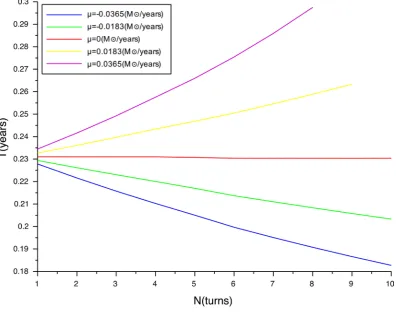
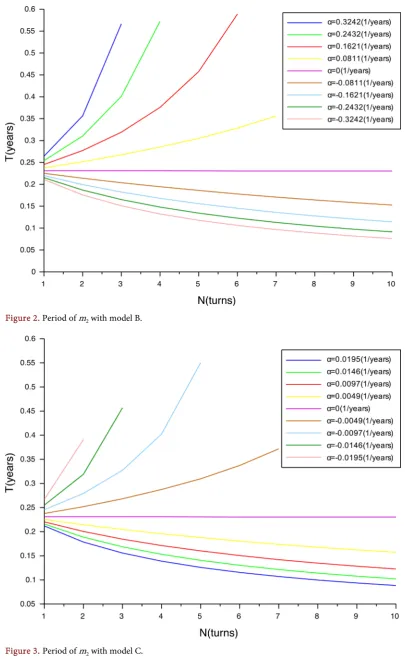
(23) where μ and α are constant which are relate with the mass lost (win) rate, m01 and m02 represent the initial mass of the stars (m01>m02). Figures 1-3 show the period of the star with mass m2 as a function of the number of turns around the star with mass m1 for the models A, B and C. The initial values taken to make these figures are
( )
0 456.8965 ,( )
0 0 aphelion ,(
)
( )
0 0,r = R v =
θ
=(24)
( )
( )
35 21 0 25.735 , 2 0 1.54 , 3.139 10 ,
year
M R
m = M m = M lθ = × −
(25) where R and M are the radius and solar mass (R =6.957 10 km× 5
and
30
1.988 10 kg
[image:4.595.143.540.398.713.2]M= × [10]). The values of the parameters μ and α shown in these figures were chosen big enough to point out the effect of mass variation on the period of the system. On these figures, the values of the parameters µ α= =0 means that there is not mass variation on the system. Therefore, the period is the
DOI: 10.4236/jamp.2018.63053 617 Journal of Applied Mathematics and Physics
[image:5.595.136.542.65.725.2]Figure 2. Period of m2 with model B.
DOI: 10.4236/jamp.2018.63053 618 Journal of Applied Mathematics and Physics same every turn. For the values µ >0 in the model A (Figure 1), α <0 in the model B (Figure 2), and α >0 in the model C (Figure 3), the star with mass m2 wins more mass and its period decreases. On the other hand, for the opposed cases, the star with mass m2 looses mass and its period increases. In summary, these results tell us that if m2 looses mass, its period is larger each turn and, eventually, the star escapes (or breaks) the binary system. On the other hand, if m2 increases its mass, its period becomes smaller each turn. These results are in agreement with what was found on the dynamics of the comets around a star [11].
4. Conclusion
Using several approximations, the dynamics of a class of binary stars with six degrees of freedom with variable mass is reduced to one degree of freedom system with variable mass. This variation of mass was chosen such that the mass of the whole system remains constant (closed system). Using three models of mass transference between the stars, we found in general that the less massive star increases its mass from the massive star, its period becomes smaller each turn, and vice versa. The mass rate exchanged has been taken here too unrealistically large to have better visualization of the expected effect, that is, this effect does not depend on the mass model. The reason is clearly seen from expressions (4) or the dynamical system (6, 7) since m2 is positive, one has a damping system, and if m2 is negative, one gets an anti-damping system. In addition, viewing the inverse process, if the period of a binary star increases or decreases, one could maybe to estimate the rate of mass exchange between them, for some case.
References
[1] Sahade, J. and Wood, F.B. (2015) Interacting Binary Stars. Series in Natural Phylo-sophy, 95, Elsevieir.
[2] Aitken R.G. (1964) The Binary Stars. Dover.
[3] Lagrange, J.L. (1873) Essai sur le problèm des trois corps. Gauthier-Villars (ŒOVRES DE LAGRANGE).
[4] Paczynski, B. (1971) Evolutionary Processes in Close Binary Systems. Annual Re-view of Astronomy and Astrophysics, 9, 183.
[5] Jorissen, A. and Frankowski, A. (2008) Detection Methods of Binary Stars with Low- and Intermediate-Mass Components. arXiv:0804.3720v2 [astro-ph].
[6] Savonije, G.J. (1978) Mass Transfer and Accretion in Close Binaries. Astron. and AstroPhys., 62, 317.
[7] Tout, C.A. and Eggleton, P.P. (1988) Tidal Enhancement by a Binary Companion of Stellar Winds from Cool Giants. Oxford University Press, Oxford.
[8] Rolfs, C.E. and Rodney, W.S. (1988) Cauldrons in the Cosmos. The University of Chicago Press, Chicago.
[9] Goldstein, H., Poole, C. and Safko, J. (2000) Classical Mechanics. Addison-Wesley, Boston.
DOI: 10.4236/jamp.2018.63053 619 Journal of Applied Mathematics and Physics Physics C, 38, 090001.https://doi.org/10.1088/1674-1137/38/9/090001
[11] López, G.V. and Juárez, E.M. (2013)Damping-Antidamping Effect on Comets Mo-tion. Journal of Modern Physics, 4, 1638-1646.