Positive Results for Parsing with a Bounded Stack using a Model-Based
Right-Corner Transform
William Schuler
Dept. of Computer Science and Engineering Minneapolis, MN
Abstract
Statistical parsing models have recently been proposed that employ a bounded stack in time-series (left-to-right) recognition, using a right-corner transform defined over training trees to minimize stack use (Schuler et al., 2008). Cor-pus results have shown that a vast majority of naturally-occurring sentences can be parsed in this way using a very small stack bound of three to four elements. This suggests that the standard cubic-time CKY chart-parsing algorithm, which implicitly assumes an
un-bounded stack, may be wasting probability
mass on trees whose complexity is beyond hu-man recognition or generation capacity. This paper first describes a version of the right-corner transform that is defined over entire probabilistic grammars (cast as infinite sets of generable trees), in order to ensure a fair comparison between bounded-stack and bounded PCFG parsing using a common un-derlying model; then it presents experimental results that show a bounded-stack right-corner parser using a transformed version of a gram-mar significantly outperforms an unbounded-stack CKY parser using the original grammar.
1 Introduction
Statistical parsing models have recently been pro-posed that employ a bounded stack in time-series (left-to-right) recognition, in order to directly and tractably incorporate incremental phenomena such as (co-)reference or disfluency into parsing deci-sions (Schuler et al., 2008; Miller and Schuler, 2008). These models make use of a right-corner tree transform, based on the left-corner transform described by Johnson (1998), and are supported by
corpus results suggesting that most sentences (in En-glish, at least) can be parsed using a very small stack bound of three to four elements (Schuler et al., 2008). This raises an interesting question: if most sentences can be recognized with only three or four elements of stack memory, is the standard cubic-time CKY chart-parsing algorithm, which im-plicitly assumes an unbounded stack, wasting prob-ability mass on trees whose complexity is beyond human recognition or generation capacity?
This paper presents parsing accuracy results us-ing transformed and untransformed versions of a corpus-trained probabilistic context-free grammar suggesting that this is indeed the case. Experimental results show a bounded-memory time-series parser using a transformed version of a grammar signifi-cantly outperforms an unbounded-stack CKY parser using the original grammar.
Unlike the tree-based transforms described previ-ously, the model-based transform described in this paper does not introduce additional context from corpus data beyond that contained in the origi-nal probabilistic grammar, making it possible to present a fair comparison between bounded- and unbounded-stack versions of the same model. Since this transform takes a probabilistic grammar as in-put, it can also easily accommodate horizontal and vertical Markovisation (annotating grammar sym-bols with parent and sibling categories) as described by Collins (1997) and subsequently.
The remainder of this paper is organized as fol-lows: Section 2 describes related approaches to pars-ing with stack bounds; Section 3 describes an exist-ing bounded-stack parsexist-ing framework usexist-ing a right-corner transform defined over individual trees; Sec-tion 4 describes a redefiniSec-tion of this transform to
ply to entire probabilistic grammars, cast as infinite sets of generable trees; and Section 5 describes an evaluation of this transform on the Wall Street Jour-nal corpus of the Penn Treebank showing improved results for a transformed bounded-stack version of a probabilistic grammar over the original unbounded grammar.
2 Related Work
The model examined here is formally similar to Combinatorial Categorial Grammar (CCG) (Steed-man, 2000). But the CCG account is a competence model as well as a performance model, in that it seeks to unify category representations used in pro-cessing with learned generalizations about argument structure; whereas the model described in this paper is exclusively a performance model, allowing gen-eralizations about lexical argument structures to be learned in some other representation, then combined with probabilistic information about parsing strate-gies to yield a set of derived incomplete constituents. As a result, the model described in this paper has a freer hand to satisfy strict working memory bounds, which may not permit some of the alternative com-position operations proposed in the CCG account, thought to be associated with available prosody and quantifier scope analyses.1
Other models (Abney and Johnson, 1991; Gibson, 1991) seek to explain human processing difficulties as a result of memory capacity limits in parsing or-dinary phrase structure trees. The Abney-Johnson and Gibson models adopt a left-corner parsing strat-egy, of which the right-corner transform described in this paper is a variant, in order to minimize memory usage. But the transform-based model described in this paper exploits a conception of chunking (Miller, 1956) — in this case, grouping recognized words into stacked-up incomplete constituents — to oper-ate within much stricter estimoper-ates of human short-term memory bounds (Cowan, 2001) than assumed by Abney and Johnson.
1The lack of support for some of these available scope
anal-yses may not necessarily be problematic for the present model. The complexity of interpreting nested raised quantifiers may place them beyond the capability of human interactive incre-mental interpretation, but not beyond the capability of post-hoc interpretation (understood after the listener has had time to think about it).
Several existing incremental systems are orga-nized around a left-corner parsing strategy (Roark, 2001; Henderson, 2004). But these systems gen-erally keep large numbers of constituents open for modifier attachment in each hypothesis. This al-lows modifiers to be attached as right children of any such open constituent. But if any number of open constituents are allowed, then either the assumption that stored elements have fixed syntactic (and se-mantic) structure will be violated, or the assump-tion that syntax operates within a bounded mem-ory store will be violated, both of which are psy-cholinguistically attractive as simplifying
assump-tions. The HHMM model examined in this
pa-per upholds both the fixed-element and bounded-memory assumptions by hypothesizing fixed reduc-tions of right child constituents into incomplete par-ents in the same memory element, to make room for new constituents that may be introduced at a later time. These in-element reductions are defined natu-rally on phrase structure trees as the result of align-ing right-corner transformed constituent structures to sequences of random variables in a factored time-series model.
3 Background
The recognition model examined in this paper is a factored time-series model, based on a Hierarchic Hidden Markov Model (Murphy and Paskin, 2001), which probabilistically estimates the contents of a memory store of three to four partially-completed constituents over time. Probabilities for expansions, transitions and reductions in this model can be de-fined over trees in a training corpus, transformed and mapped to the random variables in an HHMM (Schuler et al., 2008). In Section 4 these probabil-ities will be computed directly from a probabilistic context-free grammar, in order to evaluate the con-tribution of stack bounds without introducing addi-tional corpus context into the model.
3.1 A Bounded-Stack Model
HHMMs are factored HMMs which mimic a bounded-memory pushdown automaton (PDA), sup-porting simple push and pop operations on a bounded stack-like memory store.
of hidden statesqt (in this case, stacked-up
syntac-tic categories) and observed states ot (in this case,
words) at corresponding time stepst. A most likely sequence of hidden statesqˆ1..T can then be
hypothe-sized given any sequence of observed stateso1..T:
ˆ
q1..T = argmax q1..T
P(q1..T |o1..T) (1)
= argmax
q1..T
P(q1..T)·P(o1..T |q1..T) (2)
def= argmax
q1..T
T
Y
t=1
PΘA(qt|qt-1)·PΘB(ot|qt) (3)
using Bayes’ Law (Equation 2) and Markov in-dependence assumptions (Equation 3) to define a full P(q1..T |o1..T) probability as the product
of a Transition Model (ΘA) prior probability P(q1..T) def= QtPΘA(qt|qt-1) and an Observation Model (ΘB) likelihood probabilityP(o1..T |q1..T)def=
Q
tPΘB(ot|qt).
Transition probabilities PΘA(qt|qt-1) over
com-plex hidden statesqtcan be modeled using
synchro-nized levels of stacked-up component HMMs in an HHMM. HHMM transition probabilities are calcu-lated in two phases: a reduce phase (resulting in an intermediate, marginalized stateft), in which
com-ponent HMMs may terminate; and a shift phase (re-sulting in a modeled stateqt), in which unterminated
HMMs transition, and terminated HMMs are re-initialized from their parent HMMs. Variables over intermediate ft and modeled qt states are factored
into sequences of depth-specific variables – one for each ofDlevels in the HHMM hierarchy:
ft=hft1. . . ftDi (4)
qt=hq1t. . . qtDi (5)
Transition probabilities are then calculated as a product of transition probabilities at each level, us-ing level-specific reduceΘR,dand shiftΘS,dmodels:
PΘA(qt|qt-1) =
X
ft
P(ft|qt-1)·P(qt|ftqt-1) (6)
def=X
f1..D t
D
Y
d=1 PΘR,d(f
d
t|ftd+1qdt-1qdt-1-1)· PΘS,d(q
d
t|ftd+1ftdqdt-1qtd-1) (7)
with fD+1
t and qt0 defined as constants. In Viterbi
decoding, the sums are replaced with argmax opera-tors. This decoding process preserves ambiguity by
. . .
. . .
. . .
. . .
f3
t−1
ft2−1 ft1−1
q1
t−1
qt2−1
qt3−1
ot−1
ft3 f2
t
ft1
qt1
qt2
q3
t
[image:3.612.330.526.57.191.2]ot
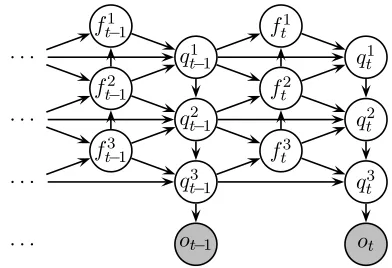
Figure 1: Graphical representation of a Hierarchic Hid-den Markov Model. Circles Hid-denote random variables, and edges denote conditional dependencies. Shaded circles are observations.
maintaining competing analyses of the entire mem-ory store. A graphical representation of an HHMM with three levels is shown in Figure 1.
Shift and reduce probabilities can then be defined in terms of finitely recursive Finite State Automata (FSAs) with probability distributions over transition, recursive expansion, and final-state status of states at each hierarchy level. In the version of HHMMs used in this paper, each intermediate variable is a reduc-tion or non-reducreduc-tion state ftd ∈ G∪ {1,0} (indi-cating, respectively, a complete reduced constituent of some grammatical category from domain G, or a failure to reduce due to an ‘active’ transition be-ing performed, or a failure to reduce due to an ‘awaited’ transition being performed, as defined in Section 4.3); and each modeled variable is a syn-tactic state qtd ∈ G×G (describing an incomplete constituent consisting of an active grammatical
cat-egory from domainGand an awaited grammatical
category from domain G). An intermediate vari-able fd
t at depth d may indicate reduction or
non-reduction according toΘF-Rd,dif there is a reduction
at the depth level immediately belowd, but must in-dicate non-reduction (0) with probability 1 if there was no reduction below:2
PΘR,d(f
d
t |ftd+1qtd-1qtd-1-1) def=
iffd+1
t 6∈G: [ftd=0]
iffd+1
t ∈G:PΘF-Rd,d(f
d
t |qdt-1, qdt-1-1)
(8)
2Here[
wherefD+1
t ∈Gandqt0=ROOT.
Shift probabilities over the modeled variable qd t
at each level are defined using level-specific transi-tionΘQ-Tr,dand expansionΘQ-Ex,dmodels:
PΘS,d(q
d
t|ftd+1ftdqdt-1qdt-1)
def=
iffd+1
t 6∈G, ftd6∈G: [qdt=qtd-1]
iffd+1
t ∈G, ftd6∈G:PΘQ-Tr,d(q
d
t |ftd+1ftdqtd-1qtd-1)
iffd+1
t ∈G, ftd∈G:PΘQ-Ex,d(qtd|qd -1
t )
(9)
where fD+1
t ∈G andq0t = ROOT. This model is
conditioned on reduce variables at and immediately below the current FSA level. If there is no reduc-tion immediately below the current level (the first case above), it deterministically copies the current FSA state forward to the next time step. If there is a reduction immediately below the current level but no reduction at the current level (the second case above), it transitions the FSA state at the current level, according to the distribution ΘQ-Tr,d. And if
there is a reduction at the current level (the third case above), it re-initializes this state given the state at the level above, according to the distribution ΘQ-Ex,d.
The overall effect is that higher-level FSAs are al-lowed to transition only when lower-level FSAs ter-minate. An HHMM therefore behaves like a prob-abilistic implementation of a pushdown automaton (or shift–reduce parser) with a finite stack, where the maximum stack depth is equal to the number of lev-els in the HHMM hierarchy.
3.2 Tree-Based Transforms
The right-corner transform used in this paper is sim-ply the left-right dual of a left-corner transform (Johnson, 1998). It transforms all right branching sequences in a phrase structure tree into left branch-ing sequences of symbols of the formAη/Aη·µ,
de-noting an incomplete instance of an ‘active’ category
Aηlacking an instance of an ‘awaited’ categoryAη·µ
yet to come.3 These incomplete constituent cate-gories have the same form and much of the same meaning as non-constituent categories in a Combi-natorial Categorial Grammar (Steedman, 2000).
3Hereηandµare node addresses in a binary-branching tree,
defined as paths of left (0) or right (1) branches from the root.
Rewrite rules for the right-corner transform are shown below:4
• Beginning case: the top of a right-expanding sequence in an ordinary phrase structure tree is mapped to the bottom of a left-expanding se-quence in a right-corner transformed tree:
Aη
Aη·0
α
Aη·1
β
⇒
Aη
Aη/Aη·1
Aη·0
α
β
(10)
This case of the right-corner transform may be considered a constrained version of CCG type raising.
• Middle case: each subsequent branch in a
right-expanding sequence of an ordinary phrase structure tree is mapped to a branch in a left-expanding sequence of the transformed tree:
Aη
α Aη·µ
Aη·µ·0
β
Aη·µ·1
γ
⇒
Aη
Aη/Aη·µ·1
Aη/Aη·µ
α
Aη·µ·0
β γ
(11) This case of the right-corner transform may be considered a constrained version of CCG for-ward function composition.
• Ending case: the bottom of a right-expanding sequence in an ordinary phrase structure tree is mapped to the top of a left-expanding sequence in a right-corner transformed tree:
Aη
α Aη·µ
aη·µ
⇒
Aη
Aη/Aη·µ
α
Aη·µ
aη·µ
(12)
This case of the right-corner transform may be considered a constrained version of CCG for-ward function application.
4
a) binary-branching phrase structure tree:
S
NP
NP
JJ
strong
NN
demand
PP
IN
for
NP
NPpos
NNP
NNP
new
NNP
NNP
york
NNP
city POS
’s
NNS
JJ
general
NNS
NN
obligation
NNS
bonds
VP
VBN
VBN
propped
PRT
up
NP
DT
the
NN
JJ
municipal
NN
market
b) result of right-corner transform:
S
S/NN
S/NN
S/NP
S/VP
NP
NP/NNS
NP/NNS
NP/NNS
NP/NP
NP/PP
NP
NP/NN
JJ
strong NN
demand IN
for
NPpos
NPpos/POS
NNP
NNP/NNP
NNP/NNP
NNP
new
NNP
york NNP
city POS
’s JJ
general NN
obligation NNS
bonds
VBN
VBN/PRT
VBN
propped PRT
up DT
the JJ
municipal NN
[image:5.612.79.541.78.450.2]market
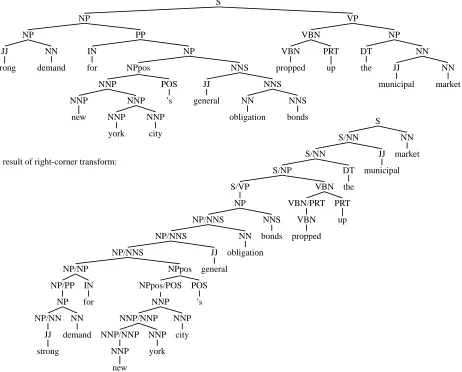
Figure 2: Trees resulting from a) a sample phrase structure tree for the sentence Strong demand for New York City’s
general obligations bonds propped up the municipal market, and b) a right-corner transform of this tree. Sequences of
left children are recognized from the bottom up through in-element transitions in a Hierarchic Hidden Markov Model. Right children are recognized by expanding to additional stack elements.
The completeness of the above transform rules can be demonstrated by the fact that they cover all pos-sible subtree configurations (with the exception of
bare terminals, which are simply copied). The
soundness of the above transform rules can be demonstrated by the fact that each rule transforms a right-branching subtree into a left-branching sub-tree labeled with an incomplete constituent.
An example of a right-corner transformed tree is shown in Figure 2(b). An important property of this transform is that it is reversible. Rewrite rules for re-versing a right-corner transform are simply the con-verse of those shown above.
Sequences of left children in the resulting mostly-left-branching trees are recognized from the bot-tom up, through transitions at the same stack ele-ment. Right children, which are much less frequent in the resulting trees, are recognized through cross-element expansions in a bounded-stack recognizer.
4 Model-Based Transforms
models. This eliminates complications in comparing models with different numbers of dependent vari-ables — and thus different numbers of free parame-ters — because the model which ordinarily has more free parameters (the HHMM, in this case) is derived from the model that has fewer (the PCFG). Since they are derived from a simpler underlying model, the additional parameters of the HHMM are not free. Mapping probability models from one format to another can be thought of as mapping the infinite sets of trees that are defined by these models from one format to another. Probabilities in the trans-formed model are therefore defined by calculating probabilities for the relevant substructures in the source model, then marginalizing out the values of nodes in these structures that do not appear in the desired expression in the target model.
A bounded-stack HHMM ΘQ,F can therefore be
derived from an unbounded PCFGΘGby:
1. organizing the rules in the source PCFG modelΘGinto direction-specific versions (dis-tinguishing rules for expanding left and right children, which occur respectively as active and awaited constituent categories in incomplete constituent labels);
2. enforcing depth limits on these direction-specific rules; and
3. mapping these probabilities to HHMM random variable positions at the appropriate depth.
4.1 Direction-specific rules
An inspection of the tree-based right-corner trans-form rewrites defined in Section 3.2 will show two things: first, that constituents occurring as left chil-dren in an original tree (with addresses ending in ‘0’) always become active constituents (occurring before the slash, or without a slash) in incomplete constituent categories, and constituents occurring as right children in an original tree (with addresses end-ing in ‘1’) always become awaited constituents (oc-curring after the slash); and second, that left chil-dren expand locally downward in the transformed tree (so eachAη·0/...locally dominatesAη·0·0/...),
whereas right children expand locally upward (so each .../Aη·1 is locally dominated by .../Aη·1·1).
This means that rules from the original grammar —
if distinguished into rules applying only to left and right children (active and awaited constituents) — can still be locally modeled following a right-corner
transform. A transformed tree can be generated
in this way by expanding downward along the ac-tive constituents in a transformed tree, then turning around and expanding upward to fill in the awaited constituents, then turning around again to generate the active constituents at the next depth level, and so on.
4.2 Depth bounds
The locality of the original grammar rules in a right-corner transformed tree allows memory limits on in-complete constituents to be applied directly as depth bounds in the zig-zag generation traversal defined above. These depth limits correspond directly to the depth levels in an HHMM.
In the experiments described in Section 5, direction-specific and depth-specific versions of the original grammar rules are implemented in an ordi-nary CKY-style dynamic-programming parser, and can therefore simply be cut off at a particular depth level with no renormalization.
But in an HHMM, this will result in label-bias ef-fects, in which expanded constituents may have no valid reduction, forcing the system to define distri-butions for composing constituents that are not com-patible. For example, if a constituent is expanded at depthD, and that constituent has no expansions that can be completely processed within depthD, it will not be able to reduce, and will remain incompatible with the incomplete constituent above it. Probabili-ties for depth-bounded rules must therefore be renor-malized to the domain of allowable trees that can be generated withinDdepth levels, in order to guaran-tee consistent probabilities for HHMM recognition.
This is done by determining the (depth- and direction-specific) probability PΘB-L,d(1|Aη·0)
or PΘB-R,d(1|Aη·1) that a tree generated at each
avoid generating a terminal with some probability at each step from the top down), so a sum over probabilities of trees with increasing length k is guaranteed to converge. The algorithm calculates probabilities of trees with increasing length kuntil convergence, or to some arbitrary limitK:
PΘB-L,d,k(1|Aη·0) def= X
Aη·1·0,
Aη·1·1
PΘG(Aη·0Aη·0·0Aη·0·1)
·PΘB-L,d,k−1(1|Aη·0·0)
·PΘB-R,d,k−1(1|Aη·0·1) (13)
PΘB-R,d,k(1|Aη·1) def= X
Aη·1·0,
Aη·1·1
PΘG(Aη·1Aη·1·0Aη·1·1)
·PΘB-L,d+1,k−1(1|Aη·1·0)
·PΘB-R,d,k−1(1|Aη·1·1) (14)
Normalized probability distributions for depth-bounded expansionsΘG-L,dandΘG-R,dcan now be
calculated using converged ΘB-L,d andΘB-R,d
esti-mates:
PΘG-L,d(Aη·0 Aη·0·0Aη·0·1) def
= PΘG(Aη·0 Aη·0·0 Aη·0·1)
·PΘB-L,d(1|Aη·0·0)·PΘB-R,d(1|Aη·0·1) (15)
PΘG-R,d(Aη·1 Aη·1·0Aη·1·1) def
= PΘG(Aη·1 Aη·1·0 Aη·1·1)
·PΘB-L,d+1(1|Aη·1·0)·PΘB-R,d(1|Aη·1·1) (16)
4.3 HHMM probabilities
Converting PCFGs to HHMMs requires the calcu-lation of expected frequenciesFΘG-L*,d(Aη
∗
Aη·µ)
of generating symbolsAη·µin the left-progeny of a
nonterminal symbolAη(in other words, ofAη·µ
be-ing a left child ofAη, or a left child of a left child
of Aη, etc.). This is done by summing over
sub-trees of increasing lengthkusing the same approx-imate inference technique described in Section 4.2, which guarantees convergence since each subtree of increasing length contributes exponentially decreas-ing probability mass to the sum:
FΘG-L*,d(Aη ∗
Aη·µ) =
∞ X
k=0
FΘG-L*,d(Aη
k
Aη·µ)
(17)
where:
FΘG-L*,d(Aη
k
Aη·0k) = X
Aη·0k−1, Aη·0k−1·1
PΘG-L*,d(Aη
k−1
Aη·0k−1)
·PΘG-L,d(Aη·0k−1 Aη·0kAη·0k−1·1) (18)
andPΘG-L*,d(Aη 0
A′η) = [Aη=A′η].
A complete HHMM can now be defined us-ing depth-bounded right-corner PCFG probabilities. HHMM probabilities will be defined over syntac-tic states consisting of incomplete constituent cat-egoriesAη/Aη·µ.
Expansions depend on only the incomplete con-stituent category../Aη (for any active category ‘..’)
atqtd−1:
PΘQ-Ex,d(aη·0·µ|../Aη) = P
Aη·0,
Aη·1
PΘG-R,d−1(Aη Aη·0Aη·1)·
FΘG-L*,d(Aη·0 ∗
aη·0·µ)
P
Aη·0,
Aη·1,
aη·0·µ
PΘG-R,d−1(Aη Aη·0Aη·1)·
FΘG-L*,d(Aη·0 ∗
aη·0·µ)
(19)
Transitions depend on whether an ‘active’ or ‘awaited’ transition was performed at the current level. If an active transition was performed (where
fd
t = 1), the transition depends on only the
in-complete constituent category Aη·0·µ·0/.. (for any
awaited category ‘..’) at qdt−1, and the incomplete constituent category../Aη (for any active category
‘..’) atqdt−−11:
PΘXQ-Tr,d(Aη·0·µ/Aη·0·µ·1|1, Aη·0·µ·0/.., ../Aη) =
Aη·0,
Aη·1
PΘG-R,d−1(Aη Aη·0Aη·1)·
FΘG-L*,d(Aη·0
∗
Aη·0·µ) FΘG-L*,d(Aη0
∗
Aη0µ0)−FΘG-L*,d(Aη0
0
Aη0µ0)·
PΘG-L,d(Aη·0·µAη·0·µ·0 Aη·0·µ·1) X
Aη·0,
Aη·1,
Aη·0·µ,
Aη·0·µ·1
PΘG-R,d−1(Aη Aη·0Aη·1)·
FΘG-L*,d(Aη·0∗Aη·0·µ)
FΘG-L*,d(Aη0∗Aη0µ0)−FΘG-L*,d(Aη00Aη0µ0)·
PΘG-L,d(Aη·0·µAη·0·µ·0Aη·0·µ·1)
(20)
If an awaited transition was performed (whereftd=
constituent categoryAη/Aη·µatqtd−1:
PΘQ-Tr,d(Aη/Aη·µ·1|0, Aη·µ·0, Aη/Aη·µ) = PΘG-R,d(Aη·µAη·µ·0Aη·µ·1) P
Aη·µ·1PΘG-R,d(Aη·µAη·µ·0Aη·µ·1)
(21)
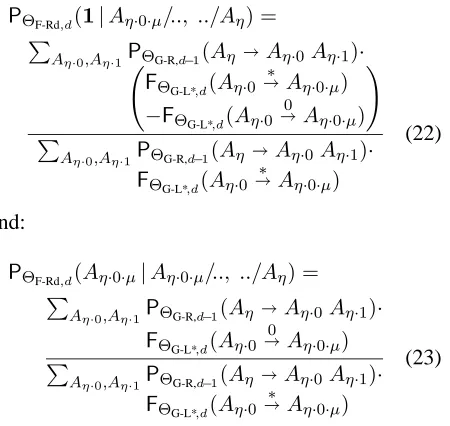
Reduce probabilities depend on the complete con-stituent category at ftd+1, and the incomplete con-stituent category Aη·0·µ·0/.. (for any awaited
cate-gory ‘..’) atqd
t−1, and the incomplete constituent
cat-egory../Aη (for any active category ‘..’) atqtd−−11. If
the complete constituent category at ftd+1 does not match the awaited category ofqd
t−1, the probability
is [ftd=f0]. If the complete constituent category atftd+1does match the awaited category ofqd
t−1: PΘF-Rd,d(1|Aη·0·µ/.., ../Aη) =
P
Aη·0,Aη·1PΘG-R,d−1(Aη Aη·0Aη·1)·
FΘG-L*,d(Aη·0 ∗
Aη·0·µ)
−FΘG-L*,d(Aη·0 0
Aη·0·µ)
!
P
Aη·0,Aη·1PΘG-R,d−1(Aη Aη·0Aη·1)·
FΘG-L*,d(Aη·0 ∗
Aη·0·µ)
(22)
and:
PΘF-Rd,d(Aη·0·µ|Aη·0·µ/.., ../Aη) = P
Aη·0,Aη·1PΘG-R,d−1(Aη Aη·0 Aη·1)·
FΘG-L*,d(Aη·0 0
Aη·0·µ)
P
Aη·0,Aη·1PΘG-R,d−1(Aη Aη·0 Aη·1)·
FΘG-L*,d(Aη·0 ∗
Aη·0·µ)
(23)
The correctness of the above distributions can be demonstrated by the fact that all terms other than
ΘG-L,d and ΘG-R,d probabilities will cancel out in
any sequence of transitions between an expansion and a reduction, leaving only those terms that would appear as factors in an ordinary PCFG parse.5
5 Results
A PCFG model was extracted from sections 2–21 of the Wall Street Journal Treebank. In order to keep the transform process manageable, punctua-tion was removed from the corpus, and rules oc-curring less frequently than 10 times in the corpus
5
It is important to note, however, that these probabilities are not necessarily incrementally balanced, so this correctness only applies to parsing with an infinite beam.
model (sect 22–24, len>40) F
unbounded PCFG 66.03
[image:8.612.78.303.276.489.2]bounded PCFG (D=4) 66.08
Table 1: Results of CKY parsing using bounded and un-bounded PCFG.
were deleted from the PCFG. The right-corner and bounded-stack transforms described in the previous section were then applied to the PCFG. The origi-nal and bounded PCFG models were evaluated in a CKY recognizer on sections 22–24 of the Treebank, with results shown in Table 1.6 Results were signif-icant only for sentences longer than 40 words. On these sentences, the bounded PCFG model achieves about a .15% reduction of error over the original PCFG (p < .1using one-tailed pairwise t-test). This suggests that on long sentences the probability mass wasted due to parsing with an unbounded stack is substantial enough to impact parsing accuracy.
6 Conclusion
Previous work has explored bounded-stack parsing using a right-corner transform defined on trees to minimize stack usage. HHMM parsers trained on applications of this tree-based transform of train-ing corpora have shown improvements over ordinary PCFG models, but this may have been attributable to the richer dependencies of the HHMM.
This paper has presented an approximate in-ference algorithm for transforming entire PCFGs, rather than individual trees, into equivalent right-corner bounded-stack HHMMs. Moreover, a com-parison with an untransformed PCFG model sug-gests that the probability mass wasted due to pars-ing with an unbounded stack is substantial enough to impact parsing accuracy.
Acknowledgments
This research was supported by NSF CAREER award 0447685 and by NASA under award NNX08AC36A. The views expressed are not nec-essarily endorsed by the sponsors.
6
References
Steven P. Abney and Mark Johnson. 1991. Memory re-quirements and local ambiguities of parsing strategies.
J. Psycholinguistic Research, 20(3):233–250.
Richard Bellman. 1957. Dynamic Programming.
Princeton University Press, Princeton, NJ.
Michael Collins. 1997. Three generative, lexicalised models for statistical parsing. In Proceedings of the
35th Annual Meeting of the Association for Computa-tional Linguistics (ACL ’97).
Nelson Cowan. 2001. The magical number 4 in short-term memory: A reconsideration of mental storage ca-pacity. Behavioral and Brain Sciences, 24:87–185. Edward Gibson. 1991. A computational theory of
hu-man linguistic processing: Memory limitations and processing breakdown. Ph.D. thesis, Carnegie Mellon.
James Henderson. 2004. Lookahead in deterministic left-corner parsing. In Proc. Workshop on
Incremen-tal Parsing: Bringing Engineering and Cognition To-gether, Barcelona, Spain.
Mark Johnson. 1998. Finite state approximation of constraint-based grammars using left-corner grammar transforms. In Proceedings of COLING/ACL, pages 619–623.
Tim Miller and William Schuler. 2008. A syntactic time-series model for parsing fluent and disfluent speech. In
Proceedings of the 22nd International Conference on Computational Linguistics (COLING’08).
George A. Miller. 1956. The magical number seven, plus or minus two: Some limits on our capacity for process-ing information. Psychological Review, 63:81–97. Kevin P. Murphy and Mark A. Paskin. 2001. Linear time
inference in hierarchical HMMs. In Proc. NIPS, pages 833–840.
Brian Roark. 2001. Probabilistic top-down parsing and language modeling. Computational Linguistics, 27(2):249–276.
William Schuler, Samir AbdelRahman, Tim Miller, and Lane Schwartz. 2008. Toward a psycholinguistically-motivated model of language. In Proceedings of
COL-ING, Manchester, UK, August.