GEC into the future:
Where are we going and how do we get there?
Keisuke Sakaguchi,1Courtney Napoles,1 and Joel Tetreault2 1Center for Language and Speech Processing, Johns Hopkins University
2Grammarly
{keisuke,napoles}@cs.jhu.edu, [email protected]
Abstract
The field of grammatical error correction (GEC) has made tremendous bounds in the last ten years, but new questions and obsta-cles are revealing themselves. In this posi-tion paper, we discuss the issues that need to be addressed and provide recommen-dations for the field to continue to make progress, and propose a new shared task. We invite suggestions and critiques from the audience to make the new shared task a community-driven venture.
1 Introduction
In the field of grammatical error correction (GEC), the Helping Our Own shared tasks in 2011 (Dale and Kilgarriff, 2011) and 2012 (Dale et al., 2012), and then the CoNLL shared tasks of 2013 (Ng et al., 2013) and 2014 (Ng et al., 2014) marked a sea change. For the first time there were public datasets, most notably the NUS Corpus of Learner English (NUCLE; Dahlmeier et al., 2013), and evaluation metrics, of which the most commonly used to date is M2(Dahlmeier and Ng, 2012). This
has allowed researchers from other fields, such as machine translation, to enter GEC more eas-ily. It has also enabled new developments, with many papers published on metrics, new algorithms (most recently neural methods), and occasionally new datasets.
Even with the accelerated progress in GEC, problems yet remain in the field. The use of spe-cific datasets may be GEC’s worst enemy, as sys-tem and even evaluation metric development rely too heavily on the NUCLE test set. While prob-ably one of the most important contributions to the field’s development to date, the lack of pub-licly available alternatives has caused some over-optimization. Other issues have also gone
undis-cussed. For example, nearly all work that has been published in the NLP community has focused on standalone systems, and very few investigate their impact on downstream users, except, e.g., Nagata and Nakatani (2010); Chodorow et al. (2010).
In this short paper, we take stock of the current state of GEC (§2) and its limitations (§3), and out-line where we believe the field should be five years from now (§4). We finish with a recommendation for a newcommunity-drivenshared task that will help the field progress even further (§5). We look forward to discussing this proposal with the com-munity and to refine a shared task for 2018. 2 GEC: A Quick Retrospective
A complete retrospective is outside the scope of this paper and thus we focus on two key aspects of the field: For a more detailed review of the field, we refer the reader to Leacock et al. (2014).
2.1 Datasets
There are several error-annotated corpora, and for the purposes of this paper, we only focus on the most recent public datasets. The size and char-acteristics of each corpus is summarized in Ta-ble 1. The most frequently used corpus for GEC is NUCLE, which was the official dataset of the 2013 and 2014 shared tasks. It is a collection of essays written by students at the National Univer-sity of Singapore (Dahlmeier et al., 2013). The test set and system results from the most recent shared task were released to the community (Ng et al., 2014), and have been the focus of recent work on automatic metrics (see §2.2). Addition-ally, this test set has been augmented with eight additional annotations from Bryant and Ng (2015) and eight from Sakaguchi et al. (2016).
The Cambridge Learner Corpus (CLC) contains a broader representation of native languages than the NUCLE, however only the First Certificate in
Num. Num. Sents. Err. type Fluency Err. span Diverse Diverse Diverse Native Corpus refs. sent. changed labeled edits >1 sent. proficiency topic L1 speakers
NUCLE 59k 2 38% 3 (7) 3 7 7 7 7
FCE 34k 1 62% 3 7 3 3 3 3 7
Lang-8 2.5M ≥1 42% 7 3 3 3 3 3 7
AESW 1.2M 1 39% 7 7 3 7 7 3 3+7
[image:2.595.74.529.60.136.2]JFLEG 1.5k 4 86% 7 3 7 3 3 3 7
Table 1: GEC corpora available for free (for research purposes) and desired properties, identified in§3.1. 3and7indicate whether the corpus exhibits each property. Fluency edits for the NUCLE test set were added by Sakaguchi et al. (2016).
English (FCE) portion is publicly available (Yan-nakoudakis et al., 2011). The FCE is approxi-mately the same size as NUCLE and was used for the 2012 shared task. However it has not been used to the same extent as NUCLE, presumably because it lacks multiple annotations and the 2012 shared task system outputs were not released.
All of the corpora described above have been annotated with spans of text containing an error and assigned an error code. Unlike these, the Lang-8 Learner Corpora Corpus of Learner En-glish (Tajiri et al., 2012) is a parallel set of original and corrected sentences from lang-8.com, an online community of language learners who post text that is corrected by other users. It is also the largest public GEC corpora, with more than 2 million English sentences.1 Another large
cor-pus currently available was released for the first Automatic Evaluation of Scientific Writing shared task (AESW; Daudaravicius et al., 2016). Unlike the other corpora, it contains scientific writing by native and non-native English speakers, corrected by professional editors. Because the writers are highly proficient, there is a lower diversity of er-rors than the other corpora. More than half of the errors are related to punctuation (Flickinger et al., 2016), which compose less than 7% of NUCLE errors.
Finally, the JHU FLuency-Extended GUG cor-pus (JFLEG) is a small dataset for tuning and eval-uating GEC systems. 1.5k sentences are taken from the GUG corpus (Heilman et al., 2014), which labels sentences with an ordinal grammati-cality score. In JFLEG, each sentence is corrected four times for grammaticality and fluency (Sak-aguchi et al., 2016).
2.2 Evaluation
Precision, recall, and F-score have been used to evaluate GEC systems that correct targeted er-ror types. Three additional evaluation metrics 1Because of noise and implementation differences in sen-tence extraction, the size varies from 2–2.5 million sensen-tences.
have been proposed for GEC: MaxMatch (M2;
Dahlmeier and Ng, 2012), I-measure (Felice and Briscoe, 2015), and GLEU (Napoles et al., 2015). The first two metrics compare the changes made in the output to error-coded spans of the refer-ence corrections. M2 was the metric used for
the 2013 and 2014 CoNLL GEC shared tasks (Ng et al., 2013, 2014). It captures word- and phrase-level edits by building an edit lattice and calcu-lating an F-score over the lattice. I-measure (IM) is based on token-level alignment-based accuracy among the source, hypothesis, and gold-standard. IM considers the distinction between “do-nothing (already grammatical) baseline” and systems that only propose wrong corrections (i.e., make the source sentence worse). Unlike these two ap-proaches, GLEU does not need error-coded refer-ences (Napoles et al., 2015). Based on BLEU (Pa-pineni et al., 2002), it computes n-gram precision of the system output against reference sentences, and additionally penalizes n-grams in the hypoth-esis that should have been corrected but failed.
3 Limitations
3.1 Problems with Datasets
GLEU IM [-100, M2[0, 100]
System [0,100] 100] P R F0.5
“a” 0.2 0.0 28.4 31.3 28.9
“a a” 0.6 0.0 28.7 31.8 29.3
“a a a” 1.6 0.0 28.7 32.0 29.4
Source 57.4 0.0 100.0 0.0 0.0
CAMB14 64.3 -5.3 39.7 30.1 37.3 CUUI14 64.6 -2.2 41.8 24.9 36.8
AMU14 64.6 -2.5 41.6 21.4 35.0
Src>Game 3 7 3 7 7
[image:3.595.71.292.62.184.2]Src<Sys 3 7 7 3 3
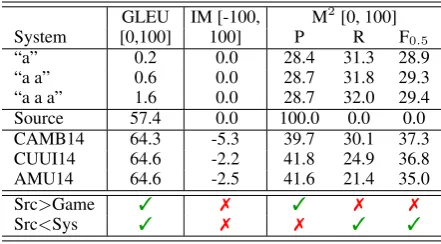
Table 2: Metric scores of three artificially contrived systems (Game), input source sentences (Src), and top 3 system out-puts (Sys) on CoNLL14 data. The bottom two rows show whether each metric scores the systems better than Game or worse than Source. Humans judge all systems be better than over Source.
McDonald, 2012).
Another issue is training data size. The sis-ter field of machine translation (MT) usually has datasets in the orders of millions or even tens of millions of sentence pairs. The largest GEC datasets barely approach that figure, with 2.5 mil-lion sentences at a maximum, a number which in-cludes sentences that were not corrected.
Table 1 summarizes the strengths and weak-nesses of the most commonly used GEC corpora across different properties ranging from size to diversity in native language (L1). The most no-table weakness across corpora is the lack of mul-tiple reference corrections. NUCLE contains two corrections per sentence and JFLEG 4. M2 and
GLEU scores increase with more references but at a diminishing rate (Bryant and Ng, 2015; Sak-aguchi et al., 2016). Further investigation is war-ranted to determine what an ideal number of refer-ences is, given the trade off between cost and relia-bility. Some corpora contain little diversity in pro-ficiency, topic, and/or native language of the writ-ers (namely NUCLE and AESW), however AESW is the only corpus to contain sentences by native English speakers.
3.2 Problems with Evaluation
The 2014 CoNLL shared task has enabled, for the first time, the development of evaluation metrics. These metrics are evaluated by comparing their ranking of the shared task systems with the rank-ing done by human annotators. Sakaguchi et al. (2016) showed that GLEU could rank systems closer to a human ranking than M2 and IM, and
a higher correlation could be found when com-bining GLEU with a reference-less fluency
met-ric (Napoles et al., 2017). However, it is impor-tant to take these results with a grain of salt—all benchmarking of the metrics was done with the CoNLL 2014 systems and data, and it remains to be seen if this ranking would hold on other, larger datasets.
Another issue with the metrics is the number of references available for comparison. As in machine translation, the more references (human-generated gold-standard corrections) one has, the better one can evaluate a system. The CoNLL 2014 test set has 18 references annotated, but one can find examples where a system pro-duces a correction which is not reflected in the ref-erences. This gets more complicated when human raters feel it is necessary to rewrite a sentence.
A third issue is that no metric directly measures meaning preservation. This means that a system could produce a more fluent version of the original but accidentally change one word, and that could change the meaning of the whole sentence. For example, if a system accidentally corrected doc-umentarytodocumentin “The documentary gave a nice summary of global warming.” By current metrics, that error would have the same penalty as a minor spelling mistake.
Finally, the most commonly used GEC met-ric, M2, has a serious weakness, which has been
noted in earlier papers (Felice and Briscoe, 2015; Sakaguchi et al., 2016; Bryant et al., 2017). The phrasal alignments under-penalize a sequence of incorrect tokens, and to illustrate how troubling this is, we tested a series of dummy systems, where each system produces the same sentence re-gardless of input (the sentences produced by each system area,a a, anda a a). Table 2 shows their scores on the CoNLL 2014 test set evaluated on the official NUCLE references (without alterna-tives), compared to the top 3 systems in the shared task, CAMB14 (Felice et al., 2014), CUUI14 (Ro-zovskaya et al., 2014), and AMU14 (Junczys-Dowmunt and Grundkiewicz, 2014). The reader will notice that GLEU and IM score these sen-tences at or near zero, however according to M2,
Metric score (rank)
GLEU IM M2
System Sentence [0,100] [-100,100] [0,100]
Source In both advertisements is said that these tooth pastes will make your
teeth briliant and brighter . 15.7 (4) 0.0 (4) 0.0 (5)
Reference ebrilliant and brighter .Both advertisementsesay that the toothpaste will make your teeth 50.7 (1) 17.4 (3) 65.2 (3) AMU16 &
NUS16 In both advertisements is said that these tooth pastes will make yourteeth briliant and brighter . 15.7 (4) 0.0 (4) 0.0 (5) CAMB14 In both advertisements is said that these tooth pastes will make your
teeth brilliant and brighter . 35.5 (3) 100.0 (1) 83.3 (1) CAMB16 In both advertisements it is said that these tooth problems will make
your teeth brilliant and brighter . 39.5 (2) 56.1 (2) 71.4 (2)
[image:4.595.70.529.60.248.2]Dummy a a a . 2.9 (5) -47.7 (5) 52.6 (4)
Table 3: An original source sentence and candidate corrections, along with the score of each sentence from different metrics. Changed or inserted spans are underlined andeindicates deletions.
4 Looking into the Future
In this section we outline our recommendations for how the field should develop.
4.1 Data
As the world’s communication is not limited to college-level essays, it is important that we have datasets which better represent as much breadth as possible. Ideally, datasets should span differ-ent genres (such as emails, blog posts, and official documents) and include content from both native and non-native speakers, as well as from different proficiency levels. All of these changes will en-able the field to better assess how we are helping
moreof the world’s writers under different condi-tions, and also enable one to test adaptation be-tween domains.
4.2 Evaluation
We envision evaluation metrics which check that corrections are not only grammatically valid, but also check that the corrections are native-sounding and preserve the original meaning or intent of the writer. Future metrics should be easy to compute and be interpretable. For instance, a range be-tween -1 and 1 may be preferred (like IM uses), since it is possible a suggested set of corrections could produce a sentence which isworsethan the original. If multiple references are used, metrics should assign credit to corrections which match different references in different places, assuming the outcome is overall coherent. In addition, most (if not all) evaluation schemes to date have focused on the sentence as the minimal unit. It would be
good to take the entire document into account and allow for more global rewrites, such as consistent tense.
Ultimately, a metric should say whether or not a system has attained the same level of perfor-mance as a human judge. One way of doing this is through a GEC Turing Test, where system out-puts are blindly judged alongside human correc-tions of the same sentences. If human adjudicators think the system outputs are indistinguishable in quality from the human corrections (for example, given a set of criteria such as being good correc-tions, meaning preserving and native-sounding) then that is a very strong signal that GEC has at-tained human-level performance.
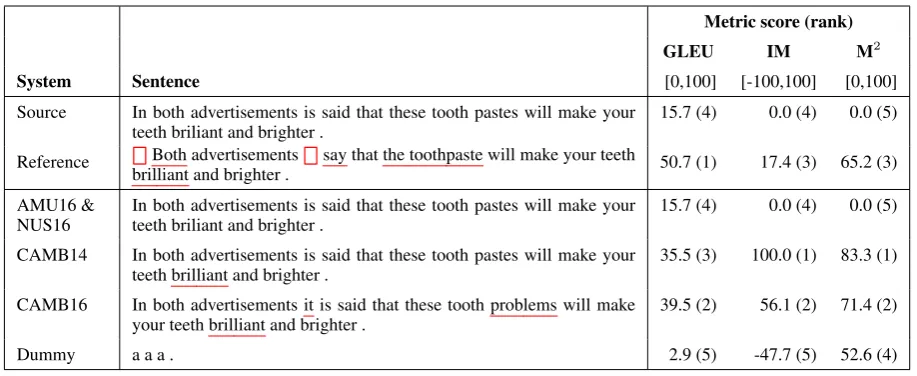
To illustrate the shortcomings of current met-rics, Table 3 contains a JFLEG sentence corrected by current leading systems (AMU16 (Junczys-Dowmunt and Grundkiewicz, 2016); NUS16 (Chollampatt et al., 2016); CAMB16 (Yuan and Briscoe, 2016)) and the automatic metric scores.2
Notice that the CAMB16 sentence, which changes
tooth pastes→tooth problems, is ranked the high-est system output by GLEU and the second highhigh-est by IM and M2. All metrics score it higher than the
unchanged Source sentence. Another issues evi-denced in the table is that IM and M2score the
im-perfect correction (CAMB14) as better than Refer-ence; and according to M2, the Dummy output is
better than Source.
We believe that the GEC field should take
notes from the Workshop on Machine Translation (WMT) (Bojar et al., 2016). There the participants in the evaluation shared tasks are also responsible for contributing system ranking judgments. This makes the whole effort more community-driven and takes the pressure off one group from having to supply all annotations.
4.3 Consensus on Goals and Applications
As a corollary to data and metrics, the end-goal of GEC also needs to be refined within the com-munity. Initial approaches to GEC seemed to fo-cus on providing feedback to English language learners where specific error types would be tar-geted and feedback would be given in terms of detection or possible corrections. The work was also motivated by concurrent work in using NLP for automatic essay scoring (for example, Attali and Burstein (2006)). Chodorow et al. (2012) noted several other applications for GEC: improv-ing overall writimprov-ing quality for both native and non-native writers, assistive language learning, and applications within NLP (such as post-editing in MT). More recently the field has drifted to “whole sentence GEC” using statistical or neural MT ap-proaches. In this situation, the writer simply gets a complete rewrite of their sentence, which may be useful as an instructional tool in some circum-stances, but not all.
There is no consensus on what the focus appli-cation(s) should be. Which application determines which methods and which evaluation metrics one uses. For example, if one wants to provide feed-back to language learners, then a high-precision, interpretable method is preferred. Conversely, if the application is simply to automatically clean up one’s writing without any feedback, then a whole sentence approach may be preferred. Very few pa-pers delve into error detection and correction for goals other than whole-sentence error correction or targeted feedback for ESL writers. Datasets and metrics should be created with a specific goal in mind. Thus, the field should reassess what are the goals and how we evaluate with respect to these goals.
5 Proposal for a New Shared Task
We believe it is time for another shared task in the field, this one designed with consideration the field should be several years from now. The CoNLL shared tasks were instrumental in unifying the field with a common benchmark corpus and
met-ric, and the AESW shared task provided data from a new domain to evaluate on. We recommend the following:
• Data: A new corpus for training and eval-uation that spans different genres. We have already begun collecting conversational data from native and non-native writers and from genres other than essays, such as emails. Our aim is to construct a corpus larger than the NUCLE to support the development of data-hungry methods such as neural MT.
• Annotation: The data is corrected for flu-ency with crowdsourcing as in Sakaguchi et al. (2016) which is a cheap and efficient way of collecting annotations of reasonable quality. Error types can be automatically tagged using a method such as that described in Bryant et al. (2017)
• Metric Evaluation: Borrowing from the WMT community, the shared task should also be a venue to improve automatic GEC evaluation. Participants will provide judg-ments on system rankings.
We invite discussion from the community and seek others to help contribute data, an-notations and other resources to make this a community-driven event. Our goal is to host a shared task in 2018. We believe that this type of collaboration has made the WMT eval-uations a success, and will similarly benefit GEC. We have set up a public mailing list where others can post their comments and sug-gestions: https://groups.google.com/ forum/#!forum/gec-sharedtask.
6 Conclusions
The goal of this paper is to laud the progress that the GEC field has made, but also highlight the lim-itations that must be addressed for the field to grow further. The reliance on a few narrow datasets is problematic as it has a major impact on system development and metric development, as well as robustness when applying these approaches in the real world. Our concern is that unless data and metrics are improved, it will be hard to assess the value of new algorithms optimized for a small set of datasets and metrics. We list a recommendation for a new shared task to fuel discussion offline as well as at the BEA12 Workshop in Copenhagen.3
3https://www.cs.rochester.edu/
References
Yigal Attali and Jill Burstein. 2006. Automated essay scoring with e-raterR v. 2. The Journal of
Technol-ogy, Learning and Assessment4(3).
Ondˇrej Bojar, Rajen Chatterjee, Christian Federmann, Yvette Graham, Barry Haddow, Matthias Huck, Antonio Jimeno Yepes, Philipp Koehn, Varvara Logacheva, Christof Monz, Matteo Negri, Aure-lie Neveol, Mariana Neves, Martin Popel, Matt Post, Raphael Rubino, Carolina Scarton, Lucia Spe-cia, Marco Turchi, Karin Verspoor, and Marcos Zampieri. 2016. Findings of the 2016 conference on machine translation. InProceedings of the First Conference on Machine Translation. Association for Computational Linguistics, Berlin, Germany, pages 131–198. http://www.aclweb.org/anthology/W16-2301.
Christopher Bryant, Mariano Felice, and Ted Briscoe. 2017. Automatic annotation and evaluation of er-ror types for grammatical erer-ror correction. In Pro-ceedings of the 55th Annual Meeting of the Associa-tion for ComputaAssocia-tional Linguistics. Association for Computational Linguistics, Vancouver, Canada.
Christopher Bryant and Hwee Tou Ng. 2015. How far are we from fully automatic high quality grammatical error correction? In Proceed-ings of the 53rd Annual Meeting of the As-sociation for Computational Linguistics and the 7th International Joint Conference on Natural Language Processing. Association for Computa-tional Linguistics, Beijing, China, pages 697–707. http://www.aclweb.org/anthology/P15-1068.
Aoife Cahill, Nitin Madnani, Joel Tetreault, and Diane Napolitano. 2013. Robust systems for preposition error correction using wikipedia re-visions. In Proceedings of the 2013 Confer-ence of the North American Chapter of the As-sociation for Computational Linguistics: Human Language Technologies. Association for Computa-tional Linguistics, Atlanta, Georgia, pages 507–517. http://www.aclweb.org/anthology/N13-1055.
Martin Chodorow, Markus Dickinson, Ross Israel, and Joel Tetreault. 2012. Problems in evaluating grammatical error detection systems. In Proceed-ings of COLING 2012. The COLING 2012 Orga-nizing Committee, Mumbai, India, pages 611–628. http://www.aclweb.org/anthology/C12-1038.
Martin Chodorow, Michael Gamon, and Joel Tetreault. 2010. The utility of grammatical error detection sys-tems for English language learners: Feedback and assessment. Language Testing27(3).
Shamil Chollampatt, Duc Tam Hoang, and Hwee Tou Ng. 2016. Adapting grammatical error correction based on the native language of writers with neu-ral network joint models. In Proceedings of the
2016 Conference on Empirical Methods in Natu-ral Language Processing. Association for Computa-tional Linguistics, Austin, Texas, pages 1901–1911. https://aclweb.org/anthology/D16-1195.
Daniel Dahlmeier and Hwee Tou Ng. 2012. Better evaluation for grammatical error correction. In Pro-ceedings of the 2012 Conference of the North Amer-ican Chapter of the Association for Computational Linguistics: Human Language Technologies. As-sociation for Computational Linguistics, Montr´eal, Canada, pages 568–572.
Daniel Dahlmeier, Hwee Tou Ng, and Siew Mei Wu. 2013. Building a large annotated corpus of learner english: The NUS Corpus of Learner English. In Proceedings of the Eighth Work-shop on Innovative Use of NLP for Building Ed-ucational Applications. Association for Computa-tional Linguistics, Atlanta, Georgia, pages 22–31. http://www.aclweb.org/anthology/W13-1703. Robert Dale, Ilya Anisimoff, and George
Nar-roway. 2012. Hoo 2012: A report on the preposition and determiner error correction shared task. In Proceedings of the Seventh Workshop on Building Educational Applica-tions Using NLP. Association for Computational Linguistics, Montr´eal, Canada, pages 54–62. http://www.aclweb.org/anthology/W12-2006. Robert Dale and Adam Kilgarriff. 2011. Helping
our own: The hoo 2011 pilot shared task. In
Proceedings of the Generation Challenges Ses-sion at the 13th European Workshop on Natural Language Generation. Association for Computa-tional Linguistics, Nancy, France, pages 242–249. http://www.aclweb.org/anthology/W11-2838. Vidas Daudaravicius, Rafael E. Banchs, Elena
Volo-dina, and Courtney Napoles. 2016. A report on the automatic evaluation of scientific writing shared task. In Proceedings of the 11th Work-shop on Innovative Use of NLP for Building Ed-ucational Applications. Association for Computa-tional Linguistics, San Diego, CA, pages 53–62. http://www.aclweb.org/anthology/W16-0506. Mariano Felice and Ted Briscoe. 2015. Towards a
stan-dard evaluation method for grammatical error detec-tion and correcdetec-tion. InProceedings of the 2015 Con-ference of the North American Chapter of the Asso-ciation for Computational Linguistics. Association for Computational Linguistics, Denver, CO. Mariano Felice, Zheng Yuan, Øistein E. Andersen,
He-len Yannakoudakis, and Ekaterina Kochmar. 2014. Grammatical error correction using hybrid systems and type filtering. InProceedings of the Eighteenth Conference on Computational Natural Language Learning: Shared Task. Association for Computa-tional Linguistics, Baltimore, Maryland, pages 15– 24. http://www.aclweb.org/anthology/W14-1702. Dan Flickinger, Michael Goodman, and Woodley
for aesw 2016 shared task on grammatical er-ror detection. In Proceedings of the 11th Work-shop on Innovative Use of NLP for Building Ed-ucational Applications. Association for Computa-tional Linguistics, San Diego, CA, pages 105–111. http://www.aclweb.org/anthology/W16-0511. Michael Heilman, Aoife Cahill, Nitin Madnani,
Melissa Lopez, Matthew Mulholland, and Joel Tetreault. 2014. Predicting grammaticality on an ordinal scale. In Proceedings of the 52nd An-nual Meeting of the Association for Computa-tional Linguistics. Association for Computational Linguistics, Baltimore, Maryland, pages 174–180. http://www.aclweb.org/anthology/P14-2029. Eduard Hovy, Mitchell Marcus, Martha Palmer, Lance
Ramshaw, and Ralph Weischedel. 2006. Ontonotes: the 90% solution. InProceedings of the human lan-guage technology conference of the NAACL, Com-panion Volume: Short Papers. Association for Com-putational Linguistics, pages 57–60.
Marcin Junczys-Dowmunt and Roman Grundkiewicz. 2014. The AMU System in the CoNLL-2014 shared task: Grammatical error correction by data-intensive and feature-rich statistical machine trans-lation. In Proceedings of the Eighteenth Confer-ence on Computational Natural Language Learn-ing: Shared Task. Association for Computational Linguistics, Baltimore, Maryland, pages 25–33. http://www.aclweb.org/anthology/W14-1703. Marcin Junczys-Dowmunt and Roman Grundkiewicz.
2016. Phrase-based machine translation is state-of-the-art for automatic grammatical error cor-rection. In Proceedings of the 2016 Con-ference on Empirical Methods in Natural Lan-guage Processing. Association for Computational Linguistics, Austin, Texas, pages 1546–1556. https://aclweb.org/anthology/D16-1161.
C. Leacock, M. Chodorow, M. Gamon, and J. Tetreault. 2014. Automated Grammatical Error Detection for Language Learners, Second Edition. Synthesis Lectures on Human Language Technologies. Morgan & Claypool Publishers. https://books.google.com/books?id=bi0QAwAAQBAJ. Mitchell P Marcus, Mary Ann Marcinkiewicz, and
Beatrice Santorini. 1993. Building a large annotated corpus of english: The penn treebank. Computa-tional linguistics19(2):313–330.
Ryo Nagata and Kazuhide Nakatani. 2010. Eval-uating performance of grammatical error de-tection to maximize learning effect. In Col-ing 2010: Posters. Coling 2010 Organizing Committee, Beijing, China, pages 894–900. http://www.aclweb.org/anthology/C10-2103. Courtney Napoles, Keisuke Sakaguchi, Matt Post,
and Joel Tetreault. 2015. Ground truth for gram-matical error correction metrics. In Proceed-ings of the 53rd Annual Meeting of the As-sociation for Computational Linguistics and the
7th International Joint Conference on Natural Language Processing. Association for Computa-tional Linguistics, Beijing, China, pages 588–593. http://www.aclweb.org/anthology/P15-2097. Courtney Napoles, Keisuke Sakaguchi, and Joel
Tetreault. 2017. Jfleg: A fluency corpus and bench-mark for grammatical error correction. In Proceed-ings of the 15th Conference of the European Chap-ter of the Association for Computational Linguistics: Volume 2, Short Papers. Association for Computa-tional Linguistics, Valencia, Spain, pages 229–234. http://www.aclweb.org/anthology/E17-2037. Hwee Tou Ng, Siew Mei Wu, Ted Briscoe, Christian
Hadiwinoto, Raymond Hendy Susanto, and Christo-pher Bryant. 2014. The CoNLL-2014 Shared Task on grammatical error correction. InProceedings of the Eighteenth Conference on Computational Natu-ral Language Learning: Shared Task. Association for Computational Linguistics, Baltimore, Mary-land, pages 1–14.
Hwee Tou Ng, Siew Mei Wu, Yuanbin Wu, Chris-tian Hadiwinoto, and Joel Tetreault. 2013. The CoNLL-2013 Shared Task on grammatical error cor-rection. InProceedings of the Seventeenth Confer-ence on Computational Natural Language Learn-ing: Shared Task. Association for Computational Linguistics, Sofia, Bulgaria, pages 1–12.
Kishore Papineni, Salim Roukos, Todd Ward, and Wei-Jing Zhu. 2002. Bleu: a method for auto-matic evaluation of machine translation. In Pro-ceedings of 40th Annual Meeting of the Associa-tion for ComputaAssocia-tional Linguistics. Association for Computational Linguistics, Philadelphia, Pennsyl-vania, USA, pages 311–318.
Slav Petrov and Ryan McDonald. 2012. Overview of the 2012 shared task on parsing the web. InSANCL. Marek Rei and Helen Yannakoudakis. 2016. Com-positional sequence labeling models for error detection in learner writing. In Proceedings of the 54th Annual Meeting of the Associa-tion for ComputaAssocia-tional Linguistics (Volume 1: Long Papers). Association for Computational Lin-guistics, Berlin, Germany, pages 1181–1191. http://www.aclweb.org/anthology/P16-1112. Alla Rozovskaya, Kai-Wei Chang, Mark Sammons,
Dan Roth, and Nizar Habash. 2014. The Illinois-Columbia System in the CoNLL-2014 shared task. In Proceedings of the Eighteenth Confer-ence on Computational Natural Language Learn-ing: Shared Task. Association for Computational Linguistics, Baltimore, Maryland, pages 34–42. http://www.aclweb.org/anthology/W14-1704. Keisuke Sakaguchi, Courtney Napoles, Matt Post, and
Toshikazu Tajiri, Mamoru Komachi, and Yuji Mat-sumoto. 2012. Tense and aspect error correction for ESL learners using global context. InProceedings of the 50th Annual Meeting of the Association for Computational Linguistics. Association for Compu-tational Linguistics, Jeju Island, Korea, pages 198– 202. http://www.aclweb.org/anthology/P12-2039. Helen Yannakoudakis, Ted Briscoe, and Ben
Med-lock. 2011. A new dataset and method for au-tomatically grading ESOL texts. In Proceedings of the 49th Annual Meeting of the Association for Computational Linguistics: Human Language Technologies. Association for Computational Lin-guistics, Portland, Oregon, USA, pages 180–189. http://www.aclweb.org/anthology/P11-1019. Zheng Yuan and Ted Briscoe. 2016.