Mining User Relations from Online Discussions using Sentiment Analysis
and Probabilistic Matrix Factorization
Minghui Qiu†, Liu Yang†,‡, Jing Jiang† †
School of Information Systems, Singapore Management University, Singapore
‡
School of Software and Microelectronics, Peking University, China
{minghui.qiu.2010,jingjiang}@smu.edu.sg, [email protected]
Abstract
Advances in sentiment analysis have enabled extraction of user relations implied in online textual exchanges such as forum posts. How-ever, recent studies in this direction only con-sider direct relation extraction from text. As user interactions can be sparse in online dis-cussions, we propose to apply collaborative filtering through probabilistic matrix factor-ization to generalize and improve the opinion matrices extracted from forum posts. Exper-iments with two tasks show that the learned latent factor representation can give good per-formance on a relation polarity prediction task and improve the performance of a subgroup detection task.
1 Introduction
The fast growth of the social Web has led to a large amount of interest in online social network analysis. Most existing work on social network analysis re-lies on explicit links among users such as undirected friendship relations (Liben-Nowell and Kleinberg, 2003), directed following relations (Hopcroft et al., 2011) and trust/distrust relations (Leskovec et al., 2010). However, besides these explicit social rela-tions, the various kinds of interactions between on-line users often suggest other implicit relations. In particular, in online discussion forums, users inter-act through textual posts and these exchanged texts often reveal whether two users are friends or foes, or whether two users share the same viewpoint towards a given issue.
To uncover such implicit relations requires text analysis and particularly sentiment analysis.
Re-cently, Hassan et al. (2012) studied predicting the polarity of user interactions in online discussions based on textual exchanges. They found that the au-tomatically predicted signed relations had an accu-racy above 80%. The extracted signed network was further used to detect ideological subgroups. This is a piece of pioneering work that extracts online social relations based on text analysis.
In this paper, we further extend the idea of mining social relations from online forum posts by incorpo-rating collaborative filtering. Our work is motivated by the observation that direct textual exchanges be-tween users are sparse. For example, in the data set we use, only around 13% of user-user pairs have di-rect interactions. Collaborative filtering is a com-monly used technique in recommender systems to predict missing ratings. The key assumption is that if two people have the same opinion on an itemA, they are likely to also have the same opinion on a different itemB. In online discussion forums, users express their opinions about each other as well as the various aspects of the topic under discussion, but not every user comments on every aspect or every other user. Collaborative filtering allows us to iden-tify users with the same opinion even if they have not directly interacted with each other or commented on any common aspect.
Our method starts with extracting opinions on users and topic aspects from online posts using sen-timent analysis. The results are two matrices indi-cating the sentiment polarity scores between pairs of users and pairs of a user and an aspect. To in-corporate collaborative filtering, we choose proba-bilistic matrix factorization (PMF) (Salakhutdinov
and Mnih, 2008), a technique that has been success-fully applied for collaborative filtering-based recom-mendation problems. PMF automatically discovers a low-rank representation for both users and items based on observed rating data. In our problem, the predicted sentiment polarity scores are treated as rat-ing data, and the results of PMF are low-rank vectors representing each user in online discussions.
We evaluate our method on two tasks. The first is to predict the polarity of interactions between two users not from their own textual exchanges but from their interactions with other users or comments on topic aspects. The second is to use the latent vectors to group users based on viewpoints. We find that the latent factor representation can produce good predic-tion results for the first task and improve the cluster-ing results of the second task compared with a num-ber of baselines, showing the effectiveness of col-laborative filtering for mining social relations from online discussions.
2 Related Work
Our work is closely related to recent studies on detecting subgroups from online discussions (Abu-Jbara et al., 2012; Dasigi et al., 2012; Hassan et al., 2012). Abu-Jbara et al. (2012) proposed to build discussant attitude profiles (DAP) from on-line posts and use these profiles to cluster users into subgroups. A DAP is a vector that contains the attitudes of a discussant towards other discussants and a set of opinion targets. We also extract opin-ions of users towards other users and opinion tar-gets from posts, which are similar to DAPs. The difference is that we further apply probabilistic ma-trix factorization to derive a low-rank representation from the raw opinion scores. Our comparison with DAP-based clustering shows that probabilistic ma-trix factorization can improve subgroup detection. Hassan et al. (2012) proposed to predict the polar-ity of interactions between users based on their tex-tual exchanges. They defined a set of interaction features using sentiment analysis and applied super-vised learning for polarity prediction. In compari-son, our work is unsupervised, that is, we do not use any ground truth of interaction polarity for training. Probabilistic matrix factorization was proposed by Salakhutdinov and Mnih (2008) as a
collabo-rative filtering method for recommender systems. It has attracted much attention and been extended by Ma et al. (2008) and Wang and Blei (2011). In particular, Ma et al. (2008) proposed a SocRec model that combines social network information with rating data using the PMF framework to per-form social recommendation. Our model bears sim-ilarity to SocRec in that we also consider two types of interactions, i.e. user interactions and user-aspect interactions. However, different from Ma et al. (2008), we predict both the user and user-aspect scores from textual posts using sentiment analysis, and the user-user opinion polarity scores are symmetric.
Part of our method uses sentiment analysis to ex-tract opinions from text. This is built on top of a large body of existing work on opinion extraction, e.g. Choi et al. (2006) and Wu et al. (2009). As the sentiment analysis component is not our main con-tribution, we do not review existing work along this direction in detail here. Interested readers can refer to Pang and Lee (2008).
The idea of incorporating sentiment analysis into collaborative filtering algorithms has been explored by Kawamae (2011), Moshfeghi et al. (2011) and Leung et al. (2011). While their work also com-bines sentiment analysis with collaborative filtering, the purpose is to improve the accuracy of item rec-ommendation. In contrast, we borrow the idea and technique of collaborative filtering to improve user relation mining from online text.
3 Method Overview
In this section, we provide an overview of our method. We first introduce some concepts.
User: We useuserto refer to a discussant in an on-line discussion. Each user has an onon-line ID, which can be used by other users to refer to him/her in a post. Users are both opinion holders and opinion targets. For example, User 1 below expresses a neg-ative opinion towards another user in the following snippet.
User 1: Actually, I have to disagree withyou.
opinions on targets such as “President Obama” and “Republican party,” as shown in the following snip-pets. These aspects are all related to Obama’s pres-idential campaign. As we will explain later, the as-pects we consider are named entities and frequent noun phrases.
User 2: Americans should vote for President Obama be-cause he picks good corporations as winners.
User 3: I simply point out how absolutely terrible the Re-publican partyis.
Polarity Score: A sentiment polarity score is a real number between 0 and 1, where 0 indicates a completely negative opinion and 1 indicates a com-pletely positive opinion.
User-User Opinion Matrix: The opinions ex-tracted from posts between users are represented by a user-user opinion matrixS, where entry si,j is a polarity score between thei-th user and thej-th user. We assume that the polarity scores are symmetric.
User-Aspect Opinion Matrix: The opinions held by different users on the various topic aspects are represented by a user-aspect opinion matrix R, where entryri,kis a polarity score indicating thei-th
user’s opinion towards thek-th aspect.
Given the matricesS andR, we perform proba-bilistic matrix factorization to derive a low-rank vec-tor representation for users and aspects such that if the polarity score between two users or a user and an aspect is high, the dot product between the corre-sponding two vectors is also high.
In Section 4, we will explain in detail how we identify topic aspects from a discussion thread and how we obtain polarity scores from posts. In Sec-tion 5, we will present the details of our probabilistic matrix factorization model.
4 Construction of Opinion Matrices
The opinion matrices are constructed from a single forum thread discussing some controversial topic.
4.1 Aspect Identification
As we have pointed out, there are two kinds of opin-ion targets, namely users and aspects. Users are clearly defined and can often be identified in posts by their IDs or second person pronouns. For aspects, however, there is not a pre-defined set. We observe that these topic aspects are usually named entities
or noun phrases frequently mentioned. We therefore use the OpenNLP toolkit1to perform chunking and obtain noun phrases and the Standford NER tagger2 to identify named entities from the posts.
Some of the candidate aspect phrases identified above actually refer to the same actual aspect, e.g. “Obama voter,” “Obama voters” and “the Obama voter.” We remove stop words from each candidate phrase and use the WordNet by Miller (1995) to ob-tain the lemma of each word such that we can nor-malize the candidate aspect phases to some extent.
Finally, to select salient aspects for a given discus-sion topic, we count the number of times each candi-date aspect has been expressed a positive or negative opinion on by all users, and select those candidate aspects which have opinion expressions from at least
M users. We setM to 2 in our experiments. Fig-ure 1 shows the top salient aspects for the thread on “Will you vote for Obama?” We acknowledge there are still duplicate aspects in the results like “Repub-lican Party” and “GOP”. To normalize these aspects, some additional information such as Wikipedia en-tries and Google snippets may be considered. We will study this problem in our future work.
4.2 Opinion Expression Identification
Our next step is to identify candidate opinion expres-sions. This problem has been studied in Hu and Liu (2004), Popescu and Etzioni (2005), and Hassan and Radev (2010). Based on previous work, we do the following. We first combine three popular sen-timent lexicons to form a single sensen-timent lexicon: the lexicon used in Hu and Liu (2004), MPQA Sub-jectivity Lexicon by Wilson et al. (2005) and Senti-WordNet by Baccianella et al. (2010). Our final sen-timent lexicon contains 15,322 negative expressions and 10,144 positive expressions. We then identify candidate opinion expressions by searching for oc-currences of words in this lexicon in the posts.
4.3 Opinion Relation Extraction
Given a post that contains an aspect and an opin-ion expressopin-ion, we still need to determine whether the opinion expression is used to describe the as-pect. This is a relation extraction problem. We use a supervised learning approach based on dependency
1
http://opennlp.apache.org/
0 20 40 60 80 100
OBAMABUSH AMERICA
PALIN REPUBLICANCONGRESS
TAX_CUTAMERICANCLINTONMCCAIN TEA_PARTY
IRAQ
SARAH_PALIN PRESIDENT_OBAMA
REAGAN RON_PAUL
ECONOMIC_POLICY AFGHANISTAN
CARTER FOX
HEALTH_CARE NATIONAL_DEBT
DEMOCRAT GOP
MIDDLE_CLASS
OBAMA_ADMINISTRATION REPUBLICAN_PARTY
TAX_BREAK WASHINGTON
FEDERAL_GOVERNMENTHEALTH_CARE_REFORM HITLER
[image:4.612.91.518.58.189.2]IRAQ_WAR WALL_STREET
Figure 1: Salient aspects and number of users who express opinions on them in the thread “Will you vote for Obama?”
ID Dependency path rule Example
R1 ADJOP←amod←NT R I simply point out howterribleREPUBLICAN PARTY is. R2 ADJOP→nsubj→NT R BUSH is even morereasonablefor tax hike than Obama.
R3 VOP→dobj→NT R I would neversupportOBAMA.
R4 VOP→prep∗ →NT R I’llvotefor OBAMA.
R5 VOP→nsubjpass→NT R DEMOCRATIC PARTY are ultimatelycorruptedby love of money. R6 NOP ←dobj←V →nsubj→NT R PAKISTAN is increasing terroristthreat.
R7 ADJOP←amod←N→nsubj→NT R OBAMA was atopscorer for occidental college. R8 ADVOP←advmod←V →nsubj→NT R OBAMA issmarterthan people.
Table 1: Examples of frequent dependency path rules in our training data. OP and TR refer to the opinion and the target. The opinion words are in italic and the aspect words are in uppercase.
paths. Previous work by Mintz et al. (2009), and Qiu et al. (2009) has shown that the shortest path be-tween a candidate opinion aspect and a candidate opinion expression in the dependency parse tree can be effective in extracting opinion relations. We use the Stanford Parser from Klein and Manning (2003) to obtain the dependency parse trees for each sen-tence in the posts and then get the dependency paths between each pair of candidate aspect and opinion expression. We use dependency relations and POS tags of nodes along the path to represent a depen-dency path. Given a set of training sentences (we use the one from Wu et al. (2009)), we can get a set of dependency path rules based on their frequencies in the training data. Table 1 shows the frequent de-pendency path rules in our training data.
When a pair of aspect and opinion expression is identified to be related, we use the polarity of the opinion expression to label the relation. Finally, given a pair of users, we use the percentage of pos-itive interactions between them over all subjective interactions (i.e. interactions with either positive or negative opinions) as extracted from their exchanged posts as the sentiment polarity score between the
two users, regardless of the reply-to direction of the posts. Similarly, given a user and an aspect, we also use the percentage of positive opinion re-lations extracted as the sentiment polarity score be-tween them. Thus the user-user opinion matrix and the user-aspect opinion matrix are constructed. If there is no subjective interaction detected between two users or between a user and an aspect, the cor-responding entry in the matrix is left empty. We will see later that empty entries in the matrices are not used in the probabilistic matrix factorization step.
5 Probabilistic Matrix Factorization
As we have pointed out earlier, a problem with the matrices extracted as described in Section 4 is that the matrices are sparse, i.e. many entries are empty. For the data set we use, we find that around87%of entries in the user-user opinion matrix and around 90%of entries in the user-aspect opinion matrix are empty. In this section, we describe how we use Probabilistic Matrix Factorization (PMF) to repre-sent users and aspects in a latent factor space and thus generalize the user preferences.
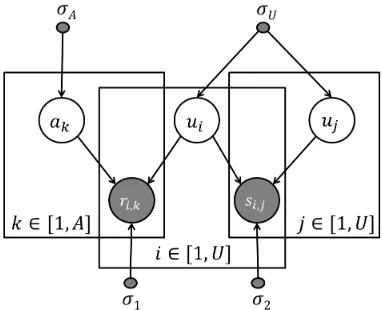
[image:4.612.90.525.225.322.2]proba-bilistic matrix factorization from Salakhutdinov and Mnih (2008), originally proposed for recommender systems. The main difference is that the user-user opinion polarity scores are symmetric. Our model is also similar to the one used by Ma et al. (2008). We describe our model as follows.
We assume that there are K latent factors with which both users and aspects can be represented. Let
ui ∈RK denote the vector in the latent factor space
for thei-th user, andakthe vector for thek-th aspect.
Recall that the opinions extracted from posts be-tween users are represented by a user-user opinion matrixS, and the opinions held by different users on the various topic aspects are represented by a user-aspect opinion matrixR. We assume that the polar-ity scoressi,jbetween thei-th and thej-th users and ri,k between thei-th user and thek-th aspect in the two matricesSandRare generated in the following way:
p(si,j|ui, uj, σ21) = N(si,j|g(uTi uj), σ12),
p(ri,k|ui, ak, σ22) = N(ri,k|g(uTi ak), σ22),
where σ12 and σ22 are variance parameters, g(·) the logistic function, andN(·|µ, σ2)is the normal
dis-tribution with meanµand varianceσ2.
We can see that with this generative assumption, if two users are similar in terms of their dot product in the latent factor space, then they are more likely to have positive interactions as extracted from their textual exchanges. Similarly, if a user and an aspect are similar, then the user is more likely to express a positive opinion on the aspect in his/her posts. The latent factors can therefore encode user preferences and similarity between two users in the latent factor space reflects whether they share similar viewpoints. We also place the following prior overuiandak:
p(ui|σ2U) = N(ui|~0, σU2I),
p(ak|σA2) = N(ak|~0, σA2I),
[image:5.612.333.524.62.217.2]where σU2 andσA2 are two variance parameters for users and aspects, respectively, andIis the identify matrix.
Figure 2 shows the plate notation for the genera-tive model.
LetUbe aK×Umatrix containing the vectorsui
[image:5.612.316.543.337.488.2]for allUusers, andAbe anK×Amatrix containing
Figure 2: Probabilistic matrix factorization model on opinion matrices.
the vectors ak for all A aspects. To automatically
learnU andA, we minimize the following objective function:
L(U,A,S,R)
= 1
2
U
X
i=1 A
X
k=1
I(ri,k)(ri,k−g(uTiak))2
+ λ1 2
U
X
i=1 U
X
j=1
I(si,j)(si,j−g(uTiuj))2
+ λU 2 ||U ||
2 F+
λA
2 ||A|| 2
F, (1)
where λ = σ21
σ2 2
, λU = σ2
1
σ2 U
, and λA = σ2
1
σ2 A
, I(s) is an indicator function which equals 1 whensis not empty and otherwise 0.
To optimize the objective function above, we can perform gradient descent onU andAto find a local optimum point. The derivation is similar to Ma et al. (2008).
Degenerate Versions of the Model
We refer to the complete model described above as PMF-UOM (PMF model based on User Opinion Matrices). PMF-UOM has the following two degen-erate versions by considering either only the user-user opinion matrix or only the user-user-aspect opinion matrix.
of the square errors involvingR and the regularizer onA.
PMF-UA:In this degenerate version of the model, we use only the user-aspect opinion matrix to learn the latent factor representation. Specifically, the ob-jective function is modified such that we drop the sum of the square errors involvingS.
6 Experiments
In this section, we present our experiments that eval-uate our model.
6.1 Data Set and Experiment Settings
The data set we use comes from Abu-Jbara et al. (2012) and Hassan et al. (2012). The data set contains a set of discussion threads collected from two political forums (Createdebate3and Politicalfo-rum4) and one Wikipedia discussion session. We randomly select 6 threads from the original data set to evaluate our model. Some details of the data we use are listed in Table 2.
ID topic #sides #sentences #users
DS1 Vote for Obama 2 12492 197
DS2 Abortion Banned 6 3844 70
DS3 Profile Muslims 4 2167 69
DS4 England and USA 6 2030 62
DS5 Tax Cuts 2 1193 26
DS6 Political Spectrum 7 1130 50
Table 2: Some statistics of the data sets.
In our experiments, for the PMF-based methods, we set the number of latent factors to be 10 as we do not observe big difference when vary the latent factor size from 10 to 50. For the other parame-ters, we select the optimal setting for each thread based on the average of 50 runs. λU is chosen
from{0.1,0.01},λAfrom{0.01,0.001}andλfrom {1,0.1}.
6.2 Relation Polarity Prediction
The first task we use to evaluate our model is to pre-dict the polarity of interactions between two users. Different from Hassan et al. (2012), however, we are not using this task to evaluate the accuracy of sentiment analysis from text. Our experimental set-ting is completely different in that we do not make
3www.createdebate.com
4www.politicalforum.com
use of the text exchanges between the two users but instead use their interactions with other users or as-pects. The purpose is to test the effectiveness of col-laborative filtering.
Experimental Setting: The experiments are set up in the following way. Given a pair of usersiandj
who have directly exchanged posts, i.e. si,j is not empty, we first hide the value ofsi,jin the matrixS. Let the altered matrix beS¬(i,j). We then useS¬(i,j)
instead ofS in the learning process as described in Section 5 to learn the latent factor representation. Letuˆi anduˆj denote the learned latent vectors for
useriand userj. We predict the polarity of relation betweeniandjas follows:
ˆ
si,j =
1 ifg(ˆuTiuˆj)>0.5,
0 otherwise,
whereg(·)is the logistic function to convert the dot product into a value between 0 and 1.
To judge the quality of the predicted polarityˆsi,j, we could compare it withsi,j. But sincesi,jitself is
predicted from the textual exchanges betweeniand
j, it is not the ground truth. Instead, we ask two hu-man annotators to assign the true polarity label for user iand userj by reading the textual exchanges between them and judging whether they are friends or foes in the discussion thread. The annotators are asked to assign a score of 0 (indicating a negative relation), 0.5 (indicating a neutral relation) or 1 (in-dicating a positive relation). The lowest agreement score based on Cohen’s kappa coefficient among the 6 threads we use is 0.56, showing fair to good agree-ment. As ground truth, we set the final polarity score to 1 if the average score of the two annotators is larger than 0.5 and 0 otherwise.
We compare the PMF-based methods with two majority baselines: MBL-0 always predicts negative relations for all the user pairs (assuming most rela-tions are negative) and MBL-1 always predicts posi-tive relations (assuming most relations are posiposi-tive). We use MAE (mean absolute error) and RMSE
(root mean square error) as defined below as perfor-mance metrics:
MAE =
P
i,j|sˆi,j−li,j|
N ,
RMSE = s
P
i,j(ˆsi,j−li,j)2
0.2 0.4 0.6 0.8 1.0
DS1 DS2 DS3 DS4 DS5 DS6
MAE
[image:7.612.313.528.62.216.2]MB-1 MB-0 PMF-UU PMF-UA PMF-UOM
Figure 3: Comparing all the methods in terms of MAE.
0.2 0.4 0.6 0.8 1.0
DS1 DS2 DS3 DS4 DS5 DS6
RMSE
MB-1 MB-0 PMF-UU PMF-UA PMF-UOM
Figure 4: Comparing all the methods in terms of RMSE.
whereN is the total number of user pairs we test, and li,j is the ground truth polarity score between useriand userj.
Results: We show the results of our model and of PMF-UU and PMF-UA in terms of MAE in Figure 3 and RMSE in Figure 4. TheMAEvalues range be-tween 0.31 and 0.44 except for DS5, which has a higher error rate of 0.53. The results show that even without knowing the textual exchanges between two users, from their interactions with other users and/or with topic aspects, we can still infer the polarity of their relation with decent accuracy most of the time. The results also show the comparison between our model and the competing methods. We can see that overall the complete model (PMF-UOM) performs better than the two degenerate models (PMF-UU and PMF-UA). The differences are statistically sig-nificant at the 5% level without considering DS5, as indicated by a 2-tailed paired t-test. Comparing to the majority baselines, our model significantly performs MBL-1 at 1% significance level while out-performs MBL-0 on all the data sets except DS5. A close examinations shows DS5 has very unbalanced relations (around 83% of relations are negative). Ex-cept for the unbalanced data set, our model has rea-sonably good performance.
6.3 Subgroup Detection
The second task we study is the problem of detecting ideological subgroups from discussion threads. The original data set has been labeled with the ground truth for this problem, that is, for each thread the
number of viewpoints is known and the viewpoint held by each user is labeled. A subgroup is defined as a set of users holding the same viewpoint.
Experimental Setting: Through this second exper-iment, we would like to verify the hypothesis that using the learned latent factor representation U for users, we can better detect subgroups than directly using the opinion matrices S and R. For all the methods we compare, we first construct a feature vector representation for each user. We then apply
K-means clustering to group users. The number of clusters is set to be the true number of viewpoints for each thread. The different methods are described below:
• PMF-based methods: We simply use the learned latent vectors uˆi after optimizing the
objective function as the feature vectors to rep-resent each user.
• BL-1: This is our own implementation to sim-ulate the method by Abu-Jbara et al. (2012). Here each user is represented by a(3×(U +
A))-dimensional vector, where U is the num-ber of users and A is the number of aspects, i.e.(U+A)is the total number of opinion tar-gets. For each opinion target, there are 3 di-mensions in the feature vector, corresponding to the number of positive, neutral and negative opinion expressions towards the target from the online posts.
[image:7.612.75.292.63.215.2]repre-sent each user. Here for each opinion target, we directly use the corresponding sentiment polar-ity scoresi,jorri,jfrom the matrixSorR. For
empty entries inSandR, we use a score of 0.5.
We usePurity(the higher the better),Entropy(the lower the better) andRand Index(the higher the bet-ter) to evaluate the performance of subgroup detec-tion (Manning et al., 2008). We further useAccuracy
obtained by choosing the best alignment of clusters with the ground truth class labels and computing the percentage of users that are “classified” correctly.
Results: We first give an overview of the perfor-mance of all the methods on the task. We show the average performance of the methods on all the data sets in Figure 5. Overall, our model has a better per-formance than all the competing methods.
0.4 0.6 0.8 1.0
[image:8.612.315.546.231.506.2]Purity Entropy Accuracy RandIndex BL-1 BL-2 PMF-UU PMF-UA PMF-UOM
Figure 5: An overview of the average performance of all the methods on the 6 threads.
We present all the results in Table 3. We per-form 2-tailed paired t-test on the results. We find that PMF-UOM outperforms all the other methods in terms of RandIndex at 5% significance level and outperforms other methods in terms of Purity and Entropy at 10% significance level. Furthermore, the PMF-UOM model outperforms its degenerative models PMF-UU and PMF-UA at 10% significance level in terms of all the measures.
We observe that PMF-UOM achieves the best per-formance in terms of all the measures for almost all threads. In particular, comparison with BL-1 and BL-2 shows that collaborative filtering can gen-eralize the user preferences and help better group the users based on their viewpoints. The fact that
UOM outperforms both UU and PMF-UA shows that it is important to consider both user-user interactions and user-user-aspect interactions.
The Effects of Cluster Size:To test the effect of the number of clusters on the experiment result, we vary the number of clusters from 2 to 10 in all methods. We find that all methods tend to achieve better re-sults when the number of clusters equals the ground truth cluster size. Overall, our method PMF-UOM shows a better performance than the other four meth-ods when the number of clusters changes, which in-dicates the robustness of our method.
BL-1 BL-2 PMF-UU PMF-UA PMF-UOM
DS1
P 0.61 0.61 0.61 0.61 0.62
E 0.96 0.96 0.94 0.95 0.94
A 0.59 0.59 0.55 0.57 0.60
R 0.51 0.51 0.50 0.51 0.52
DS2
P 0.53 0.63 0.64 0.61 0.68
E 1.17 1.22 1.14 1.09 0.99
A 0.47 0.53 0.48 0.47 0.50
R 0.50 0.50 0.56 0.56 0.58
DS3
P 0.66 0.68 0.62 0.60 0.68
E 1.05 1.01 1.06 1.07 0.94
A 0.61 0.63 0.48 0.47 0.58 R 0.50 0.52 0.53 0.53 0.57
DS4
P 0.64 0.64 0.66 0.65 0.70
E 0.92 0.94 0.90 0.91 0.85
A 0.59 0.64 0.62 0.62 0.68
R 0.49 0.52 0.52 0.51 0.56
DS5
P 0.86 0.86 0.86 0.86 0.86 E 0.56 0.56 0.49 0.48 0.38
A 0.70 0.70 0.57 0.60 0.71
R 0.52 0.52 0.43 0.45 0.56
DS6
P 0.50 0.50 0.60 0.60 0.68
E 1.35 1.35 1.03 1.04 0.79
A 0.40 0.30 0.53 0.54 0.64
R 0.53 0.53 0.68 0.68 0.74
Table 3: Results on subgroup detection on all the 6 threads.P,E,AandRrefer toPurity,Entropy,Accuracy andRandIndex, respectively.
7 Conclusions
[image:8.612.81.292.301.456.2]two matrices to discover a low-rank latent factor space which aims to better generalize the users’ un-derlying preferences and indicate user similarities based on their viewpoints. Using a data set with 6 discussion threads, we showed that the learned la-tent vectors can be used to predict the polarity of user relations well without using the users’ direct interaction data, demonstrating the effectiveness of collaborative filtering. We further found that for the task of subgroup detection, the latent vectors gave better performance than using the directly extracted opinion data, again showing that collaborative fil-tering through probabilistic matrix factorization can help address the sparseness problem in the extracted opinion matrices and help improve relation mining.
Our current work mainly focuses on the user opin-ion matrices. As future work, we would like to ex-plore how to incorporate textual contents without opinionated expressions. One possible way is to consider the combination of matrix factorization and topic modeling as studied by Wang and Blei (2011) where we can use topic modeling to study textual contents.
Acknowledgments
We thank the reviewers for their valuable comments on this work.
References
Amjad Abu-Jbara, Pradeep Dasigi, Mona Diab, and Dragomir R. Radev. 2012. Subgroup detection in ideological discussions. In Proceedings of the 50th Annual Meeting of the Association for Computational Linguistics, pages 399–409.
Stefano Baccianella, Andrea Esuli, and Fabrizio Sebas-tiani. 2010. Sentiwordnet 3.0: An enhanced lexical resource for sentiment analysis and opinion mining. In LREC.
Yejin Choi, Eric Breck, and Claire Cardie. 2006. Joint extraction of entities and relations for opinion recog-nition. In Proceedings of the 2006 Conference on Empirical Methods in Natural Language Processing, EMNLP ’06, pages 431–439, Stroudsburg, PA, USA. Association for Computational Linguistics.
Pradeep Dasigi, Weiwei Guo, and Mona T. Diab. 2012. Genre independent subgroup detection in online dis-cussion threads: A study of implicit attitude using textual latent semantics. In Proceedings of the 50th
Annual Meeting of the Association for Computational Linguistics, pages 65–69.
Ahmed Hassan and Dragomir Radev. 2010. Identify-ing text polarity usIdentify-ing random walks. In Proceed-ings of the 48th Annual Meeting of the Association for Computational Linguistics, ACL ’10, pages 395–403, Stroudsburg, PA, USA. Association for Computational Linguistics.
Ahmed Hassan, Amjad Abu-Jbara, and Dragomir Radev. 2012. Detecting subgroups in online discussions by modeling positive and negative relations among par-ticipants. InProceedings of the 2012 EMNLP, pages 59–70.
John Hopcroft, Tiancheng Lou, and Jie Tang. 2011. Who will follow you back?: reciprocal relationship predic-tion. InProceedings of the 20th ACM international conference on Information and knowledge manage-ment, pages 1137–1146.
Minqing Hu and Bing Liu. 2004. Mining and summariz-ing customer reviews. InProceedings of the 10th ACM SIGKDD international conference on Knowledge dis-covery and data mining, pages 168–177.
Noriaki Kawamae. 2011. Predicting future reviews: sen-timent analysis models for collaborative filtering. In Proceedings of the fourth ACM international confer-ence on Web search and data mining, WSDM ’11, pages 605–614.
Dan Klein and Christopher D. Manning. 2003. Accurate unlexicalized parsing. InProceedings of the 41st An-nual Meeting on Association for Computational Lin-guistics - Volume 1, ACL ’03, pages 423–430, Strouds-burg, PA, USA. Association for Computational Lin-guistics.
Jure Leskovec, Daniel Huttenlocher, and Jon Kleinberg. 2010. Predicting positive and negative links in online social networks. InProceedings of the 19th interna-tional conference on World wide web, pages 641–650. Cane Wing-Ki Leung, Stephen Chi-Fai Chan, Fu-Lai Chung, and Grace Ngai. 2011. A probabilistic rat-ing inference framework for minrat-ing user preferences from reviews. World Wide Web, 14(2):187–215. David Liben-Nowell and Jon Kleinberg. 2003. The link
prediction problem for social networks. In Proceed-ings of the twelfth international conference on Infor-mation and knowledge management.
Hao Ma, Haixuan Yang, Michael R. Lyu, and Irwin King. 2008. Sorec: Social recommendation using proba-bilistic matrix factorization. InProc. of ACM interna-tional conference on Information and knowledge man-agement.
George A. Miller. 1995. Wordnet: A lexical database for english.Communications of the ACM, Vol. 38, No. 11:39–41.
Mike Mintz, Steven Bills, Rion Snow, and Dan Jurafsky. 2009. Distant supervision for relation extraction with-out labeled data. InProceedings of the Joint Confer-ence of the 47th Annual Meeting of the ACL and the 4th International Joint Conference on Natural Language Processing of the AFNLP: Volume 2 - Volume 2, ACL ’09, pages 1003–1011, Stroudsburg, PA, USA. Asso-ciation for Computational Linguistics.
Yashar Moshfeghi, Benjamin Piwowarski, and Joe-mon M. Jose. 2011. Handling data sparsity in collabo-rative filtering using emotion and semantic based fea-tures. InProceedings of the 34th international ACM SIGIR conference on Research and development in In-formation Retrieval, SIGIR ’11, pages 625–634. Bo Pang and Lillian Lee. 2008. Opinion mining and
sentiment analysis. Found. Trends Inf. Retr., 2(1-2):1– 135, January.
Ana-Maria Popescu and Oren Etzioni. 2005. Extract-ing product features and opinions from reviews. In Proceedings of the conference on Human Language Technology and Empirical Methods in Natural Lan-guage Processing, HLT ’05, pages 339–346, Strouds-burg, PA, USA. Association for Computational Lin-guistics.
Guang Qiu, Bing Liu, Jiajun Bu, and Chun Chen. 2009. Expanding domain sentiment lexicon through double propagation. InProceedings of the 21st international jont conference on Artifical intelligence, IJCAI’09, pages 1199–1204, San Francisco, CA, USA. Morgan Kaufmann Publishers Inc.
Ruslan Salakhutdinov and Andriy Mnih. 2008. Prob-abilistic matrix factorization. In Advances in Neural Information Processing Systems, volume 20.
Chong Wang and David M. Blei. 2011. Collaborative topic modeling for recommending scientific articles. In Proceedings of the 17th ACM SIGKDD interna-tional conference on Knowledge discovery and data mining, pages 448–456.
Theresa Wilson, Janyce Wiebe, and Paul Hoffmann. 2005. Recognizing contextual polarity in phrase-level sentiment analysis. InHLT/EMNLP.