International Journal of
Molecular Sciences
ISSN 1422-0067 www.mdpi.com/journal/ijms Article
The Effect of Long-Term Storage on the Physiochemical and
Bactericidal Properties of Electrochemically Activated Solutions
Gareth Robinson, Robin Thorn and Darren Reynolds *
Centre for Research in Biosciences, Department of Applied Sciences, University of the West of England, Bristol BS16 1QY, UK;
E-Mails: [email protected] (G.R.); [email protected] (R.T.)
* Author to whom correspondence should be addressed; E-Mail: [email protected]; Tel.: +44-117-328-2563; Fax: +44-117-328-2904.
Received: 6 October 2012; in revised form: 11 December 2012 / Accepted: 12 December 2012 / Published: 24 December 2012
Abstract: Electrochemically activated solutions (ECAS) are generated by electrolysis of NaCl solutions, and demonstrate broad spectrum antimicrobial activity and high environmental compatibility. The biocidal efficacy of ECAS at the point of production is widely reported in the literature, as are its credentials as a “green biocide.” Acidic ECAS are considered most effective as biocides at the point of production and ill suited for extended storage. Acidic ECAS samples were stored at 4 °C and 20 °C in glass and polystyrene containers for 398 days, and tested for free chlorine, pH, ORP and bactericidal activity throughout. ORP and free chlorine (mg/L) in stored ECAS declined over time, declining at the fastest rate when stored at 20 °C in polystyrene and at the slowest rate when stored at 4 °C in glass. Bactericidal efficacy was also affected by storage and ECAS failed to produce a 5 log10 reduction on five occasions when stored at 20 °C. pH remained
stable throughout the storage period. This study represents the longest storage evaluation of the physiochemical parameters and bactericidal efficacy of acidic ECAS within the published literature and reveals that acidic ECAS retain useful bactericidal activity for in excess of 12 months, widening potential applications.
1. Introduction
Concerns regarding the spread of antimicrobial resistance amongst microorganisms (particularly within healthcare and agricultural environments), coupled with limitations associated with existing biocides continues to drive the development of novel disinfectants. Electrochemically activated solutions (ECAS), also referred to as electrolyzed oxidizing (EO) water [1], mixed oxidant (MIOX) solutions [2] and electrochemically activated (ECA) water [3] are generated from the electrolysis of NaCl solution in an electrochemical cell. Solutions originating from reactions that occur at the anode have proven microbicidal efficacy resulting from the formation of HOCl, which is considered to be the primary antimicrobial agent. Such solutions typically exhibit redox potentials (ORP) between +800 mV and +1200 mV, and pH values in the range of 2 to 5 [4].
ECAS have a broad spectrum of activity. They have been shown to be highly effective against healthcare associated bacterial pathogens including methicillin resistant Staphylococcus aureus, Pseudomonas aeruginosa [5] and vancomycin resistant Enterococcus faecalis [6]. They have also demonstrated rapid activity against bacterial endospores including those of Clostridium difficile and Bacillus atrophaeus [5], Bacillus cereus [7] and Bacillus anthracis [8]. In addition to bacterial and sporicidal activity, ECAS have been shown to be active against human norovirus [9], hepatitis B virus [10] and HIV [11]. Fungicidal activity against Aspergillus flavus [12], Candida albicans [13] and a range of plant pathogenic fungi [14] have been demonstrated in addition to efficacy against Cryptosporidium parvum oocysts [2] and staphylococcal enterotoxin A [15]. The active antimicrobial components of ECAS have been reported to include HOCl, hydroxyl radical, and other short-lived oxidative moieties and comparisons have been made with the respiratory burst from phagocytic cells of the mammalian immune system. These have been reported to cause bacterial membrane degradation, and inactivation of cellular protein, lipids and nucleic acid [4].
chlorine), which are toxic to aquatic life. Furthermore, the use of the chlor alkali process using mercury cells to produce sodium hypochlorite is a cause for concern as these cells have been shown to release mercury into the environment [22]. The ECAS generation technology used in this study does not use mercury. Furthermore, ECAS has been shown to have greater efficacy at lower free chlorine concentrations than sodium hypochlorite [23] mitigating some of the environmental concerns around chlorine releasing agents since ECAS can be utilised at a lower free chlorine concentration.
Due to the broad spectrum of activity, safety and environmental compatibility, suggested healthcare applications for ECAS include treatment of periodontal disease [24], wound irrigation [25], instrument disinfection [6] and environmental decontamination [4]. Within the food industry, applications include disinfection of food processing equipment [26] and direct washing of fruits and vegetables [27], fish [28], poultry [29] and meat [30]. Furthermore, ECAS have been shown to have useful biofilm removal properties [31]. Disadvantages to ECAS as general purpose disinfectants include concerns about potential corrosiveness [32], substantially reduced efficacy in the presence of organic soiling [5,33,34] and declining bactericidal activity if not used shortly after production [35,36].
A number of studies have investigated the physiochemical properties of ECAS under short term storage in the absence of antimicrobial efficacy testing. A study by Len et al. [36] investigated the chlorine loss, redox potential (ORP) and pH of ECAS when stored in glass jars, open or closed, agitated or non agitated, in light or dark conditions. For open containers, the physiochemical parameters were measured periodically over 4 days and for closed containers over 58 days. Hsu and Kao [37] studied pH, ORP, total residual chlorine, dissolved O2, conductivity, and Na+ and Cl−
concentrations of ECAS stored in glass bottles, for 12 days (opened periodically) or 21 days (opened only for measurements on first and last day). Another study investigated hypochlorous acid loss from ECAS stored in Erlenmeyer flasks at a range of temperatures from 25 °C to 40 °C for 22 days [38].
containers and where bactericidal efficacy and the physiochemical parameters have been measured contemporaneously throughout.
2. Results and Discussion 2.1. Redox Potential (ORP)
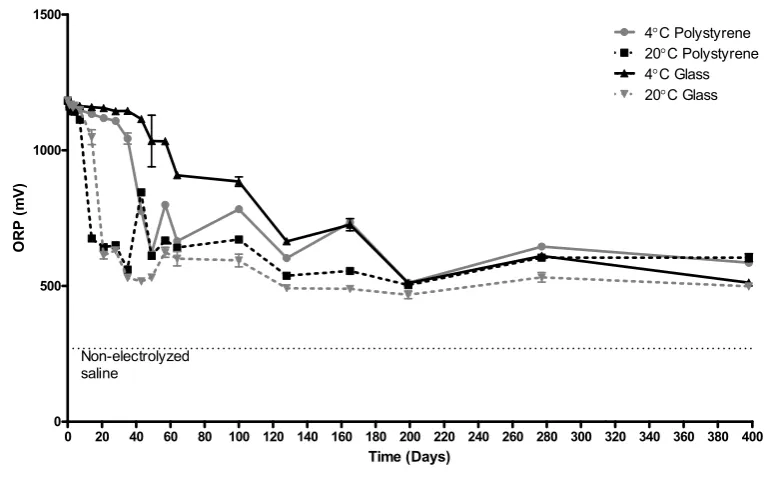
[image:4.595.104.487.441.689.2]During long term storage, the ORP of ECAS is reduced substantially from that at the point of production, though the rate of reduction depends upon storage conditions, as shown in Figure 1. Irrespective of storage material, ECAS stored at 20 °C demonstrated a greater reduction in ORP over a shorter time period than that stored at 4 °C. The ORP of ECAS stored in polystyrene dropped at a slightly faster rate than that stored in glass. After 14 days, the ORP of ECAS stored in polystyrene and glass at 4 °C was 675 mV and 1048 mV respectively, compared to 1133 mV and 1159 mV respectively for polystyrene and glass at 4 °C. ECAS stored in glass at 4 °C showed the slowest decline in ORP retaining an ORP of greater than 1000 mV for 57 days compared to that of 35 days for ECAS stored in plastic at 4 °C, 14 days for ECAS stored in glass at 20 °C and 7 days for ECAS stored in polystyrene at 20 °C. It is also clear that, although in the short term, storage material and temperature greatly influence the retention of a high ORP, following long term storage the redox potential of the stored solutions begins to equilibrate.
Figure 1. Redox potentials (ORP) of electrochemically activated solutions (ECAS) (mV) stored in polystyrene or glass containers at 20 °C or 4 °C for 398 days. N = 3 ± SD.
0 20 40 60 80 100 120 140 160 180 200 220 240 260 280 300 320 340 360 380 400 0
500 1000 1500
20C Polystyrene 4C Glass 20C Glass 4C Polystyrene
Non-electrolyzed saline
Time (Days)
O
R
P (
m
V)
2.2. pH
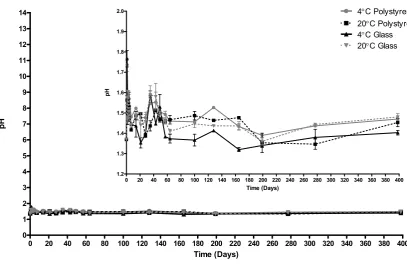
Figure 2. pH of ECAS stored in polystyrene or glass containers at 20 °C or 4 °C for 398 days. N = 3 ± SD.
0 20 40 60 80 100 120 140 160 180 200 220 240 260 280 300 320 340 360 380 400 0
1 2 3 4 5 6 7 8 9 10 11 12 13
14 4C Polystyrene
20C Polystyrene
4C Glass
20C Glass
Time (Days)
pH
0 20 40 60 80 100 120 140 160 180 200 220 240 260 280 300 320 340 360 380 400
1.2 1.3 1.4 1.5 1.6 1.7 1.8 1.9 2.0
Time (Days)
pH
2.3. Free Chlorine
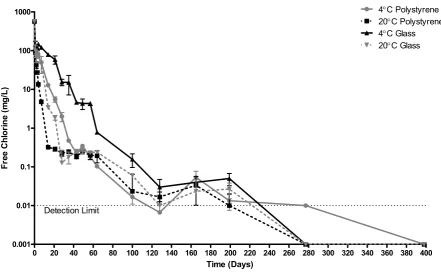
Figure 3 shows the free chlorine level of stored ECAS over a 398 day period. In all cases, the greatest loss in free chlorine occurred over the first 24 h. As was the case with ORP, the rate of loss is the slowest when stored in glass at 4 °C. The detection limit of the test procedure is 0.01 mg/L. By 277 days, all samples except for those stored in polystyrene at 4 °C had free chlorine levels of <0.01 mg/L. ECAS stored in polystyrene at 4 °C had 0.01 mg/L of measurable free chlorine remaining. The time point at which free chlorine levels within the stored ECAS became not statistically different from zero varied according to storage material and temperature. For polystyrene at 20 °C, this was day 7, for glass at 20 °C day 14, for polystyrene at 4 °C day 21 and for glass at 4 °C day 28.
2.4. Antibacterial Activity
Figure 4 shows the log10 reduction in viable bacteria when using stored ECAS against
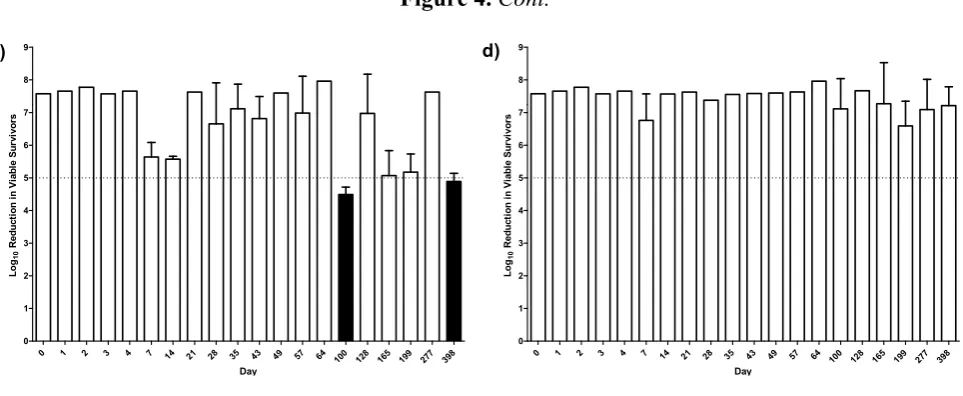
P. aeruginosa ATCC 9027. Over the first 4 days of storage, zero counts were recorded on all recovery plates indicating that the population of surviving bacteria within the test was fewer than 10 cfu/mL. Basic bactericidal activity is retained in all storage conditions, though the consistency of the result varies depending on storage material and temperature. When stored in polystyrene at 20 °C (Figure 4a), ECAS failed to produce a log10 reduction of 5 (the definition of basic bactericidal activity under
EN 1040:2005) on three occasions, compared to two occasions when stored in glass at 20 °C (Figure 4c). When stored at 4 °C in polystyrene or glass (Figure 4b,d respectively), a 5 log10 reduction
was achieved at every time point. There was greater variability in the log10 reduction achieved when
stored at 20 °C than at 4 °C and the log10 reduction was consistently higher when stored in glass compared
condition (± SD) was 6.634 ± 1.204 in polystyrene at 20 °C, 6.720 ± 1.135 in glass at 20 °C, 7.196 ± 0.6947 in polystyrene at 4 °C and 7.441 ± 0.3402 in glass at 4 °C.
Figure 3. Free chlorine concentration of ECAS (mg/L) stored in polystyrene or glass containers at 20 °C or 4 °C for 398 days. N = 3 ± SD.
0 20 40 60 80 100 120 140 160 180 200 220 240 260 280 300 320 340 360 380 400 0.001 0.01 0.1 1 10 100
1000 4C Polystyrene
20C Polystyrene
4C Glass
20C Glass
Detection Limit Time (Days) Fr ee C h lo ri ne ( m g/ L )
Figure 4. Log10 reduction in viable P. aeruginosa ATCC 9027 when treated with ECAS
stored in polystyrene containers at 20 °C (a) or 4 °C (b) or in glass containers at 20 °C (c) or 4 °C (d) for 398 days. N = 3 ± SD. Broken line indicates 5 log10 reduction required to meet
EN1040:2005. Black bars show instances where 5 log10 reduction was not achieved.
0 1 2 3 4 7 14 21 28 35 43 49 57 64 100 128
165 199 277 398
0 1 2 3 4 5 6 7 8 9 Day Lo g10 R ed u ct io n in V ia b le S u rv iv o rs
0 1 2 3 4 7 14 21 28 35 43 49 57 64 100 128
165 199 277 398
[image:6.595.62.542.534.708.2]Figure 4. Cont.
0 1 2 3 4 7 14 21 28 35 43 49 57 64 100
128 165 199 277 398
0 1 2 3 4 5 6 7 8 9 Day Lo g10 R educ ti on i n V ia b le S u rv iv or s
0 1 2 3 4 7 14 21 28 35 43 49 57 64 100 128 165 199
277 398
0 1 2 3 4 5 6 7 8 9 Day Lo g10 R educ ti on i n V ia b le S u rv iv or s c) d) 2.5. Discussion
The physiochemical properties of ECAS depend upon the characteristics of the electrochemical cell from which it is produced and its operating parameters [4]. Electrolysis of NaCl in these electrochemical cells yields a solution from both the anodic and cathodic chamber of the cell. Acidic ECAS are produced from the anode and can yield solutions with an ORP of greater than +1100 mV and a pH of lower than 2.7. Whereas the cathodic solutions are basic with a pH of 11 or more and an ORP lower than −800 mV and weak antimicrobial activity compared to acidic ECAS [40]. A modified variant of acidic ECAS can also be produced by directing some of the anodic output back into the cathode chamber, producing a neutralised anolyte often referred to as neutral electrolyzed water [39]. The antimicrobial properties of acidic ECAS have been widely reported, though one of the primary concerns regarding these solutions is the rapid loss of antimicrobial activity post-production [16]; however, this lack of residual activity is likely to contribute to the environmental compatibility of ECAS. Neutralised acidic ECAS have shown greater antimicrobial activity during shelf life trials than their acidic counterparts [41]. Superior antimicrobial activity during storage can be attributed to the greater stability of neutral ECAS, as these solutions generally have lower ORP values at the point of production than those of acidic ECAS, which is considered to be the primary contributor to their bactericidal activity [42].
storage conditions compared to levels recorded at the point of production. Len et al. stored their ECAS in 1.7 L volumes in glass vessels compared to the 30 mL samples stored in our study. The ECAS used in the current study had an ORP of 1180 mV, a pH of 1.37 and a free chlorine concentration of 570 mg/L at the point of production compared to that of 1020–1120 mV, pH 2.5–2.6 and 53–56 mg/L chlorine used by Len et al. They suggested that the primary mechanism of chlorine loss under closed conditions (in the absence of evaporation) was self-decomposition of chlorine species in solution. The ECAS samples used in the study by Len et al. were pH adjusted up to 9 though they found that more rapid chlorine loss was observed at lower pH values. This could account for the rapid chlorine loss observed in the current study. This study found that pH remained stable throughout storage. Len et al. observed only slight reductions in ORP, as did Hsu and Kao [37] who also observed a stable pH during storage, but more rapid loss of chlorine in those ECAS with the lowest pH and highest chlorine levels at the point of production.
Cui et al. [39] studied neutral and acidic ECAS stored for 30 days, also finding that pH remained stable during the storage period. The acidic ECAS used in their study had a pH of 3.01, ORP of 1079.1 and chlorine concentration of 25 mg/L and they found that in addition to pH, ORP remained stable over the storage period under closed conditions, whilst chlorine concentrations decreased by 80% and 96% in dark and light conditions respectively and to undetectable levels in open conditions after 30 days. Evaluating bactericidal activity against Salmonella Enteritidis and Escherichia coli O157:H7 demonstrated that acidic ECAS stored for 30 days was no less effective than at the point of production. Although the authors recognised that acidic ECAS have potent bactericidal activity due to lower pH and higher ORP than neutral ECAS, they concluded that available chlorine may be the primary factor responsible for bactericidal activity. This is in contrast to the work of Venkitanarayanan et al. [43] who suggested that ORP, pH and chlorine act in combination. Our study also demonstrated bactericidal activity in the absence of detectable chlorine, supporting the assertion that the bactericidal activity of these solutions is not wholly dependent on chlorine concentration. Nisola et al. [35] stored neutral and acidic ECAS for 30 days at 25 °C and tested them against E. coli O157:H7 and Salmonella Typhi. The acidic ECAS was produced with a pH of 2.0, ORP of 1271 mV and chlorine concentration of 173 mg/L. At the point of production acidic ECAS was the superior biocide, the authors suggesting that the low pH sensitised bacterial membranes to chlorine penetration. Under closed conditions a slight decrease in ORP was observed with a concomitant increase in pH and chlorine, which stabilised after 10 days. Following 30 days storage, 1.1 and 1.0 log10 reductions in S. typhi and E. coli were observed
respectively compared to >8 log10 reductions at the point of production. Conversely, in the current
study a >7 log10 reduction in viable P. aeruginosa was measured after 398 days storage in all
conditions with the exception of polystyrene at 20 °C. The ECAS evaluated in the current study failed to achieve a >5 log10 reduction in viable bacteria on five occasions, all of which occurred when stored
at 20 °C though on four of those occasions solutions stored under the same conditions achieved a >5 log10 reduction at a later date. ORP and free chlorine were found to decline more slowly at 4 °C
than at 20 °C and also more slowly when stored in glass vessels than polystyrene vessels. Failure to achieve a >5 log10 reduction on these independent test dates may have been due to headspace being left
in the vessels, although every effort was made to exclude this at the point of production. The presence of headspace would have allowed more rapid volatilisation of Cl2 from solution compared to the
capable of meeting or exceeding a modified EN 1040:2005 up to 277 days post production under all storage conditions tested and up to 398 days in three of the four conditions tested. This activity is most reliably achieved with samples stored at 4 °C rather than 20 °C, and in glass rather than polystyrene vessels and whilst storage in glass vessels would be impractical on a day-to-day basis, this research has also demonstrated retention of basic bactericidal activity when stored in plastic for a period of up to 13 months. Under the storage conditions tested, temperature had more of an influence on the physiochemical parameters and antimicrobial efficacy of ECAS than storage material. Previous work has shown that acidic ECAS are potent bactericidal and sporicidal agents [5]. Whilst high-level efficacy may be dependent on a combination of ORP, pH and chlorine concentration [43], the physiochemical parameters of solutions stored under differing conditions equilibrate after long term storage, suggesting that for long-term storage applications, storage temperature and material may be less important than for short-term storage applications.
3. Experimental Section
3.1. Solutions and Storage Conditions
ECAS was produced from a saturated sodium chloride solution and softened mains water in an electrochemical cell (Bridge Systems Ltd.: Fife, UK) at a rate of 200 mL/min from the anodic chamber and 400 mL/min from the cathodic chamber. ECAS was produced at an ORP of 1183.1 mV, a pH of 1.37 and a free chlorine concentration of 570 mg/L. ECAS was collected in two sets of containers; 30 mL thick-walled glass Universal bottles with rubber-sealed aluminium screw caps, and 30 mL polystyrene Universal bottles with high density polyethylene screw caps. The containers were filled sufficient to exclude air, sealed and stored under dark conditions at either 4 °C or 20 °C. At the every time point, three samples of ECAS stored under each of the four conditions were analysed for ORP, pH, free and total chlorine and tested for bactericidal activity.
3.2. Physiochemical Properties
The redox potential and pH of ECAS were measured immediately after collection (Sartorius PT-10P portable meter with PYP12 pH electrode and CEPTRL/87 ORP electrode, calibrated according to manufacturer’s instructions; Sartorius: Epsom, UK). At each time point, three ECAS samples stored in glass and plastic at 4 °C and 20 °C were tested similarly. Furthermore, free and total available chlorine were assayed using a chlorine DPD test (Palintest: Gateshead, UK) following appropriate dilution in sterile deionized water.
3.3. Bactericidal Activity
single, isolated colony was subcultured onto TSA for 18–24 h. Colonies were suspended in diluent (1 g/L Tryptone, 8.5 g/L NaCl) to a density of 1.5–5 × 10⁸ cfu/mL (test suspension). 1 mL of test suspension and 1 mL water were added to a Universal bottle and incubated at 20 °C for 2 min ± 1 s. 8 mL of stored ECAS (equilibrated to 20 °C) was added for a contact time of 5 min ± 10 s followed by immediate removal to neutralizer (Letheen Broth, BD: Oxford, UK) for 5 min ± 10 s. Duplicate 1 mL volumes were transferred directly from the neutralizer and from 10-fold dilutions made into diluent, to a sterile petri dish. Twenty microliters melted TSA cooled to 45 °C was added to each petri dish. Plates were incubated at 37 °C and counted at 24 and 48 h with the higher number used for biocide evaluation.
3.4. Statistical Analysis
An analysis of variance (ANOVA) was performed (GraphPad Prism 5.03, GraphPad Software Inc.: La Jolla, CA, USA), followed by Dunnett’s multiple comparison test against a chlorine level of 0.0 mg/L with a P value of <0.05 being regarded as significant in order to determine at what time point the free chlorine levels within the stored ECAS became not statistically different from zero.
4. Conclusions
This study represents the longest evaluation of the physiochemical parameters and bactericidal efficacy of ECAS within the published literature and reveals that acidic ECAS retains useful bactericidal activity for significantly longer than has been previously demonstrated and may have applications beyond those previously considered. The potent antimicrobial activity of ECAS at the point of production is widely reported in the literature, as are its credentials as a “green biocide”. Our study demonstrates that ECAS may be suited to situations where generation at the point of use is not possible due to cost or resource limitations. Furthermore, we have shown that ECAS is bactericidal in the absence of measurable chlorine. This furthers our understanding of the mechanism of action of these solutions, strongly suggesting that there are multiple biocidal components working in combination [43] rather than the antimicrobial activity being exclusively due to the presence of HOCl. Now that it has been demonstrated that ECAS can retain basic bactericidal activity for over 12 months in storage, it would be of benefit to further investigate how extended storage of this type affects the kill kinetics and antimicrobial spectrum compared to ECAS used at the point of production.
Conflict of Interest
The authors declare no conflict of interest. References
1. Sharma, R.R.; Demirci, A. Treatment of Escherichia coli O157:H7 inoculated alfalfa seeds and sprouts with electrolyzed oxidizing water. Int. J. Food Microbiol. 2003, 86, 231–237.
3. Cloete, T.E.; Thantsha, M.S.; Maluleke, M.R.; Kirkpatrick, R. The antimicrobial mechanism of electrochemically activated water against Pseudomonas aeruginosa and Escherichia coli as determined by SDS-PAGE analysis. J. Appl. Microbiol. 2009, 107, 379–384.
4. Thorn, R.M.; Lee, S.W.; Robinson, G.M.; Greenman, J.; Reynolds, D.M. Electrochemically activated solutions: Evidence for antimicrobial efficacy and applications in healthcare environments. Eur. J. Clin. Microbiol. Infect. Dis. 2012, 31, 641–653.
5. Robinson, G.M.; Lee, S.W.; Greenman, J.; Salisbury, V.C.; Reynolds, D.M. Evaluation of the efficacy of electrochemically activated solutions against nosocomial pathogens and bacterial endospores. Lett. Appl. Microbiol. 2010, 50, 289–294.
6. Shetty, N.; Srinivasan, S.; Holton, J.; Ridgway, G.L. Evaluation of microbicidal activity of a new disinfectant: Sterilox 2500 against Clostridium difficile spores, Helicobacter pylori, vancomycin resistant enterococcus species, Candida albicans and several mycobacterium species. J. Hosp. Infect. 1999, 41, 101–105.
7. Kim, C.; Hung, Y.C.; Brackett, R.E. Efficacy of electrolyzed oxidizing (EO) and chemically modified water on different types of foodborne pathogens. Int. J. Food Microbiol. 2000, 61, 199–207. 8. Rogers, J.V.; Ducatte, G.R.; Choi, Y.W.; Early, P.C. A preliminary assessment of
Bacillus anthracis spore inactivation using an electrochemically activated solution (ECASOL). Lett. Appl. Microbiol. 2006, 43, 482–488.
9. Park, G.W.; Boston, D.M.; Kase, J.A.; Sampson, M.N.; Sobsey, M.D. Evaluation of liquid- and fog-based application of sterilox hypochlorous acid solution for surface inactivation of human norovirus. Appl. Environ. Microbiol. 2007, 73, 4463–4468.
10. Tagawa, M.; Yamaguchi, T.; Yokosuka, O.; Matsutani, S.; Maeda, T.; Saisho, H. Inactivation of a hepadnavirus by electrolysed acid water. J. Antimicrob. Chemother. 2000, 46, 363–368.
11. Morita, C.; Sano, K.; Morimatsu, S.; Kiura, H.; Goto, T.; Kohno, T.; Hong, W.; Miyoshi, H.; Iwasawa, A.; Nakamura, Y.; et al. Disinfection potential of electrolyzed solutions containing sodium chloride at low concentrations. J. Virol. Methods 2000, 85, 163–174.
12. Xiong, K.; Liu, H.; Liu, R.; Li, L. Differences in fungicidal efficiency against Aspergillus flavus for neutralized and acidic electrolyzed oxidizing waters. Int. J. Food Microbiol. 2010, 137, 67–75. 13. Zeng, X.; Ye, G.; Tang, W.; Ouyang, T.; Tian, L.; Ni, Y.; Li, P. Fungicidal efficiency of
electrolyzed oxidizing water on Candida albicans and its biochemical mechanism. J. Biosci. Bioeng. 2011, 112, 86–91.
14. Buck, J.W.; van Iersel, M.W.; Oetting, R.D.; Hung, Y.-C. In vitro fungicidal activity of acidic electrolyzed oxidizing water. Plant Dis. 2002, 86, 278–281.
15. Suzuki, T.; Itakura, J.; Watanabe, M.; Ohta, M.; Sato, Y.; Yamaya, Y. Inactivation of Staphylococcal enterotoxin-A with an electrolyzed anodic solution. J. Agric. Food Chem. 2002, 50, 230–234.
16. Huang, Y.; Hung, Y.; Hsu, S.; Huang, Y.; Hwang, D. Application of electrolyzed water in the food industry. Food Control 2008, 19, 329–345.
18. Guentzel, J.L.; Liang Lam, K.; Callan, M.A.; Emmons, S.A.; Dunham, V.L. Reduction of bacteria on spinach, lettuce, and surfaces in food service areas using neutral electrolyzed oxidizing water. Food Microbiol. 2008, 25, 36–41.
19. Rahman, S.M.E.; Ding, T.; Oh, D. Inactivation effect of newly developed low concentration electrolyzed water and other sanitizers against microorganisms on spinach. Food Control 2010, 21, 1383–1387.
20. Landa-Solis, C.; González-Espinosa, D.; Guzmán-Soriano, B.; Snyder, M.; Reyes-Terán, G.; Torres, K.; Gutierrez, A.A. Microcyntm: A novel super-oxidized water with neutral pH and disinfectant activity. J. Hosp. Infect. 2005, 61, 291–299.
21. Rutala, W.A.; Weber, D.J. Uses of inorganic hypochlorite (bleach) in health-care facilities. Clin. Microbiol. Rev. 1997, 10, 597–610.
22. Dufault, R.; LeBlanc, B.; Schnoll, R.; Cornett, C.; Schweitzer, L.; Wallinga, D.; Hightower, J.; Patrick, L.; Lukiw, W.J. Mercury from chlor-alkali plants: Measured concentrations in food product sugar. Environ. Health 2009, 8, 2.
23. Robinson, G.M.; Tonks, K.M.; Thorn, R.M.; Reynolds, D.M. Application of bacterial bioluminescence to assess the efficacy of fast-acting biocides. Antimicrob. Agents Chemother. 2011, 55, 5214–5220.
24. Marais, J.T.; Williams, W.P. Antimicrobial effectiveness of electro-chemically activated water as an endodontic irrigation solution. Int. Endod. J. 2001, 34, 237–243.
25. Selkon, J.B.; Cherry, G.W.; Wilson, J.M.; Hughes, M.A. Evaluation of hypochlorous acid washes in the treatment of chronic venous leg ulcers. J. Wound Care 2006, 15, 33–37.
26. Ayebah, B.; Hung, Y. Electrolyzed water and its corrosiveness on various surface materials commonly found in food processing facilities. J. Food Process Eng. 2005, 28, 247–264.
27. Koseki, S.; Yoshida, K.; Isobe, S.; Itoh, K. Efficacy of acidic electrolyzed water for microbial decontamination of cucumbers and strawberries. J. Food Prot. 2004, 67, 1247–1251.
28. Ozer, N.P.; Demirci, A. Electrolyzed oxidizing water treatment for decontamination of raw salmon inoculated with Escherichia coli O157:H7 and Listeria monocytogenes Scott A and response surface modeling. J. Food Eng. 2006, 72, 234–241.
29. Park, H.; Hung, Y.; Brackett, R.E. Antimicrobial effect of electrolyzed water for inactivating campylobacter jejuni during poultry washing. Int. J. Food Microbiol. 2002, 72, 77–83.
30. Fabrizio, K.A.; Cutter, C.N. Stability of electrolyzed oxidizing water and its efficacy against cell suspensions of Salmonella typhimurium and Listeria monocytogenes. J. Food Prot. 2003, 66, 1379–1384.
31. Thantsha, M.S.; Cloete, T.E. The effect of sodium chloride and sodium bicarbonate derived anolytes, and anolyte-catholyte combination on biofilms. Water SA 2006, 32, 237–242.
32. Tanaka, N.; Fujisawa, T.; Daimon, T.; Fujiwara, K.; Yamamoto, M.; Abe, T. The effect of electrolyzed strong acid aqueous solution on hemodialysis equipment. Artif. Organs 1999, 23, 1055–1062.
34. Park, E.; Alexander, E.; Taylor, G.A.; Costa, R.; Kang, D. The decontaminative effects of acidic electrolyzed water for Escherichia coli O157:H7, Salmonella typhimurium, and Listeria monocytogenes on green onions and tomatoes with differing organic demands. Food Microbiol. 2009, 26, 386–390.
35. Nisola, G.M.; Yang, X.; Cho, E.; Han, M.; Lee, C.; Chung, W.J. Disinfection performances of stored acidic and neutral electrolyzed waters generated from brine solution. J. Environ. Sci. Health A Tox. Hazard. Subst. Environ. Eng. 2011, 46, 263–270.
36. Len, S.V.; Hung, Y.C.; Chung, D.; Anderson, J.L.; Erickson, M.C.; Morita, K. Effects of storage conditions and ph on chlorine loss in electrolyzed oxidizing (EO) water. J. Agric. Food Chem. 2002, 50, 209–212.
37. Hsu, S.; Kao, H. Effects of storage conditions on chemical and physical properties of electrolyzed oxidizing water. J. Food Eng. 2004, 65, 465–471.
38. Kunigk, L.; Schramm, L.J.; Kunigk, C.J. Hypochlorous acid loss from neutral electrolyzed water and sodium hypochlorite solutions upon storage. Braz. J. Food Technol. 2008, 11, 153–158.
39. Cui, X.; Shang, Y.; Shi, Z.; Xin, H.; Cao, W. Physicochemical properties and bactericidal efficiency of neutral and acidic electrolyzed water under different storage conditions. J. Food Eng. 2009, 91, 582–586.
40. Hotta, K.; Kawaguchi, K.; Saitoh, F.; Saito, N.; Suzuki, K.; Ochi, K.; Nakayama, T. Antimicrobial activity of electrolyzed NaCl solutions: Effect on the growth of streptomyces Spp. Actinomycetologica 1994, 8, 51–56.
41. Tomás-Callejas, A.; Martínez-Hernández, G.B.; Artés, F.; Artés-Hernández, F. Neutral and acidic electrolyzed water as emergent sanitizers for fresh-cut mizuna baby leaves. Postharvest Biol. Technol. 2011, 59, 298–306.
42. Park, H.; Hung, Y.; Chung, D. Effects of chlorine and pH on efficacy of electrolyzed water for inactivating Escherichia coli O157:H7 and Listeria monocytogenes. Int. J. Food Microbiol. 2004, 91, 13–18.
43. Venkitanarayanan, K.S.; Ezeike, G.O.; Hung, Y.C.; Doyle, M.P. Efficacy of electrolyzed oxidizing water for inactivating Escherichia coli O157:H7, Salmonella enteritidis, and Listeria monocytogenes. Appl. Environ. Microbiol. 1999, 65, 4276–4279.