Rawad Hammad, Mohammed Odeh, Zaheer Khan
Software Engineering Research Group, University of the West of England, Bristol, UK [email protected]
[email protected] [email protected]
Abstract: There is a lack of a standard based approach that can be used to evaluate the effectiveness of different e-learning models due to their diversity and complexity. This paper introduces a new evaluation approach to assess the effectiveness of e-learning models. This approach is derived using: (i) the ISO 25010 “Systems and software Quality Requirements and Evaluation (SQuaRE): System and software quality models” and (ii) the ISO 25012 “Systems and software Quality Requirements and Evaluation (SQuaRE): Data quality model”. Hence, the proposed evaluation approach is based on the following three main models: (i) quality in use, (ii) product quality and (iii) data quality models. In this research the proposed evaluation approach has been applied to compare and evaluate capabilities of five different e-learning models.
In addition to core qualities of ISO25010 and ISO25012 models, new qualities such as pedagogical, semantic and process-based techniques are defined to accommodate domain-specific aspects. The application of the proposed evaluation approach reveals promising results such as: (i) its ability to abstract the semantic heterogeneity between different terminologies used to describe the capabilities of different e-learning models and (ii) its holistic approach as well as its ability to be extended to assess unstructured e-learning contents. Additionally, this research identifies a list of e-learning models’ capabilities where some are common between different models e.g. interoperability and reusability; and others are specific to certain models such as processability.
Keyword: learning effectiveness, learning evaluation, data quality, product quality, quality in use, e-learning capabilities
1. Introduction
The widespread use of e-learning in different contexts (e.g. academic institutions, on-job training, etc.) has led to the proliferation of a spectrum of e-learning models where significant differences between these models exist (e.g. adaptive versus one-size-fits-all e-learning). In this context, e-Learning model refers to the specific role technology plays in support learning and teaching. In addition, e-Learning practitioners (e.g. learners, instructors, etc.) use e-learning differently, which impacts the evaluation of e-learning. So, different approaches have been used for e-learning evaluation such as: (i) comparing e-learning with traditional learning which is empirically robust (Murray and Pérez, 2015); (ii) benchmarking models which often disregard key variables in the wider e-learning context or their designers are locked into a particular model of e-learning that limits their transferability e.g. Williams, Kear and Rosewell (2012); (iii) using evaluation tools to monitor and analyse user interaction yet they lack guidance on interpretation and analysis (Hand, 2012); (iv) evaluating e-learning models from practitioners’ perspective (e.g. AbuShaban and Hammad (2006)); and (v) product evaluation done by third party which often disconnect systems from their actual application (Tseng, Lin and Chen, 2011).
2009). This suggests dividing the overall factors affecting e-learning effectiveness into three main concerns: (i) technology-related, (ii) pedagogy-related and (iii) data-related (Hammad, Odeh and Zaheer, 2013).
Considering the promising results of adopting concern-based approaches in different contexts (e.g. Panunzio and Vardanega adopt it to capture extra-functional requirements in real-time software systems (2014), Khan (2009) adopts it for evaluation of software research, etc.), in this research, we introduce an e-learning effectiveness evaluation approach based on the design principle ‘separation of concerns’. Examples on these e-learning concerns are: the quality of e-learning contents, quality of other types of data retained in the system, quality of using a system by a certain stakeholder in a specific context and quality of software/system. Each of these concerns will be handled by one or more model of the proposed evaluation approach. The rest of this paper is organised as follows: section two describes the context of e-learning evaluation, why it is needed and why it is challenging; section three introduces the proposed approach; section 4 shows the application of the proposed approach on a case study; section 5 discusses and reflects upon certain research issues; section 6 concludes the research and elaborates further on future directions.
2. The Context of e-Learning Evaluation
The latest survey of Technology-Enhanced Learning (TEL) for Higher Education in the UK (Walker et al 2014) shows number of considerable conclusions that are useful in the context of this research. First, it shows the wide adoption of TEL/e-learning approaches in UK Higher Education Institutions (HEIs) (i.e. 94 respondents, out of 158 institutions approached, are using e-learning tools.) Second, the report shows that e-learning is an intrinsic part of HEI strategies which continues to influence TEL development especially in teaching, learning and assessment. Third, the way that e-learning is adopted and applied is contextualised to a very large extent since e-learning is affected by most of the HEI components such as: resources, community, etc. Fourth, learning solutions need to be integrated with other external tools such as plagiarism detection and e-submission, which raises concerns related to conformance to standards. Fifth, the clear dominance of adopting commercial Learning Management Systems (LMS) reflects to the extent e-learning adoption can be costly.
In addition to the cost of LMSs, other concerns related to infrastructure, employment, training and resources can also add further costs and can be time-consuming during different stages of e-learning life cycle. Once an HEI opt for a certain e-learning solution (e.g. Blackboard Learn), it becomes difficult to change, since this change requires much effort (e.g. data migration, system configuration, etc.) Finally, the contextualised application of e-learning by HEIs shows the necessity of evaluating the effectiveness of e-learning. The previously-discussed concerns make the evaluation process challenging because it is extremely difficult to develop an approach that can objectively address different e-learning factors and their relationships.
3. Model-based Evaluation Approach
Due to the deficiency of the current e-learning evaluation approaches (e.g., usually provide general results, do not help in evaluating system quality, fail to capture operational levels -i.e. system in use-, their results are not transferable, etc.) and in order to respond to the above-mentioned challenges, we introduce an e-learning evaluation approach. We opted for a systematic and standard-based approach to add consistency to the proposed evaluation approach because different systems are evaluated against a coherent set of precisely-defined quality characteristics. This approach is based on: (i) the ISO 25010 Quality in use model, (ii) the ISO 25010 product quality model and (iii) the ISO 25012 Data quality model. Generally, ISO 25010 and ISO 25012 have been extensively used for system and software product evaluation on product and data quality levels. For instance, Lew and Olsina adopt ISO 25010 as a model for web quality (2011); Peters-Anders et al adopt ISO 25010 for evaluating large-scale smart cities projects (2014); Khan et al adopted it to evaluate integrated software systems (2012); and Rafique et al use ISO 25012 as an information quality evaluation framework (2012). Additionally, ISO 9126 - ISO 25010 precursor - has been used for e-learning evaluation (Chua and Dyson, 2004).
3.1 Models constituting the Evaluation Approach
Our proposed evaluation framework is composed of three main models in addition to a group of extended qualities to respond to e-learning particularities. Below is a brief description of the main models.
3.1.1 ISO/IEC 25010
(i) product quality (PQ) model which focuses on the target computer system that includes the target software product and (ii) quality in use (QiU) model which focuses on the human-computer system that includes the target computer system and target software product. PQ handles software static properties and system dynamic properties, yet QiU covers issues related to system use by a specific stakeholder in a certain context. Firstly, PQ characteristics are: functional suitability, performance efficiency, compatibility, usability, reliability, security, maintainability and portability. Secondly, QiU characteristics are: effectiveness, efficiency, satisfaction, freedom of risk and context coverage (ISO/IEC 25010 2011). Most PQ and QiU characteristics are composed of a set of related sub-characteristics as explained in table 1.
3.1.2 ISO/IEC 25012
Ideally, PQ and QiU models need a complementary data quality (DQ) model which is established in ISO 25012. ISO 25012 defines a data quality model for data retained in a structured format within a computer system and it aims to support the implementation of systems’ life cycle processes (ISO/IEC 25012 2008). The quality of data exchanged, processed and used by learning systems is essential for successful learning due to: (i) e-learning systems are primarily designed to deliver knowledge codified in contents i.e. part of data and (ii) the life time of e-learning data (e.g. e-learning lessons, students’ marks, etc.) is often longer than system life cycle which necessitates evaluating data quality. DQ model defines fifteen characteristics in the three following categories: a) inherent characteristics: (i) accuracy, (ii) completeness, (iii) consistency, (iv) credibility and (v) currentness; b) inherent and system dependent: (vi) accessibility, (vii) compliance, (viii) confidentiality, (ix) efficiency, (x) precision, (xi) traceability, (xii) understandability; and c) system dependent: (xiii) availability, (xiv) portability and (xv) recoverability as explained in table 1. However, data in e-learning systems are distributed online in different formats (e.g., wikis, videos, pdf documents, etc.) rather than being distributed in a structured format (e.g. database, XML files, etc.). Data includes: (i) data produced by humans such as e-learning lessons, which could be in different formats: text, images, videos, etc. and (ii) data captured or produced by system such as: e-learner preferences, e-learner model, etc. ISO 25012 respond to structured data only, but other unstructured e-learning data such as lessons need further extension (e.g. detailed benchmarking developed by educational experts) to critically assess the quality of data and contents.
3.2 Description of the proposed evaluation approach
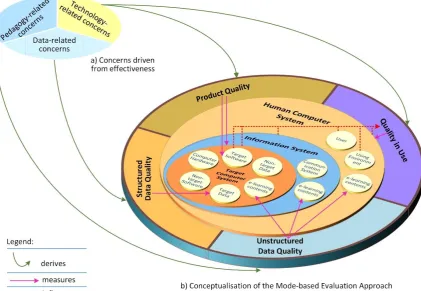
Figure 1: Conceptualisation of the model-based evaluation approach and concerns behind its derivation (Adapted from ISO 25010 2011)
For the purpose of simplifying the proposed evaluation approach and making it more applicable, a limited version of DQ has been adopted since the rest of data qualities have been covered by similar PQ and QiU characteristics. More specifically, the following data qualities: (i) completeness, (ii) accessibility, (iii) compliance, (iv) confidentiality, (v) efficiency, (vi) understandability and (vii) availability are respectively covered by the following product qualities and qualities in use: (i) functional completeness, (ii) accessibility, (iii) interoperability and co-existence, (iv) confidentiality, (v) efficiency, (vi) semanticability and (vii) availability. Although, data quality differs from product quality, e-learning system cannot be characterised as confidential unless it is confidential on both levels product and data. Option remains available for those who want to evaluate data qualities apart from product qualities to adopt full data quality model (i.e. 15 characteristics instead of the above-described eight characteristics choice). Table 1 describes the evaluation approach characteristics, introduced in figure 1. This includes characteristics of PQ, QiU, extended ones and DQ. Despite the comprehensiveness of the ISO-based models, extended qualities are needed due to peculiarities of e-learning domain and hence domain-specific qualities such as pedagogy, semantic and process-based approach has been introduced. This resulted in a model-based evaluation approach that is composed of 42 capabilities and covering the previously-discussed concerns.
Table 1: Model-based Evaluation Framework
# Capability Description Source
1. Interoperability degree to which two or more systems, products or components can exchange information and use the information that has been exchanged.
PQ
2. Reusability degree to which an asset can be used in more than one system, or in building other assets.
PQ
3. Accessibility degree to which a product or system can be used by people with the widest range of characteristics and capabilities to achieve a specified goal in a specified context of use.
PQ
4. Availability degree to which a system, product or component is operational and
accessible when required for use.
[image:4.595.69.514.635.777.2]# Capability Description Source
5. Modularity degree to which a system or computer program is composed of discrete
components such that a change to one component has minimal impact on other components.
PQ
6. Usability degree to which a product or system can be used by specified users to achieve specified goals with effectiveness, efficiency and satisfaction in a specified context of use.
PQ
7. Modifiability degree to which a product or system can be effectively and efficiently modified without introducing defects or degrading existing product quality.
PQ
8. Performance
Efficiency
performance relative to the amount of resources used under stated conditions.
PQ
9. Resource Utilisation
degree to which the amounts and types of resources used by a product or system when performing its functions meet requirements.
PQ
10. Compatibility degree to which a product, system or component can exchange
information with other products, systems or components, and/or perform its required functions, while sharing the same hardware or software environment.
PQ
11. Co-existence degree to which a product can perform its required functions efficiently
while sharing a common environment and resources with other products, without detrimental impact on any other product.
PQ
12. Functional correctness
degree to which a product or system provides the correct results with the needed degree of precision
PQ
13. Functional Completeness
degree to which the set of functions covers all the specified tasks and user objectives.
PQ
14. Learnability degree to which a product or a system can be used by specified users to
achieve specified goals of learning to use the product or system with effectiveness, efficiency, freedom from risk and satisfaction in a specified context of use.
PQ
15. Appropriateness Recognisability
degree to which users can recognize whether a product or a system is appropriate for their needs.
PQ
16. Confidentiality degree to which a product or a system ensures that data are accessible only to those authorized to have access
PQ
17. Functional Suitability
degree to which a product or a system provides functions that meet stated and implied needs when used under specified conditions.
PQ
18. Trust degree to which a user or other stakeholder has confidence that a
product or a system will behave as intended
QiU
19. Flexibility degree to which a product or system can be used with effectiveness, efficiency, freedom from risk and satisfaction in contexts beyond those initially specified in the requirements. For instance, adapting a product for additional user groups.
QiU
20. Effectiveness accuracy and completeness with which users achieve specified goals QiU
21. Efficiency resources expended in relation to the accuracy and completeness with
which users achieve goals.
QiU
22. Satisfaction degree to which user needs are satisfied when a product or a system is
used in a specified context of use.
QiU
23. Adaptability degree to which a product or system can effectively and efficiently be adapted for different or evolving hardware, software or other operational or usage environments where this adaptability is initiated by the user him/herself not the system.
EC, Adapted
from PQ 24. Adaptivity degree to which a product or system can effectively and efficiently be
adaptive for different or evolving user requirements where this adaptivity is initiated by the system itself without direct user initiation (Weibelzahl 2005). Personability is a subtype of adaptivity.
EQ
25. Discoverability degree to which an artefact (e.g. LO) can be automatically discovered. EQ
26. Extendability degree to which an artefact (e.g. system, component, etc.) can be extended to accommodate new capabilities.
# Capability Description Source 27. Adoption
Flexibility
degree to which an artefact (e.g. model, system, etc.) can be applied by institution without complex changes required from the institutions. This includes organisational, cultural or technological changes.
EQ
28. Real-time Adaptability
degree to which a product or system can effectively and efficiently be adapted for changing or evolving user requirements during runtime.
EQ
29. Semanticability degree to which an artefact can capture its usage contexts by specific user so system functionalities become more meaningful to the user.
EQ
30. Intelligentability degree to which an artefact can use unconventional (i.e. artificial intelligence) techniques to provide outcomes with a sufficient level of effectiveness, efficiency and satisfaction.
EQ
31. Processability degree to which an artefact can utilise business process techniques included in design, management, enactment and analysis of operational business processes (Aalst, Hofstede and Weske 2003).
EQ
32. Pedagogical Neutrality
degree to which different pedagogical principles, models and frameworks can be represented to the sufficient level (Koper and Van Es 2003).
EQ
33. Pedagogical Expressiveness
degree to which an artefact can express a wide range of possible pedagogical scenarios (Caeiro-Rodríguez, Anido-Rifón and Llamas-Nistal 2010). A pedagogical scenario represents a learning/teaching scenario from pedagogical perspective, this does not cover technological issues.
EQ
34. Pedagogical Usefulness
degree to which a learner is satisfied with his/her perceived achievement of learning objectives, material fitness and learning outcomes based on his/her interaction with an artefact (e.g. LO).
EQ
35. Accuracy degree to which data have attributes that correctly represent that true value of the intended attribute of a concept or event in a specific context of use.
DQ
36. Consistency degree to which data have attributes that are free from contradiction and are coherent with other data in a specific context of use.
DQ
37. Credibility degree to which data have attributes that are regarded as true and believable by users in a specific context of use.
DQ
38. Currentness degree to which data have attributes that are of the right age in a specific
context of use.
DQ
39. Precision degree to which data have attributes that are exact or that provide
discrimination is a specific context of use.
DQ
40. Traceability degree to which data have attributes that provide an audit trail of access
to the data and of any changes made to the data in a specific context of use.
DQ
41. Portability degree to which data have attributes that enable them to be installed, replaced or moved from one system to another while preserving the existing quality in a specific context of use.
DQ
42. Recoverability degree to which data have attributes that enable them to maintain and
preserve a specified level of operations and quality, even in the event of failure, in a specific context of use.
DQ
Keys:
Symbol Description
PQ Product Quality Model (ISO/IEC 25010 2011) DQ Data Quality Model (ISO/IEC 25012 2008) QiU Quality in Use Model (ISO/IEC 25010 2011)
EQ Newly introduced qualities
4. Proof of Concept: Application of the Proposed Evaluation Approach
actually evaluating and testing the selected e-learning models which are derived by carrying out extensive literature review where these models have been described. Third, researchers document the results of each model. Fourth, researchers visually represent the results and reflect on their commonalities and specialities.
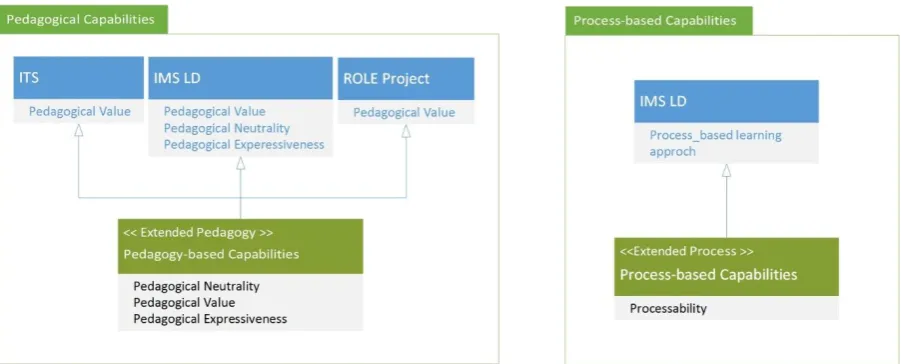
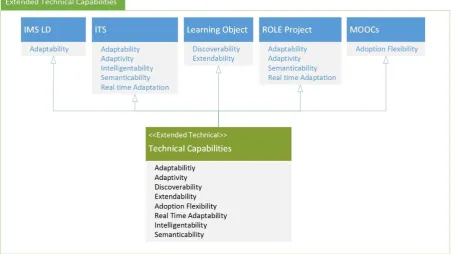
The following models have been chosen: (i) Learning Object (LO), (ii) IMS Learning Design (IMS LD), (iii) Massive Online Open Courses (MOOCs), (iv) Intelligent Tutoring Systems (ITS) and (v) Responsive Open Learning Environment (ROLE) where the above evaluation process has been applied. Due to space restrictions we can not presented detailed outcome of each step but final results are partly presented. The chosen models vary from a simple model such as LO to complicated models e.g. ROLE and ITS, also from widely-adopted models e.g. MOOCs to standard e.g. IMS LD. We thoroughly studied and evaluated the models one by one using the proposed approach and selected evaluation results are presented below in Figures 2 and 3.
[image:7.595.73.524.388.570.2]As part of the investigation it is found that the key capabilities offered by LO model are: interoperability, reusability, accessibility, availability, modularity and discoverability. Furthermore, ITS and ROLE share common capabilities such as adaptivity, semanticability, interoperability, intelligentability and pedagogical value. Figure 2 and 3 illustrate which of the five chosen e-learning models offer any of the pedagogical, process-based and extended technical capabilities. In both figures, the stereotypes <<extended pedagogy>>, <<extended process>> and <<extended technical>> refer to newly introduced capabilities (i.e. not existed in ISO 25010 and 25012) in pedagogy, process and technical domains. Most ITSs follow problem-based teaching approach, hence they explicitly exhibit pedagogical value but they are not neutral nor expressive because they cannot represent other pedagogical scenarios. In contrast, IMS LD is more pedagogical neutral and expressive because it can model different pedagogical scenarios. Additionally, IMS LD is the only model out of the selected models that offers processability because it explicitly allows defining a process to be followed by the learner based on a group of learning activities, while learning processes in other models are codified in the system and cannot be changed. Finally, figure 2 and 3 shows part of the results only due to the space restrictions.
Figure 3: Extended technical capabilities
5. Discussion and Reflections
The above proposed evaluation approach for e-learning is a first step towards more comprehensive and holistic evaluation of learning models. The application of the proposed evaluation approach to five e-learning models, with variety of capabilities, aimed to assess the effectiveness as well as the applicability of the proposed approach. Preliminary results shown in the previous section indicate that it can be used precisely derive capabilities of different e-learning models since all models are compared against a list of well-structured and defined criteria. However, further work is needed to check whether the proposed approach is sufficient enough to evaluate the effectiveness of e-learning models. For instance, in Figure 2 pedagogical value is present in ITS, IMS LD and ROLE but it is not clear to what extent the pedagogical value is mature in these models. This suggests assigning weights to metrics so that different capabilities can be measured and compared between different e-learning models. Furthermore, discovered capabilities differ in terms of their impact and measurement. For instance, interoperability is one of the key capabilities because it impacts the completeness of achieving a specific goal by a given e-learning system. Nonetheless, pedagogical capabilities seem more challenging since they cover processes, experiences learners gain, outcomes and relationships of teaching and learning in higher education (REA 2006). Therefore, measuring the pedagogical effectiveness depends on number of factors such as: data used in e-learning systems, roles of actors and their interaction with the systems (e.g. instructors, technical support, etc.), tools and algorithms behind the scene, to mention but a few. This also reaffirms above arguments that there is a need for accurate metrics and scale to assess to what extent the discovered capabilities are implemented by a particular model. This metrics based assessment is under development in the current stage of research.
with institution-specific approaches e.g. benchmarking or subject-specific e.g. custom metrics for engineering disciplines, which may lead to conflicting assessment criteria and would require resolution. Also, instantiation process is needed for wider adoption of this evaluation approach. To conclude, Effective instantiation process will add the value for this holistic approach and make its application successful.
Figure 4: Conceptualisation of holistic application of the proposed evaluation approach
6. Conclusion
In this paper researchers introduce a first step towards developing a new holistic evaluation approach for e-learning effectiveness. In its current stage, standard-based approach has been adopted to respond to three main concerns of e-learning systems. First, product quality standard handles software static characteristics and system dynamic characteristics. Second, quality in use standard handles system use by a certain stakeholder in a certain context. Thirdly, data quality standard handles structured data retained in the system. Meanwhile, the proposed approach leaves the door open for adopting institution-specific additional tools and measures (e.g. benchmarking) to assess other e-learning components such as pedagogy and contents. Based on the successful indications shown in section 4 where this approach is applied on five selected e-learning models, we are developing further measures and scale for assessing the discovered capabilities as well as a rigorous instantiation process to guide the application of the proposed evaluation approach.
References
Abu Shaban, S. and Hammad, R. (2006) Evaluating The Use of WebCT in Teaching at The Islamic University of Gaza, The 4th Conference on e-learning applications at The American University, Cairo.
Caeiro-Rodríguez, M., Anido-Rifón, L. and Llamas-Nistal, M. (2010) Challenges in Educational Modelling: Expressiveness of IMS Learning Design, Subscription Prices and Ordering Information, Vol. 13, no. 4, pp. 215-226.
Chua, B.B. and Dyson, L.E. (2004) Applying the ISO 9126 model to the evaluation of an e-learning system, Beyond the comfort zone: Proceedings of the 21st ASCILITE Conference, pp. 184, Perth.
Halachev, P.M. (2009) E-learning effectiveness, Interactive Computer Aided Learning International Conference Kessel University Press, Austria.
Hand, A. (2012) Evaluating the suitability of current Authoring Tools for developing e-learning Resources, Heriot Watt University.
ISO/IEC 25010 (2011) Systems and software engineering–Systems and software Quality Requirements and Evaluation (SQuaRE)–System and software quality models, International Standard Organisation, Geneva.
ISO/IEC 25012 (2008) Software product Quality Requirements and Evaluation (SQuaRE): Data quality model, International Standard Organization, Geneva.
Johnson, R.D., Gueutal, H. and Falbe, C.M. (2009) Technology, trainees, metacognitive activity and e-learning effectiveness, Journal of Managerial Psychology, vol. 24, no. 6, pp. 545-566.
Brambilla, M., Cabot, J. and Wimmer, M. (2012) Model-driven software engineering in practice, Synthesis Lectures on Software Engineering, Morgan & Claypool Publishers.
Khan, Z. (2009) Bridging the gap between business process models and service-oriented architectures with reference to the grid environment, International Journal of Grid and Utility Computing, 2 (4). pp. 253-283. ISSN 1741-847X.
Khan, Z., Ludlow, D. and Rix, J. (2012) Applying the criteria indicators and metrics evaluation method on ICT research: The HUMBOLDT project. Research Evaluation Journal, 22 (1). pp. 30-40. ISSN 0958-2029.
Koper, R. and Van Es, R. (2003) Modelling units of learning from a pedagogical perspective, In Learning Network and Learning Design, Open University, Netherland.
Lew, P., & Olsina, L. (2011). Instantiating web quality models in a purposeful way, In Web Engineering (pp. 214-227). Springer Berlin Heidelberg.
Novo-Corti, I., Varela-Candamio, L., & Ramil-DíAz, M. (2013). E-learning and face to face mixed methodology: Evaluating effectiveness of e-learning and perceived satisfaction for a microeconomic course using the Moodle platform, Computers in Human Behaviour, 29(2), 410-415.
Murray, M. C., & Pérez, J. (2015) Informing and performing: A study comparing adaptive learning to traditional learning, Informing Science: the International Journal of an Emerging Transdiscipline, 18, 111-125.
Panunzio, M., and Vardanega, T. (2014). An architectural approach with separation of concerns to address extra-functional requirements in the development of embedded real-time software systems, Journal of Systems Architecture, 60(9), 770-781.
Peters-Anders, J., Loibl, W., Züger, J., Khan, Z., & Ludlow, D. (2014). Exploring Population Distribution and Motion Dynamics through Mobile Phone Device Data in Selected Cities–Lessons Learned from the UrbanAPI Project, Proceedings of the International Conference on Urban Planning and Regional Development in the Information Society (REAL CORP),Vienna, Austria.
RAE (2006) Generic statement on criteria and working methods, Research Assessment Exercise, UK.
Rafique, I., Lew, P., Abbasi, M. Q. and Li, Z. (2012). Information quality evaluation framework: Extending ISO 25012 data quality model. World Academy of Science, Engineering and Technology, 65, 523-528.
Siegel, J.M. (2014) Model Driven Architecture (MDA): MDA Guide revision. 2.0, Object Management Group.
Tseng, M. L., Lin, R. J., & Chen, H. P. (2011). Evaluating the effectiveness of e-learning system in uncertainty, Industrial Management & Data Systems, 111(6), 869-889.
Van Der Aalst, Wil MP, Ter Hofstede, A.H. and Weske, M. (2003) Business process management: A survey, In Business process management, eds. Van Der Aalst, Wil MP & M. Weske, Springer Berlin, Heidelberg, pp. 1-12.
Walker, R., Voce, J., Nicholls, J., Swift, E., Ahmed, J., Horrigan, S. and Vincent, P. (2014) 2014 Survey of Technology Enhanced Learning for higher education in the UK, Universities and Colleges Information Systems Association (UCISA), Oxford, UK.
Weibelzahl, S. (2005) Problems and pitfalls in the evaluation of adaptive systems, 10th International Conference on User Modelling (UM'05), eds. S. Weibelzahl, A. Paramythis and J. Masthoff, IRM Press, 24th to 30th July 2005, pp. 285.