Managing employees with control, commitment or
with both: what leads to more affective
commitment and proactive work behavior?
2011 - 2012
B.J. (Marloes) van de Maat Student 0213039
Masterthesis Psychology
Specialization Work and Organization
Graduation committee: Dr. H. Boer
Acknowledgement
Abstract
Key words: Human Resource Management, (affective) commitment, control, leadership, participation, culture, work enrichment, performance appraisal, proactive
work behavior.
Samenvatting
commitment variabelen op affectieve commitment en proactief werkgedrag is niet voor alle variabelen bevestigd. Enkel een positief, interactief effect van werkverrijking en transformationeel leidershap op affectieve commitment en proactief werkgedrag is bevestigd. Ten slotte worden in dit onderzoek de beperkingen en de aanbevelingen voor verder onderzoek besproken.
Trefwoorden: Human Resource Management (HRM), (affectieve) betrokkenheid, controle, leiderschap, participatie, cultuur, werkverrijking, beoordeling, proactief
Table of contents
1. Introduction 7
2. The relation between Human Resource Management and affective commitment
and proactive work behavior 9
2.1 Human Resource Management (HRM) 9
2.2 Affective commitment 9
2.3 Proactive work behavior 11
2.4 Research model 13
3. Theoretical framework 13
3.1 Context of Human Resource Management 13
3.2 Control- and commitment based management 14
4. Characteristics and outcomes of control based management 14
4.1 Transactional leadership 16
4.2 Performance appraisal 17
5. Characteristics and outcomes of commitment based management 18
5.1 Transformational leadership 20
5.2 Participation in decision making 21
5.3 Work enrichment 22
6. Participants 23
7. Method 26
7.1 Procedure 26
7.2 Measures 27
8. Results 28
8.1 Descriptive statistics and correlation analysis 28
8.2 Testing hypothesis 30
8.2.1 Interaction effect of transactional and transformational leadership 30 8.2.2 Interaction effect of transactional leadership and performance appraisal 31 8.2.3 Interaction effect of participation and transformational leadership 32 8.2.4 Interaction effect of work enrichment and transformational leadership 33
9. Conclusion and discussion 35
Literature 37
Managing employees with control, commitment or with both: what leads to
more affective commitment and proactive work behavior?
Comparing and combining the ´commitment management approach´ with the ´control management approach´ - through the influence of hr-practices - and discovering its effect on
affective commitment and proactive work behavior of employees.
1. Introduction
Research from Khatri & Budhwar (2002) notes that a gradual shift from control management
to commitment management is nowadays taking place in a variety of organizations and industries. Commitment and control are two distinct ways in which employee behaviours’ and attitudes can be influenced (Arthur, 1994). According to Walton (1985), there can be made a distinction between HR practices that focus upon enhancing employee commitment and HR practices that increase control of the manager over employees and the production process. Although control and commitment management are considered as extremes on a continuum, practise shows that both styles do not act separately but interact with each other and strengthen the effect on employees outcomes.
Research from Walton (1985) shows that the shift from control to commitment is necessary since we are operating under competitive and dynamic business conditions. It may be clear that the more attention an organization exerts on its internal environment, the greater chance it has for external survival. For example, market success depends on a superior level of performance and employees’ motivation, a level that in turn requires the deep commitment, not merely the obedience of employees. This commitment-management approach cannot flourish in a workplace only dominated by the use of control management. Walton (1985) stated that the shift from control management to commitment management has many positive effects on the welfare, commitment, satisfaction and work behavior of employees, by giving them broader responsibilities and to encourage them to contribute. Eliciting worker commitment and providing the environment in which one can flourish, pays according to Walton (1985), tangible dividends for the individual and the organization. Although Walton stated that the commitment management approach has positive outcomes on employees´ commitment, the approach is expected to be influenced by organizational characteristics (Johns, 2006), for example culture, and acts through the use of a particular HR-practices that are either control oriented or commitment oriented.
2. The relation between Human Resource Management and affective commitment and proactive work behavior
2.1 Human Resource Management (HRM)
´´Human Resource Management (HRM) is the function within an organization that focuses on recruitment of, management of, and providing direction for the people who work in the organization. HRM can also be performed by line managers´´ (Heathfield, 2000, Humanresources.about.com). HRM is now expected to add value to the strategic utilization of employees and that employee programs impact the business in measurable ways. Research from Gellatly, Hunter, Currie and Irving (2009) shows that the resource-based view of the firm proposes that an organizations investment in its human capital resources can be a source of sustainable competitive advantage and high performance. The practical implication of this proposal is that firms develop, through their HR tools, internal workforce capabilities that are rare, valuable, inimitable, and non-substitutable, and that allow them to exploit opportunities and/or neutralize environmental threats to a greater extent than their competitors. Important point to note is that HR tools (either control or commitment) affects the outcomes (and success) of the products/services via their impact on employee behavior. It has also been suggested that employee behaviours, such as lack of initiative and motivation, low commitment, and dislike for work are more a reflection of the management systems rather than employees’ innate desires or needs (Khatri et al, 2004). So, when HR (in particular leadership) is practiced with a good balance between control and commitment, the effect will be that employees will show more affective commitment and proactive work behavior.
2.2 Affective organizational commitment
have the opportunity to reach more committed employees through focusing on human relations and the psychological needs of employees. Next to human centered culture there is also an organizational type of culture that is focused on exercising control: the control centered culture. This type of culture is focused on controlling internal processes and has a low flexibility in its structure (tall hierarchy). Although, there are different types of commitment, in this research paper, the interest will go out to the affective organizational commitment. This refers to employees' emotional attachment to, identification with, and involvement in, the organization (Allen & Meyer, 1990). Beside that, organizational culture will also be investigated in the light of human centered culture and control centered culture. One goal is to discover the relation between types of culture, management style and affective commitment and proactive work behavior.
2.3 Proactive work behavior
Proactive behavior involves self initiated, anticipatory action aimed at changing either the situation or oneself. Bindl and Parker (2009) stated examples that include taking charge to improve work methods, proactive problem solving, using personal initiative, making ideas, and proactive feedback seeking.
system can lead to employees who are more likely to engage in organizational citizenship behaviors (Organ, 1988) and employees who are committed to their organization (Arthur, 1994). Following Tsui et al. (1997) and Whitener (2001), a social exchange theory (Blau, 1964) framework will be used to explore the relationship between a HRM configuration and proactive work behavior. It is suggested that employees interpret actions within the organizational context such as HRM practices (Wayne, Shore & Liden, 1997) as signals of the personified organizational commitment to them. Employees reciprocate their perceptions accordingly in their own commitment and behavior to the organization.
As considered above, research shows that affective commitment and proactive work behavior are effects of HRM. The social exchange theory can be named as the underlying mechanism of this relation and explains that when an organization puts effort on her employees´ they can expect more commitment en proactive work behavior in return and this makes an organization successful. The reason that affective commitment and proactive work behavior are measured in this paper is because we want to explain the relation between these variables (separated) and the two different HRM approaches (commitment and control) and its antecedents (HR-practices), when they are compared on the construct ´leadership´. The interactive effect of transformational- and transactional leadership will be measured and this will properly explain the amount of affective commitment employees’ experience and their level of proactive work behavior. It may be clear that high commitment HRM leads to more affective commitment and proactive work behavior, but what is the influence of control based HRM? This research approach and its outcomes can enrich the current research findings about HRM-approaches (and instruments) and its effects on employees´ behavior. Now the dependent variables are explained, its time to introduce the research question and model.
Research question:
2.4 Research model
3. Theoretical framework
3.1 Context of Human Resource Management
Within organizations, the overall management approach affects its outcomes via a causal chain in which management policies and organizational characteristics like culture and type of organization, determine human resource management practices and the management style. Johns (2006) argued that the impact of context on organizational behavior is not sufficiently acknowledged by researchers. He defined context as ´situational opportunities and constraints that affect the occurrence and meaning of organizational behavior as well as functional relationships between variables´ (Johns, 2006 p. 386). Context can serve as a main effect or interact with personal variables such as disposition to affect organizational behavior. The essential point made in the article of Johns (2006) is that context can have both subtle and powerful effects on research results. Rousseau and Fried also admit the influence of context on a organization. They noted that “contextualization entails linking observations to a set of relevant facts, events, or points of view that make possible research and theory that form part of a larger whole” (2001: 1).
Perceived characteristics of the organization
- Human centred culture
Perceived commitment management:
- Transformational leadership - Participation
- Work enrichment
Affective commitment &
Proactive work behavior Perceived control
management:
- Transactional leadership - Performance appraisal
Perceived characteristics of the organization
This paper will pay attention to the organizational characteristics because they are essential in the way HR management acts. The variable ´organizational culture´ will be conducted to the independent variables and will be split up into two different types of culture: control centred culture and human centred culture. Cameron and Quinn (1999) described the control culture and related it to hierarchical organizations who share similarities with the stereotypical large, bureaucratic corporation. They defined control culture as performing internal focus and integration. Organizations where a control culture is leading are characterized by standardization, control, and a well-defined structure for authority and decision making. A human centered culture is focusing on its employees: the employee is standing central in the organization. The organization who has a human centered culture is paying a lot of attention to employee development and procedures and rules are placed on the background. The organization is characterized by innovation and flexibility.
3.2 Control- and commitment based management
According to Walton (1985), there can be made a distinction between those HR practices that focus upon enhancing employee commitment and those practices that increase control of the manager over employees and the production process. These two aspects of HRM practices are considered the extremes on a continuum, where HR practices tend to be either more commitment- or more control-oriented. In the next section, these two forms of HR practices and their effects on employees´ behavior will be further described in relation to different types of organizations. It will become clear that a commitment approach is usually linked to a profit organization that is characterized by a flat organizational structure. The control approach is a management outcome that is common in a bureaucratic organization with a tall hierarchy and a non-profit character.
4. Characteristics and outcomes of control based management
leadership (Bass et al., 1996). Khatri et al. (2004), assumes that the control-based approach is used by managers that see their employees as incapable of self-regulating their behaviors and cannot be trusted. Consistent with this assumption, the natural emphasis of control-based management is on monitoring employee behavior closely via a variety of control mechanisms. Since the underlying assumption is that people must be made to do what is necessary for the success of the enterprise, attention is directed to an elaborate machinery of direction and control.
Characteristics of a organization with a control-based management are a tall hierarchy; a formal organizational structure; direct supervision; low employee participation and the communication is mostly vertical (top down) (Verheul, 2003, with input from Beer et al. (1984), Arthur (1992) and Boselie (2002)). Tasks are narrowly defined and standardized so that they can be properly monitored. Control-based, bureaucratic models are maladaptive when massive change, environmental dynamism and considerable uncertainty are the norm. Self-regulating capacities of employees, shaped and normalized in large part through the powers of expertise, have become key resources for modern forms of organization; especially in a competitive and dynamic business conditions. Control based management is characterized by a division of work into small, fixed jobs for which individuals can be held accountable, and direct control with managers supervising rather than facilitating employees (Walton, 1985).
In this paper, control based HR-practices will be linked to a bureaucratic organization and we will see of the employees´ of this ´control´ organization show less affective commitment and proactive work behavior through the application of control management. Bureaucratic practices are those traditional aspects of HRM that firms use to manage human capital systematically by formalizing the ways they manage employees through transactional leadership, defining jobs, establishing expectations and evaluating performance (Kaman, 2001).
For this research, two constructs are chosen to measure control based management:
transactional leadership and performance appraisal. These two constructs will be the independent variables in this research paper on the side of ´control´ (in relation to the two dependent variables). The independent commitment variables will first be further outlined before the effects of these variables will be discussed.
4.1 Transactional leadership
Transactional leader behaviors involves an exchange between the leader and follower, such that the leader provides rewards in return for the subordinates effort. According to Bass (1985), there are two main forms of transactional leadership behavior. One is contingent reward behavior, which is analogous to positive supervisory feedback and the other form of transactional leadership is called "management by exception" and contingent punishment by others. This behavior consists of a variety of forms of negative feedback (e.g., correction, criticism, and/or other forms of punishment), administered by the manager contingent on poor performance. According to Connelly and Ruark (2010), transactional leaders provide stable, risk-averse leadership in exchange for follower effort and performance. Leaders ascribing to this approach focus on the effective and efficient exchange of information intended to: a) clarify objectives and expectations, and b) identify contingencies in the form of rewards and punishments for when followers meet or fail to meet those objectives. In essence, this kind of exchange forms the basis for leader–follower interactions and relationships.
identifies transactional leadership as being based on material or economic exchange and transformational leadership as being based on social exchange. Summarized, leadership can find its implementation in a ´control´ or ´commitment´ manner. These two approaches have their influence on the work behavior and amount of commitment of employees by influencing work behavior. As noted earlier, these two leadership styles do properly not act separately but control and commitment management are two extremes on a continuum that will show a interactive effect to reach the best employees´ outcomes. This interactive effect of the leadership styles will be further outlined, later on in this research paper. Now, the first hypothesis will be outlined on basis of the just mentioned findings.
H1a There is a positive relation between transactional leadership and affective commitment
H1b There is a positive relation between transactional leadership and proactive work behavior
H2a There is a positive interactive effect of transactional leadership and transformational leadership on affective commitment
H2b There is a positive interactive effect of transactional leadership and transformational leadership on proactive work behavior
4.2 Performance appraisal
Performance appraisal is a formal organisational mechanism for controlling the performance of work tasks on a rational, subjective and continuous basis, and is according to Bevan and Thompson (1991): a) the yearly or half-yearly setting of individual performance targets relating to the operating units’ target within the overall organization; b) formal review of progress towards these targets, and/or the identification of training needs; c) the creation of a shared vision of the organizations objectives, occasionally through a mission statement communicated to all employees.
employees, the behavioural effect of it depends on the outcome of the performance appraisal. If a supervisor gives an employee a poor score on her appraisal, the employee may feel a loss of motivation and commitment in the workplace. Consequently, this can impact the employees´ productivity and performance. Employees who receive good scores on their appraisals are generally motivated to perform well and maintain their productivity. Positive feedback on appraisals gives employees a feeling of worth and value, especially when accompanied by a raise (Bartolomei, 2004). Although, we want to investigate the interactive effect between control and commitment variables, performance appraisal cannot be combined with one of the ´commitment management variables´: transformational leadership, participation or job enrichment, because literature does not explain an underlying mechanism between this variables in terms of affective commitment or proactive work behavior. An alternative is to research the interactive effect between performance appraisal and transactional leadership (the ´control management variables´) and to see what this combination will have on affective commitment and proactive work behavior.
H3a There is a positive relation between performance appraisal and affective commitment H3b There is a positive relation between performance appraisal and proactive work
behavior
H4a There is a positive interactive effect of transactional leadership and performance appraisal on affective commitment
H4b There is a positive interactive effect of transactional leadership and performance appraisal on proactive work behavior
5. Commitment based Human Resource Management
commitment HRM is emphasizing on the benefits of meeting employee needs and enabling workers to have control over their work lives. Many firms recognize the need to provide the information, flexibility and voice that employees require to contribute to organizational success. Kaman (2001) refers to Baron and Kreps (1999) who describe high commitment HRM as "an ensemble of HR practices that aim at getting more from workers by giving more to them".
Organizations who have a commitment basis management style are characterised by a flat structure and employees are working interdependent, with extensive information sharing, clear communication and there is room for participation in decision making. Managers perform leadership on an transformational manner and employees have the opportunity to work outside the boundaries of the work (work enrichment). Commitment HRM systems also emphasize employee development and trust. The HRM systems are bundles of coherent HR-practices, characterizing the strategic HRM approach. Commitment-based management does not mean that there is no control used in the organization. Control in a commitment-based approach is achieved through creating commitment in employees toward organizational goals and objectives. Research from Khatri (2002) notes that the commitment-based approach has several behavioral consequences for employees. For example, employees take more initiative and seek more responsibility. They are more actively engaged and committed to their work and they have a high morale toward the organization. Employees who are involved in a commitment-based approach are also more energized, motivated and they are more willing to cooperate and to trust each other. The utilization of human capacity is high (in terms of knowledge and emotional energy). Finally, employees take pride in the organization and its mission: they go beyond the call of duty. Research from Walton (1985) showed that there are several ´commitment´ variables that have positive effects on the affective commitment and work behavior of employees.
For this research, three constructs are chosen to measure the relationship with affective commitment and proactive work behavior: transformational leadership,
5.1 Transformational leadership
Walton (1985) developed the commitment model for supervisors, which requires that first line supervisors must facilitate employees rather than direct the workforce. Supervisors must help employees to develop the ability to manage themselves. According to the commitment model of Walton (1985) is the role of transformational leadership, a key component of commitment-based management, very crucial for organizations. A leader must be able to create a compelling vision that motivates employees and communicates the need for change. They must create an environment of psychological safety that fosters open reporting, active listening, and frequent sharing of insights and concerns and they must see the importance of empowering and supporting team learning throughout the organization. The application of the commitment-based management approach requires skilful managers who have good leadership skills and understand human behavior. Transformational and inspirational leaders are ‘socially adept’ and ‘daring and change seeking’. Walton (1985) discovered a highly significant positive relationship exists between a socially skillful, daring, and change-seeking
leadership style and the motivation of employees.
H5a There is a positive relation between transformational leadership and affective commitment
H5b There is a positive relation between transformational leadership and proactive work behavior
5.2 Participation in decision making
Walton (1985) states that employee participation or empowerment can be defined as the process of involving employees in some or many aspects of decision making that had been reserved for management. By decentralizing managerial decision making and setting up formal participation mechanisms, a commitment-based system can lead to a highly motivated and an empowered workforce whose goals are closely aligned with those of management. Farndale, Ruiten, Kelliher and Hope-Hailey (2011) investigated the influence of ‘employees’ voice’ on organizational commitment and the willingness of employees to change. The roots of employee voice lies in influence being shared among individuals who are hierarchically
unequal. In essence, voice relates to employees’ ability to influence the outcome of
organizational decisions by having the opportunity to advance their ideas and have them
considered. Employee voice in an organization can be examined in several ways: the
existence of mechanisms to facilitate employee voice, a climate that encourages employees
to put forward their ideas and opinions and the extent to which influence is associated with
voice, that is, whether employee ideas and opinions really affect the outcome of decisions.
Opportunities for employee voice may be implemented at different levels in the workplace,
for example, at the organizational level (employee surveys), between the employee and his or
her immediate line manager or at the workgroup level. The perception of voice can explain
the amount of influence that an employee is experiencing and this self-perception can explain
the commitment level and (proactive) work-behavior of an employee, because perceptions
can explain behavior.
between participation and transformational leadership (the ´commitment management variables´) on affective commitment and proactive work behavior.
H6a There is a positive relation between participation and affective commitment
H6b There is a positive relation between participation and proactive work behavior
H7a There is a positive interactive effect of participation and transformational leadership on affective commitment
H7b There is a positive interactive effect of participation and transformational leadership on proactive work behavior
5.3 Work enrichment
Work enrichment is concerned with the design of jobs, so that employees have high levels of discretion and decision-making powers (Wood and Wall, 2007). This can be achieved through the design of individual jobs so that they conform to the characteristics that Hackman and Oldham (1976) specify in their Job Characteristics Model (1976), in which autonomy is a key feature, or through the formation of teams that have considerable autonomy. The job characteristic model is based on the definition of five core job dimensions: (1) skill variety, (2) task identity, (3) task significance, (4) autonomy, and (5) feedback; which if perceived in the job are suggested to have a positive effect on a workers attitude and behavior. The theories underlying either mode of enrichment emphasize the role that it can play in increasing work motivation and job satisfaction, and how this can in turn enhance individual and collective performance. The importance of intrinsic motivation thus underlies the concept of work enrichment. Enriching a job is proposed to increase positive work outcomes (i.e. performance, satisfaction, motivation) and decrease negative work outcomes (i.e. absenteeism, turnover, stress).
how this can in turn enhance individual and collective performance. The importance of intrinsic motivation thus underlies the concept of work enrichment. This approach allows employees to take on more responsibility. Research from Bauer (2011) founds that companies using job enrichment may experience positive outcomes, such as reduced turnover, increased productivity, and reduced absences. This may be because employees who have the authority and responsibility over their work can be more efficient, eliminate unnecessary tasks, take shortcuts, and increase their overall performance. This theory leads to the following hypothesis:
H8a There is a positive relation between work enrichment and affective commitment H8b There is a positive relation between work enrichment and proactive work behavior
Also work enrichment cannot be combined with any control management variable, so it will also be combined with transformational leadership. This leads to the following hypothesis:
H9a There is a positive interactive effect of work enrichment and transformational leadership on affective commitment
H9b There is a positive interactive effect of work enrichment and transformational leadership on proactive work behavior
6. Participating organizations
In this chapter, the two organizations who participated in this research, will be further described on their characteristics. It will become clear that both organizations are very different. For example, their environments, their services and costumers are extremes on a continuum.
Lucky The Feel Good Provider
The overall climate within Lucky is very informal and employees work together (and for each other) to accomplish what needs to be done. The company believes in empowering their employees with information so that they are more able to act like owners and take responsibility to make decisions. The management gives the employees the freedom to do what they like to do, in order to meet the goals and expectations. The organizational structure is informal and flat (minimum status differentials). The organizational communication is extensive and takes place in all directions: horizontal and vertical. It stresses cooperation and employee involvement. Lucky invests in hiring, training, and developing of employees and builds mutual commitment with its employees. In total, 120 employees work for Lucky. The relation between the management and the employees is intensive. An employee is not a so called ‘number’ but it has its own voice and participation within the organization. The employees can participate in decision making and have influence on the way, work is designed and performed. The environment of Lucky is at the moment very turbulent. The economic crisis of the last years had its impact on the hospitality industry. Lots of organization in this branch of business lost their market value and even bankrupted. Nowadays, a business in an uncertain environment should maintain a flexible organizational structure to adequately adapt to changing market circumstances. This flexibility is more likely to be feasible when a business focuses on commitment in the structuring of HRM practices than when the focus is on control. Further, commitment is a very important goal of HRM in this service/profit sector because committed employees are important for customer loyalty and satisfaction. In service firms the relationship between customers and employees is the key to the production process. The organizational culture can be described as a human-centred culture. Mutual commitment is an important factor for the employees and there is much space for individual development. The business culture is also a very dynamic culture with opportunities for innovation and individual initiatives. The culture can handle the turbulent and continuous changing environment and it is focusing on achieving goals by the use of competition.
Dutch tax collectors’ office (Belastingdienst Oost-Nederland)
7. Method
7.1 Participants & procedure
The data for the present study, who was collected from Lucky The Feel Good Provider came from 75 employees. All these employees received the questionnaire after there yearly job evaluation conversation and all the employees completed the questionnaire (response rate of 100%). Their participation was voluntary and they were provided complete anonymity. The questionnaire was filled in with paper and pencil. The employees had the opportunity to ask for clarification when particular questions where unclear. The age of the respondents varies a little; for example, 89% of the employees are in the category of 16 to 25 years, 56% were male and respectively 44% female. More than half of the respondents have a “HBO” level education (54%). The average organizational tenure of the employees falls in the category of 1 to 5 years (68%). Almost all the employees have an operational position within the organization (87%).
7.2 Measures
For the analysis of the different variables, a questionnaire is used (see Appendix A). This questionnaire consists of a number of scales that are described in detail below. The scales are translated from English into Dutch and all the items of the scales were measured on a five-point Likert scale.
Perceived human centered culture. Perceived human culture was measured by a subscale of the Organizational Culture Assessment Instrument (OCAI) from Cameron and Quinn (1999). In total, 5 items were used to measure perceived human centered culture. A sample item was ´´the organization has a strong personal character; it looks like one big family´´ (α = .86).
Perceived control centered culture. Perceived control centered culture was also measured by a subscale of the Organizational Culture Assessment Instrument (OCAI) from Cameron and Quinn (1999). In total, 5 items were used to measure perceived control centered culture. A sample item was `´My organization has a formal character and formal procedures are prescribing employees´ behavior´´ (α = .81).
Transformational leadership. Transformational leadership was also measured with a subscale of the CLIO: a questionnaire for measuring leadership. In total, 5 items were used from the CLIO to measure transformational leadership. A sample item was ´´my supervisor talks with employees about what’s important for them´´ (α = .80).
Participation. Participation was measured by a scale named, the ´´High involvement work practices´´, who was developed by Guthrie (2001). In total, 6 items were used from their scale to measure participation. A sample item was ´´I have influence about what happens on my job´´ (α = .80).
Transactional leadership. Transactional leadership was measured by using 5 items of a subscale of the Dutch version of the CLIO: a scale for measuring leadership. The CLIO can be used to measure charismatic and empowering leadership but also to measure autocratic, transactional and passive leadership. The CLIO is developed by De Hoogh, Den Hartog and Koopman (2004). A sample item measuring transactional leadership was “my supervisor pays a lot of attention on clear appointments and fair rewards” (α = .84).
Performance appraisal. Performance appraisal was measured by a scale from Keeping and Levy (2000) named, ´´performance appraisal reactions: measurement, modeling, and method bias´´. In total, 3 items were used from this scale to measure how employees, performance appraisal experience. A sample item was ´´the appraisal helped me to get a better understanding of my mistakes´´ (α = .87).
Affective commitment. Affective commitment of the employees was measured by the scale ´Organization Commitment Questionnaire´ (OCQ) from Mowday & Steers (1979). In total, 5 items were used from both surveys to measure affective commitment. A sample item was ´´this organizations means a lot to me´´ (α = .83).
Proactive work behavior: proactive work behavior is measured by a scale from Bateman and Crant (1993), ´´ The proactive personality scale (PPS)´´. In total, 6 items were used to measure this construct. A sample item was ´´I handle problems on a active manner´´ (α=.86).
Background variables. The questionnaire measures different background variables that can have a potential influence on the independent and dependent variables. The background variables are: gender, age, educational background, position of the employee within the organization and the years of tenure.
8. Results
8.1 Descriptive statistics and correlation analysis
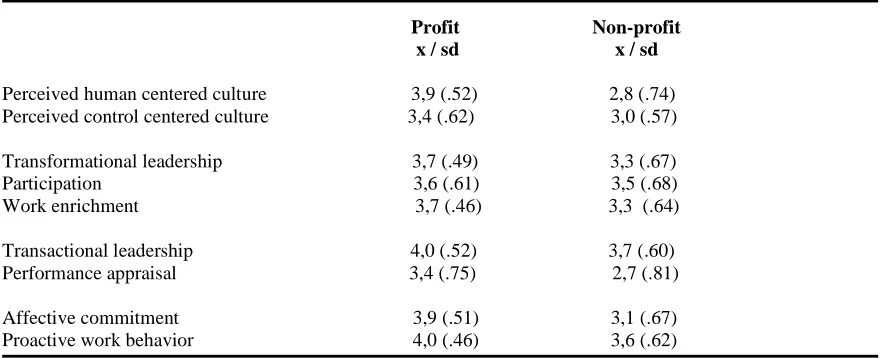
Table 1: descriptive statistics
Profit Non-profit x / sd x / sd
Perceived human centered culture 3,9 (.52) 2,8 (.74) Perceived control centered culture 3,4 (.62) 3,0 (.57)
Transformational leadership 3,7 (.49) 3,3 (.67) Participation 3,6 (.61) 3,5 (.68) Work enrichment 3,7 (.46) 3,3 (.64)
Transactional leadership 4,0 (.52) 3,7 (.60) Performance appraisal 3,4 (.75) 2,7 (.81)
Affective commitment 3,9 (.51) 3,1 (.67) Proactive work behavior 4,0 (.46) 3,6 (.62)
The results of table 1 confirms the expectation that the participants of the profit organisation judge the control and commitment constructs higher than the participants of the non-profit organisation. To see of this difference is significant, a t-test for two independent samples is performed. The t-test shows the outcome that only the construct ´participation´ does not have a significant differences between the answers of the two participating groups (profit vs. non-profit). Further, all the constructs show a significant differences between the answers of the participants.
[image:29.595.84.526.568.722.2]Table 2 presents the correlations for all the variables investigated in this study. Given the fact that the variables are normal distributed, Pearson’s correlation is used to measure the correlation between the variables.
Table 2: correlation analyses
Affective commitment proactive work behavior
Perceived human centered culture ,72** ,39**
Perceived control centered culture ,40** ,33**
Transformational leadership ,50** ,41**
Participation ,43** ,48**
Work enrichment ,62** ,64**
Transactional leadership ,52** ,38**
The results of the correlation analysis shows that there is a significant, positive relation between transactional leadership and affective commitment (r =.52, p<.01) and between transactional leadership and proactive work behavior (r =.38, p<.01), so hypothesis 1a and 1b are confirmed. The relation between performance appraisal and affective commitment and respectively the relation between performance appraisal and proactive work behavior are all positive, significant relations (r =.50, p<.01) vs. (r =.32, p<.01). This outcome means that hypothesis 3a and 3b are confirmed. The correlation analysis also shows that there is a significant, positive relation between transformational leadership and affective commitment (r =.50, p<.01) and between transformational leadership and proactive work behavior (r =.41, p<.01). So, hypothesis 5a and 5b are also confirmed. The relation between participation and affective commitment also is a significant, positive relation (r =.43, p<.01). Participation and proactive work behavior are also significant, positive related (r =.48, p<.01). hypothesis 6a and 6b are supported with this outcomes. Finally, the significant, positive relation between work enrichment and affective commitment (r =.62, p<.01) and between work enrichment and proactive work behavior are also significant, positive relations (r =.64, p<.01). This means that also hypothesis 8a and 8b are confirmed.
8.2 Testing interaction effects
8.2.1 Interaction effect of transactional and transformational leadership
For testing hypothesis 2, 4, 7 and 9, regression analysis, is performed. First, hypothesis 2a and 2b, are being tested (table 3.1 and 3.2).
[image:30.595.86.536.623.696.2]H2a There is a positive interactive effect of transactional leadership and transformational leadership on affective commitment
Table 3.1: results of the interactive effect of transformational- and transactional leadership on affective commitment
Variables step 1 step 2
Gender .05 .09
Age -.47** -.48**
Educational level -.08 -.07 Interaction leadership -.28**
To test above mentioned, the following steps are performed. First, the z-scores for the two leadership styles are calculated and after that they are multiplied with each other. After this, the interaction term is put into a regression analysis with ´affective commitment´ and ´proactive work behavior´ as dependent variables. The outcome of the interactive effect of the two leadership styles on affective commitment, shows a small negative, but significant relation (β=-.28, p<.01). With this outcome, hypothesis 2a is not supported. Now, hypothesis
2b will be tested.
[image:31.595.84.537.348.424.2]H2b There is a positive interactive effect of transactional leadership and transformational leadership on proactive work behavior
Table 3.2: results of the interactive effect of transformational- and transactional leadership on proactive work behavior
Variables step 1 step 2
Gender .03 .07
Age -.31** -.32**
Educational level .09 -.02 Interaction leadership -.34**
R² = .11 for step 1, R² = .22 for step 2 N = 145 *p<0.05, **p<0.01
The outcome of the interactive effect of the two leadership styles on proactive work behavior shows a small negative, but significant relation (β=-.34, p<.01). With this outcome,
hypothesis 2b is not supported.
8.2.2 Interaction effect of transactional leadership and performance appraisal
Now, hypothesis 4 a and b will be tested (table 4.1 and 4.2).
Table 4.1: results of the interactive effect of transactional leadership and performance appraisal on affective commitment
Variables step 1 step 2
Gender .05 .08
Age -.47** -.49**
Educational level -.08 -.07 Interaction transac.perf.appr. -.18*
R² = .22 for step 1, R² = .25 for step 2 N = 145 *p<0.05, **p<0.01
The outcome of the interactive effect of transactional leadership and performance appraisal on affective commitment (β=-.18, p<.05) shows a small negative, but significant relation.
With this outcome, hypothesis 4a is not supported. Now, hypothesis 4b will be tested.
H4b There is a positive interactive effect of transactional leadership and performance appraisal on proactive work behavior
Table 4.2: results of the interactive effect of transactional leadership and performance appraisal on proactive work behavior
Variables step 1 step 2
Gender .03 .07
Age -.31** -.33**
Educational level .09 .09 Interaction transac.perf.appr. -.21**
R² = .11 for step 1, R² = .16 for step 2 N = 145 *p<0.05, **p<0.01
The outcome of the interactive effect of transactional leadership and performance appraisal on proactive work behavior (β=-.21, p<.01) shows a small negative, but significant relation.
With this outcome, hypothesis 4b is not supported.
8.2.3 Interaction effect of participation and transformational leadership
Hypothesis 7 a and 7b will now be tested (table 5.1 and 5.2).
[image:32.595.83.537.134.213.2] [image:32.595.85.537.413.490.2]Table 5.1: results of the interactive effect of participation and transformational leadership on affective commitment
Variables step 1 step 2
Gender .05 .08
Age -.47** -.46**
Educational level -.08 -.09 Interaction parti.transf. -.27**
R² = .22 for step 1, R² = .29 for step 2 N = 145 *p<0.05, **p<0.01
The outcome of the interactive effect of participation and transformational leadership on affective commitment (β=-.27, p<.01) shows a small negative, but significant relation. With
this outcome, hypothesis 7a is also not supported. Now, hypothesis 7b will be tested.
[image:33.595.85.536.138.216.2]H7b There is a positive interactive effect of participation and transformational leadership on proactive work behavior
Table 5.2: results of the interactive effect of participation and transformational leadership on proactive work behavior
Variables step 1 step 2
Gender .03 .07
Age -.31** -.31**
Educational level .09 .08 Interaction parti.transf. -.32**
R² = .11 for step 1, R² = .21 for step 2 N = 145 *p<0.05, **p<0.01
The outcome of the interactive effect of participation and transformational leadership on proactive work behavior (β=-.32, p<.01) shows a small negative, but significant relation.
With this outcome, hypothesis 7b is also not supported.
8.2.4 Interaction effect of work enrichment and transformational leadership
Finally, hypothesis 9 a and 9b will be tested (table 6.1 and 6.2).
[image:33.595.84.537.413.489.2]Table 6.1: results of the interactive effect of participation and transformational leadership on affective commitment
Variables step 1 step 2
Gender .05 .07
Age -.47** -.37**
Educational level -.08 -.03 Interaction work.transf. .34**
R² = .22 for step 1, R² = .32 for step 2 N = 145 *p<0.05, **p<0.01
The outcome of the interactive effect of work enrichment and transformational leadership on affective commitment (β=.34, p<.01) shows a small positive, but significant relation! With
this outcome, hypothesis 9a is supported. Finally, hypothesis 9b will be tested.
[image:34.595.85.537.138.216.2]H9b There is a positive interactive effect of work enrichment and transformational leadership on proactive work behavior
Table 6.2: results of the interactive effect of participation and transformational leadership on proactive work behavior
Variables step 1 step 2
Gender .03 .04
Age -.31** -.23**
Educational level .09 .12 Interaction work.transf. .28**
R² = .11 for step 1, R² = .18 for step 2 N = 145 *p<0.05, **p<0.01
The outcome of the interactive effect of work enrichment and transformational leadership on proactive work behavior (β=-.28, p<.01) also shows a small positive and significant relation.
[image:34.595.84.537.420.497.2]9. Conclusion and discussion
This paper has undertaken an evaluation of the effects of ‘commitment’ and ‘control’ HR practices on two employees´ attitudes, namely affective commitment and proactive work behavior. The results were based on questionnaires collected from employees working for two different organizations. The outcomes of the regression analyses shows that all the ´commitment´ constructs (transformational leadership, participation and work enrichment) have a significant, positive effect on the two dependent variables: affective commitment and proactive work behavior, so all hypothesis are supported. The construct ´work enrichment´ shows the largest relation with affective commitment and proactive work behavior, followed by transformational leadership and participation.
The ´control´ constructs (transactional leadership and performance appraisal) showed a positive relation with affective commitment and proactive work behavior and this outcomes supported all hypothesis. The hypothesis that predicted the positive interactive effects between the different variables was only supported one time. The hypothesis that expected a positive interactive effect of transformational- and transactional leadership, of transactional leadership and performance appraisal and of transformational leadership and participation on respectively affective commitment and proactive work behavior were all not supported and showed a significant, negative relation. Only the hypothesis that predicted a positive interactive effect of transformational leadership and work enrichment on affective commitment and proactive work behavior was supported. This relation is also supported by research from Bass (1985) and Gardner and Avolio (1998) who stated that a transformational leader inspires employees´ to do more than is expected from them. A transformational leader is a leader who is committed to employees and who puts effort to get the best above in them. This leads to the outcome that an employee appreciates the strains of a leader even more.
relation can be that the two styles are conflicting because values of the leadership styles can compete with each other according to Quinn and Rohrbaugh (1983), in terms of flexibility and innovation. Further research is interesting to find out what the precise explanation could be.
Literature
Agarwal, S. (1999). Impact of job formalization and administrative controls on attitudes of industrial salespersons. Industrial Marketing Management,28, 359-368.
Allen, N.J. and Meyer, J.P. (1990). The measurement and antecedents of affective,
continuance and normative commitment to the organization. Journal of Occupational Psychology,
63, 1-18.
Angle, H. 1., & Perry, J. L. (1981). An empirical assessment of organizational
commitment and organizational effectiveness. Administrative Science Ouarterlv,
27, 1-14.
Appelbaum, E., Bailey, T., Berg, P. & Kalleberg, A. (2000). Manufacturing advantage: why high performance work systems pay off. Ithaca: Cornell University Press.
Arthur, J.B. (1994). Effects of human resource systems on manufacturing performance
and turnover. Academy of Management Journal, 37 (3), 670-687.
Bass, B.M., Avolio B.J. & Atwater, L.E. (1996), The transformational and transactional
leadership of men and women. Applied Psychology, 45, 5-34.
Bateman, T.S., & M.J. Crant. 1993. The proactive component of organizational behavior: A measure and correlates. Journal of Organizational Behavior, 14(2), 103–18.
Bateman, T S., & Strasser, S. (1984). A longitudinal analysis of the antecedents of
organizational commitment. Academy of Management Journal, 27, 95-112.
Bevan, S., & Thompson, M. (1991). Performance management at the crossroads. Personnel
Management, 36-40.
Blake, R.R. & Mouton J.S., (1964). The Managerial Grid, Houston: Gulf Publishing Company.
Cameron, K.S. and Quinn, R.E. Onderzoeken en veranderen van organisatiecultuur, Academic Service, ISBN 9052612919.
Campbell, D. J. (2000). The proactive employee: Managing workplace initiative. Academy
of Management Executive, 14, 52–66.
Coates, G. (2000). Experiencing performance appraisal in a trust hospital. Electronic Journal of Sociology. ISSN: 1198 3655.
Connelly, S. & Ruark, G. (2010). Leadership style and activating potential moderators of
the relationships among leader emotional displays and outcomes. The Leadership Quarterly 21:
745-764.
Curran, J., Kitching, J., Abbott, B. & Mills V. (1993). Employment and employment
relations in the small service sector enterprise. Small Business Research Centre, Kingston Business School.
De Hoogh, A.H.B., Den Hartog, D.N., & Koopman, P.L. (2004). De ontwikkeling van de
CLIO, een instrument voor het meten van leiderschap in organisaties. [The development of the CLIO: A questionnaire for measuring charismatic leadership]. Gedrag & Organisatie, 17, 354-382.
Farndale, Ruiten, Kelliher and Hope-Hailey (2011)
Gellatly, I.R., Hunter, K.H., Currie, L.G. & Irving, P.G. (2009). HRM practices and
organizational commitment profiles. The International Journal of Human Resource Management.
20 (4), 869–884.
Gould-Williams, J. (2004). The effects of ‘high commitment’ HRM practices on employee attitude: the views of public sector workers. Public Administration, 82(1), 63-81.
Guthrie, J.P. (2001). High-involvement work practices, turnover, and productivity. Management Journal,
44(1), 180-109.
Hackman, J.R. & Oldham, G.R. (1976). Motivation through the design of work: test of
Theory. Organizational Behavior and Human Performance.
Heathfield, S.M. (2000). Humanresources.about.com.
Heskett, J.L., Sasser, W.E. and Schlesinger, L.A. (1997). The service profit chain: how
leading companies link profit and growth to loyalty, satisfaction and value. New York: Free Press.
Huselid, M.A. (1995). The impact of human resource management practices on turnover,
productivity and corporate financial performance. Academy of Management Journal, 38, 635-672.
Johns, G. (2006). The essential impact of context on organizational behavior. Academy of
Management Review, 31(2), 386–408.
Kaman, V. (2001). Bureaucratic and high commitment human resource practices in small
service firms. Human Resource Planning.
Keeping, L.M. & Levy, P.E. (2000). Performance appraisal reactions: measurement,
modeling and method bias. Journal of Applied Psychology, 85(5), 708-723.
Khatri, N., Baveja, A., Boren, S.A., & Mammo, A. (2004). Medical errors and quality of
care: from control to commitment. California Management Review, 48, 115-141.
Khatri, N. & Budhwar, P. (2002). A Study of strategic HR issues in an Asian context.
Personnel Review, 31/2, 166-188.
Kim, W. C, & Mauborgne, R. A. (1993). Procedural justice, attitudes, and subsidiary' top management compliance with multinationals' corporate strategic decisions.
Academy of Management Journal, 36, 502-528.
Koch, J.D. & Steers, R.M. (1978). Job Attachment, satisfaction and turnover among public sector employees. Journal of Vocational Behaviour, 12, 119-128.
MacKenzie, S.B., Podsakoff, P.M. & Rich, G.A. (2001). Transformational and transactional leadership and salesperson performance. Journal of the Academy of Marketing Science, 29 (2), 15-134.
Mathieu, J. E., & Zajac, D. M. (1990). A review and meta-analysis of the antecedents, correlates, and
consequences of organizational commitment. Psychological Bulletin, 108. 171-194.
McGregor, D., (1960). The Human Side of Enterprise, New York: McGraw-Hill.
Meyer, J.P. & Allen, N. J. (1997). Commitment in the workplace: Theory, research, and application. Thousand Oaks, CA. Sage Publications.
Meyer, J.P., Allen, N.J. & Smith, J.A. (1993). Commitment to organizations and occupations: Extension and test of a three-component conceptualization. Journal of Applied Psychology, 78(4), 538-550.
Meyers, S. A. and Kassing, J. W (1998). The relationship between perceived supervisory communication behaviors and subordinate organizational identification. Communication Research Reports, 15, 71-81.
Mowday, R.T, & Steers, R. (1979). The Measurement of Organizational Commitment. Journal of
Vocational Behavior, 14, 224-247.
Mowday, R. T., Porter, L. & Steers, R. (1982). Employee-organization linkages: The psychology of
commitment, absenteeism, and turnover. New York: Academic Press.
Parker, S.K., Williams, H.M. & Turner, N. (2006). Modeling the antecedents of proactive behavior at work. Journal of Applied Psychology, 91(3), 636-652.
Paul, A. K. & Anantharaman, R. N. (2002). 'Business strategy, HRM practices and organizational
performance: a study of the Indian software industry. Journal of Transnational Management
Development, 7(3), 27-51.
Sandee Bybee-Lovering, B.A. (1999). Commitment in the workplace. Texas Tech University.
Scott, S.G., & R.A. Bruce (1994). Determinants of innovative behavior: A path model of
individual innovation in the workplace, Academy of Management Journal, 38, 1442-1465.
Sheldon, M. E. (1971). Investments and involvements as mechanisms producing
commitment to the organization. Administrative Science Quarterly, 16, 143-150.
Snell, S.A. and Dean, J.W. (1992). Integrated manufacturing and human resource management: A human
capital perspective. The Academy of Management Journal, 35 (3), 467-504.
Steers, R.M. (1977). Antecedents and outcomes of organizational commitment. Administrative Science
Quarterly, 22, 46-56.
Stevens, J. M., Beyer, J. & Trice, H.M. (1978). Assessing personal, role, and organizational predictors of
managerial commitment. Academy of Management Journal, 21, 380-396.
Verheul, I. (2003). Commitment or control? Human resource management practices in female and male-led businesses. EIM: business & policy research. Scientific analysis of entrepreneurship and MSEs.
Walton, R.E. (1985). From control to commitment in the workplace. Harvard Business Review,
March-April, 77-84.
Whitener, E.M. (2001). Do ''high commitment'' human resource practices affect employee commitment? : A cross-level analysis using hierarchical linear modeling. Journal of Management, 27, 515
Wood, S. & De Menezes, L. (1998). High commitment management in the U.K.: evidence from the workplace industrial relations survey and employers’ manpower and skills practices survey.
Human Relations, 51, 485–515.
Wood, S.J. & Wall, T.D. (2007). Work enrichment and employee voice in human resource management
Appendix A: questionnaire
Instructie
Ten eerste wil ik u hartelijk danken voor het meewerken aan mijn onderzoek. Het invullen van deze
vragenlijst zal ongeveer 15 minuten van uw tijd kosten. In dit onderzoek wil ik graag uw meningen en
percepties meten, ten aanzien van uw werkomgeving. Het uiteindelijke doel van dit onderzoek is om
betrokkenheid van medewerkers te meten en hoe deze betrokkenheid wordt bewerkstelligd door de
inzet van Human Resource Management.
Om de wetenschappelijke kwaliteit van het onderzoek te garanderen, vraag ik u om de vragen zo
waarheidsgetrouw mogelijk in te vullen en uw ware gevoelens en gedachtes te uiten. Voor iedere
vraag geldt: u kunt niet “goed” of “fout” antwoorden. Antwoorden moeten gebaseerd zijn op uw eigen
oordeel. Probeer niet te lang na te denken, meestal is de eerste ingeving het beste.
De vragenlijst is anoniem, vul het daarom vrij en onafhankelijk in. Uw antwoorden op de vragen zullen
alleen worden gebruikt voor wetenschappelijk onderzoek en niet voor andere doeleinden. Bovendien
worden er geen individuele resultaten geanalyseerd, maar wordt er een analyse uitgevoerd op basis
van de gemiddelde scores die gezamenlijk behaald zijn door de respondenten.
Onderstaand volgen een aantal uitspraken. Als u het sterk eens bent met een uitspraak, omcirkelt u
een 5; als u het er sterk mee oneens bent, omcirkelt u een 1; als u onzeker bent of denkt dat de
vraag niet op u van toepassing is, omcirkelt u een 3.
Sterk mee
oneens Oneens
Niet eens en niet
oneens Eens Sterk mee eens
1 2 3 4 5
Mijn leidinggevende…
1 Zorgt ervoor dat er randvoorwaarden worden geschapen zodat medewerkers
hun werk goed kunnen doen.
1 2 3 4 5
2 Hecht veel waarde aan heldere afspraken en een eerlijke beloning. 1 2 3 4 5
3 Ziet erop toe dat afspraken worden nagekomen. 1 2 3 4 5
4 Bekritiseert medewerkers alleen met een goede reden. 1 2 3 4 5
5 Is te vertrouwen, houdt zich aan zijn/haar woord. 1 2 3 4 5
6 Is betrouwbaar in het nakomen van zijn/haar verplichtingen. 1 2 3 4 5
7 Praat met medewerkersover wat voor hen belangrijk is. 1 2 3 4 5
8 Stimuleert medewerkers om op nieuwe manieren over problemen na te denken. 1 2 3 4 5
9 Heeft visie en een beeld van de toekomst. 1 2 3 4 5
10 Is altijd op zoek naar nieuwe mogelijkheden voor de organisatie. 1 2 3 4 5
11 Moedigt medewerkers aan om onafhankelijk te denken. 1 2 3 4 5
12 Is in staat anderen enthousiast te maken voor zijn/haar plannen. 1 2 3 4 5
13 Betrekt medewerkers bij besluiten die van belang zijn voor hun werk. 1 2 3 4 5
14 Stimuleert medewerkers hun talenten zo goed mogelijk te ontwikkelen. 1 2 3 4 5
15 Geeft medewerkers het gevoel aan een belangrijke, gemeenschappelijke
missie/opdracht te werken. 1 2 3 4 5
16 Laat zien overtuigd te zijn van zijn/haar idealen, opvattingen en waarden. 1 2 3 4 5
17 Delegeert uitdagende verantwoordelijkheden aan medewerkers. 1 2 3 4 5
Sterk mee
oneens Oneens
Niet eens en niet
oneens Eens Sterk mee eens
1 2 3 4 5
Participatie
18 Ik kan meebeslissen over de wijze waarop het werk gedaan wordt. 1 2 3 4 5
19 Ik heb invloed op de verdeling van het werk onder mij en mijn collega’s. 1 2 3 4 5
20 Ik kan meebepalen wat wel en wat niet tot mijn takenpakket behoort. 1 2 3 4 5
21 Ik kan meebeslissen over de aard van mijn werkzaamheden. 1 2 3 4 5
22 Ik heb invloed over wat er gebeurt op mijn werkplek. 1 2 3 4 5
23 Ik kan meebeslissen over dingen die met mijn werk te maken hebben. 1 2 3 4 5
25 Ik heb rechtstreeks invloed op beslissingen van mijn afdeling. 1 2 3 4 5
26 Ik heb inbreng bij de werving en selectie van nieuwe collega’s. 1 2 3 4 5
27 Ik heb de mogelijkheid om verbeterpunten aan te geven voor de organisatie. 1 2 3 4 5
Sterk mee
oneens Oneens
Niet eens en niet
oneens Eens Sterk mee eens
1 2 3 4 5
Betrokkenheid
28 Ik ervaar problemen van deze organisatie als mijn eigen problemen. 1 2 3 4 5
29 Ik voel me emotioneel gehecht aan deze organisatie. 1 2 3 4 5
30 Deze organisatie betekent veel voor mij. 1 2 3 4 5
31 Ik voel me thuis in deze organisatie. 1 2 3 4 5
32 Ik voel me als ‘een deel van de familie’ in deze organisatie. 1 2 3 4 5
33 Ik vind het leuk om over deze organisatie te praten met mensen van buiten de
organisatie.
1 2 3 4 5
34 Ik zou graag de rest van mijn loopbaan in deze organisatie blijven werken.
35 Ik denk dat ik me aan een andere organisatie net zo makkelijk zou kunnen
hechten als aan deze organisatie.
1 2 3 4 5
36 Ik ben bereid om mij, naast mijn reguliere verantwoordelijkheden, extra in te
zetten voor de organisatie en haar succes.
1 2 3 4 5
37 Ik vertel mijn vrienden dat mijn organisatie geweldig is om voor te werken. 1 2 3 4 5
38 Ik vind dat mijn waarden en de waarden van de organisatie erg overeenkomen. 1 2 3 4 5
39 Ik ben er trots op om anderen te kunnen vertellen dat ik tot deze organisatie
behoor.
1 2 3 4 5
40 Ik ben erg blij dat ik voor deze organisatie heb gekozen en niet voor een andere
organisatie, op het moment dat ik werkzoekende was.
1 2 3 4 5
41 Ik geef echt om het lot van deze organisatie. 1 2 3 4 5
42 Voor mij is dit, van alle organisatie, de beste organisatie om voor te werken. 1 2 3 4 5
Sterk mee
oneens Oneens
Niet eens en niet
oneens Eens Sterk mee eens
1 2 3 4 5
Inhoud van functie / werkzaamheden
43 Mijn functie biedt mij veel variatie. 1 2 3 4 5
44 Mijn functie biedt mij de mogelijkheid om het werk dat ik ben begonnen ook af te
maken.
1 2 3 4 5
45 De manier waarop mijn werk wordt uitgevoerd beïnvloedt veel andere mensen. 1 2 3 4 5
46 Mijn functie geeft mij de vrijheid om mijn eigen gang te gaan. 1 2 3 4 5
47 De uitkomsten van mijn werk geven mij feedback over hoe goed ik mijn werk
uitvoer.
1 2 3 4 5
48 Mijn functie biedt mij de mogelijkheid om aan veel interessante projecten te
werken.
1 2 3 4 5
49 Mijn functie is zodanig ingericht dat ik de mogelijkheid heb om met klanten/