Reference Architecture for Visualization
and Prototype Implementation using Wiki
Thesis for the degree of Master of Science of the University of Twente
S.U. Wicaksono
Reference Architecture for Visualization and Prototype Implementation using Wiki
Author Sulistyo Unggul Wicaksono
Study program Master of Science in Business Information Technology
Student number S1027085
e-mail [email protected]
Graduation committee
First supervisor Dr. M.E. Iacob
School of Management and Governance
Information Systems and Change Management Group University of Twente, Enschede, The Netherlands
Second supervisor Dr. N. Sikkel
Faculty of Electrical Engineering, Mathematics, and Computer Science Information Systems Group
University of Twente, Enschede, The Netherlands
External supervisors Dr. Ir. H. Bakker
CTO
BiZZdesign, The Netherlands
W. Engelsman, Msc.
In this information-rich era, knowledge plays an important role for organizations. The challenge is not only of having the right knowledge, but also of making relevant knowledge actionable. In organizations having knowledge generated from problem-solving interactions, management and accommodation of that knowledge play an important role. Repeated process of regulating and advancing IT support that is available or prepared to be made available for an organization is called management of enterprise architecture. It is a process that involves IT, business process, strategies, and business goals.
To accommodate those generated knowledge, organizations will need to focus on how to sort and filter knowledge. The kind of knowledge that should be sorted and codified are knowledge related to problem solving interactions. We refer to that kind of knowledge as enterprise knowledge.
This research aims at studying how to present enterprise knowledge using a visualization tool. From literature research, we find that enterprise knowledge can be embedded in diagrams as a form of visualization formats. These diagrams will be referred as models in the remainder of this research.
A study of presenting enterprise knowledge is important because it is highly practical. This is due to knowledge visualization and visual representations exist in many fields across different domains of business. There are many ways to present enterprise knowledge contained in models. To do so, choices can be made from numerous visualization tools.
Growth of wiki software since the advent of Wikipedia has made wiki software a relevant choice as tool to manage and visualize knowledge, including enterprise knowledge. Some of the softwares have high extensibility, which enables extra functions added by developers, including that related to knowledge extraction and presentation. This thesis provides a reference architecture and its implementation in form of a prototype built with a wiki software. Both are provided to facilitate presentation of enterprise knowledge. The reference architecture is designed to facilitate enterprise knowledge contained in any models. Utilization of knowledge repository and various possible visualization tools is prominent in the reference architecture.
For prototype implementation, the enterprise knowledge embedding format is restricted to business process models and architecture models. The prototype is then validated by means of a survey. This survey’s result shows that although our prototype still has limitations, it fulfills the requirements to present enterprise knowledge embedded in models.
Table of Contents
ABSTRACT 3
1. INTRODUCTION 9
1.1 CONTEXT 9
1.2 RESEARCH GOAL 10
1.3 RESEARCH QUESTIONS 10
1.4 RESEARCH APPROACH AND REPORT STRUCTURE 10
2. STATE OF THE ART 13
2.1 KNOWLEDGE AND ITS CONVERSION 13
2.2 ENTERPRISE KNOWLEDGE 14
2.3 KNOWLEDGE VISUALIZATION 15
2.4 KNOWLEDGE VISUALIZATION USING WIKI 16
2.4.1 USING WIKI TO MANAGE KNOWLEDGE ... 16
2.4.2 WIKI TECHNOLOGIES FOR KNOWLEDGE VISUALIZATION ... 17
2.4.3 OVERVIEW OF WIKI SOFTWARE ... 19
2.5 KNOWLEDGE REPOSITORY 19 2.6 ENTERPRISE KNOWLEDGE EMBEDDING 21 2.7 CURRENT SITUATION AT BIZZDESIGN 21 2.7.1 BIZZDESIGN ... 21
2.7.2 BIZZDESIGN REPOSITORY ... 22
2.8 SUMMARY 24 3. REFERENCE ARCHITECTURE FOR ENTERPRISE KNOWLEDGE VISUALIZATION 25 3.1 PRELIMINARIES 25 3.1.1 MANAGING ENTERPRISE KNOWLEDGE TO BE VISUALIZED ... 25
3.1.2 VISUALIZING MODELS CONTAINING ENTERPRISE KNOWLEDGE ... 26
3.2 ENTERPRISE KNOWLEDGE VISUALIZATION REFERENCE ARCHITECTURE 26 3.2.1 REQUIREMENTS FOR REPOSITORY ... 29
3.2.2 BUSINESS LAYER OF REFERENCE ARCHITECTURE ... 36
3.2.3 APPLICATION LAYER OF REFERENCE ARCHITECTURE ... 38
3.2.4 TECHNOLOGY LAYER OF REFERENCE ARCHITECTURE ... 39
4. ENTERPRISE KNOWLEDGE VISUALIZATION AT BIZZDESIGN 41
4.1 WIKI AND MEDIAWIKI 41
4.2 BUSINESS PROCESS MODELS AND ARCHITECTURE MODELS 42
4.3 IMPLEMENTATION OF ENTERPRISE KNOWLEDGE VISUALIZATION USING WIKI SOFTWARE 44
4.3.1 REQUIREMENTS ANALYSIS AND DEFINITION ... 44
4.3.2 SYSTEM AND SOFTWARE DESIGN ... 45
4.3.3 IMPLEMENTATION AND UNIT TESTING ... 49
4.3.4 INTEGRATION AND SYSTEM TESTING... 53
4.3.5 OPERATION AND MAINTENANCE ... 57
4.4 IMPACT TO BIZZDESIGN’S SITUATION 57 4.4.1 FEATURES OF THE PROTOTYPE ... 58
4.4.2 ADDITIONAL INFORMATION ... 59
4.4.3 ADDITIONAL FUNCTIONS ... 60
4.5 SUMMARY 61 5. VALIDATION 62 5.1 VALIDATION APPROACH 62 5.2 VALIDATION RESULT 65 5.2.1 FUNCTIONALITY... 65
5.2.2 UTILITY/USEFULNESS ... 67
5.2.3 QUALITY ... 69
5.3 SUMMARY 70
6. FINAL REMARKS 72
6.1 CONCLUSION 72
6.2 LIMITATIONS 74
6.3 FUTURE WORK 75
ACKNOWLEDGEMENTS 76
REFERENCES 77
APPENDIX A. PROTOTYPE SOURCE CODE 82
Table of Figures
Figure 1-1 Methodology of this research ... 11
Figure 2-1 Potential explicability of knowledge (Zack, 1999) ... 15
Figure 2-2 Main page of ArchiXL’s wiki (ArchiXL, 2012) ... 16
Figure 2-3 “Fiscaal” as an application service in ArchiXL’s wiki (ArchiXL, 2012)... 17
Figure 2-4 Categorization in Wikipedia ... 18
Figure 2-5 BiZZdesign tool architecture (BiZZdesign, 2011) ... 22
Figure 2-6 Sample repository structure (BiZZdesign, 2011) ... 23
Figure 2-7 Metamodel hierarchy ... 24
Figure 3-1 Enterprise knowledge visualization reference architecture ... 37
Figure 4-1 Example of a business process model (Dijkman & Joosten, 2002) ... 42
Figure 4-2 Example of an architecture model (Lankhorst at al., 2009) ... 43
Figure 4-3 Waterfall software development life cycle (Huo et al., 2004) ... 44
Figure 4-4 Architecture of the prototype ... 46
Figure 4-5 Data model of BiZZdesign repository ... 48
Figure 4-6 Interface design ... 49
Figure 4-7 Testing of initial page of enterprise knowledge visualization using repository (Initializer component) ... 54
Figure 4-8 Testing visualization of ‘profit’ model package ... 55
Figure 4-9 Testing visualization of ‘claim settlement’, inside ‘profit’ model package ... 55
Figure 4-10 Testing visualization of ‘Archisurance’ model package ... 56
Figure 4-11 Testing of search function of the prototype with search query that includes wildcard character ... 56
Figure 4-12 Testing of search function of the prototype with search query that includes both wildcard and operator ... 57
Figure 4-13 An XML page generated by repository system ... 60
Figure 5-1 Map of EK visualization prototype’s validation question ... 63
Figure 5-3 Answers to Q1 ... 66
Figure 5-4 Answers to Q2 ... 66
Figure 5-5 Answers to Q3 ... 66
Figure 5-6 Answers to Q4 ... 66
Figure 5-7 Answers to Q5 ... 67
Figure 5-8 Answers to Q6 ... 67
Figure 5-9 Answers to Q7 ... 67
Figure 5-10 Answers to Q8 ... 68
Figure 5-11 Answers to Q9 ... 68
Figure 5-12 Answers to Q10 ... 68
Figure 5-13 Answers to Q11 ... 68
Figure 5-14 Answers to Q12 ... 69
Figure 5-15 Answers to Q13 ... 69
Figure 5-16 Answers to Q14 ... 69
Figure 5-17 Answers to Q15 ... 70
Figure 5-18 Answers to survey questions ... 70
List of Tables
Table 1-1 Research questions and corresponding methodology ... 11Table 3-1 Mapping of quality goals of reference architecture and requirements of repository ... 35
Table 3-2 Requirements for repository ... 36
Table 4-1 Mapping of prototype architecture to reference architecture ... 48
Table 4-2 Features of the prototype ... 59
Table 5-1 Design-science research guidelines (Hevner et al., 2004) ... 62
Abbreviations
API Application Programming Interface
BPS Business Process Support
DBMS Database Management System
EA Enterprise Architecture
GUI Graphical User Interface
IS Information System
IT Information Technology
KM Knowledge Management
KMS Knowledge Management System
PHP PHP Hypertext Preprocessor
SQL Structured Query Language
WAMP Windows Apache MySQL PHP
WYSIWYG What You See Is What You Get
1.
Introduction
1.1
Context
Growth of information technology including how it enables organizational growth has resulted in business and technology initiatives within organizations. Challenges and dynamics in organizational activities require those initiatives to be aligned with a common organizing logic.
In aligning those initiatives within a process of change involves integration, a holistic approach is needed (Iacob et al., 2007a). Enterprise architecture management can be defined as a repeated and perpetual process of regulating and advancing IT support that is available for an organization. It is a process that involves IT, business process, strategies, and business goals (Ernst et al., 2006).
A model can include knowledge (Purvis et al., 2001) and can also be represented in a graphical representation (Goul & Corral, 2007). To communicate graphical representations, a relevant presentation enabler shall be of high importance in consideration.
As a provider of enterprise architecture management tools, BiZZdesign-made tools have been widely used by information system architects and business analysts. Results from the tools easily connect to users and stakeholders with related background. Nonetheless, there is further need to have knowledge spread and made understandable to different stakeholders, including organization personnel without education background in the area. In regard to that, knowledge contained inside architecture models and business processes models has to be represented.
Thus, a possible solution of visualization is sought to represent knowledge contained in the repository. Knowledge that is going to be represented is gained from usage of tools related to business process and architecture. This particular repository has been a mean for business process-related design tools to retrieve and store knowledge.
1.2
Research goal
With context from previous section, the need for a conceivable knowledge presentation is addressed. We can thus state the goal of this research:
“To study how to design a system to present embedded enterprise knowledge.”
1.3
Research questions
With the research goal in mind, the followings research questions are formed: 1. What is the knowledge stored in a repository of an organization?
a. What type of knowledge is stored?
b. What are the formats of the knowledge stored? 2. How is wiki supporting presentation of enterprise knowledge?
a. What are the advantages of a wiki?
b. How can wiki support presentation of enterprise knowledge?
3. What is the design of a system that transfers enterprise knowledge from a repository to a wiki?
a. How to design reference architecture for visualizing enterprise knowledge? b. How to implement a prototype based on the reference architecture?
1.4
Research approach and report structure
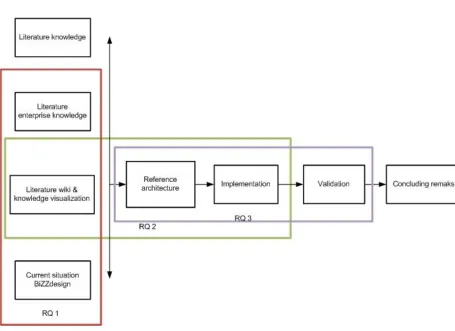
The research will be conducted with steps shown in Figure 1-1. Each research question in previous section will be solved using relevant methodology. The corresponding methodologies can be seen in Table 1-1.
Research question Methodology
What is the knowledge stored in a repository of an organization?
What type of knowledge is stored?
What are the formats of the knowledge stored?
BiZZdesign documentation
and literature research.
How is wiki supporting presentation of enterprise knowledge?
What are the advantages of a wiki?
How can wiki support presentation of enterprise knowledge?
Literature and case studies
What is the design of a system that transfers enterprise knowledge from a repository to a wiki? How to design reference architecture for
visualizing enterprise knowledge?
How to implement a prototype based on the reference architecture?
Implementation of prototype
and literature research,
[image:11.595.116.529.71.169.2]survey.
Table 1-1 Research questions and corresponding methodology
Figure 1-1 Methodology of this research
Research questions 1 will be answered with literature studies and current situation assessment. Research question 2 and 3 will be responded with combination of steps, which is depicted in our methodology in Figure 1-1.
[image:11.595.103.558.203.534.2]2
2.
State of The Art
Existing theories and research that serves as bases and reference for this research covers these domains: knowledge-enterprise knowledge, knowledge visualization, knowledge repositories, and embedding of enterprise knowledge. Current situation of the company that this research is conducted at is added in next section. We describe each domain starting from knowledge in this chapter.
2.1
Knowledge and its conversion
Some knowledge can be expressed with written formats or spoken words. This kind of knowledge is called explicit knowledge. On the other side, knowledge that is rooted in people’s mind and cannot be articulated easily is called tacit knowledge (Hasan & Pfaff, 2006).
On knowledge importance, Nonaka (1991) comes with the argument below: One sure source of lasting competitive advantage is knowledge.
Knowledge can be seen by how it is attached to individual or by its background (i.e. situation) (Stenmark, 2001). Knowledge ranges from specific to general. Specific knowledge is subject-oriented or topic-oriented. Meanwhile, general knowledge is extensive and independent to a certain phenomenon. It is also commonly available in public and tends to be able to be structured easier. Consequently it has more significance in communities of practice or communities of knowledge (Zack, 1999).
Nonaka (1994) proposes four types of knowledge conversion: tacit to tacit (socialization), tacit to explicit (externalization), explicit to explicit (combination), and explicit to tacit (internalization). Socialization deals with relocation of tacit knowledge in an interpersonal direction. Direct interactions with stakeholders inside or outside the organization are important in socialization. Experience and attained skill play an important role in this process.
Communication between groups in an organization is an example of this. Internalization, the last conversion type, is a process of understanding and gripping explicit knowledge into tacit knowledge possessed by a person. Internalization is largely experiential.
In this research, we consider organization and embedding to be prominent and we relate it with externalization and combination from Nonaka (1994). The relation motivates us to study how knowledge and its representation can use the help of IT in its conveyance.
2.2
Enterprise knowledge
Organizations have different ways to discover knowledge. This can include different tools and approaches to examine data in text and numeric format. Knowledge generation from numeric databases is an example of how organizations discover knowledge. Application of knowledge discovery has been used in fields such as security, customer analysis, fraud analysis, and product analysis (O’Leary, 1998).
To gain effectiveness in growth and performance, organizations with knowledge-intensive activities need to share and integrate highly distributed knowledge (Zack, 1999). In distributing, tacit knowledge needs to be turned into explicit to be shared, exchanged, and combined (Nonaka, 1991). To be able to have a competitive performance, organizations need to seek a balance between portions of knowledge made explicit and knowledge left tacit. Outside initiating community, parts of tacit knowledge need to be made explicit. Determining which knowledge to be made explicit relevantly is a challenge towards that balance (Zack, 1999).
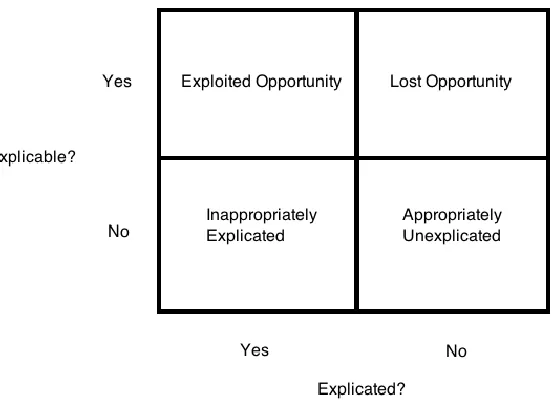
Zack (1999) argues that the process of turning private knowledge to become accessible can cause refusal to accept in certain organizational cultures. Lack of formal model or language to articulate can also cause tacit knowledge to stay unarticulated, which is an example of intellectual restriction. There are four conditions in regard to relation of tacit knowledge and explicit knowledge. In Figure 2-1, explicability of knowledge and connection to opportunity is shown. A lost opportunity means a failure to explicate potentially explicable knowledge. An organization needs to pay attention on ability to articulate certain knowledge to decide whether to articulate certain knowledge or not. This will in turn lead to competitive advantage as a result of a right balance between tacit and explicit knowledge (Zack, 1999).
From the perspective of IS, knowledge is on top of data-information-knowledge hierarchy. In this hierarchy, Hasan & Pfaff (2006) consider information to be significant, prepared data. Meanwhile, knowledge is information that is actionable.
Figure 2-1 Potential explicability of knowledge (Zack, 1999)
Adopting the definition from Firestone (2000), enterprise knowledge management can be defined as management function responsible for regular implementation, selection and evaluation of knowledge strategies that are directed towards creating an environment to support knowledge work within continuous, dynamic circulation of knowledge-related problem-solving interactions.
2.3
Knowledge visualization
Visualization can be defined as cognitive process using human vision system, which has analytical functions and potent information processing capabilities. It has always been a dominant factor in scientific progress. With aid of computers, visualization has become even more capable (Hoogeboom, 2005).
According to Kurfess (2008), visualization is one way of presenting knowledge and it is possibly the most important. Still in the same context, Kurfess also argues that explicit knowledge can be presented almost directly, while tacit knowledge must be regulated. Moving on, Eppler and Burkhard (2004) suggest knowledge visualization as being concerned with:
The use of visual representations to improve the creation and transfer of knowledge between at least two people.
this research. We also consider presentation of knowledge to be closely related to knowledge visualization.
2.4
Knowledge visualization using Wiki
2.4.1 Using Wiki to manage knowledge
[image:16.595.93.528.303.586.2]Gonzalez-Reinhart (2005) divides early wiki use for knowledge management (KM) into three generations. The first generation provides a KM that can be characterized as conventional. This generation starts from Wiki-Wiki in 1995 and until the use of wiki before 2004. The second generation is more intended for users in corporate level that has not switched to wiki, mostly in 2004.
Figure 2-2 Main page of ArchiXL’s wiki (ArchiXL, 2012)
Meanwhile, the third generation emerged around October 2005. A release called Application Wiki was showing functionality exceeding attributes found in previous two generation of wikis. In this third generation, an addition to basic wikis is WYSIWYG editing, allowing users or contributors to edit pages (Gonzalez-Reinhart, 2005).
wiki’s content is composed of parts of IT reference architecture defined by the company. Figure 2-2 shows how a wiki software can handle links and facilitate them using image representation.
Relation between concepts in ArchiXL’s wiki has been handled so that users can browse through related objects. Relations and related objects are clearly shown in the information box (see Figure 2-3).
Figure 2-3 “Fiscaal” as an application service in ArchiXL’s wiki (ArchiXL, 2012)
Moreover, wiki is also a common tool for knowledge management. A research done using two different wiki softwares had shown that wiki facilitates knowledge creation and knowledge sharing, two important aspects of knowledge management (Liang et al., 2009).
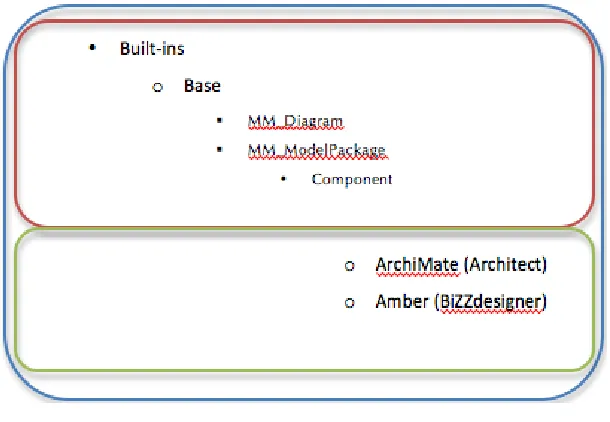
2.4.2 Wiki technologies for knowledge visualization
A page under a certain title in Wikipedia can be written on any subject. McMahon (2008) adds that while there are regulations in order to prevent offensive or profit-oriented contents, wide range of knowledge that can be introduced represents the width inside Wikipedia. Di Iorio and Zacchiroli (2006) examine that authors pay attention to domains in a wiki with previously-assigned structure, even if they do have the liberty to create new contents. Contents placed in wikis indirectly go through a process of checking. This is due to that wiki make it possible for people to collect and present information of importance or interest. Additionally, organizational peers are actually editors that can modify other person’s post. The role of editors will enrich a posting by adding additional information, links, tables, and photos (McMahon, 2008).
In a wiki, taxonomy can have two meanings to users. On one side, it eases navigation. On the other side, users can feel that the wiki is unable to be modified in terms of content structure. Thus, it is a wiki manager’s job to make sure the navigation is easy enough while sending right signal of flexibility (McMahon, 2008).
covering projects, courses, department’s issues, and students’ clubs (Buffa, 2006). Its structure and taxonomy facilitate 4000 pages that are classified into 25 workspaces, showing that taxonomy can be an enabler of knowledge visualization.
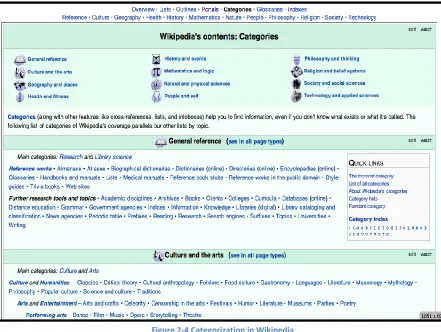
[image:18.595.107.548.287.619.2]In relation to taxonomy, one of other important features of a wiki for knowledge visualization is categorization. In Figure 2-4, an example of wiki technology used for categorizing contents of Wikipedia at the end of the year 2011 is shown. In Wikipedia, contents are divided into twelve: general reference, culture and the arts, geography and places, health and fitness, history and events, mathematics and logic, natural and physical sciences, people and self, philosophy and thinking, religion and belief systems, society and social sciences, and technology and applied sciences.
Figure 2-4 Categorization in Wikipedia
2.4.3 Overview of Wiki software
These following wiki software products are considered the most common example by Louridas (2006) and Ebersbach et al. (2006).
Confluence is a wiki with an ability to provide different spaces in structuring its content. This ability means that it has multi-linked wikis as part of its features, alongside space and page-level security constraints and multiple content searching. Confluence, released in 2004, is one example of proprietary wiki software.
MediaWiki was born as a necessity in the project of Wikipedia in 2002. It facilitates numerous extensibilities, also flexibility enabled by the use of PHP Hypertext Preprocessor (PHP) script.
MoinMoin is another wiki software. Written in Python, this software enables user registration and does not require a database connection. It is supported with a plug-in system for feature augmentation and other functions.
TWiki, which has many plug-ins and features, is the most all-inclusive one. TWiki, created to be a company intranet, is utilized progressively for commercial purposes, due to its significant stature of development. Created in July 1998, it allows easy reporting and access control.
UseModWiki, released initially in 1999, is one of the oldest and the most widely used wiki software. It has had a prominent effect on other wikis’ development. One example of a product of that effect is MediaWiki, whose syntax firmly takes after that of UseModWiki.
2.5
Knowledge Repository
According to Zack (1999), for explicit knowledge to be managed there are four primary resources needed: repositories, refineries, organization roles, and information technology. Information technology infrastructure should be seamless for providing a flow of explicit knowledge through stages of refining process to enable knowledge capture, handling digital objects that points to knowledge unit, presenting content to make it usable in different cases, and reaching relevant needed contents (Zack, 1999).
Repository is defined by Bernstein & Dayal (1994) as a shared, structured set containing information on an enterprise that is mainly about managed artifacts that the enterprise produces or uses. These artifacts include documents, maps, information systems, software and components. Knowledge as an object is composed by two components: structure and content. Zack sees the design of a knowledge repository to be based on those components. Knowledge structure gives the background for contents accumulated inside. This background would be needed to interpret those contents in many different views.
units of knowledge becomes a necessity. These knowledge units have different attributes whose values vary depending on the context and kind of explicit knowledge that is stored. Those units act as base element of the structure; a bundle of content open to manipulation, storage, retrieval, labeling, and indexing. In doing all these, the mentioned schemes are useful because they symbolize conceptual associations, ordered sequences, and/or cause-effect relationship (Zack, 1999).
Explicit organizational knowledge has a span that makes recording relevant knowledge content a challenge to strive for repositories. In order to capture noteworthy and meaningful concepts, the design of a repository should enable sufficient knowledge recording capability. It is a knowledge engineer job to itemize the repository in accordance to those concepts. Moreover, several repositories can be joined together inside a knowledge platform, regardless of the structures of each repository. The structure can be different because type of knowledge or content in each repository can vary. A logical linkage can be made across those repositories with content from each serving as context for explicating other repositories’ content (Zack, 1999).
Dingsoyr and Royrvik (2003) point out that:
In creating a knowledge repository, knowledge is collected, summarized, and integrated across sources.
The repository can either be filled with knowledge by letting workers themselves identify what knowledge has adequate value to be stored in the repository. It can also be done by assigning some people in an organization to scan communication processes to uncover knowledge (van Heijst et al., 1997).
A study has developed a knowledge management system, which includes a repository divided in two parts (Dingsoyr and Royrvik, 2003). The first one stores structured internal knowledge that includes databases for sales and marketing information and employee capability. It also includes examples of documents, templates, software components, procedure information, and research reports. The second one stores informal internal knowledge that includes electronic discussion forums, news and announcement, general review of projects, and technical documents.
2.6
Enterprise knowledge embedding
Repositories can store knowledge using a predefined structure. This structure, however, needs to be customized to set of knowledge that needs to be stored, as section 2.5 described. For enterprise knowledge, possible medium can vary depending on how organizations approach their problems in attempt to solve those problems (Das, 2003). Argote et al. (2003) also underlines the importance of knowledge embedding approach.
Vernadat (2001) mentioned that projecting enterprise knowledge can bring value to the enterprise. Medium of embedding for enterprise knowledge can vary from plant layout model (Berio & Vernadat, 1999), workflow (Goul & Corral, 2007; Kuhn, et al., 2003), business process model, reference model (Kuhn, et al., 2003), database design, data flow diagram, and action diagram (Purvis, 2001). Enterprise modeling in particular deals with depiction and examining automation in the enterprise, including building model that represents activities within an enterprise (Berio & Vernadat, 1999).
Enterprise models are used to help understand specific condition with high intricacy that made it difficult to understand (Ba et al., 1995). They also can assist in performance analysis, explain design environment (Goul & Corral, 2007), and decision support (Ba et al., 1995). Various modeling languages and tools to develop enterprise models exist (Vernadat, 2001).
2.7
Current situation at BiZZdesign
2.7.1 BiZZdesign
Figure 2-5 BiZZdesign tool architecture (BiZZdesign, 2011)
BiZZdesign’s service lines are aligned to the company’s mission: to help organizations govern and change (themselves) effectively using enterprise architecture, business process management and governance supported by methods, tools, consultancy, and training (BiZZdesign, 2012). The enterprise knowledge in BiZZdesign is mostly involved in its software tools and their content portal, InSite. InSite is a viewer of the contents of repository from both Architect and BiZZdesigner, the modeling tools. BiZZdesign’s modeling tools enables creation and/or modification of architecture models and business process models.
2.7.2 BiZZdesign repository
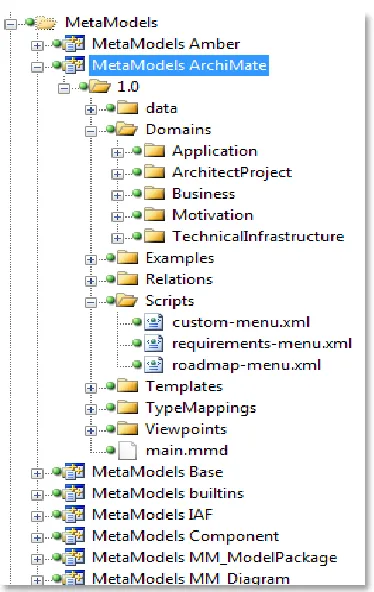
The repository is used with every comprehensive use of modeling tools and the InSite portal. Figure 2-5 shows how BiZZdesign’s tool architecture is structured. Enterprise knowledge contained in business process and architecture models from the two modeling tools are stored in a repository as metamodels. A sample structure can be seen in Figure 2-6. BiZZdesign repository is currently developed to provide services to be used by external applications, changing from currently single-purpose repository client to a repository enable to couple with multiple tools for sharing knowledge. This coupling to multiple tools will be enabled with a service.
Figure 2-6 Sample repository structure (BiZZdesign, 2011)
Figure 2-7 Metamodel hierarchy
BiZZdesign tool architecture is a generic tool framework for graphical modeling tools. This tool architecture is extensible and configurable by model engineers. Main functions are developed as pluggable tool components (BiZZdesign, 2011). Among the technologies used by this tool architecture are Windows GUI front ends (C++), Repository (shared file, relational database), Web application server (Java), and Browser client (Flash).
2.8
Summary
3
3.
Reference
Architecture
for
Enterprise Knowledge Visualization
After reviewing literature from previous chapter, we continue with designing reference architecture to visualize enterprise knowledge. In this chapter, we define the aspects of designing reference architecture for knowledge visualization. We then specify the required components and why they are required in a reference architecture for visualizing enterprise knowledge.
3.1
Preliminaries
In section 2.1, we mentioned that we relate externalization and combination conversion type from Nonaka (1994) to knowledge organization and embedding. Knowledge combination and externalization result in the spread of explicit knowledge within an enterprise. Meanwhile, Zack (1999) argues that explicit and tacit knowledge need to have the right balance in an organization to maintain competitive advantage. Enterprise knowledge is then embedded in a knowledge format. This knowledge format is then visualized with the help of a visualization tool.
3.1.1
Managing enterprise knowledge to be visualizedInteractions and activities in an enterprise defined by Firestone (2000) can have complexities that require the presence of a knowledge management method. Andersson et al. (2004) discuss about integration of business process support (BPS) with knowledge management and come up with three assumptions below.
For the knowledge management to be of use in an organization it should be seamlessly incorporated in everyday business activities, for a business support system to be able to automatically gather and distribute knowledge, both the business and support system should be process-oriented, and important prerequisite for a knowledge management system (KMS) will function in practice is that a majority of the organization staff actually use the system in a major part of their daily work.
2004). Section 1.1 provided definition of management of enterprise architecture that includes regulating and advancing IT support. Knowledge visualization, including managing knowledge to be visualized, is considered part of both processes. Section 2.6 provided description and examples of how enterprise knowledge can be embedded and then, later, stored in a repository. Enterprise knowledge facilitated in this design is that contained in models. Enterprise model is described by Fox and Gruninger (1998) as:
An enterprise model is a computational representation of the structure, activities, processes, information, resources, people, behavior, goals, and constraints of a business, government, or other enterprise. It can be both descriptive and definitional-spanning what is and what should be.
The definition above implies that enterprise model can contain information that is related to interactions and activities in an enterprise. This will be further discussed in subsection 3.2.1.
3.1.2
Visualizing models containing enterprise knowledgeAs discussed in section 2.3, Kurfess (2008) argues that visualization is one way to present knowledge. As a mean capable of visualizing knowledge, wiki has also been discussed in subsections 2.4.1 and 2.4.2. However, in this chapter, the reference architecture designed is not solely oriented to wiki software products. Instead, we believe that any visualization tools intended for models that contain enterprise knowledge should be capable of accessing stored knowledge. As section 2.5 underlined, we consider repository of knowledge to be a generic element that can facilitate storage of enterprise knowledge. It can also have the flexibility to handle knowledge embedding in form of models.
Based on those viewpoints, models are observed. They can consist of objects, relations, texts and more importantly graphical representation, as explanation in section 2.6 implies. These properties are complemented with explanations that can also be enclosed in those models. How those properties can be generated and subsequently visualized will be discussed in section 3.2.
3.2
Enterprise knowledge visualization reference architecture
In previous section, we discussed relation of architecture elements and visualization, and how knowledge management works with visualization. This section will start with definitions of reference architecture. We start with a definition by Bass et al. (2003) who stress on software elements and their functionality:
architecture is the plotting of that functionality onto a system decomposition. The plotting may be (although not necessarily) one to one. A software element may implement part of a function or several functions.
Gallagher (2000) coins another definition with emphasis on domains and instantiation aspects.
A reference architecture is the generalized architecture of several end systems that share one or more common domains. The reference architecture defines the infrastructure common to the end systems and the interfaces of components that will be included in the end systems. The reference architecture is then instantiated to create a software architecture of a specific system. The definition of the reference architecture facilitates deriving and extending new software architectures for classes of systems. A reference architecture, therefore, plays a dual role with regard to specific target software architectures. First, it generalizes and extracts common functions and configurations. Second, it provides a base for instantiating target systems that use that common base more reliably and cost effectively.
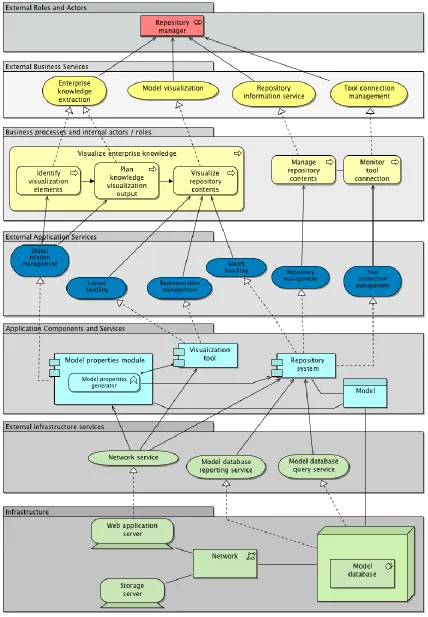
We then define reference architecture for enterprise knowledge visualization as depiction of reference for elements and functionality of architecture components with concern on instantiation for systems carrying out the task of visualizing enterprise knowledge embedded in models.
The reference architecture is designed with ArchiMate, which has an underlying framework that consists of business, application, and technology layers (Iacob et al., 2004). Moreover, components for each layer are identified based on the literature study on enterprise knowledge, knowledge visualization, and knowledge repository. We design this reference architecture with consideration of its quality. The followings are quality goals that this reference architecture should have:
High availability (QG1)
To manage knowledge in an enterprise that is highly dynamic, a repository needs to be ready to be called at anytime. It should have a system that has a high uptime. To achieve this, hardware redundancy and software redundancy as suggested in a case study by Bass et al. (2003) can be chosen as a solution. In an ArchiMate model, this will affect technology layer including infrastructure, external infrastructure services, and application components and services. Software redundancy and hardware redundancy on enterprise knowledge visualization can be achieved by using fault detection, fault recovery, and fault prevention methods mentioned by Bass et al (2003).
Capability to handle and manage models and properties (QG2)
of models.
Not only models, a repository should also be able to manage objects that models can contain. It should be able to give information on specific properties of models. This can include relation between objects, sequences, layers, pointers, etc. Goul and Corral (2007) defines goal of model management as:
The goal of model management is to develop a generic infrastructure that offers an order-of-magnitude productivity improvement to builders of model-driven applications, such as database tools, application design tools, message translators, and customizable commercial applications.
Properties included by models should include graphical representation. A separate function of repository to generate this should be allocated. Graphical representation of models will then be passed to or obtained by visualization tool(s). In order to have both capability to handle models and capability to manage models and properties, the models themselves need to have sufficient definition so that it can be used and presented in different scenarios (Zack, 1999). A method to achieve those is by having specially assigned element of repository for models.
Visualization process discussed in this chapter and used as a base for reference architecture is based on a framework for knowledge visualization suggested by Eppler & Burkhard (2004). Based on that framework, we specify the knowledge type (enterprise knowledge), visualization goal (codifying the knowledge), and visualization format (conceptual diagrams) used in this reference architecture. Eppler and Burkhard define conceptual diagrams as:
Conceptual diagrams, by contrast, are abstract, schematic representations used to explore structural relationships among parts. They help reduce complexity, amplify cognition, explain causal relationship and to structure information. The type of knowledge that is conveyed by conceptual diagrams is analytic and their format is thus highly structured and systematic.
Therefore, repository should provide a graphical representation quality that is sufficient and able to be handled by visualization tools. This leads to the next quality goal: flexibility of the system.
Flexibility (QG3)
visualization symbols based on elements of model. Applicability (QG4)
This reference architecture will need to be applicable in different enterprises and on different repositories. Therefore, modularity of repository system, including its functions and services is important in order to visualize enterprise knowledge and models. Bass et al. (2003) suggest template providing and cautiously handing over responsibilities to modules to achieve this applicability quality goal.
3.2.1 Requirements for repository
Aiming for quality goals of high availability, capability to handle and manage models, flexibility and applicability would mean a generic repository design is needed. This variety of model can include data model, reference model, business process model, and other types of model containing enterprise knowledge. Fox and Gruninger add that from practical point of view enterprise model must be able to correspond to things that are planned, anticipated, and that has occurred in an enterprise. Activities inside an enterprise should be covered by knowledge contained in enterprise models (Fox & Gruninger, 1998).
Repository system is fundamental in our enterprise knowledge visualization reference architecture. In order to produce a generic repository system design to facilitate enterprise knowledge visualization, following requirements related to business domain (van Wasbeek, 2006) are necessary.
Increase system quality (RR1)
A repository should have necessary functions or services that can lead to overall system quality. In practice, a repository can be used by more than one visualization system. Thus, this requirement is closely related to support for system expandability, the next requirement of repository in business domain.
Support for system expandability (RR2)
An enterprise with different activities and interactions is highly open to being expandable. Therefore, it is important to consider a repository design to support expandability in the future. This requirement and increase system quality requirement correspond to applicability quality goal of reference architecture.
Increase system lifecycle (RR3)
Decrease task completion time (RR4)
Explanation in section 2.5 provides arguments to support that repository can help to manage knowledge. Referring to the argument by Nonaka (1991) in section 2.1, management of knowledge will then be crucial to an organization’s competitive advantage. This management of knowledge can thus relate to completion time for finishing projects or tasks. Therefore, a repository needs to be designed with consideration of task completion time. To quality goals of reference architecture, this requirement corresponds with high availability, capability to handle and manage models and its properties, and flexibility.
Van Wasbeek (2006) provided other supporting requirements for repository to manage artifacts that we consider relevant for our reference architecture. A repository capable to provide management for any type of models should enable metadata information addition, provide facilitation on relation between knowledge units, and provide container for model definitions.
Metadata information addition (RR5)
To add metadata information in a model, basic information from where those metadata are obtained has to be understood. Metadata information can be used to identify models and will also be useful for repository search function. This is covered by a literature describing a tool for enterprise modeling by Rospocher et al. (2009). The literature provides explanation of aspects that can be added as metadata information. Rospocher et al. state that enterprise model should describe:
The domain, the processes and the competencies of an enterprise.
Those three properties will be described one by one. Domain of an enterprise covers explanation of business domain that an enterprise is involved in. Operations within an enterprise contain inherent knowledge that should be stored. This knowledge is consisted of conceptualization of connections between units within an enterprise, including information that can be derived from those units. The business domain has a set of underlying constraints and set of working procedure, including which things should be addressed when carrying out certain tasks. This needs to be captured in relations, objects, and concepts of an enterprise model (Rospocher et al., 2009).
A business domain of an organization consists of tasks that are defined or being planned. Process of an enterprise includes steps of tasks that are carried out by previously assigned roles through task assignment breakdown. Sequences or steps of tasks that are carried out also exist in enterprise models. Rospocher et al. address this and mentioned that procedures and outline in a business domain can complement metadata information of enterprise models (Rospocher et al., 2009).
The matter concerning this involvement is related to how capable those people are. In order for organization to fulfill their purpose, its employees need to have certain capability and attitude. Rospocher et al. also add that there is a relation between domain and process information of an enterprise model. They state that this connection is facilitated by information of competency. That kind of metadata information is crucial because it covers skills of a person of group of people and his/her/their level of knowledge to perform a certain assignment. This metadata information is motivated by the fact that an individual or group of people undergoes a learning process in carrying out an assignment of set of tasks (Rospocher et al., 2009).
Those three metadata information can be added to an enterprise model. The level of width and/or depth of that information depend on how an organization would like to have their goals fulfillment breakdown and how detailed an organization want to evaluate their performance. An enterprise model is a medium for those, as the definition from Fox and Gruninger (1998) implies. To the quality goals of reference architecture, this requirement corresponds to capability to handle and manage models and its properties. Relation between knowledge units (RR6)
Zack (1999) states that a sufficient knowledge recording capability is important for a knowledge repository. As the summary enterprise domain from Rospocher et al. underlines, models containing enterprise knowledge can contain relation of knowledge units. Zack adds that these knowledge units have a variety of attribute that reflects the context and the kind of explicit knowledge stored.
Since an organization can store explicit knowledge in many different formats, it is crucial for the repository to have the adaptability and flexibility to be able to take in those different formats. A supporting application or function to validate those formats can also be helpful. For an enterprise, this can provide more orderliness in their knowledge management. For people concerned with repository and its supporting components, this will be beneficial for further possible uses of repository contents.
Orderliness in knowledge storage is also indirectly implied by Dingsoyr and Royrvik (2003) who realizes that knowledge repository gathers its content from collection and with integration from many different sources of knowledge.
An issue of knowledge input process should also be taken into account. Van Heijst et al. (1997) mention two kinds of possible input process. The first is a judgment of adequacy from involved workers on related knowledge and which of those should be stored within a repository. Second approach is selecting knowledge by assigning a group of people that have necessary required knowledge to sort from abundance of knowledge medium formats and gather them.
defining relation. However, an organization needs to make sure workers with related knowledge can allocate a portion of their human resource to be able to sort which knowledge is related to which domain(s). To optimize the first input process, a role to administer knowledge division in respective organizational division should be considered. It would be better if this input process is thoroughly planned, so that workers can have knowledge medium formats that are already sorted or tagged to ease their task of selecting which knowledge to be stored in repository.
The second input process choice requires a separate process for selecting the right group(s) of people. These people need to have comprehensive understanding of the enterprise. This understanding should include not only in depth comprehension on specific domain or group of domain, but also an understanding of how different domains collaborate and assist each other. This kind of understanding is usually present in people with a significant amount of experience in the organization. People who built their career within the organization would make a good candidate.
Another possibility for the second input process choice is to outsource an expert on specific domain or group of knowledge. In choosing the expert(s) to outsource to, a background of repository knowledge can also be taken into consideration. He or she or they might come from a sector that has close relation to that of the organization. A combination between internal personnel and external expert to form a group of people to sort required knowledge is also an option, although this might require them to spend a preliminary time to work with each other.
Overall, in facilitating relation between knowledge units, it is fundamental for a repository to have adaptability, flexibility, orderliness, and relevant choice of input process. These are needed to ensure the repository contain knowledge that will be useful for its further uses and ready for any adjustment in knowledge medium formats in the future. This requirement therefore corresponds with capability to handle models and its properties of the quality goals of reference architecture.
Properly defining relation between knowledge units as an input to repository is prominent for future uses of repository because it will determine the structure of repository. Since a repository needs to provide its contents to application or stakeholders, a relevant structure or set of structures would be needed. An enterprise can be different to other enterprise in the level of complexity of its activities and processes. This level of complexity leads to variety of knowledge and knowledge medium formats (Dingsoyr & Royrvik, 2003). A case of a repository having different structures for different set of stored knowledge is therefore possible.
need to be allocated to administer or manage repository. Because structure decision is prominent, stakeholders need to allocate certain resources to repository design and knowledge medium formats that it contains or will contain. Examples of variety of different knowledge medium formats are provided in section 2.5.
Container for model definition (RR7)
The variety of interactions and activities within an enterprise are purposed for solving problems in an organization. To solve those problems, certain decisions should be made. Definitions from Fox and Gruninger (1998) shows that enterprise models contain set of properties that can aid in making those decisions.
However, those set of properties can be contained in a way that makes decision making more difficult. Along with metadata information, this repository requirement is also important for identification. Difficulties in identifying can lead to decision making constraints and eventually can cost more time and eventually would not be beneficial for an organization.
In order to support the decision making, a repository should contain definition of those properties so that users can understand models better. To do so, a container for model definition should support checking and enclosing of properties. For example, a model can belong to specific organizational body or department and might only be viewable by users with specific privileges.
Time information is also an important part of model definition (Fox & Gruninger, 1998). An organization can run its business better if there is clarity on which models are related to activities in the past, which models are related to current activities, and which models are related to future plans. Related to time information, a proper management of past models can be useful for the management to perform evaluation and plan future activities. Overall, to the quality goals of the reference architecture, this requirement corresponds to capability to handle and manage models and its properties.
Moreover, a generic repository should be independent to any database or server, should be able to include support for inconsistency inspection, should not be difficult to configure, and should support impact analysis (van Wasbeek, 2006).
Independency (RR8)
Repository system in our reference architecture should not be restricted to a specific database or server. It should be able to couple with any kind of server installed on any platform. Format of database should also not be a constraint for future systems basing their implementation on this reference architecture.
change and/or configuration. Expansion of current system and current enterprise scope should also be taken into account. This requirement of independency corresponds to the flexibility and applicability quality goals of the reference architecture.
Support for inconsistency inspection (RR9)
An inconsistency in repository contents can cause them to be unable to be accessed by users or adjacent applications. Although methods of backing up the repository can be taken as an approach to prevent this, it still needs to be complemented with an inconsistency inspection. This requirement corresponds to capability to handle and manage models and its properties and also the quality goal of high availability.
A reason for this because backing up, however automatic it would be, will still consume an amount of time. In enterprises with little or zero fault tolerance, this can lead to organizations not being able to provide service properly and/or not being able to conduct their business to their tightly measured plan and budget. Thus, inconsistency inspection is also necessary for repository system.
Ease of configuration (RR10)
A repository system can have complexities behind its interface. A certain set of procedures and packaging of functions need to be conducted before a repository system is installed. It is prominent so that people assigned with the task to implement or configure the repository can have their job performance enhanced. The procedures and packaging can also improve applicability of overall reference architecture (fourth quality goal).
Furthermore, an ease of configuration can help the job of person or group of people assigned to manage the repository. The argument from Dingsoyr and Royrvik (2003) that implies on variety of knowledge medium formats also corroborate the need for configuration ease. Enterprise with various knowledge medium formats can use the help of reference architecture with a repository system that is easy to set up.
Ease of configuration can also cover structures of repository. A generic repository design should be able to facilitate various knowledge storage structures. Therefore, a configuration interface to help choose relevant repository structure is important in this reference architecture.
Support for analysis on change request (RR11)
In order to fulfill this requirement, a repository should include a list of requirements for a change to happen. Not only that, it should also store lists of which files, which components of systems and which items that can be affected by a change request. For overall quality goal of reference architecture, this requirement corresponds to capability to handle models and its properties.
To complement previous requirements, a generic repository should also be able to provide interface for repository manager to edit its contents and configurations. It should also provide support for documentation of models (van Wasbeek, 2006).
Support for documentation (RR12)
As the example in section 2.4 provides, a wiki implementation example in ArchiXL shows the presence of documentation. Fulfillment of this requirement will enhance the performance of user related to visualization tool use. Although documentation of models can be simple, it is still important to facilitate the use of symbols, as Bobrik et al. (2006) underline.
A documentation can be embedded as properties of models (Rospocher et al. 2009). This documentation is a mean to understand a model better. As mentioned in container for model definition requirement, users that have certain tasks related to making decision can benefit from the fulfillment of this requirement. Therefore, this requirement also supports the second quality goal of the reference architecture (capability to handle and manage models and its properties).
Editing interface (RR13)
To manage its contents, there should be a role assigned specifically. This role will have special privileges to handle models and its properties. Therefore, it corresponds with the second quality goal of reference architecture.
Models, including its properties, come from different sources of knowledge across an organization, as Dingsoyr and Royrvik (2003) point out. For that reason, the role assigned to edit the repository also need to have a comprehensive understanding, at least in regard to structure or set of structures of the repository.
Quality goals
Corresponding repository requirements
High availability (QG1) RR3, RR4, RR9 Capability to handle and manage models
and its properties (QG2) RR4, RR5, RR6, RR7, RR9, RR11, RR12, RR13
Flexibility (QG3) RR3, RR4, RR8
Applicability (QG4) RR1, RR2, RR3, RR8, RR10
Symbol Requirement name RR1 Increase system quality
RR2 Support for system expandability RR3 Increase system lifecycle
RR4 Decrease task completion time RR5 Metadata information addition RR6 Relation between knowledge units RR7 Container for model definition RR8 Independency
RR9 Support for inconsistency inspection RR10 Ease of configuration
RR11 Support for analysis on change request RR12 Support for documentation
RR13 Editing interface
Table 3-2 Requirements for repository
Table 3-1 provides a mapping of quality goals and corresponding repository requirements. List of repository requirements can be found in Table 3-2.
3.2.2 Business layer of reference architecture
Figure 3-1 Enterprise knowledge visualization reference architecture
capability to handle and manage models and enterprise knowledge extraction corresponds to flexibility quality goal.
Requirements for repository include those that require a role to manage or administer the repository system. Among them are inconsistency checking, repository ease of configuration, and analysis of change request. Thus, we define repository manager role for the external actors and roles on the business layer and model visualization, enterprise knowledge extraction, tool connection management and repository information service as external business services.
To be able to monitor repository, its connection with tools, and overall visualization process, there needs to be separate relevant business processes. We believe that in any visualization system of enterprise knowledge, elements of visualization need to be identified first before visualization output is planned and the actual visualization is conducted. Both identification of visualization elements and planning of its output are realized by enterprise knowledge extraction business service, which is a component summarizing the bridge between repository and visualization process.
For the repository and visualization tool to be able to be monitored by repository manager, business processes related to repository content and tool connection are needed. Visualization process, manage repository content and monitor tool connection should be included as business processes in business layer.
3.2.3 Application layer of reference architecture
In section 2.5, we discussed knowledge repository and one of its necessity is that it needs to have sufficient knowledge recording capability. To support the need, the repository must be able to store object relation and representation. Both require different instances from overall management of the repository, because we assume that object relations are stored with different method than representations and that object relation will relate directly to navigation system in the visualization system, as Andersson et al. (2004) suggest. Therefore, repository management, object relation management, and representation management are identified as required external application services. Those three application services correspond with capability to handle and manage models and its properties, our second quality goal for the reference architecture.
Repository management application service and manage repository contents business process will play their part for privilege-related concerns. To make sure conceptual diagrams in models are visualized properly, components layout handing and search handling are needed as external application services of application layer. Repository system should also be able to manage tool connection.
requirements for repository (see Table 3-2) are necessary to be fulfilled to optimize repository system’s functionality.
In this reference architecture, visualization tool and model properties module as application components, realized by layout handling and representation management, and object relation management respectively have assignment relation. A data object of Model is needed as resource for generation of enterprise knowledge to be visualized. This data object is associated with repository system and model properties module and should also be part of this reference architecture’s application layer.
3.2.4 Technology layer of reference architecture
Repository system will need solid database infrastructure and services. For external infrastructure services, both database reporting service and database query service will be needed to support repository system in that case. Additionally, a network service would be used by both visualization tool and repository system for network-related access. All three of network service, database reporting service, and database query service are used by repository system application component. In some systems basing its architecture on this reference architecture, network service might also have possibility to be used by either visualization tool application component or model properties module application component, or both. Therefore, we depict its relation to those two components.
Meanwhile, for infrastructures, web application server (to provide the necessary input for especially repository system), model database, and network are the main infrastructure components for this reference architecture. Model database has association with Model data objects, which is essential for generating enterprise knowledge. Also, a storage server is needed for flexibility of web application server and possibility to connect with separate model databases.
3.3
Discussion and summary
A reference architecture comprised of component for knowledge visualization was provided in this chapter, supported with arguments from related literature. We started the discussion in this section by asking whether the reference architecture built indeed can be referred. We do this mainly with looking into elements and their functionality, so that future systems can be built to visualize enterprise knowledge.
Regardless of size of organization that has a repository storing enterprise knowledge, we assume that there has to be a repository manager role. The supporting business processes realizes four main business services that repository manager should at least address in achieving the task of visualizing enterprise knowledge. Those business services matches with quality goals defined in section 3.2.
system built based on our reference architecture will require to have specially assigned part of repository to handle models if that repository does not only contain models.
Domokos & Varro (2002) also briefly discuss the role of layouter and renderer components. The mentioned components were thus translated in the components for business layer and application layer, namely identify visualization elements and knowledge visualization output planning business processes, metamodel generator and image generator applications, and layout management and representation management application services.
Moreover, application services, application components, and infrastructures follow the concepts from our four quality goals. We consider technology layer (application components, external infrastructure services, and infrastructure) in particular to suffice the need to give facilities for system with repository and model with objects, relation and, graphical representation. The consideration is based on findings from Yan et al. (2009).
Overall, quality goals and tactics has been defined and chosen for this reference architecture. These four quality goals and their respective tactics to achieve them can be taken as approach for future systems basing their implementation on this reference architecture. A set of requirement for repository system, a key component in this reference architecture, have also been described and mapped to the quality goals.
4
4.
Enterprise Knowledge Visualization at
BiZZdesign
In this chapter, an implementation of enterprise knowledge visualization reference architecture is described. The implementation, carried out at BiZZdesign, is based on the reference architecture provided in chapter 3.
4.1
Wiki and MediaWiki
Interest in wiki-based systems is growing steadily since Wikipedia was founded. The number of wiki software is growing and not only in commercial organizations but also in the software engineering community (Farenhorst & van Vliet, 2008).
In this research, we use MediaWiki due to its extensibility (Boulain et al., 2006) and ability to handle external knowledge formats. MediaWiki enables those with series of extensions made by developers. Updates of architectural views or any models and/or contents are handled by an external service, so that MediaWiki can focus on handling visualization of enterprise knowledge. Generally, there are extensions for enterprise knowledge extraction. These extensions can accommodate various external knowledge formats and bridge them to pages in MediaWiki. One of them is capable to extract XML tags and will be part of implementation section (section 4.3).
MediaWiki is different from a structured wiki. A structured wiki aims at combining wiki with advantage of a database application. MediaWiki’s shortage on that feature is balanced with simplicity and look and feel (Louridas, 2006).
4.2
Business process models and architecture models
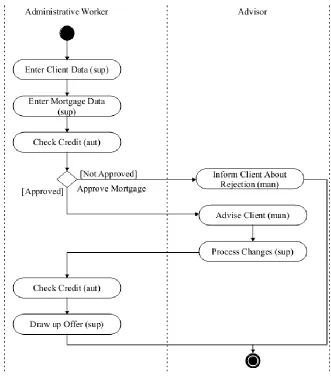
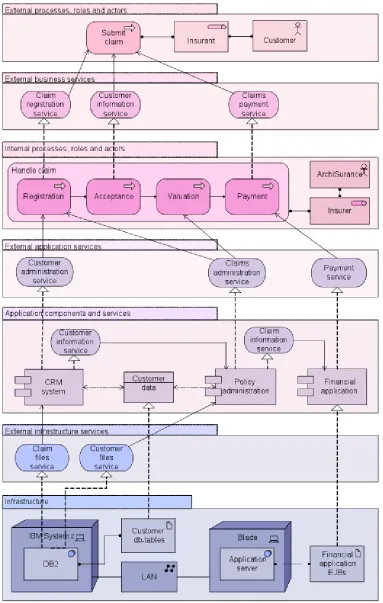
[image:42.595.154.485.164.540.2]Models can aid us i