Perceptions in the virtual storyteller
Hans ten Brinke April 16, 2014
Graduation committee dr. M. Theune prof. dr. D.K.J. Heylen
The Virtual Storyteller is a multi-agent system that can generate stories. It does this by simulating the actions of autonomous characters in a virtual storyworld. The characters can select goals that have been provided by a storyworld author and will plan actions to achieve those goals. My work on the Virtual Storyteller aims to make the characters more believable by limiting their perceptions to what they should realistically be able to see.
This thesis describes a set of visibility rules that the character agent applies to incoming percep-tions. The agent still keeps a complete and accurate version of the storyworld in memory which the agent can use on an actor level. The character however uses an incomplete and possibly incorrect version of the storyworld to make plans. To help the character make plans in case it does not have all the required knowledge available in-character, an assumption operator is intro-duced. This allows the character to make assumptions about the location of objects to prevent it from deciding that a goal is no longer achievable. Using these assumptions, the character can search for objects in the storyworld.
When I was looking for a subject for my Master Thesis, the Virtual Storyteller was one of the first projects to catch my attention. Since then I have done two research topics as well as this thesis on the subject and I am still not out of ideas. Making a computer write stories is an amazing experience in itself. But besides storytelling, I am also interested in games and especially in games with great stories that also give the player a lot of freedom. How cool would it be to play a game in which every decision you make has an impact on the story? You could play it many times without getting bored by the story.
Now the story of my studies at the University of Twente is finally coming to an end. I would like to take this opportunity to thank the people that have made my work possible. First of all, thanks go to my parents, who gave me the chance to study in the first place. I would also like to thank my girlfriend’s parents who have been very supportive along the way and most importantly during the final stretch.
A lot of gratitude goes to my graduation comittee. First of all, Mari¨et Theune, thank you for all the support and the endless patience. Jeroen Linssen, thank you for filling the spot left by Ivo, your advice on my thesis has been very helpful. Thanks also to Dirk Heylen for guiding me in the right direction during the early stages of the project and for providing support when it was needed. To all members of the Storytelling group, past and present I would also like to say thanks, it has been an inspiring experience. Especially I want to thank Ivo Swartjes for his great work on the Virtual Storyteller and his useful advice and technical support.
Finally I would like to thank some people who have helped me to see my studies through to the end, Kees Ketting, Frank Droste and Fata Proost. Your support has been invaluable and without you I might not have made it this far.
Most important of all, I would like to thank my girlfriend, Ilse Slag, for sticking with me through good times and bad times. We’ve been through a lot together, but now we can close this chapter with a happy end and look forward to the next part of our story.
1 Introduction 7
1.1 The Virtual Storyteller . . . 7
1.2 The problem . . . 8
1.3 Goal . . . 10
1.4 Research methodology . . . 10
1.5 Thesis outline . . . 11
2 Perceptions in the Virtual Storyteller 12 2.1 Overview . . . 12
2.2 The storyworld . . . 12
2.2.1 The Ontology . . . 12
2.2.2 Operators . . . 14
2.2.3 Perceptions . . . 15
2.3 The characters . . . 15
2.3.1 The planner . . . 16
2.3.2 Goal selection . . . 17
2.4 The plot agent . . . 18
2.4.1 Fabula . . . 19
2.5 Hiding perceptions . . . 19
2.5.1 Senses . . . 20
2.5.2 Visibility . . . 20
2.5.3 Obviousness . . . 21
2.5.4 Interpretation . . . 22
2.5.5 Planning . . . 23
3.1 The Oz Project . . . 24
3.2 FearNot! . . . 25
3.3 Character-based storytelling . . . 26
3.4 Game AI literature . . . 26
3.5 Utility for the VST . . . 27
3.5.1 Planning . . . 27
3.5.2 Assumptions . . . 28
3.5.3 Character versus actor . . . 28
3.6 Conclusion . . . 29
4 A new perception system 31 4.1 The knowledge base . . . 31
4.2 Visibility rules . . . 32
4.3 First test of the visibility rules . . . 34
4.4 An Improved InterpretationManager . . . 35
4.5 The planner and OWL reasoning module . . . 36
4.6 Initial character knowledge . . . 38
4.7 Second test . . . 39
4.8 Conclusion . . . 39
5 Making assumptions 41 5.1 The problem . . . 41
5.2 Preconditions . . . 42
5.3 Internal element operators . . . 43
5.4 Conclusion . . . 44
6 Authoring a story 46 6.1 Expanding the story . . . 46
6.1.1 New goals . . . 46
6.1.4 Guiding the story . . . 47
6.2 Authoring . . . 48
6.2.1 Goals . . . 48
6.2.2 Reactive actions . . . 50
6.3 Evaluation . . . 51
6.4 Conclusion . . . 56
7 Conclusions & Recommendations 57 7.1 Conclusions . . . 57
7.2 Recommendations for future work . . . 58
7.2.1 Different senses . . . 58
7.2.2 Obviousness . . . 59
7.2.3 Certainty . . . 59
7.2.4 Narration . . . 59
7.2.5 Actor goals . . . 59
7.2.6 OOC fabula . . . 60
7.2.7 Anticipating actions . . . 60
7.2.8 Final thoughts . . . 61
Appendices 62 Appendix A Separating knowledge 63 A.1 RDF load functions . . . 63
A.2 Incoming knowledge . . . 63
A.3 Visibility rules . . . 64
Appendix B Debugging tools 66
Appendix C The storyworld 68
1
Introduction
Stories exist in many forms, from oral narrative to written literature, classical theatre and mod-ern movies, comic books and videogames. For as long as language has existed, man has been able to tell a wide variety of stories. Computers have become an increasingly popular medium for storytelling, be it as the main medium in for instance games and weblogs, as an alternative for traditional media as ebooks or as part of cross-media projects. But is it also possible for a computer to create interesting stories?
Several systems have been designed over the years that allow a computer to generate stories. One of these systems is under development at the University of Twente. It is called the Virtual Storyteller (VST) and it started out as a master project by Sander Faas in 2002 [Faa02]. The Virtual Storyteller is a multi-agent framework designed to generate and present stories. Its structure is inspired by an Improvisational Theatre form called Typewriter. In a Typewriter scene there are several actors, one of whom is assigned the role of narrator and director. The director is respon-sible for setting the overall structure of the story by providing a location and adding characters and the other actors make use of improvisation to fill in the plot.
The Virtual Storyteller uses an approach similar to Typewriter. A plot agent takes on the role of director and is responsible for the setting, assigning the roles and keeping track of the plot. One or more character agents try to fill in the plot by making plans to fulfill their goals or reacting to situations that arise. The original project was expanded upon by students and their advisors in smaller as well as larger projects. In 2006 the basic architecture of the Virtual Storyteller was redesigned to its current structure [Swa06, Swa10]. This thesis describes my contribution to the VST. In this chapter, the Virtual Storyteller will be briefly introduced. After that the goal of my work on the VST is explained and finally some initial research questions will be formulated.
1.1
The Virtual Storyteller
drag-ging them from one location to another. Available actions can be chosen from a list. My work however has been done on the non-interactive version. This thesis will focus on the simulation part of the storyteller, which is described in more detail in Chapter 2.
Figure 1.1: Global architecture of the Virtual Storyteller [Swa10]
1.2
The problem
On the surface, two stories may appear different. The characters, places and events in one story are different from those in the other. However, below the surface, stories share many common elements, patterns and structures. Aristotle describes a story as a complete causal chain of events. It has a beginning for which the cause is not important to the story, a middle for which the events have a cause within the story and which themselves are the cause for further events within the story and an end that causes no further events relevant to the story[Ari07]. Freytag describes a dramatic structure of five parts also known as Freytag’s pyramid: exposition, rising action, climax, falling action, and d´enouement [Fre00]. Campbell describes a pattern found in many stories from around the world, the monomyth, also referred to as the hero’s journey [Cam49]. On a smaller scale, authors also often apply common techniques to move a story forward, to drive the characters to action. Although put into very different contexts, many situations in stories have very similar underlying structures. A lot of examples of such conventions, also referred to as tropes, can be found on TV Tropes [tvt].
The stories generated by the VST still have much room for improvement. Many types of elements that are commonly used in stories by human authors are currently beyond the VST’s capabilities. One of the problems that is preventing many of these elements from being used is the fact that characters in the VST are omniscient. Almost all human authored stories, whether they are fairy-tales or complex literary works, rely on the fact that characters are not omniscient. A person is missing, an object stolen, a character tries to reach his goals by deception, there are many ele-ments where false or missing information is key to a plot.
wolf wants to take advantage of this and eventually manages to trick the little goats into letting him in by disguising his paws and his voice. Only one of the goats escapes by hiding inside a grandfather clock. Neither the wolf’s disguise or the little goat’s hiding spot would have worked if the characters were omniscient.
Vladimir Propp made an analysis of Russian Folk Tales by breaking them down into morphemes. He discovered 31 recurring functions that make up the narrative structure of these stories. Trick-ery is one of them, but many of the others also rely on deception or misinterpretation [Pro68]. They would not work if the characters knew everything. If a false hero would attempt to claim the hero’s prize or marry the princess, no-one would believe his lies. A character would not fall into a trap if he knew about it. Stories in the detective genre are based on the fact that the detec-tive does not know who committed the crime. The problem of omniscient characters has to be solved in order for a number of other concepts to work:
• Deception
• Character believability
• Emotions
• Social interactions
What a character has or has not perceived plays a key role in their behaviour. While writing one of the first story generation systems, TALE-SPIN [Mee77], Meehan already encountered the problem of perception. He overlooked the concept of noticing when writing the inference rules for his program and the following mis-spun tale resulted:
Henry Ant was thirsty. He walked over to the river bank where his good friend Bill Bird was sitting. Henry slipped and fell in the river. He was unable to call for help. He drowned.
Bill bird was meant to rescue his friend, but Henry could not ask for help because the rules of the program prevented talking when in water. Bill did not notice his friend falling in the river, he would only respond if he was asked a direct question. The problem with the VST is the opposite, characters notice everything even when they should not. The main reason for this is the way agents perceive the storyworld. At the beginning of the simulation all characters have a full and accurate model of the storyworld in memory, and as actions are performed, the results of those actions are broadcast to all characters. Thus there is no way to keep information hidden from a character. If a character tried to deceive another, the other would immediately see through this. Apart from making deception impossible, omniscient characters are also less believable. If a character on the other end of the storyworld is moving the object the hero is after, the hero will instantly know this. Instead of going to where he should believe the object to be, he will alter his plans and go toward the object’s new location.
Character emotions are currently not being simulated by the VST, but in future versions they are expected to play an important role in the characters’ decision making process. Character omni-science will be a considerable problem there as well. Characters will form emotions based on perceptions and beliefs. Imagine a storyworld with several characters all doing different things at the same time. If they had to respond emotionally to every event in the world, instead of just those that they can see, it would become confusing to the audience.
each other. Before we can think of implementing social interactions, we will need to create an environment in which they are useful. This will be required in order to implement concepts like trust and betrayal or the possibility of eavesdropping which often occur in stories.
1.3
Goal
The goal of this project is to allow the character’s knowledge of the world to differ from the actual state of the world. The perception system is altered to allow the results of actions to be hidden from characters. It should be possible for a character to run into a situation that is dif-ferent from what he believes to be true. At the same time, the characters have a role as actor for which they require complete and correct information about the world. To facilitate this we separate the agent’s knowledge into actor knowledge and character knowledge. In the resulting system characters will have to find ways to discover the missing information. The ultimate goal is to improve the stories the VST generates. In order to evaluate whether the system can gen-erate interesting stories with non-omniscient characters, a new story domain is created. So the following is needed:
• Perception system
• Separate knowledge bases for actor and character
• Reasoning skills to help characters find missing information
• Story domain for testing
• Evaluation
The project time has to be divided between these activities. Because of this, the reasoning abilities will only get limited attention and the resulting behaviour will not be very sophisticated. Social interactions could also be considered to allow characters to share their beliefs with each other, but this would require additional social reasoning skills. Researching and implementing those would likely be enough for a separate thesis so they will be outside the scope of this project. To compensate for this, the evaluation stories will use relatively simple characters that will not require complex behaviour. During the evaluation we will also try to deceive the characters. De-ception can take many forms, some more complicated than others. Most of them require that the characters have insight into each other’s behaviour to work effectively. This includes knowledge about what the intended victim knows, their decision-making process, plans and goals. Much of this is currently missing from the VST so we can’t implement complex forms of deception yet. Therefore, the new perception system will be tested with relatively simple forms of deception such as hiding objects and giving false information about the location of objects.
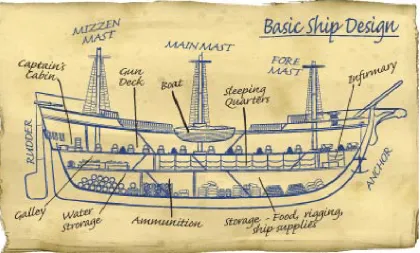
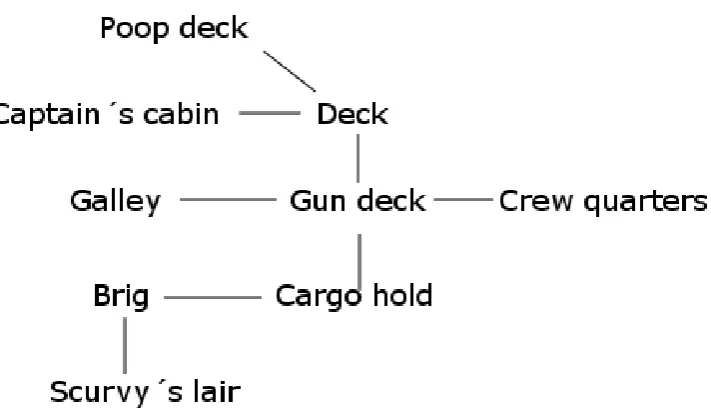
One of the existing story domains, the pirate domain, will be adapted to form the new story-world. The original pirate characters are replaced with simple cartoonish characters. A rat has invaded the pirate ship and is stealing food supplies. A few pirate insults later the name Scurvy the Bilge Rat is born. In order to get rid of Scurvy, a cat named O’Malley is brought on board. The story will follow these two as they try to find objects or one another, or hide from the other using the perception system. The domain is partly inspired by cartoons like Tom and Jerry, mixed in with the existing pirate domain.
1.4
Research methodology
Research question 1a: How can perceptions be blocked for characters?
Research question 1b: How can the character be made to deal with missing informa-tion?
In order to answer these questions we first have to investigate how perceptions originate and are handled by the system. During the design of the plot agent it was argued that the plot agent should have ways to steer the direction of the plot, one of which was the ability to influence character perceptions. This resulted in the implementation of a perception manager which could eventually be improved to block perceptions from characters. However, since this original de-sign, the VST has evolved. One of the first questions will be whether the plot agent is the right candidate to decide what characters can see.
Character agents have been given a dual role as actor and character and now have more respon-sibility for the plot. In order to support both roles, the agent will require two sets of knowledge: an accurate one for the actor and a more believable incomplete one for the character. The char-acter agent’s knowledge base will be divided into in-charchar-acter knowledge and out-of-charchar-acter knowledge. This results in a system where perceptions can be hidden from characters and de-ception becomes possible without depriving the actor of the accurate and complete knowledge it requires for out-of-character behaviour such as justifying goals and using framing operators. However, as expected another consequence is that characters can get stuck when they no longer know where an object is. In the old system this would mean the object doesn’t exist. In the new system, the object may exist without the character knowing. The character will either have to find out where it is or fail to make a plan. A method has to be devised to allow the character to search for the missing information in a believable way. Methodical searching of the storyworld may give a solution to the planning problem but won’t nescessarily improve the resulting story. We have looked at other storytelling systems similar to the VST. Do they deal with issues of per-ception or deper-ception at all? And if so, how do they handle planning when a character no longer has all the knowledge required to make a plan? The systems that were examined that deal with this problem all use a very different method of planning. Changing the planner entirely is not an option so a different solution has to be found. We will allow characters to make assumptions about the missing facts. These assumptions don’t always have to lead straight to the intended target, otherwise the situation would be no better than before the new perception system. The assumptions can be used to give a character false information and steer the plot in more excit-ing directions by makexcit-ing use of the actor’s knowledge. This way the plannexcit-ing problem can be solved and at the same time it gives an opportunity to steer the story towards a more interesting outcome.
1.5
Thesis outline
2
Perceptions in the Virtual Storyteller
This chapter will give a more detailed look at the Virtual Storyteller and how it generates stories, giving special attention to the role of perceptions in the system. The second half of this chap-ter discusses how changing the perception system will affect the rest of the system, and where changes need to be made.
2.1
Overview
As mentioned in Chapter 1, the Virtual Storyteller is a multi-agent framework that generates stories by simulation. The plot generation is split up between three parties, as shown in Figure 1.1. The character agents represent the characters of the story. They are given goals to achieve in order to advance the plot and they will try to make plans to reach these goals. The world agent is responsible for keeping track of the world as it is as well as any operators that change it. The plot agent was originally intended to take the role of the director from the typewriter scene. In this capacity it has the ability to influence the direction of the plot by rejecting requests from the characters or blocking perceptions. In practice, these options are not being used as all actions are approved and perceptions are always passed on to every character. Currently the most important task of the plot agent is to record the plot, building the fabula layer that the narrator can transform into a story [Swa06]. A more detailed explanation of each of the agents follows below.
The agentlauncher is the central interface that can be used to select the story domain and launch the JADE (Java Agent DEvelopment) [jad] agent platform on which the agents run. After select-ing a story domain and startselect-ing a plot and world agent, the plot agent takes control. Character agents can be started manually, or will be started by the plot agent when required. The story gen-eration takes place in discrete turns, initiated by clicking the next turn button on the plot agent or activating an automated loop. The knowledge base of the agents makes use of the SWI Prolog Semantic Web Library [Wie], using JPL to connect the Java layer to the Prolog layer.
2.2
The storyworld
The world agent is responsible for keeping track of the environment in which the story takes place. Each agent has a knowledge base which includes a personal copy of the storyworld. How-ever, the world agent has the central copy and is the only one that can directly execute operators on it. The other agents can only request operators and wait for the results.
2.2.1
The Ontology
further on in this chapter. It also contains a basic description of the different action types, though the actual implementation of the actions is done in prolog, using schemas as explained below. Figure 2.1 shows part of the ontology for the Scurvy domain, including the core and fabula on-tologies it builds on. Using the facts from these onon-tologies, a storyworld instance is created using “Turtle” or Terse RDF Triple language. This instance represents the state of the storyworld at any time during the story. It is built up of RDF triples of the form: (subject, predicate, object). Some examples of RDF-triples:
( scs : s c u r v y rdf : t y p e scs : rat ) \\ ( scs : c h e e s e 0 1 rdf : t y p e scs : f o o d ) \\ ( scs : s c u r v y swc : has scs : c h e e s e 0 1 ) \\
[image:16.595.165.432.366.735.2]This signifies that Scurvy is a rat, the objectcheese01is a type of food and Scurvy is holding cheese01. In this examplecheese01is an identifier, but it doesn’t have to be an actual piece of cheese since the ontology does not go into enough detail to list cheese as a subclass of food. Note the different prefixes used in subject, predicate and object. The prefix determines which ontology the object is from: scs for the scurvy setting, rdf for the resource description format, swc for storyworld core.
2.2.2
Operators
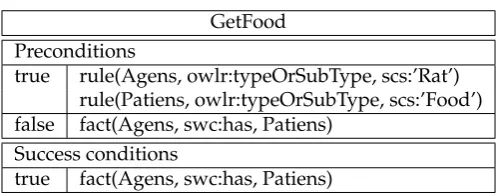
In order to reach their goals, characters have to be able to change the world. The actions and events are defined as STRIPS-like operators [FN72]. Every action has preconditions, effects and a duration. Preconditions are represented as a list of conditions. Each condition has a truth value and a list of subconditions. The truth value signifies whether the subconditions must be true or false in order for the condition to hold. A subcondition may query a fact or fabula triple, or apply a rule. Rules are written in prolog to define more complex relations. For example, the typeorsubtype rule is an OWL rule that can be used to determine if an object is of a certain class or a sublass thereof. The preconditions of a dress action use this rule to determine whether the object to be worn is a subtype of thewearableproducttype. Thewearableproducttype is defined in the core ontology and subtypes can then be defined in a storyworld setting ontology, which contains domain-specific knowledge. A fairytale setting may define a crown as awearableproduct, in a pirate setting it could be an eyepatch.
Dress Preconditions
true rule(Agens, knowsAction, Dress)
rule(Patiens, typeOrSubType, WearableProduct) fact(Agens, has, Patiens)
Effects
true fact(Agens, isWearing, Patiens) false fact(Agens, has, Patiens)
The effects of an operator specify lists of triples that become true or false upon sucessful exe-cution of the operator. The world agent keeps track of all operators that have been scheduled for execution. Upon starting an operator the preconditions must be fulfilled or the operator is cancelled. For operators with a duration, i.e. actions and events, the preconditions must hold for the duration or the operator will fail. For instance when a character wants to walk from one area to the next, a precondition is that the path must not be blocked. If for some reason the path becomes blocked before the duration is over, the action is canceled before any effects are applied. If not, the effects are applied and the character is removed from the starting area and added to the destination area. Events are similar to actions, they can make physical changes to the world and they have a duration. Unlike actions however, events are not directly performed by characters al-though they may result from character actions and they may be used in plans. Take for instance a pirate character Billy Bones who has a goal that his enemy’s ship is destroyed. He has no actions to perform that directly destroy the ship. He can however plan an action to fire a cannon at the ship, followed by an event in which the ship sinks, causing it to be destroyed. The event has a precondition that a cannon has been fired at the ship. Billy cannot execute the event himself, he will have to request the plot agent to perform it. The latter can then decide whether to accept or deny the request, although as mentioned earlier, in practice the plot agent always accepts these requests [Swa06].
Sink Preconditions
true rule(Agens, typeOrSubType, Ship)
rule(Instrument, typeOrSubType, Cannon) fact(Instrument, shotAt, Agens)
Effects
true fact(Agens, sunkBy, Instrument)
reduce this impact, the VST makes use of a technique called late commitment [ST09]. Instead of completely defining the entire setting at the start of the story, parts of it are filled in as needed when the story progresses. For this purpose, framing operators were introduced. They have a very similar structure to actions and events, however they are interpreted differently. The effects of a framing operator establish a fact as though it had been that way since the story started. Therefore a framing operator has no duration and characters do not react to the effects. In the eyes of the character nothing has happened, the world was always like this. Characters can use framing operators for two purposes. If a character has no goal and no possible goals left to choose from, he can justify a goal by using a framing operator to fulfill an open precondition of that goal. For instance, if a goal specifies a character needs to be the captain of a ship to adopt that goal and there is no captain specified for the ship yet in the story, a framing operator can be used to make someone captain, after which they can adopt the goal. If a character can no longer find a plan to reach his current goal he can use a framing operator to change the setting so that a plan becomes possible. For example if a character wants to kill another character but has no weapon, they can use a framing operator to add a weapon to the storyworld. Special care has to be taken when authoring these framing operators to prevent introducing inconsistencies with the story so far.
2.2.3
Perceptions
The world agent is responsible for keeping track of all operators that have been scheduled for execution. Every turn, the world agent checks the list of scheduled operators for any that have completed their duration. If the preconditions still hold, the action was succesful and the effects are applied, otherwise the action failed. This is where character perceptions originate. The results are sent to the plot agent which will process them and turn them into perceptions to be distributed to the characters.
When the plot agent receives an operator result from the world agent, it is sent to the perception manager, which checks whether the action was finished and if so registers the operator and effects in its operator history. This history is processed each turn to determine for each character which operators that character still has to be informed of. Whenever it finds such an operator, the effects are converted into RDF-triples, which are then turned into perception objects and sent to the character. The awareness map is updated to reflect that the perception has been sent to that character so that it is not sent again later. No checks are made whether the character would logically be able to see the action or event.
Once a character receives a perception it is sent to the interpretation module. This module pro-cesses incoming perceptions and setting changes. The RDF-triples contained in the perception are stored in the character’s personal copy of the storyworld. Fabula-elements for the perception and the beliefs that follow from it are added to the character’s episodic memory. A reinterpretation step follows, during which a character might derive additional beliefs from the initial percep-tion. For instance, seeing a character who is lying on the deck might be a reason to interpret that character is dead. However no rules for reinterpretation have been implemented yet so for now only the initial beliefs are returned. In fact, agents don’t need to reinterpret any beliefs as they already know everything about the storyworld through the perceptions they receive. If there was an action or event that caused the character to die, everyone would have received a perception of this. This will change once perceptions can be blocked.
2.3
The characters
task of ensuring a well-structured plot. More recent work however has pointed out that coupling autonomous characters with the guidance of a drama manager is problematic [ST09]. Therefore, some of the responsibility for the plot has been shifted to the character agents. This corresponds to the ideas of improvisational theatre, where the characters share responsibility for the plot but none of them can directly control the outcome of the story. The character agent is given two roles: the character in the story (in-character, IC) as well as the actor that plays this character (out-of-character, OOC). The framing operators mentioned earlier are an example of out-of-character behaviour. Figure 2.2 shows a global view of the character agent. The character process as shown in the image has actually been extended to an actor process, but the basic principle remains the same. The interpretation module was introduced in the previous section. After it has processed all perceptions for that turn, the actor process selects what action to perform. Reactive behaviour takes precedence over planned behaviour. The reactive process handles immediate reactions to the character’s surroundings by triggering rules, e.g. when someone greets you, you greet back. The deliberative process is tasked with handling planned behaviour. It appraises the current sit-uation and selects which goal to act upon. Then it copes with the sitsit-uation by making a plan to achieve the goal and selecting an executable action from that plan.
2.3.1
The planner
[image:19.595.108.512.508.712.2]The deliberative process makes use of a partial order planner to choose actions that will achieve the character’s goal. It creates a basic plan consisting of a start step which is the current situation, and a final step which is the desired situation. It then recursively chooses either operators or pre-vious plan steps that fulfill open preconditions in the plan, or the start step if it already fulfills the preconditions. Causal links are added between each step and the precondition it fulfills. Order-ing constraints ensure the correct order of execution and threat resolution ensures that the new step does not break any causal links by removing effects that are needed further on in the plan. This is repeated until all preconditions are fulfilled. The planner can insert IC operators (normal character actions) as well as OOC operators (events the character did not intend to happen such as a storm that blows his ship off course, or framing operators) into a plan. When choosing an operator to insert, existing plan steps and new IC operators are considered before OOC opera-tors. The planner will explore all possible plans consisting of a given maximum number of steps, starting at 1, and increase the maximum only if no plan can be found.
Figure 2.2: Architecture of the character agent [Aut]
operators. A character may not perform IC operators solely to fulfill the preconditions of an OOC operator. The character should have no knowledge of OOC behaviour and should not be trying to assist the actor unless it does so with an IC motivation. For example, there are two characters who hate each other. One of them decides he wants to kill the other, but he has no weapon. There is a framing operator which says a rapier can be added to the world, but only for a pirate. So the character signs up to become a pirate, then frames a rapier. Once he frames the rapier, it is treated as if he always had it. So there was no apparent motivation for him to become a pirate. If there already was another IC reason for him to sign up to be a pirate, it would be fine. In that case, the action will be added as a plan step for that reason and can then be used. If there is no such reason then the only other option would be to use a framing operator that said the character had also been a pirate all along. Therefore, when fulfilling an open precondition of an OOC operator, only other OOC operators or existing plan steps may be used. A second problem is that framing operators may introduce inconsistencies. For example, the hero is trying to get past a guard, and is not allowed to have a sword, so as not to arouse suspicion. Further on in the plan, the hero needs a sword after all, but since there is none, he frames one. Now a contradiction arises, because if he frames the sword, he always had it, so he would also have had it when he was walking past the guard. The effects of the framing operator contradict the preconditions of a planned action. When this happens, the framing operator should always be executed first. Further steps can then be planned to lift the contradiction. To ensure this, a causal link is added between the start step and each effect of a framing operator. The POP threat resolution will then order the steps correctly. In the example, the hero would for instance frame the sword at the start of the plan, then hide it to get past the guard and retrieve it later.
2.3.2
Goal selection
Aside from planning to reach the current goal, the character also needs to select the next goal from its desires. A goal selection module is presented in [TROdAH04] but this is currently out-dated. During my work on the VST, a new goal selection model was created [Bra10]. Since it was completed well after my work had started, not much has been done to incorporate it into the additions I made to the system. The new goal selection module makes use of character traits and interests that provide positive or negative motivation towards selecting a goal. Goals are defined in schemas similar to actions. There are preconditions to adopt the goal and success and failure conditions that determine when the goal has been achieved or can no longer be achieved. These schemas can now be annotated with lists of positive and negative motivations which influence the choice a character makes when presented with multiple possible goals. A dramatic choice element is introduced that links the character’s choice to its motivations in the fabula, so that the characters’ motivations can be communicated to the audience. When one goal associated with a dramatic choice is completed, the alternatives are dropped. For example, a pirate character is ordered by his captain to dump the treasure overboard because the ship is being chased. The dramatic choice has two goals for the pirate to choose from: to dump the treasure as ordered, or to defy the orders. The first choice has positive motivations for loyalty and self preservation but negative motivations for greed, the second has the exact opposite motivations. The pirate has personality traits that assign a strength to each of these motivations, and by subtracting the value of the negative motivations from the value of the positive motivations, the importance of each choice for the pirate is calculated and the most important is chosen [Bra10].
should complete the cooking goal before switching. If on the other hand she was taking a pack of flour from the cupboard and accidentally dropped it on the floor, this event could trigger a goal to clean up the mess she made.
When a character no longer has any goals to adopt, because the preconditions of those goals aren’t met, a goal can be justified. To justify a goal, the planner is used as well. However, since justification of a goal is an OOC process, the planner can only use OOC operators when justifying a goal. Executing the resulting plan will change the story setting so that the goal can be adopted. For instance if a goal to find a treasure exists, but no treasure has been placed yet, a framing operator could be used to put a treasure on a remote island [ST09].
2.4
The plot agent
[image:21.595.108.503.357.636.2]In the first version of the VST, there was no plot agent and no world agent. The director agent was responsible for directing the plot, recording the events of the story so far and keeping track of the world. In [Swa06] this functionality was divided between the plot agent and the world agent. It was argued that the plot agent should have ways of understanding the emerging story and controlling its direction. As mentioned earlier in this chapter, some of this responsibility has shifted to the character agents, but the plot agent still plays a central role. Figure 2.3 shows a global view of the plot agent.
Figure 2.3: Global architecture of the plot agent [Swa10]
stories consist of just one thread, but recent work has allowed the introduction of secondary conflicts [Tom09].
2.4.1
Fabula
[image:22.595.104.503.351.572.2]One of the main tasks of the plot agent is to record the plot. It uses a fabula model to do this. It records a network of causal relations between seven types of elements. Setting elements are aspects of the storyworld. Actions and events cause changes in the storyworld. Goals are what drives characters to these actions, and outcomes relate to the success or failure to achieve these goals. Perceptions are what a character sees of the world. Internal elements are what goes on inside a character, such as beliefs and emotions. These elements are connected by four types of causal relations. Physical and psychological causality represent causes that are unintentional, whereas motivation is an intentional cause. Enablement is a relation in which one element makes another element possible, the effects of the cause overlap with the preconditions for the result. Figure 2.4 shows the possible connections between each of the element types.
Figure 2.4: Fabula model [ST08]
Pieces of fabula are built as characters receive perceptions, form beliefs, take on goals and execute actions. These pieces are sent to the plot agent, where the fabula builder assembles them into its fabula graph. The narrator can use this graph to determine what elements of the fabula are relevant to the story and turn them into text [Swa06, ST08, Swa10].
2.5
Hiding perceptions
2.5.1
Senses
If we want to hide perceptions from characters, the first question that rises is how to decide what a character can perceive. Perception is the process of consciously registering a sensory stimulus. The traditional five senses are sight, hearing, smell, touch and taste, although there are others depending on the definition of what constitutes a sense. Animals sometimes have senses that are unlike any human sense, for instance the ability in some birds to detect the Earth’s magnetic field to help them navigate. Beyond that, characters in stories sometimes have their own amaz-ing powers of perception. For instance, Spiderman has his “spidey sense” which warns him of impending danger. Another example is clairvoyance, which is sometimes used as a plot device to give a character information they could not have gotten otherwise. Currently the perceptions in the VST do not trigger a particular sense. They contain facts about values of properties that are changed by an operator. As they are all passed on to the characters, there is no need to distin-guish between senses. If we want to block a perception for a character, it will be because none of the senses could have believably registered the fact for that character. If multiple senses are im-plemented, then each property will have to be linked to one or more senses which it may trigger. This will be required because each sense will have a different method to determine whether it has been triggered. Where a visible change in the world may be perceived a lot later than the action that caused it, a sound made by that action is transient and can only be perceived at the time it is made. Some properties may not be linked to any sense, which means that the property can not be directly perceived and must be deduced from other facts. For instance, when emotions are intro-duced, a character may not always show his (true) emotions externally. A character should not be able to perceive another character’s internal emotional state directly, unless we have a character with empathic powers (the ability to sense another’s emotions), a plot device sometimes used in science fiction or fantasy.
The main reasons for implementing multiple senses would be to increase believability and to in-crease the amount of information a character can use. For this project, the main goal of blocking perceptions is to be able to hide information from characters. For this reason, we will start by implementing only the sense of sight. Expandability is a key feature of the VST, so an approach will be used that can easily be expanded with other senses. As storyworlds become larger and more complex, other senses or sources of information will get a more important role. Characters will need more ways to fill in the things they don’t know. Hearing will become more impor-tant when social interactions are implemented. The Interactive Storyteller already has sounds although they were added mostly for entertaining the audience; nevertheless it may be interest-ing if the characters can hear them and respond appropriately. As shown by the examples, the traditional five senses may sometimes not be enough for a story, which is another good argument for an expandable approach. New and possibly strange senses can be added when a story needs them.
2.5.2
Visibility
consid-ered a path in some domains. In a modern storyworld, a security camera could be used as a link to provide a view of a remote location or possibly even a past event. This means that even on the level of a single sense, the system should be expandable, allowing multiple, possibly domain specific methods by which a character could receive a perception. Prolog rules can be used to describe the multiple methods by which a character can receive a perception. New clauses can be added to a rule when new methods of perception are added to the domain.
Aside from determining perceptions for a character, perception rules could also be used in pre-conditions. Take for instance an action to shoot another character. In the old situation, to prevent characters from shooting each other from the other side of the storyworld, you would have to add a precondition that the characters are at the same location. Using perception rules, this pre-condition could be replaced by a rule that determines you can only shoot what you can see.1
Different rules could also be set up for the other senses. That way the smell of food could be used as a precondition for a “become hungry” event, which would allow a character to justify a goal to eat something. Or the rule could be used straight away as a precondition for the goal: “If I can smell food, I want to eat it.”
2.5.3
Obviousness
In the previous section, we have only looked at the necessary conditions for having a perception. This prevents a character from seeing anything the character could not possibly have seen. We may also want to be able to hide perceptions a character could have seen. Sometimes, a char-acter might not notice something that is happening right under their nose. For instance, a thief might be picking the hero’s pockets. If the thief is always instantly discovered, this will not add much excitement to the storyline. This means it should be possible for characters to not notice something that they could have seen. Some events however are nearly impossible not to notice. For instance it would be unlikely for a pirate on deck to miss the fact that the ship is sinking. This suggests that it should be possible to determine the obviousness of a perception. Part of the solution could be to add an obviousness attribute to action and event schemas. However some effects of an action might be more obvious than others. For sound effects there may be a loud-ness to determine how likely it is for someone to hear it, for sight, the size of an object would be important. Other factors also play a role, such as what the target of the action is. Is the character who would receive the perception personally involved in the action? And what is he focused on himself? If the character who had his pocket picked tries to pay for something in a shop, he does not realise that his wallet is gone. His action will fail, but the world agent does not explain why it failed. If nothing changes the obviousness of the fact that the wallet is missing there is no new trigger for the related perception. The character would get stuck trying to get his wallet without ever knowing why he can’t.
The second problem is how to make the decision whether or not to miss a perception. A ran-dom choice would increase the number of possible stories that can be generated, but it would make it difficult to reproduce the outcome of a particular story, making iterative authoring of a storyworld a lot more difficult.
Another idea would be to base the decision on what the result of the perception would be for the story by determining what the emotional result would be for the character. Emotions are an important part of stories, and while the characters in the VST have no emotional system yet, in the future such a system might be used to help guide the story as well as improve the believability of the characters. Such guidance could be accomplished by making a pre-appraisal of the results of a perception before deciding what to do with it. By comparing the emotional result of the perception to how we want the character to feel at that moment in the story, the decision could
1This would cause strange behaviour in a world where cameras allow visibility of remote places. If that were the case,
be made for the character to overlook something. For instance it could guide the hero character to be more open to perceptions that would cause negative emotions if the story is working up to a climax. Instead of adding randomness, this would actually contribute to the story.
At a more direct level, the actor could be given more influence over the character’s behaviour. The actor might be given some goals that describe those things the author would like to see in the story aside from the goals that the characters are given. If a perception were to threaten such a goal, that would be a reason to let the character miss it. Implementing actor goals on top of the new perception system would be too much work for this project. Without a reasonable method to make the decision, the obviousness attribute would lose its purpose. Because of this, the ob-viousness attribute was left for future work so that more time could be spent on the planning problem described further on. Characters will see everything they could possibly see in this im-plementation. However, the idea of allowing the actor to guide the story towards an interesting outcome will be explored more in the next chapter.
2.5.4
Interpretation
As shown in paragraph 2.2.3, perceptions only happen at the time an action has been completed. This will be a problem when characters no longer receive all perceptions immediately. If a char-acter enters a place where something has changed while he was not around to witness it, the character will not know about the change, nor will he be informed of it. The character may then repeatedly attempt an action which is possible according to his beliefs while in the actual world it isn’t, resulting in an endless loop of failed actions. Characters will need a way to detect these changes.
Previously characters would also see all effects of an operator. For instance, a walk action has effects that the character is at the new location and no longer at the old location. If O’Malley believes Scurvy is on the Deck, yet now he sees him in the cargo hold, the belief that Scurvy is on the deck will have to be dropped. If only part of the effects of an operator are visible, the other effects should also be deduced. In this case, Scurvy can not be in two places at once, so even though O’Malley can not see the deck, he should still deduce that Scurvy is no longer there because he can’t be in two places at once.
If we replace Scurvy in the above example with a generic object, O’Malley might assume the object he sees is a different object than the one he saw before and the original is still where he thought it was. This would be difficult to implement because all objects in the VST have unique identifiers. Making O’Malley assume it is a different object with an identifier that does not exist will be tricky, and from a storytelling perspective, the use of this scenario is dubious. The other way around, making O’Malley think it is the original object when it is not, is a more useful scenario as it can have an impact on the story when for instance the object turns out to be fake. This could be achieved by using inference operators.
never had). This problem will not be solved in this project. In the current implementation, when an object is visible for a character, all triples concerning that object will also be visible, including the ones that are no longer true. For now we will ignore the fact that not all properties are visual as the other senses will not yet be implemented. All properties will use the rules for visibility.
2.5.5
Planning
The planner currently makes use of the fact that characters are omniscient. They know everything there is to know about the world. Because of this, if there is a possible plan in the current world state, it will be found. If the planner no longer has all the facts at its disposal when it starts planning, it may not be able to find a complete plan, which will result in a failed goal. This is different from the way a real person would plan. For instance, Jack is hungry. He decides he wants something to eat. When he leaves home to go to the supermarket he may not even know exactly what he is going to eat, let alone where exactly he is going to find it. He’s not going to simply ignore his hunger and abandon his goal to eat. He just starts executing his plan to go to the store and fills in details about the rest of the plan later. He may find a nice product that is on offer and think of other ingredients to add. He will then start looking for those, or ask an employee where to find them. This does not mean that the characters in the VST should be programmed to behave exactly the same way, but a way will have to be found for characters to behave believably despite the fact that they don’t have all the information. Chapter 3 will give an overview of a number of other storytelling systems and investigate how they cope with or avoid this problem.
2.6
Conclusion
In this chapter we have explained the importance of perceptions in the VST. They are a key element in the chain between performing actions and updating beliefs to reflect the results of those actions. Because of that they also play a central role in the making and executing of plans. If perceptions are hidden from characters, this will directly affect the beliefs characters have. Indirectly, it will have an effect on what emotions a character will receive when emotions are implemented. Furthermore, having false beliefs or missing beliefs will influence what plans a character can and will make.
3
Perception and deception in other storytelling systems
In this chapter we will describe a number of other storytelling systems, making note of how they handle perceptions and planning. This provides some helpful ideas on how to deal with the problem of planning with incomplete information. This is not a complete overview of automated story generation systems because for many of them there is no clear description of how percep-tions are handled. As a related field of research where similar problems may be handled, game AI literature provides some insights into the problem as well.
3.1
The Oz Project
The Oz Project at Carnegie Mellon developed technologies for building believable agents for interactive storytelling. It has been discontinued as of December 2002, however former members of the project still work on similar projects. In [BLR92] the Tok agent architecture is summarized and a particular agent, Lyotard, is described. Tok is an agent architecture developed for use in an Oz world. Lyotard was designed to pass as a believable house cat in an Oz simulation, and displays goal-directed behaviour, reactivity, emotion and social behaviour. The Tok agent is divided into several subsystems, most notably Hap, Em and the sensory routines and integrated sense model. Hap handles reactive and goal-directed behaviour, while Em concerns itself with the character’s emotions and social relations. The sensory routines collect sensory information which is then merged into the integrated sense model (ISM), which keeps track of the agent’s knowledge of the current state of the world. This world is implemented as an object oriented simulation in which agents can perform actions by invoking methods on appropriate sets of objects. Objects are connected to each other by topological relations.
active plan tree (APT), which expands and contracts as goals or plans succeed or fail. Goals in the APT have success tests, expressions which are evaluated to test whether the goal has been reached. Plans have context conditions to test whether a plan can still succeed. After receiving sensory information, Hap modifies its active plan tree according to these tests. Information about the outcomes is sent to Em, which uses this to generate emotions based on the OCC model for emotions [OCC88].
3.2
FearNot!
[image:28.595.105.499.304.583.2]FearNot! is an emergent drama system designed as an educational tool to teach children how to deal with bullying. In a typical FearNot! simulation, the user is shown a scene in which a character gets bullied, after which the user can give the victim advice on how to deal with the situation. The scene is then played again with the user’s input. It is very important for the user to feel empathy with the characters, most notably the victim. Therefore the project focuses on creating believable characters. The architecture of a FearNot agent is shown in Figure 3.1.
Figure 3.1: Architecture of a FearNot! character agent [ADP06]
The reactive layer of appraisal uses a set of rules to generate emotions. Each rule has an event that triggers it and the OCC appraisal values that are affected by that event, e.g. praiseworthiness, desirability for others. The deliberative layer appraises events in relation to the character’s goals. Emotion potentials of hope and fear are generated for every plan in memory, using the chance of success as well as the importance of success or failure. The resulting emotion is biased by the character’s personality. The stronger emotion is used to guide planning.
The coping mechanism is similarly divided into reactive and deliberative components. The reac-tive layer uses a set of action rules. The agent’s mental state is compared to that list and the rule triggered by the most intense emotion is chosen. If multiple matches come up the most specific one is chosen. The deliberative coping process first selects which of the agent’s goals to attend to by picking the ones that generate the strongest emotions. Once a goal is chosen the most appro-priate existing plan is selected or a new one is made, and brought into focus. This triggers the prospect based emotions: hope, fear and inter-goal fear. The last is fear that this plan threatens an interest goal, a state the character tries to maintain or avoid, e.g. a goal not to get hurt. An action is chosen and the cycle repeats.
3.3
Character-based storytelling
Another Interactive Storytelling system is presented in [CCM02]. The system makes stories in the sitcom genre, inspired by the television sitcom Friends. The stories it generates revolve around the main character Ross asking Rachel out on a date. The story is presented to the user through the Unreal 3d engine, which lets the user navigate the storyworld as a spectator. Additionally the user can interfere with the story by stealing objects from the world or by giving the charac-ters advice through speech recognition. The system uses a character-based approach to the story, similar to the emergent approach used in the VST. The main plot results from the Hierarchical Task Network planner that defines how goals are decomposed into subgoals and possible plans to achieve them. At the bottom of these plan trees are terminal actions with preconditions sim-ilar to those in the VST. The variety of resulting stories is dependent on the interaction between the different characters’ plans which differ due to random placement of characters at the start of the story. The preconditions for a terminal action may not hold, due to the activities of another character or user interference, causing action failure. In such a case the agent tries to repair the plan using action repair or situational reasoning. Action repair tries to restore the preconditions for the original action. For instance if Monica’s presence in the room is preventing Ross from reading Rachel’s diary he may wait for Monica to leave and continue his plan afterwards. Situ-ated reasoning tries to respond appropriately to the current situation while trying to achieve a specific resulting state and avoiding undesirable results. In the above example, Ross could try to influence Monica to leave in order to continue his plan. This combines situated reasoning, deal-ing with the situation of Monica in the room, with action repair, restordeal-ing the precondition for the intended action. The paper doesn’t specify whether an agent can find an object that has been moved or how it would do this. When the plan fails due to an object being stolen by the user, the agent will find the next applicable plan in its HTN and try that instead. Like the Oz system, this puts a lot of the creativity in the plan author’s hands.
3.4
Game AI literature
Aside from dedicated storytelling systems, other fields of research were also examined. One closely related field is that of computer games. They also try to convey stories to the user in an interactive manner, using virtual characters in a virtual world. How are the non-player charac-ters in computer games controlled? How do they perceive the world around them? Are they omniscient or do they only act on what they can see?
their goals are. Virtual participants should only perceive those parts of the world they can realis-tically perceive. Actors on the other hand should be omniscient. However, an actor should still be aware of the realistic bounds of his perception to remain believable. Virtual participants should only be allowed to communicate in a realistic manner, using a common language and following rules of proximity. Virtual actors don’t need to adhere to such rules and can use additional means of communication hidden from the audience. Virtual participants only try to achieve the goals a normal human would pursue. Virtual actors should on the other hand appear to be trying to achieve those goals, while pursuing additional meta-goals that will increase the entertainment value for the user by trying to achieve a certain effect in the audience’s mind. To be able to pur-sue such meta-goals, a virtual actor needs additional knowledge about how or when to elicit a certain response from the audience.
Another interesting article about the development of AI for opponents in computer games de-scribes the concept of believable stupidity [Wes09]. In many games, a computer opponent has a vast advantage over a human player by the amount of calculations it can make. It could be evened out by reducing the amount of calculations the AI is allowed to make but this can result in the AI making incredibly stupid mistakes a human player would never make. A proposed alternative is to program the AI to set up situations that the player can exploit while still play-ing to the height of its ability in most cases. For instance an opponent in a chess game can be programmed to make a mistake that costs it a piece. After putting itself at a disadvantage, the AI continues to try and win the game. Lid´en describes how opponents in a shooter game may be programmed to deliberately miss on the first shot, giving the player time to react as opposed to killing the player without warning. At the same time, the shots may be aimed at particular elements in the environment that will explode in a dramatic manner and provide an even more tense experience for the player[Lid04]. The important part is that the goal of the AI should not be to win but to provide an interesting game to the player.
3.5
Utility for the VST
3.5.1
Planning
The perception system used by Oz is quite versatile and enables some of the possibilities we would like to have in the VST. It allows for hiding information from agents as well as misin-terpreting perceptions. Agents have an incomplete and possibly inaccurate view of the world, which makes it possible to deceive them. But how does the agent deal with the planning prob-lem if he has an incomplete world perspective? This is one of the main probprob-lems the VST will encounter. An advantage Hap has over the planner used in the VST is that it doesn’t have to make plans, only test which ones are applicable. This places a considerable responsibility in the hands of the author of the plan libraries. The agents are limited in their behaviour to what the author has given them. Also as the storyworlds get a bit larger and more complex, writing plan libraries will be a considerable amount of extra work. The plan library can be used to author very specific behaviour but prevents the agents from coming up with radically new behaviour. The same problem applies to the HTN system used by Cavazza’s system. Emergent behaviour is one of the reasons a partial order planner was chosen for the VST [Kru07]. Scrapping the partial order planner and making a new one is not really an option for this project as it would be enough work to write a separate thesis.
has a number of strategies to find food. He can try the most likely place, his bowl, he can meow for attention or he can try a place where he remembers seeing food. He assumes that by executing one of these behaviours, he will find the location of the food, fulfilling the preconditions of the eat action. The partial order planner used by the VST does not make use of decompositions, only primitive actions.
3.5.2
Assumptions
What might be possible for the VST is to allow the planner to make assumptions about the loca-tion of an object similar to how Lyotard assumes he will find food in the most likely place. If a character has any belief about the location of an object, the planner would be able to make a plan that can be executed. It may turn out the food is not there, but if this is the case, new assumptions can be made. Unlike planning systems in other application domains, occasional plan failure is not a big problem in a storytelling context. Characters in stories regularly run into situations that don’t turn out exactly as planned. How they deal with the problem is often an important part of the story. A key question will be how to make those assumptions believable, and addition-ally, how they could be used to steer the story in an interesting direction. One of the things the Oz project does is to use past knowledge in combination with current sensory information. The agents in the VST have an episodic memory which stores all past beliefs, perceptions, goals and actions. Up to now, not much was done with this since the current world knowledge was always correct and up to date. But when current knowledge no longer suffices, past beliefs can be used to provide useful information on where to look.
As mentioned, the perception system of FearNot is not very helpful for this project due to the sin-gle location settings it uses. Currently, VST characters don’t have an emotional system. Once they do, perceptions will play a central role in it. Getting too many perceptions simultaneously will cause too many emotions which may lead to characters that appear inconsistent. As suggested in 2.5.3 an emotion system could also be used to influence perceptions.
Both FearNot and Character-based Storytelling allow for user interactions and suggestions. Hav-ing the user interact with the characters might be an option to assist with the plannHav-ing problem. It brings to mind the concept of a Dutch childrens tv show “De film van ome Willem” in which a cast of actors plays out a story in front of a live studio audience. The characters will regularly turn towards the audience to ask them a question or to tell them not to betray a secret. In the interactive version of the VST a similar method could be used to have the user make suggestions to the characters instead of directly controlling the characters actions, to achieve a less direct form of control. For instance if O’Malley asks the user where Scurvy is, the user could then click on a location to make O’Malley look there. This can’t be done in the current implementation however as the interactive interface was made after this project was already well underway.
3.5.3
Character versus actor
to split actor knowledge and character knowledge into separate knowledge bases. By doing this the actor’s knowledge can be used to guide the character and perform OOC behaviour. At the same time the character’s limited knowledge base can be used to improve believability. Instead of reducing the agent’s knowledge, it will be increased. If this separation is made then the plot agent will have to keep sending perceptions to all the actors to keep their knowledge up to date. In that case it may be best to leave it up to the actor to decide what perceptions to pass on to the character, since the actor will know what the character should be able to see.
Like opponents in a computer game the goal of the actors in the VST should not be to reach their character’s goal, but to create an interesting story. In the words of John Lennon: “Life is what happens to you while you’re busy making other plans.” This goes for characters in stories as well. Stories are not so much about characters reaching goals but about the conflicts they come across while trying to reach those goals. If the characters have only their goals to guide them, they will not seek out conflict because it is not asked of them and it would only impede on reaching their goals. Characters that have directly opposing goals may still get in each other’s way. But a character will not take a wrong turn and walk into a trap. A storyworld author may provide all the elements required for a conflict, but if those elements don’t come together in the story, there will be no conflict. Similar to the explosive elements in a shooter environment, a storyworld may have opportunities for events that, while interesting for the audience, are not in the interest of any of the characters’ goals. If the actor knows about these elements, he can direct the character towards them, instead of directly towards the character’s goal. At a moment when a character no longer knows where to go, the actor has a perfect opportunity to steer the character towards conflict without limiting the character’s autonomy. Of course the story will still not be interesting if it is not believable so the actor will have to keep in mind what the character does know. However, by making the actor direct the character in a false direction, the character can be steered towards the conflict and be forced to deal with it. Previously, deceiving characters in such a manner would not be possible because they would know the truth and choose the easiest and shortest plan. By ensuring such direction only takes place when the character does not know exactly where to go, the chances of forcing the character into incoherent behaviour should be minimal.
It can be argued that guiding the characters towards conflict would reduce the emergent nature of the story by forcing it in a particular direction, but if this means that fewer uninteresting choices are made, that is not really a problem. Eventually the agent will discover the mistake and emergent behaviour will take over again to deal with the situation. If the actor has more options for conflicts to choose from, then it will add a different source for emergence, story goals instead of character goals. Additionally, an author would not put a lot of time writing possibilities for conflict in a storyworld to find out they don’t take place because the opportunities never arise. In most stories a character has to make such a mistake to even create the basis for a story. Imagine a horror film in which the main character makes the wise and completely believable decision not to enter the creepy looking house. It would be a very short film. The audience has to suspend their disbelief about the main character’s mistake to enter the building in order for an entertaining story to begin. Similarly, the audience should accept the fact that a character “accidentally” walks straight into a conflict if the conflict makes for an entertaining story. Whether the resulting story truly will be more interesting depends on many other factors, including the creativity of the author of the storyworld. But by allowing the characters to be directed towards the authored conflicts, an important step will be made.
3.6
Conclusion
other existing operators making it easy to integrate with the system. It will allow a character to make assumptions about missing facts by making use of past knowledge which is stored in a character’s episodic memory. Even though the information provided by the operator may be false, it will allow characters to plan with it and continue trying to achieve their goals instead of giving up.
![Figure 1.1: Global architecture of the Virtual Storyteller [Swa10]](https://thumb-us.123doks.com/thumbv2/123dok_us/9857186.486914/11.595.88.514.156.415/figure-global-architecture-virtual-storyteller-swa.webp)

![Figure 2.2: Architecture of the character agent [Aut]](https://thumb-us.123doks.com/thumbv2/123dok_us/9857186.486914/19.595.108.512.508.712/figure-architecture-of-the-character-agent-aut.webp)
![Figure 2.3: Global architecture of the plot agent [Swa10]](https://thumb-us.123doks.com/thumbv2/123dok_us/9857186.486914/21.595.108.503.357.636/figure-global-architecture-plot-agent-swa.webp)
![Figure 2.4: Fabula model [ST08]](https://thumb-us.123doks.com/thumbv2/123dok_us/9857186.486914/22.595.104.503.351.572/figure-fabula-model-st.webp)
![Figure 3.1: Architecture of a FearNot! character agent [ADP06]](https://thumb-us.123doks.com/thumbv2/123dok_us/9857186.486914/28.595.105.499.304.583/figure-architecture-fearnot-character-agent-adp.webp)