On joint diagonalization of cumulant matrices for
independent component analysis of MRS and EEG
signals.
Laurent Albera, Amar Kachenoura, Fabrice Wendling, Lotfi Senhadji, Isabelle
Merlet
To cite this version:
Laurent Albera, Amar Kachenoura, Fabrice Wendling, Lotfi Senhadji, Isabelle Merlet. On joint
diagonalization of cumulant matrices for independent component analysis of MRS and EEG
signals.. Engineering in Medicine and Biology Society (EMBC), 2010 Annual International
Conference of the IEEE, Aug 2010, Buenos Aires, Argentina. IEEE, 2010, pp.1902-1905, 2010,
<10.1109/IEMBS.2010.5627334>.
<inserm-00540489>
HAL Id: inserm-00540489
http://www.hal.inserm.fr/inserm-00540489
HAL
is a multi-disciplinary open access
archive for the deposit and dissemination of
sci-entific research documents, whether they are
pub-lished or not.
The documents may come from
teaching and research institutions in France or
abroad, or from public or private research centers.
L’archive ouverte pluridisciplinaire
HAL
, est
destin´
ee au d´
epˆ
ot et `
a la diffusion de documents
scientifiques de niveau recherche, publi´
es ou non,
´
emanant des ´
etablissements d’enseignement et de
recherche fran¸
cais ou ´
etrangers, des laboratoires
publics ou priv´
es.
On joint diagonalization of cumulant matrices for independent
component analysis of MRS and EEG signals
Laurent Albera, Amar Kachenoura, Fabrice Wendling, Lotfi Senhadji and Isabelle Merlet
Abstract— An extension of the original implementation of JADE, named eJADE(1) hereafter, was proposed in 2001 to perform independent component analysis for any combination of statistical orders greater than or equal to three. More precisely, eJADE(1) relies on the joint diagonalization of a set of several cumulant matrices corresponding to different matrix slices of one or several higher order cumulant tensors. An efficient way, without lose of statistical information, of reducing the number of third and fourth order cumulant matrices to be jointly diagonalized is proposed in this paper. The resulting approach, named eJADE(2)3,4, can be interpreted as an improvement of the eJADE(1)3,4 method. A performance comparison with classical methods is conducted in the context of MRS and EEG signals showing the good behavior of our technique.
I. INTRODUCTION
Independent Component Analysis (ICA) has lately raised great interest in numerous applications including telecom-munications, audio, or biomedical engineering [1], [9]–[11], [17], [19]. For instance, Hu et al. [9] proposed to use ICA for identification and removal of the reference signal con-tribution from intracranial ElectroEncephaloGraphy (EEG) recorded with a scalp reference signal. They showed that such an approach gave better results than bipolar or average common reference EEG montages. In fact ICA aims at extracting the sources i) based on their mutual independence and ii) from the sole observation of the mixtures recorded by electrodes.
Comon originally proposed to maximize contrast functions (simply called contrasts) derived from Higher Order (HO) cumulants of the data in order to perform ICA [5]. This led to the famous CoM2 method using Fourth Order (FO) cumulants. Another famous ICA technique method appeared at the same period, proposed by Cardoso and Souloumiac [3]. The latter, named JADE(1)4 hereafter, maximizes a novel FO contrast by means of the joint diagonalization of a set of several cumulant matrices corresponding to different matrix slices of the FO cumulant tensor. A second implementation, called JADE(2)4 hereafter, was also given aiming at reducing the number of matrices to be jointly diagonalized without loss of statistical information. This requires to compute the principal eigenvectors of the symmetric square unfolding matrix, named quadricovariance, of the whole FO cumulant tensor. The idea of combining HO cumulants of different or-ders was originally proposed by Moreau [15]. Moreau unified both contrasts maximized by CoM2 and JADE4, respectively,
L. Albera, A. Kachenoura, F. Wendling, L. Senhadji and I. Merlet are with the INSERM U642, Rennes F-35000, France, and the Université de Rennes 1, LTSI, Rennes F-35000, France.
through a more general contrast. Then he extended it to any HO statistics and gave the possibility of combining different HO’s. Moreover, he showed how such a generalized contrast could be maximized by using a Jacobi-like procedure similar to that used in CoM2. In addition, he showed that a link with joint diagonalization of a set N of cumulant matrices corresponding to different matrix slices of one or several HO cumulant tensors can be established for some values of his generalized contrast. In particular, such a link allowed him to propose an extension of JADE(1)4 , called eJADE(1)hereafter, to any HO(’s). More recently, Blaschke and Wiskott proposed to maximize a contrast combining Third Order (TO) and FO cumulants leading to the CubICA technique [2]. If CubICA can be seen as an extension of CoM2, the contrast maximized by authors is just a particular case of the general contrast introduced by Moreau [15]. The optimization scheme is close enough to that proposed by Moreau. Hence the response made by Moreau two years later [16].
The solution proposed in this paper, named eJADE(2)3,4, aims at improving the eJADE(1)3,4 method [15]. More pre-cisely, an efficient way, without lose of statistical infortion, of reducing the number of TO and FO cumulant ma-trices to be jointly diagonalized is proposed. A performance comparison with nine classical ICA methods is performed in the context of Magnetic Resonance Spectroscopic (MRS) and EEG signals showing the good behavior of our technique.
II. ASSUMPTIONS AND PROBLEM FORMULATION
We assume thatK realizations of anN-dimensional real
random vectorxare observed such that:
x=Pp=1apsp+ν=A s+ν (1) where s = [s1,· · · , sP]T is a P-dimensional real random
vector, called source vector, with mutually independent com-ponents. We also assume that each sourcesp has a non-zero TO or FO marginal cumulant. Matrix A= [a1,· · ·,aP] is the (N×P) static mixing matrix with linearly independent columnsap. As far as theN-dimensional real random vector
ν is concerned, it represents an additive Gaussian noise
independent of the source vector.
The goal of ICA is to determine a separating matrix,W, such that:
y=WTx (2) is an estimate of vectorsup to a multiplicativetrivialmatrix
(i.e. of the form ΛΠ where Λ is invertible diagonal and
Π is a permutation). In eJADE(2)3,4, as in numerous other
ICA algorithms, the construction of W requires the blind
III. THE CORE OF THE EJADE(2)3,4METHOD
As most of ICA techniques, eJADE(2)3,4 requires a
prewhitening step. Such a procedure is well described in [5, section 2.2] and it is not detailed hereafter. Just recall that it allows to reduce the search space to the set of the orthogonal mixing matrices. As a result, without loss of
generality, consider that x and A given in (1) are a P
-dimensional random vector and a (P×P) orthogonal matrix, respectively.
A. Toward an extended HO statistical matrix
LetCn1,n2,n3,xandCn1,n2,n3,n4,xbe the entries of the TO and FO cumulant arrays,C3,x andC4,x, respectively, of the observation vector x (1). They can be sorted together in a (M ×P2) rectangular matrix Tx(3,4) where M =P +P2, entrywise defined by Tm(31,4),m2,x =Cp1,p2,m1,x where m2 =
p2+P(p1−1) for m1≤P andTm(31,4),m2,x=Cp1,p2,p3,p4,x
wherem1=p4+P p3andm2=p2+P(p1−1)form1> P. Under assumptions of section II and using the multi-linearity property enjoyed by cumulants, we can show that matrix
T(3,4)
x has the following algebraic structure:
T(3,4)
x =C(AA)T (3)
where the (M ×P) matrix C = [C3,sAT,C
4,s(AA)T]T
is function of the (P ×P) following diagonal matrices
C3,s = diag ([C1,1,1,s,C2,2,2,s,· · ·,CP,P,P,s]) and C4,s =
diag ([C1,1,1,1,s,C2,2,2,2,s,· · ·,CP,P,P,P,s]). Recall that thep
-th column vector of -the Khatri-Rao productAAis given
by[A1,papT,· · ·, A
P,papT]TwhereAn,pdenotes the (n, p)-th
component ofA.
B. Principle of the eJADE(2) approach
The first step of the eJADE(2)3,4 consists in computing a Singular Value Decomposition (SVD) of matrixTx(3,4), say computing the following decomposition:
Tx(3,4)=U D VT (4)
whereDis a (P×P) positive semi-definite diagonal matrix
and whereVTV =UTU =I
P withIP the (P×P) identity
matrix. From (3), we can show that:
V = (AA)Q (5) whereQis a (P×P) non-singular matrix. LetQp1,p2 be the (p1, p2)-th entry ofQ. By writtingr1=p2+P(p1−1), we derive from (5) that the (r1, r2)-th entry,Vr1,r2, of matrix V has the following expression:
Vr1,r2 =
P r3=1
Qr3,r2Ap1,r3Ap2,r3 (6)
Now, let’s build thePmatricesV(r2)of size (P×P), whose
(p1, p2)-th entry,V(r2)
p1,p2, is given byVp(1r,p2)2 =Vp2+P(p1−1),r2.
Then, for every1≤r2≤P, we have:
V(r2)=A Q(r2)AT (7)
whereQ(r2)= diag (Q(:, r
2))is a (P×P) diagonal matrix
whose diagonal components are the elements of the r2-th
column ofQ. So, a joint diagonalization of the P matrices
V(r2)using for instance the JAD technique [4] (and not the
JADE algorithm [3]) or the ELSALSsymscheme [12] allows
us to identify the orthogonal mixing matrix A. Note that
the eJADE(2)3 method can be identically described provided that the (M×P2) matrixTx(3,4)is replaced by the (P×P2) matrixTx(3)entrywise given byTm(3)1,m2,x=Cp1,p2,m1,xwith
m2=p2+P(p1−1).
IV. PERFORMANCE COMPARISON OFICAMETHODS ON
MRSANDEEGSIGNALS
This section aims at comparing the performance of eleven
ICA methods, namely CoM2 [5], INFOMAX [13], JADE(1)4
[3], JADE(2)4 [3], eJADE(1)3 [15], eJADE(1)3,4 [15], CubICA3 [2], CubICA4 [2], CubICA3,4 [2], eJADE(2)3 and eJADE(2)3,4, on MRS and EEG synthetic signals.
A. Cumulant informative degree and performance criterion First of all, we propose the following criterion to measure
the q-th order Cumulant Informative Degree (CID)
associ-ated to a bidimensional random vector swith unit-variance components: CID(sq)=2 |C1,...,1,s|+|C2,...,2,s| p1· · · 2 pqCp1,...,pq,s(1−δ[p1, . . . , pq]) (8)
where the generalized Kronecker symbol δ is given by
δ[p1, . . . , pq] = 1 if p1 =. . . = pq and δ[p1, . . . , pq] = 0
otherwise. The CID(sq)criterion simply measures the diago-nal character of theq-th order cumulant tensor ofs, say the statistical independence at orderqof both components ofs. Secondly, we propose to measure the error between the
mixing matrix A and its estimate A using the following
performance criterion [6]:
D(A,A) = min
Π Ψ(A,AΠ) (9)
where Πbelongs to the set of permutations and where:
Ψ(A,A) =
P p=1
ap−(aTpap/ap2)ap (10)
It is noteworthy that theD criterion is invariant to scale and permutation indeterminacies inherent in ICA.
B. Magnetic resonance spectroscopic data
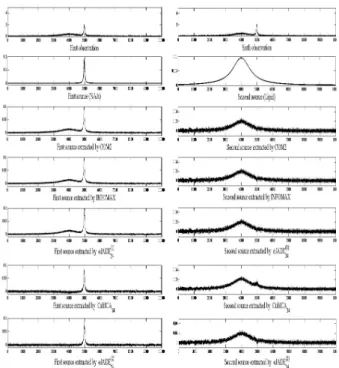
In the MRS context, it is assumed that the metabolites do not interact so that the static linear mixing model is valid. In addition, several studies [18] showed that ICA is able to de-compose the MRS data into components with features typical of different brain tissue or lesion types. Eight observations (two of them are represented in figure 1), considered as a noisy mixture of one source of interest, namely the N-Acetyl Aspartate (NAA) metabolite, and one artifact source such as the lipid metabolite, are generated. Each metabolite spectrum (one realization is depicted in figure 1) is built using a lorentzian function where the parameters (location and scale parameters) are fixed to derive realistic NAA and lipid-like metabolites. As far as the additive noise is considered, a
−15dB −10dB −5dB 0dB 5dB COM2 1.2077 1.0499 0.7803 0.4560 0.2103 INFOMAX 1.2114 1.0773 0.8148 0.4722 0.2141 eJADE(1)34 1.2079 1.0506 0.7818 0.4566 0.2105 JADE(1)4 1.2076 1.0499 0.7803 0.4560 0.2103 eJADE(1)3 1.2099 1.0671 0.8404 0.5060 0.2277 CubICA34 1.2187 1.1679 1.1099 0.0891 0.0455 CubICA4 1.2187 1.1680 1.1084 0.0898 0.0456 CubICA3 1.1654 0.7142 0.1509 0.0622 0.0427 eJADE(2)34 1.1769 0.6981 0.1511 0.0640 0.0417 JADE(2)4 1.1773 0.7463 0.1567 0.0642 0.0417 eJADE(2)3 1.1481 0.6966 0.1468 0.0608 0.0413 TABLE I
CRITERIONDAT THE OUTPUT OF THE11 ICAMETHODS AS A FUNCTION OFSNRIN THE CONTEXT OFMRSDATA
Fig. 1. Median over 30 realizations of the sources at the output of CoM2, INFOMAX, eJADE(1)34, CubICA34and eJADE(2)34in the context of MRS data (SNR=0 dB)
Gaussian vector process is used to simulate the instrumental noise. Regarding the mixing matrix A, it is defined as the concatenation of two columns modelling the concentration of the NAA and the lipid. Finally, all reported results are obtained by calculating the median over 30 independent experiments.
Table I shows the D criterion at the output of the
eleven ICA methods as a function of the Signal-to-Noise Ratio (SNR). The eJADE(2)3 method clearly gives the best results. Next, three methods, namely CubICA3, eJADE(2)34 and JADE(2)4 , show similar and good results. Eventually, the seven other methods seem to be less efficient, especially the eJADE(1)and JADE(1)techniques. This shows the interest of the eJADE(2)implementation, say in efficiently reducing the
number of cumulant matrices before jointly diagonalizing them. This result is confirmed in figure 1, which displays both sources at the output of CoM2, INFOMAX, eJADE(1)3,4, CubICA3,4 and eJADE(2)3,4. The first source estimated by eJADE(1)3,4is clearly a mixture of the NAA and lipid metabo-lites whereas eJADE(2)3,4 succeeds in extracting both metabo-lites. The fact that eJADE(2)3 gives better results than JADE(2)4 is in total agreement with the CID values computed at orders 3 and 4, respectively, from the bidimensional vectorsof the NAA and lipid metabolites. Indeed, we getCID(3)s = 6,7932
andCID(4)s = 4,3927, which shows that the TO cumulants are more informative than the FO ones and which justifies their use in the case of MRS data.
C. Electroencephalographic signals
In the particular context of epileptic patients, for whom EEG remains a key diagnosis tool, ICA is suitable for denoising purposes, when electrophysiological events such as interictal spikes or ictal discharges are masked by artifacts, particularly muscle activity [14]. Indeed, EEG can be con-sidered as a static linear mixture of such activities, assumed mutually independent due to their different physiological origins [10]. However, there is still few studies attempting to validate ICA approaches using data for which the sources of EEG activity are known a priori. In this study we focus on the denoising of EEG data in the particular case of epileptic interictal spikes. The simulated EEG data (two observations are displayed in figure 2), are generated using a realistic head model [7], [8], that consists in three nested homogenous volumes realistically shaping the brain, the skull and the scalp, respectively. More precisely, two distributed sources, referred to as "patches" in the sequel and related to interictal spikes, are simulated. One patch is defined in the left superior temporal gyrus, and another one is given in the left supramarginalis gyrus. Each patch is composed of 100 dipole sources assigned with hyper-synchronous (and so very close) spike-like activities. These activities were kept inde-pendent between the two patches (their mean is displayed in figure 2). From this setup, and using 18 electrodes, the forward problem is then calculated giving a mixing matrix
A= [A1, A2], whereA1 andA2are two(18×100)matrices associated with patch 1 and 2, respectively. Uncorrelated background activities are attributed to the remaining part of the cortical activity. 30 trials of these simulated EEG are generated for the study. A different muscle activity issued from real EEG data is added to each of them.
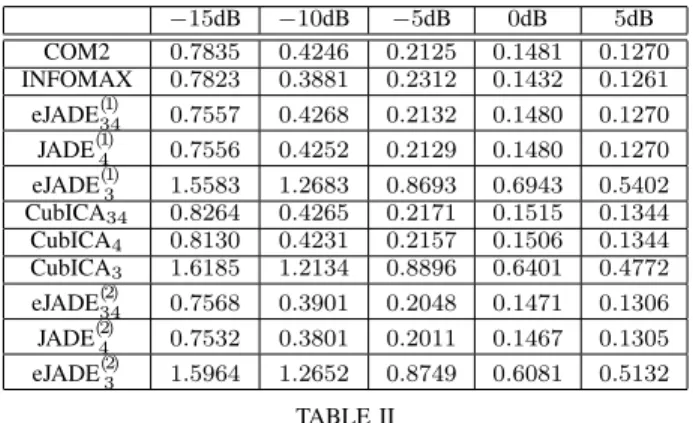
The D criterion, computed at the output of the eleven
ICA methods as a function of the SNR, is displayed in table II. All methods seem to give good results, except eJADE(1)3 , eJADE(2)3 and CubICA3 as announced by the CID values computed at orders 3 and 4, respectively, from the bidimensional vectorsof the mean activities of both patches: CID(3)s = 5,2036andCID(4)s = 9,0764. It appears that FO cumulants are practically twice more informative than TO cumulants. This result points out the robustness of eJADE(2)3,4 with respect to weakly informative TO cumulants. Figure 2
−15dB −10dB −5dB 0dB 5dB COM2 0.7835 0.4246 0.2125 0.1481 0.1270 INFOMAX 0.7823 0.3881 0.2312 0.1432 0.1261 eJADE(1)34 0.7557 0.4268 0.2132 0.1480 0.1270 JADE(1)4 0.7556 0.4252 0.2129 0.1480 0.1270 eJADE(1)3 1.5583 1.2683 0.8693 0.6943 0.5402 CubICA34 0.8264 0.4265 0.2171 0.1515 0.1344 CubICA4 0.8130 0.4231 0.2157 0.1506 0.1344 CubICA3 1.6185 1.2134 0.8896 0.6401 0.4772 eJADE(2)34 0.7568 0.3901 0.2048 0.1471 0.1306 JADE(2)4 0.7532 0.3801 0.2011 0.1467 0.1305 eJADE(2)3 1.5964 1.2652 0.8749 0.6081 0.5132 TABLE II
CRITERIONDAT THE OUTPUT OF THE11 ICAMETHODS AS A FUNCTION OFSNRIN THE CONTEXT OFEEGDATA
Fig. 2. Both sources at the output of COM2, INFOMAX, eJADE(1)34, CubICA34and eJADE(2)34in the context of EEG data (SNR=−10 dB)
confirms the good behavior of eJADE(2)3,4with respect to other methods.
V. CONCLUSION
In order to perform ICA, an efficient way of jointly using SO, TO and FO statistics is proposed, leading to the eJADE(2)3,4 method. The latter can be interpreted as an improvement of the eJADE(1)3,4 technique. The SVD-based reduction of the set of TO and FO cumulant matrices to be jointly diagonalized is shown to considerably improve performance in the case of MRS signals. Interestingly, poorly informative TO cumulants as observed in EEG do not affect performance of eJADE(2)3,4, which encourages us to combine them with FO cumulants in all contexts. It is noteworthy that all tests were made using realistic synthetic signals in
order to allow for a quantitative comparison of eleven ICA methods, most of them based on the use of HO cumulants.
REFERENCES
[1] L. ALBERA, P. COMON, L. PARRA, A. KARFOUL, A. KACHENOURA, and L. SENHADJI, “Biomedical applications,” inHandbook of blind source separation, P. COMON and C. JUTTEN, Eds. Academic Press, March 2010.
[2] T. BLASCHKE and L. WISKOTT, “CuBICA: Independent component analysis by simultaneous third- and fourth-order cumulant diagonal-ization,”IEEE Transactions on Signal Processing, vol. 52, no. 5, pp. 1250–1256, May 2004.
[3] J. F. CARDOSO and A. SOULOUMIAC, “Blind beamforming for non-gaussian signals,” IEE Proceesings-F, vol. 140, no. 6, pp. 362– 370, Dec. 1993.
[4] ——, “Jacobi angles for simultaneous diagonalization,”SIAM Journal Matrix Analysis and Applications, vol. 17, no. 1, pp. 161–164, 1996. [5] P. COMON, “Independent Component Analysis, a new concept ?”
Signal Processing, Elsevier, vol. 36, no. 3, pp. 287–314, 1994. [6] P. COMON, X. LUCIANI, and A. L. F. DE ALMEIDA, “Tensor
decompositions, alternating least squares and other tales,”Journal of Chemometrics, vol. 23, no. 7-8, pp. 393–405, July-August 2009. [7] D. COSANDIER-RIMÉLÉ, J. BADIER, P. CHAUVEL, and
F. WENDLING, “A physiologically plausible spatio-temporal model for depth-EEG signals recorded with intracerebral electrodes in human partial epilepsy,” IEEE Transactions On Biomedical Engineering, vol. 3, no. 54, pp. 380–388, February 2007.
[8] D. COSANDIER-RIMÉLÉ, I. MERLET, J. BADIER, P. CHAUVEL, and F. WENDLING, “The neuronal sources of EEG: Modeling of simultaneous scalp and intracerebral recordings in epilepsy,” NeuroIm-age, no. 42, pp. 135–146, April 2008.
[9] S. HU, M. STEAD, and G. A. WORRELL, “Automatic identification and removal of scalp reference signal for intracranial EEGs based on independent component analysis,” IEEE Transactions onBiomedical Engineering, vol. 54, no. 9, pp. 1560–1572, Sep. 2007.
[10] C. J. JAMES and C. W. HESSE, “Independent component analysis for biomedical signals,” Physiological measurement, vol. 26, no. 1, pp. 15–39, 2005.
[11] A. KACHENOURA, L. ALBERA, L. SENHADJI, and P. COMON, “ICA: a potential tool for BCI systems,” IEEE Signal Processing Magazine, special issue on Brain-Computer Interfaces, vol. 25, no. 1, pp. 57–68, Jan. 2008.
[12] A. KARFOUL, L. ALBERA, and G. BIROT, “Blind underdetermined mixture identification by joint canonical decomposition of HO cumu-lants,”IEEE Transactions On Signal Processing, vol. 58, no. 2, pp. 638–649, February 2010.
[13] T. W. LEE, M. GIROLAMI, and T. J. SEJNOWSKI, “Indepen-dent component analysis using an extended infomax algorithm for mixed sub-gaussian and super-gaussian sources,”Neural Computation, vol. 11, no. 2, pp. 417–441, 1999.
[14] P. LEVAN, E. URRESTARAZU, and J. GOTMAN, “A system for automatic artifact removal in ictal scalp eeg based on independent component analysis and bayesian classification,”Clinical Neurophys-iology, vol. 117, no. 4, pp. 912–927, 2006.
[15] E. MOREAU, “A generalization of joint-diagonalization criteria for source separation,”IEEE Transactions on Signal Processing, vol. 49, no. 3, pp. 530–541, March 2001.
[16] ——, “Comments on CuBICA: Independent component analysis by simultaneous third- and fourth-order cumulant diagonalization,”IEEE Transactions on Signal Processing, vol. 54, no. 12, pp. 4826–4828, December 2006.
[17] F. POREE, A. KACHENOURA, H. GAUVRIT, C. MORVAN, G. CARRAULT, and L. SENHADJI, “Blind source separation for ambulatory sleep recording,”IEEE Transactions on Information Tech-nology in Biomedicine, vol. 10, no. 2, pp. 293–301, Apr. 2006. [18] J. PULKKINEN, A. M. HÄKKINEN, N. LUNDBOM, A. PAETAU,
R. A. KAUPPINEN, and Y. HILTUNEN, “Independent component analysis to proton spectroscopic imaging data to human brain tu-mours,”European Journal of Radiology, vol. 56, no. 2, pp. 160–164, Nov. 2005.
[19] L. SENHADJI, A. KACHENOURA, L. ALBERA, and P. COMON, “On the use of independent component analysis techniques in the field of brain computer interface,” IRBM, vol. 30, no. 5-6, pp. 211–217, November-December 2009.