Original citation:
Hadley, Mark J.. (1997) The logic of quantum mechanics derived from classical general
relativity. Foundations of Physics Letters, Volume 10 (Number 1). pp. 43-60.
Permanent WRAP url:
http://wrap.warwick.ac.uk/62982
Copyright and reuse:
The Warwick Research Archive Portal (WRAP) makes this work of researchers of the
University of Warwick available open access under the following conditions. Copyright ©
and all moral rights to the version of the paper presented here belong to the individual
author(s) and/or other copyright owners. To the extent reasonable and practicable the
material made available in WRAP has been checked for eligibility before being made
available.
Copies of full items can be used for personal research or study, educational, or
not-for-profit purposes without prior permission or charge. Provided that the authors, title and
full bibliographic details are credited, a hyperlink and/or URL is given for the original
metadata page and the content is not changed in any way.
Publisher statement:
The final publication is available at Springer via http://dx.doi.org/10.1007/BF02764119
A note on versions:
The version presented here may differ from the published version or, version of record, if
you wish to cite this item you are advised to consult the publisher’s version. Please see
the ‘permanent WRAP url’ above for details on accessing the published version and note
that access may require a subscription.
arXiv:quant-ph/9706018v1 9 Jun 1997
The Logic of Quantum Mechanics Derived from
Classical General Relativity
Mark J Hadley
∗Dept. of Physics, Univ. of Warwick
COVENTRY CV4 7AL, UK
February 1, 2008
Abstract
For the first time it is shown that the logic of quantum mechanics can be derived from Classical Physics. An orthomodular lattice of propo-sitions, characteristic of quantum logic, is constructed for manifolds in Einstein’s theory of general relativity. A particle is modelled by a topo-logically non-trivial 4-manifold with closed timelike curves - a 4-geon, rather than as an evolving 3-manifold. It is then possible for both the state preparation and measurement apparatus to constrain the results
of experiments. It is shown that propositions about the results of mea-surements can satisfy a non-distributive logic rather than the Boolean logic of classical systems. Reasonable assumptions about the role of the measurement apparatus leads to an orthomodular lattice of propositions characteristic of quantum logic.
1
Comment
This paper has been published in Foundations of Physics Letters [1]. The work forms the basis of my doctoral thesis [2]. A short, less formal talk about my work is archived in quant-ph/9609021 [3].
2
INTRODUCTION
Quantum logic is characterised by the propositions of an orthomodular lattice, the distinguishing feature of which is the failure of the distributive law which is replaced with the weaker orthomodularity condition[4]. From this orthomodu-lar lattice it is then possible to generate the Hilbert space structure of quantum mechanics[5]. That quantum systems satisfy a non-Boolean logic is an experi-mental fact that has never been satisfactorily explained.
This paper suggests an origin for quantum logic and formally constructs an orthomodular lattice of propositions about manifolds in classical general relativity.
Since the formulation of general relativity, attempts[6, 7] have been made to model elementary particles as topologically non-trivial structures in spacetime
called geons. These models exhibited interesting particle-like properties, such as mass and charge without apparent sources, but could not reproduce the features of quantum mechanics which the particles must obey. These models were, however, based onthree-manifolds evolving in time, in the sense that there was a global hypersurface permitting the definition of a global time coordinate. Once the manifold was defined at a given time its evolution was deterministic -independent of subsequent measurements that may, or may not, be made.
There has recently been much speculation about the existence of closed timelike curves (CTCs), their stability and the possibility of time travel with its associated inconsistencies [8]. Although CTCs appear unphysical, there is nothing in the theory of general relativity to exclude them[9]. General relativity treats spacetime as a manifold, which is locally diffeomorphic to ℜ4
, but does not prescribe its topology[7]. Interacting classical objects (or fields) in a space-time with CTCs require additional boundary conditions to uniquely determine their evolution [8]. Data that would normally be sufficient to define a unique trajectory may, in the presence of CTCs, permit more than one possibility.
This work suggests a model for a particle as a non-trivial topological struc-ture in four dimensions (space and time) not just space. While it is an obvious extension of the old ideas on geons, it makes fuller use of the richness of general relativity than did the earlier work. Thus the extension from topologically non-trivial 3-spaces (3-geons) to spacetime (4-geons) gives rise to the possibility of CTCs and the associatedimpossibility of defining a global time coordinate.
It is well known that if states are modelled as projections of a complex Hilbert space then the symmetries of the spacetime (Galilean or Poincar´e) to-gether with the appropriate internal symmetries of the object leads inevitably to the familiar equations of non-relativistic and relativistic quantum mechanics respectively, together with commutation relations and a universal constant with the dimensions of Planck’s constant[10].
The conjectured 4-geon description of particles is speculative but this single assumption is able to unify the particle and field descriptions of nature, ex-plain quantum logic and in doing so reconciles general relativity and quantum mechanics.
3
4-GEON
The present analysis is based upon a model of an elementary particle as a dis-tortion of spacetime, (a four dimensional semi-Riemannian manifold with non-trivial topology). The manifold includes both the particle and the background metric, and being four dimensional without aglobaltime coordinate, the particle and its evolution are inseparable - they are both described by the four-manifold. We now express the properties, which we require of a particle, in the language of manifolds.
Axiom 1 (Asymptotic flatness) Far away from the particle spacetime is topo-logically trivial and asymptotically flat with an approximately Lorentzian metric.
In mathematical terms - spacetime is a 4-manifold, M and there exists a 4-manifold K, such that M/K is diffeomorphic to ℜ4
onM/K is asymptotically Lorentzian.‡ K or (B3× ℜ) can be regarded as the
world-tube within which the ‘particle’ is considered to exist.
This axiom formally states the fact that we experience an approximately Lorentzian spacetime, and that if space and time are strongly distorted and convoluted to form a particle then that region can be localised. (It may be noted that asymptotic flatness is not a reasonable property to require for a quark because it cannot be isolated [there is no evidence of an isolated quark embedded in a flat spacetime] therefore the present work cannot be applied automatically to an isolated quark.)
The position of a distortion of spacetime is not a trivial concept - it implies a mapping from the 4-manifold, which is both the particle and the background spacetime, onto the flat spacetime used within the laboratory. There is in gen-eral no such map that can be defined globally, yet a local map obviously cannot relate the relative positions of distant objects. This axiom gives a practical definition of the position of a particle - it is the region where the non-trivial topology resides. Any experimental arrangement which confines (with barriers of some sort) the B3 region of non-trivial topology, defines the position of the
particle. From this axiom, the region outside the barrier is topologically trivial and thereforedoes admit global coordinates.
Using the asymptotic flatness axiom it is now possible to define what is meant by a particle-like solution:
Axiom 2 (Particle-like) In any volume of 3-space an experiment to deter-mine the presence of the particle will yield a true or a false value only.
This is consistent with the non-relativistic indivisibility of the particle. By contrast, a gravitational wave may be a diffuse object with a density in different regions of space which can take on a continuous range of values. An object which did not satisfy this axiom (at least in the non-relativistic approximation) would not be considered to be a particle. The axiom is clearly satisfied by classical particles and, because it refers only to the result of a position measurement, it conforms also with a quantum mechanical description of a particle.
The particle-like axiom requires the property of asymptotic flatness, defined above, to give meaning to a 3-space. The three space is defined in the global asymptotically flat, topologically trivial region, M/K, which is diffeomorphic toℜ4/(B3× ℜ) as defined above.
We are now able to state the required properties of a 4-geon.
Conjecture 1 (4-Geon) A particle is a semi-Riemannian spacetime manifold,
M, which is a solution of Einstein’s equations of general relativity. The manifold is topologically non-trivial, with a non-trivial causal structure, and is asymptot-ically flat and particle-like (Axiom 2).
It would be very appealing ifMwas a solution of the vacuum equations[6], but for the arguments that follow this is not essential; unspecified non-gravitational sources could be part of the structure. The assumed existence of CTCs as an integral part of the structure (rather than as a passive feature of the background topology) is an essential feature of the manifold; when they exist additional boundary conditions may be required to define the manifold[8]. This aspect of the structure provides a causal link between measurement apparatus and state
‡B3
preparation, permitting both to form part of the boundary conditions which constrain the field equations.
The axioms formally state conditions that any description of a particle must reasonably be expected to satisfy. In contrast, the 4-geon (Conjecture 1 above) is novel and speculative since it is not known whether such solutions exist -either to the vacuum or the full field equations of general relativity; however, there no reason to suppose that they cannot exist. It will be shown that this sin-gle speculative element not only yields quantum logic, but is sufficient to derive the equations of quantum mechanics and in doing so reconciles general relativ-ity with quantum mechanics. Although this work proposes novel and unproven structures in general relativity it requires neither a modification, nor any addi-tion to Einstein’s equaaddi-tions; the number of spacetime dimensions remains 3 + 1. The work does not require extraneous particle fields (as used in conventional quantum field theory), nor does it impose a quantum field of unknown origin (as does Bohm’s theory). In short, this single conjecture is sufficient to unify particle and gravitational field descriptions of Nature, quantum and classical logic and quantum mechanics with general relativity.
4
STATE-PREPARATION AND MEASUREMENT
The role of both the measurement and state preparation in defining the 4-geon is crucial. It is self-evident that state preparation sets boundary conditions. Whether we regard a particle as a classical billiard ball, a quantum of a quantum field, or a classical field, the state preparation limits the possibilities; it restricts the possible solutions to those consistent with the apparatus. Systems with slits, collimators and shutters provide obvious boundary conditions which any solution must satisfy. For a geon, or a 4-geon, a barrier is a region which the topologically non-trivial region cannot traverse. Such barriers can be used to form slits and collimatorsetc.. and they obviously restrict the space of possible solutions. We state this formally as an axiom:
Axiom 3 (State preparation) The state preparation sets boundary condi-tions for the solucondi-tions to the field equacondi-tions.
The exact nature of these boundary conditions, and whether they can always be equated with physical barriers such as collimators, is irrelevant to the analysis that follows.
Consider now an apparatus associated with a measurement, which is in many respects similar to that involved in a state preparation. Arrangements of slits, barriers and collimators are common features of the measurement apparatus. They are constructed from barriers which cannot be traversed by the non-trivial topology, which is the particle.
We take as a paradigm for a position measurement that barriers divide space into regions which are then probed (in any manner) to ascertain the existence, or otherwise, of the particle in a region. The particle-like axiom and the asymp-totic flatness axiom assures us that the topologically non-trivial region can be confined but not split.
while a very similar system of shuttersetc., resulting in confinement to one of a number of regions and subsequent detection, acts as a measurement.
For a classical object there is no causal connection that could allow the mea-surement conditions to influence the evolution. If the state preparation was insufficient to uniquely specify the trajectory there would be a statistical distri-bution of possible initial states, each of which would evolve deterministically. By contrast on a spacetime with CTCs extra conditions are required for a unique deterministic evolution [8]. With a particle modelled as a 4-geon however, there wouldbe a causal link allowing the measurement conditions to contribute to the definition of the 4-manifold. A 4-geon is a 4-dimensional spacetime manifold which satisfies the boundary conditions set by both the state preparation and the measurement. This justifies a further axiom:
Axiom 4 (Measurement process) The measurement process sets boundary conditions for the 4-geon which are not necessarily redundant, in the sense that they contribute to the definition of the 4-manifold.
This axiom is inevitable if the particle contains CTCs, because the state prepa-ration and the measurement conditions can no longer be distinguished by causal arguments.
Axiom 5 (Exclusive experiments) Some pairs of measurements are mutu-ally exclusive in the sense that they cannot be made simultaneously.
This axiom expresses an established experimental fact - see[12, Chapter 7]. The famous examples of two such complementary variables arex-position and x-momentum. The x and y components of spin form another pair of comple-mentary variables with a very simple logical structure. That measurements cannot be made simultaneously is still consistent with classical physics; objects would have a precise position and momentum, but we could only measure one property or the other. Quantum mechanics goes much further and asserts that a particle cannoteven posses precise values of both properties simultaneously. The present work is unique in explaining why an inability to make simulta-neous measurements should lead to incompatible observables in the quantum mechanical sense.
5
PROPOSITIONS AND 4-MANIFOLDS
We now consider the semi-Riemannian manifolds,M, that could satisfy the dif-ferent boundary conditions imposed by state preparation and measurement: Let
M ≡ {M} denote the set of 4-manifolds consistent with the state preparation
Consider first the case of the classical 3-geon. EachM corresponds to an evolving 3-manifoldM3. EachM3 will evolve deterministically in a way
deter-mined uniquely by the Einstein field equations and the initial conditionM3(t 0)
(the distribution of M3(t
0) determines the distribution of M3(t) at any later
time t1 > t0). If the geon is particle-like, then any experiment that depends
upon a position measurement will give a result for eachM3at any time.
Con-sequently, the boundary conditions imposed by measurements are necessarily compatible with any 3-geon that satisfies the particle-like proposition; in other words they are redundant.
By contrast, the 4-geon with CTCs as part of its structure cannot be decom-posed into a three manifold and a time variable. It is known that further bound-ary conditions need not be redundant in a spacetime which admits CTCs[8]. In principle, the measurement apparatus itself can provide additional boundary conditions.
Consider measurements P, Q for which the boundary conditions cannot be simultaneously applied. They could be thex-component of spin and y-compon-ent of spin, orx-position andx-momentum; for simplicity we will consider two-valued measurements (eg.spin up or down for a spin-half particle orx-position >0 andx-momentum>0). We will denote the result that“the state has a +ve P value” by P+, (P−, Q+, Q−, are defined similarly). As propositions, P+ is
clearly the complement ofP−; ifP+is true thenP−is false andvice versa, and similarly forQ+ andQ−.
As before, let M ≡ {M} denote the set of 4-manifolds consistent with the state preparation. The measurements define subsets of {M}; we denote by P those manifolds consistent with the state preparation andthe boundary conditions imposed by a P-measurement. P is clearly the disjoint union ofP+
andP− - the manifolds corresponding toP+
andP−, respectively. Where the boundary conditions imposed by the measurement are not redundant{M},P
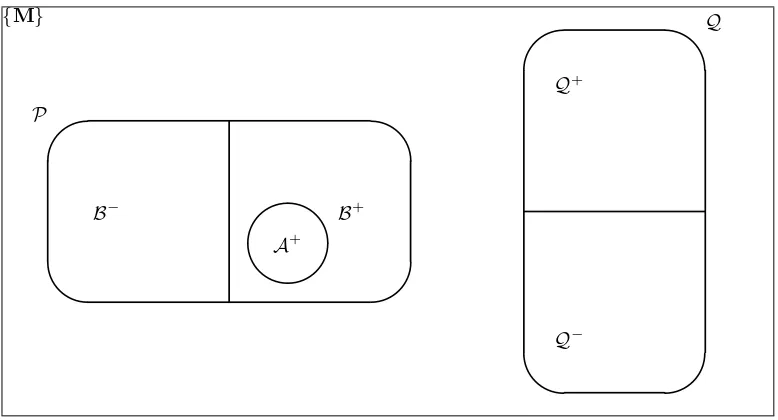
andQneed not be the same (see Figure 1). There is a one-to-one correspondence between the sets of manifolds in the Figure and the four non-trivial propositions, p, q, r, s. However, two statements, or experimental procedures correspond to the same proposition if they cannot be distinguished by any state preparation -in other words if they give exactly the same -information about each and every state. Therefore the statement that P has a value is always true by the particle-like Axiom 2, as is the statement that Q has a value; hence the subsets P and
Qcorrespond to the samepropositionI and we have the possibility:
P+
6
= (P+
∩ Q+
)∪(P+
∩ Q−) (1)
If the boundary conditions are incompatible thenP andQare disjoint and the following holds (see Figure 1):
0 = (P+∩ Q+
) = (P+∩ Q− )6=P+
(2)
6
GENERAL RELATIVITY AND QUANTUM
MECHANICS
The significance of this result (Equation 1) is that the failure of the distributive law is synonymous with the existence of incompatible observables[4, Page 126]; it is a definitive property of non-classical systems of which a system obeying the rules of quantum mechanics is an example. To obtain quantum mechanics (as represented by a projections of a Hilbert space) we need to replace the distributive law with the weaker orthomodular condition:
a≤b⇒b=a∨(b∧NOT(a)) (3) where≤is a partial ordering relation which is transitive, reflexive and anti-symmetric; it corresponds to set theoretic inclusion of the manifolds,A ⊆ B.
For propositions,aandb, the ordering relation can only be applied if they can be evaluated together [4, Chapter 13]. Whena≤bthere must be a measurement apparatus which enablesaandbto be measured together. LetP be the subset ofMdefined by this measurement (see Figure 2). ThenA+
⊆ B+
⊆ Pand the complements with respect toP satisfyB−⊆ A−⊆ P
. Clearly:
A+
⊆ B+
⇒ B+
=A+
∪(B+
∩ A−) (4)
Hence the weaker orthomodularity condition is satisfied by propositions about the 4-geon manifolds. Quantum mechanics (as represented on a com-plex Hilbert space) is a realization of non-distributive proposition systems which satisfy Equation 3, and is believed to be unique as a representation on a vec-tor space. For a review and further references on the relation between non-distributive proposition systems, quantum mechanics and complex Hilbert spaces see [4, Chapters 21,22].
7
CONSTRUCTION OF A MODULAR
LAT-TICE
By considering the measurements of thexandycomponents of spin of a 4-geon with spin-half it is possible to construct a modular lattice of propositions. It has been reported by Friedman and Sorkin[13] that manifolds with the trans-formation properties of a spinor can be constructed. For the construction which follows, we require the 4-geon to have more than one possible outcome from a Stern-Gerlach apparatus. We will consider two possible outcomes (> 0,≤0); the exact spectrum, whether it is finite or infinite, continuous or discrete is not important. The choice of x and y-spin and the restriction to two outcomes is made to give a simple model of the spin for a spin-half particle; momentum and position could equally well have been used.
{M}
'
&
$
%
P
P− P+
'
&
$
%
Q
Q−
[image:9.612.100.493.148.358.2]Q+
Figure 1: Sets of 4-manifolds consistent with both state preparation and the boundary conditions imposed by different measurement conditions.
{M}
'
&
$
%
P
&% '$
A+
B− B+
'
&
$
%
Q
Q−
Q+
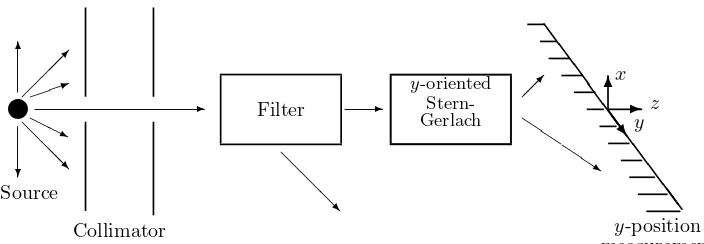
[image:9.612.101.490.451.661.2]The set of all possible 4-geon manifolds, ˜M, is not very useful, since it includes manifolds compatible and incompatible with every experimental ar-rangement. Let us constrain the possible manifolds by setting up the state preparation apparatus as depicted in Figure 3. By Axiom 3, the apparatus im-poses boundary conditions which limit the set of relevant manifolds toM ⊂M˜, i.e. to those 4-geons compatible with the apparatus of Figure 3.
Next we can set up a Stern-Gerlach apparatus aligned with the x-axis, fol-lowed by an x-position detector which here gives a value for the spin (see Fig-ure 4). By Axiom 2, the particle will certainly be detected at one position and only one position. We denote by X the 4-geon manifolds consistent with the state-preparation and thex-oriented Stern-Gerlach equipment. ClearlyX ⊆ M; because of the 4-geon postulate we can have X 6=M. Of all the manifolds in
X, some will correspond to x >0, and the remainder to x≤0; these will be denotedX+ andX−, respectively. Note that the same measurement apparatus determinesx >0 andx≤0; thereforeX =X+∪ X−.
Ay-axis measurement may be made in a similar way (see Figure 5) which defines subsets Y, Y+ and Y− of M. An x and y-oriented Stern-Gerlach ap-paratus clearly cannot both be set in the same place at the same time; they are incompatible, and by Axiom 4 the boundary conditions which they set are incompatible. HenceY andX are disjoint subsets ofM.
7.1
The Propositions
The propositions are the equivalence classes of outcomes of yes/no experiments, two experiments being equivalent if there is no state preparation that can dis-tinguish them. Four non-trivial propositions,p,q,r ands, can be stated about thexandy-spin of 4-geon manifolds, M. They listed in Table 1, together with the subsets of manifolds in the equivalence class and the experimental results which they relate to.
In addition, there are the two trivial propositions 0 andI. Axiom 2 ensures that there exists at least one 4-geon manifold consistent with any measurement (∃M∈ X). Equivalently, given the state-preparation and measurement bound-ary conditions then M∈ X. The trivial propositions,I (which is always true) and 0 (which is always false), correspond to this Axiom and its converse:
0 ≡ M∈ ∅
≡ X =∅
≡ Y =∅
I ≡ M∈ X for anx-spin measurement
≡ M∈ Y for ay-spin measurement
y Filter @ @ @ R 1 HHj @
[image:11.612.153.408.139.270.2]@@R 6 ? - -Source Collimator
Figure 3: The boundary conditions imposed by state-preparation
x-position measurement x-oriented Stern-Gerlach y Filter 6 -@ @ @ R 1 HHj @
@@R 6 ? -Q Q Q QQs
[image:11.612.151.495.326.483.2]3 -Source Collimator z x
Figure 4: The boundary conditions imposed by state-preparation and anx-spin measurement y Filter S S S S S S S S SS 6 -SSw @ @ @ R 1 HHj @
@@R 6 ? - - Q Q
QQs
Source Collimator y-oriented Stern-Gerlach z x y y-position measurement
[image:11.612.150.502.543.665.2]7.2
Partial Ordering
The ordering relation for two propositions,aandb, isa≤bwhich means that a true implies that b is true. For the spin-half system the partial ordering is almost trivial:
0≤p≤I, 0≤q≤I, 0≤r≤I, 0≤s≤I (6) In this case there can be no ordering between p and r etc. when they are in different directions, because X and Y are disjoint (and can clearly be distin-guished by some state preparations) and so a manifold cannot be in both. The propositions of the system therefore form a poset (partially ordered set). Gen-erally, the ordering relation can only be applied to propositions if there exists at least one experimental arrangement which evaluates both of them together.
7.3
Meet and Join
The meet of two propositions,a∧b, is the largest proposition, the truth of which implies that both a and b are true. For any poset it follows that: a∧a= a, a∧I=aanda∧0 = 0. For this system we have in addition:
a∧b= 0, ∀a6=b (7)
For a 4-geon manifold,M, to be in the meet ofpandr, it would have to be inX+
andY+ which is not possible; the solution set is therefore the empty set which
corresponds to 0. Membership of the subsetsX+ andY+corresponds to
physi-cally distinguishable statements about the state preparation so the equivalence relation does not affect this conclusion.
The join of two propositions,a∨b, is the smallest proposition which is true whenever eitheraorbis true. For any poset it follows that: a∨a=a,a∨0 =a anda∨I=I. For this system we have in addition:
a∨b=I ∀a6=b (8)
In this small system there is no other acceptable choice forp∨retc.
7.4
Orthocomplementation
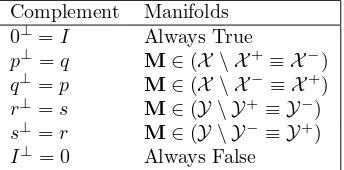
As in classical mechanics we consider the orthocomplementationa⊥of a propo-sition a by taking the set-theoretic complement with respect to all possible outcomes of the same experiment. We define the complements of our system in Table 2
From Table 2 and Table 1, it is clear that the required properties of ortho-complementation are satisfied:
1. (a⊥)⊥=a
The first two follow directly from set theory, while the third only applies in the cases: a < I or 0< a, because of the simple structure of this poset.
The definition given satisfies DeMorgan’s laws: (a1∧a2)⊥ = a⊥1 ∨a
⊥
2 (9)
(a1∨a2)⊥ = a⊥1 ∧a
⊥
2 (10)
(11) Thus we have an orthocomplemented poset. DeMorgan’s Laws can be used to define the join of two incompatible propositions in terms of the meet and orthocomplementationeg.:
p∨r= (q∧s)⊥= 0⊥=I (12)
7.5
Lattice
A lattice is a poset where the meet and join always exist. The meet and join of any two elements of this system always exist, these being 0 and I respectively, for any two different propositions. Table 3 shows the meet and join for all the propositions.
The poset is thus seen to be an orthocomplementedLattice.
7.6
Orthomodularity
The orthomodularity condition:
a≤b⇒b=a∨(b∧a⊥) (13) is satisfied by the simple spin-half poset, as can be seen by considering each case,∀a∈ {p, q, r, s}:
0≤a ⇒ a= 0∨(a∧I) (14) a≤I ⇒ I=a∨(I∧a⊥) (15) a≤a ⇒ a=a∨(a∧a⊥) (16) 0≤I ⇒ I= 0∨(I∧I) (17)
7.7
Modularity
That this lattice is modular can be seen by examining it case by case. The failure of the modularity law, as required for a strictly orthomodular lattice, will only occur for systems with an infinite spectra [14, Page 220].
7.8
Distributivity
A simple counterexample suffices to show that the distributive rule fails for propositions about different directions:
Proposition Manifolds Measurement 0 ∅ Always False
p M∈ X+ Thex-Spin is measured to be>0
q M∈ X− Thex-Spin is measured to be≤0 r M∈ Y+ They-Spin is measured to be>0
s M∈ Y− They-Spin is measured to be≤0 I M∈ X Thex-Spin is measurable
[image:14.612.124.403.167.266.2]I M∈ Y They-Spin is measurable
Table 1: The propositions and sets of manifolds of the spin-half system
Complement Manifolds 0⊥=I Always True
p⊥=q M∈(X \ X+≡ X−)
q⊥ =p M∈(X \ X−≡ X+)
r⊥ =s M∈(Y \ Y+ ≡ Y−)
s⊥=r M∈(Y \ Y−≡ Y+)
[image:14.612.126.298.377.462.2]I⊥= 0 Always False
Table 2: The complements of the propositions of the spin-half system
∧ 0 p q r s I
0 0 0 0 0 0 0
p 0 p 0 0 0 0
q 0 0 q 0 0 0
r 0 0 0 r 0 0
s 0 0 0 0 s 0
I 0 0 0 0 0 I
∨ 0 p q r s I
0 0 I I I I I
p I p I I I I
q I I q I I I
r I I I r I I
s I I I I s I
0 I I I I I I
[image:14.612.127.429.567.661.2]7.9
Atomicity
An atom is a proposition, different from 0, which does not have any smaller proposition. The propositionsp, q, r, sare clearly the atoms.
7.10
Covering Property
We say that acoversb ifa > b, anda≥c≥b implies eitherc=aor c=b. A lattice has the covering property if the join of any element,a, with an atom not contained inacoversa. Clearly∀a, b∈ {p, q, r, s}:
0∨a = a which covers 0 (19) a∨b = I which coversa (20) This establishes that the system has the covering property.
Starting with propositions about sets of manifolds in classical general rel-ativity, we have constructed a non-distributive, orthomodular lattice, which is atomic and has the covering property. The significance is not just that such a lattice is a feature of quantum mechanics, but that it isthedistinguishing feature of quantum mechanics. It has previously been thought that a non-distributive lattice of propositions could never be constructed from a classical theory and hence that no classical explanation of quantum mechanics was possible; this is shown to be false. The present work gives a classical explanation for the origin of quantum mechanics and because it is based on the accepted theory of general relativity, it offers the most economical interpretation.
8
CONCLUSIONS
By modelling particles as 4-geons in general relativity (rather than evolving 3-manifolds), features characteristic of quantum mechanics can be derived. This work therefore offers a novel possibility for a classical basis for quantum me-chanics, and in doing so offers a way to reconcile general relativity and quantum mechanics. Some of the implications and unresolved issues are:
1. Time is an asymptotic approximation as expected by workers in quantum gravity[15].
2. The theory does not exclude classical objects. Measurements of a 3-geon, if one existed, could not satisfy the logic of quantum mechanics. Grav-itational waves are also described as evolving 3-manifolds and, although there may be some problems defining a global hypersurface [16], they do not have the topological structure to exhibit the measurement-dependent effects characteristic of quantum mechanics.
3. It follows from the previous comment that there is no graviton. Poten-tially, this is a testable prediction of the theory.
have different asymptotic properties. This is an almost inevitable conse-quence of reconciling quantum mechanics and general relativity[17]. How-ever, the present perspective on the origin of quantum mechanics accounts for the lack of a well-defined metric as being due to incompleteness of boundary conditions imposed by state preparation, rather than as an in-herent feature of the gravitational field.
5. Non-local effects - as exemplified by the EPR experiments - can be ex-plained by theories with non-trivial topologies[11, Page 481], since with CTCs there can exist causal routes from one arm of the experiment to the other. Quantum mechanics itself requires only a failure of weak-causality (statistical correlations of a non-local character between spacelike sepa-rated events[18]); with CTCs as an essential part of the structure of an elementary particle however, it is not clear why a failure of strong-causality (communication between spacelike separated events) is not apparent. 6. Like all theories of quantum gravity and interpretations of quantum
me-chanics, this work is speculative. The theory can only be proven if exact solutions to Einstein’s equations with the required properties are found. Considering the difficulty of finding exact solutions with non-trivial topol-ogy, a more practical way of confirming these ideas is to examine the predictions, the first of which is the absence of a graviton.
It would indeed be ironic if the interpretation quantum theory with which Einstein was so dissatisfied could be seen to be a consequence of his general theory of relativity.
9
Acknowledgements
I would like to thank Dr Hyland and Professor Isham for helpful discussions. This work was supported by the University of Warwick
References
[1] Mark J Hadley. The logic of quantum mechanics derived from classical general relativity. Foundations of Physics Letters, 10(1):43–60, February 1997. Submitted June 1996.
[2] Mark J Hadley. A Gravitational Theory of Quantum Mechanics. PhD thesis, Department of Physics, University of Warwick, February 1997. [3] Mark J Hadley. A gravitational explanation of quantum mechanics. Talk
given at the 5th UK Conference on Conceptual and Philosophical problems in Physics, September 1996.
[4] Enrico G Beltrametti and Gianna Cassinelli. The Logic of Quantum Me-chanics, volume 15 of Encyclopedia of Mathematics and its Applications. Addison-Wesley Publishing Company, 1981.
[6] A Einstein and N Rosen. The particle problem in general relativity.Physical Review, 48:73–77, 1935.
[7] C W Misner and J A Wheeler. Classical physics as geometry. Annals of Physics, 2:525, 1957.
[8] John Friedman, Michael S Morris, Igor D Novikov, and Ulvi Yurtsever. Cauchy problem in spacetimes with closed timelike curves.Physical Review D, 42(6):1915–1930, 1990.
[9] Kip S Thorne. Closed timelike curves. In13th International Conference on General Relativity and Gravitation 1992. Institute of Physics Publishing, 1992.
[10] Leslie E Ballentine. Quantum Mechanics. Prentice Hall, 1989.
[11] Peter R Holland. The Quantum Theory of Motion. Cambridge University Press, 1993.
[12] Paul Arthur Schilpp, editor. Albert Einstein: Philosopher-Scientist. Cam-bridge University Press, 1970.
[13] John L Friedman and Rafael D Sorkin. Half-integral spin from quantum gravity. General Relativity and Gravitation, 14:615–620, 1982.
[14] Joseph M Jauch. Foundations of Quantum Mechanics. Addison-Wesley Publishing Company, 1968.
[15] C J Isham. Structural issues in quantum gravity - plenary session lecture given at the gr14 conference, florence. gr-qc/9510063, August 1995.
[16] Roger Penrose. A remarkable property of plane waves in general relativity. Reviews of Modern Physics, 37(1):215–220, 1973.
[17] Don N Page and C D Geilker. Indirect evidence for quantum gravity. Physical Review Letters, 47(14):979–982, 1981.