http://wrap.warwick.ac.uk
Original citation:
He, Ligang, Duan, K., Chen, X., Zou, D., Han, Z., Fadavinia, A. and Jarvis, Stephen A.
(2011) Modelling workflow executions under role-based authorisation control. In: 8th
IEEE International Conference on Services Computing (ICSC'11), Washington DC, USA,
4-9 July 2011. Published in: 2011 IEEE International Conference on Services Computing
(SCC) pp. 200-208.
Permanent WRAP url:
http://wrap.warwick.ac.uk/45666
Copyright and reuse:
The Warwick Research Archive Portal (WRAP) makes this work by researchers of the
University of Warwick available open access under the following conditions. Copyright ©
and all moral rights to the version of the paper presented here belong to the individual
author(s) and/or other copyright owners. To the extent reasonable and practicable the
material made available in WRAP has been checked for eligibility before being made
available.
Copies of full items can be used for personal research or study, educational, or not-for
profit purposes without prior permission or charge. Provided that the authors, title and
full bibliographic details are credited, a hyperlink and/or URL is given for the original
metadata page and the content is not changed in any way.
Copyright statement:
“© 2011 IEEE. Personal use of this material is permitted. Permission from IEEE must be
obtained for all other uses, in any current or future media, including reprinting
/republishing this material for advertising or promotional purposes, creating new
collective works, for resale or redistribution to servers or lists, or reuse of any
copyrighted component of this work in other works.”
A note on versions:
The version presented here may differ from the published version or, version of record, if
you wish to cite this item you are advised to consult the publisher’s version. Please see
the ‘permanent WRAP url’ above for details on accessing the published version and note
that access may require a subscription.
Modelling Workflow Executions under Role-based Authorisation Control
Ligang He
1, Kewei Duan
2, Ali Fadavinia
1and Stephen A. Jarvis
11. Department of Computer Science, University of Warwick, Coventry, UK 2. Department of Computer Science, University of Bath, Bath, UK
Abstract— Workflows are often used to represent enterprise-type activities, and authorisation control is an important security consideration in enterprise-level applications. Role-Based Access Control (RBAC) is a popular authorisation control scheme under which users are assigned to certain roles, and the roles are associated with permissions. This paper presents a novel mechanism for modelling workflow execution in cluster-based resource pools under Role-Based Access Control (RBAC) schemes. Our modelling approach uses Coloured Timed Petri-Nets, and various authorisation constraints are modelled, including role constraints, temporal constraints, cardinality constraints, Binding of Duty and Separation of Duty constraints, etc. The interactions between workflow authorisation and workflow execution are also captured in the model. In this paper, the modelling mechanism is developed in such a fashion that the construction of the authorisation model for a workflow can be automated. This feature is very helpful in modelling a large collection of authorisation policies or complex workflows. A Petri-net simulation tool, the CPN-Tool, is utilised to implement the developed modelling mechanism and simulate the constructed model. Both system-level performance (e.g., utilisation of resource pools) and application-level performance (e.g., workflow response time) can be obtained from model simulations. This work can be used to plan system capacity and investigate the impact of authorization policies on system and application performance.
Keywords: Modelling, Authorisation, Workflow, RBAC
I. INTRODUCTION
Business processes or workflows are often used to model enterprise applications [6]. A workflow consists of multiple activities or tasks with precedence constraints. When we design workflow management/scheduling strategies, or evaluate the performance of workflow execution on target resources, it is often assumed that when a task is allocated to a resource, the resource will accept the task and start the execution once the processor becomes available. In reality, however, authorisation policies may be deployed in the organisations and used to specify who is allowed to perform which tasks at what time. When these authorisation schemes are taken into account, the situation can become complex.
A number of authorisation schemes have been presented, see [1][16]. The RBAC (Role Based Access Control) scheme is one of the most popular authorisation schemes. Under the RBAC scheme, users are assigned to certain roles, while the roles are associated with prescribed permissions. Therefore, the organisations can control the users’ permissions through these roles.
The following example illustrates RBAC deployed in banking [3]. A bank often uses a variety of computing applications to support its business; these applications may be deployed on a central resource pool (e.g., a computing cluster) at the bank. A workflow may consist of tasks such as credit data checks, automated signature approval, risk analysis and so on. In each task, a particular application has to be launched to perform the corresponding business functions. Under RBAC, an application can only be launched by certain users (i.e., the employees in the bank) assuming certain roles (i.e., jobs such as branch manager or financial advisor). The following authorisation constraints are often encountered in such scenarios: 1) Role constraints: An application may only be run by assuming a particular set of roles; 2) Temporal constraints: A role or user is only active during certain time intervals (e.g., an employee only covers morning shifts in a particular role); 3) Cardinality constraints: The maximum number of applications running simultaneously under a role is N; 4) Separation of Duty constraints: If Task A is run by a role (or a user), then Task
B must not be run by the same role (or user); 5) Binding of Duty constraints: If Task A is run by a role (or user), then Task B must be run by the same role (or user).
performance (e.g., utilisation and throughput) and for application-oriented performance (e.g., response time of workflows).
In this paper, the Colour Timed Petri-net formalism [8][19] is applied to model workflow authorisation and execution. A Petri-net simulation tool, the CPN Tool [25], is utilised to implement and simulate the model. Performance data is then obtained from running model simulations. The work presented in this paper can be used to plan system capacity or estimate application performance in the presence of authorisation policies. This work can also provide insight into how to tune performance by adjusting authorisation policies so as to achieve balance between performance and security overhead.
The remainder of this paper is organised as follows: Section 2 discusses related work; Section 3 introduces the Colour Timed Petri-Net formalism applied in this paper; workflow authorisation and execution is modelled in Section 4; model simulations are provided in Section 5 and, Section 6 concludes the paper.
II. RELATED WORK
Workflow management has been extensively studied and as a result is well documented in related literature [3][6][11][18]. Much of this research is aimed at automating the execution, and enhancing the performance, of workflows in parallel and distributed systems [11][19]. Some of this research has also utilised Petri-nets to model workflow execution, however we note that their work does not formally investigate the performance of workflow execution under authorisation constraints.
Research has also been conducted on the topic of security and authorisation constraints in workflow execution [3][7][19][20]. Some of this research also uses Petri-nets to model authorisation constraints. The work presented in this paper differs from that research in the following respects: First, the work found in [3][20] does not capture the temporal constraints of the roles’ availability; in this work, the roles’ temporal constraints are modelled. Second, it is assumed in [3][7][14] that a task can only be run under one role. This assumption simplifies the modelling process; however, the assumption is not always true. It may well be the case that a task is allowed to run under a range of roles. The relaxation of this assumption is especially necessary when temporal constraints of roles’ availability are taken into account. In so doing, when one role is not available, another activated role may be assigned to run the task, so that the workflow execution can still progress. In this work, the task-role assignments and the task-user assignments are modelled in a flexible fashion, which allows a task to be run under a selection of roles/users. Third, the work in [5][22] does not capture the interactions between workflow authorisation and workflow execution. The work presented in this paper models resource competition and interactions between the authorisation module and the execution module. Finally, previous work only models the execution
or authorisation of a single workflow [21][24]. The modelling mechanism developed here however, is able to model the simultaneous execution of multiple workflows.
In previous work [10], we have applied Generalised Stochastic Petri-Net (GSPN) theory to model workflow executions under Role-based Authorisation Control, and then used standard Petri-net analysis techniques to theoretically calculate the performance from the constructed models. Although GSPN is adequate to model the scenarios investigated in that work, it struggles to meet the following new requirements: First, although the temporal constraints are modeled in [10], the temporal constraints have to be regular due to the nature of GSPN. In this paper, the tokens’ temporal attributes, the time stamps and the transition guards in the CTPN formalism, are all combined to capture any type of temporal constraints. Second, duty constraints are also modelled in [10]. However, it is assumed that two tasks with duty constraints have to be run in sequence. In this paper, the duty constraints between parallel tasks are modelled. Moreover, Separation of Duty and Binding of Duty are modelled in a uniform fashion in this paper, which enables the assembly of authorisation modules to be automated. Third, the maximum number of workflow instances has to be known in advance before constructing the models and the number cannot be varied after the models have been constructed. In this work, different workflow instances are represented by different token colours and the number of workflow instances is an adjustable model parameter. Finally, it is very difficult for the GSPN modelling scheme in [10] to achieve automated component assembly. It becomes tedious and error-prone when we need to model a large collection of authorisation policies. In this work, the model is constructed in a modular fashion and individual authorisation modulars can be assembled automatically to form the authorisation model for the entire system.
Another major difference between the work in [10] and this work is that in [10] we applied a theoretical approach to calculate performance metrics from the constructed models. In this paper, the developed modelling mechanism has been implemented and performance data can be obtained by running model simulations. These two approaches complement each other, but the simulation approach is more amenable to evaluating large-scale and irregular models.
III. COLOUR TIMED PETRI-NETS
The formal definition of a Colour Petri-Net (CPN) differs depending on the source literature [3][25]. The CPN formalism applied in this paper can be formally defined as in Eq.(1) [25],
termed the transition’s output places; CS is a set of colours1 (a colour in the CPN in [25] is represented as a data type, which can be a primitive data type or a derived data type); CF: P → 2CPis the colour function mapping from places to a subset of the colour set2; A: (T × P)
∪ (P × T) →f(CF(P)) is
the arc function, mapping a directed arc (from a place to a transition or from a transition to a place) to a function of the colours in the place P; G: T → is a guard
function mapping a transition to a function of the colours in all places associated with T. The guard function defined in [25] represents the substantive difference from CPN definitions found in other literature [3].
A CPN model consists of places (defined in P) and transitions (defined in T), and a number of directed arcs (defined in IN and OUT). Each place can be marked with a number of tokens, and each token has a data value, which is termed the token color. The data value can be a primitive data type, such as an integer and a string, or a complex structure consisting of other primitive data types or complex structures. The number of tokens and the token colours in each place, called a marking, represents the state of the model. A place is associated with a data type (termed a
colour set), which is defined in CS. A place’s colour set determines the set of token colours that the tokens in the place are allowed to possess. The model determines whether a token can be fired through the arc functions associated with the arcs (defined in A) and/or guard functions associated to transitions (defined in G). An arc function evaluates to a set of tokens, which determine the type and number of tokens that can pass through the arc. An arc function or a guard function can contain a number of variables as well as the operations (e.g. comparison) and logical operators (e.g. if-else branch) on these variables. Therefore, an arc function or a guard function may evaluate to different values for different tokens.
A Colour Timed Petri-Net is an extension of a CPN. In a CTPN, a token can be associated with both a colour and a time stamp. Furthermore, a CPN model has a global timer representing the model time. The time stamp attached to a token indicates the earliest time when the token can be processed. In addition to the arc and guard function, whether a transition can fire or not in a CTPN model, is also controlled by the model’s global timer and the tokens’ time stamps. The rule is, that besides satisfying the arc and the guard functions associated with a transition, the tokens must have time stamps which are no later than the value of the global timer. The model remains at a given model time as long as there are enabled transitions. If there are no such transitions, the global timer is advanced to the earliest model time at which at least one transition is enabled.
1A colour in the CPN defined in [25] is represented as a data type, which
can be a primitive data type (e.g., an integer) or a derived data type (e.g., a record derived from other data types).
2 2CP is the power set of the colour set.
IV. MODELLING WORKFLOW AUTHORISATION
In this section, various types of authorisation constraint and controls are modelled using CTPNs. These include: 1) Role constraints; 2) Temporal constraints; 3) Role and user assignment; 4) Binding-of-duty constraints; 5) Separation-of-duty constraints; 6) Cardinality constraints; 7) Workflow execution under authorisation control.
A. Role and user assignment subject to temporal constraints
As discussed in the banking example above, a constituent task of a workflow involves an application being launched by an employee with an official position. Generally speaking, a role (e.g., an official position) and a user (e.g., an employee) need to be assigned to handle a task of a particular type in the workflow. The model of assigning a role and a user to a task is illustrated in Figure 1. In this model, the transition Trt assigns a role in the Pr place to a task
in the Pt place, and deposits a token to the Prt place,
indicating the task-role assignment has been established. When a token is deposited into the place Purt, it means that a
user has been assigned to the task. We call the model of assigning a role and a user to a task a role and user assignment module. It will be shown in Subsection IV.C that these modules can be assembled to construct the authorisation control module for the entire workflow.
A Petri-net model can be formally defined using Eq.1. The remainder of this subsection is dedicated to determining the attributes CS, CF, A and G (ie., token colours, arc and Guard functions) for the role and user assignment module in Fig.1. These attributes together enforce the temporal constraints and role constraints. It is straightforward to determine the attributes P, T, I and O in the model. Therefore, they are omitted for brevity.
Figure 1. Role and user assignment module 1) Token colours
• A token in the Pr place, denoted as r, represents a role. The
colour of the token r is defined as r = (rid, D), where rid is the role identifier and D is a set of durations in which the role is activated and can be assigned to tasks, i.e.,
D = {[ldi, udi] | i ∈ℵ }. (2) • A token in the Pt place, denoted as t, represents a task. The
token colour is defined as t = (tid, wid, e), where tid is the task identifier, wid is the identifier of the workflow that the task belongs to, and e is the task’s execution time. A time stamp ts is attached to the token t, which is symbolised as
• The colour of a token in the Prt place, which is the
combination of the color attributes of token t and r, is defined as follows:
rt = (tid, wid, e, rid, D)
• A token in place Pu represents a user, whose colour is
defined as u = (uid, rid), where rid is the role that the user belongs to.
• The colour of a token in the place Purt is defined as urt = (uid, rid, tid, wid, e, D)
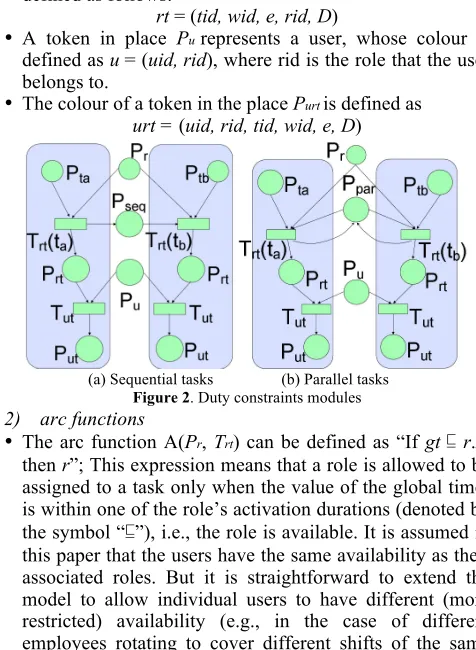
[image:5.612.52.290.102.427.2](a) Sequential tasks (b) Parallel tasks Figure 2. Duty constraints modules 2) arc functions
• The arc function A(Pr, Trt) can be defined as “If gt ⊑r.D
then r”; This expression means that a role is allowed to be assigned to a task only when the value of the global timer is within one of the role’s activation durations (denoted by the symbol “⊑”), i.e., the role is available. It is assumed in this paper that the users have the same availability as their associated roles. But it is straightforward to extend the model to allow individual users to have different (more restricted) availability (e.g., in the case of different employees rotating to cover different shifts of the same official position).
• Other arc functions in the model are defined as A(Pt, Trt) =
“t”, A(Pu, Tut) = “u”, A(Prt, Tut) = “rt” and A(Tut, Purt) =
“urt”
3) Guard functions
The guard G, associated with transition Trt, denoted as G(Trti), is used to enforce role assignment restrictions. There
are two types of restriction. One is the role constraint which specifies the set of roles that are allowed to run a task. This restriction is expressed as “r.rid ∈ R(ti)”, where R(ti)
denotes the set of roles which can run ti. The other type of
restrictions specify that a role is assigned to a task only when the task can run to completion within one of the role’s activation durations specified in Eq.2. This restriction is motivated by the fact that most existing workflow description languages, such as BPMN [26], assume that a task in a workflow is atomic. This restriction is formulated as “[gt, gt+t.e] ⊑r.D”. Therefore,
G(Trti) = r.rid ∈R(ti) && [gt, gt+t.e] ⊑r.D. (3)
B. Binding of duty and separation of duty constraints
The duty constraints impose restrictions on the role assignments of two tasks in a workflow. Although Binding of Duty (BoD) and Separation of Duty (SoD) represent opposite authorisation behaviors, these two types of duty
constraints are modelled in a uniform fashion so that they have the same model structure. We call these the SoD module and the BoD module. The differences between these are essentially in some arc and guard functions, as well as the colour set of some places. The benefit of doing this is that the models for individual duty constraints can be easily assembled to form the authorisation model for the entire workflow.
There are two types of relationship between two tasks in a workflow in terms of precedence constraints: sequential tasks and parallel tasks. Assume task ta and tb. If tb ∈
Pred(ta) or tb ∈ Succ(ta) (Pred(ti) and Succ(ti) denote the set
of tasks which are task ti’s predecessors and successors,
respectively), then ta and tb are sequential tasks and have to
be run in the required order. If tb ∉ Pred(ta) and tb ∉ Succ(ta), ta and tb can be executed in parallel. Duty constraints are
modelled in a different way for these two types of tasks. Their model structures are shown in Fig.2a and Fig.2b, respectively.
1) Sequential tasks
As shown in Fig.2a, the duty constraints module consists of the role and user assignment modules for ta and tb, connected by place Pseq. Pseq is one of the output places of
transition Trt(ta) and one of the input places of transition Trt(tb). The attributes of the role and user assignment
modules have been discussed in Subsection A. The attributes related to the new place, Pseq, are as follows.
• Token colours: The colour of a token in place Pseq is
defined as seq = (tid, wid, rid), which carries the information of which role has been assigned to task tid.
• Arc functions: A(Trt(ta), Pseq) and A(Pseq, Trt(tb)) are both
defined as “seq”.
• Guard functions: The guard functions associated with
Trt(tb) are different for SoD and BoD constraints. If it is a
SoD constraint, G(Trt(tb)) is expressed as Eq.4. If it is a
BoD constraint, G(Trt(tb)) is formulated as Eq.5. t in Eq.4
and Eq.5 is a token in place Ptb. The condition seq.wid=t.wid is used to guarantee that the same workflow instance is referred to, since this model allows multiple instances of the same workflow to be processed simultaneously. Different instances of a workflow will have different values of wid.
seq.wid=t.wid && seq.rid ≠r.rid. (4)
seq.wid=t.wid && seq.rid = r.rid. (5)
2) Parallel tasks
Similar to Fig.2a, a new place, labelled Ppar, is used in
Fig.2b to interface between the role and user assignment module when ta and tb are parallel tasks. In the remainder of
this subsection we first determine the attributes related to place Ppar, and then use an example to illustrate the
workings of the module.
• Guard functions: If a SoD constraint, the guard function of the transition Trt(ta) (or Trt(tb)) is formulated as Eq.6. If a
BoD constraint, it is expressed as Eq.7.
((t.tid = par_init.tida || t.tid = par_init.tidb) && t.wid = par_init.wid) || (t.wid = par.wid && r.rid ≠par.rid) (6) ((t.tid = par_init.tida || t.tid = par_init.tidb) && t.wid = par_init.wid) || (t.wid = par.wid && r.rid = par.rid) (7)
• Arc functions: A(Ppar, Trt) and A(Trt, Ppar) are defined in
Eq.8 and Eq.9, respectively.
A(Ppar, Trt) = par_init || par (8) A(Trt, Ppar) =“if part_init then par” (9)
3) Workings of the duty constraint modules
The workings of the duty constraint modules and the above expressions are illustrated as follows. When performing the role assignment for a task (e.g., ta), the
model will check whether the other task (e.g., tb) has been
assigned a role. Assume there is a BoD constraint between ta
and tb, then the place Ppar will contain a par_init token in the
model’s initial marking. When the Trt transition performs
the role assignment for ta, it will evaluate which token in Ppar can satisfy Eq.6, and therefore can be fired by the
transition. There are two possibilities:
a) If there is a corresponding par_init token in Ppar,
which means that tb has not been assigned a role, then the
first part of Eq.6 (i.e., the portion before the second “||”) will be evaluated as true. Consequently, the Trt(ta) transition will
remove the par_init token from Ppar and deposit a par token
back to Ppar as shown in Eq.9.
b) If there is a par token in Ppar, this means that tb has
been assigned to a role. Further, if there is a role in place Pr
whose identifier (i.e., r.rid) is the same as the role assigned to tb (i.e., par.rid), the second part of Eq.6 will be evaluated
as true. Thus, the BoD constraint is enforced.
C. Assembling authorisation modules
One of the biggest advantages of the modelling mechanism developed in this paper is that the authorisation model can be constructed automatically by assembling a set of interacting hierarchical modules. There are clear interfaces and hierarchy structure among the modules. As shown in Fig.2, the duty constraints module consists of the role and user assignment modules for ta and tb, interfacing
via place Ppar or Pseq. Generally, the assembly procedure is
as follows.
Definition 1. Mk = (Pk, Tk, Ik, Ok, CSk, CFk, Ak, Gk) is the
role and user assignment module for task tk;
Definition 2. M = (P, T, I, O, CS, CF, A, G) is a module in which j tasks, ti1, ti2, …, tij, have the duty constraints with
task tk;
Definition 3. M’=(P′, T′, I′, O′, CS′, CF′, A′, G′) is the module that captures the duty constraints between the j tasks in module M and task tk in module Mk.
Then, the module M’ in Definition 3 can be constructed by assembling M and Mk as shown in Theorem 1.
Theorem 1. Given Mk, M, and M’ in Definition 1, 2 and 3,
the attributes of M’can be computed as follows.
• (10)
• T′ = T Tk (11) • CS′ = CS ∪CSk ∪seq ∪{par, par_init} (12) • CF′ = CF ∪ CFk ∪ CF(Pseq) ∪ CF(Ppar) (13) • A′ can be computed using Eq.14, where Pseq(tx, ty) or
Ppar(tx, ty) denote the Pseq or Ppar place that is added to
model the duty constraintsbetween tx and ty.
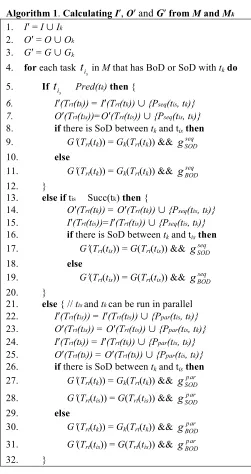
• I′, O′ and G′ can be computed using Algorithm 1, where , , and are the guard expressions specified in Eq.4, Eq.5, Eq.6 and Eq.7, respectively.
Proof. 1) For each task in the module M that has the duty constraint with task tk, a new place (either Pseq or Ppar
depending on whether they have the precedence constraint) is added in the new module M′. So P′ can be computed as in Eq.10. 2) There is no need to add new transitions in M’. So
T′ can be computed as Eq.11. 3) The new colour set of M′ is the union of the colour sets of Mk and M, plus the colours of
the tokens in place Pseq and Ppar. So CS′ can be computed as
Eq.12. Similarly, CF′ can be computed using Eq.13. 4) The arc function set in M′ is the union of the arc function sets of Mk and M plus the arcs added between place Pseq or Ppar and
the corresponding Trt transitions, as shown in Fig.2. So A′
can be computed using Eq.14. 5) Since there are no new transitions added in M′, steps 1 to 3 in Algorithm 1 first
initialise I′, O′, and G′ to be the union of I and Ik, O and Ok,
and G and Gk respectively. Then in the for-loop, the
algorithm adjusts the input, output and guard functions of the individual transitions that have the arc connections with the newly added Pseq and Ppar places.
The importance of Theorem 1 is that with the formalised equations and algorithm, the process of constructing the authorisation control model can be automated rather than being built manually, which can greatly speedup the modelling process.
(a) An exemplar workflow (b) Duty constraints graph Figure 3. An exemplar workflow and its duty constraints graph
Table 1 Role descriptions in the loan lending workflow
Role Description Role Description
[image:7.612.309.560.169.643.2]SM Second Market Official BM Bank Manager FA Financial Advisor CL Bank Clerk LB Loan Broker UW Underwriter
Table 2 Task descriptions and role constraints in the workflow Task Description Role constraints t1 Updating products and rates SM
t2 Product and Rate decision engine FA/LB/BM t3 Collecting data FA/LB/CL t4 Analysing data of third-party 1 FA/LB/CL t5 Analysing data of third-party 2 FA/LB/CL t6 Analysing business rules FA/BM t7 Underwriting UW/BM
Assume that the following BoD and SoD constraints are imposed on the tasks, where r(ti) denotes the role assigned
to task ti.
C1: r(t2) = r(t4);C2: r(t2) ≠ r(t5);C3: r(t2) ≠ r(t7); C4: r(t6) ≠ r(t7);C5: r(t3) = r(t5);
These duty constraints can be represented as a duty constraints graph shown in Fig.3b. In the duty constraints graph, if there are duty constraints between two sequential tasks, a single-headed arrow is used to connect the predecessor to the successor. If there exists duty constraints between two parallel tasks, the two tasks are connected by a double-headed arrow. Applying the module assembly operations described in Eq.10-14 and Algorithm 1, the hierarchy of the authorisation control model for the entire workflow can be constructed as shown in Fig.4, where Murt(ti) denotes a role and user assignment module for task ti; please note that there should be a directed arc from the Pr
place and the Pu place to every module as shown in Fig.2,
these are omitted for the sake of clarity.
In this work we model the fact that the tokens in Pr and Pu are shared by all tasks. This is reasonable since the roles
and users are global parameters and should be applied to all tasks in the system. Cardinality constraints, which specify the maximum number of tasks that can be handled at the same time by a role (or a user), can be modelled by the number of tokens representing the role (or the user) in Pr (or Pu).
D. Modelling workflow execution under authorisation
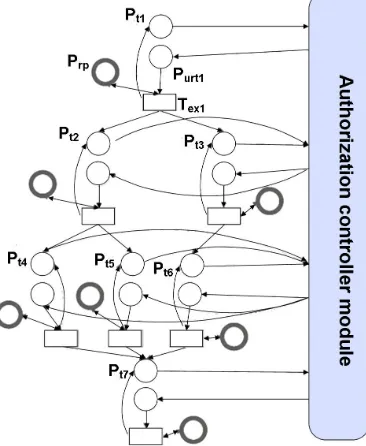
Fig.5 models the execution of the workflow in Fig.3a under authorisation control. The detailed hierarchy of the Authorisation Control Module (ACM) can be found in Fig.4. It can be seen that there are clear interfaces between the actual execution of the workflow and the ACM. When
task ti is ready (i.e. it has no predecessor or its predecessors
have been completed), a token t is deposited into place Pti,
which is the same Pti place in the ACM. This starts the
authorisation process in the ACM for the task. After the authorisation is completed, a urt token is deposited by the ACM into the Purti place. The task is now assigned a role
and a user, and can undergo the resource allocation procedure.
Algorithm 1. Calculating I′, O′ and G′ from M and Mk 1. I′ = I ∪Ik
2. O′ = O ∪Ok
3. G′ = G∪Gk
4. for each task in M that has BoD or SoD with tkdo
5. If Pred(tk) then {
6. I′(Trt(tk)) = I′(Trt(tk)) ∪{Pseq(tis, tk)} 7. O′(Trt(tis))=O′(Trt(tis)) ∪{Pseq(tis, tk)}
8. if there is SoD between tk and tisthen
9. G′(Trt(tk)) = Gk(Trt(tk)) &&
10. else
11. G′(Trt(tk)) = Gk(Trt(tk)) &&
12. }
13. else if tis Succ(tk) then {
14. O′(Trt(tk)) = O′(Trt(tk)) ∪{Pseq(tis, tk)}
15. I′(Trt(tis))=I′(Trt(tis)) ∪{Pseq(tis, tk)}
16. if there is SoD between tk and tisthen
17. G′(Trt(tis)) = G(Trt(tis)) &&
18. else
19. G′(Trt(tis)) = G(Trt(tis)) &&
20. }
21. else { // tis and tk can be run in parallel
22. I′(Trt(tis)) = I′(Trt(tis)) ∪{Ppar(tis, tk)}
23. O′(Trt(tis)) = O′(Trt(tis)) ∪{Ppar(tis, tk)}
24. I′(Trt(tk)) = I′(Trt(tk)) ∪{Ppar(tis, tk)}
25. O′(Trt(tk)) = O′(Trt(tk)) ∪{Ppar(tis, tk)}
26. if there is SoD between tk and tisthen
27. G′(Trt(tk)) = Gk(Trt(tk)) &&
28. G′(Trt(tis)) = G(Trt(tis)) &&
29. else
30. G′(Trt(tk)) = Gk(Trt(tk)) &&
31. G′(Trt(tis)) = G(Trt(tis)) &&
32. }
Figure 4. Hierarchy of the authorisation control module for the workflow in Fig.3a
Figure 5. Modelling workflow execution under authorisation control; only the Petri-net components for task t1 are labelled, and the labels for other tasks are omitted for the sake of clarity); the place Pnp represents the node pool and the individual Pnp places should be regarded as a single Pnp place.
Figure 6. Authorisation and executions of multiple workflows (submitted by different clients); ACM stands for Authorisation Control Module, and WEM stands for Workflow Execution Module
In Fig.5, the place Pnp, depicted as a bold circle,
represents the resource pool. In this place, a token represents a resource (e.g., a compute node), and the number of tokens represents the number of resources currently available in the system. The Tex transition represents the resource allocation
and task execution. There is only one resource pool (therefore, a single Pnp place) in the model, connecting to all Tex transitions. Fig.5 is drawn so that every Tex transition is
associated with a separate Pnp place; this is done for the sake
of clarity (to avoid too many arcs crossing the figure). These individual Pnp places should be regarded as a single Pnp place.
A token in the Pnp place is defined as np = nid.
In this model, the execution of a task is modelled in the following way. If there are tokens in the Pnp place (i.e., there
are free compute nodes) and there is the urti token in Purti,
the Texi transition fires immediately (indicating the start of ti’s execution) and a t token is deposited into the Ptj place
(suppose tj is ti’s child). The time stamp of the deposited
token t will be set as the current global time plus ti’s
execution time, that is, tj@ts =gt + ti.e. Therefore, the tj
token is not allowed to be fired until the time duration of ti.e
has lapsed, which simulates the execution of task ti.
Moreover, after a task is completed, the role and user assigned to the task need to be returned to place Pr and Pu,
so that the role and the user can be assigned to other tasks. This procedure is modelled as follows. When Texifires, an r
token is deposited back to the Pr place and a u token to the Pu place. The time stamps of these two tokens are both set as gt+ti.e. Similarly, when Texi fires, an np token is deposited
back to the Pnp place (expressed as double-headed arrows). np@ts is also set as gt+ti.e, which means that although the np token is back to the Pnp place, the corresponding resource
is only allowed to be allocated to other tasks when the simulated execution of ti has been completed.
If multiple workflows are running (and each workflow can have many instances) in the system, an authorisation control module and an execution module need to be constructed for each workflow. The model structure for authorising and executing multiple workflows is shown in Fig.6. As can be seen from the figure, the different workflow authorisation modules only share place Pr and Pu,
and the different workflow execution modules only share the Pnp place.
V. MODEL SIMULATIONS
The modelling mechanism presented in this paper has been implemented using the CPN Tools [25]. The CPN Tools are a software platform that is able to construct and simulate Petri-net models. CPN provides a flexible mechanism that allows users to monitor a set of places and/or transitions. The runtime status of these places and transitions can be automatically collected during model simulations. CPN can evaluate a constructed Petri-net model in terms of various performance metrics. For example, resource utilisation can be evaluated by monitoring the number of tokens in the place corresponding to the resource pool (which is Pnp in our model). Assuming the initial
marking of the place is n, and during model simulations the average number of tokens in the place observed by CPN is
avg_n, then the resource utilisation, denoted as ru, can be calculated as:
ru = 1 − avg_n/n
[image:8.612.61.290.491.584.2]when the last task in the workflow is completed. The difference between these two time stamps is the response time of the workflow. Based on this information, we can easily calculate the mean response time of all workflows. Other performance metrics that the CPN tools are able to evaluate include throughput, deadline miss rate, etc. In this section, the simulation results are presented in terms of mean Response Time (RT) of workflows and Resource Utilisation (RU) of the resource pool, The performance in terms of deadline miss rate and throughput has the correlated relationship with response time and utilisation, respectively.
In the simulations, the CTPN model is constructed for the loan lending workflow given in Fig.3a. The workflow instances arrive following the Poisson process. The runtime of a task follows an exponential distribution and the mean runtime of task t1-t7 is set to be 10, 15, 5, 10, 10, 20 and 25
time units, respectively, based on runtime comparisons among the tasks in reality [28].
1) Impact of Cardinality constraints
Fig.7 shows workflows’ RT and RU with the existence of cardinality constraints as the arrival rate of workflow instances increases. In order to investigate the impact of cardinality constraints, no other constraints are imposed except the duty constraints given in Fig.3b. Each role has 4 users. There are 8 homogeneous resources in the pool.
It can be observed from Fig.7a that when cardinality constraints are imposed, RT increases. This is because it is more likely that the tasks have to wait not only for resources, but also for the availability of roles. This result is to be expected and the qualitative analysis seems obvious. However, only through the modelling approach and simulation results we can acquire quantitative insight into how much impact a particular authorisation constraint can have. For example, suppose the workflows’ RT is desired to be no more than 300 time units. When there is no cardinality constraint, the system can accommodate a workflow stream with a mean arrival rate of up to 0.095. However, when the cardinality constraint is 8 and 4, the workload level that the system is able to handle is reduced to approximately 0.075 and 0.045, respectively.
(a) Mean response time (b) Resource utilisation Figure 7. Impact of cardinality constraints on mean response time and resource utilisation; “no card” means there are no cardinality constraints; “card=8” and “card=4” mean that the maximum number of tasks that a role can run simultaneously is 8 and 4, respectively.
As can be observed from Fig.7b, the cardinality constraints also have a negative impact on RU. Quantitatively, when there are no cardinality constraints, the resource utilisation is approximately 90% as the arrival rate increases. However, in the case of “card =8”, the utilisation can only reach around 75%; the performance is even worse (approximately 35%) when the cardinality parameter is 4. These results suggest that even if there are free resources in the system, the tasks cannot make use of them because of the unavailability of roles due to the cardinality constraints. Through modelling and simulation, we are able to determine an optimised number of resources when we plan a system’s capacity to support workflow executions under pre-specified authorisation constraints.
2) Impact of Temporal constraints
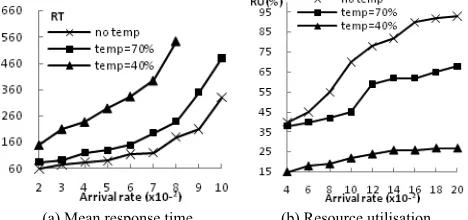
Fig.8 demonstrates the impact of temporal constraints on performance in terms of RT and RU as the workflow instances’ arrival rate increases. The temporal constraints on roles are set in the following way in the simulations in Fig.8. For each role, a time duration is selected from a period of 100 time units. The selected time duration occupies the specified percentage of the 100 time units. The starting time of the selected duration is chosen randomly. For example, to select a time duration which is 70% of 100 time units, the starting point of the duration is randomly selected from 0 to 30%×100 time units.
(a) Mean response time (b) Resource utilisation Figure 8. Impact of temporal constraints on mean response time and resource utilisation; “no temp” means there are no temporal constraints; “temp = 70%” and “temp = 40%” means that the roles are available for 70% and 40% of the time, respectively.
It can be observed from Fig.8 that temporal constraints have a negative impact on performance in terms of both RT and RU, as to be expected. Another interesting observation is that under temporal constraints, the performance seems to be less affected compared with the performance under cardinality constraints. This may be because the roles’ availability period may overlap. Therefore, when one role is not available for a task, the task may be able to find another available role.
3) Impact of the number of resources
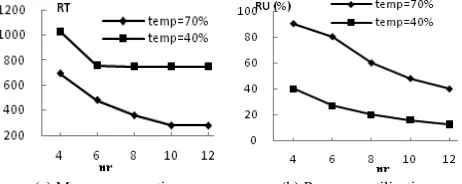
[image:9.612.320.554.377.487.2] [image:9.612.59.291.557.667.2]when nr is greater than a threshold, the workflow executions are mainly hampered by the authorisation constraints. These results demonstrate that with the modelling and simulations, we can quantitatively investigate the impact of the deployed authorisation policies, and therefore can potentially balance the authorisation policy settings to remove performance bottlenecks. The trend in Fig.9b is different from that in Fig.9a. In Fig.9b, RU keeps decreasing as nr increases. A closer observation shows that RU decreases linearly after nr
is greater than 10 and 6 in the case of temp=70% and temp=40%, respectively. This is because of the same reason discussed above, i.e., an execution bottleneck is now caused by the authorisation constraints and therefore, the increased resources will be largely idle. This result suggests that when planning system capacities, we should take the authorisation policies into account and avoid over-provisioning unnecessary resources.
[image:10.612.61.292.271.363.2](a) Mean response time (b) Resource utilisation Figure 9. Effect of increasing the number of resources (nr) in the existence of temporal and cardinality constraints; card=8; arrival rate is 7×10⁻²
VI. CONCLUSIONS
This paper employs Colour Timed Petri Nets (CTPN) to model workflow execution under authorisation constraints in cluster-based resource pools. Various authorisation constraints are modelled in this paper, including role constraints, temporal constraints, cardinality constraints, separation of duty and binding of duty constraints. The model allows a task in the workflow to run under a selection of roles and users, and it also allows multiple workflows from different clients to be authorised and executed in the system simultaneously. The model is constructed in a modular fashion. Therefore, it is easy to model a large collection of authorisation policies and complex workflows using the modelling approach developed in this paper. The modelling mechanism has been implemented using the CPN Tools. Various performance metrics can be computed from the constructed model, including those for system-oriented performance and application-oriented performance.
REFERENCES
[1] G. Ahn and R. Sandhu, “Role-Based Authorization Constraints Specification,” ACM Trans. Information and System Security, 3(4), 2000. [2] R. Alfieri, R. Cecchini, V. Ciaschini, L. Agnello, A. Frohner, A. Gianoli, K. Lorentey and F. Spataro, “VOMS, an Authorization System for Virtual Organizations”, in 1st European Across Grids Conference, Santiago de Compostela, Spain, February 13–14, 2003.
[3] V. Atluri, “A Petri net based safety analysis of workflow authorization models”, Journal of Computer Security, 8(2/3): 209-240, 2000
[4] R. Baker, L. Gommans, A. McNab, M. Lorch, L. Ramakrishnan, K. Sankar and M. Thompson, “Conceptual Grid Authorization Framework and Classification”, in 7th Global Grid Forum Workshop (GGF7), March, 2003 [5] X. Zhao, Z. Qiu, C. Cai, H. Yang, “A formal Model of Human Workflow”, the 2008 IEEE International Conference on Web Services, pp. 195-202.
[6] D. Chakraborty, V. Mankar, A. Nanavati, “Enabling Runtime
Adaptation of Workflows to External Events in Enterprise Environments”,
the 2007 IEEE International Conference on Web Services, pp.1112-1119.
[7] J. Crampton, “A reference monitor for workflow systems with
constrained task execution”, Proceedings of the tenth ACM symposium on
Access control models and technologies, pp. 38-47, 2005
[8] Y. Jin, S. Reveliotis, “A generalized stochastic Petri net model for performance analysis and control of capacitated reentrant lines”, IEEE Transactions on Robotics and Automation, 19(3): 474 - 480, 2003 [9] G. Della-Libera, P. Hallam-Baker, M. Hondo, T. Janczuk, et al. Web Services Security Policy Language (WS-SecurityPolicy), http://www-106.ibm.com/developerworks/library/ws-secpol/. 2002.
[10] L. He, M. Calleja, M. Hayes, S.A. Jarvis, Performance prediction for running workflows under role-based authorization mechanisms," Proc. of the 2009 IEEE International Symposium on Parallel & Distributed Processing, IEEE Computer Society Press.
[11] L. He, S Jarvis, D. Spooner, D. Bacigalupo, G. Tan, G. Nudd, "Mapping DAG-based Applications to Multiclusters with Background Workload", Proceedings of the 5th IEEE International Symposium on Cluster Computing and the Grid (CCGrid'05), 9-12 May 2005, Cardiff, UK [12] L. He, S.A. Jarvis, D.P. Spooner, H. Jiang, D.N. Dillenberger, G. Nudd, "Allocating Non-real-time and Soft Real-time Jobs in Multiclusters", IEEE Transactions on Parallel and Distributed Systems, 17(2):99-112, 2006
[13] S. Indrakanti and V. Varadharajan, “An Authorization Architecture for Web Services”, 19th Annual IFIP WG 11.3 Working Conference on Data and Applications Security, pp. 222-236, 2005
[14] D. Ferrariolo, J. Barkley, and D. Kuhn, “A Role-Based Access Control Model and Reference Implementation within a Corporate Intranet,” ACM Trans. Information and System Security, vol. 2, no. 1, pp. 34-64, 1999. [15] I. Foster, C. Kesselman, J. Nick and S. Tuecke, “The Physiology of the Grid: An Open Grid Services Architecture for Distributed Systems Integration”, in Open Grid Service Infrastructure WG (GGF), June, 2002. [16] J. Joshi, E. Bertino, U. Latif and A. Ghafoor, “A Generalized Temporal Role-Based Access Control Model”, IEEE Transactions on Knowledge and Data Engineering, 17(1): 4-23, 2005
[17] K. Keahey and V. Welch, “Fine-Grain Authorization for Resource Management in the Grid Environment”, in 3rd International Workshop on Grid Computing, Baltimore, USA, November 18, 2002, pp. 199–206. [18] S.H. Kim, J. Kim, S.J. Hong and S. Kim, “Workflow-based Authorization Service in Grid”, in 4th International Workshop on Grid Computing, Phoenix, USA, November 17, 2003, pp. 94–100.
[19] S. Manolache, “Schedulability Analysis of Real-Time Systems with Stochastic Task Execution Times”, Ph.D Thesis, Department of Computer and Information Science, IDA, Linkoping University
[20] K. Tan, J. Crampton and C. Gunter, “The consistency of task-based authorization constraints in workflow systems”, In Proceedings of 17th IEEE Computer Security Foundations Workshop, pp. 155–169, 2004 [21] J. Wainer, P. Barthelmess, A. Kumar, “W-RBAC – A workflow security model incorporating controlled overriding of constraints”, Intl. Journal of Cooperative Information Systems, 12(4), 455–486, 2003 [22] T. Ziebermayr and S. Probst. “Web Service Authorization Framework”, The 2004 International Conference on Web Services, pp.614. [24] W. Zuberek, “Timed petri nets in modeling and analysis of cluster tools,” IEEE Trans. on Robotics and Automation, 17, pp.562–575, 2001 [25] K. Jensen, L. Kristensen, L. Wells, “Coloured Petri Nets and CPN Tools for modelling and validation of concurrent systems”, Intl. Journal on Software Tools for Technology Transfer, 9(3), pp.213-254, 2007