INFORMATION AGGREGATION,
COSTLY VOTING
AND COMMON VALUES
Sayantan Ghosal
And
Ben Lockwood
No 670
WARWICK ECONOMIC RESEARCH PAPERS
Information Aggregation, Costly Voting and
Common Values
Sayantan Ghosal and Ben Lockwood
∗University of Warwick
First version: January 2002
This version: January 2003
Abstract
In a model of majority voting with common values and costly but voluntary par-ticipation, we show that in the vicinity of equilibrium, it isalways Pareto-improving
for more agents, on the average, to vote. This demonstrates that the negative vot-ing externality identified by Borgers(2001) in the context of private values is always dominated by a positive informational externality. In addition, we show that
mul-tiple Pareto-ranked voting equilibria may exist and moreover, majority voting with compulsory participation can Pareto dominate majority voting with voluntary
par-ticipation. Finally, we show that the inefficiency result is robust to limited preference heterogeneity.
Keywords: Voting, information, pivot, externality, inefficiency.
JELClassification Numbers: D72, D82.
∗We would like to thank B. Dutta, M. Morelli, C. Perroni their comments. Address for
1. Introduction
Many decisions are made by majority voting. In most cases, participation in the vot-ing process is both voluntary and costly. The question then arises whether the level of participation is efficient i.e. is there too much or too little voting?
In a model with costly voting and private values, Borgers (2001) identifies a negative externality from voting: the decision of one voter to vote lowers the probability that any other voter is pivotal, and thus reduces the benefit to voting of all other agents. A consequence of the negative externality is that compulsory voting is never desirable: all voters are strictly better offat the (unique) voluntary voting equilibrium. An implication of this global result is a local one: in the vicinity of an equilibrium it is always Pareto-improving for fewer agents, on the average, to vote.
In this paper, we re-examine the nature of inefficiency of majority voting in a model with costly participation and common values. Our motivation is two-fold. First, we believe there is good reason to suppose that many decisions made by majority voting have a significant common-values component. By a common-values component, we mean that voters basically agree on the correct course of action, given full information about the environment, but in practice, information is very imperfect due to the complexity of the issue. An example would be state referenda in the US over issues1 such as gun control and legalization of marijuana2.
What links these two issues is major disagreement over the evidence, combined with some consensus over what the right course of action would be, were there to be agreement on the evidence. For example, there is disagreement in the US over whether more relaxed gun control actually leads to greater crime, but general agreement that crimes such as murder, robbery and so on are unacceptable. Again, there is disagreement over whether consumption of marijuana is more harmful than consumption of alcohol, and whether the former leads on to harder drugs, but increasing consensus that if neither of these things is true, then it is not really consistent for consumption of alcohol to be legal, but
1Note that we do not includefiscal issues such as referenda on property taxes, etc. on this list, as almost
by definition, there are gainers and losers from such measures, and so preferences will be heterogenous.
2For example, in the Cogressional elections of November 2000, 42 states had 204 ballot initiatives
consumption of marijuana to be illegal.
Our second motivation is that in a common values environment, in addition to the negative “pivot” externality identified by Borgers (2001), there is3a positive informational externality from voting: an individual voter, by basing his voting decision on his informa-tive signal, improves the quality of the collecinforma-tive decision for all voters. On the face of it, it is not at all obvious, in general, which of these two externalities dominates. To put it another way: will potential voters participate too little or too much in decision-making?
We show the following. First, we demonstrate that the payoff to voting for any one individual can be decomposed into two parts: a term equal to the probability that the voter is pivotal, times the probability that she makes the correct decision in this case, plus a term giving her expected payoffif she is not pivotal. Thefirst term is decreasing in the probability that any other voter votes (this is the “pivot” externality), but with common values, the second term is increasing in the probability that any other voter votes (the information externality). Second - and this is our main result - we show that the second externalityalways dominates thefirst: overall any voter’s payofffrom voting (or indeed, not voting) is always increasing in the probability that any other voter votes4.
We also demonstrate a simple intuition for the main result, which we call a weak swing voter’s curse, following Fedderson and Pesendorfer(1996). In our setting, when any particular voter faces an odd number of other voters, conditional on being pivotal, she is indifferent about voting or abstaining, because this situation can only arise when in total there are equal numbers of signals in favor and against the two alternatives. This effect lowers the overall ex ante benefit to any voter from participation below what is socially optimal.
In moving to common values, we show additionally that voting equilibrium is no longer unique: typically, there will be several equilibria. Nevertheless, we show that starting at any voting equilibrium, an increase in the probability that agents vote always leads to a Pareto-improvement5. So, compared to the private values case, the inefficiency of voting equilibrium is reversed: with costly participation, majority voting fails to aggregate
3As Borgers remarks,“In a common value model of voting...there will be positive externalities to voting
which can mitigate or outweigh the negative externality which we identify. In such a model one cannot expect as clear-cut results as we obtain here”.
4It may seem surprising that this dominance holds even when the informativeness of the signals is
low, as then the positive informational externality is weak. However, in this event the pivot externality must be weak also, as the value to any voter of being pivotal is small, as his voting decision is based on a signal that is not very informative.
5In section 4, we demonstrate the robustness of this key result to the introduction of limited preference
information efficiently because not enough voters, on the average, participate in the voting process. One policy implication of our result is that by providing voting subsidies and recovering the cost through lump-sum taxes, all voters can be made better-off.
Additional results that follow are that under some conditions, voting equilibria can be Pareto-ranked, with an equilibrium with more voters Pareto-dominating the equilibrium with fewer voters, on the average. We also show that there are conditions under which compulsory voting Pareto-dominates voluntary majority voting. By contrast, in Borgers (2001), the unique voluntary voting equilibrium always Pareto dominates compulsory majority voting.
Finally, show that our main result on the nature of inefficiency of voting equilibria is robust to the introduction of preference heterogeneity. Specifically, we consider a utility function that is a convex combination of the common value specification of this paper, and the private values specification of Borgers. We characterize the maximum weight on the private values component such that the model has a voting equilibrium where all agents vote with their signals, rather than according to their idiosyncratic preference. We are then able to show that as long as the private values component is weighted by less than this maximum, the main results of the paper all carry over to this considerably more general specification.
Apart from Borgers’ paper, this paper is related to a few other recent papers on voting with incomplete information6. In a model of voting with common values with partisan voters and uninformed agents, Feddersen and Pesendorfer (1996)7 show that voting does not aggregate information efficiently in a finite electorate. The presence of partisan voters and uninformed voters adds noise to the voting process. In the absence of partisan voters, uninformed voters would abstain, implying that majority voting would aggregate information efficiently: as participation is costless, the remaining, symmetrically informed, non-partisan voters would all vote. In their set-up, voting fails to aggregate information efficiently astoo many voters participate. In contrast, here we show that even with symmetrically informed, non-partisan voters, majority voting may fail to aggregate information efficiently if participation is costly because there is too little voting on the average.
6We should also mention Osborne, Rosenthal and Turner (2000) who study a model of costly
par-ticipation. However, the focus of our paper and the formal model differs from their paper. They do not explicitly model voting and agents have complete information. Moreover, they do not consider the efficiency of participation equilibria.
7Other papers on information aggregation include Feddersen and Pessendorfer (1997) and Dekel and
Our model is also closely related to that of Persico(2001), who considers the design of voting rules and committee size when committee members have to pay for informative signals8. Our model is more general in what it assumes about the cost of observing signals (costs may be heterogenous, and are privately observed, whereas in Persico’s paper, there is a homogenous cost which is common knowledge), but otherwise, more special (it does not allow for asymmetry in priors or over the cost of different types of mistaken decisions). However, we are addressing a rather different issue; Persico studies the optimal design of a committee (numbers of members, voting rule) subject to the constraint that members are given the correct incentives to acquire information: we are looking at how information acquisition is sub-optimal, given a voting particular rule (majority voting)9 andfixed size of the electorate.
In the next section, we set out the model. Section 3 characterizes participation equi-libria. Section 4 contains the main results on the sign of the externalities and efficiency of equilibrium. Section 5 discusses the extension to the case of heterogenous preferences, and the last section concludes.
2. The Model
There is a setN ={1, ..n}of agents, who can collectively choose between two alternatives,
A and B. Voters have identical payoffs over alternatives, but their payoffs are state-dependent. Specifically, there are two states of naturesA, sB.The the payofffor all voters is a mapu:{A, B} × {sA, sB}→<such thatu(A, sA) =u(B, sB) = 0 and−1otherwise: so, there is a cost of making the wrong decision, normalized at 1.
Agents have identical priors over the two states: all believe that each state is equally likely. However, prior to the decision to vote, voters receive private signals about the state of nature. Specifically, eachi∈N privately observes signal σi ∈{σA,σB},where σi is uncorrelated with σj for all i, j ∈ N. We assume that signals are informative i.e. the probability of signal σk, conditional on state sk is q >0.5, k=A, B.
We also assume that participation in the election is costly: i.e. it is costly to attend a meeting, or go to a polling station. Specifically, each voter i ∈ N incurs a privately observed cost of participation, ci: if he wishes to vote, he must pay this cost10. We
8This paper by Persico extends the Condorcet jury literature (Austen-Smith and Banks (1996),
Fed-dersen and Pessendorfer (1998)) to allow for endogenous acquisition of information.
9However, we strongly conjecture that majority voting is optimal in our set-up, in a well-defined sense:
study of thechoice of voting rule in our set-up is a topic for future work.
assume that the ci are independently and identically distributed across individuals: ci
is distributed on support [c,c¯] ⊂<++ with the probability distribution F(c). Moreover, we also assume that ci is independently distributed from σi for each individual i. The sequence of events is as follows.
Step 0. Each i ∈ N privately observes his cost of voting, and decides whether to participate or not.
Step 1. The state of the world is realized, and eachi∈N privately observes her signal
σi of the state.
Step 2. All iwho have decided to participate11, vote either for A or forB.
Step 3. The alternative with the most votes is selected. If bothA, Bget equal numbers of votes, each is selected with probability 0.5.
Note that Step 3 embodies the assumption that there is no distinguished status quo. In particular, if no-one votes, each alternative is selected with equal probability. We focus on the subgame-perfect Bayesian equilibria of the above game. Also, we impose three relatively weak assumptions12 on strategies. First, we suppose all agents behave alike in equilibrium (anonymity). Second, we rule out randomization. Second, we assume that player’s equilibrium strategy at the voting stage is weakly undominated. Call any subgame-perfect Bayesian equilibrium satisfying these three conditions a participation equilibrium.
3. Participation Equilibrium
In the above environment, thenvoters play a two-stage game of incomplete information. We solve the game backwards in the usual way, so we begin with the voting subgame when potential voters have made their participation decisions.
purchasing, or observing, the signal,σi.
11We have not specified whether voters observe the total number of participants, sayl,at Step 2. One
possibility is that they do i.e. at Step 2,i0sinformation set is(ci,σi, l). This is the natural assumption to make if voting takes place at a meeting of some kind. An alternative is that they do not i.e. at Step 2,
i0sinformation set is (ci,σi).This is the natural assumption to make if voting is in a general election or referendum, where members of the public attend polling stations. Under the assumptions made below on strategies in the voting subgame, it makes no difference which of these assumptions hold: there is always a unique equilibrium at the voting stage.
3.1. Voting
At stage 2, a strategy fori is of the form γ :{σA,σB}→{A, B}.In this case, a voter has four possible strategies: (i) ignore her information i.e. choose eitherAorB independently of her signal: (ii) vote with her signal (i.e. vote forAifσi =σ
Aand forB otherwise): (iii) voter against her signal i.e. vote forB ifσi =σ
Aand forB otherwise. It is easy to see that only (ii) is weakly undominated, as the others are all sub-optimal in the event that i is pivotal, andi is always pivotal for someγ of the other voters13. Following Persico(2001), we will call strategy (ii) sincere voting. So, the only possible voting equilibrium is where all participants vote sincerely.
3.2. Participation
Letpdenote the ex-ante probability, before learning(σi, ci), that any individualiparticipates. So, the probability that exactly l voters other than i have chosen to participate is given by
v(l:p) =
Ã
n−1
l
!
pl(1−p)n−1−l. (3.1)
We now calculate the gain to participating relative to not for somei:when combined with the cost of participating, this will allow us to characterizei0s equilibrium voting strategy. Case 1: l even. Here,i is pivotal only when there is a tie i.e. exactly 2l voters vote for
A while the other 2l voters vote forB. In this event, what isi0s gain to participating? If he does not vote, both alternatives will be selected with probability 0.5, and this yields him a payoff of 0.5. If he does vote, how will he vote? As he is pivotal, he knows that the l agents who vote have received l/2 signals in favor of A, and l/2 in favor of B. In this case, the voting behavior of other players conveys no additional information to voter
i about the state of the world, and so he votes according to his signal i.e. sincerely, so he will select the correct alternative with probabilityq. So, his gain to voting is q−0.5.
The probability thati is pivotal, given exactlyl other voters and his private informa-tion, ci, is calculated as follows. Obviously,ci is uninformative about the signals received by other voters. Given that other voters vote according to their signals, the unconditional
13This fact depends crucially on the fact that the majority voting rule is statistically optimal in the
probability that l/2 voters receive a signal in favor of each alternative is simply14
π(l:q) =
Ã
l
l 2
!
ql2(1−q)
l
2 (3.2)
Case 2: l odd. In this case, the only situation where i0s is pivotal is when l+1
2 voters have voted for one alternative, and l−21 for the other. In this case, the voting behavior of other players does convey information to i. In particular, suppose that i has observed a signal in favor of A. The first possibility is where l+12 others are voting for A. Then, the event thatiis pivotal implies thatihas l+12 + 1signals favoringAand l−21 signals favoring
B. Therefore, voter i prefers A, but knows that he does not need to vote for alternative
A to be selected; there is already a majority for alternative A. In the second case, player
i0s updated information set has l−1
2 + 1 signals favoring A and l+1
2 signals favoring B. Therefore, voter i is indifferent betweenA andB. So, we conclude that voter i has zero gain from voting when l is odd, even when he is pivotal. This is the weak swing voter’s curse referred to in the introduction.
The preceding discussion implies that the unconditional expected gain to voting is:
B(p) = (q−1
2) n−1
X
l=0
v(l:p)β(l:q) (3.3)
where
β(l :q) =
(
π(l:q) l even
0 l odd (3.4)
It is now clear that if all other voters play a voting strategy γ with voting probability
p, then i0s (strict) best response is to vote if ci < B(p) and not if ci > B(p). Following Borgers, we call this acutoff strategy,and we denote the cutoffgenerally bycˆ. Generally,
c∗ is an equilibrium cutoff strategy if c ≤ B(F(c∗)), all c ≤ c∗, and c ≥ B(F(c∗)), all
c ≥ c∗. A symmetric Bayesian equilibrium in cutoff strategies is a γ∗ where every voter
votes according to his signal if c ≤ c∗ and abstains otherwise. We can now show that
there is at least one symmetric Bayesian equilibrium in threshold strategies.
Proposition 1. There is at least one symmetric Bayesian equilibrium in cutoffstrategies. If c∗ solves B(F(c∗)) = c∗, then c∗ is an equilibrium cutoff. If B(1) > c, then c∗ =c is an equilibrium cutoff. If q−12 < c, thenc∗ =cis the unique equilibrium cutoff. Finally,
B(1) =
(q−12)
Ã
n−1 (n−1)/2
!
qn−21(1−q)
n−1
2 if n−1even
0 if n−1odd
Proof. Existence of some equilibrium follows from the continuity ofB(F(.))on[c, c].The remaining parts follow directly from the definition of equilibrium, except the last part. This follows from the fact that Pnl=0−1v(l : p)β(l : q) < 1, so B(p) < B(0), all p > 0, so if B(0)< c,neither of the other types of equilibria are possible. Finally, the formula for
B(1) follows from (1.1)-(1.5). ¤
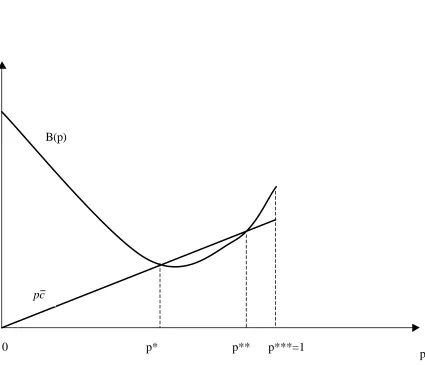
This result leaves open the possibility that multiple equilibria exist, and the following example confirms this.
Example 1(Multiple Equilibria).
Assume n= 3, and thatcis uniform on [0, c]. In this case, from (3.3),(3.4), we have:
B(p) = (q−0.5)[2p2q(1−q) + (1−p)2] (3.5)
Note that p∗ =F(c∗) =c∗/c, so assuming an interior equilibrium, the equilibrium
condi-tionB(F(c)) = ccan be rewritten in terms ofp as B(p) =pc, or explicitly as
(q−0.5)[2p2q(1−q) + (1−p)2] =pc (3.6)
This is a quadratic inp, with two roots:
p=
(2 +α) +
− p
(2 +α)2−8q(1−q)−4
2[2q(1−q) + 1] (3.7)
whereα =c/(q−0.5).If we takeq = 0.75,andc= 0.09,then it is easy to check that the two roots are
p∗ = 1.3119 1.375 , p
∗∗ = 1.0481
1.375
i.e. the voting game has two interior equilibria.Note also for these numbers that B(1) = 0.09375> c, so there is also a corner equilibrium where p∗∗∗ = 1.All these equilibria are illustrated in Figure 1 below.k
In the preceding example, the multiple equilibria are due to the non-monotonicity of the benefit function B(p). This is in contrast to the case of private values, where the benefit from voting is strictly decreasing in p, and hence there is a unique equilibrium (Borgers(2001), Proposition 2).
3.3. Comparing Common and Private Values
The equilibria of our model can in fact be compared to the voting equilibrium with private values in Borgers(2001). The first step is to note that the gain from voting with private values is, in our notation:
BP V(p) = 1 2
n−1
X
l=0
v(l:p)π(l : 0.5) (3.8)
Note three differences between (3.3) and (3.8). First, in the private values case, there is a benefit to voting even when the number of voters is odd. Second q is replaced by 0.5 in π(l : .) as any voter cannot predict how any other will vote, given that he decides to vote at all. As q(1−q) is maximized at q = 0.5, we can assert that π(l : 0.5)>π(l :q),
all q 6= 0.5.Finally, the benefit from one’s most preferred alternative relative to random selection rises from q −0.5 to 0.5 as in the private values case, voters are sure which alternative is best. It is clear that all these three differences raise the benefit to voting in the private values case, so that it is always true that
BP V(p)> B(p), 0≤p≤1 (3.9)
Moreover, as shown by Borgers, BP V(p) is decreasing in p, and so there is always a unique equilibrium in the private values case. Let cP V be the unique equilibrium cost cutoff in the private values case, and let cmax be the highest equilibrium cutoff in the common values case (this is well-defined by Proposition 1). Then we have:
Proposition 2. cmax ≤cP V, andcmax < cP V if cP V <¯c.
Proof. Case 1. BP V(1) > c.¯ Then cP V = ¯c. Also, BP V(1) > B(1) by (3.9), so by Proposition 1, with common values, cmax≤cP V.
Case 2. BP V(cP V) = cP V, some c˜∈ [c,¯c). In this case, as B(p) lies everywhere below
BP V(p),andp=F(c) is increasing inc,B(F(c))< BP V(F(c)), c∈[c,¯c]. Therefore, if c∗
solves B(F(c∗)) =c∗ then c∗ < c
P V, and in particular cmax < cP V. ¤
4. The Inefficiency of Participation Equilibria
The central and striking result with private values and costly voting is that the nega-tive externalities from voting decisions imply that compulsory voting is never desirable (Borgers (2001)). An implication of this “global” result is a “local” one: starting at the Bayes-Nash equilibrium cutoffc∗,it isalwaysPareto-improving to lower the cutoffslightly,
so that fewer agents vote on average. This could be implemented (for example) by taxing voting and returning the revenue as a lump-sum. Here, we investigate the robustness of this result.
4.1. Participation Externalities
We begin by defining the ex ante payoffto any citizen (i.e. prior to observingσi, ci),ignoring participation costs, but conditional on participating or not participating. Consider the ex ante payoffto any citizen if exactlymcitizens vote sincerely i.e. according to their signals. As all agents have identical prior beliefs that each state is equally likely and losses from type-I errors (choosingB when the state issA)and type-II errors ((choosing Awhen the state issB)are the same, the ex ante payoffis simply minus the cost of making the wrong decision (a type-I or type-II error), given majority voting:
u(m) =
−Pmk=(m+1)/2
Ã
m k
!
(1−q)kqm−k if m is odd
−Pmk=m2+1
Ã
m k
!
(1−q)kqm−k+ 0.5
Ã
m k
!
(1−q)m/2qm/2 if m is even
It is well-known that u(m+ 1) > u(m) i.e. more signals there are, the lower the prob-ability of error. Now, let u1(p), u0(p) be the expected payoffs from participation and non-participation for a given citizen i respectively, given that all j 6= i participate with probability p.These are:
u0(p) = n−1
X
m=0
fm(p)u(m), u1(p) = n−1
X
m=0
fm(p)u(m+ 1)
where {fm(p)}nm=0−1 is the Binomial distribution, with parameters n−1, p.
pivotal. In the common values setting, the first part of this statement is still true. The ambiguity arises because the increase in p can increase the expected utility of a voter when he is not pivotal, as more information is brought to the decision.
This can be shown most clearly in the case of three voters. Then, by direct calculation, we have:
u1(p) = (1−p)2q+ 2p(1−p)(q2+ 2q(1−q)0.5) +p2[q3+ 3q2(1−q)] (4.1)
The explanation is as follows.
• With probability (1−p)2, only 1 votes, so the correct decision will be taken with probability q.
• With probability 2p(1−p), only 1 and either 2 or 3 vote, so the correct decision will be taken with probability 1 when both receive the correct signal (which occurs with probability q2) or with probability half when both receive different signals
• With probabilityp2,all voters vote, so the correct decision will be taken with proba-bility 1 when all receive the correct signal (which occurs with probaproba-bilityq3)or when two out of three receive the correct signal (which occurs with probability3q2(1
−q))
Now (4.1) can be decomposed in the following way:
u1(p) =qΛ(p) +p2q2, Λ(p) =©1−p2+p22q(1−q)ª (4.2)
whereΛ(p)is the probability that1is pivotal. To see this, note that 1 isalways pivotal if no, or one other citizens participate, which occurs with probability 1−p2, and is pivotal when two other citizens participateonly if they receive different signals, which occurs with probability 2q(1−q). This decomposition is also possible in the general case, although the formula is complex and unenlightening15.
Clearly,Λ(p)is decreasing inp.This is as in private values case. But,unlike in private values case, 1 receives a positive benefit from an increase in p when he is not pivotal, as term p2q2 is increasing in p. By computation, it follows that when n= 3, this second effect dominates the first, and the overall participation externality is positive. We can prove that it is also true in the general case.
15Generally, u
Proposition 3. Both u1(p), u0(p) are increasing in p for all p∈ [0,1). That is, with common values, the overall participation externality is positive.
Proof. First, letfm(p)denote the probability that 0≤ m≤n−1other voters than
i vote when the probability of participation is p. Clearly, these are the probabilities of a Binomial distribution with parametersn−1, p. So
u1(p) = n−1
X
m=0
fm(p)u(m+ 1)
So,
u1(p0)−u1(p) = n−1
X
m=0
(fm(p0)−fm(p))u(m+ 1).
Now, for p0 > p,{fm(p0)}n−1
m=0first-order stochastically dominates{fm(p)} n−1
m=0.Asu(m+1) is monotonically increasing in m, we know that16
u1(p0)−u1(p) = n−1
X
m=0
(fm(p0)−fm(p))u(m+ 1) ≥0
The proof is the same for u0(p). ¤
4.2. Inefficiency of Equilibrium
In view of Proposition 3, one might expect any of the participation equilibria characterized in Proposition 1 to be inefficient, with too little participation, and here we prove that this is the case. The ex ante expected utility of any voter (i.e. prior to observation of (σi, ci)) in an equilibrium with participation probability p is:
U(p) = (1−p)u0(p) +pu1(p)−
Z F−1(p)
c
cf(c)dc (4.3)
So, differentiating:
U0(ˆc) = (1−p)u00(p) +pu01(p) +¡u1(p)−u0(p)−F−1(p)¢ (4.4) = (1−p)u00(p) +pu01(p) +¡B(p)−F−1(p)¢
where the second line follows from the definition of B(p) in Section 2 above. Evaluated at an interior Bayes-Nash equilibrium i.e. ˆc = c∗, c< c∗ < c, the last term vanishes, as
p=F(c∗),so B(p)−F−1(p) =B(F(c∗))−c∗ = 0. So, from (4.4), we have:
U0(F(c∗)) = (1−F(c∗))u00(F(c∗)) +F(c∗)u01(F(c∗)) (4.5)
But by Proposition 3, as u0, u1 are increasing inp, U0(F(c∗))>0. So, we have proved: Proposition 4. For all1≥q >0.5,starting any interior symmetric Bayesian equilibrium
c∗ ∈(c, c), a small increase in the cutoff cˆfromc∗ is always ex ante Pareto-improving.
Proposition 4 contrasts sharply with Borgers’ results. His global result with private val-ues establishes that it is never optimal to force agents to vote i.e. to raiseˆctoc. However, the proof of this result also establishes the local result that a small decrease in the cutoff
ˆ
c from c∗ is always ex ante Pareto-improving. In this sense, Proposition 4 shows how
a move from private values to common values reverses the nature of the inefficiency of voting equilibria.
Now consider two symmetric voting rules with cutoffs c∗ and c∗∗ such that c∗ < c∗∗. Then, the difference between the expected payoffs at the two equilibria can be written as
U(c∗∗)−U(c∗) =
Z c∗∗
c∗
(u00(F(c)) +F(c)B0(F(c)))f(c)dc+
Z c∗∗
c∗
(B(F(c))−c)f(c)dc
(4.6) whereU(c)≡U(F(C)).By Proposition 3, we know that thefirst integral is positive. How-ever, the sign of the second integral is ambiguous as B(p) is, in general, non-monotonic. This makes it impossible to obtain a general Pareto-ranking of equilibria. In particular, we cannot show that, in general, a Bayesian equilibrium with a higher cutoffvalue Pareto dominates a Bayesian equilibrium with a lower cutoff value. In general, it is also not possible to show that compulsory majority voting Pareto dominates Bayesian equilibrium outcomes with voluntary majority voting. However, the following results can be stated.
Proposition 5.Suppose that there are multiple voting equilibria as represented by cut-offs: c1 < .. < ck < ... < cm. If either (a) m ≥ 2, and B(1) < c or (b) m ≥ 3, there
is some k, 1 ≤ k ≤ m−1, such that the voting equilibrium ck+1 Pareto dominates the
voting equilibrium ck. If B(1) ≥c, then cm =c, and this equilibrium Pareto-dominates
equilibriumcm−1 i.e. starting atcm−1,imposing compulsory voting is Pareto-improving. Proof. As B(1) < c remark that at p = F(cm), B0(p) < 0. As m ≥ 2, it follows that there is at least one Bayesian equilibrium with cutoff ck, for some k, 1 ≤ k ≤ m −1 so that B0(p) > 0, p = F(ck) for some k < m. As B0(p) > 0, p = F(ck), for some
k < m, B(F(c)) > c, c ∈ (ck, ck+1). Alternatively, suppose there exist at least three voting equilibria. Then, there is at least one voting equilibrium with cutoff ck so that
B0(p) ≥ 0, p = F(ck) for some k < m. As B0(p) ≥ 0, p = F(ck), for some k < m,
of cm, cm−1, B(F(c)) ≥ c, c ∈ (cm−1, cm). So, from (4.6), U(c) = U(cm) > U(cm−1) i.e.
compulsory voting Pareto-dominates voluntary voting equilibriumcm.
Can compulsory voting lead to a Pareto-improvement when ¯c is not a voting equi-librium threshold? The following example shows that this a robust possibility. In this example, there is a unique equilibrium with ˆc < c, and starting at this equilibrium, im-posing compulsory voting leads to a strict Pareto-improvement.
Example 2 (Compulsory Voting May be Desirable).
The Example is the same as Example 1 i.e. n = 3 and uniform distribution of costs. Ex ante payoffs in this example can be computed from formula (4.3), which in this case simplifies to
U(p) =u0(p) +pB(p)− 1
c
Z pc
0
cdc=u0(p) +pB(p)−cp2/2
for any voting probability p.We already have computed a formula for B(p) i.e. (3.5) in Example 1. Also, note that
u0(p) = 0.5(1−p)2+ 2p(1−p)q+p2q
So, using (3.5), in the above formula, we conclude that
U(p) = 0.5(1−p)2 + 2p(1−p)q+p2q+p(q−0.5)[2p2q(1−q) + (1−p)2]−cp2/2 (4.7)
Now letq = 0.75,andψ be the value of cfor which the larger root of (3.6) is equal to 1. This will be the value for whichB(1) =ψ,andB(1) = (q−0.5)2q(1−q) = 0.09375.Then from Figure 1, it is clear that for c >ψ, there will be a unique equilibrium given by the smaller root to (3.6): the larger root is greater than 1 and so cannot be an equilibrium probability. So, takec = 0.0938. Then α =c/(q−0.5) = 0.3752.In this case, there is a unique interior equilibrium with voting probability given by the smaller root to (3.7) i.e.
p∗ = 0.99947
1.375 = 0.72689 (4.8) Now substituting ¯c= 0.0938and q= 0.75 in (4.7), after some simplification, we get:
U(p) = 0.5 + 0.75p−0.7969p2+ 0.34375p3 (4.9)
So, U(1) = 0.79685 > 0.75613 = U(p∗) i.e. compulsory voting leads to a strict Pareto-improvement. Indeed, from (4.9), it can be shown that U(p) is everywhere increasing in
Finally, we conclude this section by examining what happens when signals become uninformative. The following proposition shows that as signals become uninformative both the negative pivot externality and the positive information externality, and thus their overall effect, become negligible.
Proposition 6. As signals become uninformative, i.e. q → 0.5, U0(F(c∗)) tends to zero i.e. the welfare gain from raising participation from its equilibrium level becomes negligible .
Proof. As q → 0.5, u(m) → −0.5, all m. So, u1(p), u0(p) → −0.5, all p ∈ [0,1]. So,
u0
1(p), u00(p)→0 and the result then follows from (4.5). ¤
On the face of it, this result is somewhat counter-intuitive as the informativeness of the signal becomes small, one would think that the positive information externality becomes small, but not necessarily the pivot externality. However, the pivot externality becomes small because the value of being pivotal (to the pivotal voter) goes to zero with q−0.5 : if one’s signal is almost uninformative, the gain to being pivotal becomes negligible.
5. Preference Heterogeneity
It may be argued that while many collective decision problems have a common values component, voters almost always have personal or idiosyncratic preferences on issues. So, it is interesting to ask how robust our results are to the introduction of preference heterogeneity across voters17. In this section, we study this issue and obtain some results that go beyond the usual claim that results are robust to “small enough” perturbations in preferences. In particular, we can explicitly characterizethe size of the deviation away from common values (in a well-defined sense) such that voters are willing to ignore their personal preferences on the alternatives and vote with their signal. In this event, our main results, Propositions 4 and 5, still hold.
We model preference heterogeneity as follows. Let ai be a random draw from{A, B}
with Pr(ai = A) = 0.5, and define u0 : {A, B} × {A, B} → < with u0(L, ai) = 0, when
ai 6= L, and u0(L, ai) = 1 if ai = L. We also assume that the (a1..an) are indepen-dently distributed. The interpretation of ai is that it is an individual preference
param-17Note also that all agents have identical prior beliefs that each state is equally likely and losses from
eter. In Borgers’ (2001) model of pure private values, agents all have utility functions
u0(ai, K).Now define we define a new utility function:
ui(K, s) = (1−ε)u(K, s) +εu0(ai, K), K =A, B, 0≤ε≤1
where u(K, s) is the common values utility defined above. We now define the mixed preference (common values, private values) model as following. At step 1, nature now generates a pair (ai,σi) for each i
∈ N which is transmitted privately to each i. In subsequent play, agents are assumed to have utility functions (u1...un) over actions and states. In all other respects, the mixed model is the same as the common values model defined in Section 2. Note that if ε= 0, the mixed model reduces to the common values model. Our robustness result is the following:
Proposition 7. In the mixed preference model, there is an equilibrium where those participating vote according to their signal if the weight on private values is sufficiently small, i.e. ε<min{ˆε,˜ε}, ˜ε= (q−0.5)/(1 +q−0.5), ˆε= (χ−0.5)/(2 + (χ−0.5)), where
χ=q2/(q2+ (1
−q)2).Moreover, expected payoffs at this equilibrium to non-participants
and participants are (1−ε)u0(p)−0.5ε, (1−ε)u1(p)−0.5ε respectively, where p is the
equilibrium participation probability. Consequently, for ε < min{ˆε,˜ε}, Propositions 4 and 5 apply in the mixed preference model.
Proof. (i) The bound on ε. We proceed by calculating the gain to a voter ifrom voting according to her signal, rather than voting according to her private preference, conditional on fixed l. We make this calculation under the assumption that all j 6=i vote according to their signals.
Case 1: l even. Here, i is pivotal only when there is a tie i.e. exactly l
2 voters vote for A while the other l
2 voters vote for B. The gain to voting according to the signal is lowest when the signal and the personal preference parameter are opposed i.e. σi = σ
K,
ai = L, L
6
=K. Then, the payoff to voting according to the signal is (1−ε)(q−1)−ε.
The payoff to voting according to personal preference is−(1−ε)0.5. So, it is preferable to vote according to personal preference ifε<˜ε= (q−0.5)/(1 +q−0.5).
Case 2: l odd. In this case, there are two subcases wherei is pivotal. Assume w.l.o.g. thati0s signal is in favor of alternativeA.The first subcase is where l+1
2 voters have voted forA, and l−1
2 forB.In this case,iinfers that the probability ofAisχ=q
2/(q2+(1
−q)2), as he has observed two signals more signals in favor of q than against18.Then, the payoff
18Formally,χis equal to the posterior probability that the state is (say) A, given that there arel+ 1
to voting according to signal is (1−ε)(χ−1)−ε. The payoff to voting according to personal preference is (1−ε)0.5.
The second subcase is where l+12 voters have voted forB, and l−21 for A.In this case,
i infers that the probability of A is 0.5, as he has effectively observed equal numbers of signals in favor of AandB. Then, the payoffto voting according to signal is (1−ε)(0.5− 1)−ε,and the payoff to voting according to personal preference is−(1−ε)0.5.
Conditional onl odd,i does not know which of these two subcases has occurred when he decides whether to vote with his signal or with his personal preference. But, as the signals are i.i.d., knowing σi does not help predict the signals of others. So, these two events will be equally likely. So, the overall expected gain to i from voting according to his signal, rather than for his personal preference, is always at least
∆= 0.5(1−ε)(0.5−1) + 0.5(1−ε)(χ−1)−ε+ (1−ε)0.5
So,∆>0 if ε <ˆε = (χ−0.5)/(2 + (χ−0.5)).So, if ε<min{ˆε,˜ε}, the best response to allj 6=ivoting with their signals is for ito vote with her signal,whatever l.
(ii) Remainder of proof. In an equilibrium where all participants vote according to their signals, the expected value of the common value component of ui is u0(p) if i does not participate, andu1(p)if she does. The expected value of the private value component ofui is simply −0.5,as the collective decision is taken on information that is uncorrelated withai.The formulae for equilibrium payoffs follow immediately. These formulae say that equilibrium payoffs are just affine transformations of equilibrium payoffs in the original common game, and it is clear from the inspection of proofs of Propositions 4 and 5 that these proofs are unaffected by affine transformations of payoffs. ¤
Several points on the bound min{ˆε,˜ε} are worth noting. First, it only depends on the informativeness of the signal, q. As the signal is informative q > 0.5, χ > 0.5,
and so ˆε,˜ε > 0 always: moreover, upper bounds on ˆε,˜ε is when q = 1, in which case ˆ
ε= 1/5, ˜ε= 1/3.
6. Conclusion
finding that there are two different externalities at work: the negative “pivot” externality identified by Borgers (2001) and the positive information externality. In the vicinity of a Bayesian equilibrium, the positive informational externality always outweighs the neg-ative “pivot” externality implying that too few voters, on the average, participate in the voting process.
References
[1] Austen-Smith, D. and J.S. Banks (1996),“Information Aggregation, Rationality and the Condorcet jury theorem”,American Political Science Review, 90, pp.34-45.
[2] Borgers, T. (2001),“Costly Voting”, mimeo, University College London.
[3] Dekel, E. and M. Piccione (2000),“Sequential Voting Procedures in Symmetric Bi-nary Elections”, Journal of Political Economy, 108(1), pp.34-55.
[4] Feddersen, T and W. Pessendorfer (1996), “The Swing Voter’s Curse”, American Economic Review, 86(3), pp.3408-424.
[5] Feddersen, T and W. Pessendorfer (1997),“Voting Behavior and Information Aggre-gation in Elections with Private Information”, Econometrica, 65(5), pp.1029-1058.
[6] Feddersen, T and W. Pessendorfer (1998) “Convicting the Innocent: the Inferiority of Unanimuous Jury Verdicts under Strategic Voting”, American Political Science 92(1), pp.25-35.
[7] Hadar,J. and W.R.Russell (1969), “Rules for Ordering Uncertain Prospects”, Amer-ican Economic Review, 59(1), pp. 25-34.
[8] Lohmann, S. (1994),“Information Aggregation with Costly Political Action”, Amer-ican Economic Review, 84(1), pp.518-530.
[9] Osborne, M. and J. Rosenthal and M. Turner (2000), “Meetings with Costly Partic-ipation”,American Economic Review, 90(4), pp.927-943.
[10] Persico, N., (2001), “Committee Design with Endogeous Information”, Review of Economic Studies , forthcoming
Figure 1 : Multiple Symmetric Bayesian Equilibria
p p***=1
0
B(p)
p* p**