Local decision-makers views’ of national guidance on interventional
procedures in the UK
ABSTRACT
Objectives: To identify how NHS decision-makers manage and perceive NICE interventional procedures guidance (IPG) and to determine whether there would be additional information that would be useful to present to decision-makers.
Methods: Qualitative study using one-to-one semi-structured interviews. The framework approach was used to analyse the data generated from 14 participants, and emergent themes coded. Data were analysed separately for providers and commissioner organisations.
Results: Perceptions about how IPGs are managed in provider organisations varied. Some decision-makers considered that guidance is handled very well. Others think that management is suboptimal and haphazard, and it is unclear about whether clinicians follow procedure for cautionary guidance. In commissioner organisations, IPGs are not seen as a priority by most and are not considered an area that will soon enter routine clinical practice. Moreover, commissioners felt that IPGs lacked relevance as there is no consideration of whether procedures are cost-effective or affordable. In general, respondents perceive that the content and quality of guidance is satisfactory. To different extents, useful additional types of information for inclusion in guidance would be: prevalence, incidence, cost, patient views, consequences of using the new treatment, comparative information, effectiveness and cost-effectiveness.
INTRODUCTION
New interventional procedures are often introduced in a variable and somewhat uncontrolled manner. Following concerns described in the Bristol Inquiry (Kennedy report),1 a programme of work within the National Institute for Health and Clinical Excellence (NICE) was established to improve and regulate how these procedures enter routine clinical practice. Since 2003, the Interventional Procedures Programme has provided guidance on the safety and efficacy of new interventional procedures to decision-makers in the National Health Services (NHS) in the United Kingdom (UK)2 The guidance includes a description of the technology, a summary of results and the type of recommendation made by the committee (normal, cautionary, research only, should not be used).3
Interventional procedures guidance (IPG) is not mandatory and therefore it is the responsibility of each organisation to implement them. As the success of this Programme is dependent on appropriate engagement from the NHS,4 this study was designed to explore how NHS decision-makers respond to IPGs. We also aimed to: (1) identify how decision-makers perceive IPGs; (2) identify key problems related to IPGs, as perceived by NHS decision-makers; (3) determine whether there would be additional information that would be useful to them; and (4) offer insights in how IPGs can be improved.
METHODS
Participants and setting
list of known committee members of the Interventional Procedures Programme hosted at NICE; an NHS network group with an interest in public health; and snowball sampling of key participants involved in decision-making on prioritisation of treatments in the NHS. A recruitment letter with details about the study was e-mailed to every person contacted.
Data collection
Data was generated from NHS decision-makers using one to one, face to face semi-structured interviews, at a time and venue convenient for the participant. Prior to the interview, participants received a „participant information leaflet‟ explaining study‟s objectives and purpose of the interview. All participants signed a consent form at the beginning of the interview. Using an interview topic guide, participants were asked open-ended questions exploring (1) how IPGs are handled in their place of work in terms of process, dissemination and monitoring; (2) their perceptions about IPGs; and (3) problems and improvements related to the guidance, including additional types of information that could be added to guidance. Following the interview, participants were also asked to rate on a visual analogue scale (VAS) ranging from zero to ten, how much they would value different types of information if it were added to the IPG. They were also asked to rank which types of information would be most useful at the time guidance is issued. The different types of information can be seen in Figure 3. The ranking exercise was designed to identify not only what would be useful to have, but also, what is it that decision-makers really want. Data were digitally recorded and transcribed verbatim.
Data analysis
and emerging themes from the transcripts. Two researchers systematically coded the transcripts. Thematic categories were developed by further refining the initial coding frame and thematic charts were checked by at least one other researcher within the team. Disagreements were resolved by consensus or arbitration. Data obtained from the VAS and ranking exercise were subjected to descriptive analyses. Medians were calculated and radar diagrams were plotted.
Different organisational arrangements of the NHS are in place in England, Scotland and Wales, however, regardless of country, NHS organisations can be broadly divided into commissioner and provider of services. Decision-makers‟ views for both types of organisational arrangements were explored, and a stratified data-analysis was conducted in order to identify potential subgroup differences in how IPGs are handled and perceived by commissioners and providers.
RESULTS
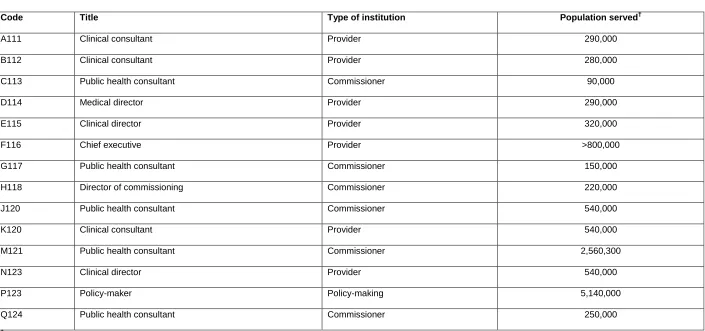
Out of the 18 decision-makers contacted, 15 replied and agreed to be interviewed, although an interview time could not be set for one. Fourteen interviews were conducted by one researcher (TL) over a period of four months in 2008. The sample varied in relation to setting, type of organisational structure (commissioner or provider) and role in the decision-making process (Table 1). Respondents were widely dispersed: nine from England (six of ten Strategic Health Authorities), four from Scotland and one from Wales.
Dissemination and management strategies of interventional procedures
guidance
Provider organisations
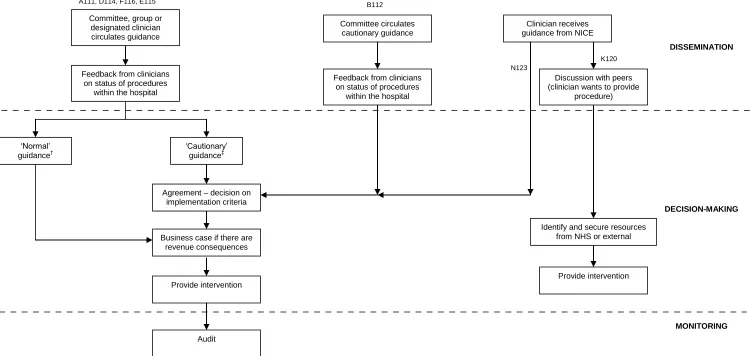
centres, all guidance is disseminated to relevant clinicians by a designated individual or a committee/group within the organisation. In one centre, a designated individual within a committee/group circulates only cautionary guidance. In two centres, an internal system for dissemination of guidance did not appear to exist and clinicians in these centres received guidance directly from NICE.
In general, following circulation of guidance, the committee/group or designated individual expects feedback from clinicians on the status of the procedures in their organisation, or whether they would like to provide the procedures. For example, one respondent explained that:
D114: “All the guidance that is produced by IPAC, which is relevant to the trust… gets forwarded to the lead clinician… and it is expected that they actually feedback what they find…”
In five centres, for procedures with „cautionary‟ guidance (see Figure 1), a group/committee is expected to agree and decide on the implementation criteria. If the procedure has cost-consequences while appearing to provide additional benefits to patients, or had the potential to improve survival, then a business case would be prepared by the clinician making the request.
One centre however seemed to lack a structured process in the method in which IPGs were managed:
K120: “(…) I‟m not sure it has a formal mechanism to react to it…I‟m aware they receive them, but I‟m not sure that anything then happens… I think that the expectation is that within each specialty people will pay attention to them.”
Commissioner organisations
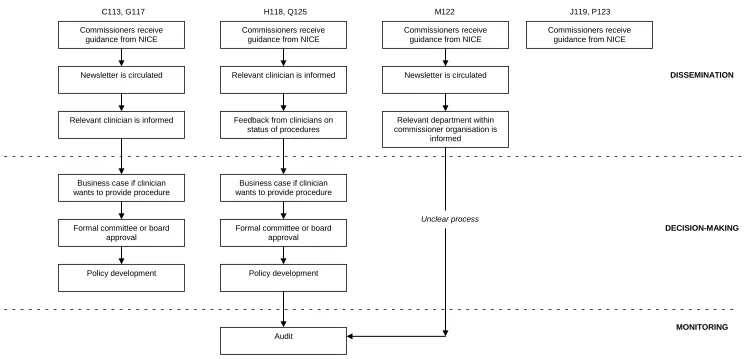
Figure 2 describes the different patterns in which commissioner organisations manage IPGs. In terms of dissemination, commissioners receive guidance directly from NICE. In three centres, this is then circulated across the organisation. In four centres, guidance is also circulated to relevant clinicians and it is expected that they will provide feedback on the status of the procedures in their organisation or whether they would like to provide the procedures is expected:
H118: “(…) the interventional procedure guidance comes into the commissioning part of the organization and we have a group that is set up that… decides which provider it is relevant for and sends it to the provider for them to feedback to the commissioner.”
In four centres, after guidance is disseminated, a business case would usually be prepared and presented to the commissioner organisation if the clinician wants to provide the procedure.
Although the majority of centres seem to have a process to handle IPGs, the general impression was that the commissioner organisation works in a reactive manner, as one participant said:
Q125: “So we wait for NICE… to issue guidance and we wait for people to put in requests then we begin to respond, as opposed to doing things more proactively...”
Perceptions about management and importance of guidance
Provider organisations
Some decision-makers considered that guidance is handled very well and an active system within the centres exists to respond to guidance. However, one participant felt that guidance could be better managed (especially for monitoring) if there were more resources available. Others thought that management was suboptimal and haphazard and it was unclear about whether clinicians follow the procedure for cautionary guidance:
B112: “I think is rather haphazard. I don‟t think we really have a good method…I‟m not sure that the trust is really taking it on board.”
One participant noted that guidance is increasingly seen by consultants as a support material to get procedures approved:
B112: “…I‟ve noticed more recently when consultants are submitting their evidence, will quote the NICE guidance if it supports what they want to do. So, I think they‟re learning that it‟s [NICE guidance] actually there to support them more often than not.”
Furthermore, IPGs were described as a method of confirmation to clinicians who already perform the procedure, and to inform patients and those clinicians who have never performed it:
introduction… what it is trying to do is to tell the wider institution about these procedures, and maybe patients who might be thinking about them or indeed maybe general practitioners that might need to know a bit, or maybe, say generalists, who might not have started doing those procedures.”
Commissioner organisations
IPGs are not seen as a priority by most. Respondents expressed that this is because this guidance does not have the same mandatory nature as NICE technology appraisals have in the NHS within England:
C113: “…we‟re more interested in technology assessment [appraisals] more than IPGs, because IPGs are not compulsory for the NHS.”
However, one participant highlighted IPGs as a way of identifying areas for future research rather than technologies that will soon enter routine clinical practice in the NHS.
Q125: “My perception is that we look at an area that NICE has issued good practice guidelines for further applied research; that this is not an area of work that will be routinely brought into practice in the NHS at the present time.”
Many respondents were concerned about the lack of relevance of IPGs to the commissioners as they do not inform commissioners whether the procedure is cost-effective or affordable:
C113: “But for IPGs, it‟s „safe‟ and „efficacious‟, OK, that‟s nice to know, but I need to know if it is cost-effective, if it is affordable, who to give it to, and so on.”
Perceptions about content and quality
Provider organisations
B112: “I think they‟re fantastic! …I think that the advice is practical without being too restrictive… The quality of the recommendations depends very much on the quality of the evidence…”
Commissioner organisations
In general, respondents at commissioner organisations perceived that the content and quality of guidance is also satisfactory. One added that guidance is „useful‟ and „educative‟:
G117: “They can be quite useful; …it has been quite an educative experience. In terms of what they do… they‟re fine.”
However, there were arguments that the content of guidance is not applicable to commissioner organisations. This was also supported by two additional respondents adding that important information about costs and cost-effectiveness is absent:
C113: “…the most important thing is the cost-effectiveness… that‟s why they‟re [IPGs] not very useful in everyday life…”
Although they broadly thought guidance was adequate, commissioners felt that it was unclear whether the procedure is applied research, or is already in practice, and whether the procedure is being recommended by NICE or recommended on the possible introduction on safety and governance issues:
Perceived potential barriers to effective response to guidance
Provider organisations
It was highlighted that it is difficult to monitor procedures with IPGs within provider organisations, as these are not coded.
A111: “For example code for coblation tonsillectomy. That is something that there were great concerns over. It‟s only one way of doing tonsillectomy and it doesn‟t show through in the coding and there‟s no way of telling from the data the hospital collects how many coblation tonsillectomies are occurring...”
It was also noted that some clinicians felt that guidance affects their clinical freedom, potentially creating some resistance in taking on board trust procedure. Moreover, there have been concerns about how IPGs are interpreted, suggesting a degree of ambiguity in the guidance:
B112: “The problem is sometimes people don‟t read the guidance properly and they put their own interpretation on the wordings… people tend to read what they want to read, they will interpret it as NICE has damned this when actually hasn‟t.”
Other problems were related to how NICE interventional procedures advisory committee (IPAC) is regulated and set up, and concerns about its representative nature were expressed:
F116: “Another thing about the IPAC is probably the representative nature of the committee… there‟s an awful lot of white middle aged men on the committee! It‟s not perhaps as diverse as it should be!”
Commissioner organisations
The main problem perceived by commissioners was that IPGs seem to lack context, consider procedures in isolation, and lack prioritisation:
this is something that would be absolutely first line, and would be the treatment for everybody... That‟s not always clear, especially when you start getting into some tertiary level stuff where you‟re really not sure how exactly a patient has been treated.”
Q125: “…there is lack of prioritisation within the NICE process… they‟ve just issued a guidance on all these new technologies over the year as if they were all likely to be of equal benefit.”
There were also concerns about the ambiguity of guidance. A couple of respondents noted that there is confusion regarding the status of IPGs, giving rise to external pressures:
Q125: “…we had a request from the patient and his GP… They quoted the fact that NICE had issued interventional procedures guidance about this [a procedure] and they took that as a sign of approval the fact that NICE had made some recommendations about audit, about governance, about the introduction of an interventional procedure. They took that as overall approval of the procedure and… think PCTs should commission it. “
Suggestions for improving response to guidance and its content
Provider organisations
Some respondents felt that better management plans within provider organisations are required to deal with procedures with an IPG:
B112: “…we should have somebody sifting through it all, making sure that procedures that have cautionary guidance are being used or not and then having fairly robust methods of checking that… people are following the guidelines…”
introduction of a NICE interventional procedure should become more centralised since the decision-maker who holds the budget, does not often realise the impact of such procedure at the individual clinical units. Guidance should be circulated not only to relevant clinicians, but also to those who are responsible for budget allocation.
N123: “I think that the dissemination to certain managers that hold the purse strings might be useful so that they know that this might be needed.”
Moreover, one respondent stressed that there should be better support mechanisms from NICE or the government regarding the implementation of guidance at provider organisations:
A111:”I think the big fault of all… government initiatives is that it stops at the guidance, and very often there isn‟t any real help to implement things. There isn‟t any real look to see how well they‟ve been implemented… NICE puts out this information, but it puts out into a vacuum and how individual trusts deal with it is up to them.”
Although quality and content of guidance was described as being satisfactory, respondents felt that additional information on top of what is currently provided in the guidance would be useful. It was noted that there are issues surrounding the production of business cases. One respondent would like to see more readily available information to help inform business cases, and suggested that NICE could produce some relevant information to help procedures being introduced.
Another cited that it would be useful to include in the guidance information about whether the speciality associations agree with NICE‟s decision, and details about what other centres are doing:
K120: “…it would be useful to know whether the specialty association… agrees as well that this is a reasonable thing to be doing… It would be nice to get some input from a number of centres around the country as to how many they‟re doing, what the outcomes are, and to be able to talk to other units that are doing it.”
In general, respondents felt that in terms of additional types of information, they would like to see information on costs of the procedure as well as the number of patients affected:
E115: “the areas where we need to go looking for more information surround all the business case arguments, so the cost, the number of patients, etc, but on the other hand it is not within IPAC‟s remit.”
Also, one respondent mentioned that it would be useful to have more comparative information between treatments:
D114: “I think the area of weakness is that there isn‟t a comparison data between the two different procedures… it would be more useful to have more comparative data.”
Commissioner organisations
One respondent would like to see better monitoring of NICE interventional procedures, but the majority were unclear about what can be improved in the current management of IPGs. However, they expressed improvements related to the content of guidance. Like providers, one respondent cited that it would be useful to know what other centres are doing and wondered whether NICE would be prepared to include that sort of information in the guidance.
C113: “Something that is useful would be what happens around the country. What other PCTs do… When we get the requests from the clinician, they tell us „oh, everybody else is doing it, apart from you!‟.”
In order to help decision-makers make judgements about likely benefits and give an indication of hierarchy between treatments, one respondent would like to see a linkage and a comparison between guidance that was issued for the same clinical problem:
Q125: “NICE have issued guidance in the last two or three years on foam sclerotherapy for varicose veins, radiofrequency ablation for varicose veins and laser treatment for varicose veins… they‟ve issued them all independently even though they‟re all for treatment of varicose veins… if they‟re going to issue guidance in a number of new technologies in one clinical area, I can‟t see why they couldn‟t reference the other guidance… Even if it wasn‟t an absolute judgement, they could give some indication of the hierarchy, what‟s likely to be superseded? Is there poor benefits?”
Also, it was noted that it would be useful if NICE could give an indication of what treatments are not worth doing:
Another respondent felt that IPGs should provide more detail about the likely status of the procedure in the NHS and that NICE provides advice to the NHS as a whole not just to individual clinicians:
G117: “…Given that NICE is for advice to the NHS… they should be looking at the importance to the commissioning body as opposed to advice to the individual clinician because they‟re giving advice to the NHS and sometimes that gets forgotten and the commissioning body is not an expert in every minor detail in what goes on in a clinical treatment.”
In general, decision-makers suggested that NICE IPGs would be more useful if they gave and indication of the cost and if they went beyond efficacy to effectiveness and cost-effectiveness if the evidence exists:
C113: “The most important thing is the cost-effectiveness. They don‟t look at that. That‟s why they‟re not very useful…”
G117: “…last week we had two that we were looking at the IPGs partly because is just to say „is there any objective evidence on the safety and efficacy, particularly efficacy for individual patients?‟ But it still doesn‟t help us because of cost-effectiveness.
Also, some respondents would like to see details about the prevalence and incidence of the condition because such information is not readily available and without this, it is difficult to make a decision as to whether a procedure should be implemented or not. Moreover, two respondents cited that guidance should incorporate patient and carer views.
Based on VAS responses, all types of information were thought to be highly useful, but the ones that they would value the most were: „number of patients affected‟, „cost of treatment‟, „effectiveness‟ and „cost-effectiveness‟ (Figure 3).
DISCUSSION
This study is the first to explore how decision-makers in the NHS manage and perceive IPGs. It identifies some potential barriers to the successful implementation of IPGs and identifies areas of improvement.
The findings of this exploratory study suggest that the process in which IPGs are managed varies between countries, centres and type of institution. It was found that guidance appears to reach commissioners and providers and in most institutions there are efforts to have a structured process of response for IPGs. However, having a process in place does not necessarily mean that the procedure is followed as this depends on the value that decision-makers place on this type of guidance. Promulgation of guidance has been shown to have little effect on practice.7 The patterns of management identified in our research describe organisational responses to manage the implementation of new interventional procedures. In terms of perceptions, the management of guidance is suboptimal; there is a lack of a structured process in some centres; and there is resistance to conform to guidance. This indicates that improvements are required in how IPGs are handled and perceived in the NHS. Another point for analysis is whether commissioner organisations should have a role in the management of IPGs as these are generally perceived as low priority and lacking relevance.
procedures. Compliance with the latter type of guidance is mandatory in England and Wales. Our study suggests that there needs to be an improvement in how the different types of recommendations in an IPG are perceived and the role of the Programme requires better understanding.
An interesting finding arising from this study was that the purpose of an IPG can be perceived as nothing more than a method of confirmation to those already performing the procedure, or as information to generalists and patients about the existence of such procedures. It was also noted that guidance can be perceived as a „good practice guideline‟ rather than something that would soon enter routine clinical practice. These perceptions go against the purpose of this type of guidance as delineated in the 2003 health services directive.4
It was perceived that monitoring is an area that needs to be improved for effective management of procedures in the NHS. The main factors that seemed to contribute to ineffective monitoring were: lack of coding, registries and resources.
would be a good thing to add to guidance, they seemed more concerned about the lack of information on prevalence, costs and comparative information between treatments. Despite the perceived value of cost-effectiveness data, decision-makers at provider organisations would also like to have more readily available information to help inform business cases. This includes information about prevalence, the consequences of using the new treatment, and effectiveness. Adding such information to guidance would improve how decision-makers value and perceive this type of guidance.
It was highlighted that NICE should be reminded that it provides advice to the NHS as a whole and not just for individual clinicians, and therefore, more information around the procedures is required as guidance will also be considered by decision-makers who dot have a clinical background.
This study illustrates how decision-makers in the NHS value the concept of transparency. There were remarks about the representative nature of people sitting in the advisory committee, and how they are selected, as well as whether individual medical speciality associations endorse the recommendations issued by NICE. Also decision-makers highlighted that they would like to know which treatments are offered in other centres. If there were national registers and appropriate coding available for all NICE procedures, then this type of information could be more easily retrieved.
Strengths and limitations
decision-makers‟ perceptions about guidance and the identification of problems and likely improvements related to guidance.
The study allowed us to evaluate the needs of NHS decision-makers in terms of what would be useful to be added to the guidance to improve decision-making about the introduction of new interventional procedures. By using a ranking approach with incorporated monetary cost for obtaining each type of information, it allowed the identification of information that is genuinely useful given the constrained resources available to the NHS. Moreover, participants came from a diverse background reflecting different cultures and organisational structures within the NHS, making findings relevant to the wider UK context.
The study relied on perceptions and experiences of decision-makers, therefore actual practice may differ. Also, five out of the seven participants interviewed in the provider organisations are members of the NICE Interventional Procedures Advisory Committee. It is possible that participant‟s exposure to decision-making in relation to interventional procedures may have been atypical and therefore their views might not be representative of the NHS as a whole. Although the sample size was purposively identified, it is possible that radically different approaches might have been identified, had more people been interviewed. There was, as described in the results, a degree of consistency between interviewees. Overall, our interviews enabled the identification of a range of knowledge interpretation and general awareness towards NICE Interventional Procedures Guidance, which was our purpose.
Conclusion
and what should be happening and that guidance from the Interventional Procedures Programme may not be having the desired impact. This study therefore suggests that the management and perceptions of IPGs could be improved.
Competing interests
None.
Ethical approval
Not required.
REFERENCES
1. Learning from Bristol: the report of the public inquiry into children's heart surgery at the Bristol Royal Infirmary 1984-1995. Available at:
http://www.bristol-inquiry.org.uk/final_report/index.htm. 2007.
2. National Institute for Clinical Excellence. Press release - NICE launches first interventional procedures guidance to protect patients and support health professionals when performing innovative surgical procedures; 2003. Available at:
http://www.nice.org.uk/newsroom/pressreleases/pressreleasearchive/pressrele
ases2003/guidance_to_protect_patients.jsp
3. National Institute for Health and Clinical Excellence, Interventional Procedures Programme methods guide 2007; Available at:
http://www.nice.org.uk/media/70C/85/IPMethodGuideforweb180607.pdf.
5. Pope C, Ziebland S, Mays N. Qualitative research in health care: Analysing qualitative data. BMJ 2000; 8;320:114-6.
6. Bryman A, Burgess RG. Analysing qualitative data. In: Ritchi J, Spencer L, editors. Qualitative data analysis for applied policy research 1994; Routledge; London.
Figure 1 Patterns of the management of interventional procedures guidance in provider organisations
K120 N123
B112 A111, D114, F116, E115
Committee, group or designated clinician circulates guidance
Feedback from clinicians on status of procedures
within the hospital
„Normal‟ guidance†
„Cautionary‟ guidance‡
Agreement – decision on implementation criteria
Business case if there are revenue consequences
Provide intervention
Audit
DISSEMINATION
DECISION-MAKING
MONITORING
Committee circulates cautionary guidance
Feedback from clinicians on status of procedures
within the hospital
Clinician receives guidance from NICE
Discussion with peers (clinician wants to provide
procedure)
Provide intervention Identify and secure resources
Figure 2 Patterns of the management of interventional procedures guidance in commissioner organisations
J119, P123 M122
H118, Q125 C113, G117
Commissioners receive guidance from NICE
Newsletter is circulated
Relevant clinician is informed
Business case if clinician wants to provide procedure
Formal committee or board approval
Policy development
Commissioners receive guidance from NICE
Relevant clinician is informed
Feedback from clinicians on status of procedures
DISSEMINATION
Business case if clinician wants to provide procedure
Formal committee or board approval
Policy development
Audit
DECISION-MAKING
MONITORING
Commissioners receive guidance from NICE
Newsletter is circulated
Relevant department within commissioner organisation is
informed
Commissioners receive guidance from NICE
Commisioners 0 1 2 3 4 5 6 7 8 9 10 11
number of patients affected
number of patients treated
cost of new treatment
training needs
current management
average cost of current management consequences of using new treatment
costs of consequences effectiveness costs in comparison with current treatment
cost-effectiveness Providers 0 1 2 3 4 5 6 7 8 9 10 11
number of patients affected
number of patients treated
cost of new treatment
training needs
current management
average cost of current management consequences of using new treatment
costs of consequences effectiveness costs in comparison with current treatment
[image:24.842.35.771.140.395.2]cost-effectiveness
Figure 3 Radar diagrams describing median scores for each type of information ranked by participants in the ranking exercise (1=last choice; 11=first choice)
Table 1 Participant characteristics
Code Title Type of institution Population served†
A111 Clinical consultant Provider 290,000
B112 Clinical consultant Provider 280,000
C113 Public health consultant Commissioner 90,000
D114 Medical director Provider 290,000
E115 Clinical director Provider 320,000
F116 Chief executive Provider >800,000
G117 Public health consultant Commissioner 150,000
H118 Director of commissioning Commissioner 220,000
J120 Public health consultant Commissioner 540,000
K120 Clinical consultant Provider 540,000
M121 Public health consultant Commissioner 2,560,300
N123 Clinical director Provider 540,000
P123 Policy-maker Policy-making 5,140,000
Q124 Public health consultant Commissioner 250,000