Galaxy And Mass Assembly (GAMA): The sSFR–M
∗
relation part I –
σ
sSFR
–M
∗
as a function of sample, SFR indicator, and environment
L. J. M. Davies ,
1‹C. del P. Lagos ,
1,2A. Katsianis ,
3A. S. G. Robotham ,
1,2L. Cortese ,
1,2S. P. Driver,
1M. N. Bremer,
4M. J. I. Brown,
5S. Brough ,
6M. E. Cluver ,
7,8M. W. Grootes,
9B. W. Holwerda ,
10M. Owers
11and S. Phillipps
41ICRAR, The University of Western Australia, 35 Stirling Highway, Crawley, WA 6009, Australia 2ARC Centre of Excellence for All Sky Astrophysics in 3 Dimensions (ASTRO 3D)
3Department of Astronomy, Universitad de Chile, Camino El Observatorio 1515, Las Condes, 7591245 Santiago, Chile 4School of Physics, University of Bristol, Tyndall Avenue, Bristol BS8 1TL, UK
5School of Physics and Astronomy, Monash University, Clayton, VIC 3800, Australia 6School of Physics, University of New South Wales, Sydney, NSW 2052, Australia
7Centre for Astrophysics and Supercomputing, Swinburne University of Technology, John Street, Hawthorn, VIC 3122, Australia 8Department of Physics and Astronomy, University of the Western Cape, Robert Sobukwe Road, Bellville 7535, South Africa 9ESA/ESTEC SCI-S, Keplerlaan 1, NL-2201 AZ Noordwijk, the Netherlands
10Department of Physics and Astronomy, University of Louisville, 102 Natural Science Building, Louisville, KY 40292, USA 11Department of Physics and Astronomy, Macquarie University, North Ryde, NSW 2109, Australia
Accepted 2018 October 29. Received 2018 October 28; in original form 2018 September 6
A B S T R A C T
Recently, a number of studies have proposed that the dispersion along the star formation rate (SFR) – stellar mass relation (σsSFR–M∗) – is indicative of variations in star formation history
driven by feedback processes. They found a ‘U’-shaped dispersion and attribute the increased scatter at low and high stellar masses to stellar and active galactic nuclei feedback, respectively. However, measuringσsSFRand the shape of theσsSFR–M∗relation is problematic and can vary
dramatically depending on the sample selected, chosen separation of passive/star-forming systems, and method of deriving SFRs (i.e. Hαemission versus spectral energy distribution fitting). As such, any astrophysical conclusions drawn from measurements of σsSFR must
consider these dependencies. Here, we use the Galaxy And Mass Assembly survey to explore howσsSFRvaries with SFR indicator for a variety of selections for disc-like ‘main-sequence’
star-forming galaxies including colour, SFR, visual morphology, bulge-to-total mass ratio, S´ersic index, and mixture modelling. We find that irrespective of sample selection and/or SFR indicator, the dispersion along the sSFR–M∗ relation does follow a ‘U’-shaped distribution. This suggests that the shape is physical and not an artefact of sample selection or method. We then compare theσsSFR–M∗relation to state-of-the-art hydrodynamical and semi-analytic models and find good agreement with our observed results. Finally, we find that for group satellites this ‘U’-shaped distribution is not observed due to additional high scatter population at intermediate stellar masses.
Key words: galaxies: evolution – galaxies: general – galaxies: groups: general.
1 I N T R O D U C T I O N
Star-forming galaxies over a range of epochs and environments have been found to display a tight correlation between their star formation
rate (SFR) and stellar mass (M∗), described as the star-forming
sequence (SFS, or star-forming ‘main sequence’; Elbaz et al.2007;
Noeske et al.2007; Salim et al.2007; Whitaker et al.2012; Davies
E-mail:[email protected]
et al.2016). This sequence has been shown to be largely linear out
to high redshift, but with increasing normalization as a function
of look-back time (e.g. Lee et al.2015; Schreiber et al.2015). The
physical interpretation of these observations (i.e. Bouch´e et al.2010;
Daddi et al.2010; Genzel et al.2010; Lagos et al.2011; Dav´e et al.
2013; Lilly et al.2013; Mitchell et al.2016) is that the bulk of
star-forming galaxies reside in a self-regulated equilibrium state, where the inflow rate of gas for future star formation is balanced by the rate at which new stars are formed and the outflow of gas from feedback events [i.e. supernovae (SNe) and active galactic nuclei (AGN)].
2018 The Author(s)
However, within the full sSFR–M∗ plane the situation is more complex. While this simple self-regulated model is likely to fit for sources that sit close to the locus of the SFS, there exist various other population that deviate from this model, such as the passive cloud that sits below the SFS, ‘green valley’ sources that sit be-tween the SFS and passive cloud, and star-bursting sources that reside above the SFS. More recent results have found that galaxies move significantly within the SFS over their lifetime based on small
star-burst/quenching events (i.e. Magdis et al.2012; Tacchella et al.
2016), such that the locus of the SFS remains constant at a given
epoch, but with individual galaxies move within the SFS producing the observed scatter. In addition, there has been recent evidence to suggest that the SFS is non-linear in the high stellar mass regime
and flattens (e.g. Rodighiero et al.2010; Elbaz et al.2011; Whitaker
et al.2012; Lee et al. 2015; Katsianis, Tescari & Wyithe2016;
Grootes et al.2017,2018). This is likely to be caused by the
inclu-sion of non-star-forming bulge components in stellar mass estimates
at log10[M∗/M]>10 (Erfanianfar et al.2016). The flattening is
found to be removed when only considering disc-dominated
sys-tems (e.g. Abramson et al.2014; Willett et al.2015) and/or just the
disc components of galaxies (Davies et al., in preparation – paper II in this series – and Cook et al., in preparation).
The position of a galaxy within the sSFR–M∗plane is largely
determined by its star formation history (SFH, Madau, Pozzetti &
Dickinson1998; Kauffmann et al.2003). This history is governed
by many events, which occur in the lifetime of the galaxy that
can fundamentally affect its trajectory through the sSFR–M∗plane,
such as gas accretion (Kauffmann et al.2006; Sancisi et al.2008;
Mitchell et al.2016), mergers (e.g. Bundy et al.2004; Baugh2006;
Kartaltepe et al.2007; Bundy et al.2009; de Ravel et al.2009; Jogee
et al.2009; Lotz et al.2011; Robotham et al.2014, and see review
of Conselice2014), SNe feedback (Dekel & Silk1986; Dalla
Vec-chia & Schaye2008; Scannapieco et al.2008), and AGN feedback
(Kauffmann et al.2004; Fabian2012), environmental effects such as
starvation, strangulation, and stripping (e.g. Giovanelli & Haynes
1985; Moore et al.1999; Peng et al. 2010; Cortese et al.2011;
Darvish et al.2016), and morphological changes (Conselice2014;
Eales et al.2015). It is the combination of these SFHs that ultimately
result in the distribution of points in the sSFR–M∗plane
(Abram-son et al.2016). As such, understanding the global distribution of
sources within this plane, the position of various sub-population split on properties such as environment, morphology and structure, and physical mechanisms that result in galaxies moving through the plane is essential to our parametrization of the factors driving galaxy evolution.
One key diagnostic of these physical mechanisms is the
disper-sion along the sSFR–M∗relation (σsSFR–M∗, Guo et al.2015; Willett
et al.2015; Katsianis et al., in preparation). This dispersion is
es-sentially a metric of the variation in a galaxy’s recent SFH at a given stellar mass. For example, recent quenching and star-burst events push galaxies below and above the SFS, respectively, increasing the dispersion. In addition, as these events have opposite effects in terms of sSFR, asymmetry in the distribution of points about the SFS at a given mass is indicative of predominant quenching/starbursts
There is currently rich debate as to the shape of theσsSFR–M∗
relation. At high redshifts (z > 1) and for predominantly
UV-derived SFRs, authors have generally found a relatively constant
dispersion of∼0.3 dex (Elbaz et al. 2007; Noeske et al. 2007;
Rodighiero et al.2010; Whitaker et al.2012; Schreiber et al.2015).
However, other authors have suggested that this dispersion may
increase with decreasing stellar mass at log10[M∗/M] < 10 in
high-redshift samples and be driven by stochastic SFHs in
low-mass galaxies (Santini et al.2017). For more nearby samples and
higher stellar mass galaxies, other studies have identified a
disper-sion that increases at log10[M∗/M]> 10 (Guo et al.2015) and
attribute the large dispersion to the presence of bulges and bars (their sample is purely selected based on sSFR and thus contain
bulge+disc systems). To overcome this, Willett et al. (2015)
ex-plore theσsSFR–M∗relation in a morphologically selected sample
of disc-like spirals from Galaxy Zoo (Willett et al.2013). They
find a minimum vertex parabolic (‘U’-shaped) dispersion that
de-creases with stellar mass from log10[M∗/M] ∼ 8–10 and then
increases at log10[M∗/M] ∼ 10–11.5. This is loosely
consis-tent with the Guo et al. (2015) results at the high-mass end, but
finds the upturn in dispersion occurs at higher masses. In addition, there also appears to be some variation in the literature
measure-ments ofσsSFR–M∗depending on the SFR indicator used; with UV-,
Hα-, and SED-derived SFRs producing different dispersions. This
is potentially due to the varying biases included in different SFR indicators and the physical time-scales over which they probe;
for example Hα-derived SFRs are much more sensitive to short
time-scale fluctuations in SFH (for a detailed discussion of SFR indicators, their biases, and time-scales see Kennicutt & Evans
2012; Davies et al.2015b, 2016, and Katsianis et al.2017for a
simulations perspective).
Evidently the observational picture is far from clear, with differ-ent teams applying differdiffer-ent selection methods and using differdiffer-ent SFR indicators finding different results. However, hydrodynamical
simulations can offer some further insights into theσsSFR–M∗
rela-tion and the physical processes driving its shape. Sparre et al. (2015)
use the Illustris simulation (Vogelsberger et al.2014) to explore the
evolution of the sSFR–M∗relation for all Illustris galaxies and atz
∼0 find a relatively flatσsSFR–M∗at 9<log10[M∗/M]<10.5 and
increasing dispersion to higher masses. However, they do not make any selection to exclude passive systems, and hence this increased dispersion is likely due to the passive population becoming more prevalent at high stellar masses.
More recently, Katsianis et al. (in preparation) applied a similar
approach to the EAGLE simulation (Crain et al.2015; Schaye et al.
2015; McAlpine et al.2016; Matthee & Schaye2018) and find a
minimum vertex parabolic (‘U’-shaped)σsSFR–M∗relation similar
to that of Willett et al. (2015) – note that Matthee & Schaye (2018)
find a linearly decreasing σsSFR–M∗when excluding the passive
population based on sSFR (which we also explore here). Moreover, the work of Katsianis et al. (in preparation) also allows an explo-ration of the physical mechanisms that are driving this dispersion. First, they rerun their analysis with no-AGN feedback and find that the dispersion is dramatically reduced at the high stellar mass end, suggesting it is AGN feedback that drives the high dispersion at
log10[M∗/M]∼10–11.5 observed by Guo et al. (2015) and
Wil-lett et al. (2015) – this is also discussed in Matthee & Schaye (2018).
Next, they rerun their analysis with stellar feedback turned off and find a reduced scatter at the low stellar mass end, suggesting it is stellar feedback/star formation that drives the observed dispersion at these lower masses.
Similarly, using the semi-analytic model (SAM), Shark, Lagos
et al. (2018) showed that the adopted star formation law had a
strong effect on the scatter of the SFS (through their effect on the time-scales of atomic to molecular hydrogen and molecular-to-stars conversion). However, the choice of star formation law rarely affected the zero-point of the main sequence. These simulation results suggest that the scatter of the SFS is rich in information about the physics of galaxy formation and provide us with both a
prediction for the shape of theσsSFR–M∗relation and the physical
mechanisms driving it. We must now aim to test this prediction via our observational samples.
In this series of papers, we produce a detailed analysis of the
sSFR–M∗plane and the factors driving its formation. In this first
paper, we explore the observed dispersion along the SFS and its variation with sample selection, SFR indicator, and group/isolated environment using the Galaxy And Mass Assembly (GAMA)
sam-ple. We explore whether the variation in thez∼0σsSFR–M∗
ob-served by previous authors is physical or an artefact of their chosen
method. Following this, we will determine how the sSFR–M∗plane
can be sub-divided into different population based on various mor-phological and structural tracers, how this varies with environment, and how these population are indicative of different evolutionary
pathways through the sSFR–M∗plane. Finally, we will use our new
SED fitting codePROSPECT(Robotham et al., in preparation) to
de-termine SFHs and AGN fractions for galaxies across the sSFR–M∗
plane and explore the physical mechanisms that have shaped thez
∼0 SFR–M∗relation using all observations presented in the series.
This paper is organized as follows. In Section 2, we discuss the ob-servational samples used in this work and briefly describe our choice of SFR indicators. In Section 3, we detail different methods for se-lecting the SFS based on SFR, colour, and morphology/structure.
In Section 4, we present the resultantσsSFR–M∗ relation derived
from each sample and explore its variation with SFR indicator and environment. We also compare our results to the Shark and EA-GLE simulations. Finally, in Section 5 we present our conclusions.
Throughout this paper, we use a standardCDM cosmology with
H0 = 70 km s−1Mpc−1, = 0.7, andM = 0.3.
2 DATA A N D S A M P L E S E L E C T I O N S
2.1 Galaxy And Mass Assembly Survey
The GAMA survey covers 286 deg2 to a main survey limit of
rAB<19.8 mag in three equatorial (G09, G12, and G15) and two
southern (G02 and G23 survey limit ofiAB < 19.2 mag in G23)
regions. The limiting magnitude of GAMA was initially designed to probe all aspects of cosmic structures on 1 kpc to 1 Mpc scales
spanning all environments and out to a redshift limit ofz∼0.4.
The spectroscopic survey was undertaken using the AAOmega
fibre-fed spectrograph (Saunders et al.2004; Sharp et al.2006) in
conjunction with the two-degree field (Lewis et al.2002) positioner
on the Anglo–Australian telescope and obtained redshifts for
∼240 000 targets covering 0< z0.5 with a median redshift ofz
∼0.25, and highly uniform spatial completeness (see Baldry et al.
2010; Robotham et al.2010; Driver et al. 2011; Hopkins et al.
2013, for summary of GAMA observations).
Full details of the GAMA survey can be found in Driver et al.
(2011,2016a), Liske et al. (2015), and Baldry et al. (2018). In this
work, we utilize the data obtained in the three equatorial regions,
which we refer to here as GAMA IIEq. Stellar masses for the GAMA
IIEq sample, and those used in this work, are derived from the
ugriZYJHKphotometry using a method similar to that outlined in
Taylor et al. (2011) – assuming a Chabrier initial mass function
(IMF; Chabrier2003), GAMA DMU StellarMassesLambdarV20.
All photometry used in this work is measured using the Lambda Adaptive Multi-Band Deblending Algorithm for R and presented in
Wright et al. (2016), GAMA DMU LambdarPhotometryV01.
In this paper, we also use the recent GalaxyZoo classifications that are based on the Kilo Degree Survey (KiDS, de Jong et al.
2013,2015,2017) imaging in the GAMA regions. For these
classi-fications, 49 851 galaxies were selected from the GAMA equatorial
0 0.05 0.1 0.15
10
7
10
8
10
9
10
10
10
11
10
12
Redshift
Stellar
Mass,
Mʘ
GAMA Galaxies Sample used in this paper
0.8 0.9 1 1.1 1.2 1.3 1.4 1.5
u
*-r
[image:3.595.315.541.55.278.2]*
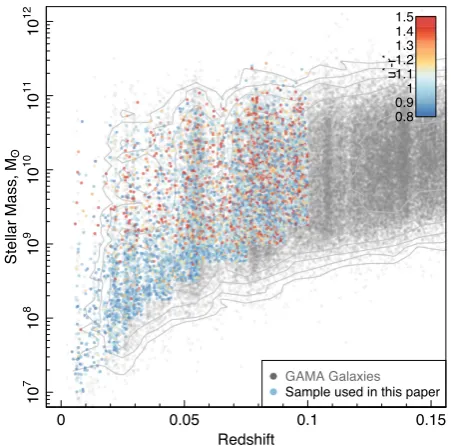
Figure 1. The redshift–stellar mass distribution of galaxies used in this work in comparison to the full GAMA sample. We initially se-lect isolated (non-group or pair) galaxies in volume-limited samples in log10[M∗/M]=0.25 bins of stellar mass (see Section 2.1 for details).
Selected points are coloured by their rest-frame, extinction-correctedu−r colour. The contours display the density of GAMA points.
fields with redshiftsz <0.15. Within GalaxyZoo, the GAMA
sam-ple received almost two million classifications from over 20 000 unique users in 12 months. The GAMA–KiDS GalaxyZoo clas-sifications use the standard decision tree implemented for cur-rent GalaxyZoo projects. A full description of the GAMA–KiDS GalaxyZoo effort can be found in Kelvin et al. (in preparation).
In this work, we further restrict our sample to galaxies within rolling volume-limited samples and initially galaxies that are not in either a group or pair in the GAMA group catalogues of Robotham
et al. (2011), i.e. isolated centrals, GAMA DMU GroupFindingV10.
To define our volume-limited samples, we follow a similar
ap-proach to Lange et al. (2016) and split the full GAMA catalogue
intolog10[M∗/M] =0.25 bins of stellar mass. For each bin,
we calculate the redshift where 97.7 per cent of the sample has a
maximum observable redshift (Vmax) greater than the medianVmax
of the bin. We then exclude all galaxies above this redshift, within the particular stellar mass bin. Finally, we put an upper redshift limit ofz <0.1. This process allows us to extend to lower stellar masses in our very local sample.
The resultant redshift–stellar mass selection of our sample in
comparison to the full GAMA sample is shown in Fig.1. Thez <
0.1 restriction is to largely remove any evolution in the SFS across our sample redshift range. In addition, a number of GAMA data
products that are required for our analysis are only available forz <
0.1 GAMA galaxies (see Section 3). The isolated centrals restriction allows us to remove any additional environmental quenching effects that may induce additional scatter in the SFS, which is not driven
by feedback (however, c.f. Barsanti et al.2018, find that groups can
affect galaxies SF properties out to large radii). Note that we do not include group centrals in our sample as there is currently some debate as to whether or not these galaxies undergo environmental
quenching (e.g. see Wang et al.2018). However, we do perform our
analysis including group centrals and find that it does not
cantly affect our results. The effect of group environment onσsSFR
is then explored further in Section 4.3 and in the following papers in this series. In total, there are 9005 galaxies in our starting sample.
2.1.1 GAMA SFR indicators
The GAMA SFR indicators used in this work are described at length
in Davies et al. (2016). Briefly, we use (i)MAGPHYS-derived SFRs
outlined in Driver et al. (2018) and based on the energy balance
SED-fitting codeMAGPHYS(da Cunha, Charlot & Elbaz2008), (ii)
combined Ultraviolet and Total Infrared (UV+TIR) SFRs derived
from the Brown et al. (2014) galaxy spectra, (iii) Hα-derived SFRs
using GAMA spectra discussed in Liske et al. (2015) and the
pro-cess outlined in Gunawardhana et al. (2011, 2015) and Hopkins
et al. (2013), and using the line measurements of Gordon et al.
(2017), (iv)Wide-field Infrared Survey Explorer(WISE) W3-band
SFRs derived using the prescription outlined in Cluver et al. (2017),
and (v) extinction-correctedu-band SFRs derived using the GAMA
rest-frameu-band luminosity andu−gcolours from Davies et al.
(2016). All SFRs are scaled to a Chabrier IMF and for further details
of these SFR indicators and their derivation see Davies et al. (2016).
We repeat all of the analysis in this paper for each of these SFR indicators, but for clarity we initially only show results for
MAGPHYS-derived SFRs. Similar figures for all of our indicators are presented in the Appendix and discussed in Section 4. We note here that different SFR indicators can be appropriate for different science cases, and contain different biases/assumptions, as such we consider a variety here.
3 I S O L AT I N G T H E TA R G E T P O P U L AT I O N
In order to explore the stellar mass dependence onσsSFR, and in a
similar manner to previous authors, we must first isolate our popula-tion of interest. The method by which this is undertaken is largely de-pendent on the specific scientific question being addressed (i.e. see
Renzini & Peng2015). For example, if we wished to study the
dis-persion within the SFS to explore self-regulated growth via star for-mation, we may select sources based solely on SFR to exclude pas-sive systems. Conversely, if we wish to investigate the SFH of star-forming discs we may wish to isolate morphologically selected
disc-like systems, irrespective of their position in the sSFR–M∗plane.
However, care must then be taken when drawing inferences
regard-ing theσsSFR–M∗relation when applying different selection
meth-ods, as these can significantly affect the observed distribution. For example, is the parabolic distribution observed by previous authors largely driven by sample selection and not pure physical processes? Here, we aim to explore the impact of sample selection on the
σsSFR–M∗relation and thus provide a robust description of the
in-trinsic shape of the dispersion. In the following sub-sections, we ex-plore a number of different selection criteria for identifying sources
that may be used to parametrizeσsSFR–M∗. In subsequent sections,
the impact of each of these selections on the shape of the derived
σsSFRrelation will be explored. The population selected by each of
these selections is displayed in Fig.2forMAGPHYS-derived sSFRs.
In Section 4.0.1, we will also explore using a non-physically
mo-tivated mixture-modelling method to determine theσsSFR–M∗, but
separate it from the physically motivated selection applied here.
3.1 No selection
First, we explore theσsSFR–M∗relation with no selection applied to
the population (other than those previously described). This
sam-ple contains all 9005 sources with both star-forming and passive systems, and morphological pure discs, ellipticals, and two
compo-nent disc+bulge systems. TheσsSFR–M∗relation derived from this
distribution is most directly comparable to the previous simulation results from Illustris and EAGLE that do not apply any selection cri-teria largely because all other selections are non-trivial to compute using the simulation data. In addition, this selection is informative in its own right as it essentially describes global SFH of all galaxies at a given stellar mass and can be used to identify star-burst/quenched population irrespective of their non-star-forming properties. Panel A
of Fig.2displays our sample with no further selection forMAGPHYS
-derived SFRs (and in the appendix for all other SFR indicators).
3.2 u−rcolour selection
One potential method for identifying late-type (star-forming) galax-ies is through rest-frame, extinction-corrected broad-band opti-cal colours. Galaxy colours have a long history in selecting star-forming, passive, and green-valley systems (for some examples see
Salim et al.2005; Schawinski et al.2014; Taylor et al.2015). Old
stellar population show a red colour with substantially more flux at longer wavelengths. However, with star formation activity high-mass, blue stars increasingly contribute to the galaxy’s spectral shape, flattening the SED, and producing bluer colours. As such, optical colour provides a measure of recent SFH and can be used to
isolate star-forming systems. Here, we useu−rcolour to isolate
late-type, star-forming galaxies as theuband is strongly correlated
with recent star formation (see Davies et al.2016) and therband is
representative of the underlying older stellar population.
We use the GAMA extinction-corrected rest-frame u∗ − r∗
colours taken from Taylor et al. (2011) and separate the population
following the approach outlined in Bremer et al. (2018), where we
apply a mass-dependent colour selection for star-forming galaxies of
u∗−r∗<0.15×log10[M∗/M]+0.05. (1)
This relation sits between the blue and red galaxy selection lines
of Bremer et al. (2018). This forms our u − r colour-selected
sample and is displayed in panel B of Fig.2. 8338 star-forming
sources are selected using this criteria, while 667 are classed as
passive. We note that au−rcolour selection is not as extreme as
a pure sSFR cut (described in the next section) as theu−rcolour
essentially probes the contribution of young stellar population over a relatively large evolutionary baseline, while sSFR measures the recently formed stellar population on a short time-scale. In
addition, theu−rcolour selection is sensitive to dust obscuration.
While we use extinction-corrected colours, these my suffer from large uncertainties in extremely dusty galaxies.
3.3 sSFR selection
It is also possible to isolate the SFS using star formation alone. To do this, one must somewhat arbitrarily choose at which SFR to divide the two population, which can have a strong effect on the measured dispersion (i.e. too low a cut and you include the
passive population, too high a cut and you artificially reduceσsSFR).
In addition, applying a single sSFR cut to isolate the star-forming
population is only appropriate if the slope of the sSFR–M∗relation
is unity, this is not the case (see panel C of Fig. 2). However,
given that this approach is applied by many previous studies (i.e.
Guo et al.2015), we replicate a similar selection here. With the
caveats of potential errors due to choice of star-forming-passive cut
10
−
13
10
−
12
10
−
11
10
−
10
10
−
9
10
−
8
sSFR, yr
−
1
All Galaxies (A) All
# selected = 9005 # not selected = 0
u-r SF u-r Passive (B) u-r colour
# selected = 8338 # not selected = 667
Log[sSFR]>-11.31 Log[sSFR]<=-11.31 (C) sSFR
# selected = 8105 # not selected = 900
10
−
13
10
−
12
10
−
11
10
−
10
10
−
9
10
−
8
sSFR, yr
−
1
Disk Dominated (Galaxy Zoo) Bulge Dominated (Galaxy Zoo) (D) Galaxy Zoo Morphology
# selected = 4012 # not selected = 1044
Disk-proxy (Grootes et al)
(E) Grootes et al Morphology
# selected = 2049
B/T<0.5 B/T>=0.5
(F) Bulge-to-total
# selected = 2302 # not selected = 929
107 108 109 1010 1011
10
−
13
10
−
12
10
−
11
10
−
10
10
−
9
10
−
8
StellarMass,Mʘ
sSFR, yr
−
1
n<2.5 n>=2.5
(G) Sersic Index
# selected = 7479 # not selected = 1526
107 108 109 1010 1011
StellarMass,Mʘ
Disk Dominated + n<2.5
(H) Morphology + Sersic Index
# selected = 3550
107 108 109 1010 1011
StellarMass,Mʘ Disk Dominated + B/T<0.5 + n<2.5 (I) Morphology + B/T
+ Sersic Index
[image:5.595.59.537.59.545.2]# selected = 1094
Figure 2. The sSFRMAGPHYS–M∗relation colour-coded by various selection methods for identifying the SFS. The linear fit (light blue line) is taken from Davies et al. (2016). (A): the full distribution ofz <0.1 GAMA galaxies that are not in a group or pair (i.e. isolated down to GAMA limit), (B): selection based onu−rcolour, (C): selection based on sSFR, (D): selection based on visual morphological classification from Galaxy Zoo, (E): selection based on the morphological proxy analysis of Grootes et al. (2014) – vertical dashed line shows stellar mass limit of this analysis, (F): selection based on r-band bulge-to-total light ratio (B/T) – note this sample only extends toz <0.06, (G): selection based on S´ersic index, (H): selection based on visual morphology and S´ersic index selection combined, (I) selection based on visual morphology, S´ersic index, and B/T selections combined. The number of galaxies in each selection are displayed in the bottom left corner of each panel. The total number of selected and non-selected galaxies displays the number of sources for which we have the required measurements for the selection. For panels that do not have a value for ‘non-selected’, either the catalogue used only contains the selected sample (panel E), or the selection if knowingly incomplete and the ‘non-selected’ number is not informative (panels H and I).
in mind, here we isolate the SFS by selecting galaxies for which
log10[sSFR, yr−1] > SFS10-ScSFR dex. Where SFS is the fit to
sSFR–M∗taken from Davies et al. (2016) – shown as the blue line
in Fig.2, SFS10is the normalization of the fit at log10[M∗/M]=
10 and ScSFR =1.4,0.8,0.8,0.9, and 0.6 forMAGPHYS, UV+TIR,
Hα, W3, andu-band SFRs, respectively (to account for varying
scatter/normalization on the relations). The impact of this selection forMAGPHYSis displayed in panel C of Fig.2. ForMAGPHYSSFRs, 8105 star-forming sources are selected, while 900 are classed as passive.
3.4 Morphological/structural selections
In order to produce samples that may be used to explore the recent SFH of spiral/disc-like systems, we also use a number of different morphological selections. These selections are aimed at identifying disc-dominated systems irrespective of their position relative to the locus of the SFS, and in practice may be used to explore the
evolution of all disc-like galaxies in the SFR–M∗plane.
3.4.1 Galaxy Zoo
Our initial disc-like selection is based on the GAMA–KiDS Galaxy Zoo classifications outlined in Section 2.1. For disc-dominated sys-tems, we select galaxies that are not edge-on (so that visual classi-fications are not confused) and have no bulge, or are classified as a spiral:
(pno−bulge>0.619 & pnot−edge−on>0.715) | pspiral>0.619, (2)
wherepis the debiased vote fraction. For comparison in panel D of
Fig.2, we also show bulge-dominated systems selected as
pbulge−dominant>0.619 & pnot−edge−on>0.715. (3)
This selection is based around those used by the Galaxy Zoo team
in Willett et al. (2015) for spiral galaxies. Note that we do explore
various otherpvalues for each of the selections above and find
that within sensible ranges it does not have a strong impact on
the shape of the derivedσsSFR–M∗relation. Using these selections,
4012 galaxies are classed as disc-dominated and 1044 as bulge-dominated. The remaining 3949 are two-component or ambiguous, and are excluded.
3.4.2 Grootes et al. disc proxy
Grootes et al. (2014) used a non-parametric cell-based method to
identify a highly complete and pure sample of spiral galaxies at
log10[M∗/M]>9.0. In this approach, colour, S´ersic index, stellar
mass surface density, and effective radius from SDSS imaging were used as a proxy for morphological classifications. These were then compared to previous SDSS-based Galaxy Zoo classifications to highlight the robustness of their method. Here, we use the Grootes et al. sample as spiral systems, which reside on the SFS. However, we highlight that these morphological proxies only extend down to
log10[M∗/M] ∼9.0 and therefore do not cover our full sample
(see panel E of Fig.2). There are 2049 source in the Grootes et al.
catalogue that meet our initial selections.
3.4.3 Bulge-to-total mass
In addition to morphological selections, we can also select samples based on a galaxy’s structural components. These components rep-resent a largely non-subjective measure of structural evolution from
pure disc-like systems, to two component bulge+disc, and pure
spheroid ellipticals. A simple metric for these classifications is the galaxy’s bulge-to-total flux ratio (B/T); the ratio of light arising from
the bulge compared to total bulge+disc, where B/T=1 is a pure
elliptical and B/T =0 is a pure disc. Using the 2-component S´ersic
fits to GAMA galaxies based on SDSSr-band imaging (Lange et al.
2016), we select a population with B/T<0.5 as disc-dominated
sys-tems (see panel F of Fig.2). The analysis of Lange et al. (2016) only
provides 2-component S´ersic fits atz <0.06 leaving a starting
sam-ple of 3231 galaxies, 2302 of which have B/T<0.5 and 929 B/T>
=0.5. Thus, this selection is limited to local galaxies. Note that we
repeat our analysis with a more extreme B/T<0.3 selection to
ex-clude equally weighted bulge-disc systems, but find similar results.
3.4.4 S´ersic index
A cruder metric for galaxy structure is the single component S´ersic
index (n). Briefly, the S´ersic index is a measure of the shape of a
galaxy’s light profile, withn =1 following an exponential profile,
which is found to fit galaxy discs, andn =4 a de Vaucouleurs
profile commonly associated with spheroidal components, such as bulges and elliptical galaxies. This is simply an empirical formalism that is found to fit the 2D light profile of a galaxy but does not fully
represent the 3D distribution of stars. Kelvin et al. (2012) produced
single-S´ersic fits for GAMA galaxies using the SDSS and UKIDSS
LAS imaging bands outlined in Hill et al. (2011). Here, we use the
SDSSr-band S´ersic index to isolate a disc-like sample with ann
<2.5 selection. This selection is found to separate disc-dominated
and spheroid-dominated systems in Lange et al. (2015). Panel G
of Fig.2displays our S´ersic index selected sample isolating the
SFS and removing galaxies in the passive cloud. 7478 sources are selected as low S´ersic index using this criteria, while 1526 are classed as having high S´ersic index.
3.4.5 Combined morphological selections
In addition to our individual morphological selections, we also pro-duce samples using combined Galaxy Zoo morphology and single
S´ersic Index (Panel H of Fig.2, selecting 3550 sources) and Galaxy
Zoo morphology, single S´ersic Index and B/T (Panel I of Fig.2,
selecting 1094). These samples are less complete, but form a more robust selection of disc-like systems than the individual morpho-logical selections as they must meet two or more of our selection criteria. We do not show the ‘not selected’ galaxies here, as the selection is incomplete and therefore the ‘not selected’ population is not informative.
4 A M A S S D E P E N D E N T σS S F R?
Using each of the sample selection methods described above, we
exploreσsSFRas a function of stellar mass. Here, we defineσsSFR
as the standard deviation of log10[sSFR] for the selected population
at a given stellar mass. Note that following this we also calculate
the dispersion based on the interquartile range of log10[sSFR], to
remove any dependencies on assumption of a Gaussian-like distri-bution.
We take all of our selected galaxies (black points in Fig.2A, and
green points in Fig.2B-I) and split our samples into log10[M∗/M]
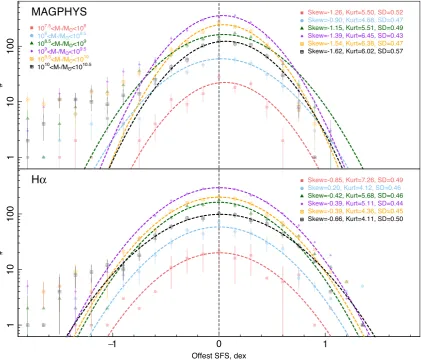
=0.5 bins of stellar mass. Fig.3displays an example of the
distri-bution of galaxies away from the median in each bin with Poisson
errors, for bothMAGPHYSand HαSFRs. For this figure, we only
show sources identified as disc like from our combined Galaxy Zoo morphology and S´ersic index selection (i.e. the population in Panel
H of Fig.2). This shows the spread of sSFRs away from the locus
of the SFS at a given stellar mass.
For illustrative purposes only, in Fig.3we fit a lognormal in each
mass bin (dashed lines) to highlight any deviation in the popula-tion from a symmetric lognormal distribupopula-tion. Unsurprisingly, at all masses we see an asymmetric tail extending to low sSFRs in-dicative of a green-valley/passive population (also see Oemler et al.
2017). We also potentially see an additional star-burst population
1
10
100
#
Skew=-1.26, Kurt=5.50, SD=0.52
Skew=-0.90, Kurt=4.68, SD=0.47
Skew=-1.15, Kurt=5.51, SD=0.49
Skew=-1.39, Kurt=6.45, SD=0.43
Skew=-1.54, Kurt=6.38, SD=0.47
Skew=-1.62, Kurt=6.02, SD=0.57
107.5<M*/Mʘ<10 8
108<M*/Mʘ<10
8.5
108.5<M */Mʘ<109
109<M*/Mʘ<10 9.5
109.5<M*/Mʘ<10 10
1010<M
*/Mʘ<1010.5
MAGPHYS
−1 0 1
1
10
100
Offest SFS, dex
#
Skew=-0.85, Kurt=7.26, SD=0.49
Skew=0.20, Kurt=4.12, SD=0.46
Skew=-0.42, Kurt=5.68, SD=0.46
Skew=-0.39, Kurt=5.11, SD=0.44
Skew=-0.39, Kurt=4.36, SD=0.45
Skew=-0.66, Kurt=4.11, SD=0.50
[image:7.595.89.511.57.421.2]H
α
Figure 3. The distribution of points away from the SFS isolated using the combined morphology+S´ersic index selection from Section 3.4. We display the distribution in stellar mass bins for bothMAGPHYSand Hαderived SFRs. Points are fit with a lognormal distribution (dashed lines) to highlight any deviation from this symmetric shape. In both SFRs and at all masses, the distributions display a negative skew value, highlighting that the distributions have asymmetric tails extending to low stellar masses. For both SFRs in all but the lowest stellar mass bin, the skew value becomes more negative to higher stellar masses suggesting that the distribution becomes more asymmetric as a function of mass.
in the Hαdistribution at high SFRs (particularly seen in the
posi-tive kurtosis of the 8<log10[M∗/M]<9 bin). This is interesting
as it may provide evidence of short duration star-burst activity; as
Hαprobes star formation integrated over shorter time-scales than
MAGPHYS(see Davies et al.2015b). This will be explored further in later papers of this series.
To determine how these distributions vary as a function of stellar mass, we calculate the skewness, kurtosis, and standard deviation
of log10[sSFRs] in each mass bin; given in the legend of Fig. 3.
Interestingly, with the exception of the 8.0<log10[M∗/M]<8.5
bin in Hα, all distributions show a negative skew (from the green
valley/passive population) but with skewness increasing for higher
stellar masses for bins at log10[M∗/M]>8.0. Tentatively, this may
indicate that any physical processes that drive the shape of this dis-tribution are more likely to produce more symmetrical scatter at the low-mass end (potentially stochastic star formation bursts leading to stellar feedback), and asymmetrical scatter at the high-mass end (po-tentially AGN feedback). However, care must be taken as we may simply be missing a significant fraction of the quenched population at low stellar masses, and artificially removing the asymmetric tail due to selection affects imposed by GAMA. In order to go further,
we require much deeper spectroscopic surveys of the local Uni-verse, such as the Wide Area VISTA Extragalactic Survey (WAVES
Driver et al.2016b), which will allow a detailed exploration of the
distribution of star formation in very low-mass galaxies.
Taking this further, we then use the standard deviation
measure-ments described above to derive the σsSFR–M∗ and measure the
interquartile range in the same stellar mass bins; for all selections described in Section 3.
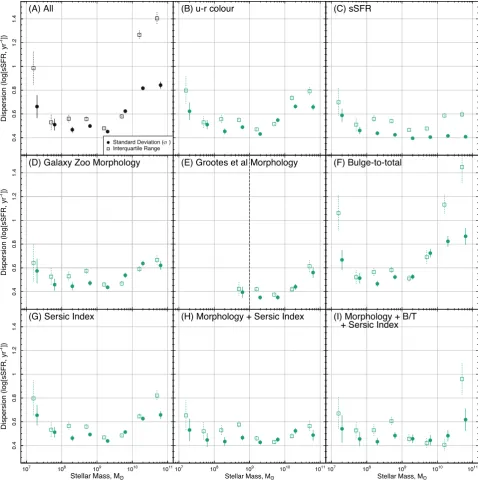
Fig.4displaysσsSFR (filled circles) and the interquartile range
(open squares) in log10[M∗/M] = 0.5 bins of stellar mass
fol-lowing the same panel layout as Fig.2. Here, we only show
fig-ures for MAGPHYSSFRs, but similar figures for other SFR
indi-cators are given in the Appendix. Statistical errors on σsSFR are
calculated as
ErrσsSFRi ∼
2σ4
sSFRi(Ni−1)
−1
2σsSFRi
, (4)
whereiis the index of the stellar mass bin andNis the number of
galaxies in that bin (Rao1973). We then combine this in
quadra-ture with the error calculated from 100 bootstrap resamples of the
0.4
0
.6
0.8
11
.2
1
.4
Dispersion (log[sSFR, yr
−
1])
Standard Deviation (σ) Interquartile Range
(A) All (B) u-r colour (C) sSFR
0.4
0
.6
0.8
11
.2
1
.4
Dispersion (log[sSFR, yr
−
1])
(D) Galaxy Zoo Morphology (E) Grootes et al Morphology (F) Bulge-to-total
107 108 109 1010 1011
0.4
0
.6
0.8
11
.2
1
.4
StellarMass,Mʘ
Dispersion (log[sSFR, yr
−
1])
(G) Sersic Index
107 108 109 1010 1011
StellarMass,Mʘ (H) Morphology + Sersic Index
107 108 109 1010 1011
StellarMass,Mʘ (I) Morphology + B/T
[image:8.595.56.535.57.541.2]+ Sersic Index
Figure 4. The resultant dispersion along the sSFR–M∗relation measured using both the standard deviation (σsSFR–M∗, filled circles) and interquartile range (open squares). Each panel shows a different method for isolating the SFS described in Section 3. This Figure follows the same layout as Fig.2, but only using SFS-selected population (green points when both green and red are present in Fig.2). While the normalization and shape changes, the majority distributions show a ‘U’-shaped dispersion with minimum at∼109.25 M
and increased scatter at low and high masses for bothσsSFRand interquartile range.
population within the errors of both stellar mass and SFR. For errors on the interquartile range, we only apply the bootstrap resampling errors. This bootstrap resampling is intended to take into account the varying measurement error in each of our SFR indicators as a function of stellar mass.
First, we find that the majority of the panels show close to
‘U’-shaped distribution with minima atσsSFR∼0.35–0.5 dex and
log10[M∗/M] = 8.5–9.5 (in the following section, we fit these
distributions with a second-order polynomial to find the minimum
points). We observe a steep increase in bothσsSFRand interquartile
range to higher stellar masses than this minima. The increase to
lower stellar masses is much shallower but tentatively observable in both measures of dispersion. These results are roughly
consis-tent with observations of Guo et al. (2015) and Willett et al. (2015)
modulo slight differences in normalization (∼0.1 dex) and have
comparable scatter to the recent results of Boogaard et al. (2018).
We also find a consistency between the dispersion measured using
bothσsSFRand the interquartile range at most stellar masses, this
indicates that the assumption of a lognormal distribution of sSFRs at a given stellar mass is appropriate. The places where this does not hold true are when stellar masses are either very low or very
high (this is also displayed in the larger kurtosis values in Fig.3).
In these regimes, the interquartile range may be a more accurate representation of the dispersion as it does not assume a lognormal distribution.
We find that while sample selection does affect the normalization of the dispersion at specific stellar masses, we do see consistency between sample selections in terms of the minimum point in both stellar mass and dispersion, and in the overall shape; with all samples displaying a dispersion that rises to low and high stellar masses.
We also find that when selecting on sSFR (panel C) we observe
a more linear distribution with decreasingσsSFRto higher stellar
masses. This is as expected as a hard cut in sSFR simply removes the high-dispersion population at high stellar masses (see panel C of
Fig.2). In combination, the panels in Fig.4suggest that irrespective
of the method for selecting a star-forming/disc-like galaxy popu-lation based on colour and morphology, in GAMA we observe a
‘U’-shapedσsSFR–M∗relation, which is largely consistent with the
previous observations of Guo et al. (2015) and Willett et al. (2015).
4.0.1 Mixture modelling method
In addition to the physically motivated sample selections described
previously, it is also possible to determine theσsSFR–M∗ relation
based on mixture modelling of the star-forming and passive
population (see Taylor et al.2015, for a similar approach). Here,
we use the [R] MIXTOOLS:NORMALMIXEM function to perform
a maximum log-likelihood mixture fit to the two population in
log10[M∗/M] =0.5 bins of stellar mass at log10[M∗/M]>8.5
(below this we assume a single high-sSFR population). The top
panel of Fig.5shows the sSFR–M∗ plane forMAGPHYS-derived
SFRs. The green and red lines display the mean (solid lines) and
1σ width (dashed lines) of the mixture models for the high-sSFR
and low-sSFR population, respectively.
The bottom panel of Fig. 5then showsσsSFR–M∗ relation for
the high-sSFR population, where errors are calculated using
equa-tion (4) but whereNis the number of galaxies in a particular stellar
mass bin multiplied by the mixing proportion in the high-sSFR pop-ulation. Once again we find a ‘U’-shaped distribution with minima
at log10[M∗/M]∼9.25 andσsSFRincreasing to low and high stellar
masses. We do find that the normalization of theσsSFR–M∗relation
for our mixtures is slightly lower than for our previous selections
(minima atσsSFR∼0.3 dex), likely due to the fact that large
dis-persion points are included in the low-sSFR mixture irrespective of their physical properties.
However, it is interesting to highlight that when using non-physically motivated separation between the star-forming and
pas-sive population we still observe a ‘U’-shapedσsSFR–M∗. This result
is therefore once again, unlikely to be driven by choice of sample selection.
4.1 Variation with SFR indicator
We also consider if the results described above hold true for differ-ent SFR indicators; as differdiffer-ent observables can provide differdiffer-ent
measures of star formation with varying degrees of scatter (e.g.see
Davies et al.2016). In addition, other explorations into the
disper-sion along the SFS have used a number of different SFR indicators. As such, we wish to produce a comparison point to these studies from GAMA in the local Universe.
Hence, we reproduce our analysis for all other SFR indicators
dis-cussed in Section 2.1.1. Figures identical to Figs2and4are given in
the appendix for UV+TIR, Hα, W3, andu-band SFRs. In the
ma-jority of cases, these figures display a largely ‘U’-shapedσsSFR–M∗
10
−
13
10
−
12
10
−
11
10
−
10
10
−
9
10
−
8
sSFR, yr
−
1
High sSFR population +/-sigma Low sSFR population +/-sigma
107 108 109 1010 1011
0.2
0
.4
0.6
0.8
StellarMass,Mʘ
σsSFR
[image:9.595.315.541.55.482.2], dex
Figure 5. Mixture modelling of the star-forming and passive population assuming lognormal distributions in sSFR. The top panel displays the SFR– M∗plane forMAGPHYS-derived SFRs. The green and red lines display the mean (solid lines) and 1σ width (dashed lines) of the mixture models as a function of stellar mass. The bottom panel shows theσsSFR–M∗relation for
the high-sSFR population.
relation with minimum atσsSFR∼0.35–0.5 dex and log10[M∗/M]
=9–10. They all display a steep increase of dispersion to high
stel-lar masses, and a more tentative, shallow increase to lower stelstel-lar masses.
The u-band SFRs (Fig.A4) do have a much smaller dispersion
across all stellar masses (minimum at σsSFR ∼ 0.2–0.3 dex) but
retain a ‘U’-shape. The changes in normalization ofσsSFRbetween
SFR indicator are likely due to the robustness of each indicator in measuring SFRs and how correlated they are with stellar mass; with high scatter indicative of larger measurement error and/or unknown assumptions in converting from an observable to a true SFR (e.g.
see Davies et al.2016).
In Fig. A5, we produce a comparison of all SFR indicators
by scaling the distributions using the minimum dispersion in each indicator. This removes some of the dependence on absolute
(A)
(D)
(E)
[image:10.595.61.531.52.370.2](B)
(C)
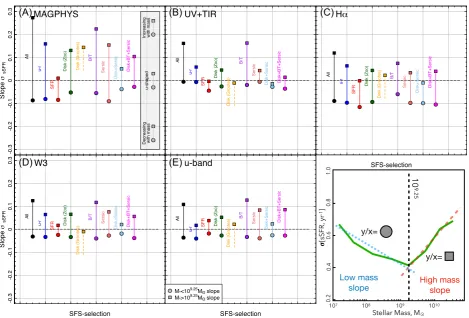
Figure 6. The high-mass and low-mass slope of theσsSFR–M∗relation for different SFR indicators (described in Section 2.1.1) and using each method for isolating the SFS (described in Section 3). We separate theσsSFR–M∗distributions in Fig.A5and take the high-mass end as log10[M∗/M]>9.25 and low-mass end as log10[M∗/M]<9.25. We then linearly fit the slope at high (squares) and low masses (circles) – see bottom right-hand panel. Each other panel displays a different SFR indicator, and each pair of points/line displays a different method for isolating the SFS. In this figure, when the pair of points spans the dashed zero line, the distributionσsSFR–M∗is parabolic with a minimum vertex, when they both sit below the dashed zero lineσsSFRdecreases
with mass, and when they both sit above the dashed zero lineσsSFRincreases with mass. The size of the distance between the two points is indicative of how
curved the distribution is about log10[M∗/M]=9.25. Note that for the Grootes et al. morphological proxy, we only have the high-mass slope. We find that in almost all cases theσsSFR–M∗relation is parabolic (the pairs of points span the dashed zero line). We also note that if we use either log10[M∗/M]=8.75 or log10[M∗/M]=9.75 as our minimum points it does not significantly alter these results.
normalization between SFR indicators and allows a more direct comparison of their shape. In the majority of cases, each indicator shows a ‘U-shape’ with largely consistent increases in dispersion to low and high stellar masses, irrespective of SFR used. The most
notable exception to this is the UV+TIR indicator. This is largely
due to the tfact hat the minimum point inσsSFR occurs at higher
stellar masses for this indicator (close to log10[M∗/M] =10).
In order to easily compare the shape of theσsSFR–M∗relation
for all SFR indicators and sample selections, we define a simple
metric based on the slope ofσsSFR–M∗in the low- and high-stellar
mass regime; divided at log10[M∗/M] = 9.25. To choose this
reference point, we fit a second-order polynomial to theσsSFR–M∗
relation for all samples and SFR indicators and find the median
minimum point to be at log10[M∗/M] =9.261, hence our closest
stellar mass bin is log10[M∗/M] = 9.25. We then perform a
least-squares linear fit to the low-mass and high-massσsSFR–M∗,
respectively. This process is described visually in the bottom
right-hand panel of Fig.6. While the point at log10[M∗/M] =9.25 does
not represent the minimum in all distributions (see above), we wish
to use a consistent point across allσsSFR–M∗relations to highlight
any variation with sample selection and/or SFR indicator. However,
we do repeat this analysis for slopes about both log10[M∗/M]
=8.75 and log10[M∗/M]=9.75 and find consistent results. While
this is potentially a crude metric for the shape of the distributions, it allows an easy comparison of multiple different samples in the same figure.
Fig.6displays these low- and high-mass slopes for each sample
selection (colours) and for each SFR indicator (panels). In this
figure, points that span they=0 line have a ‘U’-shaped distribution.
In addition, the separation between the points (length of the coloured lines) describes how curved the distribution is, with points close together indicating a linear relation, and far apart a highly curved
distribution. For samples that cross they=0 line, the position where
the coloured line crosses they= 0 line describes the asymmetry
of the distribution about log10[M∗/M] =9.25. For example, a
purely symmetric ‘U’-shape would have widely vertically spaced
points with the dashed y= 0 crossing at the mid-point of their
connecting line.
From this figure, we see that the majority of our samples have
widely separated points that span the y = 0 line. This metric
displays, at a glance, that irrespective of sample selection or SFR
indicator theσsSFR–M∗relation is U’-shaped with minimum close
to log10[M∗/M]=9.25 and increasing dispersion to low and high
stellar masses. The exception to this is the selection using sSFR that
107 108 109 1010 1011
0
0
.2
0.4
0
.6
0.8
1
StellarMass,Mʘ
σsSFR
, dex
(A) All
EAGLE (All) Shark-Medi (All) Shark-Micro (All) MAGPHYS
UV+TIR Hα
W3 u-band
107 108 109 1010 1011
StellarMass,Mʘ
(C) sSFR
[image:11.595.79.519.57.277.2]EAGLE (sSFR cut) Shark-Medi (sSFR cut) Shark-Micro (sSFR cut)
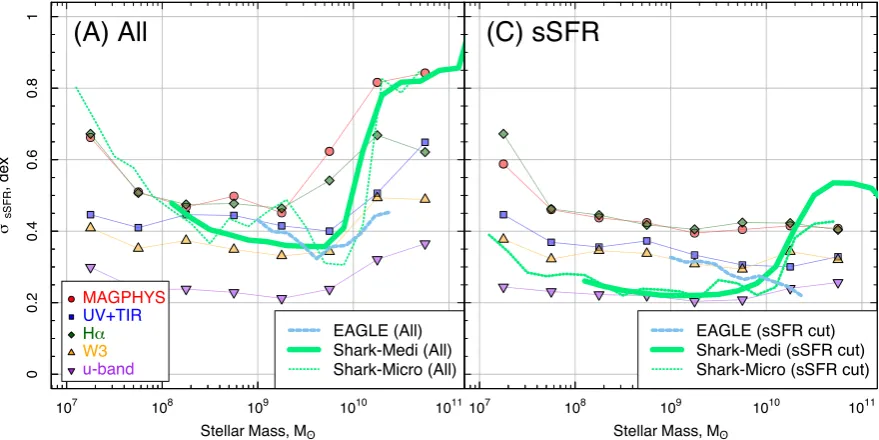
Figure 7. σsSFR–M∗relation from the Shark SAM (solid green) compared to our observations for different SFR indicators (coloured points) and the EAGLE simulation results (dashed blue lines). The left-hand panel displays the relation for all galaxies, while the right-hand panel shows only galaxies with log10[sSFR,
yr−1]>−11. Both simulations are only shown above their mass resolution limits. Shark displays a remarkably similar distribution to our data in the left-hand
panel, and both Shark and EAGLE show a similar relation but offset slightly in normalization in the right-hand panel at log10[M∗/M]<10. At the highest
stellar masses, we see an upturn for Shark, which is not found in EAGLE or the observations; due to that fact that in Shark, star formation in very massive galaxies declines slowly and galaxies stay above the sSFR cut.
has a linearly decreasing dispersion with stellar mass in the majority
of cases (both points sit below the y =0 line). Once again this is
expected as the cut in sSFR removes the large dispersion population at high stellar masses.
4.2 Comparison to the state-of-the-art semi-analytic model and hydrodynamical simulations
In addition to the Katsianis et al. (in preparation) results from
EA-GLE discussed previously, we also compare our observedσsSFR–
M∗relation to the state-of-the-art SAM Shark (Lagos et al.2018).
Briefly, Shark is a highly flexible and modular open-source SAM, which includes several different models for gas cooling, AGN, stel-lar and photoionization feedback, and star formation. Here, we use
the Shark parameters described in Lagos et al. (2018) run over the
SURFS (Elahi et al.2018) simulations with Planck15 cosmology
and take the Shark+SURFS galaxies in the z =0 shapshot. We
use both the medi-SURFS (medium box size and medium mass resolution) and mircro-SURFS (small box size and high-mass res-olution) simulation runs (we do not go into further details of the
simulations here, for more details see Elahi et al.2018and Lagos
et al.2018). Using the Shark-simulated galaxies, initially we take
all isolated central galaxies (as in GAMA) and bin in stellar mass
bins of log10[M∗/M] =0.2 dex. We then calculate the standard
deviation of sSFRs in each bin (consistent with our observational data). For details of the EAGLE results and in-depth discussion of
the EAGLEσsSFR–M∗relation, see Katsianis et al. (in preparation).
The left-hand panel of Fig.7displays theσsSFR–M∗relation using
all SFR indicators used in this work for all isolated galaxies overlaid with the relations measured from both Shark and EAGLE (Note that for EAGLE we also only include all isolated central galaxies at z
∼ 0). We find that theσsSFR–M∗ relation from both simulations
are consistent with the GAMA results; showing a ‘U’ shape with
minimum at log10[M∗/M]=9–10 and a steep rise at higher stellar
masses (albeit only over a small stellar mass range for EAGLE). We also highlight the gradual rise to lower stellar masses in the Shark results, which is observed in some of our SFR indicators. This falls below the mass resolution limit for EAGLE.
We also replicate the sample with a log10[sSFR, yr−1]>−11 cut
(right-hand panel of Fig.7), where both EAGLE and Shark follow
a similar relation to the observational data at low to intermediate stellar masses, which sits within the spread of the different SFR indicators explored here. At the highest stellar masses, we still see
an upturn inσsSFRfor Shark, which is not found in EAGLE or the
observations. This is due to the fact that in Shark, star formation in very massive galaxies declines slowly and galaxies stay above the sSFR cut. In EAGLE, massive galaxies tend to quench rapidly, dropping below the sSFR cut. We also note that the EAGLE mass
resolution is limited at log10[M∗/M]∼9 and the resolution limit
for Shark is log10[M∗/M]∼8 for medi-SURFS and log10[M∗/M]
∼7 for micro-SURFS.
In summary, the Shark model reproduces the observedσsSFR–M∗
relation across all stellar masses incredibly well given that it was not specifically tuned to reproduce the dispersion in this plane, while EAGLE reproduces the relation well above its resolution limit. We note here again that within EAGLE, Katsianis et al. (in preparation) attribute the high dispersion at low and high stellar masses to stellar and AGN feedback, respectively. It is worth highlighting that both EAGLE and Shark use a physical model for AGN and stellar feed-back (i.e. not a simple mass scaling that may artificially produce
these results). In addition, Lagos et al. (2018) showed that the scatter
of the SFS is very sensitive to the adopted star formation law; that is both the way that the interstellar medium is partitioned between ion-ized, atomic, and molecular gas, and the way molecular gas is con-verted into stars. Various theoretical and empirical models for star
formation were used leading to>0.2 dex differences inσsSFR. These
results suggest that the interplay between gas/stars within the galaxy
can also play a significant role in shaping theσsSFR–M∗relation.
−
0.3
−
0.2
−
0.1
0
0.1
0
.2
0.3
SFS-selection
Slope
σ
sSFR
All
Increasing with mass
u-shaped
Decreasing with mass
(A) MAGPHYS
u-r
SFR
Disk (Zoo)
Disk (Grootes) B/T
Sersic
Disk+Sersic
Disk+BT+Sersic
−
0.3
−
0.2
−
0.1
0
0.1
0
.2
0.3
SFS-selection
Slope
σ
sSFR
All
M*<10 9.25
Mʘ slope M*>10
9.25 Mʘ slope
(C) H
α
u-r
SFR
Disk (Zoo)
Disk (Grootes)
B/T
Sersic
Disk+Sersic
Disk+BT+Sersic
108 109 1010 1011
00
.1
0
.2
0.3
0
.4
StellarMass,Mʘ
Δ σ
sSFR
(group-isolated)
(A) MAGPHYS
Allu-r
sSFR
Disk (Zoo) Disk (Grootes)
B/T
Sersic
Disk+Sersic
Disk+B/T+Sersic
108 109 1010 1011
00
.1
0
.2
0.3
0
.4
StellarMass,Mʘ
Δ
σsSFR
(group-isolated)
[image:12.595.87.506.58.465.2](C) H
α
Figure 8. Top: The same diagnostic displayed in Fig.6but for justMAGPHYSand Hα-derived SFRs in group satellite galaxies. The differences between these panels and Fig.6highlight additional sources of scatter in theσsSFR–M∗relation in groups (see text for details). Bottom: The relative difference betweenσsSFR
for group satellites andσsSFRfor isolated galaxies in three stellar mass bins. We find increased dispersion in group satellites at all stellar masses (σsSFR>
0), which is more extreme at low and intermediate masses.
4.3 The impact of group environment
Finally, we consider the impact of group-scale environments on
the metric used to parametrize the shape of theσsSFR–M∗relation
in Section 4.1. Differences between these metrics for isolated and group environments can potentially elucidate additional physical
sources of dispersion in the sSFR–M∗ relation caused by group
astrophysical processes. To reduce confusion in the number of
sam-ples displayed, in this section we will only focus onMAGPHYSand
Hα-derived SFRs.
To explore the effect of group environment, we select all galaxies
within our volume-limited samples that are in an N> 2 group
from the GAMA group catalogue of Robotham et al. (2011). We
then exclude all sources that are closest to the iterative centre of the group as a central. The remaining sources form our ‘group satellites’ sample, for which we repeat all of the analysis in the previous sections.
The top row of Fig.8displays the same metric as in Fig.6but for
the group satellites. There are two notable differences: (i) the pairs of points for each sample selection are closer together indicating that the distribution is less curved, and (ii) the points are more negative both at the high- (squares) and low- (circles) mass end indicating that in most cases the distributions are no longer ‘U’ shaped but
have a decreasingσsSFRwith increasing stellar mass.
However, the top row of Fig.8does not inform as to whether
the observed changes are caused by the dispersion increasing or de-creasing in group environments, only that the relative shape of the
σsSFR–M∗relation changes. To explore this further, the bottom row
of Fig.8displays the normalization difference ofσsSFRbetween the
isolated and group satellite samples at three stellar mass bins (i.e. for each independent sample selection and SFR indicator we measure
the offset between log10[σsSFR] in isolated and group environments
at log10[M∗/M]=8.25, 9.25, and 10.25). We find thatσsSFRis
larger in group satellites than in isolated galaxies for all samples
107 108 109 1010
Stellar Mass, M
0.2
0.4
0.6
0.8
1.0
σsSFR
, dex
Isolated
Groups - MAGPHYS
Groups - H
Incr
eased
Sca
[image:13.595.53.281.56.259.2]tter
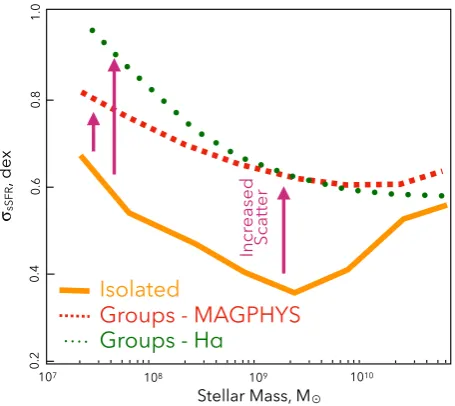
Figure 9. Cartoon representation of the differences in observedσsSFR–M∗
relation between isolated and group environments. The parabolic distribution observed in isolated galaxies is removed by additional large dispersion at low and intermediate stellar masses.
and at all stellar masses (i.e. all points are above zero), but that the increase in dispersion is much larger at low and intermediate stellar masses than at high stellar masses. This indicates that group
envi-ronments preferentially increaseσsSFRfor low-mass galaxies, likely
due to increased satellite quenching low-mass galaxies leading to increased dispersion (this is explored in detail in Davies et al., in
preparation). To highlight this, Fig.9shows a cartoon
representa-tion of how theσsSFR–M∗ relation changes between isolated and
group satellite galaxies.
To explore the population that is driving the observed differences between isolated galaxies and group satellites further, we return to
the full sSFR–M∗plane and compare the distribution of sources in
each environment. Fig.10displays the HαandMAGPHYSsSFR–M∗
plane for isolated galaxies (top rows) and group satellites (bottom row) selected as disc-like systems using the combined Galaxy Zoo morphology and S´ersic index selection. The dashed vertical lines display the points at which we measure the normalization difference
inσsSFRfor Fig.8.
First, we find that there is uniformly larger dispersion along the SFS population at all stellar masses in groups; potentially due to more stochastic star formation processes occurring in groups via interactions. We also find an additional population of quenched
group satellite galaxies at log10[M∗/M]∼9–10. To highlight this,
in Fig.10we colour all galaxies with sSFRHα <10−11.2 in red.
This population increasesσsSFRat the point whereσsSFR–M∗is a
minimum in isolated galaxies, removing the ‘U’-shape shape. This population is likely produced by group-quenching processes (such as strangulation/starvation/stripping). We leave detailed discussion of potential physical mechanisms that may produce these population to the following papers in this series.
However, interestingly we note that this population sits on a
tight sequence when using Hα-derived SFRs, but is much more
dispersed to higher sSFR when usingMAGPHYS-derived SFRs. This
potentially indicates that group satellites that appear passive in Hα
-derived SFRs are still transitioning across the green valley when
usingMAGPHYS-derived SFRs. There are two important differences
between SFRs measured using these indicators: (i) GAMA Hα
SFRs are derived from fibre-fed spectroscopy and therefore only
probe the central regions of galaxies, while MAGPHYS SFRs are
integrated over the whole galaxy, and (ii) HαSFRs probe a much
shorter integrated physical time-scale than MAGPHYS SFRs (i.e.
<20 Myr as compared to<100 Myr, e.g. Davies et al.2015a). The
differences in the red points in different columns of Fig.10could
be attributed to sources that have quenched on short time-scales, and thus still have residual star formation when measured using
MAGPHYS, or sources that are undergoing inside-out quenching and thus become completely passive over the central regions observed by our fibre-fed spectroscopy prior to the whole galaxy becoming passive. We leave detailed discussion of these mechanisms to the following papers, where we aim to produce a more complete picture
of the sSFR–M∗plane based on multiple observations.
5 C O N C L U S I O N S
In the first paper of this series, we have parametrized the dispersion along the SFS for different sample selections and SFR indicators within GAMA. We find that
(i) Irrespective of selection method of star-forming disc-like
sys-tems, the σsSFR–M∗ relation is parabolic with high dispersion at
the low and high stellar mass end and minimum point of σsSFR
∼0.35–0.5 dex at log10[M∗/M]∼8.75–9.75. This holds true for
different SFR indicators and when using mixture modelling, albeit
with differences in normalization ofσsSFR.
(ii) Our results are largely consistent with a number of previous studies and simulation results from EAGLE, Illustris, and Shark. The EAGLE study suggests that this parabolic dispersion is pro-duced via stellar and AGN feedback at the low- and high-mass end, respectively, while Shark suggests that the interplay between gas/stars within the galaxy can also play a significant role in shap-ing the dispersion. This will be explored further observationally in subsequent papers in this series.
(iii) In combination, these results suggest that the ‘U’ shape of
σsSFR–M∗relation is physical and not an artefact of sample selection
or method.
(iv) For group satellite galaxies, we find an increased dispersion at all stellar masses potentially due to more stochastic star formation processes occurring in groups. We also find an additional population
of quenched sources at log10[M∗/M] ∼ 9–10, which increases
σsSFRand removes the parabolic shape.
(v) We tentatively suggest that this population is produced by group-quenching processes and highlight that differences between
Hα- andMAGPHYS-derived SFRs for this population may be
in-dicative of short time-scale quenching. However, we leave detailed discussion to the following papers.
We have parametrized the σsSFR–M∗ relation in the local
Universe and highlighted that it is a useful tool in exploring the recent SFH of galaxies both in terms of the variation of dispersion as a function of stellar mass and in the differences between isolated galaxies and group satellites. In the following papers in this series,
we will explore the morphological evolution across the sSFR–M∗
plane and the physical processes that drive the formation of this fundamental relation.
AC K N OW L E D G E M E N T S
GAMA is a joint European–Australian project based around a spec-troscopic campaign using the Anglo- Australian Telescope. The