Modélisation Mathématique et Analyse Numérique
DISCONTINUOUS GALERKIN METHODS FOR PROBLEMS WITH
DIRAC DELTA SOURCE
∗Paul Houston
1and Thomas P. Wihler
2Abstract. In this article we study discontinuous Galerkin nite element discretizations of linear second-order elliptic partial dierential equations with Dirac delta right-hand side. In particular, assuming that the underlying computational mesh is quasi-uniform, we derive an a priori bound on the error measured in terms of theL2norm. Additionally,
we develop residualbased a posteriori error estimators that can be used within an adaptive mesh renement framework. Numerical examples for the symmetric interior penalty scheme are presented which conrm the theoretical results.
1991 Mathematics Subject Classication. 65N30.
June 17, 2011.
1. Introduction
In this article, we will consider the numerical approximation of the boundary value model problem
−∆u=δx0 inΩ, (1)
u= 0 on∂Ω, (2)
based on employing discontinuous Galerkin (DG) nite element discretizations. Here, Ω⊂R2 is an open bounded polygonal domain, and δx0 denotes the Dirac delta distribution at some given pointx0 ∈Ω. Throughout, in order to avoid technical diculties due to corner singularities, we
suppose that the domainΩis convex (this assumption can be relaxed in some parts of the article; this will be remarked on later). The weak formulation of (1)(2) is to ndu∈W01,p(Ω)such that
a(u, v) := Z
Ω
∇u· ∇vdx=v(x0) ∀v∈W01,q(Ω), (3)
with 1≤p <2, and 1 p+
1
q = 1. In this manuscript, for s∈N0 andt ≥1, W
s,t(Ω) signies the
standard Sobolev space of all functions whose (weak) derivatives up to ordersare bounded in the Ltnorm. Moreover, Ws,t
0 (Ω) is the subspace of functions belonging to Ws,t(Ω) with zero trace
along the boundary∂Ω. Ift= 2, we simply write Hs(Ω) =Ws,2(Ω). Following [3, Section 2] the
above weak formulation is well-posed.
Keywords and phrases: Elliptic PDEs, discontinuous Galerkin methods, Dirac delta source.
∗Thomas Wihler acknowledges the nancial support of the Swiss National Science Foundation (SNF) under grant No. 200021 126594
1 School of Mathematical Sciences, University of Nottingham, University Park, Nottingham, NG7 2RD, UK, [email protected]
2Mathematics Institute, University of Bern, CH-3012 Bern, Switzerland, [email protected]
c
Second-order elliptic partial dierential equations of the form (1)(2) are employed, for instance, in the modelling of diusion processes, heat ow, structural mechanics applications, or electric potentials, whenever point sources or loads occur. In addition, problems with a δ-source appear
as dual problems in deriving point-wise error estimates for nite element discretizations; see, e.g., [6, 10, 12]. From an analytical point of view, the challenge in describing such problems in a proper manner lies in the fact that the Dirac δ-distribution in R2 does not belong to H−1(Ω); thereby, the solution of (1)(2) is not anH1function. Consequently, the numerical approximation
of (1)(2) by, for example, nite element methods, requires a non-standard analysis. Here, in the context of conforming FEM, we mention the a priori results in [7, 17], as well as the a posteriori error analysis in [3]. For DG approximations to low-regularity problems, see, e.g., [13, 19].
The focus of the current paper is to extend some of the results developed for standard FEM to the context of discontinuous Galerkin methods. In particular, we shall derive a priori, as well as residual-based (global upper and local lower) a posteriori error estimates with respect to theL2
norm. Whilst striving to keep matters rather general, we will use the symmetric interior penalty discontinuous Galerkin method (SIPG), see [4, 9, 18], as an example to illustrate our results.
The outline of the article is as follows: In Section 2, we recall some basic denitions for dis-continuous Galerkin discretizations. Then, in Section 3 the a priori error analysis of a general class of DG methods on quasi-uniform meshes is presented. Section 4 presents the residualbased a posteriori error analysis. Subsequently, in Section 5 numerical experiments are undertaken to conrm the theoretical results. Finally, in Section 6 we add some concluding remarks.
2. Discontinuous Galerkin Methods
In this paper, we are interested in solving (1)(2) numerically by means of suitable discontinuous Galerkin discretizations. Before discussing these schemes, we will rst introduce a suitable nite element mesh framework for them.
2.1. Meshes, Spaces, and Element Boundary Operators
We consider shape-regular meshes T that partition Ω into open ane disjoint triangular or quadrilateral elements{K}K∈T, i.e.,Ω =SK∈T K. We suppose that T is constructed in such a manner thatx0 lies in the interior of some element K0∈ T. Furthermore, we permit meshes to
be 1-irregular. Each element K ∈ T is an image of the open reference triangle Tb ={(bx1,xb2) : −1 < xb1 < 1,−1 < xb2 < −xb1} or of the open reference square Qb = (−1,1)2, respectively. By hK, we denote the diameter of an element K ∈ T; the elemental diameters are stored in a
vectorh= [hK]K∈T.
Moreover, we will dene some suitable element boundary operators that are required for DG methods. To this end, we denote by EI the set of all interior edges and by EB the set of all boundary edges inT. Additionally, we setE =EI∪ EB. The boundary ∂K of an element Kand the sets∂K\∂Ωand∂K∩∂Ωwill be identied in a natural way with the corresponding subsets ofE.
LetK] and K[ be two adjacent elements ofT, and xan arbitrary point on the interior edge
e∈ EI given bye=∂K]∩∂K[. Furthermore, letv andqbe scalar- and vector-valued functions,
respectively, that are suciently smooth inside each element K]/[. By(v]/[,q]/[), we denote the
traces of(v,q)onetaken from within the interior ofK]/[, respectively. Then, the averages of v
andq atx∈eare given by
hhvii= 1
2(v]+v[), hhqii= 1
2(q]+q[),
respectively. Similarly, the jumps ofvand qatx∈eare given by
respectively. Here, for K ∈ T, we denote bynK the unit outward normal vector to ∂K. On a
boundary edgee∈ EB, we sethhvii=v,hhqii=qand[[v]] =vn, withndenoting the unit outward
normal vector on the boundary∂Ω.
2.2. DG Discretizations
For a given nite element meshT and a xed polynomial degree`≥1, let us consider the DG nite element space
VDG(T) ={v∈L2(Ω) :v|K ∈S`(K)∀K∈ T }, (4)
where, for K ∈ T, S`(K) signies either the space P`(K) of all polynomials of total degree at
most`onK, when Kis a triangle, or the space Q`(K)of all polynomials of degree at most `in
each coordinate direction, whenKis a quadrilateral.
Let us now consider a DG bilinear formaDG(·,·)which discretizes the problem (1)(2), i.e., we
seek a DG solutionuDG∈VDG(T)such that
aDG(uDG, v) =v(x0) ∀v∈VDG(T). (5)
We assume that the matrix corresponding to aDG(·,·)on VDG(T)×VDG(T) is non-singular, so
that the discrete solutionuDG is uniquely dened. Moreover, we suppose that aDG(·,·)is of the
form
aDG(w, v) =
Z
Ω
∇hw· ∇hvdx+F(w, v), (6)
where∇hdenotes the elementwise gradient, andF(·,·)is a bilinear form featuring the numerical uxes of the DG scheme under consideration.
In order to give an example, we recall the symmetric interior penalty discontinuous Galerkin method (SIPG); see, e.g., [4, 5, 15, 18]. More precisely, for a xed parameterγ >0, we dene the DG form
aDG(w, v) =
Z
Ω
∇hw· ∇hvdx−
Z
E
hh∇hwii ·[[v]] ds
−
Z
E
[[w]]· hh∇hviids+γ
Z
E
h−1[[w]]·[[v]] ds.
(7)
Here,h∈L∞(E)is given by
h(x) = (
min(hK], hK[) forx∈∂K]∩∂K[∈ EI,
hK forx∈∂K∩∂Ω∈ EB.
For suciently largeγ >0, the formaDG(·,·)is coercive with respect to a suitable DG energy norm
and hence, using the SIPG form (7) in (5), the matrix corresponding to the bilinear formaDG(·,·)
is invertible; cf., e.g., [16].
3. Convergence Behavior on Quasi-Uniform Meshes
The aim of this section is to prove an a priori error estimate for the DG method (5) with respect to theL2norm. To this end, let us suppose that the meshT is quasi-uniform, with mesh
sizeh:= maxK∈ThK, that is, there exists a constantρ >0such that
ρ < hK hK0
< ρ−1,
3.1. A Discrete
δ
-Function
Following the approach [17], we commence by constructing a discrete approximation δh ∈
VDG(T)of the Dirac delta functionδx0. More precisely, let
δh:=
(
0 onΩ\K0,
δK0 onK0,
whereK0∈ T is the unique element whichx0 belongs to. We deneδK0 ∈S`(K0)by Z
K0
δK0vdx=v(x0) ∀v∈S`(K0).
Clearly, we have that
Z
Ω
δhvdx=v(x0) (8)
for any v ∈ VDG(T). We now write Π`K0 to be the L
2projection operator onto
S`(K0); more
precisely, givenw∈L2(K
0), we dene Π`K0w∈S`(K0)as follows: Z
K0
(w−Π`K0w)vdx= 0 ∀v∈S`(K0). (9)
Thereby,
kδhkL2(Ω)= sup v∈L2 (K0 )
v6≡0 Z
K0
δhvdx
kvkL2(K 0)
= sup v∈L2 (K0 )
v6≡0 Z
K0
δhΠ`K0vdx
kvkL2(K 0)
. (10)
Now, using thatkwkL2(K0)≥ Π`K
0w L2(K
0)for anyw∈L
2(K
0), we obtain
kδhkL2(Ω)≤ sup v∈L2 (K0 )
Π` K0v6≡0
Z
K0
δhΠ`K0vdx
Π`K
0v
L2(K 0)
= sup v∈L2 (K0 )
Π` K0v6≡0
Π`K
0v(x0)
Π`K 0v
L2(K 0)
≤ sup
v∈L2 (K0 ) Π`
K0v6≡0 Π`K
0v
L∞(K0)
Π`K
0v
L2(K 0)
.
Furthermore, employing the inverse estimate
kwkL∞(K
0)≤Ch
−1
K0kwkL2(K0) ∀w∈S`(K0), (11) it follows that
kδhkL2(Ω)≤Ch
−1
K0. (12)
In addition, lettingv≡1in (10) leads to
kδhkL2(Ω)≥
v(x0) kvkL2(K
0)
= 1
k1kL2(K 0)
≥Ch−K1
0. (13)
3.2. A Priori Error Analysis
The functionδh from (8) is used to dene the ensuing auxiliary problem: −∆Uh=δh inΩ,
Uh= 0 on∂Ω.
The standard weak formulation is to ndUh∈H01(Ω) such that
a(Uh, v) = Z
Ω
Since Ω is convex, the Laplace operator ∆ : H2(Ω)∩H1
0(Ω) → L2(Ω) is an isomorphism; see,
e.g., [8,11]. In particular,
∆−1
L2→H2(Ω)∩H1 0(Ω)
<∞. (14)
Thus, we have
Uh
H2(Ω)≤CkδhkL2(Ω). (15) Referring to [17], the following error bound holds
u−U
h
L2(Ω)≤Ch, (16)
whereuis the solution of (1)(2), andC >0is a constant depending on the distance ofx0to∂Ω.
In addition, using (8), we notice that the DG solutionuDG from (5) satises
aDG(uDG, v) =v(x0) =
Z
Ω
δhvdx
for anyv ∈VDG(T). Consequently,uDG can be seen to be the DG approximation ofUh. Hence,
provided that (14) holds, we may assume that we have the estimate
Uh−uDG
L2(Ω)≤Ch
2 Uh
H2(Ω). (17)
Indeed, this bound is true for various DG schemes in the literature (such as, for instance, the SIPG method (7)); see [5]. Thus, employing (12) we conclude that
Uh−uDG
L2(Ω)≤Ch
2kδhk
L2(Ω)≤Ch. (18)
Thereby, exploiting the triangle inequality, gives
ku−uDGkL2(Ω)≤ u−Uh
L2(Ω)+
Uh−uDG
L2(Ω); (19) inserting the bounds (16) and (18) into (19), we deduce the following result.
Theorem 3.1. Let T be a quasi-uniform mesh of mesh sizeh. Furthermore, suppose that (14),
as well as the L2error estimate (17) hold. Then, we have the following a priori error bound
ku−uDGkL2(Ω)≤Ch,
where u and uDG are the solutions of (1)(2) and (5), respectively, and C > 0 is a constant
independent ofh.
Remark 3.2. We remark that the above error bound may be improved on meshes that are appropriately graded about the pointx0; see [2].
4. Residual-Based A Posteriori Error Analysis
We now proceed by developing an L2norm a posteriori error analysis of the DG schemes
dened in (5). Here, we derive both general upper and (local) lower bounds on the error measured in terms of theL2norm. Additionally, in order to present a specic example, the general results
4.1. Upper Bound
For anyp∈L2(Ω), let us consider the dual problem
−∆ψ=p inΩ, (20)
ψ= 0 on∂Ω. (21)
The weak formulation reads: ndψ∈H1
0(Ω) such that
a(ψ, v) = Z
Ω
pvdx ∀v∈H01(Ω),
wherea(·,·)is the bilinear form dened in (3). By (14), we have the elliptic regularity estimate
kψkH2(Ω)≤CkpkL2(Ω). (22)
For theL2norm of the erroru−u
DG in the DG discretization, we may write
ku−uDGkL2(Ω)= sup p∈L2 (Ω)
p6≡0 Z
Ω
(u−uDG)pdx
kpkL2(Ω)
. (23)
Here, for the integral we have Z
Ω
(u−uDG)pdx=a(u, ψ) +
Z
Ω
uDG∆ψdx=ψ(x0) +
Z
Ω
uDG∆ψdx.
Twofold integration by parts (element by element) of the last term results in Z
Ω
uDG∆ψdx = −
X
K∈T Z
K
∇uDG· ∇ψdx+
X
K∈T Z
∂K
(∇ψ·nK)uDGds
= X
K∈T Z
K
ψ∆uDGdx−
X
K∈T Z
∂K
(∇uDG·nK)ψds
+ X
K∈T Z
∂K
(∇ψ·nK)uDGds.
Furthermore, applying some elementary calculations, we obtain Z
Ω
uDG∆ψdx=
X
K∈T Z
K
ψ∆uDGdx−
Z
EI
[[∇huDG]]ψds+
Z
E
[[uDG]]· ∇ψds.
For anyψh∈VDG(T), there holds
ψh(x0) =aDG(uDG, ψh) =
Z
Ω
∇huDG· ∇hψhdx+F(uDG, ψh);
cf. (6). An elementwise integration by parts and elementary manipulations as before, yield that Z
Ω
∇huDG· ∇hψhdx
=− X K∈T
Z
K
ψh∆uDGdx+
X
K∈T Z
∂K
(∇uDG·nK)ψhds
=− X K∈T
Z
K
ψh∆uDGdx+
Z
E
hh∇huDGii ·[[ψh]] ds+
Z
EI
Therefore, we obtain that
Z
Ω
(u−uDG)pdx= (ψ−ψh)(x0) +
X
K∈T Z
K
(ψ−ψh)∆uDGdx
−
Z
EI
[[∇huDG]]hhψ−ψhiids+R[uDG, ψ](ψh),
where
R[uDG, ψ](ψh) =
Z
E
hh∇huDGii ·[[ψh]] ds+
Z
E
[[uDG]]· ∇ψds+F(uDG, ψh) (24)
is a residual term. We make the assumption that
|R[uDG, ψ](ψh)| ≤CΥ(uDG)|||ψ−ψh|||h, (25)
where C > 0 is a constant independent of h, Υ(uDG) is a computable quantity, and ||| · |||h is a
semi-norm such that we can nd an interpolantψh∈VDG(T)of the solutionψof (20)(21) with
h−K2
0 sup
x∈K0
|(ψ−ψh)(x)| 2
+ X
K∈T
h−K4kψ−ψhk2L2(K)
+ X
K∈T
h−K2k∇(ψ−ψh)k 2
L2(K)+|||ψ−ψh|||2h≤Ckψk 2 H2(Ω),
(26)
for a constantC >0independent ofh. Here,K0∈ T is again the element containing the pointx0
which theδ-distributionδx0 from (1) is centered at. In order to proceed, we recall the L2projection onto
S`(K0) from (9). Then, applying (8),
gives
(ψ−ψh)(x0) = (ψ−Π`K0ψ)(x0) + Π
`
K0(ψ−ψh)(x0)
= (ψ−Π`K0ψ)(x0) + Z
K0
Π`K0(ψ−ψh)δhdx
= (ψ−Π`K0ψ)(x0) +
Z
K0
(ψ−ψh)δhdx.
Hence,
Z
Ω
(u−uDG)pdx= (ψ−Π`K0ψ)(x0) + X
K∈T Z
K
(ψ−ψh)(∆uDG+δh) dx
−
Z
EI
Therefore, using (25), it follows that Z Ω
(u−uDG)pdx
≤ sup
x∈K0
(Π`K0ψ−ψ)(x) +
X
K∈T
kψ−ψhkL2(K)k∆uDG+δhkL2(K)
+ h
3
2[[∇huDG]] L2(EI)
h
−3
2hhψ−ψhii
L2(EI)+CΥ(uDG)|||ψ−ψh|||h
≤C h2K0+ X
K∈T
h4Kk∆uDG+δhk 2 L2(K)+
h
3
2[[∇huDG]]
2
L2(EI)+ Υ(uDG)
2
!12
×
h−K2
0 sup
x∈K0
(ψ−Π`K 0ψ)(x)
2
+ X
K∈T
h−K4kψ−ψhk2L2(K)
+ h
−3
2hhψ−ψhii
2
L2(EI)+|||ψ−ψh|||
2 h
12
.
Here, employing a standard trace inequality, we notice that
h
−3
2hhψ−ψhii
2
L2(EI)≤C X
K∈T
h−K3kψ−ψhk 2
L2(∂K\∂Ω)
≤C X
K∈T
h−K4kψ−ψhk2L2(K)+h−
2
K k∇(ψ−ψh)k 2 L2(K)
.
Furthermore, sup
x∈K0
(ψ−Π`K0ψ)(x) ≤ sup
x∈K0
|(ψ−ψh)(x)|+ sup
x∈K0
Π`K0(ψ−ψh)(x) .
Applying the inverse estimate (11), leads to
sup
x∈K0
Π`K0(ψ−ψh)(x)
≤Ch−K1 0
Π`K0(ψ−ψh)
L2(K0)≤Ch
−1
K0kψ−ψhkL2(K0).
It follows that Z Ω
(u−uDG)pdx
≤C h2K0+ X
K∈T
h4Kk∆uDG+δhk2L2(K)+ X
K∈T
h3Kk[[∇huDG]]k2L2(∂K\∂Ω)+ Υ(uDG)2
!12
×
h−K2
0 sup
x∈K0
|(ψ−ψh)(x)| 2
+ X
K∈T
h−K4kψ−ψhk2L2(K)
+ X
K∈T
h−K2k∇(ψ−ψh)k 2
L2(K)+|||ψ−ψh|||2h 12
.
Recalling (26), this becomes
Z Ω
(u−uDG)pdx
≤C h2K
0+ Υ(uDG)
2+ X
K∈T e
ηK
!12
where, for eachK∈ T, the local error indicatoreηK is given by
e
ηK :=h4Kk∆uDG+δhk2L2(K)+h
3
Kk[[∇huDG]]k2L2(∂K\∂Ω).
Thereby, for any constantκ >0, dening the error indicators ηκ,K:=h4Kk∆uDG+δhk
2
L2(K)+h
3
Kk[[∇huDG]]k 2
L2(∂K\∂Ω)+κ
2h
Kk[[uDG]]k 2
L2(∂K), (27) noting that [[u]]|E = 0 (for u ∈ W01,p(Ω)), employing the elliptic regularity bound (22), and
recalling (23), yields the following result.
Theorem 4.1. Let uDG be the DG solution given by (5) and ψ be the solution of (20)(21).
Assume that the residual R[uDG, ψ](ψh) dened in (24) satises (25) and (26) for some
semi-norm||| · |||h and some interpolantψh∈VDG(T). Then, the a posteriori error estimate holds
ku−uDGk2L2(Ω)+κ2 h
1
2[[u−uDG]]
2
L2(E)≤C h
2
K0+ Υ(uDG)
2+ X
K∈T
ηκ,K
!
, (28)
whereηκ,K,K∈ T, are the local error indicators dened in (27). The constantC >0 is
indepen-dent of handκ.
Remark 4.2. The two equivalent terms h
1
2[[u−uDG]]
2
L2(E)and P
K∈T hKk[[uDG]]k 2
L2(∂K)have been added on both sides of the a posteriori error estimate (28) since the extendedL2norm
ku−uDGk2
0,h≡ ku−uDGk 2
L2(Ω)+κ
2
h 1
2[[u−uDG]]
2
L2(E)
of the error appears to be a suitable norm for proving local lower a posteriori error estimates; see the subsequent section.
4.2. Local Lower Estimates
Whilst our result in the previous section proves the reliability of the proposed a posteriori error estimator, we now focus on eciency bounds in the sequel. We note that the convexity of the domainΩis not required in this part of the article.
Let us consider the individual terms in the error indicatorηκ,K,K∈ T, from (27).
Proposition 4.3. For each K∈ T, the lower error bounds
k∆uDG+δhkL2(K
0)≤Ch
−2
K0
kδh−δx0kH−2(Ω)+ku−uDGkL2(K 0)
,
and
k∆uDG+δhkL2(K)≤Ch
−2
K ku−uDGkL2(K), K∈ T \ {K0},
hold.
Proof. For each elementK∈ T we dene a smooth bubble functionbK onK that satises
suppbK ⊆K, bK≥0, sup
x∈K
bK(x) = 1, bK|∂K= 0, ∇bK|∂K=0. (29)
Then, focusing on K0 rst and using the equivalence of norms in nite dimensional spaces, we
have that
Ck∆uDG+δhk 2 L2(K
0)≤ Z
K0
v(∆uDG+δh) dx=
Z
Ω
(δh−δx0)vdx+ Z
K0
wherev:=bK(∆uDG+δh). Noticing that v|∂K0= 0 and
∇v|∂K0 =bK|∂K0∇(∆uDG+δh)|∂K0+∇bK|∂K0(∆uDG+δh)|∂K0=0,
integrating by parts twice in the second integral yields
Ck∆uDG+δhk 2 L2(K
0)≤ Z
Ω
(δh−δx0)vdx+ Z
K0
∆v(uDG−u) dx
≤kδh−δx0kH−2(Ω)+ku−uDGkL2(K0)
kvkH2(K0).
Again, due to equivalence of norms in nite dimensional spaces, and scaling, we have
kvkH2(K
0)≤Ch
−2
K0kvkL2(K0).
Hence,
Ck∆uDG+δhk 2
L2(K0)≤h
−2
K0
kδh−δx0kH−2(Ω)+ku−uDGkL2(K0)
kvkL2(K0)
≤h−K2
0
kδh−δx0kH−2(Ω)+ku−uDGkL2(K0)
k∆uDG+δhkL2(K0).
Dividing both sides of the above inequality byk∆uDG+δhkL2(K0)proves the proposition forK0.
ForK∈ T \ {K0}we letv=bK∆uDG and notice that δh|K = 0andv(x0) = 0. Thence,
Ck∆uDG+δhk 2
L2(K)=Ck∆uDGk 2 L2(K)≤
Z
K
v∆uDGdx=
Z
K
v∆(uDG−u) dx.
The remainder of the proof is very similar as before.
Proposition 4.4. OnK0, the following local lower bound holds
hK0 ≤C
ku−uDGkL2(K0)+kδh−δx0kH−2(Ω)
.
Proof. On the elementK0consider a smooth bubble functionbK0 that satises the properties (29) as well as
bK0(x0) = 1, kbK0kL2(K 0)≤
1 2kδhk
−1
L2(K
0)=O(hK0), k∆bK0kL2(K
0)≤Ch
−1
K0.
Due to (12) and (13), this construction is possible by choosing a bubble function possessing a suciently small support inK0. Then,
1 = Z
Ω
δx0bK0dx= Z
K0
∇(u−uDG)· ∇bK0dx+ Z
K0
∇uDG· ∇bK0dx.
Integration by parts, leads to
1 = −
Z
K0
(u−uDG)∆bK0dx− Z
K0
bK0∆uDGdx
= −
Z
K0
(u−uDG)∆bK0dx− Z
K0
(δh+ ∆uDG)bK0dx+ Z
K0
δhbK0dx
≤ ku−uDGkL2(K0)k∆bK0kL2(K0)+kδh+ ∆uDGkL2(K0)kbK0kL2(K0)
+kδhkL2(K
0)kbK0kL2(K0)
≤ Ch−K1
This implies the bound
hK0≤C
ku−uDGkL2(K0)+h
2
K0kδh+ ∆uDGkL2(K0)
.
Invoking the bound from Proposition 4.3 shows the estimate.
In order to bound the term k[[∇huDG]]kL2(∂K\∂Ω) from (27) we assume that the mesh T is regular (i.e., it does not contain any hanging nodes).
Proposition 4.5. LetT be regular. Consider two elementsK], K[∈ T that share an interfacee=
(∂K]∩∂K[)◦∈ EI. We letωe:= (K]∪K[)◦. Then, the lower bound holds
h
3
2[[∇uDG]]
L2(e)≤C
ku−uDGkL2(ωe)+ h
1
2[[u−uDG]]
L2(e)+kδh−δx0kH−2(Ω)
.
Proof. Following [13, 14], let us dene an auxiliary function χe∈H01(ωe)(which depends on the
function[[∇uDG]]|e) with the following properties:
χe|∂ωe = 0, ∇χe|∂ωe =0, [[∇χe]]|e= 0,
as well as
k[[∇uDG]]k 2
L2(e)≤C Z
e
χe[[∇uDG]] ds,
and
h
−1
2∇χe L2(e)+
h−2χe
L2(ω
e)+kχekH2(ωe)≤C h
−3
2[[∇uDG]]
L2(e). (30) Then, we have
Ck[[∇uDG]]k2L2(e)≤ Z
e
χe[[∇uDG]] ds=
Z
∂K]
χe(∇uDG·nK]) ds+ Z
∂K[
χe(∇uDG·nK[) ds.
Applying Green's formula, we obtain
Ck[[∇uDG]]k 2
L2(e) ≤ Z
ωe
∇χe· ∇huDGdx+
Z
ωe
χe∆huDGdx
= −
Z
ωe
∇χe· ∇h(u−uDG) dx+
Z
ωe
χe(∆huDG+δh) dx
−
Z
ωe
(δh−δx0)χedx,
where∆hsignies the elementwise Laplacian. Integrating by parts we get
−
Z
ωe
∇χe· ∇h(u−uDG) dx=−
Z
e
∇χe·[[u−uDG]] ds+
Z
ωe
(u−uDG)∆hχedx.
Thence,
k[[∇uDG]]k 2
L2(e)≤C
h
−1
2∇χe L2(e)
h
1
2[[u−uDG]]
L2(e)+ku−uDGkL2(ωe)k∆hχekL2(ωe)
+kχekL2(ω
e)k∆huDG+δhkL2(ωe)+kδh−δx0kH−2(Ω)kχekH2(ωe)
Furthermore, we have
k[[∇uDG]]k2L2(e)≤C
h
1
2[[u−uDG]]
2
L2(e)+ku−uDGk
2 L2(ωe)+
h2(∆huDG+δh)
2 L2(ω
e)
+kδh−δx0k
2 H−2(Ω)
12
×
h
−1
2∇χe
2
L2(e)+ h−2χe
2 L2(ω
e)+kχek
2 H2(ωe)
12
.
Using (30), and recalling the previous Proposition 4.3, it follows that
k[[∇uDG]]k2L2(e)
≤C
h
1
2[[u−uDG]]
2
L2(e)+ku−uDGk
2 L2(ω
e)+kδh−δx0k
2 H−2(Ω)
12
kh−32[[∇uDG]]kL2(e).
Now, noting thath|ωe∼hK] ∼hK[, completes the proof. Finally, we have the identity
h
1 2[[uDG]]
L2(∂K)= h
1
2[[u−uDG]]
L2(∂K), K∈ T, (31) by observing again that[[u]]|E = 0.
Remark 4.6. The termkδh−δx0kH−2(Ω)appearing in the lower error estimates above takes the role of a data approximation term. We note that
Z
Ω
(δx0−δh)ψdx= (ψ−ψh)(x0)− Z
Ω
δh(ψ−ψh)
≤ sup
x∈K0
|(ψ−ψh)(x)|+kδhkL2(K
0)kψ−ψhkL2(K0)
for anyψ∈H2(Ω)and anyψh∈VDG(T). Let us chooseψh∈S1(K),K∈ T, to be an interpolant
that satises the standard approximation estimate
h−K2kψ−ψhk 2
L2(K)+k∇(ψ−ψh)k 2
L2(K)≤Ch
2 Kkψk
2
H2(K), K∈ T. (32) Evidently, since∇2ψ
h≡0on each element, we additionally have that
∇2(ψ−ψh)
L2(K)≤CkψkH2(K), (33) where the constant C > 0 is independent of h. Furthermore, due to the continuous Sobolev
embeddingH2(Ω),→L∞(Ω)(see, e.g., [1]), and by using a scaling argument, we conclude that sup
x∈K
|(ψ−ψh)(x)| ≤ChKkψkH2(K). (34)
Therefore, using the above bounds, together with (12), we obtain Z
Ω
(δx0−δh)ψdx≤ChK0kψkH2(K 0)
for a constantC >0 independent ofh. Therefore,
kδx0−δhkH−2(Ω)= sup
ψ∈H2(Ω),ψ6≡0 Z
Ω
(δx0−δh)ψdx
kψkH2(Ω)
4.3. Application to the SIPG method
We will now apply Theorem 4.1 to the SIPG method (7). More precisely, the quantityΥ(uDG)
from (25) will be dened explicitly. To this end, we start by noticing that the numerical uxes in the SIPG formaDG(·,·)from (7) satisfy
F(uDG, ψh) =−
Z
E
hh∇huDGii ·[[ψh]] ds−
Z
E
[[uDG]]· hh∇hψhiids+γ
Z
E
h−1[[uDG]]·[[ψh]] ds
for anyψh∈VDG(T). Consequently, the residualRfrom (24) satises
R[uDG, ψ](ψh) =
Z
E
[[uDG]]· hh∇h(ψ−ψh)iids+γ
Z
E
h−1[[uDG]]·[[ψh]] ds.
Using thatψ∈H1
0(Ω), we notice that[[ψ]] = 0onE. Therefore, we obtain |R[uDG, ψ](ψh)|
≤ Z E
[[uDG]]· hh∇h(ψ−ψh)iids
+ γ Z E
h−1[[uDG]]·[[ψ−ψh]] ds
≤ h 1 2[[uDG]]
L2(E)
h
−1
2hh∇h(ψ−ψh)ii L2(E)+
γh
1 2[[uDG]]
L2(E)
h
−3
2[[ψ−ψh]] L2(E).
Employing the Cauchy-Schwarz inequality, this implies (25), with
Υ(uDG) :=
p
1 +γ2 h
1 2[[uDG]]
L2(E)≤C p
1 +γ2 X K∈T
h2Kk[[uDG]]k 2 L2(∂K)
!12
, (35)
and
|||ψ−ψh|||2h:=
h
−1
2hh∇h(ψ−ψh)ii
2
L2(E)+ h
−3
2[[ψ−ψh]]
2
L2(E)
≤C X
K∈T
h−K3kψ−ψhk2L2(∂K)+h−
1
K k∇(ψ−ψh)k 2 L2(∂K)
.
Applying the trace inequality, with scaling, yields
|||ψ−ψh|||2 h≤C
X
K∈T
h−K4kψ−ψhk2L2(K)+h
−2
K k∇(ψ−ψh)k 2 L2(K)+
∇2(ψ−ψh)
2 L2(K)
.
We choose ψh ∈VDG(T)to be an interpolant ofψ that fulls the bounds (32)(34); this then
implies that (26) holds.
Thus, employing Theorem 4.1 and recalling (35), we deduce the following result.
Theorem 4.7. The SIPG method (7) for the numerical approximation of (1)(2) satises the a posteriori error estimate
ku−uDGk2
L2(Ω)+κ2 h
1
2[[u−uDG]]
2
L2(E)≤C h
2 K0+
X
K∈T
ηSIPGκ,K
!
, (36)
where
ηκ,KSIPG:=h4Kk∆uDG+δhk 2
L2(K)+h3Kk[[∇huDG]]k 2
L2(∂K\∂Ω)+ (1 +γ2+κ2)h2Kk[[uDG]]k 2 L2(∂K),
for any K ∈ T, and any constant κ >0. Here, C >0 is a constant independent of h, uDG,γ,
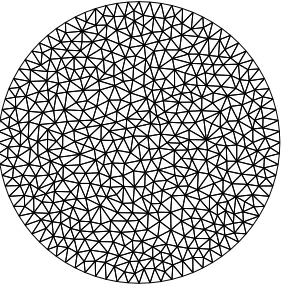
Figure 1. Initial mesh, consisting of 988 elements.
Remark 4.8. Local lower a posteriori error estimates for the SIPG scheme are given by the gener-ally valid estimates from Section 4.2. Evidently, a sensible choice ofκis given byκ∼γ. This will
ensure the equivalence of the termsκ2
h
1
2[[u−uDG]]
2
L2(E)and(1+γ
2+κ2)P
K∈Tk[[uDG]]k 2 L2(∂K) appearing on the left and right-hand side of the a posteriori error estimate (36), respectively; cf. (31).
Remark 4.9. We note that the convexity of Ω is not essential in the a posteriori error analy-sis above. In the non-convex case, however, the presence of possible corner singularities in the solution ψ of (20)(21) implies that ψ ∈ W2,p(Ω) for some p < 2 rather than ψ ∈ H2(Ω); see,
e.g., [11]. Consequently, a rened analysis based onLp spaces is required. This can again be done
along the lines of [3]; cf. also [19].
5. Numerical Examples
We consider the case when the computational domain Ωis the unit disc, i.e., Ω ={x∈ R2 : |x| < 1}. Settingx0 =0, the analytical solution to (1)(2) is the fundamental solution of the
Laplace equation; namely,
u(x) =− 1
2πln|x|.
Our numerical experiments are based on the SIPG method (7); here, we chooseγ =κ= 10. Firstly, we investigate the asymptotic convergence of the SIPG on a sequence of successively ner quasi-uniform unstructured triangular meshes for`= 1,2. Here, the initial mesh consists of 988 elements; cf. Figure 1. In Tables 1 and 2 we present a comparison of theL2(Ω)norm, as well as the
extendedL2(Ω)norm dened in Remark 4.2, of the erroru−u
DGfor`= 1,2, respectively, as the
initial mesh is uniformly rened. In each case we show the number of elements in the computational mesh, the number of degrees of freedom in the nite element space VDG(T), the corresponding
L2(Ω)norm and extendedL2(Ω)norm of the error, together with their respective computed rate
of convergencek. Here, we observe that (asymptotically)ku−uDGkL2(Ω)converges to zero at the rateO(h)as htends to zero, cf. Theorem 3.1. Similar behavior of the normku−uDGk0,h is also
observed asymptotically.
Secondly, we now investigate the performance of the a posteriori error estimate derived in Theorem 4.7 within an automatic hversion adaptive renement procedure which is based on
1-irregular triangular elements, with`= 1. Thehadaptive meshes are constructed by marking the
Elements Dof ku−uDGkL2(Ω) k ku−uDGk0,h k
988 2964 0.5096E-02 0.00 0.1019 0.00
[image:15.612.146.454.97.176.2]3952 11856 0.3004E-02 0.76 0.4105E-01 1.31 15808 47424 0.2133E-02 0.49 0.1677E-01 1.29 63232 189696 0.8467E-03 1.33 0.9547E-02 0.81 252928 758784 0.5272E-03 0.68 0.4981E-02 0.94
Table 1. Convergence of ku−uDGkL2(Ω) and ku−uDGk0,h on quasi-uniform triangular meshes with`= 1.
Elements Dof ku−uDGkL2(Ω) k ku−uDGk0,h k
988 5928 0.2112E-02 0.00 0.1100 0.00
[image:15.612.146.456.226.303.2]3952 23712 0.1451E-02 0.54 0.3400E-01 1.69 15808 94848 0.7444E-03 0.96 0.1715E-01 0.99 63232 379392 0.3484E-03 1.10 0.8688E-02 0.98 252928 1517568 0.1817E-03 0.94 0.6064E-02 0.52 Table 2. Convergence of ku−uDGkL2(Ω) and ku−uDGk0,h on quasi-uniform triangular meshes with`= 2.
103 104 105 106
10−4 10−3 10−2 10−1 100
Error Bound True Error
Degrees of Freedom
0 2 4 6 8 10
0 1 2 3 4 5 6
E
ffe
ct
ivi
ty
Inde
x
Mesh Number
(a) (b)
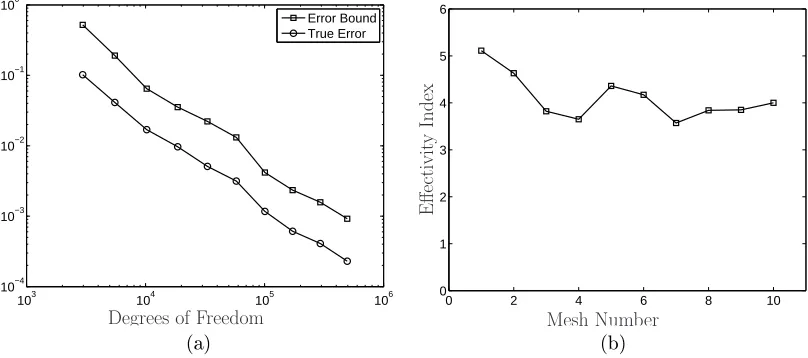
Figure 2. (a) Comparison of the actual and estimated extendedL2(Ω)norm of
the error with respect to the number of degrees of freedom; (b) Eectivity indices.
actual and estimated extended L2(Ω)norm of the error on each of the meshes generated based
on employing hadaptive mesh renement. Here, we observe that the a posteriori bound
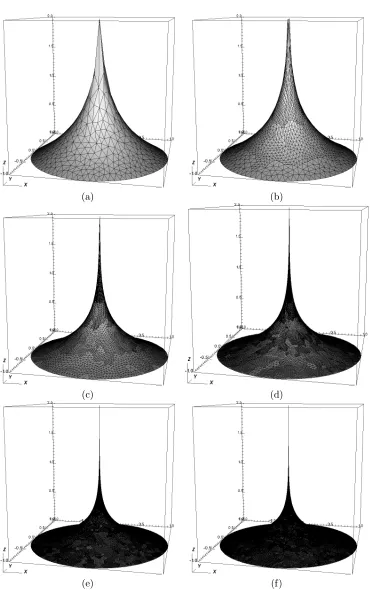
over-estimates the true error by a consistent factor. Indeed, the eectivity index tends to a value of around4as the mesh is adaptively rened, cf. Figure 2(b). In Figure 3 we plot the meshes overlayed onto the corresponding computed DG solution after 0 (initial mesh), 2, 4, 6, 8, and 9 adaptive renement steps have been undertaken. Here, we observe that the mesh has been signicantly rened in the vicinity of the origin of the computational domain, where the delta-source term is centered, as expected.
6. Conclusions
[image:15.612.99.503.357.536.2](a) (b)
(c) (d)
[image:16.612.117.487.86.676.2](e) (f)
partial dierential equations with Dirac delta right-hand side. In particular, the a priori bound indicates that theL2norm of the discretization error converges to zero at the rate O(h) as the
mesh sizehtends to zero. Secondly, computable residualbased a posteriori error indicators have
been derived when the error is measured in terms of an extendedL2norm; the use of this norm
facilitates the derivation of local lower bounds. These theoretical results have been conrmed numerically; in particular, the a posteriori error bound has been employed within an automatic adaptive mesh renement algorithm.
References
[1] R. A. Adams and J. J. F. Fournier. Sobolev Spaces. Elsevier, 2003.[2] T. Apel, O. Benedix, D. Sirch, and B. Vexler. A priori mesh grading for an elliptic problem with Dirac right-hand side. submitted, 2009.
[3] R. Araya, E. Behrens, and R. Rodríguez. A posteriori error estimates for elliptic problems with Dirac delta source terms. Numer. Math., 105(2):193216, 2006.
[4] D. N. Arnold. An interior penalty nite element method with discontinuous elements. SIAM J. Numer. Anal., 19:742760, 1982.
[5] D. N. Arnold, F. Brezzi, B. Cockburn, and L. D. Marini. Unied analysis of discontinuous Galerkin methods for elliptic problems. SIAM J. Numer. Anal., 39:17491779, 2001.
[6] R. Becker and R. Rannacher. An optimal control approach to a-posteriori error estimation in nite element methods. In A. Iserles, editor, Acta Numerica, pages 1102. Cambridge University Press, 2001.
[7] E. Casas.L2 estimates for the nite element method for the Dirichlet problem with singular data. Numer. Math., 47(4):627632, 1985.
[8] M. Dauge. Elliptic Boundary Value Problems on Corner Domains. Lecture Notes in Math., 1341, Springer-Verlag, Berlin, 1988.
[9] J. Douglas and T. Dupont. Interior penalty procedures for elliptic and parabolic Galerkin methods. In Comput-ing methods in applied sciences (Second Internat. Sympos., Versailles, 1975), pages 207216. Lecture Notes in Phys., Vol. 58. Springer, Berlin, 1976.
[10] K. Eriksson, D. Estep, P. Hansbo, and C. Johnson. Introduction to adaptive methods for dierential equations. In A. Iserles, editor, Acta Numerica, pages 105158. Cambridge University Press, 1995.
[11] P. Grisvard. Elliptic Problems in Nonsmooth Domains. Pitman, 1985.
[12] P. Houston and E. Süli. Adaptive nite element approximation of hyperbolic problems. In T. Barth and H. De-coninck, editors, Error Estimation and Adaptive Discretization Methods in Computational Fluid Dynamics. Lect. Notes Comput. Sci. Engrg., volume 25, pages 269344. Springer, 2002.
[13] P. Houston and T. P. Wihler. Second-order elliptic PDE with discontinuous boundary data. IMA J. Numer. Anal., 2011. In press.
[14] V. John. A posteriori L2-error estimates for the nonconformingP
1/P0-nite element discretization of the Stokes equations. J. Comput. Appl. Math., 96(2):99116, 1998.
[15] B. Rivière. Discontinuous Galerkin Methods for Solving Elliptic and Parabolic Equations, Theory and Imple-mentation. Frontiers in Applied Mathematics. SIAM, 2008.
[16] B. Rivière, M. F. Wheeler, and V. Girault. A priori error estimates for nite element methods based on discontinuous approximation spaces for elliptic problems. SIAM J. Numer. Anal., 39(3):902931 (electronic), 2001.
[17] R. Scott. Finite element convergence for singular data. Numer. Math., 21:317327, 1973/74.
[18] M. F. Wheeler. An elliptic collocation nite element method with interior penalties. SIAM J. Numer. Anal., 15:152161, 1978.