Minkowski Polynomials and Mutations
?Mohammad AKHTAR †, Tom COATES†, Sergey GALKIN‡ and Alexander M. KASPRZYK†
† Department of Mathematics, Imperial College London,
180 Queen’s Gate, London SW7 2AZ, UK
E-mail: [email protected], [email protected], [email protected]
‡ Universit¨at Wien, Fakult¨at f¨ur Mathematik, Garnisongasse 3/14, A-1090 Wien, Austria
E-mail: [email protected]
Received June 14, 2012, in final form December 01, 2012; Published online December 08, 2012
http://dx.doi.org/10.3842/SIGMA.2012.094
Abstract. Given a Laurent polynomial f, one can form the period of f: this is a func-tion of one complex variable that plays an important role in mirror symmetry for Fano manifolds. Mutations are a particular class of birational transformations acting on Lau-rent polynomials in two variables; they preserve the period and are closely connected with cluster algebras. We propose a higher-dimensional analog of mutation acting on Laurent polynomials f in n variables. In particular we give a combinatorial description of muta-tion acting on the Newton polytope P of f, and use this to establish many basic facts about mutations. Mutations can be understood combinatorially in terms of Minkowski re-arrangements of slices of P, or in terms of piecewise-linear transformations acting on the dual polytope P∗ (much like cluster transformations). Mutations map Fano polytopes to Fano polytopes, preserve the Ehrhart series of the dual polytope, and preserve the period of f. Finally we use our results to show that Minkowski polynomials, which are a family of Laurent polynomials that give mirror partners to many three-dimensional Fano man-ifolds, are connected by a sequence of mutations if and only if they have the same pe-riod.
Key words: mirror symmetry; Fano manifold; Laurent polynomial; mutation; cluster trans-formation; Minkowski decomposition; Minkowski polynomial; Newton polytope; Ehrhart series; quasi-period collapse
2010 Mathematics Subject Classification: 52B20; 16S34; 14J33
1
Introduction
Given a Laurent polynomialf ∈C
x±11 , . . . , x±1n , one can form the period off
πf(t) =
1 2πi
nZ
|x1|=···=|xn|=1
1
1−tf(x1, . . . , xn) dx1
x1
· · ·dxn xn
, t∈C, |t| ∞. (1)
The period off gives a solution to a GKZ hypergeometric differential system associated to the Newton polytope off (see [9,§3]). Periods of Laurent polynomials and the associated differen-tial systems are interesting from the point of view of mirror symmetry, because certain Laurent polynomials arise as mirror partners to n-dimensional Fano manifolds [3,4,5,8,11,17]. In its most basic form (which will suffice for what follows) the statement that a Laurent polynomialf
is a mirror partner for a Fano manifold X means that the Taylor expansion of the period
?This paper is a contribution to the Special Issue “Mirror Symmetry and Related Topics”. The full collection
of f
πf(t) =
X
k≥0 cktk
coincides with a certain generating function for Gromov–Witten invariants ofXcalled the quan-tum period of X [9,§ 4]. The Taylor coefficientck here is the coefficient of the unit monomial
in the Laurent polynomial fk. We refer to the sequence (ck)k≥0 as theperiod sequence forf.
We expect that if the Laurent polynomialf is a mirror partner to a Fano manifold X, then there is a geometric relationship between f and X as follows (cf. [24]). Let Nf be the lattice
generated by the exponents of monomials off. Consider the Newton polytope Newt(f) off, and assume that the origin lies in its strict interior. LetXf denote the toric variety defined by the
spanning fan of Newt(f) in Nf ⊗Q; in general Xf will be singular. We expect thatXf admits
a smoothing with general fiberX. Note that our assumption that Newt(f) contains the origin is not restrictive: if the origin is outside Newt(f) then the period of f is constant, and hence cannot be the quantum period of a Fano manifold; if the origin is contained in a proper face of Newt(f) then we can reduce to a lower-dimensional situation. Note also that the latticeNf
may be a proper sublattice of Zn, see Example 8 and [6]. The picture described here implies that one might expect many Laurent polynomial mirrors for a given Fano manifold, as a smooth Fano manifold can degenerate to many different singular toric varieties.
The motivating case for this paper is that of three-dimensionalMinkowski polynomials. These are a family of Laurent polynomials in three variables, defined in Section4below, which provide mirror partners to many of the three-dimensional Fano manifolds. The correspondence between three-dimensional Minkowski polynomials and Fano manifolds is not one-to-one, in part because many Minkowski polynomials give rise to the same period sequence. There are several thousand Minkowski polynomials f: (C×)3 → C, up to change of co-ordinates on (C×)3, but between them these give only 165 distinct period sequences1. In what follows we give a conceptual explanation for this phenomenon. We define birational transformations, called mutations, that preserve periods and show that any two Minkowski polynomials with the same period are related by a sequence of mutations. Our birational transformations are higher-dimensional generalisa-tions of the mutageneralisa-tions defined by Galkin–Usnich [14]. Combining our results in Section5 with a theorem of Ilten [18] shows that wheneverf andg are Minkowski polynomials with the same period sequence, the toric varietiesXf andXg occur as fibers of a flat family over a curve. This
is consistent with our conjectural picture, which implies that whenever Laurent polynomials f
and g are mirror partners for the same Fano manifold X, the toric varieties Xf and Xg are
deformation equivalent.
The paper is organised as follows. We define mutations algebraically in Section2and combi-natorially in Section3. Algebraic mutations operate on Laurent polynomials, whereas combina-torial mutations operate on polytopes. An algebraic mutation of a Laurent polynomialf induces a combinatorial mutation of its Newton polytope Newt(f); the converse statement is discussed in Remark3. We establish various basic properties of combinatorial mutations: they send Fano polytopes to Fano polytopes (Proposition 2); there are, up to isomorphism, only finitely many mutations of a given polytope (Proposition3); and mutation-equivalent polytopes have the same Hilbert series (Proposition 4). We define Minkowski polynomials in Section4, and in Section5 show by means of a computer search that all Minkowski polynomials with the same period se-quence are connected by a sese-quence of mutations. Period sese-quences for Minkowski polynomials are listed in Appendix A, and mutations connecting the Minkowski polynomials with the same period sequence are listed in Appendix B.
1
2
Mutations
In this section we define mutations. These are a class of birational transformationsϕ: (C×)n99K (C×)n with the property that if two Laurent polynomials f and g are related by a mutationϕ, so that g=ϕ?f, then the periods off and g coincide. We begin with two examples.
Example 1. Consider a Laurent polynomial
f =A(x, y)z−1+B(x, y) +C(x, y)z,
where A, B, C are Laurent polynomials in x and y. The pullback of f along the birational transformation (C×)3 99K(C×)3 given by
(x, y, z)7→ x, y, A(x, y)z
(2)
is
g=z−1+B(x, y) +A(x, y)C(x, y)z.
We say that the Laurent polynomials f and g are related by the mutation (2).
Example 2. Consider a Laurent polynomial
f =
l
X
i=k
Ci(x, y)zi,
withk <0 andl >0 where eachCi,i∈ {k, k+ 1, . . . , l}, is a Laurent polynomial inxandy. Let Abe a Laurent polynomial in xandy such thatCi is divisible byA−i fori∈ {k, k+ 1, . . . ,−1}.
The pullback of f along the birational transformation (C×)3 99K(C×)3 given by
(x, y, z)7→ x, y, A(x, y)z
(3)
is
g=
l
X
i=k
A(x, y)iCi(x, y)zi.
We say that the Laurent polynomials f and g are related by the mutation (3).
Remark 1. Note that the pullback of a Laurent polynomial along a birational transformation of the form (2) or (3) will not, in general, be a Laurent polynomial: the condition A−iCi,
i∈ {k, k+ 1, . . . ,−1}, is essential.
Definition 1. A GL3(Z)-equivalence is an isomorphism (C×)3 →(C×)3 of the form
(x, y, z)7→ xaybzc, xdyezf, xgyhzi, whereM :=
a b c d e f g h i
∈GL3(Z).
For brevity, we write this isomorphism asx7→xM.
Definition 2. A mutation is a birational transformation (C×)399K(C×)3 given by a composi-tion of:
2) a birational transformation of the form (3); and
3) another GL3(Z)-equivalence.
Iff,gare Laurent polynomials andϕis a mutation such thatϕ?f =gthen we say that f andg
are related by the mutationϕ.
Remark 2. One can also define mutations of Laurent polynomials in n variables, using the obvious generalisations of Example2, Definition 1, and Definition 2.
Example 3. Consider the Laurent polynomial
f =xyz+x+y+z+ 1
x +
1
xyz.
The Newton polytopeP of f has two pairs of parallel facets, and we place one pair of them at heights 1 and −1 by applying the GL3(Z)-equivalencex7→xM with
M =
1 −1 1
0 1 −1
0 0 1
.
This transformsf into the Laurent polynomial
1
z
y+ y
x +
1
x
+z
1 +x+x
y
.
We now apply the birational transformation (2) with A(x, y) = y + yx + 1x, followed by the GL3(Z)-equivalencex7→xM
−1
, obtaining
g=xy2z2+xyz+ 2yz2+ 2z+1
z+
1
y + z2
x + z xy.
This shows that the Laurent polynomials f and g are related by the mutationϕ, where
ϕ(x, y, z) = xy
2z+yz+ 1 y ,
xy2 xy2z+yz+ 1,
z xy2z+yz+ 1
xy
!
.
Lemma 1. If the Laurent polynomialsf and g are related by a mutationϕ, then the periods of f and g coincide.
Proof . Letϕ: (C×)3 99K(C×)3 be the birational transformation
(x, y, z)7→(x, y, A(x, y)z)
from (3). Since GL3(Z)-equivalence preserves periods, it suffices to show that if g=ϕ?f then the periods off and gcoincide. Let
Z =
(x, y, z)∈(C×)3:A(x, y) = 0
and let U = (C×)3\Z. Note that the restrictionϕ|U:U →(C×)3 is a morphism, and that
(ϕ|U)?
dx x
dy y
dz z
= dx
x dy
y dz
z . (4)
Let
Ca,b,c=
so that the period of f is
1 2πi
nZ
C1,1,1
1 1−tf(x, y, z)
dx x dy y dz z .
The amoeba ofZ is a proper subset ofR3 [15, Chapter 6, Corollary 1.8], so there exists (a, b, c) such thatCa,b,c⊂U. The cyclesCa,b,c andCa0,b0,c0 are homologous in (C×)3 for any non-zeroa, b,c,a0,b0,c0. Thus
πg(t) =
1 2πi
nZ
C1,1,1
1 1−tg(x, y, z)
dx x dy y dz z = 1 2πi
nZ
Ca,b,c
1 1−tg(x, y, z)
dx x dy y dz z = 1 2πi
nZ
ϕ(Ca,b,c)
1 1−tf(x, y, z)
dx x
dy y
dz
z by the change of variable formula.
Now the homology classϕ(Ca,b,c)
∈H3 (C×)3,Zis equal tokC1,1,1
for some integerk, since
H3 (C×)3,Z is freely generated by C1,1,1
, and from (4) and the change of variable formula we see thatk= 1. It follows that
πg(t) =
1 2πi
nZ
C1,1,1
1 1−tf(x, y, z)
dx x
dy y
dz
z =πf(t).
Example 4. Consider the two Laurent polynomials
f1 =x+
2x y +
x
y2 +y+z+
1 z+ z y + 4 y + 1 yz + yz x + 2y x + y xz + 2z x + 5 x+ 2 xz + yz x2 +
2y x2 +
y x2z, f2 =x+2x
y + x
y2 +y+z+
1 z+ z y + 3 y + 1 yz + yz x + 3y x + y xz + 2z x + 4 x+ 2 xz + yz x2 +
2y x2 +
y x2z.
Since f1 andf2 have the same period sequence
πf1(t) =πf2(t) = 1 + 28t
2+ 216t3+ 3516t4+ 49680t5+· · ·,
and since Newt(f1) = Newt(f2), it is tempting to assume that there is some GL3(Z)-equivalence that preserves the Newton polytope and sends f1 to f2. This is not the case. However, there
does exist a birational map sending f1 tof2. This is a composition of mutations
f1 −→ϕ f −→ψ f2
factoring through
f =xz2+ 2xz+x+yz+y+ 3z+ 2
z+ z y + 1 y + y x + y xz + 2 x + 2 xz + 1
xz2 +
1
xy +
1
xyz.
The maps ϕ,ψ and their inverses are given by
ϕ: (x, y, z)7→
z(xyz+ (y+ 1)2)
y ,
xyz+ (y+ 1)2
xy , y
,
ψ: (x, y, z)7→
(x+yz+y)(xz+yz+y)
y2z(x+y) ,
ϕ−1: (x, y, z)7→
xz+y(z+ 1)2
y2z , z,
xyz xz+y(z+ 1)2
,
ψ−1 : (x, y, z)7→
(yz+z+ 1)(yz+y+z)
xyz2(z+ 1) ,
(yz+z+ 1)(yz+y+z)
xyz(z+ 1) , 1
y
.
Set P := Newt(f1) = Newt(f2) and Q := Newt(f). The polytopes P and Q are reflexive, but
since Vol(P) = 32 and Vol(Q) = 28, P and Q are not isomorphic. However, as predicted by Proposition 4 below, the Ehrhart series EhrP∗(t) and EhrQ∗(t) are equal: in other words, the
Hilbert series HilbXfi(−KXfi) and HilbXf(−KXf) agree.
3
Combinatorial mutations
The mutations of a Laurent polynomial f defined in Section 2 induce transformations of the Newton polytope of f. In this section we give a combinatorial and coordinate-free definition of these transformations, which we call combinatorial mutations, in terms of the Newton polytope alone. We then establish some basic properties of combinatorial mutations. Let us begin by fixing our notation. Let N be an n-dimensional lattice and let P ⊂NQ :=N ⊗Qbe a convex lattice polytope such that
1) P is of maximum dimension, dimP =n;
2) the origin lies in the strict interior of P,0∈P◦;
3) the vertices V(P)⊂N ofP are primitive lattice points.
We call such a polytope Fano.
Given any lattice polytopeP ⊂NQ, thedual polyhedronP∗ ⊂MQ, whereM := Hom(N,Z), is defined by
P∗ :={u∈MQ|u(v)≥ −1 for allv∈P}.
Condition 2 ensures that, when P is Fano,P∗ is a polytope. When P∗ is a lattice polytope, we say that P is reflexive. Low-dimensional reflexive polytopes have been classified [20, 21]: up to the action of GLn(Z) there are 16 reflexive polytopes in dimension two; 4,319 in dimension three; and 473,800,776 in dimension four. A Fano polytope P ⊂ NQ is called canonical if
P◦ ∩N = {0}. In two dimensions, the reflexive polytopes and canonical polytopes coincide. In general every reflexive polytope is canonical, although the converse is not true: there are 674,688 canonical polytopes in dimension three [19].
Definition 3. Letw∈M be a primitive lattice vector, and let P ⊂NQ be a lattice polytope. Set
hmin:= min{w(v)|v∈P}, hmax:= max{w(v)|v∈P}
We define the width of P with respect to wto be the positive integer
widthw(P) :=hmax−hmin.
If widthw(P) =lthen we refer towas awidthl vector forP. We say that a lattice pointv∈N
(resp. a subset F ⊂NQ) is at height m with respect tow ifw(v) =m (resp. ifw(F) ={m}).
is a well-known characterisation of reflexive polytopes [2]. For each height h ∈ Z, w defines a hyperplane Hw,h:={x∈NQ|w(x) =h}. Let
wh(P) := conv(Hw,h∩P∩N).
By definition, whmin(P) = Hw,hmin ∩P and whmax(P) = Hw,hmax ∩P are faces of P, hence V(whmin(P))⊆ V(P) and V(whmax(P))⊆ V(P). Furthermore, the facewhmin(P) is a facet of P
if and only if w = u for some vertex u ∈ V(P∗), where u denotes the unique primitive lattice point on the ray from0 throughu. Similarly,whmax(P) is a facet if and only if−w=u for some u∈ V(P∗).
Definition 4. Recall that the Minkowski sum of two polytopes Q, R⊂NQ, is
Q+R:={q+r|q∈Q, r∈R}.
Henceforth we adopt the convention that Q+∅:=∅for any polytope Q.
Definition 5. Suppose that there exists a lattice polytopeF ⊂NQ with w(F) = 0, such that for every height hmin≤h <0 there exists a possibly-empty lattice polytopeGh ⊂NQ satisfying Hw,h∩ V(P)⊆Gh+ (−h)F ⊆wh(P). We call such an F a factor forP with respect tow. We
define thecombinatorial mutation given by width vectorw, factorF, and polytopes{Gh}to be the convex lattice polytope
mutw(P, F;{Gh}) := conv
−1
[
h=hmin Gh∪
hmax
[
h=0
(wh(P) +hF)
⊂NQ.
Notice that one need only consider factors up to translation, since for anyv ∈N such that
w(v) = 0 we have mutw(P, v+F;{Gh+hv})∼= mutw(P, F;{Gh}). In particular, if whmin(P) is
zero-dimensional then combinatorial mutations with width vector w leaveP unchanged.
Example 5. Consider the situation of Example2, so thatf is the Laurent polynomial
f =
l
X
i=k
Ci(x, y)zi,
with k <0 and l >0,A is a Laurent polynomial inx and y such that
A−iCi fori∈ {k, k+ 1, . . . ,−1},
ϕis the birational transformation (x, y, z)7→ x, y, A(x, y)z
, and
g=
l
X
i=k
A(x, y)iCi(x, y)zi.
The Laurent polynomials f and g are related by the algebraic mutation ϕ. This algebraic mutation induces a combinatorial mutation of P = Newt(f) with w= (0,0,1), F = Newt(A),
hmin=k,hmax=l,
Gh = Newt
Ch A−h
, where2 hmin ≤h≤ −1,
and mutw(P, F;{Gh}) = Newt(g). 2
Remark 3. Given a Laurent polynomial f1with Newton polytope P, there may exist combina-torial mutations ofP that do not arise from any algebraic mutation off1. Given a combinatorial
mutation of P, however, there exists a Laurent polynomial f2 with Newt(f2) =P such that the
combinatorial mutation arises from an algebraic mutation off2. See Example 6 below.
Lemma 2. Let Q := mutw(P, F;{Gh}) be a combinatorial mutation of P ⊂ NQ. Then
mut−w(Q, F;{wh(P)}) is a combinatorial mutation of Q equal to P.
Proof . Let P0 := mut−w(Q, F;{wh(P)}). Clearly this is well defined. Let v ∈ V(P) be
a vertex of P with heighth. Ifh≥0 then P0 ⊇wh(P)⊇Hw,h∩ V(P), so v∈P0. Ifh <0 then P0 ⊇Gh+ (−h)F ⊇Hw,h∩ V(P). Hence P ⊆P0. Conversely let v∈ V(P0) and seth :=w(v).
If h ≥0 then v ∈ wh(P), so v ∈P. If h <0 then v ∈ Gh+ (−h)F ⊆wh(P), so again v ∈P.
Hence P =P0.
Lemma 3. Let Q:= mutw(P, F;{Gh}) be a combinatorial mutation of P ⊂NQ. Then
V(Q)⊆ {vP +w(vP)vF |vP ∈wh(P)∩N, vF ∈ V(F)}, and V(P)⊆ {vQ−w(vQ)vF |vQ ∈wh(Q)∩N, vF ∈ V(F)}.
Proof . Pick any vertexv∈ V(Q), and seth:=w(v). First consider the case whenh≥0. Notice thatv∈ V(wh(P) +hF), since otherwisevlies in the convex hull of two (not necessarily lattice)
points v1, v2 ∈ Q, and as such could not be a vertex. In general the vertices of a Minkowski
sum are contained in the sum of the vertices of the summands, hence there exist lattice points
vP ∈ V(wh(P)) and vF ∈ V(F) such thatv=vP+hvF. Ifh <0 thenv∈ V(Gh). In particular, v+ (−h)vF ⊆ wh(P) for all vF ∈ F, so there exist lattice points vP ∈wh(P) and vF ∈ V(F)
such that v=vP +hvF. Hence we have the first equation in the statement.
The second equation follows from the first by considering the inverse combinatorial mutation
mut−w(Q, F;{wh(P)}).
Proposition 1. Let P ⊂ NQ be a convex lattice polytope with width vector w and factor F. Then mutw(P, F;{Gh}) = mutw(P, F;{G0h}) for any two combinatorial mutations ofP.
Proof . Set Q := mutw(P, F;{Gh}) and Q0 := mutw(P, F;{G0h}), and suppose that Q 6= Q0.
Then (possibly after exchangingQand Q0) there exists some vertexq ∈ V(Q0) such thatq 6∈Q,
w(q) < 0. In particular, there exists a supporting hyperplane Hu,l of Q separating Q from q;
i.e. u(x)≤l for allx∈Q, andu(q)> l.
For anyv ∈ V(P) there exists vQ∈ww(v)(Q)∩N,vF ∈ V(F) such that v=vP +w(vQ)vF.
Hence
u(v) =u(vQ)−w(vQ)u(vF)≤
(
l−w(vQ)umin, ifw(vQ)≥0, l−w(vQ)umax, ifw(vQ)<0,
where umin:= min{u(vF)|vF ∈ V(F)}, and umax:= max{u(vF)|vF ∈ V(F)}.
Since mut−w(Q0, F;{wh(P)}) = P, so q −w(q)F ⊆ P. By definition there exists some vF ∈ V(F) such thatu(vF) =umax, hence
u(q−w(q)vF) =u(q)−w(q)umax> l−w(q)umax,
a contradiction. HenceQ=Q0.
Example 6. Consider the Laurent polynomial
f = z
2
y + 2z
2+yz2+2xz2 y + 2xz
2+x2z2 y +
1
x2 + x4 y2 +y
2+1 z.
The corresponding Newton polytope P has vertices {(0,1,2),(0,−1,2),(2,−1,2),(0,2,0), (4,−2,0),(−2,0,0),(0,0,−1)}. Note that the sublattice generated by the non-zero coefficients has index one.
Set w = (0,0,−1) ∈ M. The height −2 slice w−2(P) Minkowski-factorizes into two empty triangles, whereas the height−1 slicew−1(P) = conv{(0,1,1),(−1,0,1),(1,−1,1),(2,−1,1)} is indecomposable. Since there are no vertices of P at height −1, Definition 5 allows us to take
G−1 =∅. This gives a combinatorial mutation to
Q= conv{(0,−1,2),(4,−2,0),(0,2,0),(−2,0,0),(1,0,−1),(0,1,−1),(0,0,−1)}.
This corresponds to the algebraic mutationϕ: (x, y, z)7→(x, y, z/(x+y+ 1)) sending f to
ϕ∗f = z
2
y + x4 y2 +y
2+ 1 x2 +
x z +
y z +
1
z.
Setg=f+yz. Then Newt(g) =P but, since g has a non-zero coefficient on the slicew−1(P), the combinatorial mutation described above does not arise from any algebraic mutation of g.
Example 7. The weighted projective spaces P(1,1,1,3) andP(1,1,4,6) are known to have the largest degree −K3 = 72 amongst all canonical toric Fano threefolds [19, Theorem 3.6] and
amongst all Gorenstein canonical Fano threefolds [23]. We shall show that they are connected by a width three combinatorial mutation.
LetP := conv{(1,0,0),(0,1,0),(0,0,1),(−1,−1,−3)} ⊂NQ be the simplex associated with P(1,1,1,3). The primitive vector (−1,2,0) ∈ M is a width three vector on P, with w−1(P) equal to the edge conv{(−1,−1,−3),(1,0,0)}, and w2(P) given by the vertex (0,1,0). Let
F := conv{(0,0,0),(2,1,3)}, and consider the mutation mutw(P, F). This has vertices
{(−1,−1,−3),(0,0,1),(0,1,0),(4,3,6)},
and is the simplex associated with P(1,1,4,6).
Proposition 2. Let P ⊂NQ be a lattice polytope. The combinatorial mutation mutw(P, F) is a Fano polytope if and only if P is a Fano polytope.
Proof . Begin by assuming thatP is Fano, and setQ:= mutw(P, F). Letv∈ V(Q), and define h := w(v) to be the height of v with respect to w. If h ≥ 0 then v = vP +hvF for some vP ∈ V(P), vF ∈ V(F). ButvP is primitive by assumption, hence v is primitive.
If h < 0 then v ∈ V(Gh). Without loss of generality we are free to take Gh equal to the
smallest polytope such thatGh+(−h)F ⊇Hw,h∩V(P). Suppose thatvis not primitive. Then for
anyvF ∈ V(F),v+ (−h)vF is not primitive, hencev+ (−h)vF is not a point ofHw,h∩ V(P). But
this implies that we can takeG0h := conv(Gh∩N\ {v})(Gh withG0h+ (−h)F ⊇Hw,h∩ V(P),
contradicting our choice ofGh. Hence v is primitive.
Finally, the “if and only if” follows by considering the inverse combinatorial mutation.
Corollary 1. Let P ⊂NQ be a lattice polytope, and letw be a width two vector. The combina-torial mutation mutw(P, F) is a canonical polytope if and only ifP is a canonical polytope. Proof . Begin by assuming thatP is a canonical polytope, and setQ:= mutw(P, F). Sincewis
of width two, we need only show thatHw,0∩ V(P) =Hw,0∩ V(Q); it follows thatQis canonical.
ButHw,0∩V(Q)⊆Hw,0∩V(P)⊆Hw,0∩V(Q), where the second inclusion follows by considering
the inverse combinatorial mutation. Once more, the “if and only if” follows by exchanging the
Proposition 3. Let P ⊂NQ be a lattice polytope, 0∈P◦. Up to isomorphism, there are only finitely many combinatorial mutations mutw(P, F).
Proof . For fixed width vector w there are clearly only finitely many factors F, and so only finitely many combinatorial mutations mutw(P, F). Assume that 0 ∈ P◦ and consider the
spanning fan ∆ in MQ for the dual polytope P∗. Since 0 ∈(P∗)◦, any width vector w lies in a cone σ ∈ ∆. If we insist that dimσ is as small as possible, then σ is uniquely determined. If dimσ = dimP thenwhmin(P) is zero-dimensional, hence mutw(P, F)∼=P. So we may insist
that σ∈∆(n−1) is of codimension at least one.
By definition of duality, w∈ ∂(−hminP∗). Consider the corresponding face F := whmin(P).
Let lF ∈Z>0 be the largest integer such that there exist lattice polytopes A, B⊂NQ,A6=∅,
withF =lFA+B. Then, for a factor to exist,l≤lF. DefinelP := max{lF |F is a face of P}.
Then w is a primitive vector in ∆(n−1)∩lPP∗∩M, and the right hand side is a finite set that
depends only on P.
Remark 4. When dimP = 2, 0 ∈ P◦, we see that mutw(P, F) is a non-trivial combinatorial
mutation only ifw∈ {u|u∈ V(P∗)}. In particular, there are at most|V(P)|choices forw, and at most|∂P ∩N|distinct non-trivial combinatorial mutations.
LetQ⊂MQ be a rational polytope, and letr∈Z>0 be the smallest positive integer such that rQ is a lattice polytope. In general there exists a quasi-polynomial, called the Ehrhart quasi-polynomial, LQ : Z → Z of degree dimQ such that LQ(m) = |mQ∩M|. The corresponding
generating function EhrQ(t) := P m≥0
LQ(m)tm is called the Ehrhart series of Q, and can be
written as a rational function [25]
EhrQ(t) =
δ0+δ1t+. . .+δr(n+1)−1tr(n+1)−1
(1−tr)n+1
with non-negative coefficients. We call (δ0, δ1, . . . , δr(n+1)−1) the δ-vector of Q. In particular,
theδ-vector is palindromic if and only if Q∗ ⊂NQ is a lattice polytope [12].
Proposition 4. Let P ⊂ NQ be a lattice polytope, 0 ∈ P◦, and let Q := mutw(P, F) be a combinatorial mutation of P. Then EhrP∗(t) = EhrQ∗(t).
Proof . Since P∗ is the dual of a lattice polytope, for any point u ∈ M there exists a non-negative integerk∈Z≥0 such thatu∈∂(kP∗). By definition of duality, Hu,−k:={u(v) =−k| v∈NQ} is a supporting hyperplane forP. We begin by showing that the map u7→u−uminw, whereumin:= min{u(vF)|vF ∈ V(F)}, gives a supporting hyperplaneHu−uminw,−k forQ, hence u−uminw∈∂(kQ∗).
Letv∈ V(Q). Ifw(v)≥0, we can writev=vP +w(vP)vF for somevP ∈ V(P), vF ∈ V(F).
In particular,
(u−uminw)(v) =u(vP) +w(vP)(u(vF)−umin)≥ −k.
Now suppose that w(v) < 0. For any vF ∈ V(F) we have that v −w(v)uF ∈ P, hence u(v−w(v)vF)≥ −k. In particular, u(v)≥ −k+uminw(v), so
(u−uminw)(v) =u(v)−uminw(v)≥ −k+uminw(v)−uminw(v) =−k.
SinceHu,−kis a supporting hyperplane forP, there exists somevP ∈ V(P) such thatu(vP) = −k. Ifw(vP)≥0 then for anyvF ∈ V(F),vP+w(vP)vF ∈Q. PickingvF such thatu(vF) =umin,
that u(v0F) =umin. Thenu(vQ−w(vP)vF0 )< u(vQ−w(vP)vF) =−k. But vQ−w(vP)vF0 ∈P,
which is a contradiction. Henceu(vF) =umin, and so (u−uminw)(vQ) =−k. ThusHu−uminw,−k
is a supporting hyperplane for Q.
Finally, suppose thatu, u0∈∂(kP∗) are lattice points such thatu−uminw=u0−u0minw. Since for any vF ∈ V(F), (u−uminw)(vF) = u(vF), we see that umin =u0min and so u = u0. Hence |∂(kP∗)| ≤ |∂(kQ∗)|. By considering the inverse combinatorial mutation mut−w(Q, F) =P, we
have equality. The result follows.
Example 8. Consider the Laurent polynomials
f1 =xyz2u+x+y+z+
1
yz +
1
x2yz2u, f2 =xyz
2u3+x+y+z+ 1 yz +
1
x2yz2u3.
The Newton polytopesPi:= Newt(fi) are both four-dimensional reflexive polytopes in NQ, and
theδ-vectors of the dual polytopes are, respectively,
δ1 = (1,95,294,95,1), δ2 = (1,29,102,29,1).
Proposition4thus implies that there is no sequence of mutations connectingf1 andf2. However
πf1(t) =πf2(t) = 1 + 12t
3+ 900t6+ 94080t9+ 11988900t12+· · ·,
which we recognise as the period sequence forP2×P2. As in Section1, letNfi be the sublattice
ofN generated by the exponents of monomials offi, and letXfi be the toric variety defined by
the spanning fan ofPiinNfi⊗Q. The latticeNf1 is equal toN, andXf1 is isomorphic toP 2×
P2. The lattice Nf2 is an index-three sublattice of N, but the restriction ofP2 toNf2 is isomorphic
toP1 and henceXf2 is also isomorphic toP 2×
P2. Consider now the toric varietyX2e defined by
the spanning fan ofP2inNQ. This is a three-fold cover ofX2, and is not deformation-equivalent toP2×P2: X2e has Hilbertδ-vectorδ2, whereasP2×P2 has Hilbertδ-vectorδ1. As this example
illustrates, sublattices are invisible to period sequences.
Let Q := mutw(P, F) be a combinatorial mutation of P, and let rP denote the smallest
dilationkofP∗such thatkP∗is integral. WhenP is a Fano polytope, we callrP theGorenstein index. The minimum period common to the cyclic coefficients of LP∗ divides rP; when the
period does not equal rP we have a phenomena known as quasi-period collapse [7, 16]. In
general rP 6= rQ but, by Proposition 4, P∗ and Q∗ are Ehrhart equivalent. Hence we have
examples of quasi-period collapse. At its most extreme, when P is reflexive rP = 1 and so the
period of LQ∗ is one. Combinatorial mutations give a systematic way of producing families of
rational polytopes that exhibit this behaviour.
Corollary 2. A three-dimensional canonical polytopeP ⊂NQ is combinatorial mutation equiv-alent to a reflexive polytope if and only if P is reflexive.
Proof . By inspecting the classification of canonical polytopes [19] we see that the period ofLP∗
equals rP for each P.
The following example demonstrates that Corollary2 does not hold in higher dimensions.
Example 9. For any even dimension n = 2k ≥ 4, define Pk to be the polytope with n+ 2
vertices:
Pk:= conv{(2,2,1,1, . . . ,1),(2,1,2,1, . . . ,1),
This is a canonical polytope, but is not reflexive: the facet defined by all but the final ver-tex is supported by the primitive vector (n−1,−2, . . . ,−2) ∈ M at height −2. Let w := (1,−1,−1,0, . . . ,0) ∈ M be a width two vector on Pk. The face w−1(Pk) is two-dimensional;
this is the empty square, and Minkowski factors into two line segments. The corresponding combinatorial mutation gives the standard polytope forPn. By Proposition4,
EhrPk∗(t) = HilbPn(−KPn).
Since rPk = 2, we have quasi-period collapse.
The mapu 7→u−uminw on M described in the proof of Proposition 4 is a piecewise-linear transformation analogous to a cluster transformation. Let ∆F be the normal fan of F in MQ.
Notice that the normal fan is well-defined up to translation ofF. Furthermore, the cones of ∆F
are not strictly convex: they each contain the subspace Zw. Let σ be a maximum-dimensional cone of ∆F. Then there existsMσ ∈GLn(Z) such that, for anyu∈ −σ, the mapu7→u−uminw is equal to the mapu7→uMσ.
We make this explicit. Suppose without loss of generality thatw= (0, . . . ,0,1)∈M. Then a maximum-dimensional cone σ ∈ ∆F corresponds to some vertex vσ = (vσ,1, . . . , vσ,n−1,0) ∈ V(F), and
Mσ :=
1 0 . . . 0 −vσ,1
0 1 . . . 0 −vσ,2
..
. ... ... ... 0 0 . . . 1 −vσ,n−1
0 0 . . . 0 1
.
Example 10. Let w:= (0,0,1)∈M and let F := conv{(0,0,0),(1,0,0),(0,1,0)} ⊂NQ. We have:
Mσ =
1 0 0 0 1 0 0 0 1
ifσ= cone{(−1,0,0),(0,−1,0),(0,0,±1)},
1 0 −1
0 1 0
0 0 1
ifσ= cone{(1,1,0),(0,−1,0),(0,0,±1)},
1 0 0
0 1 −1
0 0 1
ifσ= cone{(−1,0,0),(1,1,0),(0,0,±1)}.
4
Three-dimensional Minkowski polynomials
Three-dimensional Minkowski polynomials are a family of Laurent polynomials in three variables with Newton polytopes given by three-dimensional reflexive polytopes. We consider Laurent polynomialsf ∈C[x±1, y±1, z±1], and writexv :=xaybzcwhere v= (a, b, c)∈Z3.
Definition 6. Let Qbe a convex lattice polytope inQ3.
1. We say that Q is a length-one line segment if there exist distinct points v, w ∈ Z3 such that the vertices of Qarev,w (in some order) andQ∩Z3 ={v, w}. In this case, we set
2. We say that Q is anAn triangle if there exist distinct points u, v, w ∈ Z3 such that the vertices of Q are u, v, w (in some order) and Q∩Z3 ={u, v
0, v1, . . . , vn}, where v0 = v, vn =w, and v0, v1, . . . , vn are consecutive lattice points on the line segment from v tow.
In this case, we set
fQ=xu+ n
X
k=0
n k
xvk.
Observe that, in each case, the Newton polytope offQ is Q.
Definition 7. Alattice Minkowski decomposition of a lattice polytopeQ⊂Qm is a
decomposi-tion Q=Q1+· · ·+Qr of Qas a Minkowski sum of lattice polytopesQi,i∈ {1,2, . . . , r}, such
that the affine lattice generated by Q∩Zm is equal to the sum of the affine lattices generated
by Qi∩Zm,i∈ {1,2, . . . , r}.
Example 11. The Minkowski decomposition
+ =
is not a lattice Minkowski decomposition, because the affine lattices in the summands generate an index-two affine sublattice ofZ2.
Definition 8. LetQbe a lattice polytope inQm. We say that lattice Minkowski decompositions
Q=Q1+· · ·+Qr, Q=Q01+· · ·+Q 0 s
ofQareequivalent ifr =sand if there existv1, . . . , vr∈Zmand a permutationσof{1,2, . . . , r} such that Q0i=Qσ(i)+vi.
Definition 9. Let Q be a lattice polytope in Q3. A lattice Minkowski decomposition Q =
Q1 +· · ·+Qr of Q is called admissible if each Qi is either a length-one line segment or an Antriangle. Given an admissible Minkowski decomposition Q=Q1+· · ·+Qr ofQ, we set
fQ:Q1,...,Qr =
r
Y
i=1 fQi.
Observe that the Newton polytope of fQ:Q1,...,Qr is Q. Observe also that if
Q=Q1+· · ·+Qr, Q=Q01+· · ·+Q0s
are equivalent lattice Minkowski decompositions of Q, thenfQ:Q1,...,Qr =fQ:Q01,...,Q0s.
Definition 10. Let P be a three-dimensional reflexive polytope in Q3. Let f be a Laurent polynomial in three variables. We say that f is athree-dimensional Minkowski polynomial with Newton polytope P if:
1. Newt(f) =P, so that
f = X
v∈P∩Z3 avxv
for some coefficientsav.
3. For each facet Q∈ F(P) of P, we have
X
v∈Q∩Z3
avxv =fQ:Q1,...,Qr
for some admissible lattice Minkowski decomposition Q=Q1+· · ·+Qr of Q.
Given a three-dimensional reflexive polytopeP, there may be:
1) no Minkowski polynomial with Newton polytope P, if some facet of P has no admissible lattice Minkowski decomposition;
2) a unique Minkowski polynomial with Newton polytope P, if there is a unique equivalence class of admissible lattice Minkowski decomposition for each facet of P;
3) many Minkowski polynomials with Newton polytope P, if there is some facet of P with several inequivalent admissible lattice Minkowski decompositions.
[image:14.612.249.374.327.461.2]Up to isomorphism, there are 4319 three-dimensional reflexive polytopes [20]; 1294 of them support no Minkowski polynomial, and the remaining 3025 together support 3747 distinct3 Minkowski polynomials.
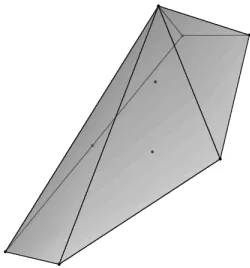
Figure 1. The polytopeP from Example12.
Example 12. Consider the three-dimensional reflexive polytope P with vertices:
{(−1,−1,−3),(1,0,0),(0,1,0),(0,0,1),(0,−1,−2),(−1,1,−1)}.
As facets, P has fourA1 triangles, oneA2 triangle, and a pentagon. The pentagonal facet of P
has two inequivalent lattice Minkowski decompositions
+ = + =
and thus there are two distinct Minkowski polynomials supported onP
f1 =x+y+z+ 1
yz2 + y xz +
2
xz2 +
1
xyz3 +
2
z,
f2 =x+y+z+ 1
yz2 + y xz +
2
xz2 +
1
xyz3 +
3
z.
3
Remark 5. Recall from Section1that we denote byNf the lattice generated by the exponents
of monomials of a Laurent polynomial f. For a three-dimensional reflexive polytope P, the lattice generated by P ∩Z3 is equal to Z3; thus whenever f is a three-dimensional Minkowski polynomial we have Nf = Z3. In dimension four there are precisely 16 reflexive polytopes P such that the lattice generated by P ∩Z4 is a proper sublattice of
Z4 [6].
Remark 6. If f is a Minkowski polynomial and g is a Laurent polynomial related to f via a mutation ϕ then in general g will not be a Minkowski polynomial; indeed Newt(g) will in general not be reflexive or even canonical (cf. Corollary 2).
5
Mutations between Minkowski polynomials
Consider now the set of all three-dimensional Minkowski polynomials, and partition this into smaller sets, which we call buckets, such that f and g are in the same bucket if and only if the first eight terms of the period sequences for f and g agree. There are 165 buckets. Using Proposition 3 and a computer search, we have determined all mutations of elements of each bucket. For all except two buckets any two Laurent polynomialsf,gin the bucket are connected by a sequence of mutations that involves only Minkowski polynomials (and hence involves only Laurent polynomials from that bucket). In fact:
1. For 156 of the buckets, any two Laurent polynomials f, g in the bucket are connected by a sequence of width two mutations that involves only Minkowski polynomials in that bucket.
2. For 7 of the buckets, any two Laurent polynomialsf,gin the bucket are connected by a se-quence of width two and width three mutations that involves only Minkowski polynomials in that bucket.
For the remaining two buckets4, any two Laurent polynomialsf,g in the bucket are connected by a sequence of mutations, but it is not possible to insist that all of the Laurent polynomials involved are Minkowski polynomials. (It is, however, possible to insist that all of the Laurent polynomials have reflexive Newton polytope.)
The sequence of mutations connecting two Minkowski polynomialsf andgis far from unique, but representative such mutations are shown in AppendixB. The mutations shown there suffice to connect any two three-dimensional Minkowski polynomials in the same bucket.
Corollary 3. Three-dimensional Minkowski polynomialsf andghave the same period sequence if and only if they have the same first eight terms of the period sequence.
Proof . Any two Minkowski polynomials in the same bucket are connected by a sequence of
mutations.
Proposition 5. If f and g are three-dimensional Minkowski polynomials with the same period sequence, then there exist a flat family π:X →Σover a possibly-reducible rational curveΣ and two distinct points0, ∞ ∈Σsuch thatπ−1(0)is isomorphic to the toric variety Xf andπ−1(∞) is isomorphic to the toric variety Xg.
Proof . Combine the results in Appendix Bwith [18, Theorem 1.3].
In particular this gives a geometric proof that if f and g are three-dimensional Minkowski polynomials with the same period sequence, then Xf and Xg have the same Hilbert series.
One might hope that substantially more is true: for example that given a bucket of Minkowski
4
polynomials {fi :i∈I} corresponding to a Fano manifoldX, the toric varieties Xfi, i∈I, all
lie in the same component of the Hilbert scheme, and that X lies in this component too. It is possible that this hope is too na¨ıve, as the geometry of Hilbert schemes is in many ways quite pathological, but in any case, as things currently stand, results of this form seem to be out of reach.
Remark 7. One might regard our results as further evidence that the mirror to a Fano mani-fold X should be some sort of cluster varietyX∨ together with a function (the superpotential) on X∨. This is familiar from the work of Auroux [1]. Given a special Lagrangian cycle and a complex structure on a Fano manifold X, mirror symmetry associates to this choice a Lau-rent polynomial. The LauLau-rent polynomial depends on our choice: there is a wall-and-chamber structure on the space of parameters, and Laurent polynomials from neighbouring chambers are expected to be related by an elementary birational transformation. Reformulating this: the mirror to X should be a pair (X∨, W) whereX∨ is obtained by gluing tori (one for each cham-ber) along birational transformations (coming from wall-crossing), and the superpotential W is a global function on X∨. When X is two-dimensional, the elementary birational transforma-tions that occur here are closely related to those in the theory of cluster algebras [13]. In our three-dimensional situation, we need to allow a still more general notion of cluster algebra.
More precisely: the fundamental objects in the theory of cluster algebras are seeds and their mutations. A seed is a collection of combinatorial and algebraic data: the so-called ex-change matrix and a basis for a field k = Q(x1, . . . , xn) of rational functions of n variables,
called a cluster. Seeds can be transformed into new seeds through a process called mutation. The Laurent phenomenon theorem of [13] says that any cluster variable is a Laurent polyno-mial when expressed in terms of any other cluster variable in any other mutation equivalent seed. This produces a large subalgebra in k, called the upper bound, consisting of those ele-ments that are Laurent polynomials when expressed in terms of cluster variables of any seed. The “Laurent phenomenon” arising from mirror symmetry for Fano manifolds (i.e. the pres-ence of a Laurent polynomial that remains a Laurent polynomial under some collection of ele-mentary birational transformations) does not fit into the framework of cluster algebras. In cluster algebras the number of ways to mutate a seed naturally is always less than or equal to the transcendence degree of k, whereas the Laurent polynomials that are mirror dual to a del Pezzo surface S have χ(S) = ρ(S) + 2 ways to mutate them [10, 14] and the tran-scendence degree of k here is 2. Furthermore, in contrast to the case of cluster algebras, the transcendence degree of the upper bound in this setting equals just one; in fact, the upper bound is just the ring of polynomials generated byW. In dimension three there are additional complications: in the Fano setting the exchange polynomials need not be binomials (cf. [22]), and we do not see how to define the 2-form that occurs in the cluster theory. In this pa-per we do not consider the problem of defining seeds in dimension three, nor do we single out the relevant notion of mutation of seeds. These are two important questions for further study.
Acknowledgements
References
[1] Auroux D., Mirror symmetry andT-duality in the complement of an anticanonical divisor,J. G¨okova Geom. Topol. GGT 1(2007), 51–91,arXiv:0706.3207.
[2] Batyrev V.V., Dual polyhedra and mirror symmetry for Calabi–Yau hypersurfaces in toric varieties,J. Al-gebraic Geom.3(1994), 493–535,alg-geom/9310003.
[3] Batyrev V.V., Toric degenerations of Fano varieties and constructing mirror manifolds, in The Fano Con-ference, Univ. Torino, Turin, 2004, 109–122,alg-geom/9712034.
[4] Batyrev V.V., Ciocan-Fontanine I., Kim B., van Straten D., Conifold transitions and mirror symmet-ry for Calabi–Yau complete intersections in Grassmannians, Nuclear Phys. B 514 (1998), 640–666, alg-geom/9710022.
[5] Batyrev V.V., Ciocan-Fontanine I., Kim B., van Straten D., Mirror symmetry and toric degenerations of partial flag manifolds,Acta Math.184(2000), 1–39,math.AG/9803108.
[6] Batyrev V.V., Kreuzer M., Integral cohomology and mirror symmetry for Calabi–Yau 3-folds, in Mir-ror Symmetry. V,AMS/IP Stud. Adv. Math., Vol. 38, Amer. Math. Soc., Providence, RI, 2006, 255–270, math.AG/0505432.
[7] Beck M., Sam S.V., Woods K.M., Maximal periods of (Ehrhart) quasi-polynomials, J. Combin. Theory Ser. A115(2008), 517–525,math.CO/0702242.
[8] Coates T., Corti A., Galkin S., Golyshev V., Kasprzyk A.M., Fano varieties and extremal Laurent polyno-mials,http://www.fanosearch.net/.
[9] Coates T., Corti A., Galkin S., Golyshev V., Kasprzyk A.M., Mirror symmetry and Fano manifolds, Preprint, 2012.
[10] Cruz Morales J.A., Galkin S., Upper bounds for mutations of potentials, Preprint IPMU 12-0110, 2012.
[11] Eguchi T., Hori K., Xiong C.S., Gravitational quantum cohomology,Internat. J. Modern Phys. A12(1997), 1743–1782,hep-th/9605225.
[12] Fiset M.H.J., Kasprzyk A.M., A note on palindromicδ-vectors for certain rational polytopes,Electron. J. Combin.15(2008), Note 18, 4 pages,arXiv:0806.3942.
[13] Fomin S., Zelevinsky A., Cluster algebras. I. Foundations, J. Amer. Math. Soc. 15 (2002), 497–529, math.RT/0104151.
[14] Galkin S., Usnich A., Mutations of potentials, Preprint IPMU 10-0100, 2010.
[15] Gel’fand I.M., Kapranov M.M., Zelevinsky A.V., Discriminants, resultants, and multidimensional determi-nants,Mathematics: Theory&Applications, Birkh¨auser Boston Inc., Boston, MA, 1994.
[16] Haase C., McAllister T.B., Quasi-period collapse and GLn(Z)-scissors congruence in rational polytopes, in Integer Points in Polyhedra – Geometry, Number Theory, Representation Theory, Algebra, Optimization, Statistics,Contemp. Math., Vol. 452, Amer. Math. Soc., Providence, RI, 2008, 115–122,arXiv:0709.4070.
[17] Hori K., Vafa C., Mirror symmetry,hep-th/0002222.
[18] Ilten N.O., Mutations of Laurent polynomials and flat families with toric fibers, SIGMA 8(2012), 047, 7 pages,arXiv:1205.4664.
[19] Kasprzyk A.M., Canonical toric Fano threefolds,Canad. J. Math.62(2010), 1293–1309,arXiv:0806.2604. [20] Kreuzer M., Skarke H., Classification of reflexive polyhedra in three dimensions, Adv. Theor. Math. Phys.
2(1998), 853–871,hep-th/9805190.
[21] Kreuzer M., Skarke H., Complete classification of reflexive polyhedra in four dimensions,Adv. Theor. Math. Phys.4(2000), 1209–1230,hep-th/0002240.
[22] Lam T., Pylyavskyy P., Laurent phenomenon algebras,arXiv:1206.2611.
[23] Prokhorov Y.G., The degree of Fano threefolds with canonical Gorenstein singularities, Sb. Math. 196 (2005), 77–114,math.AG/0405347.
[24] Przyjalkowski V., On Landau–Ginzburg models for Fano varieties,Commun. Number Theory Phys.1(2007), 713–728,arXiv:0707.3758.