, 20130687, published 4 December 2013
9
2013
Biol. Lett.
Zachary J. Hall, Sally E. Street and Susan D. Healy
complexity
The evolution of cerebellum structure correlates with nest
Supplementary data
ml
http://rsbl.royalsocietypublishing.org/content/suppl/2013/11/29/rsbl.2013.0687.DC1.ht
"Data Supplement"
References
http://rsbl.royalsocietypublishing.org/content/9/6/20130687.full.html#ref-list-1
This article cites 12 articles, 3 of which can be accessed free
This article is free to access
Email alerting service
right-hand corner of the article or click Receive free email alerts when new articles cite this article - sign up in the box at the topherehttp://rsbl.royalsocietypublishing.org/subscriptions
go to:
rsbl.royalsocietypublishing.org
Research
Cite this article:
Hall ZJ, Street SE, Healy SD.
2013 The evolution of cerebellum structure
correlates with nest complexity. Biol Lett 9:
20130687.
http://dx.doi.org/10.1098/rsbl.2013.0687
Received: 2 August 2013
Accepted: 7 November 2013
Subject Areas:
neuroscience, evolution, behaviour
Keywords:
nest construction, cerebellar foliation,
avian cerebellum
Author for correspondence:
Zachary J. Hall
e-mail: [email protected]
Electronic supplementary material is available
at http://dx.doi.org/10.1098/rsbl.2013.0687 or
via http://rsbl.royalsocietypublishing.org.
Neurobiology
The evolution of cerebellum structure
correlates with nest complexity
Zachary J. Hall, Sally E. Street and Susan D. Healy
School of Biology, University of St Andrews, Harold Mitchell Building, St Andrews KY16 9TH, UK
Across the brains of different bird species, the cerebellum varies greatly in the amount of surface folding (foliation). The degree of cerebellar foliation is thought to correlate positively with the processing capacity of the cerebellum, supporting complex motor abilities, particularly manipulative skills. Here, we tested this hypothesis by investigating the relationship between cerebellar foli-ation and species-typical nest structure in birds. Increasing complexity of nest structure is a measure of a bird’s ability to manipulate nesting material into the required shape. Consistent with our hypothesis, avian cerebellar foliation increases as the complexity of the nest built increases, setting the scene for the exploration of nest building at the neural level.
1. Introduction
All vertebrates have a brain structure called the cerebellum. Historically, the cerebellum was considered to play a major role in motor control [1] but is now known also to be involved in a range of cognitive processes, including learning, memory and language in humans [2]. Two striking morphological features of the cerebellum are the variation in both its volume and foliation (amount of sur-face folding) across species: amphibians and reptiles have unfolded cerebella, whereas birds and mammals have variably convoluted cerebella [3,4]. It has been suggested that, in birds at least, increased cerebellar foliation increases the density of cerebellar neural circuitry, allowing increased processing capacity and enhanced motor abilities, specifically manipulative skills [5,6]. Some support for this suggestion is provided by the positive correlation between cerebellar foli-ation and tool use in birds [6] and between cerebellum volume and extractive foraging in primates [7] and neural activation (as seen by functional imaging) in the cerebellum during tool use in monkeys [8].
Nest building in birds also requires some manipulative skills, which vary depending on the complexity of the nest built. Here, we examined whether variation in cerebellar foliation index (CFI; [4]) in birds is explained by the vari-ation in the complexity of their species-typical nest structure. We predicted that species that build more structurally complex nests would have higher CFIs than would species that build simpler nests.
2. Material and methods
(a) Cerebellar foliation and nest structure
We collected data on CFI, measured as the degree of cerebellar cortex folding com-pared with a hypothetical unfolded cortex for the same cerebellum size, cerebellum volume, whole brain volume and body mass from Iwaniuket al. [4] for 87 bird species. We then gathered descriptions of the species-typical nest structure from pub-lished studies and texts (see electronic supplementary material, table S1). Based on these descriptions, we categorized nest structures as No nest, Platform, Cup, Domed and Excavation nests. Birds that do not excavate or construct a nest but
lay eggs directly on a bare substrate or in a nest built by another species were categorized as building no nest. Platform nests are unshaped piles of collected nesting material, including material used to line ground scrapes and depressions. Cup nests have nest walls created during construction by the bird and not by depression of the nest’s centre by the weight of the bird and eggs’ during incubation. Domed nests have both nest walls and a roof. Finally, excavation nests are tunnels or chambers dug using the beak or feet into a substrate. Unlike Hansell [9], we did not differentiate between platform nests built in the tree and those on the ground (referred to as ‘plate’ and ‘bed’ nests, respectively, in [9]) but we did differentiate between species that excavate nests and those that nest in natural cavities or cav-ities excavated by other species (both referred to as ‘cavity nests’ in [9]). These differences in nest categorization reflected our focus on the motor processes involved in constructing the nest structure, regardless of nest location or materials used.
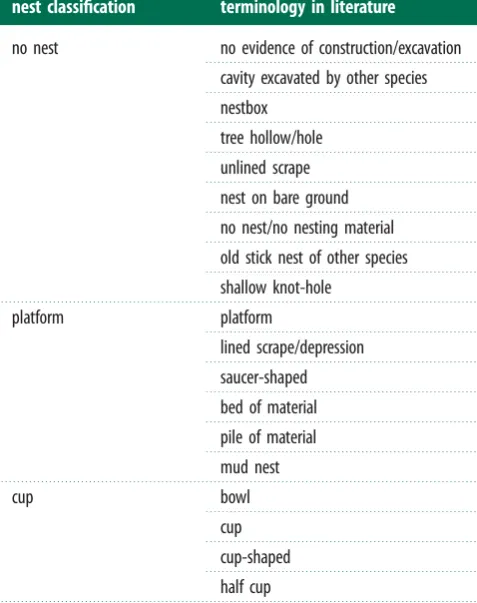
We focused on comparing no nest, platform and cup nest structures because these three nest structures differ in the degree to which material is collected and manipulated during construc-tion: birds building no nest do not collect or manipulate nest material, platform nests require the collection but little mani-pulation of material while cup nests require collection and manipulation of nest material to produce walls in the cup struc-ture. Because excavation behaviour is difficult to compare with the collection and manipulation of nest material, we excluded species that built excavation nests from further analysis. Further-more, because only two species (Acanthiza pusilla and Menura novaehollandiae) in our sample constructed domed nests, we also excluded these species from analysis as well as those species with-out a nest description. After these exclusions, 64 species remained in our analysis (see electronic supplementary material, S1). Keywords used to categorize species-typical nest structure are summarized in table 1.
(b) Statistical methods and analyses
To account for the statistical non-independence of datasets includ-ing multiple species, we analysed data usinclud-ing the phylogenetic generalized least squares (PGLS) approach, which incorporates phylogenetic relatedness of species into the error term of a regression model [10]. Regression analysis included nest structure as an independent variable on three levels (no nest, platform and cup) and CFI as a continuous, dependent variable. To account for allometric scaling effects on CFI, we included cerebellum volume as a covariate. Cerebellum volume was log-transformed to achieve normality (Shapiro–Wilkes test, p.0.05). Although previous CFI analyses included other allometric variables (body size, whole brain volume and whole brain–cerebellum volume [4]), we found that cerebellum volume predicted CFI better than the other allometric measures and after including cerebellum volume as a covariate no other allometric variable explained sig-nificant variation in CFI. In addition to testing the main effect of nest structure, we also made three planned contrasts (no nest versus platform, no nest versus cup, and platform versus cup) by changing which factor level was the reference level in the model. We ran analyses in R ([11]) using the packages ape [12] and caper [13] and viewed trees in FIGTREE[14] and DENSITREE[15].
To account for phylogenetic uncertainty, we ran our PGLS models across a sample of 3000 phylogenies built using a family backbone by Hackett and co-workers [16,17] with restricted phy-logenetic signal estimation (l¼lower: 0.01–0.1, upper: 0.95– 0.99). We used model averaging (following [18]) to estimate aver-age parameters from PGLS regressions across the tree-block, weighted by the probability of the model given each tree. Main effects could not be model-averaged across the tree-block because they are calculated from comparison of models with and without nest structure using ANOVA. Instead, we present the minimumF
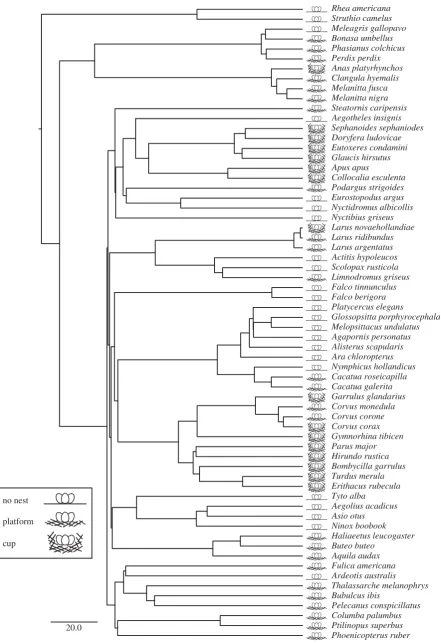
and maximumpvalues reported across the tree-block as a conser-vative means of testing for the main effect across varying phylogenies.lwas fixed at either 0.85 or 0.95 when testing for main effects. In order to ensure that our results were not affected by model uncertainty in addition to phylogenetic uncertainty, we re-ran our main PGLS analyses using Bayesian Markov chain Monte Carlo methods, which account for both model and phylo-genetic uncertainty (see electronic supplementary material, S2). All bird phylogenies were acquired from www.birdtree.org [17]. An example phylogeny is presented in figure 1.
3. Results
Across 64 species of bird, nest structure is significantly asso-ciated with cerebellar foliation (F1,60.3.875, p,0.026,R2¼
0.615; using l¼0.85¼model-averaged estimate from main regression model). Specific contrasts confirm our predictions: species that build a platform nest have higher CFIs than do species that do not build nests (figure 2;t¼2.047,p¼0.047), species that build a cup nest have higher CFIs than species that do not build nests (figure 2; t¼3.165, p¼0.003) and species that build a cup nest have higher CFIs than species that build a platform nest (figure 2; t¼2.020, p¼0.049). Altogether, as nests increase in structural complexity (no nest
[image:3.595.313.552.119.421.2]!platform!cup), CFI also increases. Furthermore, nest structure specifically explained variation in CFI when we used log-transformed cerebellum volume as a covariate and not other allometric variables (see electronic supplementary material, S2).
Table 1.
Terminology in published nest descriptions used to classify
species-typical nest structure. In our nest structure classification, we focused
on the behaviours involved in collecting and manipulating nest material as
well as manipulating nesting substrates, irrespective of nest location or the
materials used.
nest classification
terminology in literature
no nest
no evidence of construction/excavation
cavity excavated by other species
nestbox
tree hollow/hole
unlined scrape
nest on bare ground
no nest/no nesting material
old stick nest of other species
shallow knot-hole
platform
platform
lined scrape/depression
saucer-shaped
bed of material
pile of material
mud nest
cup
bowl
cup
cup-shaped
half cup
rsbl.r
oy
alsocietypublishing.org
Biol
Lett
9:
20130687
4. Discussion
Bird species that build more structurally complex nests have greater cerebellar foliation than do species that build simpler nests, which supports the hypothesis that increased
cerebellar foliation enables enhanced manipulative motor skills [5]. Similarly, Yopaket al. [19] suggest that CFI might correlate with increasingly sophisticated behaviours in chon-drichthyes, for example agile capture of cephalopod prey in the tawny nurse shark (Nebrius ferrugineus). In conjunction
20.0
Nymphicus hollandicus Steatornis caripensis Phasianus colchicus
Nyctibius griseus Struthio camelus Rhea americana
Anas platyrhynchos
Bubulcus ibis
Ptilinopus superbus Larus novaehollandiae
Melopsittacus undulatus
Corvus corone
Glossopsitta porphyrocephala
Ardeotis australis Sephanoides sephaniodes
Nyctidromus albicollis
Turdus merula Garrulus glandarius Podargus strigoides Collocalia esculenta
Corvus monedula
Pelecanus conspicillatus Glaucis hirsutus
Buteo buteo Clangula hyemalis
Corvus corax
Asio otus Ara chloropterus
Aquila audax Larus ridibundus Larus argentatus
Columba palumbus Haliaeetus leucogaster Actitis hypoleucos
Parus major Gymnorhina tibicen
Thalassarche melanophrys Cacatua galerita
Hirundo rustica Melanitta fusca
Fulica americana Platycercus elegans
Bombycilla garrulus Perdix perdix
Aegotheles insignis
Ninox boobook Meleagris gallopavo
Agapornis personatus Falco berigora Falco tinnunculus Limnodromus griseus
Tyto alba Scolopax rusticola
Erithacus rubecula
Aegolius acadicus
Phoenicopterus ruber Melanitta nigra
Alisterus scapularis Doryfera ludovicae
Apus apus
Cacatua roseicapilla Eurostopodus argus Bonasa umbellus
Eutoxeres condamini
no nest
platform
[image:4.595.78.520.39.683.2]cup
Figure 1.
Sample phylogeny of bird species included in regression analysis and species-typical nest structure classification. We included species from [6] that had a
description of the typical nest structure we could classify as no nest, a platform or a cup. Branch lengths represent time. Scale bar represents 20 Myr [17]. Species
names taken from [17].
rsbl.r
oy
alsocietypublishing.org
Biol
Lett
9:
20130687
with these data on chondrichthyes, our findings suggest that increasing cerebellar foliation may be a mechanism that is conserved across vertebrates allowing improved motor con-trol and increasingly complex behaviours. Such an increase in foliation may underpin the positive correlation between cerebellum volume and extractive foraging in primates [7]. In birds at least, increased cerebellar foliation is hypothesized to increase the density of Purkinje cells, the predominant neuron in the cerebellar cortex and only source of cerebellar output, which is thereby thought to increase the processing capacity of the cerebellum [6]. Although here we found that
cerebellar foliation is associated with manipulative skill, other processes involved in nest construction behaviour that are also supported by the cerebellum, such as motor sequencing and learning, may also explain the correlation between nest complex-ity and cerebellar foliation. Functional studies correlating neural activity with nest construction behaviour may help to identify which of the processes associated with nest construction involve the cerebellum.
In our analyses, we used a much simpler nest classification system relative to those used previously [9] to examine causes of variation in nest building. For example, we excluded nesting materials, nest attachment to substrates and nest location. By doing so, however, we had a dataset that was amenable to current comparative statistical analytical tech-niques. The association between variation in CFI and in nest structural complexity that we show here would suggest that this simple classification system may be useful for further investigation of the evolution of nest design.
Here, we found that cerebellar foliation is associated with differences in nest construction behaviour in birds. Across all bird species, nest construction behaviour varies tremen-dously, beyond the three nest classifications we tested here [9]. By continuing to identify the neural underpinnings of nest construction, we can take advantage of this variation in species-specific behaviour to understand how evolution has shaped the brain to produce unique behaviours.
Acknowledgements. We thank Randi Griffin, Natalie Cooper, Charles
Nunn, Daniel Barker and the AnthroTree Workshop 2011 for advice regarding statistical analysis. We also thank David Shuker, Rob Barton and two anonymous reviewers for helpful comments on earlier versions of the manuscript.
Data accessibility.Nest classification, nest structure description sources
and neuroanatomical measures are all included in the electronic supplementary material, S1.
Funding statement.This work was financially supported by the BBSRC
(BB/I019502/1), NSERC (PGSD3-409582-2011 to Z.J.H.) and ERC (232823 to S.E.S.).
References
1. Ito M. 1984The cerebellum and neural control. New York, NY: Raven Press.
2. Ito M. 1993 Movement and thought: identical control mechanisms by the cerebellum.Trends Neurosci.16, 453 – 454. (doi:10.1016/0166-2236(93)90076-X)
3. Larsell O. 1967The comparative anatomy and histology of the cerebellum from myxinoids through birds. Minneapolis, MN: University of Minnesota Press.
4. Iwaniuk AN, Hurd PL, Wylie DRW. 2006 Comparative morphology of the avian cerebellum: I. Degree of foliation.Brain Behav. Evol.68, 45 – 62. (doi:10. 1159/000093530)
5. Butler AB, Hodos W. 2005Comparative vertebrate neuroanatomy, 2nd edn. New York, NY: Wiley-Liss.
6. Iwaniuk AN, Lefebvre L, Wylie DR. 2009 The comparative approach and brain – behaviour relationships: a tool for understanding tool use.Can. J. Zool.63, 150 – 159. (doi:10.1037/ a0015678)
7. Barton RA. 2012 Embodied cognitive evolution and the cerebellum.Phil. Trans. R. Soc. B367, 2097 – 2107. (doi:10.1098/rstb.2012.0112)
8. Obayashi S, Suhara T, Kawabe K, Okauchi T, Maeda J, Akine Y, Onoe H, Iriki A. 2001 Functional brain mapping of monkey tool use.NeuroImage14, 853 – 861. (doi:10.1006/nimg.2001.0878) 9. Hansell MH. 2005Animal architecture. Oxford, UK:
Oxford University Press.
10. Pagel M. 1998 Inferring evolutionary processes from phylogenies.Zool. Scripta26, 331 – 348. (doi:10. 1111/j.1463-6409.1997.tb00423.x)
11. R Development Core Team. 2013 R: a language and environment for statistical computing. See http:// www.R-project.org/.
12. Paradis E, Claude J, Strimmer K. 2004 APE: analyses of phylogenetics and evolution in R language. Bioinformatics20, 289 – 290. (doi:10.1093/ bioinformatics/btg412)
13. Orme CDL. 2012 The caper package: comparative analyses in phylogenetics and evolution in R. See http://caper.r-forge.r-project.org/.
14. Rambaut A. 2012 FigTree v1.3.1. See http://tree.bio. ed.ac.uk/software/figtree/.
15. Bouckaert RR. 2010 DensiTree: making sense of sets of phylogenetic trees.Bioinformatics 26, 1372 – 1373. (doi:10.1093/bioinformatics/ btq110)
16. Hackett SJet al. 2008 A phylogenomic study of birds reveals their evolutionary history. Science320, 1763 – 1768. (doi:10.1126/science. 1157704)
17. Jetz W, Thomas GH, Joy JB, Hartmann K, Mooers AO. 2012 The global diversity of birds in space and time.Nature491, 444 – 448. (doi:10.1038/ nature11631)
18. Johnson JB, Omland KS. 2004 Model selection in ecology and evolution.Trends Ecol. Evol.19, 101 – 108. (doi:10.1016/j.tree.2003.10.013) 19. Yopak KE, Lisney TJ, Collin SP, Montgomery JC. 2007
Variation in brain organization and cerebellar foliation in chondrichthyans: sharks and holocephalans.Brain. Behav. Evol.69, 280 – 300. (doi:10.1159/000100037)
log (cerebellum volume)
CFI 3.0 3.5 4.0 4.5 5.5 5.0
3 4 5 6 7 8
cup
platform
[image:5.595.51.279.41.231.2]no nest