warwick.ac.uk/lib-publications
Original citation:Li, Shuo, Wan, Chaoying, Wu, Xiaoyu and Wang, Shifeng. (2016) Core -shell structured carbon nanoparticles derived from light pyrolysis of waste tires. Polymer Degradation and Stability, 129 . pp. 192-198.
Permanent WRAP URL:
http://wrap.warwick.ac.uk/78940
Copyright and reuse:
The Warwick Research Archive Portal (WRAP) makes this work by researchers of the University of Warwick available open access under the following conditions. Copyright © and all moral rights to the version of the paper presented here belong to the individual author(s) and/or other copyright owners. To the extent reasonable and practicable the material made available in WRAP has been checked for eligibility before being made available.
Copies of full items can be used for personal research or study, educational, or not-for-profit purposes without prior permission or charge. Provided that the authors, title and full bibliographic details are credited, a hyperlink and/or URL is given for the original metadata page and the content is not changed in any way.
Publisher’s statement:
© 2016, Elsevier. Licensed under the Creative Commons Attribution-NonCommercial-NoDerivatives 4.0 International http://creativecommons.org/licenses/by-nc-nd/4.0/
A note on versions:
The version presented here may differ from the published version or, version of record, if you wish to cite this item you are advised to consult the publisher’s version. Please see the ‘permanent WRAP URL’ above for details on accessing the published version and note that access may require a subscription.
Core-shell structured carbon nanoparticles derived from light pyrolysis of waste tires
Shuo Li, Chaoying Wan, Xiaoyu Wu, Shifeng Wang
PII: S0141-3910(16)30112-4
DOI: 10.1016/j.polymdegradstab.2016.04.013
Reference: PDST 7938
To appear in: Polymer Degradation and Stability
Received Date: 25 December 2015 Revised Date: 6 April 2016 Accepted Date: 22 April 2016
Please cite this article as: Li S, Wan C, Wu X, Wang S, Core-shell structured carbon nanoparticles derived from light pyrolysis of waste tires, Polymer Degradation and Stability (2016), doi: 10.1016/ j.polymdegradstab.2016.04.013.
M
AN
US
CR
IP
T
AC
CE
PT
ED
1
Core-shell structured carbon nanoparticles derived from light
1pyrolysis of waste tires
2Shuo Li1, Chaoying Wan2, Xiaoyu Wu1, Shifeng Wang1* 3
1
Research Institute of Polymer Material, Shanghai Key Lab. of Electrical Insulation 4
and Thermo Aging, Shanghai Jiao Tong University, Shanghai 200240, PR China 5
2
International Institute for Nanocomposites Manufacturing, WMG, University of 6
Warwick, UK, CV4 7AL 7
Abstract
8
Carbon black nanoparticles (CBlp) were derived from waste tire rubbers via a
9
melt-extrusion pyrolysis process at 300 oC. A polymeric shell was observed on the 10
surface of CBlp, which was formed by bound rubber. The chemical structure and
11
content of the bound rubber shell were characterized and quantified, and compared with 12
the commercial carbon black N330 and pyrolytic carbon black (CBp). The average
13
particle size of CBlp is about 22 nm, with a rubber shell thickness of 7-12 nm.
14
Functional carboxylic group and ZnO were detected on the surface of CBlp by FTIR
15
and XRD, respectively, which are absent from N330 and CBp. The core-shell structure
16
of CBlp facilitate the dispersion and interfacial interaction in natural rubber, and lead to
17
a higher reinforcement effect as compared those of N330 and CBp. The light pyrolysis
18
process provides a facile and clean approach to generate useful carbon nanoparticles 19
out of waste tire rubbers. 20
Keywords: waste tire rubber; light pyrolysis; carbon black; core-shell structure 21
22
23
24
25
26
* Corresponding author. Tel: 86-21-54742671 ; Fax: 86-21-54741297
M
AN
US
CR
IP
T
AC
CE
PT
ED
2
1. Introduction
1
The ever growing transportation industry has driven the fast development of 2
modern society, but meanwhile induced serious pollution issues to the environment [1]. 3
Waste tire disposal management is one of the major concerns, as about 1.4 billion unit 4
of tires are produced globally every year, and around 800 million tires are discarded 5
[2]. The present methods of disposal of waste tire rubbers include landfill, retreading 6
and pyrolysis [3,4]. Pyrolysis is an economical and environmental-friendly way to deal 7
with waste tire rubbers. It involves a process that heats tires over 400 °C in an oxygen 8
poor or free atmosphere to crack the organic components of rubber, and thus results in 9
pyrolytic carbon black (CBp) as one of the main products [5-7]. As compared to
10
commercial carbon black (e.g., N330), CBp generally has lower specific surface area
11
and higher ash content, which gives lower reinforcing efficiency to rubbers. These 12
limitations of CBp hinder its industrialization and marketability [8-10].
13
To improve the performance of CBp, different methods, such as developing high
14
efficient pyrolysis apparatuses, optimizing pyrolysis parameters and improving the 15
chemical activation of CBp have been under developing[6,11-13]. For example,
16
microwave irradiation has the advantages of low heating cost, fast and direct heating of 17
any microwave absorbing material. The CBp produced by microwave irradiation has a
18
small ash content in the range of 5.9-9.5 wt%[14]. Although this method reduces the 19
energy cost in the pyrolysis process, the properties of CBp still cannot reach the level of
20
commercial carbon black. The properties of CBp can be adjusted by either varying the
21
pyrolysis pressure [15] or atmosphere [16, 11]. The surface chemistry of CBp obtained
22
at vacuum pressure is close to that of commercial carbon black due to its low ash 23
content. Pyrolytic atmosphere was also adopted to improve the specific surface area of 24
CBp. With steam and CO2,the specific surface area of CBp reached 1000 m2 g-1 [11],
25
much larger than that of conventional CBp, which is in the range of 54-87 m2 g-1 [15].
26
M
AN
US
CR
IP
T
AC
CE
PT
ED
3 application of this pyrolytic process.
1
It is challenging to separate carbon black from chemically crosslinked structures 2
of tire rubbers. Reactive extrusion is regarded as an efficient method to devulcanize the 3
crosslinked rubber, by applying high temperature with shear and chemical force 4
[16-19]. Tzoganakis et al. [20] used supercritical CO2 to aid continuous
5
devulcanization of waste tire rubber. Shi et al. [21] combined the advantage of 6
twin-screw extrusion with an appropriate amount of desulfurizer to reclaim ground tire 7
rubber (GTR) into liquid rubber, which can be further used as a reactive softener for 8
tire rubber. The purpose of the aforementioned studies is to obtain high performance 9
devulcanized rubbers via reactive extrusion. Given the facilely adjustable processing 10
parameters, such as compounding temperature and shearing force, reactive extrusion is 11
a potential technology to dissemble the three-dimensional crosslinked covalent 12
structure of rubbers, and subsequently recover carbon black nanoparticles. 13
Generally the reinforcement of rubbers with carbon black is largely due to the 14
formation of bound rubber, and the content of bound rubber can directly reflect the 15
interactions between rubber and carbon fillers. Bound rubber is formed by physical 16
and chemical interactions between rubber and carbon black during compounding, and 17
coated firmly as a shell layer on the surface of carbon black [22,23]. The particle size, 18
specific surface area and chemical functional groups of the carbon black determine 19
the formation of bound rubber. To enhance the bound rubber content, many techniques, 20
such as oxygen plasma treatment [23], graft modification and surface coating, have 21
been adopted to treat the surface of carbon black, in order to increase the content of 22
functional groups and reduce the particle size [24-27]. Wu et al. [23] used the 23
high-energy electron beam to irradiate carbon black to increase oxygen content and 24
reduce particle sizes. However, the aforementioned methods are mostly suitable for 25
original carbon black, and involve complex and costly processes. If the bound rubber 26
M
AN
US
CR
IP
T
AC
CE
PT
ED
4
separated from recycled waste tires would be a new carbon material with some special 1
properties. 2
The aim of this study is to separate lightly pyrolytic carbon black (CBlp) from
3
GTR by using a mild twin-extrusion process. A layer of bound rubber is preserved on 4
the surface of CBlp after melt-extrusion and solvent extraction process, which is
5
detected by using FTIR and TGA. The structure, morphology and reinforcement 6
properties of CBlp were characterized by using X-ray photoelectron spectroscopy
7
(XPS), X-ray diffraction (XRD), transmission electron microscope (TEM) and 8
dynamic light scattering (DLS), and also compared with commercial carbon black 9
(N330) and pyrolytic carbon black (CBp).
10
11
2. Experimental
12
2.1 Materials
13
The GTR (600-700 µm) is shredded and ground at the ambient temperature from 14
whole used truck tire rubber. The GTR (Jiangsu Anqiang Rubber Co., Ltd) consists of 15
6.97 wt% soluble material, 40.25 wt% natural rubber, 14.64 wt% synthetic rubber, 16
30.44 wt% carbon black and 7. 70 wt% inorganic filler. The content of acetone extract 17
is 16.3% and toluene extract is 36.4%, and the left is defined as light pyrolytic carbon 18
black. Commercial carbon black (N330) with primary particle size of 26-45 nm is 19
provided by Shanghai Cabot Carbon Black Co., Ltd. Pyrolytic carbon black (CBp)
20
produced by high temperature (500-600 °C) pyrolysis, is supplied by Shandong Jintai 21
Co., Ltd. 22
Natural rubber (SCR WF) is supplied by Hainan Agribusiness Group Co., China. 23
The compounding ingredients, such as sulfur (S), zinc oxide (ZnO), and the 24
accelerator tetramethylthiuram disulfide and
25
M
AN
US
CR
IP
T
AC
CE
PT
ED
5
2.2 Preparation
1
2.2.1 Preparation of CBlp
2
CBlp was prepared in two steps. Firstly, GTR was melt-compounded through a
3
reactive extrusion process by using an inter-meshed twin-screw extruder (ZE25A from 4
Berstorff GmbH, Germany). The screws have four heating/cooling zones with a L/D 5
ratio of 41 and a diameter of 25 mm. GTR was added through the hopper at a constant 6
throughput (5 kg h-1). The screw rotation was set constant at 300 rpm and the 7
temperature was set at 300 °C for the four zones. The pyrolytic rubber compound was 8
completely dried in an oven at a temperature of 50 °C for 2 h. 9
Secondly, 2 g of the pyrolyzed rubber compound were extracted with acetone in a 10
Soxhlet apparatus for 48 h to remove polar and low molecular weight fraction such as 11
accelerator and plasticizer from the rubber. Subsequently, nonpolar components such as 12
soluble rubber were extracted with toluene for 72 h. The residual CBlp was dried in a
13
vacuum oven at 50 °C for 1 h. 14
15
2.3 Characterization and measurement
16
2.3.1 Characterization
17
Carbon blacks samples N330, CBlp and CBp were characterized by using FTIR
18
Spectrum 100, Perkin Elmer, Inc. (USA), in the wavenumber range from 4000 to 350 19
cm-1. A thermo-gravimetric analysis (TGA, Q5000IR, TA Instruments, USA) was used 20
to study the thermal degradation behavior of N330, CBp and CBlp in the temperature
21
range from room temperature to 700 °C at a heating rate of 10 °C min-1. Particle size 22
analysis of N330, CBlp and CBp were performed with particle size analyzer ZS90
23
(Malvern Instruments Ltd., UK) at 25 °C. To prepare the suspension (0.02 g l-1), 24
carbon black particles were dispersed into toluene under ultrasonication for 30 min. 25
The Brunauer-Emmett-Teller (BET) surface area of the three carbon blacks were 26
M
AN
US
CR
IP
T
AC
CE
PT
ED
6
nitrogen as the adsorbate at 100 °C. Transmission electron microscopy (TEM) was 1
conducted by using a JEM-2100 (JEOL Ltd., Japan). X-ray photoelectron spectroscopy 2
(XPS) analysis was carried out on an AXIS Ultra DLD (Shimadzu, Japan). X-ray 3
diffraction (XRD) analysis of the samples was performed with a D8 Advance (Bruker 4
Corporation, Germany).The patterns were scanned between 0 ° and 90 ° at a scanning 5
rate of 2 ° s-1. 6
2.3.2 Bound rubber extraction
7
Natural rubber compounds with carbon black samples were prepared according 8
to the formulation: NR 100 phr (parts-per-hundred rubber), carbon black 30 phr, ZnO 9
5 phr, S 2 phr, stearic acid 1 phr, TMTD 0.5 phr, CZ 0.5 phr. The mixing was carried 10
out in a S(X)K-160A Two-Roll mill from Shanghai light industry machinery Co., Ltd 11
(China). The compounds were vulcanized for 330 s (tc,90) in a hydraulic press
12
(LP-S-50, Labtech Thailand) at 143 °C and 10400 kPa into 1 mm thick sheets. 13
Total bound rubber contents of the rubber compounds of NR/N330, NR/CBlp and
14
NR/CBp compounds were determined by extracting the unbound rubber with toluene
15
at ambient temperature for 7 days and then dried at 50 °C for 24 h. The content of 16
bound rubber was calculated according to Eq.1, 17
Rb (%) = (WA-WCB)/(WB-WCB)·100 (1)
18
Where Rb is the contents of bound rubber, WA is the weight of compounds after
19
extraction, WCB is the weight of carbon black, WB the weight of compounds before
20
extraction [28]. 21
2.3.3 Mechanical testing of NR/carbon black composites
22
Tensile testing was conducted using universal mechanical tester (Instron 4465, 23
Instron Corp., USA) at room temperature. For each sample, six dumbbell shape 24
specimens of dimension of 75 x 4 x 1 mm3 were tested at 200 mm min-1, and average 25
results were obtained for comparison. 26
M
AN
US
CR
IP
T
AC
CE
PT
ED
7
3. Results and discussion
1
3.1 Characterization of carbon blacks
2
4000 3500 3000 2500 2000 1500 1000 500 CBp
CBlp N330
T
ra
n
sm
it
ta
n
ce
/
%
Wavenumbers/ cm-1
-OH
C-O -CH
2
C=O
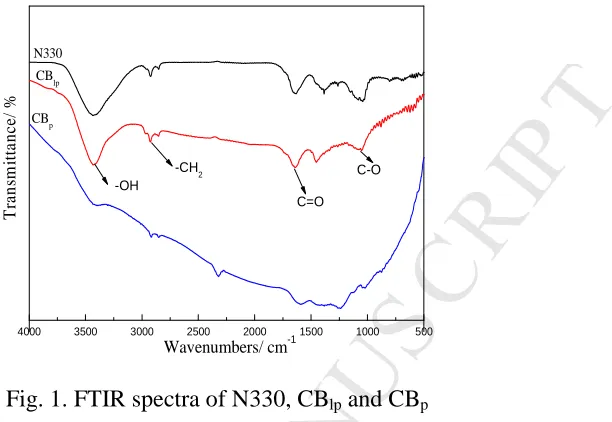
[image:9.595.189.495.146.357.2]3
Fig. 1. FTIR spectra of N330, CBlp and CBp
4
The derived CBlp was characterized by FTIR and in comparison with commercial 5
N330 and CBp. As shown in Fig. 1, the three spectra are baseline corrected and 6
normalized to the -CH3 deformation vibration peak at 1375 cm-1 [31]. CBlp shows
7
similar absorption peaks as N330, but with weaker intensities for peaks at around 3435 8
and 1084 cm-1, which are attributed to the stretching vibration of -OH and -C-O, 9
respectively [32]. This can be caused by the reactions of CBlp with rubbers during the
10
compounding process, which consumes parts of the functional groups on the CBlp
11
surface [22,33,34]. The peak around 2923 cm-1 is attributed to the stretching vibration 12
of -CH2 [35,36], it was observed on both surface of CBlp and N330, indicating some
13
organic matter left on the surface of CBlp and N330. The peak around 1632 cm-1 is
14
attributed to the stretching vibration of -C=O [35,36]. Some free radicals can be 15
generated in the process of pyrolysis of GTR rubbers, and further react with -CH=CH 16
group of the carbon chains[37,38], the oxidization of the free radicals may form the 17
-C=O group on the surface of CBlp. The characteristic peaks of -C=C and -C=O of CBlp
18
overlap together, which enhances the intensity of -C=O of CBlp. Moreover, the
19
intensities of functional groups of -OH, C-O, -CH2, and -C=O of CBlp are stronger than
M
AN
US
CR
IP
T
AC
CE
PT
ED
8
those of CBp. This may be due to the destruction of functional groups of CBp is more
1
severe than CBlp under the higher processing temperature (500 °C), or the deposit of
2
ash on the surface of CBp [8].
3
Different pyrolytic processes of tire rubber will lead to different structures of 4
carbon black. To understand the composition of N330, CBp and CBlp the thermal
5
degradation behavior was examined by TGA. As shown in Fig. 2, CBp and N330 have a
6
similar decomposition behavior when temperature is below 600 °C. N330 decomposes 7
completely at above 700 °C, while CBp has about 16 wt% residues, which should be
8
ascribed to its ash constituent. CBlp starts to degrade from 350 °C, followed with a
9
distinct weight loss of 18 wt% between 350 °C and 550 °C, which corresponds to the 10
decomposition of the bound rubber layer. 11
100 200 300 400 500 600 700 800 0
20 40 60 80 100
CBlp
CBp N330
W
ei
g
h
t
lo
ss
/
%
Temperature/ oC 12
Fig. 2. TGA results of CBp, CBlp and N330
M
AN
US
CR
IP
T
AC
CE
PT
ED
9
0 10 20 30 40 50 60 70 80 90
CBp
CB
lp
N330
In
te
n
si
ty
/
a.
u
.
Diffraction angle/ 2 theta
[image:11.595.60.509.83.764.2]1
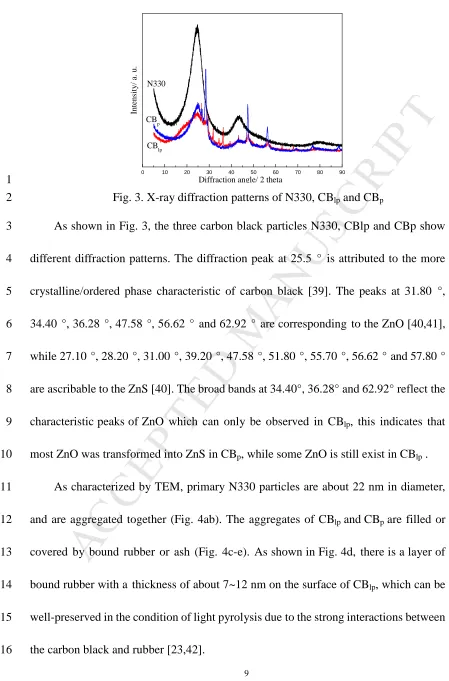
Fig. 3. X-ray diffraction patterns of N330, CBlp and CBp
2
As shown in Fig. 3, the three carbon black particles N330, CBlp and CBp show 3
different diffraction patterns. The diffraction peak at 25.5 ° is attributed to the more 4
crystalline/ordered phase characteristic of carbon black [39]. The peaks at 31.80 °, 5
34.40 °, 36.28 °, 47.58 °, 56.62 ° and 62.92 ° are corresponding to the ZnO [40,41], 6
while 27.10 °, 28.20 °, 31.00 °, 39.20 °, 47.58 °, 51.80 °, 55.70 °, 56.62 ° and 57.80 ° 7
are ascribable to the ZnS [40]. The broad bands at 34.40°, 36.28° and 62.92° reflect the 8
characteristic peaks of ZnO which can only be observed in CBlp, this indicates that
9
most ZnO was transformed into ZnS in CBp, while some ZnO is still exist in CBlp .
10
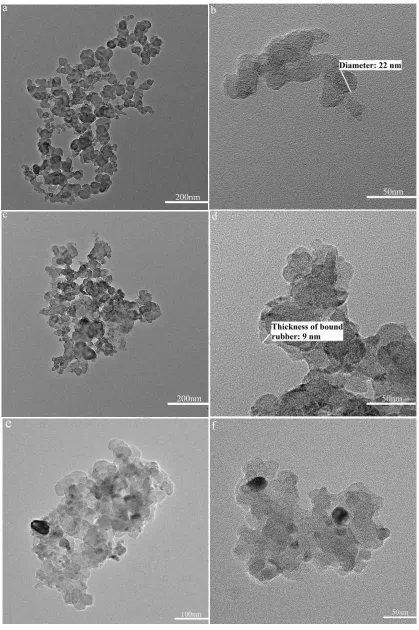
As characterized by TEM, primary N330 particles are about 22 nm in diameter, 11
and are aggregated together (Fig. 4ab). The aggregates of CBlp and CBp are filled or
12
covered by bound rubber or ash (Fig. 4c-e). As shown in Fig. 4d, there is a layer of 13
bound rubber with a thickness of about 7~12 nm on the surface of CBlp, which can be
14
well-preserved in the condition of light pyrolysis due to the strong interactions between 15
M
AN
US
CR
IP
T
AC
CE
PT
ED
[image:12.595.89.508.76.706.2]10 1
Fig. 4. TEM micrographs of (a-b)N330, (c-d)CBlp and (e-f) CBp
M
AN
US
CR
IP
T
AC
CE
PT
ED
11
In comparsion, the surface of CBp is covered with a layer of ash, which is mainly
1
derived from the deposition of inorganic filler during the pyrolysis of waste tire 2
rubber at high temperature[8]. In this situation, the carbon black particles act as seed, 3
to allow inorganic fillers to absorb and deposit onto it surface, which is shown as 4
black dots in Fig.4 e-f [43,44]. The surface chemical structure of the different carbon 5
black particles was further characterised by XPS, in order to elucidate the 6
composition of the shell materials. 7
The elemental composition on the surface of N330, CBlp and CBp are presented in
8
Table 1. The contents of elements C, N and S on the surface of CBlp are higher than that
9
of N330, while the contents of O is lower than N330, indicating an organic layer was 10
attached on the surface of CBlp, also in agreement with the result of FTIR (Fig.1). The
11
bound rubber on the surface of CBlp. suppresses the expression of O element, while the
12
presence of crosslink agent and accelerator in bound rubber provide the elements of S 13
and N. In the high temperature pyrolysis of tire rubber, gases like H2S and NH3 are
14
released [43,45], and left lower content of N and S on the surface of CBp. In comparison,
15
the light pyrolysis of tire rubber will give higher concentration of N and S on the 16
surface of CBlp.
17
Table 1 surface compositions of N330, CBlp and CBp tested by XPS
18
Carbon black Surface composition /wt%
C N O S
N330 88.38 0 11.46 0.16
CBlp 91.22 1.27 5.43 2.09
CBp 92.39 0.83 5.64 1.14
The curve fitting of C1s photo peaks of XPS spectrum are shown in Fig.5 (a). The
19
XPS spectrum of C1s for N330, CBlp and CBp are fitted to four peaks: C-C or C-H (C1,
20
BE=284.8 eV), C-O (C2, BE=285.5 eV), C=O (C3, BE=286.7 eV), and COOH (C4,
21
BE=289.0 eV) [23,41,46]. The results of the curve-fitting of the C1s spectrum are
M
AN
US
CR
IP
T
AC
CE
PT
ED
12 summarized in Table 2.
[image:14.595.59.509.82.736.2]1
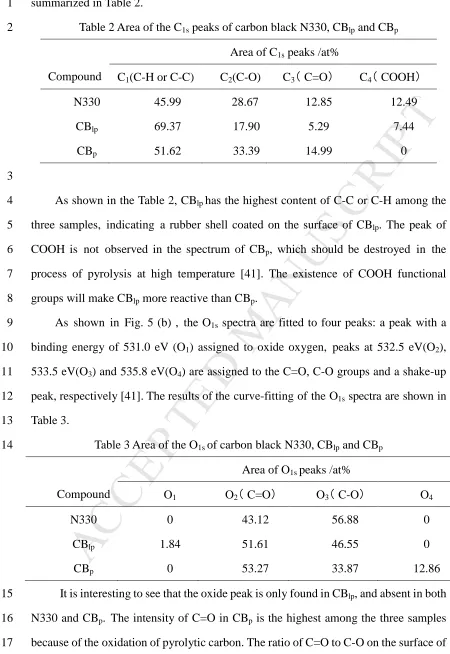
Table 2 Area of the C1s peaks of carbon black N330, CBlp and CBp
2
Compound
Area of C1s peaks /at%
C1(C-H or C-C) C2(C-O) C3(C=O) C4(COOH)
N330 45.99 28.67 12.85 12.49
CBlp 69.37 17.90 5.29 7.44
CBp 51.62 33.39 14.99 0
3
As shown in the Table 2, CBlp has the highest content of C-C or C-H among the
4
three samples, indicating a rubber shell coated on the surface of CBlp. The peak of
5
COOH is not observed in the spectrum of CBp, which should be destroyed in the
6
process of pyrolysis at high temperature [41]. The existence of COOH functional 7
groups will make CBlp more reactive than CBp.
8
As shown in Fig. 5 (b) , the O1s spectra are fitted to four peaks: a peak with a
9
binding energy of 531.0 eV (O1) assigned to oxide oxygen, peaks at 532.5 eV(O2),
10
533.5 eV(O3) and 535.8 eV(O4) are assigned to the C=O, C-O groups and a shake-up
11
peak, respectively [41]. The results of the curve-fitting of the O1s spectra are shown in
12
Table 3. 13
Table 3 Area of the O1s of carbon black N330, CBlp and CBp
14
Compound
Area of O1s peaks /at%
O1 O2(C=O) O3(C-O) O4
N330 0 43.12 56.88 0
CBlp 1.84 51.61 46.55 0
CBp 0 53.27 33.87 12.86
It is interesting to see that the oxide peak is only found in CBlp, and absent in both
15
N330 and CBp. The intensity of C=O in CBp is the highest among the three samples
16
M
AN
US
CR
IP
T
AC
CE
PT
ED
13
CBlp is higher than N330. Moreover, the shake-up peak is not observed in the spectrum
1
of N330 and CBlp, showing that there is no free oxygen molecules existing in or close
2
to the aromatic system on the surface of N330 and CBlp [41]. This phenomenon also
3
proves that the chemical structure of CBlp is more similar to N330 rather than CBp.
4
5
Fig. 5. (a) C1s XPS spectrum of carbon black N330, CBlp and CBp; and (b) O1s XPS
6
spectrum of carbon black N330, CBlp and CBp.
7
The average primary particle size of N330 is estimated to be 21 nm (also shown 8
in TEM, Fig.4), and the smaller size results in higher specific surface area, as shown 9
in the Table 4. The existence of bound rubber on the surface of CBlp increases the
10
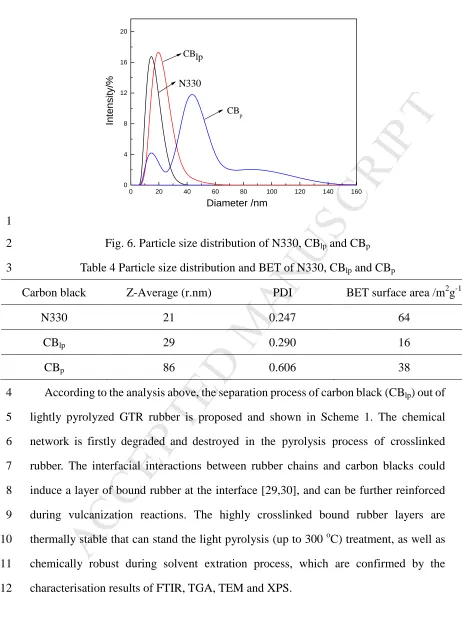
particle size to about 29 nm. The particle size and Polydispersity Index (PDI) of CBp
11
is higher than that of N330 and CBlp because some organic volatiles were released
12
during the pyrolysis of GTR, and transformed into ash and absorbed on the surface of 13
CBp [43,45](Fig. 6). The Brunauer-Emmett-Teller (BET) surface area of CBlp is
14
lower than CBp due to the coverage of the rubber on the surface(Table 4).
15
282 284 286 288 290 292
C4 C3 C2
C1 N330
CBlp
In
te
n
si
ty
CB p
Binding Energy/ ev
a
530 532 534 536
O4 O3 O2
O1 N330
CBlp
In
te
n
si
ty
b
CB p
M
AN
US
CR
IP
T
AC
CE
PT
ED
14
0 20 40 60 80 100 120 140 160
0 4 8 12 16 20
In
te
n
s
it
y
/%
Diameter /nm
CBlp
N330
CBp
1
Fig. 6. Particle size distribution of N330, CBlp and CBp
[image:16.595.60.522.86.708.2]2
Table 4 Particle size distribution and BET of N330, CBlp and CBp
3
Carbon black Z-Average (r.nm) PDI BET surface area /m2g-1
N330 21 0.247 64
CBlp 29 0.290 16
CBp 86 0.606 38
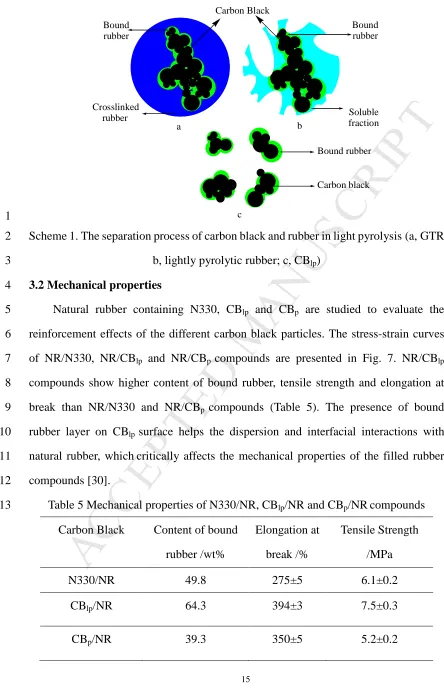
According to the analysis above, the separation process of carbon black (CBlp) out of
4
lightly pyrolyzed GTR rubber is proposed and shown in Scheme 1. The chemical 5
network is firstly degraded and destroyed in the pyrolysis process of crosslinked 6
rubber. The interfacial interactions between rubber chains and carbon blacks could 7
induce a layer of bound rubber at the interface [29,30], and can be further reinforced 8
during vulcanization reactions. The highly crosslinked bound rubber layers are 9
thermally stable that can stand the light pyrolysis (up to 300 oC) treatment, as well as 10
chemically robust during solvent extration process, which are confirmed by the 11
M
AN
US
CR
IP
T
AC
CE
PT
ED
15
Bound rubber
Crosslinked rubber
Bound rubber
Soluble fraction
Bound rubber
Carbon black
a b
c Carbon Black
1
Scheme 1. The separation process of carbon black and rubber in light pyrolysis (a, GTR; 2
b, lightly pyrolytic rubber; c, CBlp)
3
3.2 Mechanical properties
4
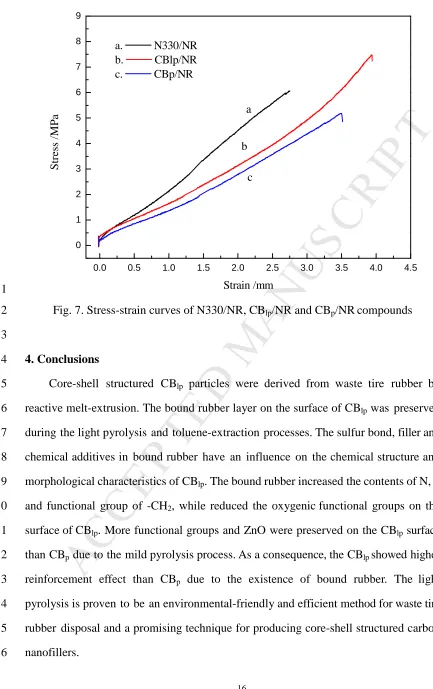
Natural rubber containing N330, CBlp and CBp are studied to evaluate the
5
reinforcement effects of the different carbon black particles. The stress-strain curves 6
of NR/N330, NR/CBlp and NR/CBp compounds are presented in Fig. 7. NR/CBlp
7
compounds show higher content of bound rubber, tensile strength and elongation at 8
break than NR/N330 and NR/CBp compounds (Table 5). The presence of bound
9
rubber layer on CBlp surface helps the dispersion and interfacial interactions with
10
natural rubber, whichcritically affects the mechanical properties of the filled rubber 11
[image:17.595.61.505.77.765.2]compounds [30]. 12
Table 5 Mechanical properties of N330/NR, CBlp/NR and CBp/NRcompounds
13
Carbon Black Content of bound
rubber /wt%
Elongation at
break /%
Tensile Strength
/MPa
N330/NR 49.8 275±5 6.1±0.2
CBlp/NR 64.3 394±3 7.5±0.3
M
AN
US
CR
IP
T
AC
CE
PT
ED
16
0.0 0.5 1.0 1.5 2.0 2.5 3.0 3.5 4.0 4.5
0 1 2 3 4 5 6 7 8 9
c b a. N330/NR
b. CBlp/NR
c. CBp/NR
S
tr
es
s /
M
P
a
Strain /mm a
[image:18.595.65.498.68.757.2]1
Fig. 7. Stress-strain curves of N330/NR, CBlp/NR and CBp/NRcompounds
2
3
4. Conclusions
4
Core-shell structured CBlp particles were derived from waste tire rubber by
5
reactive melt-extrusion. The bound rubber layer on the surface of CBlp was preserved
6
during the light pyrolysis and toluene-extraction processes. The sulfur bond, filler and 7
chemical additives in bound rubber have an influence on the chemical structure and 8
morphological characteristics of CBlp. The bound rubber increased the contents of N, S
9
and functional group of -CH2, while reduced the oxygenic functional groups on the
10
surface of CBlp. More functional groups and ZnO were preserved on the CBlp surface
11
than CBp due to the mild pyrolysis process. As a consequence, the CBlp showed higher
12
reinforcement effect than CBp due to the existence of bound rubber. The light
13
pyrolysis is proven to be an environmental-friendly and efficient method for waste tire 14
rubber disposal and a promising technique for producing core-shell structured carbon 15
M
AN
US
CR
IP
T
AC
CE
PT
ED
17
Acknowledgements:
1
This research is supported by an International cooperation project (No. 2
2013DFR50550) and Natural Science Foundation of China (No. 51273110). 3
References
4
[1]Mark JE, Erman B, Roland CM. The Science and Technology of Rubber. 4th ed. Boston:
5
Academic Press. 2013: 697-764.
6
[2]Ramarad S, Khalid M, Ratnam C, Chuah AL, Rashmi W. Waste tire rubber in polymer blends: A
7
review on the evolution, properties and future. Progress in Materials Science 2015; 72;100-40.
8
[3]Duan P, Jin B, Xu Y, Wang F. Co-pyrolysis of microalgae and waste rubber tire in supercritical
9
ethanol. Chemical Engineering Journal 2015; 269;262-71.
10
[4]Undri A, Meini S, Rosi L, Frediani M, Frediani P. Microwave pyrolysis of polymeric materials:
11
Waste tires treatment and characterization of the value-added products. Journal of Analytical and
12
Applied Pyrolysis 2013; 103;149-58.
13
[5]Aguado J, Serrano DP, Escola JM. Fuels from waste plastics by thermal and catalytic processes:
14
A review. Industrial and Engineering Chemistry Research 2008; 47(21);7982-92.
15
[6]Choi GG, Jung SH, Oh SJ, Kim JS. Total utilization of waste tire rubber through pyrolysis to
16
obtain oils and CO2 activation of pyrolysis char. Fuel Processing Technology 2014; 123;57-64.
17
[7]López G, Olazar M, Aguado R, Bilbao J. Continuous pyrolysis of waste tyres in a conical
18
spouted bed reactor. Fuel 2010; 89(8);1946-52.
19
[8]Williams PT. Pyrolysis of waste tyres: A review. Waste Management 2013; 33(8);1714-28.
20
[9]Chaala A, Darmstadt H, Roy C. Acid-base method for the demineralization of pyrolytic carbon
21
black. Fuel Processing Technology 1996; 46(1);1-15.
22
[10]Ucar S, Karagoz S, Ozkan AR, Yanik J. Evaluation of two different scrap tires as hydrocarbon
23
source by pyrolysis. Fuel 2005; 84(14-15);1884-92.
24
[11]Saleh TA, Gupta VK. Processing methods, characteristics and adsorption behavior of tire
25
derived carbons: A review. Advances in Colloid and Interface Science 2014; 211;93-101.
26
[12]Mui ELK, Ko DCK, Mckay G. Production of active carbons from waste tyres - A review.
27
Carbon 2004; 42(14);2789-805.
M
AN
US
CR
IP
T
AC
CE
PT
ED
18
[13]Murillo R, Aylón E, Navarro MV, Callén MS, Aranda A, Mastral AM. The application of
1
thermal processes to valorise waste tyre. Fuel Processing Technology 2006; 87(2);143-7.
2
[14]Undri A, Sacchi B, Cantisani E, Toccafondi N, Rosi L, Frediani M, et al. Carbon from
3
microwave assisted pyrolysis of waste tires. Journal of Analytical and Applied Pyrolysis 2013;
4
104;396-404.
5
[15]Mikulova Z, Sedenkova I, Matejova L, Večeř M, Dombek V. Study of carbon black obtained by
6
pyrolysis of waste scrap tyres. Journal of Thermal Analysis and Calorimetry 2013; 111(2);1475-81.
7
[16]Kojima M, Ogawa K, Mizoshima H, Tosaka M, Kohjiya S, Ikeda Y. Devulcanization of
8
sulfur-cured isoprene rubber in supercritical carbon dioxide. Rubber chemistry and technology 2003;
9
76(4);957-68.
10
[17]Mouri M, Sato N, Okamoto H, Matsushita M, Honda H, Nakashima K, et al. Continuous
11
Devulcanisation by Shear Flow Stage Reaction Control Technology for Rubber Recycling. Part 4. Study
12
of the Devulcanisation Process for EPDM. POLYMER RECYCLING 2000; 5(1);31-42.
13
[18]Fukumori K, Matsushita M, Okamoto H, Sato N, Takeuchi K, Suzuki Y. A New Material
14
Recycling Technology for Automobile Rubber Waste[R]. SAE Technical Paper, 2003.
15
[19]Gągol M, Boczkaj G, Haponiuk J, Formela K. Investigation of volatile low molecular weight
16
compounds formed during continuous reclaiming of ground tire rubber. Polymer Degradation and
17
Stability 2015; 119;113-20.
18
[20]Meysami M, Tzoganakis C. Continuous Rubber Devulcanization Using Supercritical Co2:
19
Recycling Tire Rubber Crumb[C]. 8th World Congress of Chemical Engineering.
20
[21]Shi J, Zou H, Ding L, Li X, Jiang K, Chen T, et al. Continuous production of liquid reclaimed
21
rubber from ground tire rubber and its application as reactive polymeric plasticizer. Polymer Degradation
22
and Stability 2014; 99;166-75.
23
[22]Leblanc JL. Rubber-filler interactions and rheological properties in filled compounds. Progress
24
in Polymer Science (Oxford) 2002; 27(4);627-87.
25
[23]Wu Y, Wen S, Shen J, Jiang J, Hu S, Zhang L, et al. Improved dynamic properties of natural
26
rubber filled with irradiation-modified carbon black. Radiation Physics and Chemistry 2015; 111;91-7.
27
[24]Soares MCF, Viana MM, Schaefer ZL, Gangoli VS, Cheng Y, Caliman V, et al. Surface
M
AN
US
CR
IP
T
AC
CE
PT
ED
19
modification of carbon black nanoparticles by dodecylamine: Thermal stability and phase transfer in
1
brine medium. Carbon 2014; 72;287-95.
2
[25]Guha A, Lu W, Zawodzinski Jr TA, Schiraldi DA. Surface-modified carbons as platinum
3
catalyst support for PEM fuel cells. Carbon 2007; 45(7);1506-17.
4
[26]Toupin M, Bélanger D. Thermal stability study of aryl modified carbon black by in situ
5
generated diazonium salt. Journal of Physical Chemistry C 2007; 111(14);5394-401.
6
[27]Zhang BB, Chen Y, Wang F, Hong RY. Surface modification of carbon black for the
7
reinforcement of polycarbonate/acrylonitrile-butadiene-styrene blends. Applied Surface Science 2015;
8
351;280-8.
9
[28]Choi S-S. Influence of storage time and temperature and silane coupling agent on bound rubber
10
formation in filled styrene–butadiene rubber compounds. Polymer Testing 2002; (21);201-8.
11
[29]Litvinov VM, Orza RA, Klüppel M, Van Duin M, Magusin PCMM. Rubber-filler interactions
12
and network structure in relation to stress-strain behavior of vulcanized, carbon black filled EPDM.
13
Macromolecules 2011; 44(12);4887-900.
14
[30]Choi S-S, Ko E. Novel test method to estimate bound rubber formation of silica-filled solution
15
styrene-butadiene rubber compounds. Polymer Testing 2014; 40;170-7.
16
[31]Forster AL, Pintus P, Messin GH, Riley MA, Petit S, Rossiter W, et al. Hydrolytic stability of
17
polybenzobisoxazole and polyterephthalamide body armor. Polymer Degradation and Stability 2011;
18
96(2);247-54.
19
[32]Liu H, Wen S, Wang J, Zhu Y. Preparation and characterization of carbon black‐polystyrene 20
composite particles by high‐speed homogenization assisted suspension polymerization. Journal of 21
Applied Polymer Science 2012; 123(6);3255-60.
22
[33]Saiwari S, Dierkes W, Noordermeer J. Devulcanization of Whole Passenger Care Tire Material.
23
KGK Kautschuk, Gummi, Kunststoffe 2013; 66(7-8 (2013));20-5.
24
[34]Fukahori Y. New progress in the theory and model of carbon black reinforcement of elastomers.
25
Journal of Applied Polymer Science 2005; 95(1);60-7.
26
[35]Soares MC, Viana MM, Schaefer ZL, Gangoli VS, Cheng Y, Caliman V, et al. Surface
27
modification of carbon black nanoparticles by dodecylamine: Thermal stability and phase transfer in
M
AN
US
CR
IP
T
AC
CE
PT
ED
20
brine medium. Carbon 2014; 72;287-95.
1
[36]Gómez-Serrano V, Piriz-Almeida F, Durán-Valle CJ, Pastor-Villegas J. Formation of oxygen
2
structures by air activation. A study by FT-IR spectroscopy. Carbon 1999; 37(10);1517-28.
3
[37]Karger-Kocsis J, Mészáros L, Bárány T. Ground tyre rubber (GTR) in thermoplastics,
4
thermosets, and rubbers. Journal of Materials Science 2013; 48(1);1-38.
5
[38]Chen X, Farber M, Gao Y, Kulaots I, Suuberg EM, Hurt RH. Mechanisms of surfactant
6
adsorption on non-polar, air-oxidized and ozone-treated carbon surfaces. Carbon 2003; 41(8);1489-500.
7
[39]Rasines G, Lavela P, Macías C, Zafra MC, Tirado JL, Ania CO. Mesoporous carbon
8
black-aerogel composites with optimized properties for the electro-assisted removal of sodium chloride
9
from brackish water. Journal of Electroanalytical Chemistry 2015; 741;42-50.
10
[40]Liu X, Liu HL, Zhang WX, Li XM, Fang N, Wang XH, et al. Facile synthesis and
11
photocatalytic activity of bi-phase dispersible Cu-ZnO hybrid nanoparticles. Nanoscale Research Letters
12
2015; 10(1);1-9.
13
[41]Darmstadt H, Roy C, Kaliaguine S. Characterization of pyrolytic carbon blacks from
14
commercial tire pyrolysis plants. Carbon 1995; 33(10);1449-55.
15
[42]Majesté J-C, Vincent F. A kinetic model for silica-filled rubber reinforcement. Journal of
16
Rheology (1978-present) 2015; 59(2);405-27.
17
[43]Martínez JD, Puy N, Murillo R, García T, Navarro MV, Mastral AM. Waste tyre pyrolysis - A
18
review. Renewable and Sustainable Energy Reviews 2013; 23;179-213.
19
[44]Senneca O, Salatino P, Chirone R. A fast heating-rate thermogravimetric study of the pyrolysis
20
of scrap tyres. Fuel 1999; 78(13);1575-81.
21
[45]Zhang X, Wang T, Ma L, Chang J. Vacuum pyrolysis of waste tires with basic additives. Waste
22
Management 2008; 28(11);2301-10.
23
[46]Attout A, Yunus S, Bertrand P. Electrospinning and alignment of polyaniline-based nanowires
24
and nanotubes. Polymer Engineering and Science 2008; 48(9);1661-6.
25
26