Original citation:
Jacobsen, Gunnar, Xu, Tianhua, Popov, Sergei and Sergeyev, Sergey. (2013) Study of EEPN mitigation using modified RF pilot and Viterbi-Viterbi based phase noise compensation. Optics Express, 21 (10). pp. 12351-12362.
Permanent WRAP URL:
http://wrap.warwick.ac.uk/94861
Copyright and reuse:
The Warwick Research Archive Portal (WRAP) makes this work by researchers of the University of Warwick available open access under the following conditions. Copyright © and all moral rights to the version of the paper presented here belong to the individual author(s) and/or other copyright owners. To the extent reasonable and practicable the material made available in WRAP has been checked for eligibility before being made available.
Copies of full items can be used for personal research or study, educational, or not-for-profit purposes without prior permission or charge. Provided that the authors, title and full
bibliographic details are credited, a hyperlink and/or URL is given for the original metadata page and the content is not changed in any way.
Publisher’s statement:
© 2013 Optical Society of America. One print or electronic copy may be made for personal use only. Systematic reproduction and distribution, duplication of any material in this paper for a fee or for commercial purposes, or modifications of the content of this paper are prohibited.
A note on versions:
The version presented here may differ from the published version or, version of record, if you wish to cite this item you are advised to consult the publisher’s version. Please see the ‘permanent WRAP URL’ above for details on accessing the published version and note that access may require a subscription.
Study of EEPN mitigation using modified RF
pilot and Viterbi-Viterbi based phase noise
compensation
Gunnar Jacobsen,1,* Tianhua Xu,1,2 Sergei Popov,2 and Sergey Sergeyev3
1Acreo Swedish ICT AB, Electrum 236, SE-16440, Kista, Sweden 2Royal Institute of Technology, Stockholm, SE-16440, Sweden
3Aston University, Birmingham, B4 7ET, UK
Abstract: We propose – as a modification of the optical (RF) pilot scheme - a balanced phase modulation between two polarizations of the optical signal in order to generate correlated equalization enhanced phase noise (EEPN) contributions in the two polarizations. The method is applicable for n-level PSK system. The EEPN can be compensated, the carrier phase extracted and the nPSK signal regenerated by complex conjugation and multiplication in the receiver. The method is tested by system simulations in a single channel QPSK system at 56 Gb/s system rate. It is found that the conjugation and multiplication scheme in the Rx can mitigate the EEPN to within ½ orders of magnitude. Results are compared to using the Viterbi-Viterbi algorithm to mitigate the EEPN. The latter method improves the sensitivity more than two orders of magnitude. Important novel insight into the statistical properties of EEPN is identified and discussed in the paper.
©2013 Optical Society of America
OCIS codes: (060.1660) Coherent communications; (060.2330) Fiber optics communications.
References and links
1. P. S. Henry, “Lightwave primer,” IEEE J. Quantum Electron. 21(12), 1862–1879 (1985).
2. G. P. Agrawal, Fiber-optic communication systems 3rd Edition (John Wiley & Sons, Inc., 2002), Chap. 2. 3. J. G. Proakis, Digital Communications 5th Edition (McGraw-Hill Companies, Inc., 2008), Chap. 10.
4. M. G. Taylor, “Coherent detection method using DSP for demodulation of signal and subsequent equalization of propagation impairments,” IEEE Photon. Technol. Lett. 16(2), 674–676 (2004).
5. A. Färbert, S. Langenbach, N. Stojanovic, C. Dorschky, T. Kupfer, C. Schulien, J. P. Elbers, H. Wernz, H. Griesser, and C. Glingener, “Performance of a 10.7 Gb/s Receiver with digital equaliser using maximum likelihood sequence estimation,” in Proceeding of IEEE European Conference on Optical Communication
(Stockholm, Sweden, 2004), paper Th4.1.5.
6. S. J. Savory, G. Gavioli, R. I. Killey, and P. Bayvel, “Electronic compensation of chromatic dispersion using a digital coherent receiver,” Opt. Express 15(5), 2120–2126 (2007).
7. S. J. Savory, “Digital filters for coherent optical receivers,” Opt. Express 16(2), 804–817 (2008).
8. S. J. Savory, “Compensation of fibre impairments in digital coherent systems,” in Proceeding of IEEE European Conference on Optical Communication (Brussels, Belgium, 2008), paper Mo.3.D.1.
9. K. Ishihara, T. Kobayashi, R. Kudo, Y. Takatori, A. Sano, E. Yamada, H. Masuda, and Y. Miyamoto, “Coherent optical transmission with frequency-domain equalization,” in Proceeding of IEEE European Conference on Optical Communication (Brussels, Belgium, 2008), paper We.2.E.3.
10. M. Kuschnerov, F. N. Hauske, K. Piyawanno, B. Spinnler, A. Napoli, and B. Lankl, “Adaptive chromatic dispersion equalization for non-dispersion managed coherent systems,” in Proceeding of IEEE Conference on Optical Fiber Communication (San Diego, California, 2009), paper OMT1.
11. R. Kudo, T. Kobayashi, K. Ishihara, Y. Takatori, A. Sano, E. Yamada, H. Masuda, Y. Miyamoto, and M. Mizoguchi, “Two-stage overlap frequency domain equalization for long-haul optical systems,” in Proceeding of IEEE Conference on Optical Fiber Communication (San Diego, California, 2009), paper OMT3.
12. T. Xu, G. Jacobsen, S. Popov, J. Li, E. Vanin, K. Wang, A. T. Friberg, and Y. Zhang, “Chromatic dispersion compensation in coherent transmission system using digital filters,” Opt. Express 18(15), 16243–16257 (2010). 13. W. Shieh and K. P. Ho, “Equalization-enhanced phase noise for coherent-detection systems using electronic
14. A. P. T. Lau, T. S. R. Shen, W. Shieh, and K.-P. Ho, “Equalization-enhanced phase noise for 100 Gb/s transmission and beyond with coherent detection,” Opt. Express 18(16), 17239–17251 (2010). 15. R. Farhoudi, A. Ghazisaeidi, and L. A. Rusch, “Performance of carrier phase recovery for electronically
dispersion compensated coherent systems,” Opt. Express 20(24), 26568–26582 (2012).
16. A. P. T. Lau, W. Shieh, and K. P. Ho, “Equalization-enhanced phase noise for 100Gb/s transmission with coherent detection,” in Proceedings of OptoElectronics and Communications Conference (Hong Kong, 2009), paper FQ3.
17. K. P. Ho, A. P. T. Lau, and W. Shieh, “Equalization-enhanced phase noise induced timing jitter,” Opt. Lett. 36(4), 585–587 (2011).
18. C. Xie, “Local oscillator phase noise induced penalties in optical coherent detection systems using electronic chromatic dispersion compensation,” in Proceeding of IEEE Conference on Optical Fiber Communication (San Diego, California, 2009), paper OMT4.
19. C. Xie, “WDM coherent PDM-QPSK systems with and without inline optical dispersion compensation,” Opt. Express 17(6), 4815–4823 (2009).
20. I. Fatadin and S. J. Savory, “Impact of phase to amplitude noise conversion in coherent optical systems with digital dispersion compensation,” Opt. Express 18(15), 16273–16278 (2010).
21. S. Oda, C. Ohshima, T. Tanaka, T. Tanimura, H. Nakashima, N. Koizumi, T. Hoshida, H. Zhang, Z. Tao, and J. C. Rasmussen, “Interplay between Local oscillator phase noise and electrical chromatic dispersion compensation in digital coherent transmission system,” in Proceeding of IEEE European Conference on Optical Communication
(Torino, Italy, 2010), paper Mo.1.C.2.
22. T. Xu, G. Jacobsen, S. Popov, J. Li, A. T. Friberg, and Y. Zhang, “Analytical estimation of phase noise influence in coherent transmission system with digital dispersion equalization,” Opt. Express 19(8), 7756–7768 (2011). 23. G. Jacobsen, T. Xu, S. Popov, J. Li, A. T. Friberg, and Y. Zhang, “Receiver implemented RF pilot tone phase noise mitigation in coherent optical nPSK and nQAM systems,” Opt. Express 19(15), 14487–14494 (2011). 24. G. Jacobsen, M. S. Lidón, T. Xu, S. Popov, A. T. Friberg, and Y. Zhang, “Influence of pre- and
post-compensation of CD on EEPN in coherent multilevel systems,” J. Opt. Commun. 32, 257–261 (2012). 25. www.vpiphotonics.com
26. M. Nakamura, Y. Kamio, and T. Miyazaki, “Pilot-carrier based linewidth-tolerant 8PSK self-homodyne using only one modulator,” in Proceeding of IEEE European Conference on Optical Communication (Berlin, Germany, 2007), paper 8.3.6.
27. M. Nakamura, Y. Kamio, and T. Miyazaki, “Linewidth-tolerant 10-Gbit/s 16-QAM transmission using a pilot-carrier based phase-noise cancelling technique,” Opt. Express 16(14), 10611–10616 (2008).
28. S. L. Jansen, I. Morita, N. Takeda, and H. Tanaka, “20-Gb/s OFDM transmission over 4,160-km SSFM enabled by RF-pilot tone for phase noise compensation”, in Proceeding of Conference on Optical Fiber Communications,
(Anaheim, California, 2007), paper PDP 15.
29. Y. Mori, C. Zhang, K. Igarashi, K. Katoh, and K. Kikuchi, “Unrepeated 200-km transmission of 40-Gbit/s 16-QAM signals using digital coherent receiver,” Opt. Express 17(3), 1435–1441 (2009).
30. G. Jacobsen, “Laser phase noise induced error rate floors in differential n-level phase-shift-keying coherent receivers,” Electron. Lett. 46(10), 698–700 (2010).
31. T. Xu, G. Jacobsen, S. Popov, J. Li, A. T. Friberg, and Y. Zhang, “Comparison of carrier phase estimation methods in coherent optical transmission systems influenced by equalization enhanced phase noise,” Opt. Commun. 293, 54–60 (2013).
32. A. J. Viterbi and A. M. Viterbi, “Nonlinear estimation of PSK-modulated carrier phase with application to burst digital transmission,” IEEE Trans. Inf. Theory 29(4), 543–551 (1983).
33. G. Colavolpe, T. Foggi, E. Forestieri, and M. Secondini, “Impact of phase noise and compensation techniques in coherent optical systems,” J. Lightwave Technol. 29(18), 2790–2800 (2011).
1. Introduction
Chromatic dispersion (CD) and laser phase noise severely impact the performance of high speed optical fiber transmission systems [1,2]. Digital coherent receivers allow complete equalization of chromatic dispersion in the electrical domain by using discrete signal processing (DSP) techniques [3–7]. Several discrete (digital) filters have been applied to compensate the chromatic dispersion in the time and frequency domain [4–12]. These include the maximum likelihood sequence estimation (MLSE) method [5], a time domain fiber dispersion finite impulse response (FD-FIR) filter [7,8,12], or a frequency domain equalizer (FDE) [9–12]. It is important to note that there is a complicated interplay between the discrete chromatic dispersion compensation and the laser phase noise. This interplay leads to a combination of equalization enhanced phase noise (EEPN), amplitude noise and time jitter [13–21].
and phase noise (laser linewidths). The derivation in [13] leads to an analytical form – with a simple physical interpretation - of the EEPN generation which results from the digital dispersion compensation. The zero-forcing equalizer is not optimal for minimizing EEPN generation in the electronic dispersion compensation stage of the Rx. It is possible to optimize a linear minimum mean square (MMSE) equalizer for specific laser phase noise influence by including laser linewidths in the equalizer description [14]. Reference [14] shows that this more optimal equalizer and the resulting EEPN is not given in closed form and that the optimization leads to very marginal influence on the EEPN generation. It is concluded that it is difficult to mitigate EEPN using simple DSP algorithms [14]. It should however be noted that the EEPN influence can be reduced significantly using a DSP implementation of the Viterbi-Viterbi algorithm [15]. In [15], the carrier phase is extracted using an optical (RF) pilot tone in the orthogonal polarization relative to the QPSK modulated signal and the Viterbi-Viterbi algorithm is applied for reducing EEPN influence. In the current paper we will – in order to simplify the discussion without sacrificing accuracy in any significant way - use the EEPN model in [13]. Based upon a leading order Taylor expansion of the laser phase noise it is possible to associate the EEPN effect with an effective laser linewidth [13,22,23]. It has been verified in brute force simulation results for the Bit-Error-Rate (BER) that this linewidth predicts resulting BER floors for differential QPSK systems well even when the EEPN influence is dominating [22,23]. The detailed effect is dependent on which type of discrete chromatic dispersion compensation is implemented in the receiver (Rx) or in the transmitter (Tx), using either post-CD compensation [23] or pre-CD compensation [24].
In this paper, we investigate - for the first time to our knowledge - how the resulting EEPN behavior can be mitigated by introducing modulation of the optical (RF) pilot phase which is correlated with the phase modulation of the QPSK signal. In the Rx, complex conjugation regenerates the deterministic (QPSK) signal, extracts the carrier phase (equivalent to the method used in [15]) and mitigates the influence of EEPN as much as possible. We include Viterbi-Viterbi algorithm into our results for the mitigation of EEPN. Our study provides significant new insight into the EEPN effect and the validation of the description via the effective linewidth [13,22]. The results of the study are presented on a BER basis using the VPI simulation platform [25].
The principle of an optical (RF) pilot tone with phase modulation is presented in section 2 of this paper. Section 3 reports simulation results, i.e. demonstrates benefit and problem areas. Section 4 gives conclusive remarks.
2. Theory
2.1 Principle and structure for Rx using optical (RF) pilot tone or distributed phase modulation in combination with CD equalization
modulation the complex conjugation and multiplication will furthermore recover a normal QPSK modulated deterministic signal.
In the case of using one polarization state for the modulated nPSK signal and the other polarization for the optical (RF) pilot tone the conjugation and multiplication in the Rx will cancel the intrinsic phase noise from the Tx and LO lasers and recover the carrier phase.
We note that the distributed modulation case is equal to the case with full modulation in one polarization and an optical (RF) pilot tone in the other when α equals 0 or 1.
We will consider an FDE filter for the chromatic dispersion compensation. We note that in this configuration the FDE and the FD-FIR filters give the same Bit-Error-Rate (BER) performance [12]. The FDE, rather than the FD-FIR filter, is selected as commonly used in most practical system demonstrations at this time. Some earlier works for PSK/QAM systems have considered an optical (RF) pilot tone transmitted in the orthogonal polarization relative to the signal [26,27]. This represents a limiting (best possible) situation for the elimination of phase noise and it is equivalent to the implementations of the optical (RF) pilot tone - and of the distributed nPSK modulation in two polarizations - considered in this paper.
We note that for OFDM systems it is more natural to have the optical (RF) pilot tone as one tone in the center of the OFDM signal grid since each OFDM tone is demodulated separately [28]. The OFDM signal and the optical (RF) pilot tone are in the same polarization state.
The principle of phase noise cancellation and carrier phase extraction by an optical (RF) pilot tone is simple. Let the detected coherent signal field be represented as (in the ideal case where the EEPN is seen as noise on the optical phase):
(
)
(
)
( ) exp ( ) ( ) ( ) ( )
s s Tx LO EEPN
E t = ⋅A j ϕ ϕ+ t +ϕ t +ϕ t +m t (1)
where n-level PSK modulation is considered, i.e. A is the modulated (real-valued) amplitude,
S
ϕ is the carrier phase of the signal (the difference of carrier phase contributions from the transmitter (Tx) and local oscillator (LO) lasers), ϕTx( )t is the phase noise from the transmitter, ϕLO( )t is the phase noise from the local oscillator, ϕEEPN( )t is the noise from
EEPN, and m(t) represents the phase modulation. The optical (RF) pilot tone is a CW optical signal from the same optical signal source as the modulated signal (i.e. it has the same phase noise but possibly a different carrier phase ϕRF). Then in the ideal case the field is given as:
(
)
(
)
( ) exp ( ( ) ( ))
RF RF Tx LO
E t = ⋅B jϕ +ϕ t +ϕ t (2)
where B is an arbitrary constant amplitude. The conjugated signal operation that eliminates the intrinsic laser phase noise is given (within the arbitrary amplitude constant, B) as:
( )
(
)
*
( ) exp( ( ) ( ))
s RF S RF EEPN
E t E⋅ t = ⋅ ⋅B A j ϕ ϕ− +ϕ t +m t (3)
where ‘*’ denotes complex conjugation. In Eq. (3) ϕ ϕS − RF is the extracted carrier phase and
it appears that the influence of EEPN is not cancelled by the conjugated signal operation. It is clear that if we can introduce an EEPN on the optical (RF) pilot which is fully correlated with (identical in this particular case) the EEPN on the signal then the conjugated signal operation in the Rx will eliminate the EEPN as well as the intrinsic laser phase noise. We investigate one way of doing this by distributed n-PSK modulation in two polarization states. If the generation of EEPN in the two polarizations is not fully correlated we can specify the effective correlation between the EEPN of the two polarization states through the parameter ρ (−1 ≤ ρ ≤ 1) which is specified through σEff2 = (1-ρ)2σEEPN2, where σEff2
( )
(
(
)
)
*
1( ) 2 exp( 1 2 1 EEPN( ) ( ))
E t E t⋅ = ⋅ ⋅B A j ϕ ϕ− + −ρ ϕ⋅ t +m t (4)
where the carrier phase ϕ ϕ1− 2 is the difference in initial phase between the optical signals in the two polarization states for the system.
2.2 Phase noise analysis
It is relevant to discuss the total phase noise influence in the system. We will use a FDE filter for CD equalization. In this configuration the EEPN scales linearly with the accumulated chromatic dispersion and the linewidth of the LO laser [13]. The LO laser that contributes to the generation of EEPN in the digital CD compensation process described via the variance
2
2 2
2
LO
EEPN EE s
S
D L f f T
c T
πλ
σ = ⋅ ⋅ ⋅ Δ ≡ Δπ ⋅ (5)
where λ is the central wavelength of the transmitted optical carrier wave, c is the light speed in vacuum, D is the chromatic dispersion coefficient of the transmission fiber, L is the transmission fiber length, ΔfLO is the 3-dB linewidth of the LO laser, ΔfEE is the 3 dB linewidth associated with EEPN and Ts is the symbol period of the transmission system. The effective phase noise variance specified in Eq. (5) has 2/3 contribution from the phase noise of EEPN and 1/3 from the amplitude noise [13] showing that EEPN is not a pure phase noise and in this way differs from intrinsic laser phase noise. Equation (5) enables a definition of the effective intermediate frequency (IF) linewidth [22] - which defines the phase noise influence in the receiver:
2
2 2 2
2 2
Eff
Tx LO EEPN
Eff Tx LO EE
S s
f f f f
T T
σ
σ σ σ
π π
+ +
Δ ≈ ≡ = Δ + Δ + Δ (6)
where ΔfTx is the 3-dB transmitter laser linewidth, σTx2 = Δ ⋅2π fTx TS is the transmitter laser
phase noise variance, ΔfLO is the 3-dB local oscillator laser linewidth and σLO2 = Δ2π fLO⋅TS is
the LO laser phase noise variance. Equation (6) implies that correlation between the LO and EEPN phase noise contributions can be neglected which is a valid approximation for a normal transmission fiber for very short (few km) or longer distances (above the order of 80 km) [22]. The BER-floor position which is defined from the phase noise influence using the optical (RF) pilot tone or the single tap normalized lease mean square (NLMS) filter to determine the carrier phase [29] is specified as (for an nPSK Rx) [22,30]:
2 1 log 2 NLMS floor Eff BER erfc n n π σ ≈
(7)
Numerical examples will be considered in Section 3 of this paper.
EEPN is significant and the carrier phase is estimated using the single tap NLMS filter or using the Viterbi-Viterbi algorithm (see e.g [31].). Thus a detailed comparison between dual polarization systems and single polarization systems using the optical (RF) principle to extract the carrier phase requires further studies. The results of the current paper show that Eq. (7) is an accurate approximation for large EEPN when the carrier phase is extracted using the optical (RF) principle as presented in section 2.1.
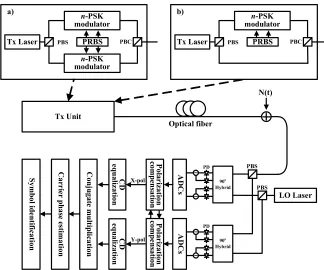
[image:7.612.141.465.144.414.2]n-PSK modulator PRBS Tx Laser N(t) LO Laser Optical fiber PBS PBC PBS PBS n-PSK modulator AD Cs Po la ri za ti on co m pen sa tio n Car rier p has e es timat ion Sy mb ol id en ti fic atio n C onj ug ate mu lt ip li cat ion X-pol Y-pol CD eq ua liz ati on PD 90o Hybrid PD 90o Hybrid ADC s Po la riz at io n com pe nsa tion CD equa li zat io n n-PSK modulator PRBS PBS PBC a) b) Tx Unit Tx Laser
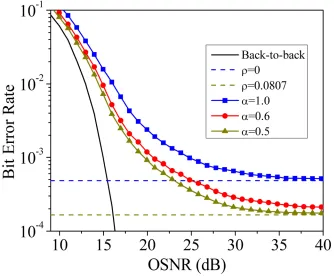
Fig. 2. BER for single channel QPSK coherent system of Fig. 1 for transmitter and Local Oscillator linewidths equal to 5 MHz. Results are for transmission distance of 2000 km. Three curves with markers are simulation results for different phase modulation balance as indicated by the α-value. The PRBS length is 216-1. Analytically specified BER-floors (Eq. (7)) are shown
by dashed lines with specified ρ-values. Figure abbreviations: OSNR - optical signal-to-noise ratio.
3. Simulation method, results and discussion 3.1 Use of distributed QPSK modulation
In the simulations, we consider a QPSK system with a symbol frequency of 28 GS/s, i.e. the single channel system capacity using In-phase and Quadrature modulation is 56 Gb/s.
We consider a normal single mode transmission fiber with dispersion coefficient D = 16 ps/nm/km and zero dispersion slope. The transmission distance L is 2000 km. We consider an intrinsic intermediate frequency 3 dB linewidth of ΔfLO = ΔfTx = 5 MHz. This gives an effective linewidth of ΔfEE = 206 MHz (see Eq. (6)). We utilize the software tool from VPI [25] for the system simulations, and we evaluate the Bit-Error-Rate versus optical signal-to-noise ratio (OSNR). In the Rx we apply optical (RF) pilot tone principle (see section 2.1) for carrier phase extraction.
Figure 2 shows BER results. As a reference, we consider the case of α = 1 where the phase modulation is in one polarization only and an optical (RF) pilot tone is transmitted in the orthogonal polarization (Fig. 1 insert b)). In this case the EEPN is not cancelled by the optical (RF) pilot tone and the resulting BER-floor - given by Eq. (7) - of 4.9·10−4 – see dashed blue
line. When the cases of α = 0.6/0.5 are considered, part of the EEPN is cancelled resulting in a BER-floor of 1.7·10−4 in the best case (α = 0.5).
the strongest correlation for full balancing (α = 0.5). The EEPN cancellation improves the BER-floor position by about ½ order of magnitude, and thus it has a partial effect. This will be discussed more in section 3.2.
It may be of interest to describe the EEPN cancellation by fitting a BER-floor into the results for α = 0.5 we can specify the effective correlation between the EEPN of the two polarization states through the parameter ρ (−1 ≤ ρ≤ 1) which is specified through σEff2 =
(1-ρ)2σ
EEPN2 - where σEff2 corresponds to the BER-floor position – Eq. (7). In our case we find
ρ = 0.0807 where a value of 1 corresponds to full correlation i.e. complete EEPN mitigation. 3.2 Using the Viterbi-Viterbi algorithm
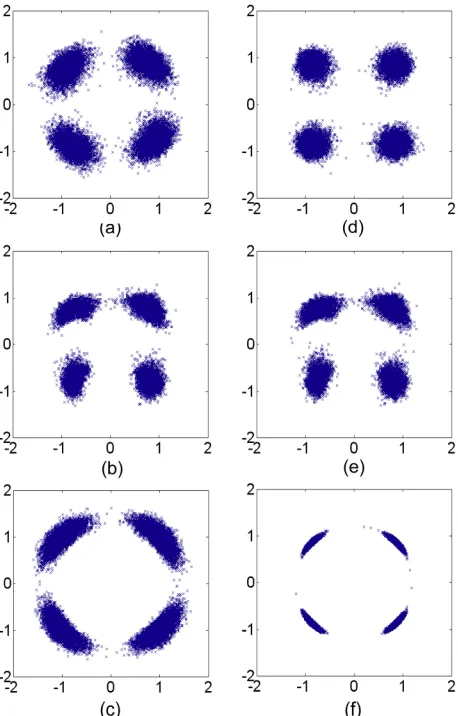
We will now use the Viterbi-Viterbi algorithm in the Rx considering the transmission cases of Fig. 2. First we look at the effect of this on constellation diagrams for OSNR = 35 dB i.e. when EEPN generates a phase noise error-rate-floor. Figure 3 shows the constellation diagrams for the single polarization QPSK system including an optical (RF) pilot tone in the orthogonal polarization state (α = 1). Results are given without using (Fig. 3(a)) and using (Fig. 3(d)) the Viterbi-Viterbi algorithm. Here we observe in Fig. 3(a) that the constellation symbols are influenced partly by phase noise (the noise cloud is partly banana-shaped) and partly by amplitude noise (the cloud center is circular) in agreement with the nature of EEPN discussed in section 2. The use of the Viterbi-Viterbi algorithm removes the part of the noise cloud which is due to phase noise and a large improvement in the BER is seen (to be quantified later).
Figure 3(b) and 3(e) show diagrams for the QPSK system with distributed phase modulation in two polarizations (α = 0.5). It appears that the modulation generates EEPN which is correlated with the QPSK symbols where the two upper symbols are dominated by phase noise whereas the lower symbols are dominated by additive noise. Also, the Viterbi-Viterbi algorithm does not improve the BER in this particular case. The reason for this is tentatively explained as follows: The Viterbi-Viterbi algorithm [32] is in the normal implementation for coherent optical QPSK systems (as used here [31]) raising the complex signal to power 4 in the QPSK case in order to eliminate the signal modulation. For this particular constellation (Fig. 3(b)) the noise is modulation dependent. Thus the Viterbi-Viterbi algorithm does not fully remove the modulation dependence and this is suggested to be the reason why it does not in an effective way mitigate the EEPN. Further theoretical investigation is needed in order to explain the simulation results in all details.
As an important reference case (considering Wiener phase noise) we have in Fig. 3(c) and 3(f) shown results for a back-to-back (for the QPSK system with an optical (RF) pilot tone) with Tx and LO laser linewidths equal to 103 MHz (the sum of the two linewidths equals the EEPN generated linewidth for the previous case - see Eq. (5)) and using a single tap NLMS filter for the carrier phase extraction [29]. The Viterbi-Viterbi algorithm is used to mitigate the phase noise as much as possible. Here we observe a clearly phase noise dominated constellation in Fig. 3(c) and the phase noise is significantly removed using the Viterbi-Viterbi algorithm – leaving a very narrow but still strongly phase noise influenced (banana shaped) noise part in Fig. 3(f). The resulting BER is expected to be improved at least somewhat.
carrier phase extraction provides complete phase noise cancellation in the pure phase noise case, and the resulting BER performance is given by the back-to-back results in Fig. 4 for linewidths of 5 MHz. These back-to-back results apply both for the QPSK system with distributed phase modulation between the orthogonal polarizations (α = 0.5) and to the QPSK system with full phase modulation in one polarization and an optical (RF) pilot tone in the orthogonal one (α = 1). The results are the same regardless of the use of the Viterbi-Viterbi algorithm as should be expected since no EEPN has been generated and the Wiener phase noise is small.
Fig. 4. BER for single channel QPSK coherent systems of Fig. 1. Curves are referred to the figure insert. Curves with α = 0.5 are for the distributed PSK modulation in two polarizations. Curves with α = 1 are for the full PSK modulation in one polarization and including an optical (RF) pilot tone in the orthogonal polarization state. Transmission distances are either back-to-back or 2000 km as indicated. Tx and LO laser have equal linwidths as specified in figure inserts. In the reference case with linewidths of 103 MHz and back-to-back transmission no optical (RF) pilot tone is included in the system and the carrier phase estimation is performed using a single tap NLMS filter (also indicated in the insert). Systems are compared using the Viterbi-Viterbi (VV) algorithm or not using it as indicated. The PRBS length for all cases is 216-1. Figure abbreviations: OSNR - optical signal-to-noise ratio; VV – Viterbi-Viterbi; PN –
phase noise; NLMS – normalized least mean square.
From Fig. 4 we conclude that the Viterbi-Viterbi algorithm is a “lucky punch” case particularly for classical QPSK systems influenced by EEPN. The algorithm is expected to work equally well for n-level PSK systems with n > 4.
We have extended our transmission range to 3000 km in order to compare in detail to BER-results of [15] for QPSK systems with and without using the Viterbi-Viterbi algorithm and have found excellent agreement.
3.3 Comparison of shared modulation and Viterbi-Viterbi EEPN mitigation techniques for practical systems
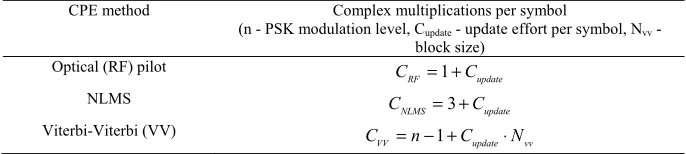
different dispersion compensation implementations in [12].) This is especially the case when using many cells NVV in the Viterbi-Viterbi algorithm. This is required when dealing with EEPN dominated noise (in the order of Nvv≈ 35 in our case). This may especially be a problem when transmitting real time services that do not allow buffering in the receiver or services requiring low latency. Also the Viterbi-Viterbi method (as implemented as in [31]) does work for n-level PSK modulation but not for classical n-level QAM modulation (with non-circular constellations) where the single tap NLMS carrier phase extraction or the classical (unmodulated) optical (RF) pilot tone implementation works well.
Table 1. Complexity of carrier phase estimation (CPE) methods
CPE method Complex multiplications per symbol
(n - PSK modulation level, Cupdate - update effort per symbol, Nvv -
block size)
Optical (RF) pilot 1
RF update
C = +C
NLMS 3
NLMS update
C = +C
Viterbi-Viterbi (VV) 1
VV update vv
C = − +n C ⋅N
Pilot-tone EEPN mitigation (with distributed QPSK modulation) works for n-level PSK modulated systems. It does not allow dual polarization operation. It gives less improvement of the EEPN sensitivity – about ½ order of magnitude for BER-floor position. However, it is computational effective and suited for real time system operation with low latency.
4. Conclusions
In this paper we propose a balanced phase modulation between two orthogonal polarizations of the optical signal in order to generate correlated equalization enhanced phase noise (EEPN) contributions in the two polarizations. The method is applicable for n-level PSK systems with coherent detection in the receiver. Then the EEPN can be in principle compensated by complex conjugation multiplication in the receiver, and the full phase modulated nPSK signal is regenerated. The proposed method is tested by system simulations in a single channel QPSK system at 56 Gb/s system rate. It is found that the conjugation and multiplication scheme cannot fully mitigate the EEPN. An improvement of about ½ order of magnitude in Bit-Error-Rate (BER) floor position is observed.
Results are compared to using the Viterbi-Viterbi algorithm to mitigate the EEPN in a classical QPSK system with an optical (RF) pilot tone in the orthogonal polarization relative to the signal. The Viterbi-Viterbi method improves the sensitivity by more than two orders of magnitude. We note that the Viterbi-Viterbi algorithm is equally effective in mitigating EEPN for dual polarization QPSK implementations (where the carrier phase is extracted e.g. from the Viterbi-Viterbi algorithm or using single tap NLMS filtering [31]).
It is seen that the use of the Viterbi-Viterbi algorithm does not improve the EEPN sensitivity any further for the system with distributed QPSK modulation in two orthogonal polarization states. For this system implementation, the receiver statistics is clearly symbol dependent and this seems to be the reason why the Viterbi-Viterbi method has problems. The Viterbi-Viterbi algorithm is found to be only marginally efficient for improving the sensitivity for Wiener laser phase noise rather than EEPN in the classical QPSK case. Thus, important novel insight into the statistical properties of EEPN is identified and discussed in this paper presenting subjects which need further investigation.
channel capacity is BERHC then the floor for the system with low capacity is about BERLC≈
(BERHC)2. Thus the dual polarization system design can significantly eliminate the EEPN
influence and the influence is mitigated further using the Viterbi-Viterbi algorithm. For dual polarization operation the carrier phase extraction cannot be done using the optical (RF) pilot scheme as used in this paper, a single tap NLMS filter or the Viterbi-Viterbi algorithm has to be applied. It is to be noted that the BER-floor approximation in Eq. (7) (without using the Viterbi-Viterbi algorithm) becomes poor (too optimistic by one order of magnitude or more) for dual polarization QPSK systems when the EEPN is significant and the carrier phase is estimated using the single tap NLMS filter or using the Viterbi-Viterbi algorithm (see e.g [31].). Thus a detailed comparison between dual polarization systems and single polarization systems using the optical (RF) principle to extract the carrier phase requires further studies. The results of the current paper show that Eq. (7) is an accurate approximation for large EEPN when the carrier phase is extracted using the optical (RF) principle as presented in section 2.1. It is of practical interest to consider implications that can be derived from the study in this paper – which is focused on n-level PSK systems - to n-level QAM systems. For practical coherent n-level QAM systems, the use of optical (RF) pilot tone phase noise compensation using distributed modulation does not seem to be feasible. Nor does the Viterbi-Viterbi algorithm (in its current implementation [31]) work for classical QAM systems. For QAM systems it is advisable to select a dual polarization design using a LO-laser with little phase noise in order to eliminate EEPN effects as much as possible or to use hardware based chromatic dispersion compensation implementations. Such are the use of Dispersion Compensating Fibers (DCFs) (rather than digital dispersion compensation in the electronic domain) or the implementation of local oscillator phase noise cancellation by digital coherence enhancement [33]. The use of DCFs require a DSP implementation of an adaptive (few taps) NLMS dispersion compensation in the receiver [12] in order to admit fluctuations in the dispersion (e.g. due to temperature drafts). The DCF is commercially realized and simple to implement, whereas the LO phase noise cancellation is under research investigation and currently requires rather complex hardware implementation [33].
Acknowledgment