warwick.ac.uk/lib-publications
Original citation:
Wen, Mingjian, Li, Junhao, Brommer, Peter, Elliott, Ryan S., Sethna, James P. and Tadmor,
Ellad B.. (201
7
) A KIM-compliant potfit for fitting sloppy interatomic potentials : application
to the EDIP model for silicon. Modelling and Simulation in Materials Science and
Engineering, 25 . 014001.
Permanent WRAP URL:
http://wrap.warwick.ac.uk/83718
Copyright and reuse:
The Warwick Research Archive Portal (WRAP) makes this work of researchers of the
University of Warwick available open access under the following conditions.
This article is made available under the Creative Commons Attribution 3.0 (CC BY 3.0) license
and may be reused according to the conditions of the license. For more details see:
http://creativecommons.org/licenses/by/3.0/
A note on versions:
The version presented in WRAP is the published version, or, version of record, and may be
cited as it appears here.
A KIM-compliant
potfit
for
fi
tting sloppy
interatomic potentials: application to the
EDIP model for silicon
Mingjian Wen
1, Junhao Li
2, Peter Brommer
3, Ryan S Elliott
1,
James P Sethna
2and Ellad B Tadmor
11
Department of Aerospace Engineering and Mechanics, University of Minnesota, Minneapolis, MN 55455, USA
2
Laboratory of Atomic and Solid State Physics, Cornell University, Ithaca, NY 14853, USA
3
Warwick Centre for Predictive Modelling, School of Engineering, and Centre for Scientific Computing, University of Warwick, Coventry CV47AL, UK
E-mail:[email protected]
Received 15 June 2016
Accepted for publication 2 November 2016 Published 28 November 2016
Abstract
Fitted interatomic potentials are widely used in atomistic simulations thanks to their ability to compute the energy and forces on atoms quickly. However, the simulation results crucially depend on the quality of the potential being used. Force matching is a method aimed at constructing reliable and transferable interatomic potentials by matching the forces computed by the potential as closely as possible, with those obtained fromfirst principles calculations. The
potfitprogram is an implementation of the force-matching method that opti-mizes the potential parameters using a global minimization algorithm followed by a local minimization polish. We extended potfitin two ways. First, we adapted the code to be compliant with the KIM Application Programming Interface (API) standard (part of the Knowledgebase of Interatomic Models project). This makes it possible to usepotfittofit many KIM potential models, not just those prebuilt into the potfitcode. Second, we incorporated the geo-desic Levenberg–Marquardt(LM)minimization algorithm intopotfitas a new local minimization algorithm. The extendedpotfitwas tested by generating a training set using the KIM environment-dependent interatomic potential (EDIP)model for silicon and usingpotfitto recover the potential parameters
Modelling Simul. Mater. Sci. Eng.25(2017)014001(18pp) doi:10.1088/0965-0393/25/1/014001
Original content from this work may be used under the terms of theCreative Commons Attribution 3.0 licence. Any further distribution of this work must
from different initial guesses. The results show that EDIP is a‘sloppy model’ in the sense that its predictions are insensitive to some of its parameters, which makesfitting more difficult. Wefind that the geodesic LM algorithm is par-ticularly efficient for this case. The extended potfitcode is the first step in developing a KIM-basedfitting framework for interatomic potentials for bulk and two-dimensional materials. The code is available for download via https://www.potfit.net.
S Online supplementary data available from stacks.iop.org/msms/25/ 014001/mmedia
Keywords: interatomic potentials, Knowledgebase of Interatomic Models, sloppy models, geodesic Levenberg–Marquardt minimization, force-matching
fitting,potfit
(Somefigures may appear in colour only in the online journal)
1. Introduction
An interatomic potential (IP) is a model for approximating the quantum-mechanical inter-action of electrons and nuclei in a material through a parameterized functional form that depends only on the positions of the nuclei. IPs such as the Lennard–Jones[1,2]and Morse
[3]potentials were initially introduced as part of theoretical studies of material behavior in the early 20th century. Interest in IPs renewed in the 1960s following the development of Monte Carlo and molecular dynamics(MD)simulation methods. This led to the development of IPs for a variety of material systems, a trend that accelerated in the 1980s with the formulation of a large number of increasingly complex IPs. (See[4]for more on the history and scientific development of IPs and MD.)Even complex IPs are far less costly to compute than afirst principles approach that involves solving the Schrödinger equation for the quantum system. This enables simulations of large systems (millions, billions and even trillions of atoms depending on the IP)for very short times or moderate-size systems for longer times(tens or hundreds of nanoseconds). Such simulations can tackle problems that are inaccessible to quantum calculations, such as plastic deformation, fracture, atomic diffusion, and phase transformations[5].
Obtaining an accurate and reliable IP constitutes a challenging problem that involves choosing an appropriate functional form and adjusting the parameters to optimally reproduce a relevant training set of experimental and/or quantum data. Traditionally IPs werefitted to reproduce a set of material properties considered important for a given application, such as the cohesive energy, equilibrium lattice constant, and elastic constants of a given crystal phase. However experience has shown that the transferability of such IPs (i.e. their ability to accurately predict behavior that they were not fitted to reproduce)can be limited due to the small number of atomic configurations sampled in the training set(although recent work[6] has shown that this approach can be effective in some cases). Further, as the complexity of IPs increases (both in terms of the functional forms and the number of parameters)it can be difficult to obtain a sufficient number of material properties for the training set. This is particularly true for multispecies systems like intermetallic alloys.
atoms obtained byfirst principles calculations for a set of atomic configurations. These can be configurations associated with important structures or simply random snapshots of the crystal as the atoms oscillate atfinite temperature. Byfitting to this information the transferability of the potential is likely enhanced since it is exposed to a larger cross-section of configuration space. The issue of insufficient training data is also resolved since as many configurations as needed can be easily generated. This makes it possible to increase the number of parameters and in fact in the original Ercolessi–Adams potential for aluminum[7]the functional forms were taken to be cubic splines with the spline knots serving as parameters. This gives maximum freedom to thefitting process(at the expense of a clear physical motivation for the functional form). The force-matching method has been widely used since its introduction and there are a number of open source implementations available. The ForceFit [8] and For-ceBalance[9]packages target organic-chemistry applications, whilepotfit[10–12]focuses on solid-state physics.
IPfitting programs(such as those mentioned above)define a‘cost function’quantifying the difference between the training set data and IP predictions and use global and/or local minimization algorithms to reduce the cost as much as possible. For example, the potfit
program uses simulated annealing for global minimization followed by a local polish using a conjugate gradient (CG)method. A difficulty associated with this procedure is that IPs are nonlinear functions that are often‘sloppy’in the sense that their predictions are insensitive to certain combinations of their parameters[13]. These soft modes in parameter space can cause the minimization algorithms to fail to converge. Recently an understanding of sloppy models based on ideas from differential geometry has led to efficient methods forfitting such models
[14]. The basic idea is that the parameters of a model(like an IP)define a manifold in the space of data predictions. Fitting the IP then corresponds tofinding the point on the manifold closest to the training set. Using these ideas Transtrumet al[14]augmented the Levenberg– Marquardt(LM)algorithm with a geodesic acceleration adjustment to improve convergence. The new geodesic LM algorithm is likely to be more efficient and more likely to converge for sloppy model systems than conventional approaches. Geodesic LM has been applied to a variety of applications in physics and biology, but until now not to the IPfitting problem.
Users can extend the OpenKIM system by uploading their own tests. The predictions of the IPs can be explored using text-based searches and a user-extendible visualization system[35]. In this paper we describe a KIM-compliant implementation of the potfitprogram designed for fitting sloppy IPs. The work has two main objectives. First, we extend the
potfitprogram to support the KIM API making it possible tofit IPs with arbitrary functional forms that are portable to a large number of KIM-compliant simulation codes. Second, we explore the efficiency of the geodesic LM algorithm forfitting IPs using the force-matching method within the potfitframework. We test the new implementation on a KIM-compliant implementation of the environment-dependent interatomic potential(EDIP)for silicon[36– 38]. We use the EDIP model to generate a training set of force configurations and explore the ability of potfitto converge back to the original EDIP parameters from different initial guesses. Wefind that EDIP has the properties of a sloppy model and that the geodesic LM algorithm can converge to the correct results in situations where other minimizers in
potfitfail.
The paper is organized as follows. In sections 2 and 3, we briefly describe the potfit
program and the KIM project, respectively. This is followed by a discussion of the mod-ifications that have been made topotfitin order to support the KIM API and the geodesic LM algorithm. In section5, we present the application of the extendedpotfitto the EDIP model. We conclude in section 6with a summary and a discussion of future directions.
2. Thepotfitprogram forfitting IPs
Thepotfitprogram[10–12](http://www.potfit.net)is an open source implementation of the force-matching method. It optimizes an IP’s parameters by minimizing a cost function defined as the weighted sum of squares of deviations between calculated and reference quantities for forces, energies and/or stresses.(The particular form of the cost function used in this paper is described in section 5.) potfit consists of two largely independent components: IP imple-mentations, and least-squares minimization. This program architecture makes it compara-tively easy to add either an IP model or a minimization algorithm, which facilitated both aspects of the current work.
potfitsupports both analytic and tabulated IPs. An analytic IP has afixed functional form with certain free parameters. Consider for example the simplest pair potential form where the total energy ofn interacting atoms is given by
å å
f=
a b ab
= =
V 1 r
2 ,
n n
1 1 ( )
in which rab is the distance between atoms α and β, andf(rab) is the energy in the bond connecting them. An example of an analytic function, is the Lennard–Jones potential for which
⎜ ⎟ ⎜ ⎟ ⎡
⎣
⎢⎛⎝ ⎞⎠ ⎛⎝ ⎞⎠ ⎤ ⎦ ⎥
f r = s - s
r r
4 ,
12 6
( )
f( )r =a ri( -ri)3 +b ri( -ri)2 +c ri( -ri)+di,
where the coefficients (a b c di, i, i, i) are obtained from the conditions that f( )ri =fi and f(ri+1)=fi+1(with different conditions at the ends that define the type of cubic spline). In this scenario the tabulated function values(f f1, 2,¼,fN)are the IP parameters. The form of interpolation used (cubic, quartic, quintic, or others) can have a strong influence on the predictions of the IP [39]. This is why the interpolation is considered part of the IP by OpenKIM(see section3)and stored along with the parameters. Thepotfitprogram supports various functional forms including a variety of pair potentials, EAM potentials [19–21], angular-dependent potentials [40], bond-order potentials (Tersoff potential [41, 42]), and induced dipole potentials (Tangney–Scandolo[43]).
Once an IP is selected, different local and global minimization algorithms are available withinpotfittofind the optimal set of parameters that minimize the cost function. Thelocal
minimization algorithm is Powell’s method [44], which is a variant of the CG method. Standard CG requires the derivative of the cost function with respect to the IP parameters. The advantage of Powell’s method is that it constructs conjugate directions without requiring derivatives. Powell’s algorithm begins with an initial guess for the IP parameters and con-verges to a nearby minimum. For highly nonlinear IPs it is possible that different initial guesses will lead to different solutions. To address this, global minimization algorithms attempt to explore the parameter space tofind the deepest minimum.potfitincludes simulated annealing and differential evolution in this class of methods. See the original potfit pu-blications [10–12]for detailed descriptions of the optimization algorithms.
3. The Open Knowledgebase of Interatomic Models project
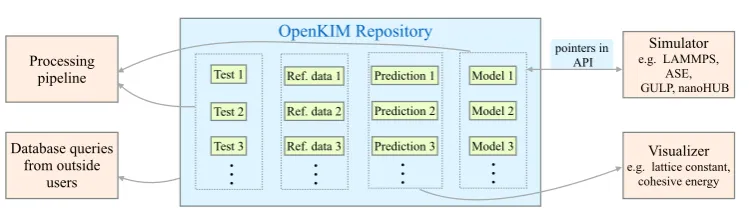
The KIM project [16–18] is an international effort aimed at improving the reliability and accuracy of molecular simulations using IPs. A schematic of the OpenKIM cyberinfras-tructure is displayed infigure1. First and foremost OpenKIM provides a repository for IPs at https://openkim.org. Within the OpenKIM system IPs are referred to more generically as
models. A KIM model consists of the computer implementation of the IP along with any parameters. A KIM IP can be a stand-alone model, or amodel driverthat reads in different parameter files to define different models. All content in the OpenKIM system is archived subject to strict provenance control and can be cited using permanent links. For example, later in this article we will be analyzing the EDIP model for silicon[36–38]archived in OpenKIM
[image:6.595.93.468.82.187.2][16, 45, 46]. The citations contain a unique 12-digit KIM identifier and 3-digit version number. This makes it possible to access the actual IP used in this publication at any later date to reproduce the calculations—an ability lacking prior to OpenKIM archiving. All content
within the OpenKIM repository is citeable in this manner and is accessible to external users through web queries.
In addition to archiving IPs, OpenKIM is tasked with determining the suitability of an IP for a given application. Since IPs are approximate, their transferability to phenomena they were not fitted to reproduce is limited. To help define a rigorous method for IP selection, OpenKIM includes a user-extendible suite ofKIM tests for characterizing an IP. Each KIM test computes the prediction of an IP for a well-defined material property(such as the surface free energy for a given crystal face under specified temperature and pressure). Each IP in the system is mated with all compatible KIM tests using an automated system called the Pro-cessing Pipeline[47]. Whenever a new model or test is uploaded to OpenKIM by members of the community, the pipeline launches to perform the new calculations. The results are stored in the OpenKIM repository and can be explored and compared with first principles and experimental reference data using text-based and graphical visualization tools[35]. Machine learning based tools are being developed to use the accumulated information on the accuracy of an IP’s predictions to help select for applications of choice[48].
The operation of the pipeline involves the coupling of pairs of computer codes, model and test, which may be written in different computer languages and need to exchange information. Specifically, the test repeatedly calls the model with new input (typically positions and species of atoms)and requires the generated output(typically energy and forces on atoms). This is made possible because all codes in OpenKIM conform to the KIM API
[22]. This is a standard developed as part of the KIM project for atomistic simulation codes to exchange information. The KIM API is a lightweight efficient interface where only pointers are exchanged between the interfacing codes, which can be written in any supported language (C, C++, Fortran 77/90/95/2003, Python). A number of major simulation codes currently support the KIM API (listed in section 1). Anyone of these codes can work seamlessly (without having to be recompiled)with any KIM model stored on the same computer as a dynamically linked library. (This is akin to a CD being placed in a player from any manu-facturer and having its content played.)This greatly increases the portability of IPs. It allows researchers to select the appropriate IP for their application and use it with their code of choice, rather than being limited to the IPs that happen to come with it.
4. Extensions topotfit: geodesic LM and KIM-compliance
An extended version of the potfitcode has been developed that includes a geodesic LM optimizer and support for the KIM API. The new code is available via https://www.potfit. net. Details of the extensions are given below.
4.1. Geodesic LM algorithm
As explained in the introduction, IPs often have the characteristics of sloppy models. This can cause the standard minimization algorithms inpotfitto fail to converge. As an alternative we have incorporated into potfitthe newly developed geodesic LM algorithm [14, 49–51]. Geodesic LM is an efficient method offering a higher likelihood of convergence for sloppy models. The performance of the geodesic LM method is discussed in section5.4. The method is described next.
å
q = q = q = q q
=
r r r
C 1 r
2
1 2
1
2 , 1
m M
m 1
2 2 T
( ) ( ( )) ( ) ( ) ( ) ( )
where the residualr:N Mis anM-dimensional vector function ofNparameters. The gradient ofCis
å
q q q q q ¶ ¶ = ¶ ¶ ¶ ¶ = = J r Cr r C , 2
i m M m m i 1 T ( ) ( ) ( )
where J is the Jacobian ofr, and the Hessian ofCis, ⎛ ⎝ ⎜ ⎞ ⎠ ⎟
å
qq q q
q q q q q q
¶ ¶ = ¶ ¶ ¶ ¶ + ¶ ¶ ¶ ¶ ¶ = + =
J J r K
C r r
r r C , 3
i j m
M m i m j m m i j T 2 1 2 2 T ( ) ( ) ( )
where K is the second derivative of r with respect toq (a third-order matrix).
Before introducing geodesic LM, let us consider the more basic Gauss–Newton method. This approach is based on a linear approximation ofr [52],
q+dq » q + q qd
r( ) r( ) J( ) . ( )4
Substituting(4)into(1)we see that,
q q q q q q
q q
q q q q
d d d
d d
d d d
+ = + +
= + +
= + +
r r
r J r J
J r J J
C C 1 2 1 2 1
2 . 5
T
T
T T T T
( ) ( ) ( )
( ) ( )
( ) ( )
Taking the first derivative of(5)with respect todq and setting it to zero, we have, q
d = -(J JT )-1 TJ r. ( )6
In (6)dq is a local decent direction of C, thus we can obtain the local minimum ofCby solving(6)iteratively. This is the Gauss–Newton method.
Levenberg[53]suggested a‘damped version’of(6)where the parameters are iteratively updated according to
q
d = -(J JT +lD)-1 TJ r, l 0. ( )7 Here λis a (non-negative)damping parameter, and D=I is the identity. The Levenberg method is an interpolation between the Gauss–Newton algorithm and the steepest decent algorithm. For smallλ,(7)reduces to the Gauss–Newton equation in(6); whereas for largeλ,
q
d » -l-1 TJ r, which lies along the gradient(i.e. the steepest descent direction)in(2). In order to overcome slow convergence in directions of small gradients, Marquardt[54] proposed taking D=diag(J JT ), where diag( )A returns a diagonal matrix with elements equal to the diagonal elements of the square matrix(A). The downside of this approach is that it greatly increases the susceptibility for parameter evaporation[50], i.e. the algorithm pushes the parameters to infinite values without finding a goodfit around saddle points.
To improve the efficiency of the LM method, Transtrum and Sethna[14,49–51] pro-posed the geodesic LM algorithm in which the minimization step size is constrained and the residual is modified to include a second-order(geodesic acceleration)correction,
q+dq » q + q qd + dq q qd
r r J 1 K
2 . 8
T
The cost function atq +dq is then
q +dq = r q+dq r q+dq + ldq Ddq
C 1
2
1
2 , 9
T T
( ) ( ) ( ) ( )
where a Lagrange multiplier is introduced to enforce the constraint on the step sizedq. Taking the first derivative of(9)with respect todq and setting it to zero, we have
⎜ ⎟
⎛
⎝ ⎞⎠
l dq dq dq
+ + + + + =
J r J J r K D J K 1J K
2 0, 10
mi m ( mi mj m mij ij) j mk mij mi mkj j k ( )
where the indices are included explicitly to avoid ambiguity and Einstein’s summation convention over repeated indices is adopted. The step sizedqiis written as a sum of two parts:
dqi=dqi( )1 +dqi( )2, (11)
wheredqi( )1 is given by (7)anddq( )i2 includes the remaining terms. Substituting(11)and(7) into(10),dqi( )2 can be solved as,
dq l dq dq
l
= - +
= - +
-J -J D J K
J J D r
1 2 1
2 , 12
i mi mj ij pj pkl k l
mi mj ij p
2 1 1 1
1
( )
( ) ( )
( ) ( ) ( )
where some small terms are ignored(see[50]for details)and the directional second derivative dq dq
=
rp Kpkl k l 1 1
( ) ( )is used.
As seen from(12), the geodesic acceleration correction only depends on the directional second derivative oriented along thefirst order correctiondq( )1. This feature is very important because the cost to compute the directional second derivative is reasonably small and hence will not overly add to the computational burden.
Finally, in order to prevent parameter evaporation in the geodesic LM algorithm and to increase the likelihood of convergence, allowable step sizes must satisfy:
q q d d a 2 , 13 2
1 ( )
( )
( )
whereαis some parameter(usually smaller than 1)and whose optimal value depends on the specific problem.
An open source implementation of the geodesic LM algorithm has been made available by Transtrum [55]. In addition to the geodesic acceleration correction, the geodesic LM package includes different options for updates to the damping parameter and the damping matrix, different conditions for accepting uphill steps(i.e. steps that increaseC), and whether or not to use Broyden’s method[56]to lower the Jacobian update frequency. In this work, the damping matrix is set to I, Umrigar and Nightingale’s method [50]is used to update the damping parameter and to decide whether to accept uphill steps, and we do not employ Broyden’s method to update the Jacobian because the computational cost in this problem is not too high.
4.2. KIM-compliance
the atoms)and receives back the required output(e.g. the forces on the atoms). Enforcing this separation makes it possible for the simulator to work with any compatible KIM model in plug-and-play fashion4. The KIM API is the standard for the exchange of information between the communicating codes. In practice this works by having all data exchanged between the simulator and IP stored in a data structure called the ‘KIM API Object.’The simulator and IP can access and change this data using KIM API library routines. The only direct data transfer required between the programs is for the simulator to pass to the KIM model the pointer to the location in memory of the KIM API Object. This makes the KIM API extremely efficient and provides it with cross language compatibility (as described in section3). This means thatpotfit, which is written in C, can work efficiently and seamlessly with KIM Models written in C, C++, Fortran 77/90/95/2003, and Python.
Thepotfitprogram has an unusual requirement for a simulator in that it needs to modify the parameters of the IP that it is optimizing. This is supported by the KIM API through the ability of KIM Models to‘publish their parameters.’A KIM model that does so has in its KIM descriptorfile a list of its parameters identified by name with the prefix‘PARAM_FREE_’. Thepotfituser can select any of these parameters to optimize. This is specified in the input
file topotfitalong with the initial guesses for the parameters, and the KIM model identifier (see section3).
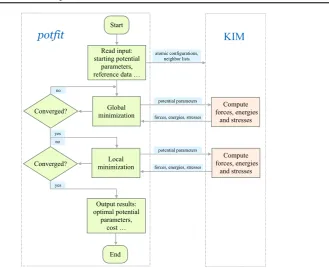
[image:10.595.134.464.78.348.2]The operation of the KIM-compliant implementation of potfitis described in figure 2. The program reads in the input defining the optimization problem and then generates one or more KIM API Objects containing the training set to be used for the optimization. At each
Figure 2.Flowchart of the KIM-compliantpotfitprogram.
step in the optimization whenever the IP parameters need to be changed, the following steps are performed using KIM API library calls:
(i)The KIM model parameters are changed in the KIM API Object; (ii)The KIM model is called to compute the new energy and forces; (iii)potfitacquires the energy and forces from the KIM API Object.
When the optimization is complete,potfitoutputs thefinal set of parameters and writes out a new KIM Model, which can be uploaded tohttps://openkim.orgif desired.
5. Application of KIM-potfitto EDIP
In this section we test the performance of KIM-potfitby applying it to the optimization of the EDIP model for silicon[36–38]archived in OpenKIM[16,45,46]. The training set consists of the energy and forces computed with the original EDIP model for a periodic configuration of5´5´5conventional unit cells for a total of 1000 atoms perturbed off the ideal diamond structure positions. Our objective is to see whether starting from different initial guesses for the parameters, the optimization procedure is able to recover the EDIP parameters.
5.1. Cost function
As explained in section 2, IP optimization corresponds to minimizing a cost function quantifying the difference between the IP’s predictions and a training set of reference data. Our training set consists of a single atomic configuration with n=1000 atoms. The cost function used in our analysis is
å
q = - +
-a= a a
f f
C 1w w E E
2
1
2 , 14
n 1
1
0 2
2 0 2
( ) ( ) ( )
where fa =fa( )q and fa0are the predicted and reference force on atomα,E=E( )q andE0 are the predicted and reference energy, and w1and w2are weights. In our example we take
=
[image:11.595.158.398.83.236.2]w1 1(Å eV)2,w2=1 1 eV( )2 to give a unitless cost function. The reference forces and energy are defined as fa0 =fa(q0) and E0=E(q0), where q0 are the original EDIP
parameters. EDIP’s functional form and parameters along with the training set used are given in the supplementary information accompanying this article.
The Hessian of the cost function at the original parametersq0 follows from(3)as
å
q q q q q q
= 
¶ ¶ =
¶ 

¶ +
¶ 
¶ 
q a q q q q
a a
=
f f
Hij C w w E E , 15
i j
n
i j i j
0 2
1 1
2
0 0 0 0 0
· ( )
where we have used(fa-fa0)∣q0 =0and(E -E0)∣q0 =0. We will use the Hessian in the next section to evaluate the sensitivity of EDIP predictions to its parameters.
5.2. EDIP sensitivity analysis
It is a common feature of IPs that the prediction of a model(including the cost function)are weakly dependent on certain directions in parameter space, i.e. the models are sloppy[57]. This is demonstrated schematically in figure3 showing the contour plot of a cost function with only two parameters. Clearly the function varies more slowly along theL2 eigendir-ection than along L1. As a result of this structure of C( )q , convergence along certain directions can be incomplete. For example in thefigure, the minimum is located atObut a convergence could terminate at a set of parameters offset to the optimal ones by Dq. An indication of whether this is occurring can be obtained by computing the angle betweenDq and the eigenvectors of the Hessian¶2C ¶ ¶q qi j evaluated atO,
q q
a = D L
D
cos i i. 16
·
( )
Point A and point B(corresponding to another fit) are equally close to the eigendirections because they form the same angles.
In general, the eigendirections associated with smaller eigenvalues are more‘sloppy’and we would expect larger scatter in thecosai values computed in(16)for an ensemble offits. Thus qualitatively we expect a behavior similar to that shown infigure4, where the scatter in
a
[image:12.595.103.472.81.237.2]cos i obtained from a large number of fitting attempts with different initial guesses would occupy a region similar to RegionI in thefigure with larger scatter along directions asso-ciated with smaller eigenvalues. This would be the signature of a sloppy model.
We perform this analysis for EDIP. EDIP has 13 parameters, but only 11 of them are used in this study with the two cutoffs excluded. The training set is described in section5.1. We take an ensemble of 100 initial guesses obtained by adding to the original EDIP para-meters random numbers ρ drawn from a Gaussian distribution with average zero and a standard deviation of 0.15, i.e. qi≔qi0´(1+r),i=1,¼, 11, and perform the fitting procedure for each one. The relative errors Dq qi 0i =(qi*-qi0) qi0 (for i=1,¼, 11) between the parametersq*obtained in thefitting procedure and the original EDIP parameters q0for all 100 optimizations are shown infigure5(a). No clear trend is apparent. Instead let us plot the cosine defined in(16)as done schematically infigure4. To improve the scaling of the plot let us modify the definition to use the logarithm of the parameters,qˆi =logqi.(This is important when different parameters have very different magnitudes.) The definition equivalent to (16)is then
q q
a = D L
D
cos ˆi i, 17
ˆ · ˆ
ˆ ( )
whereD =qˆ qˆ*- qˆ0 andLˆiis theith eigendirection of the Hessian of the cost functionCin the logarithm parameter space, ¶2C ¶ ¶q qˆi ˆj =q qi j¶2C ¶ ¶q qi j. The results for EDIP are plotted in figure5(b), and are very much in line with the expected behavior in figure 4. In particular, we see that the spread is mostly accounted for by thefirst four eigenterms each of which corresponds to a particular combination of parameters as quantified by the eigendirections.
5.3. Cost along eigendirections
The results in the previous section support the conjecture that the observed scatter in results is due to sloppy directions. However, since the Hessian is a local measure of the structure ofC
[image:13.595.96.466.77.246.2]near the optimal solution, it is possible that there are other minima further away that can trap the optimization process. To explore this possibility, we plot the cost function along the different eigendirections,
q L
= +
C si( ) C( 0 s i), (18)
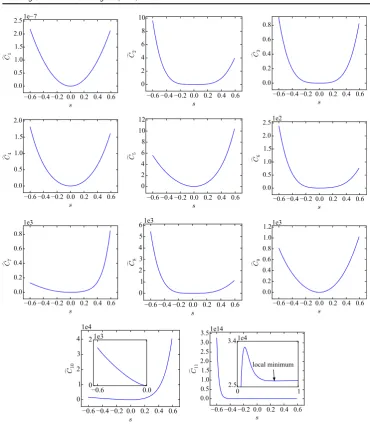
[image:14.595.93.464.77.508.2]where as beforeq0 corresponds to the original EDIP parameters andsis a scalar factor that can be positive or negative. The results are plotted infigure6for all eigendirections from the smallest eigenvalue 1 to the largest eigenvalue 11. The costC varies more slowly along the eigendirections associated with thefive smallest eigenvalues than along other directions, i.e. the cost function is moreflat in thesefive directions.(Note that the scale of they-axis is not the same in the plots, and thefirstfive plots have a significantly smaller range than the others.) This is in agreement with the previous observation that the spread of thefitted parameters is larger along these directions. We also see that an additional local minimum (aside from the
Figure 6.Cost along eigendirections.C1is associated with the smallest eigenvalue, and
C11is associated with the largest. ForC10andC11the insets show a zoomed view of the
one associated with original parameters at s=0) is only apparent along the positive 11
Table 1.Statistics on the optimization of EDIP. The number of minimization attempts
(out of a 100)that converge to a cost function below the tolerance specified on the left for the three minimizers studied and the three perturbation amplitudes(0.1, 0.2 and 0.3) used to generate the initial guesses.
Powell Standard LM Geodesic LM
Cost(C) 0.1 0.2 0.3 0.1 0.2 0.3 0.1 0.2 0.3
<
-C 10 7 85 37 7 68 46 9 100 60 14
<
-C 10 5 85 39 8 76 49 9 100 60 14
<
-C 10 3 89 47 9 100 58 16 100 64 21
<
-C 10 1 93 68 23 100 79 25 100 84 33
<
C 100 98 78 36 100 85 39 100 90 51
<
C 101 100 94 65 100 96 54 100 98 76
Figure 7.Normalized costC¯versus the number of cost function evaluationsNcost. The initial guesses for the parameters are perturbations off the original EDIP parameters drawn from a Gaussian distribution with zero mean and standard deviations of(a)0.1,
direction at a significantly higher cost function5. This minimum can trap the optimization algorithm for initial guesses in its vicinity, however over a large range near the original parameters there is only a single minimum. This suggests that a local minimizer is sufficient for this IP (using different initial guesses), which can reduce the fitting time drastically compared with global minimization efforts.
5.4. Performance of minimization algorithms
Having established in the previous section that a local minimization is sufficient for EDIP(at least in the vicinity of the original parameters), we explore the efficiency of Powell’s method, the geodesic LM algorithm added topotfit, and the standard LM algorithm described in[58] (see section4.1for details of LM and geodesic LM). The three minimizers are applied tofit EDIP. The initial guesses for the parameters are obtained in the same way as discussed in section5.2. Three sets of 100 initial guesses are constructed by perturbing the original EDIP parameters by random numbers drawn from a Gaussian distribution with zero mean and standard deviations of 0.1, 0.2 and 0.3. The results are given in table 1 showing for each minimizer and perturbation magnitude the number of attempts (out of 100)that converged below the cost level indicated on the left. For example for Powell’s method with a pertur-bation magnitude of 0.2, the algorithm converged to a cost below 10−3for 46 out of the 100 initial guesses. We see that geodesic LM outperforms the other two algorithms for all per-turbation amplitudes. In all cases it is able to converge from more initial guess to below the specified tolerance. The standard LM algorithm is superior to Powell in all cases except for the smallest perturbation.
We are also interested in the computational cost of the different minimization methods. The Powell’s algorithm requires only evaluations of the cost function, whereas LM and geodesic LM require the gradient of the cost function with respect to the parameters. The gradient is computed using numerical differentiation, which only requires evaluations of the cost function. Therefore the number of cost function evaluations(Ncost)performed during the minimization is a good metric for comparing the performance of all three methods. Figure7 shows for each perturbation amplitude, the normalized cost functionC¯ =C Cinit(whereCinit is the cost at the start of the minimization)versusNcostfor the three methods. The initialflat region is associated with the setup stage of the methods (e.g. building an initial estimate for the Hessian in Powell’s method). Examining the plots, we see that Powell and LM are comparable in performance, whereas geodesic LM is about an order of magnitude slower. Thus geodesic LM’s superior convergence properties come at the expense of a significant increase in the computational burden. For the current problem this tradeoff is acceptable since geodesic LM converges in most cases in less than 1000 cost function evaluations, which is quite reasonable for the current problem. However, when computation of the cost function is expensive(due to a larger training set or more complex IP)or when more steps are needed to converge as would be expected for IPs with more parameters, the computational cost of geodesic LM may be an issue.
6. Summary and future directions
The accuracy of an IP is critical to atomic-scale simulations. Designing a high-quality transferable IP is a very challenging task due to the complexity of the quantum mechanical
5
behavior that the IP is attempting to mimic. The developer of an IP must select a functional form with adjustable parameters and a suitably weighted training set of first principles and experimental reference data. The IP is then optimized with respect to its parameters to reproduce the training set as closely as possible in terms of specified cost function. It is then validated against an independent test set of reference data. If the validation results are inadequate, the functional form and/or the training set must be amended and the process repeated until a satisfactory IP is obtained. This process is made more difficult by the fact that many IPs are sloppy models in the sense that their predictions are weakly dependent on certain combinations of their parameters. This can cause optimization algorithms to fail to converge.
potfitis an IPfitting program based on the force-matching method. The idea is to include in the training set the forces on atoms computed from first principles for a set of atomic configurations of interest. This allows the developer to train the IP with a large amount of reference data spanning a larger portion of configuration space. We have extended potfitin two ways:
(i)We have incorporated a new optimization method based on the geodesic LM algorithm. Although slower than some other local minimizers it has improved convergence properties for sloppy models. This is the first application of geodesic LM to IP optimization.
(ii)We have adapted potfitto be compatible with the KIM API. This allows potfitto optimize KIM Models stored in the KIM Repository athttps://openkim.org. This greatly expands the functional forms thatpotfitcan optimize. The resulting IPs are portable and can be used seamlessly with many major software packages that support the KIM API.
We study the effectiveness of the new code by using it to optimize the EDIP model for silicon. This IP is not available within the original potfitcode, but is available as a KIM Model. We use EDIP to generate a training set of atomic configurations and test whether
potfitcan reproduce the EDIP parameters from different initial guesses. We make several observations:
(i)EDIP displays the characteristics of a sloppy model. For different initial guesses wefind a large scatter in the parameter values. An analysis shows that the scatter is maximal along the eigendirections of the Hessian of the cost function associated with the smallest eigenvalues. Thus the IP’s behavior depends primarily on a few stiff combinations of parameters.
(ii)At least in the vicinity of the original parameters the cost function is largely convex with only two local minima. This suggests that a local minimization method with different random initial guesses is sufficient.
(iii)The geodesic LM algorithm was on average twice as likely to converge to the correct solution from different initial guesses than standard LM or Powell’s method that tended to get trapped along sloppy directions. However, the improved performance comes at the cost of about an order of magnitude increase in computational expense for geodesic LM. For the current problem the computations were not prohibitive and geodesic LM was the preferred method.
advantage as it means that other developers will be able to draw upon previous work and adapt a model to a new application starting from the training set used in its development. This framework is currently under development for use in fitting IPs for 2D materials[59].
Acknowledgments
We thank Mark Transtrum for his open source implementation of the geodesic LM algorithm, and Colin Clement for useful discussions. The authors also thank Daniel Schopf for his assistance in merging the OpenKIM extension into the mainpotfitdistribution. The research was partly supported through the National Science Foundation(NSF)under grants No. PHY-0941493 and DMR-1408211. The authors acknowledge the support of the Army Research Office(W911NF-14-1-0247)under the MURI program.
References
[1] Jones J E 1924Proc. R. Soc.A106441–62
[2] Jones J E 1924Proc. R. Soc.A106463–77
[3] Morse P M 1929Phys. Rev.3457–64
[4] Tadmor E B and Miller R E 2011Modeling Materials: Continuum, Atomistic and Multiscale Techniques(Cambridge: Cambridge University Press)
[5] Mishin Y, Farkas D, Mehl M J and Papaconstantopoulos D A 1999Phys. Rev.B593393–407
[6] Nichol A and Ackland G J 2016Phys. Rev.B93184101
[7] Ercolessi F and Adams J B 1994Europhys. Lett.26583–8
[8] Waldher B, Kuta J, Chen S, Henson N and Clark A E 2010J. Comput. Chem.312307–16
[9] Wang L P, Chen J and Van Voorhis T 2012J. Chem. Theory Comput.9452–60
[10] Brommer P and Gähler F 2006Phil. Mag.86753–8
[11] Brommer P and Gähler F 2007Modellilng Simul. Mater. Sci. Eng.15295
[12] Brommer P, Kiselev A, Schopf D, Beck P, Roth J and Trebin H R 2015Modelling Simul. Mater. Sci. Eng.23074002
[13] Waterfall J J, Casey F P, Gutenkunst R N, Brown K S, Myers C R, Brouwer P W, Elser V and Sethna J P 2006Phys. Rev. Lett.97150601
[14] Transtrum M K, Machta B B and Sethna J P 2011Phys. Rev.E83036701
[15] Becker C A 2016 NIST Interatomic Potentials Repository Project http://ctcms.nist.gov/ potentials/
[16] Tadmor E B, Elliott R S, Sethna J P, Miller R E and Becker C A 2011JOM6317–17
[17] Tadmor E B, Elliott R S, Phillpot S R and Sinnott S B 2013Curr. Opin. Solid State Mater. Sci.17
298–304
[18] 2016 Open Knowledgebase of Interatomic Models(KIM)Websitehttps://openkim.org
[19] Daw M S and Baskes M I 1984Phys. Rev.B296443–53
[20] Daw M S 1989Phys. Rev.B397441–52
[21] Daw M S, Foiles S M and Baskes M I 1993Mater. Sci. Rep.9251–310
[22] Elliott R S and Tadmor E B 2016 KIM Application Programming Interface (API) Standard
https://openkim.org/kim-api/
[23] ASAP—As Soon As Possible molecular dynamics calculator for ASE https://wiki.fysik.dtu. dk/asap/
[24] Smith W and Forester T R 1996J. Mol. Graph.14136–41
[25] 2016 DL_POLY Molecular Simulation Packagehttp://stfc.ac.uk/SCD/44516.aspx
[26] Gale J D 1997J. Chem. Soc. Faraday Trans.93629–37
[27] 2016 GULP websitehttp://nanochemistry.curtin.edu.au/gulp/
[28] Stadler J, Mikulla R and Trebin H R 1997Int. J. Mod. Phys.C81131–40
[29] Roth J 2013 IMD: a typical massively parallel molecular dynamics code for classical simulations
—structure, applications, latest developments Sustained Simulation Performance (Cham: Springer International Publishing)pp 63–76
[31] Plimpton S 1995J. Comput. Phys.1171–9
[32] 2016 Large-scale Atomic/Molecular Massively Parallel Simulator (LAMMPS) http://lammps. sandia.gov
[33] 2016 libAtoms+QUIP websitehttp://libatoms.org
[34] Tadmor E B, Ortiz M and Phillips R 1996Phil. Mag.A731529–63
[35] Nissen-Hooper J, Karls D S, Elliott R S and Tadmor E B 2016 in preparation
[36] Bazant M Z and Kaxiras E 1996Phys. Rev. Lett.774370
[37] Bazant M Z, Kaxiras E and Justo J 1997Phys. Rev.B568542
[38] Justo J F, Bazant M Z, Kaxiras E, Bulatov V and Yip S 1998Phys. Rev.B582539
[39] Wen M, Whalen S M, Elliott R S and Tadmor E B 2015Modelling Simul. Mater. Sci. Eng.23
074008
[40] Mishin Y, Mehl M and Papaconstantopoulos D 2005Acta Mater.534029–41
[41] Tersoff J 1986Phys. Rev. Lett.56632
[42] Tersoff J 1989Phys. Rev.B395566
[43] Tangney P and Scandolo S 2002J. Chem. Phys.1178898–904
[44] Powell M J D 1965Comput. J7303–7
[45] Karls D S 2014 Original EDIP potential for silicon https://openkim.org/cite/MO_ 958932894036_001
[46] Karls D S 2014 A C-based implementation of the EDIP three-body bond-order potential of Bazant and Kaxirashttps://openkim.org/cite/MD_506186535567_001
[47] Bierbaum M, Alemi A, Karls D S, Wennblom T J, Elliott R S, Sethna J P and Tadmor E B 2016 in preparation
[48] Karls D S 2016 Transferability of empirical potentials and the Knowledgebase of Interatomic Models(KIM)PhD ThesisUniversity of Minnesota
[49] Transtrum M K, Machta B B and Sethna J P 2010Phys. Rev. Lett.104060201
[50] Transtrum M K and Sethna J P 2012 arXiv:1201.5885
[51] Transtrum M K and Sethna J P 2012 arXiv:1207.4999
[52] Madsen K, Nielsen H B and Tingleff O 2004 Methods for non-linear least squares problems
(Informatics and Mathematical Modelling)Technical University of Denmark, Konges Lyngby
[53] Levenberg K 1944Q. Appl. Math.2164–8
[54] Marquardt D W 1963J. Soc. Ind. Appl. Math.11431–41
[55] Transtrum M K 2016 Geodesic Levenberg–Marquart code package version 1.1 https:// sourceforge.net/projects/geodesiclm/
[56] Broyden C G 1965Math. Comput.19577–93
[57] Frederiksen S L, Jacobsen K W, Brown K S and Sethna J P 2004Phys. Rev. Lett.93165501
[58] Lourakis M 2016 Levmar: Levenberg–Marquardt nonlinear least squares algorithms in C/C++
http://ics.forth.gr/~lourakis/levmar/