
warwick.ac.uk/lib-publications
Original citation:
Rebassa-Mansergas, A., Anguiano, B., García-Berro, E., Freeman, K. C., Cojocaru, R., Manser,
Christopher J., Pala, A., Gaensicke, B. T. (Boris T.) and Liu, X.-W.. (2016) The age–metallicity
relation in the solar neighbourhood from a pilot sample of white dwarf–main sequence
binaries. Monthly Notices of the Royal Astronomical Society, 463 (2). pp. 1137-1143.
Permanent WRAP URL:
http://wrap.warwick.ac.uk/86859
Copyright and reuse:
The Warwick Research Archive Portal (WRAP) makes this work by researchers of the
University of Warwick available open access under the following conditions. Copyright ©
and all moral rights to the version of the paper presented here belong to the individual
author(s) and/or other copyright owners. To the extent reasonable and practicable the
material made available in WRAP has been checked for eligibility before being made
available.
Copies of full items can be used for personal research or study, educational, or not-for-profit
purposes without prior permission or charge. Provided that the authors, title and full
bibliographic details are credited, a hyperlink and/or URL is given for the original metadata
page and the content is not changed in any way.
Publisher’s statement
This article has been published in Monthly Notices of the Royal Astronomical Society©: 2016
owners: the Authors; Published by Oxford University Press on behalf of the Royal
Astronomical Society. All rights reserved.
A note on versions:
The version presented in WRAP is the published version or, version of record, and may be
cited as it appears here.
The age–metallicity relation in the solar neighbourhood from a pilot
sample of white dwarf–main sequence binaries
A. Rebassa-Mansergas,
1‹B. Anguiano,
2E. Garc´ıa-Berro,
1,3K. C. Freeman,
4R. Cojocaru,
1C. J. Manser,
5A. F. Pala,
5B. T. G¨ansicke
5and X.-W. Liu
6,71Departament de F´ısica, Universitat Polit`ecnica de Catalunya, c/Esteve Terrades 5, E-08860 Castelldefels, Spain
2Department of Physics and Astronomy, Macquarie University, North Ryde, NSW 2109, Australia
3Institute for Space Studies of Catalonia, c/Gran Capit`a 2–4, Edif. Nexus 201, E-08034 Barcelona, Spain
4Research School of Astronomy and Astrophysics, Australian National University, Canberra, ACT 2611, Australia
5Department of Physics, University of Warwick, Coventry CV4 7AL, UK
6Kavli Institute for Astronomy and Astrophysics, Peking University, Beijing 100871, P. R. China
7Department of Astronomy, Peking University, Beijing 100871, P. R. China
Accepted 2016 August 9. Received 2016 August 9; in original form 2016 June 21
A B S T R A C T
The age–metallicity relation (AMR) is a fundamental observational constraint for understand-ing how the Galactic disc formed and evolved chemically in time. However, there is not yet an agreement on the observational properties of the AMR for the solar neighbourhood, primarily due to the difficulty in obtaining accurate stellar ages for individual field stars. We have started an observational campaign for providing the much needed observational input by using wide white-dwarf–main-sequence (WDMS) binaries. White dwarfs are ‘natural’ clocks and can be used to derive accurate ages. Metallicities can be obtained from the main-sequence compan-ions. Since the progenitors of white dwarfs and the main-sequence stars were born at the same time, WDMS binaries provide a unique opportunity to observationally constrain in a robust way the properties of the AMR. In this work we present the AMR derived from analysing a pilot sample of 23 WDMS binaries and provide clear observational evidence for the lack of correlation between age and metallicity at young and intermediate ages (0–7 Gyr).
Key words: stars: abundances – binaries: spectroscopic – stars: low-mass – white dwarfs – solar neighbourhood.
1 I N T R O D U C T I O N
The observed evolution of stellar abundances as a function of age, i.e. the age–metallicity relation (AMR), is the fossil record of the chemical evolution and enrichment history of the Galactic disc. The AMR is hence a critical observational constraint to understand how the Galactic disc formed and evolved chemically. The AMR has been extensively studied in the past decades (see the reviews of e.g. Freeman & Bland-Hawthorn2002; Nomoto, Kobayashi & Tominaga2013, and references therein). Whilst early observational studies found a correlation between stellar ages and metallicity in the solar vicinity (e.g. Rocha-Pinto et al.2000; Soubiran et al.2008), more recent works show a substantial scatter in the relation, sug-gesting that a clear correlation between the age and the metallicity does not exist (e.g. Haywood et al.2013; Bergemann et al.2014). These discrepancies in the derived AMRs are likely to arise due to the fact that measuring precise stellar ages is a difficult endeavour,
E-mail:[email protected]
subject to substantial uncertainties (Soderblom2010). Indeed, im-portant differences between different works arise when comparing ages derived for the same stars (Anguiano et al.2010). The discrep-ancies in stellar ages, and hence in the derived AMRs, are the main motivation to explore other dating methods and their application to understand the chemical evolution of the Galactic disc.
Open clusters have been frequently used to study the AMR. These studies show the same scatter of metallicities as observed in field stars (Friel1995; Carraro, Ng & Portinari1998; Pancino et al.2010). Hence, these results support the idea of a lack of correlation between the metallicity and the age. However, it is important to bear in mind that open clusters generally dissolve after 1 Gyr (Vande Putte et al.
1138
A. Rebassa-Mansergas et al.
WDs are the most typical endpoint of the evolution of most main-sequence (MS) stars (see Althaus et al.2010and references therein). Because nuclear reactions do not operate in their deep interiors, the evolution of WDs can be considered as a relatively simple gravothermal cooling process. The evolutionary cooling times are now very accurate (Fontaine, Brassard & Bergeron2001; Renedo et al.2010), providing a reliable way of measuring the WD age from the temperature and surface gravity measured observationally. By taking into account the initial-to-final mass relationship (Ferrario et al.2005; Catal´an et al.2008), the MS mass of the WD progenitor can also be computed, and from it the time spent on the MS can be derived, using the appropriate evolutionary sequences. Thus, one can easily obtain the total age as the sum of the MS lifetime of the WD precursor and the (cooling) age of the resulting WD that we observe today.
A large fraction of MS stars are found in binary systems (Ragha-van et al. 2010; Yuan et al.2015). Like in single stars, the vast majority of primary (or more massive) stars in these binaries will also become WDs. There are two main channels that lead to the formation of these white-dwarf–main-sequence (WDMS) binaries (Willems & Kolb2004). In∼75 per cent of the cases, the initial or-bital separation is wide enough to allow the evolution of the primary star as if it were single. Hence, the separations of these WDMS bi-naries are either roughly the same as the initial ones, or wider due to mass loss of the WD progenitors that result in the adiabatic ex-pansion of the orbits. In the remaining∼25 per cent of the cases the initial orbital separation of the MS binary is short enough so that the binary undergoes a common envelope phase (Webbink2008). As a consequence, the orbital period distribution of WDMS bina-ries is bi-modal, with close WDMS binabina-ries that evolved through common envelope being concentrated at short orbital periods, and wide WDMS binaries that evolved avoiding mass transfer interac-tions at long orbital periods (Farihi, Hoard & Wachter2010; Nebot G´omez-Mor´an et al.2011).
Wide WDMS binaries offer a promising methodology to provide input to determine the AMR. Metallicities can be directly deter-mined from the MS components in the same way as it is done for single MS stars, and accurate ages can be determined from the ob-served properties of the WDs. Since the two components in each binary are coeval, the WDs and MS stars have the same age, and consequently employing the accurate WD ages provides also that of the MS companions. We have started an observational campaign to measure MS star metallicities and WD ages from a statistically large sample of WDMS binaries. In this paper we present the tech-niques applied to derive ages using the stellar parameters measured directly from the WD spectra, the metallicity obtained from the MS companion spectra and, finally, we discuss the AMR we obtained using a pilot data set of 23 WDMS binaries.
2 T H E W D M S B I N A RY S A M P L E
Our sample is the largest and most homogeneous catalogue of WDMS binaries currently known (Rebassa-Mansergas et al.2016), obtained from the Sloan Digital Sky Survey (SDSS). Radial veloc-ity studies have allowed the identification of hundreds of both close SDSS WDMS binaries that evolved through a common envelope phase and wide binaries that did not interact (Rebassa-Mansergas et al.2007, 2011; Schreiber et al.2008). Close WDMS binaries cannot be considered in our programme, as the evolution of the WD progenitors was truncated during the common envelope phase and hence these WDs do not follow a clear initial-to-final mass rela-tion. Among the sub-population of wide SDSS WDMS binaries,
we selected 118 systems which are bright enough (g< 19 mag) to allow deriving accurate WD ages and MS star metallicities from spectroscopic observations at current medium- and large-aperture ground-based telescopes.
3 O B S E RVAT I O N S
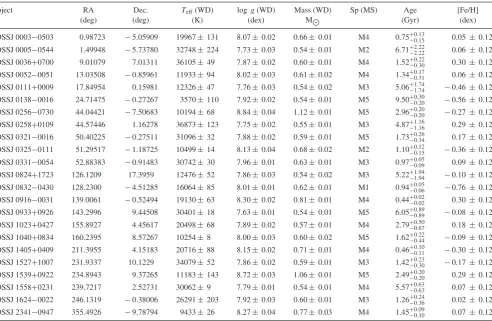
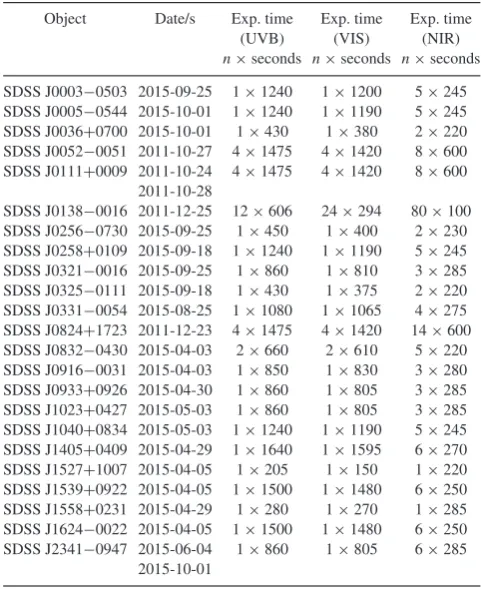
We observed 19 wide WDMS binaries in our sample with the Very Large Telescope at Cerro Paranal (Chile) equipped with the X-Shooter instrument (Vernet et al. 2011) – the target names and coordinates are provided in Table1. X-Shooter takes simultane-ous spectra on three different arms (UVB; 3000–5600 Å, VIS; 5500–10200 Å, NIR; 10200–24800 Å), thus covering the 3000– 24 800 Å wavelength range in one single exposure. We used the 0.9–1 arcsec slits, which resulted in resolving powers of 4350, 7450 and 5300 in the UVB, VIS and NIR arms, respectively. The obser-vations were performed in service mode throughout 2015 and the exposure times were chosen so that the resulting spectra were of a signal-to-noise (SN) ratio of40 in the regions of interest (the Balmer lines in the UVB/VIS and the Na I absorption doublet at 2205/2209 nm in the NIR). A log of the observations is provided in Table2. In the NIR the spectra were observed in stare mode. The data were reduced, wavelength calibrated and flux calibrated with theESOREFLEXX-Shooter pipeline, version 2.6.8. An example of reduced and calibrated spectrum is shown in the left-hand panel of Fig.1.
Three additional wide SDSS WDMS binaries in our sample were previously observed by X-Shooter by some of us in a separate pro-gram, aimed at measuring accurate temperatures for ZZ Ceti WDs in detached WDMS binaries (Pyrzas et al.2015): SDSSJ 0052−0051, SDSSJ 0824+1723 and SDSSJ 0111+0009 (Table1). We reduced these data in the same way as described above.
Finally, we included in our sample the eclipsing SDSS WDMS binary SDSSJ 0138−0016 (Parsons et al.2012) (see Table1), which has also been observed intensively with the X-Shooter instrument. With an orbital period of 1.7 h, this system has certainly evolved through a common envelope phase. However, it contains an ultra-cool WD (3570 K) that allows deriving a robust ultra-cooling age of 9.5 Gyr. We reduced and calibrated the NIR X-Shooter data of SDSSJ 0138−0016 to derive the metallicity of the MS companion.
The X-Shooter spectra of all our targets except
SDSSJ 0325−0111 clearly displayed the WD and MS fea-tures necessary for deriving accurate ages and metallicities (see a description of our method in Section 4). SDSSJ 0325−0111 turned out to be a spatially resolved WDMS binary in the X-Shooter acquisition image for which the X-Shooter spectrum only displayed the MS component, i.e. the WD ended up outside the slit. We identified five additional spatially resolved binaries among our 23 targets as revealed by their X-Shooter acquisition images: SDSSJ 0832−0430, SDSSJ 0933+0926, SDSSJ 1405+0409, SDSSJ 1558+0231 and SDSSJ 2341−0947. This could affect the relative flux contribution of the two stars in the X-Shooter spectra, as the probability exists that they did not both fit fully into the slit. However, as we will show in Section 4, we do not make use of absolute fluxes to derive the ages and metallicities, hence this issue is not expected to affect our results.
4 R E S U LT S
In total we have X-Shooter spectra of 23 wide WDMS binaries. Here we report the spectral analysis performed to derive the WD
Table 1. Names and coordinates of the 23 wide WDMS binaries studied in this work. WD stellar parameters (namely effective temperature,Teff, surface gravity, logg, and mass) and M dwarf spectral types (Sp) obtained fitting the X-Shooter spectra are also provided. WD ages (obtained assuming the initial-to-final mass relation of Catal´an et al.2008) and MS star [Fe/H] values are given in the last two columns. The WD parameters and age of SDSSJ 0138−0016 are taken from Parsons et al. (2012). The WD parameters of SDSSJ 0325−0111 are derived fitting the available SDSS spectrum.
Object RA Dec. Teff(WD) logg(WD) Mass (WD) Sp (MS) Age [Fe/H]
(deg) (deg) (K) (dex) M (Gyr) (dex)
SDSSJ 0003−0503 0.98723 −5.05909 19967±131 8.07± 0.02 0.66±0.01 M4 0.75+−00..1315 0.05±0.12
SDSSJ 0005−0544 1.49948 −5.73780 32748±224 7.73± 0.03 0.54±0.01 M2 6.71+−22..2222 0.06±0.12 SDSSJ 0036+0700 9.01079 7.01311 36105±49 7.87± 0.02 0.60±0.01 M4 1.52+−00..2230 0.30±0.12
SDSSJ 0052−0051 13.03508 −0.85961 11933±94 8.02± 0.03 0.61±0.02 M4 1.34+−00..1731 0.06±0.12
SDSSJ 0111+0009 17.84954 0.15981 12326±47 7.76± 0.03 0.54±0.02 M3 5.06+−11..7474 −0.46±0.12 SDSSJ 0138−0016 24.71475 −0.27267 3570±110 7.92± 0.02 0.54±0.01 M5 9.50+−00..3020 −0.56±0.12
SDSSJ 0256−0730 44.04421 −7.50683 10194±68 8.84± 0.04 1.12±0.01 M5 2.96+−00..2020 −0.27±0.12
SDSSJ 0258+0109 44.57446 1.16278 36873±123 7.75± 0.02 0.55±0.01 M3 4.87+−11..1616 0.29±0.12 SDSSJ 0321−0016 50.40225 −0.27511 31096±32 7.88± 0.02 0.59±0.01 M5 1.73+−00..2634 0.17±0.12
SDSSJ 0325−0111 51.29517 −1.18725 10499±14 8.13± 0.04 0.68±0.02 M2 1.10+−00..1215 −0.36±0.12
SDSSJ 0331−0054 52.88383 −0.91483 30742±30 7.96± 0.01 0.63±0.01 M3 0.97+−00..0509 0.09±0.12
SDSSJ 0824+1723 126.1209 17.3959 12476±52 7.86± 0.03 0.54±0.02 M3 5.22+−11..9494 −0.10±0.12
SDSSJ 0832−0430 128.2300 −4.51285 16064±85 8.01± 0.01 0.62±0.01 M1 0.94+−00..0506 −0.76±0.12
SDSSJ 0916−0031 139.0061 −0.52494 19130±63 8.30± 0.02 0.81±0.01 M4 0.44+−00..0202 0.30±0.12 SDSSJ 0933+0926 143.2996 9.44508 30401±18 7.63± 0.01 0.54±0.01 M5 6.05+−00..8989 −0.08±0.12
SDSSJ 1023+0427 155.8927 4.45617 20498±68 7.89± 0.02 0.57±0.01 M4 2.79+−00..5067 0.18±0.12
SDSSJ 1040+0834 160.2395 8.57267 10254±8 8.00± 0.03 0.60±0.02 M5 1.62+−00..2244 −0.09±0.12
SDSSJ 1405+0409 211.3955 4.15183 20716±88 8.15± 0.02 0.71±0.01 M4 0.46+−00..1011 −0.30±0.12 SDSSJ 1527+1007 231.9337 10.1229 34079±52 7.86± 0.02 0.59±0.01 M3 1.42+−00..2330 −0.17±0.12
SDSSJ 1539+0922 234.8943 9.37265 11183±143 8.72± 0.03 1.06±0.01 M5 2.49+−00..2020 0.29±0.12
SDSSJ 1558+0231 239.7217 2.52731 30062±9 7.79± 0.01 0.54±0.01 M4 5.57+−00..6363 0.07±0.12
SDSSJ 1624−0022 246.1319 −0.38006 26291±203 7.92± 0.03 0.60±0.01 M3 1.26+−00..2436 0.02±0.12 SDSSJ 2341−0947 355.4926 −9.78794 9433±26 8.27± 0.04 0.77±0.03 M4 1.45+−00..0910 0.07±0.12
ages and MS star metallicities together with the AMR derived from this pilot sample.
4.1 WD ages
We used the decomposition/fitting routine outlined by Rebassa-Mansergas et al. (2007) to subtract the MS star contribution from the combined UVB and VIS arm X-Shooter spectra and record the MS star spectral type. We then fitted the normalized Balmer lines of the residual WD spectra (see e.g. in Fig.1, right panel) with the model grid of Koester (2010) considering the 3D corrections by Tremblay et al. (2013), and derived WD effective temperatures and surface gravities. We interpolated these values on the cooling tracks of Renedo et al. (2010) to obtain the WD masses and cooling ages. We then used the initial-to-final mass relation of Catal´an et al. (2008) to derive the WD progenitor masses. Finally, the WD progenitor lifetimes were obtained interpolating the WD progenitor masses in the BASTI isochrones (Pietrinferni et al.2004), for which we adopted the metallicities as derived from the MS companions (see below). The WD cooling ages added to the MS lifetimes of their progenitors gave the total ages of the binaries. The age uncertainties were obtained propagating the WD mass uncertainties resulting from the fits (typical errors were∼0.01M; see Table1). The WD ages are also reported in Table 1. Inspection of Table1 reveals that the age uncertainties increase considerably for decreasing WD masses. This can be explained as follows: the progenitors of low-mass WDs of low-mass<0.57Mare low-mass stars which spend a
long time in the MS. This time spent in the MS is very sensitive to the mass of the star, thus even small errors in the WD progenitor masses translate into rather different ages spent on the MS.
As mentioned in Section 3, the X-Shooter spectrum of SDSSJ 0325−0111 displayed only the features of the MS com-ponent, hence no WD parameters could be measured. Thus, we fitted the available optical SDSS spectrum of this object in the same way as described above to measure the WD stellar parameters and the age.1
This method of calculating total ages as the sum of the WD cool-ing and the MS progenitor lifetimes has been tested uscool-ing WDs in open and globular clusters, with the WD ages derived in this way and those from the MS turn-off of the clusters being very similar (Garc´ıa-Berro et al. 2013; Torres et al.2015). However, it is important to mention that these works employ the theoreti-cal initial-to-final mass relation of Renedo et al. (2010). Although this theoretical relation is virtually identical to the semi-empirical relation from Catal´an et al. (2008) assumed in this work, it is impor-tant to bear in mind that the initial-to-final mass relation for WDs
1All SDSS WDMS binaries studied in this work have available SDSS
1140
A. Rebassa-Mansergas et al.
[image:5.595.306.546.309.493.2]Figure 1. Left panel: example X-Shooter spectrum of SDSSJ 0036+0700, an SDSS WDMS binary in our sample (black; regions dominated by telluric absorption are shown in grey). The WD dominates the flux contribution at blue wavelengths (λ <600 nm), the MS companion contributes most to the red (and near-infrared) part of the spectrum. The best-fitting WD model and MS star template to the observed optical spectrum are shown as blue and red solid lines. On the top right corner we zoom-in to the Na I absorption doublet at 2205/2209 nm (free of telluric absorption), used to derive the MS star [Fe/H] abundance. Right panel: the normalized residual WD Balmer lines (black) that result from substracting the MS star contribution and the best-fitting WD model (blue). The fit provides very accurate values of the WD effective temperature and surface gravity, which are used to calculate the WD masses and total ages of the binaries.
Table 2. Log of the observations. The dates are provided in the second col-umn. The exposure times in each arm are given in the last three columns in the formatn× t, wheren is number of spectra. We average the spec-tra before performing the analysis. The specspec-tra of SDSS J0052−0051, SDSS J0111+0009, SDSS J0138−0016 and SDSS J0824+1723 were ob-tained as part of different programs but were independently reduced and calibrated by us in the same way as our own data (Section 3).
Object Date/s Exp. time Exp. time Exp. time (UVB) (VIS) (NIR)
n×seconds n×seconds n×seconds
SDSS J0003−0503 2015-09-25 1×1240 1×1200 5×245 SDSS J0005−0544 2015-10-01 1×1240 1×1190 5×245 SDSS J0036+0700 2015-10-01 1×430 1×380 2×220 SDSS J0052−0051 2011-10-27 4×1475 4×1420 8×600 SDSS J0111+0009 2011-10-24 4×1475 4×1420 8×600
2011-10-28
SDSS J0138−0016 2011-12-25 12×606 24×294 80×100 SDSS J0256−0730 2015-09-25 1×450 1×400 2×230 SDSS J0258+0109 2015-09-18 1×1240 1×1190 5×245 SDSS J0321−0016 2015-09-25 1×860 1×810 3×285 SDSS J0325−0111 2015-09-18 1×430 1×375 2×220 SDSS J0331−0054 2015-08-25 1×1080 1×1065 4×275 SDSS J0824+1723 2011-12-23 4×1475 4×1420 14×600 SDSS J0832−0430 2015-04-03 2×660 2×610 5×220 SDSS J0916−0031 2015-04-03 1×850 1×830 3×280 SDSS J0933+0926 2015-04-30 1×860 1×805 3×285 SDSS J1023+0427 2015-05-03 1×860 1×805 3×285 SDSS J1040+0834 2015-05-03 1×1240 1×1190 5×245 SDSS J1405+0409 2015-04-29 1×1640 1×1595 6×270 SDSS J1527+1007 2015-04-05 1×205 1×150 1×220 SDSS J1539+0922 2015-04-05 1×1500 1×1480 6×250 SDSS J1558+0231 2015-04-29 1×280 1×270 1×285 SDSS J1624−0022 2015-04-05 1×1500 1×1480 6×250 SDSS J2341−0947 2015-06-04 1×860 1×805 6×285
2015-10-01
remains still rather unconstrained observationally. We hence de-cided to re-derive our ages using two additional (and empirical) initial-to-final relations, namely those presented by Ferrario et al. (2005) and Gesicki et al. (2014). As can be seen in Fig.2, we found
Figure 2. Comparison between the WD ages derived using three different initial-to-final mass relations: the semi-empirical relation of Catal´an et al. (2008) adopted in this work labelled as C2008 (this relation is virtually identical to the theoretical relation of Renedo et al.2010), the empirical relation of Ferrario et al. (2005) (F2005) and the empirical relation of Gesicki et al. (2014) (G2014).
no substantial differences between the ages obtained using these relations and the one from Catal´an et al. (2008).
4.2 Ms star metallicities
Due to selection effects, the SDSS WDMS binary sample is bi-ased towards the detection of low-mass MS companions of spectral type M (Rebassa-Mansergas et al.2010). Several methods exist for measuring M dwarf metallicities (specifically [Fe/H] abundances), either from high-resolution optical (Neves et al.2014) or infrared (Lindgren, Heiter & Seifahrt2016) spectra, or from low/medium resolution infrared spectra such as those obtained in this work (Rojas-Ayala et al.2012; Mann et al.2014; Newton et al.2014). The methods described by Rojas-Ayala et al. (2012) and Mann et al. (2014) make use of semi-empirical relations based on the
[image:5.595.42.283.385.680.2]Figure 3. Upper panel: the age–[Fe/H] relation derived from the 23 SDSS WDMS binaries studied in this work. The ages are obtained assuming the initial-to-final mass relation of Catal´an et al. (2008). Bottom panel: average [Fe/H] values for 1 Gyr bins, together with their standard deviations (σ) for ages derived using the initial-to-final mass relation of Catal´an et al. (2008) – black dots – Ferrario et al. (2005) – cyan squares – and Gesicki et al. (2014) – red triangles. In those cases where only one point falls within the age bin, we assumeσto be 0.12 dex, i.e. the [Fe/H] accuracy of the method we used (Newton et al.2014). The average [Fe/H] values are provided in Table3. Independently of the initial-to-final mass relation used, the average values of [Fe/H] are nearly identical for the 0.5, 1.5 and 2.5 Gyr age bins, and become systematically different for larger ages (see Table3). The observed scatter of [Fe/H] at all ages remains independently of the adopted initial-to-final mass relationship.
equivalent widths of different atomic lines (Ca I and Na I) as well as the H20-K2 index to obtain [Fe/H]. However, deriving the H2 0-K2 index requires measuring the median flux in the 2360–2480 nm range, which is unfortunately dominated by noise in our spectra. Thus, we obtained the [Fe/H] abundances from theK-band, NIR X-Shooter spectra of the M dwarfs (see Fig.1) following the procedure described in Newton et al. (2014). This method provides [Fe/H] fol-lowing a semi-empirical multivariate linear regression based solely on the Na I absorption doublet (2205/2209 nm) equivalent width (EWNa). The Na I doublet has been proven to be a good tracer of metallicity (e.g. Covey et al.2010). Newton et al. (2014) calibrated their metallicity relation using M dwarfs in common proper motion pairs with F, G, K stars and demonstrated that the [Fe/H] values ob-tained in this way are accurate up to 0.12 dex. They also claimed that the relation is well behaved for M dwarfs of spectral types M1–M5, which is the case for all M dwarfs in our observed WDMS binaries (Table1). The validity of the relation of Newton et al. (2014) has been tested by Veyette et al. (2016) using PHOENIX atmospheric models, who concluded that it was appropriate.
In order to measure the EWNa values we corrected the systemic (radial) velocities of the binaries and normalized the flux of each spectrum in the 2194–2220 nm region fitting a third-order spline function. The Na I doublet feature was excluded in the process of normalization. We then used the trapezoidal rule to integrate the flux of absorption doublet within the 2204–2210 nm region. The values of [Fe/H] we derived are listed in Table1.
In the upper panel of Fig.3we display our resulting AMR. In the bottom panel of the same figure we display the average[Fe/H] per 1 Gyr bins along with their standard deviations (σ). These values are also reported in Table3. The AMR derived in this way shows an intrinsic scatter>0.2 dex for most ages, independently
Table 3. [Fe/H] ±σfor 1 Gyr bins. In those cases where only one point falls within the age bin, we assumeσto be 0.12 dex, i.e. the [Fe/H] accuracy of the method we used (Newton et al.2014). The first row indicates the initial-to-final mass relation used for calculating the ages: C2008 (Catal´an et al.2008), F2005 (Ferrario et al.2005) and G2014 (Gesicki et al.2014).
C2008 F2005 G2014
Age bin [Fe/H] σ Age bin [Fe/H] σ Age bin [Fe/H] σ (Gyr) (dex) (dex)
0.5 −0.12 0.42 0.5 −0.11 0.34 0.5 −0.10 0.38 1.5 0.00 0.21 1.5 0.05 0.22 1.5 0.02 0.22 2.5 0.07 0.30 2.5 0.01 0.40 2.5 0.10 0.33 3.5 – – 3.5 0.29 0.12 3.5 −0.14 0.23 4.5 0.29 0.12 4.5 −0.01 0.12 4.5 0.06 0.12 5.5 −0.16 0.27 5.5 – – 5.5 – – 6.5 −0.01 0.10 6.5 −0.46 0.12 6.5 – – 7.5 – – 7.5 −0.08 0.12 7.5 – – 8.5 – – 8.5 0.06 0.12 8.5 – – 9.5 −0.56 0.12 9.5 −0.56 0.12 9.5 −0.56 0.12
of the assumed initial-to-final mass relation. This significant scatter suggests a lack of correlation between the values of [Fe/H] and ages derived from our pilot data set of 23 WDMS systems.
5 D I S C U S S I O N
The existence of an AMR in the solar vicinity has been long dis-cussed. Earlier studies of field stars displayed a trend of decreasing [Fe/H] for increasing ages (Twarog1980; Edvardsson et al.1993). More recently, Rocha-Pinto et al. (2000) and Soubiran et al. (2008) found also a correlation between age and [Fe/H] using chromo-spheric activity to derive the ages of late-type stars and ages derived using isochrones for a sample of giants, respectively. However, re-cent results using mainly a sample of turn-off stars together with isochrone fitting techniques to derive stellar ages show a substantial scatter in the relation as well as a nearly flat distribution for ages younger than∼6–8 Gyr, suggesting there is no correlation between age and metallicity in the solar vicinity (Feltzing, Holmberg & Hurley2001; Holmberg, Nordstr¨om & Andersen2009; Casagrande et al.2011; Haywood et al.2013; Bergemann et al.2014). Using high-resolution spectra of solar twins, Nissen (2015) found also a lack of correlation between [Fe/H] and age over an age interval of 8 Gyr. However, for many of the elements Nissen (2015) found there is a tight correlation between [X/Fe] and stellar age with amplitudes up to∼0.15 dex.
The discrepancies observed in the AMR reported above are most likely due to the difficulty of measuring precise ages for field stars (Soderblom2010). In order to overcome this problem the AMR has been analysed using open clusters (Friel1995; Carraro et al.1998; Pancino et al.2010). These studies support a lack of correlation between age and [Fe/H]. However, it is important to emphasize that the lifetimes of open clusters are generally below 1 Gyr (Vande Putte et al.2010), which makes it difficult to constrain the AMR at intermediate and old ages. Moreover, the current sample of open clusters has not been analysed in a homogeneous way, which would leave these studies inconclusive (Casamiquela et al.2016).
[image:6.595.309.549.111.254.2]1142
A. Rebassa-Mansergas et al.
see Fig.3). Zhao et al. (2011) performed a similar exercise using a sample of 21 wide WDMS binaries mostly containing F-, G-or K-type companions. Their results suggested the existence of a correlation between age and metallicity. However, to derive WD ages they used cooling models (e.g. Wood1995), as well as pre-WD evolutionary times (Iben & Laughlin1989) that were not state-of-the-art.
For young and intermediate ages (8 Gyr), we find that the av-eraged AMR fluctuates between−0.4 and+0.3 dex, but does not show any apparent slope. Although more data are needed to draw more solid conclusions about the slope of the AMR in this region, our observations agree with similar studies (Casagrande et al.2011; Haywood et al. 2013; Bergemann et al. 2014) using sub-giants and turn-off stars. Also, Casagrande et al. (2011), Haywood et al. (2013), and Bergemann et al. (2014) found a decline of [Fe/H] for ages longer than∼8 Gyr. However, our current data do not allow us to confirm, nor discard, this trend of the AMR. Finally, we find an intrinsic scatter of∼0.2 dex in our AMR, a value larger than the nominal observational error on [Fe/H] (0.12 dex). The fact that we observe a large scatter of [Fe/H] for young and intermediate ages, as previously reported in several other observational studies targeting field stars, supports the idea of the methods used for calculating stellar ages (e.g. chromospheric activity, isochrone fitting) being reliable. However, it is noteworthy that differences arise when com-paring individual ages of selected field stars derived using different techniques (Anguiano et al.2010). This makes it difficult to assess which of the employed methods is more reliable.
Our results provide clear additional observational evidence for the existence of a physical mechanism/s that causes the observed scatter of [Fe/H] in the observed AMR in the solar neighbourhood. Several mechanisms have been suggested to explain the scatter observed in the AMR. Among them we mention self-enrichment of gas in star-forming regions (Pilyugin & Edmunds1996), episodic gas in-fall on to the disc (K¨oppen & Hensler2005), or the currently most accepted scenario, invoking radial migration effects – metal-rich stars form in the inner disc and subsequently migrate to the metal-poorer outer disc (Sellwood & Binney2002; Roˇskar et al.2008; Minchev et al.2011). Due to the small WDMS binary sample size we cannot confirm nor discard any of these (or any other) scenarios. Clearly, the analysis of a larger sample will help in settling all these issues.
6 C O N C L U S I O N S
In this work we used WDs in WDMS binaries as tools to test the existence of the AMR in the solar vicinity. The total ages for the WDs were obtained using the most reliable cooling tracks as well as reliable evolutionary times for their progenitors, whereas metallici-ties for MS stars were derived using the most commonly employed techniques. This procedure has allowed us to derive both accurate ages and reliable metallicities in a homogeneous way. Our analysis of a pilot sample of 23 such systems clearly illustrates the lack of correlation between age and [Fe/H] at young and intermediate ages (0–7 Gyr). This result provides robust observational evidence for the existence of a physical mechanism/s that causes the observed scatter of [Fe/H] in the observed AMR.
AC K N OW L E D G E M E N T S
This research has been funded by MINECO grant AYA2014-59084-P, by the AGAUR, by the European Research Council under
the European Union’s Seventh Framework Programme (FP/2007-2013)/ERC Grant Agreement n.320964 (WDTracer), and by the National Key Basic Research Program of China (2014CB845700). BA gratefully acknowledges the financial support of the Australian Research Council through Super Science Fellowship FS110200035. This work is based on observations made with ESO Telescopes at the La Silla Paranal Observatory under programme ID 095.B-0019. It is also based on data products from observations made with ESO Telescopes at the La Silla Paranal Observatory under programmes ID 088.D-0481 and 288.D-5015.
R E F E R E N C E S
Althaus L. G., C´orsico A. H., Isern J., Garc´ıa-Berro E., 2010, A&AR, 18, 471
Anguiano B., Freeman K. C., Steinmetz M., de Boer E. W., 2010, in Block D. L., Freeman K. C., Puerari I., eds, Galaxies and their Masks, in American Astronomical Society Meeting Abstracts Vol. 42 of BAAS, p. 478
Bergemann M. et al., 2014, A&A, 565, A89
Carraro G., Ng Y. K., Portinari L., 1998, MNRAS, 296, 1045
Casagrande L., Sch¨onrich R., Asplund M., Cassisi S., Ram´ırez I., Mel´endez J., Bensby T., Feltzing S., 2011, A&A, 530, A138
Casamiquela L. et al., 2016, MNRAS, 458, 3150
Catal´an S., Isern J., Garc´ıa-Berro E., Ribas I., 2008, MNRAS, 387, 1693 Covey K. R., Lada C. J., Rom´an-Z´u˜niga C., Muench A. A., Forbrich J.,
Ascenso J., 2010, ApJ, 722, 971
Edvardsson B., Andersen J., Gustafsson B., Lambert D. L., Nissen P. E., Tomkin J., 1993, A&A, 275, 101
Farihi J., Hoard D. W., Wachter S., 2010, ApJS, 190, 275 Feltzing S., Holmberg J., Hurley J. R., 2001, A&A, 377, 911
Ferrario L., Wickramasinghe D., Liebert J., Williams K. A., 2005, MNRAS, 361, 1131
Fontaine G., Brassard P., Bergeron P., 2001, PASP, 113, 409 Freeman K., Bland-Hawthorn J., 2002, ARA&A, 40, 487 Friel E. D., 1995, ARA&A, 33, 381
Garc´ıa-Berro E., Torres S., Isern J., Salaris M., C´orsico A. H., Althaus L. G., 2013, Eur. Phys. J. Web Conf., 43, 05003
Gesicki K., Zijlstra A. A., Hajduk M., Szyszka C., 2014, A&A, 566, A48 Haywood M., Di Matteo P., Lehnert M. D., Katz D., G´omez A., 2013, A&A,
560, A109
Holmberg J., Nordstr¨om B., Andersen J., 2009, A&A, 501, 941 Iben I., Jr, Laughlin G., 1989, ApJ, 341, 312
Koester D., 2010, Mem. Soc. Astron. Italiana, 81, 921 K¨oppen J., Hensler G., 2005, A&A, 434, 531
Lindgren S., Heiter U., Seifahrt A., 2016, A&A, 586, A100
Mann A. W., Deacon N. R., Gaidos E., Ansdell M., Brewer J. M., Liu M. C., Magnier E. A., Aller K. M., 2014, AJ, 147, 160
Minchev I., Famaey B., Combes F., Di Matteo P., Mouhcine M., Wozniak H., 2011, A&A, 527, A147
Nebot G´omez-Mor´an A. et al., 2011, A&A, 536, A43
Neves V., Bonfils X., Santos N. C., Delfosse X., Forveille T., Allard F., Udry S., 2014, A&A, 568, A121
Newton E. R., Charbonneau D., Irwin J., Berta-Thompson Z. K., Rojas-Ayala B., Covey K., Lloyd J. P., 2014, AJ, 147, 20
Nissen P. E., 2015, A&A, 579, A52
Nomoto K., Kobayashi C., Tominaga N., 2013, ARA&A, 51, 457 Pancino E., Carrera R., Rossetti E., Gallart C., 2010, A&A, 511, A56 Parsons S. G. et al., 2012, MNRAS, 426, 1950
Pietrinferni A., Cassisi S., Salaris M., Castelli F., 2004, ApJ, 612, 168 Pilyugin L. S., Edmunds M. G., 1996, A&A, 313, 783
Pyrzas S. et al., 2015, MNRAS, 447, 691 Raghavan D. et al., 2010, ApJS, 190, 1
Rebassa-Mansergas A., G¨ansicke B. T., Rodr´ıguez-Gil P., Schreiber M. R., Koester D., 2007, MNRAS, 382, 1377
Rebassa-Mansergas A., G¨ansicke B. T., Schreiber M. R., Koester D., Rodr´ıguez-Gil P., 2010, MNRAS, 402, 620
Rebassa-Mansergas A., Nebot G´omez-Mor´an A., Schreiber M. R., Girven J., G¨ansicke B. T., 2011, MNRAS, 413, 1121
Rebassa-Mansergas A., Ren J. J., Parsons S. G., G¨ansicke B. T., Schreiber M. R., Garc´ıa-Berro E., Liu X.-W., Koester D., 2016, MNRAS, 458, 3808
Renedo I., Althaus L. G., Miller Bertolami M. M., Romero A. D., C´orsico A. H., Rohrmann R. D., Garc´ıa-Berro E., 2010, ApJ, 717, 183 Rocha-Pinto H. J., Maciel W. J., Scalo J., Flynn C., 2000, A&A, 358, 850 Rojas-Ayala B., Covey K. R., Muirhead P. S., Lloyd J. P., 2012, ApJ, 748,
93
Roˇskar R., Debattista V. P., Quinn T. R., Stinson G. S., Wadsley J., 2008, ApJ, 684, L79
Schreiber M. R., G¨ansicke B. T., Southworth J., Schwope A. D., Koester D., 2008, A&A, 484, 441
Sellwood J. A., Binney J. J., 2002, MNRAS, 336, 785 Soderblom D. R., 2010, ARA&A, 48, 581
Soubiran C., Bienaym´e O., Mishenina T. V., Kovtyukh V. V., 2008, A&A, 480, 91
Torres S., Garc´ıa-Berro E., Althaus L. G., Camisassa M. E., 2015, A&A, 581, A90
Tremblay P.-E., Ludwig H.-G., Steffen M., Freytag B., 2013, A&A, 559, A104
Twarog B. A., 1980, ApJ, 242, 242
Vande Putte D., Garnier T. P., Ferreras I., Mignani R. P., Cropper M., 2010, MNRAS, 407, 2109
Vernet J. et al., 2011, A&A, 536, A105
Veyette M. J., Muirhead P. S., Mann A. W., Allard F., 2016, preprint
(arXiv:1605.04904)
Webbink R. F., 2008, in Milone E. F., Leahy D. A., Hobill D. W., eds, Astrophysics and Space Science Library, Vol. 352, Astrophysics and Space Science Library, p. 233
Willems B., Kolb U., 2004, A&A, 419, 1057
Wood M. A., 1995, in Koester D., Werner K. ed., White Dwarfs. Lecture Notes in Physics, Vol. 443. Springer Verlag, Berlin, p. 41
Yuan H., Liu X., Xiang M., Huang Y., Chen B., Wu Y., Hou Y., Zhang Y., 2015, ApJ, 799, 135
Zhao J. K., Oswalt T. D., Rudkin M., Zhao G., Chen Y. Q., 2011, AJ, 141, 107
![Table 3. ⟨[Fe/H]⟩ ± σ for 1 Gyr bins. In those cases where only one pointfalls within the age bin, we assume σ to be 0.12 dex, i.e](https://thumb-us.123doks.com/thumbv2/123dok_us/9479526.454206/6.595.47.286.55.234/table-fe-gyr-bins-cases-pointfalls-age-assume.webp)
