generated by the chemical milling of aluminium air-craft parts. Chemical milling is used to remove metal from aluminium parts, such as curved sections of wing or fuselage that are difRcult to machine with mechanical devices. The part is dip-coated with aRlm of rubber, and then a selected portion of the rubber is stripped away to expose the metal surface. Then the part is immersed in boiling NaOH that rapidly and uniformly dissolves the metal from the exposed sur-face. The dissolved aluminium accumulates in the etch tank as NaAlO2, which must be discarded event-ually. When the NaOH is removed from the solution by dialysis, the NaAlO2 hydrolyses to Al(OH)3 and NaOH. The Al(OH)3 is recovered by Rltration and sold as a pure product, and the released NaOH is returned to the etch tank along with the dialysed NaOH. Dialysis allows recovery of essentially all of the NaOH and completely eliminates the need for disposal of the waste etchant. An industrial installa-tion of base dialysis has been operating
success-fully in a chemical milling plant in California since 1991.
See Colour Plate 48.
Further Reading
Bailey DE (1993) Acid recycling system. US Patent 5 264 123.
Davis TA (1991) Recovery of sodium hydroxide and alumi-nium hydroxide from etching waste. US Patent 5 049 233.
Marshall RD and Storrow JA (1951) Dialysis of caustic soda solutions.Industrial and Engineering Chemistry.
Engineering and Process Development42: 2934}2943. Saddington AW and Julien AP (1938) Dialysis of aqueous
caustic solution. US Patent 2 138 357.
Shigekuni N and Motomura K (1979) Diffusion dialysis method. Japanese Patent 54 136 580.
Zender J (1946) Process and apparatus for dialyzing solu-tions. US Patent 2 411 238.
Donnan Dialysis
T. A. Davis, Annandale, NJ, USA
Copyright^ 2000 Academic Press
Introduction
Donnan dialysis is a separation process that utilizes counterdiffusion of two or more ions through an ion-exchange membrane to achieve a separation. It can also be viewed as a continuous deionization process. For example, water softening can be done with a cation}exchange membrane. Hard waterSows on one side of the membrane, and NaCl brineSows on the other side. Na# ions from the brine diffuse across the membrane and cause the Ca2#
and Mg2#ions to diffuse in the opposite direction.
Donnan dialysis is usually performed as a continuous, countercurrent process so that a substantial portion of a cation from a dilute solution could be concen-trated into a small volume. Differences in the volumes and concentrations of the two solutions can be exploited to achieve some interesting and useful separations.
Donnan dialysis can be used for changing composi-tions of process or analytical solucomposi-tions, pollution con-trol, and even deionization of a process stream. The deionization process, called ‘neutralization dialysis’,
combines Donnan dialysis through both cation-ex-change and anion-excation-ex-change membranes in one appar-atus with H# and OH\ ions exchanging for the cation and anion of a salt.
In the discussions that follow, the fundamental principles of Donnan dialysis will be presented, and some of its applications and capabilities will be described. The type of equipment and membrane arrangements appropriate for both Donnan dialysis and neutralization dialysis will be presented.
Background
initial concentrations were different, counterdiffusion of equal amounts of Na#and K#through the mem-brane produced solutions with equal ratios of Na#/K# on both sides of the membrane at equilibrium. This relationship of concentrations of the ions in the solutions on opposite sides of the membrane is called the ‘Donnan equilibrium’.
Before proceeding with the theory, it is useful to deRne some terms that are often used in discussions of modern polymeric ion-exchange membranes. First, an ‘ion-exchange membrane’ is a plastic Rlm with Rxed ionically charged groups dispersed more or less uniformly within theRlm. Associated with theRxed charges are mobile charges of opposite sign called ‘counterions’. The counterions are free to exchange with other counterions in the adjacent solutions. When the membrane hasRxed negative charges, e.g., sulfonic acid groups, it is called a ‘cation-exchange membrane’, and the counterions are cations. In the external solutions, mobile anions are associated with the cations, but in the membrane the charge balance is satisRed by the Rxed negative charges. Therefore, anions tend to be excluded from the interior of the cation-exchange membrane. The ions with the same charge as theRxed charge in the membrane are called ‘co-ions’.
Theory
The Donnan equilibrium relationship is derived from thermodynamics. Under conditions of equilibrium the chemical potentialiof any dissolved species i is the same in every phase present:
i"3i#RTlnai [1]
Here,3i is the chemical potential of species i in the standard state, R is the gas law constant, T is the absolute temperature, and ai is the activity of the particular chemical species i being considered. How-ever, electrical potentials must also be considered when the chemical species are ionic, so the electro-chemical potential i must be used to describe the equilibrium:
i"3i#RTlnai#ziF [2]
where ziis the ionic charge,F is Faraday’s constant, andis the electrical potential. When the two liquids, phase 1 and phase 2, are at equilibrium with the membrane, there is also equilibrium between the two liquid phases, and the electrochemical potential of any mobile species i in the two phases can be equated.
i1"i2, orRTlnai1#ziF1"RTlnai2#ziF2 [3]
It should be noted that the3i terms cancel because the same standard state exists in both liquid phases. But the co-ions are not free to move through the mem-brane that separates the two liquid phases, so there is no opportunity for their concentrations to change. Whenever salt concentrations on opposite sides of the membrane differ, there will be a potential difference across the membrane caused by the concentration difference. This potential difference, called the ‘Don-nan potential’,EDon, is described by rearrangement of eqn [3]:
EDon"2!1"RT/ziF(lnai1!lnai2)
"RT/Fln(ai1/ai2)1/zi [4]
Since the Donnan potential acts on all mobile ionic species, the value of (ai1/ai2)1/ziis the same for all of the counterions in the system. In other words, the con-centration difference of the co-ions causes an electri-cal potential that acts on the counterions.
As Donnan pointed out in his seminal description of the theory, a precise treatment of the equilibria would require the use of activities rather than concen-trations of ions in the solutions. But the use of molar concentrations greatly simpliRes the presentation of the theory, so that is the approach taken here. For the experiment described by Donnan wherezi"#1 for both Na#and K#ions, the equilibrium written with concentrations would be:
[Na#]1/[Na#]2"[K#]1/[K#]2or [Na#]1/[K#]1
"[Na#]2/[K#]2 [5]
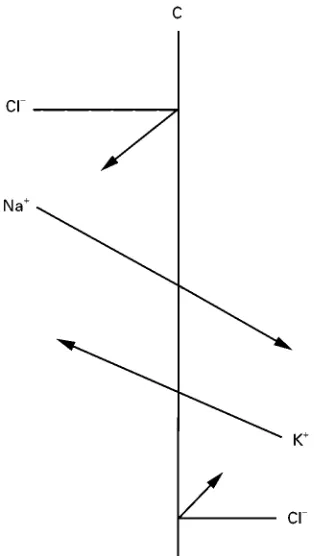
Figure 1illustrates theSow of ions in the approach to Donnan equilibrium. Two dilute salt solutions NaCl and KCl are separated a cation-exchange membrane, labelled C, which is permeable to the cations Na# and K#but impermeable to the common anion Cl\. The concentration difference of Na#ions across the membrane provides a driving force for their diffusion through the membrane. There is no netSow of elec-tric current through the membrane, so any net trans-fer of Na#to the right must be balanced by transfer of an equivalent amount of K# to the left. Those diffusive processes will occur until an equilibrium is established.
Figure 1 Donnan potential forces K> ions to higher concen-tration.
solutions, expressed in litres:
(c1!x/V1)/(x/V1)"(x/V2)/(c2!x/V2) [6] Solving this equation forxyields:
x"c1c2/(c1/V2#c2/V1) [7]
Donnan dialysis is particularly effective for recov-ery or removal of multivalent ions. The Donnan equi-librium for a divalent Ca2#ion and a univalent K#is
described by the equation: ([Ca2#]
1/[Ca2#]2)1/2"[K#]1/[K#]2 [8] For maintenance of electroneutrality in the system, the transport of x moles of Ca2# ions through the
membrane requires the transport of 2x moles of K#ions in the opposite direction. Thus the equilib-rium is described by:
[(c1!x/V1)/(x/V1)]1/2"(2x/V2)/(c2!2x/V2) [9]
For V1"10, V2"1 and initial concentrations of
c1"0.01 andc2"1, the value of x"0.095 is
cal-culated by eqn [9], which means that more than 95% of the calcium would be driven through the mem-brane. The effect of valence is even more dramatic
when thec1/c2ratio is much lower than the value used in this example.
Comparison of Donnan Dialysis with
Conventional Ion Exchange
In many respects Donnan dialysis can be viewed as a continuous ion-exchange process. For instance, both processes can be used for the softening of water. In conventional exchange softening, the ion-exchange resin beads are initially in the Na# form. When hard waterSows through a column of the Na# form resin beads, Ca2# ions in the water exchange
with Na#ions on the resin. When the supply of Na# ions on the resin approaches exhaustion, theSow of hard water is stopped, the resins are regenerated by passing NaCl brine through the column, and then the cycle is repeated. In contrast, water softening with Donnan dialysis is a continuous process. The Na# ions for regeneration are always available in the solu-tion on one side of the membrane, and the Ca2#ions
are continuously removed from the feed stream. Both processes are effective for water softening. Donnan dialysis works best in a situation where a continuous Sow is expected. Softening with a bed of resin beads can easily accommodate variableSow rates or even on/off operation. Since water softening is most often done in situations whereSow ratesSuctuate widely, the use of resin beads rather than membranes is the accepted practice.
If a particular exchange of ions can be accomp-lished by the cyclic process with ion-exchange resin beads or the continuous process with ion-exchange membranes, what factors might inSuence the selec-tion of the membrane process over the convenselec-tional process? Because the membrane process is continu-ous, it operates at steady-state conditions everywhere in the dialyser. In cases where acid or base is used to drive the process, conditions of pH extremes can be avoided more easily with Donnan dialysis than with conventional ion exchange. Compared to mem-branes, ion-exchange beads offers a large surface area in a small volume, so the rates of mass transfer are faster with beads. But that large surface area can be a problem if components of the solution are subject to denaturation at surfaces where pH ex-tremes exist. Donnan dialysis can be a much gentler process.
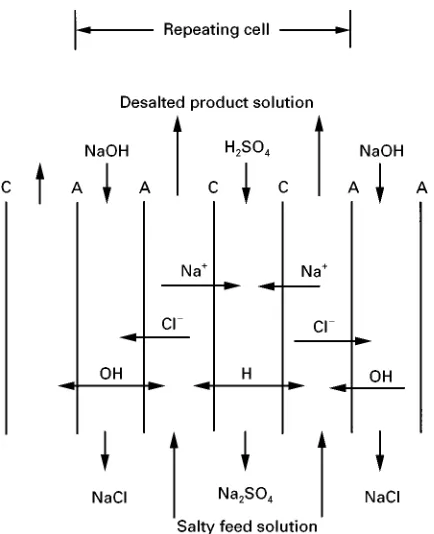
Figure 2 Neutralization dialysis for desalination. C"cation; A"anion.
than it would be in the spent regenerant of an ion-exchange process. However, Donnan dialysis has the advantages that it is continuous and does not require the rinse step after regeneration. If the application is one in which the stripper solution is already available and needs to have the transported ion in it, then the Donnan dialysis can be an advantageous process.
Neutralization Dialysis
Anion- and cation-exchange membranes can be com-bined into a single dialyser where both acid and base drive the transport of the cation and anion of a salt as illustrated in Figure 2. Since the hydrogen and hy-droxyl ions that drive the transport are neutralized in the feed solution, the driving force for desalting can be maintained until almost all of the acid and base are consumed. Neutralization dialysis has been used ef-fectively for desalination of aqueous solutions of or-ganic compounds. Research has demonstrated that the Sux of salt ions increases with acid and base concentration up to about 0.1 M. Above those levels there was little beneRt in raising the acid and base concentrations.
It should be noted from Figure 2 that the mem-brane arrangement in neutralization dialysis is differ-ent from that in electrodialysis. Here there are four membranes in a repeating sequence, two anion-exchange membranes and then two cation-anion-exchange
membranes. It is a fortunate circumstance in neutral-ization dialysis that the acid only contacts cation-exchange membranes, because anion-cation-exchange mem-branes are notoriously leaky to acids. Likewise, the two anion-exchange membranes that bound the base compartments resist leakage of base.
Neutralization dialysis competes with deionization with mixed bed ion-exchange resins which has lower capital cost. But neutralization dialysis has the ad-vantage of being a continuous process that can be controlled by theSow rates and concentrations of the acid and base. Moreover, the feed solution is not exposed to such severe pH extremes as it would be in deionization with ion-exchange resins.
Membranes for Donnan Dialysis
Many ion-exchange membranes are manufactured for electrodialysis, and most of them would be poten-tially useful for Donnan dialysis. In addition, the NaRon Suoropolymer cation-exchange membranes made by DuPont are uniquely suited to Donnan di-alysis because of their ability to withstand severe thermal and chemical attack. Fluoropolymer mem-branes have been used to recover chromic acid, a strong oxidizing agent that attacks hydrocarbon-based membranes. NaRon has been made as small tubules and fabricated into shell-and-tube dialysers.
The preparation of hollowRbres for use in analyti-cal devices was reported in 1981. Low-density poly-ethylene was extruded into 300M i.d., 380M o.d. hollowRbres that were sulfonated with 10% chloro-sulfonic acid in methylene chloride. A bundle of eight hollow Rbres was inserted into a coiled tube and sealed with silicone rubber caulk.
Japanese researchers have made cation exchange membranes, speciRcally selective to the transport of uranyl ions, by forming a copolymer of 2,3-epithio-propyl methacrylate and 2-acrylamide-2-methyl-propanesulfonic acid. They observed that the propor-tions of the monomers had a great effect on the ability of the membranes to transport uranyl ions. High transport was achieved when the 2-acrylamide-2-methylpropanesulfonic acid content was at least 34%, but very low transport occurred when that monomer comprised less than 21% of the membrane. By contrast, they found that the Selemion DLE mem-brane did not transport the uranyl ions under the same experimental conditions. The same researchers also made anion-exchange membranes of 2,3-epithiopropyl methacrylate}dodecyl methacrylate} methylacrylamide propyltrimethylammonium chlor-ide terpolymer that selectively transported ferric oxalate complex anions from acidic ferric sulfate solution to a receiving solution containing sodium oxalate. These studies suggest that the development of ion-speciRc membranes could lead to selective sep-arations by Donnan dialysis that cannot be economi-cally achieved by other methods.
The amount of membrane area required for a par-ticular Donnan dialysis application depends on the mass transfer rates that can be achieved. However, the user should be cautious about relying upon mass transfer data obtained in stirred cells to design indus-trial systems, because the high shear rates obtained by stirring might not be achieved in a commerical dialy-ser. Results reported for Donnan dialysis of uranyl ions in a countercurrent dialyzer should offer realistic mass transfer coefRcients for design purposes. AM-Fion C-103 cation-exchange membranes separated solutions of 0.01 M UO2(NO3)2and 2 M HNO3. The solution compartments between the membranes were formed with 0.38-mm-thick woven screens of stain-less steel. Uranyl ion Suxes were about 9;10\10mol cm\2s\1. The treatment rate was about 3 L h\1m\2, and 96% of the UO
2(NO3)2was recovered.
Apparatus
The equipment used for Donnan dialysis is similar to that used for dialysis and diffusion dialysis. Mem-brane shapes include sheets, tubes, and hollowRbres. Sheet membranes have been fabricated into spiral-wound devices, but the dominant conRguration for Sat membranes is the plate-and-frame arrangement used in electrodialysis. Thus any supplier of elec-trodialysis equipment is a potential supplier of stacks for Donnan dialysis. Since the major resistance to transport usually lies in the boundary layer of the
dilute solution, equipment designers strive to achieve high shear in the feed solution. There is a major advantage to countercurrent Sow of the feed and stripper solutions, because that conRguration leads to maximum driving forces and maximum total transfer of the desired ions.
In a commercial dialyser, the simultaneous achieve-ment of both high shear and countercurrentSow is difRcult. High shear can be achieved by rapid stirring or by highSow rates, but the beneRts of countercur-rentSow can only be achieved if the residence time in the device is sufRcient for a large fraction of the desired ion to be transferred through the membrane. As discussed below, studies of the effects of solution velocity on mass transfer rates show correlation with Vn where the exponent n is always less than unity.
This means that increasing the solution velocity through a dialyser of a given length always results in a smaller fraction of the solute being transferred through the membrane. Therefore, an increase in solution velocity requires an increase in path length to achieve the same fraction of transfer. (ThisVn
rela-tionship also applies to dialysis, diffusion dialysis, and electrodialysis.)
Process Design and Control
Most often the objective of Donnan dialysis is to both recover a target ionic species from a feed solution and raise its concentration. An increase in the concentra-tion is achieved by the use of a small volume of a stripper solution with a diffusing ionic species that is higher in concentration than that of the target ionic species in the feed. A strip solution of about 1 M might be used with a typical 0.001 M feed solution. One might expect that a more concentrated strip solution would recover the target ionic species at a higher concentration, but stripper concentrations higher than 1 M do not seem to be beneRcial. More concentrated strip solutions lead to osmotic dehydra-tion of the gel structure of the membrane which reduces membrane permeability. Moreover, co-ion transport due to reduced Donnan exclusion at the higher concentrations allows loss of solutes from the receiving solution across the membrane, and osmotic transport of water through the membrane dilutes the strip solution.
The effects of hydrodynamics on mass transfer rates in Donnan dialysis have been studied by several researchers who correlated the data using the stan-dard equation Sh"kScmRen. The Sherwood number
Sh"KD/h, Schmidt number Sc"/D, and
Table 1 Dimensionless parameters for correlation of mass
transfer rates in Donnan dialysis through Nafion
Cation Strip acid k m n
Cu2# H
2SO4 0.48 0.33 0.28
Ni2# H
2SO4 0.166 0.33 0.475
Na#, K# HNO
[image:6.568.299.509.425.683.2]3 0.201 0.4 0.62
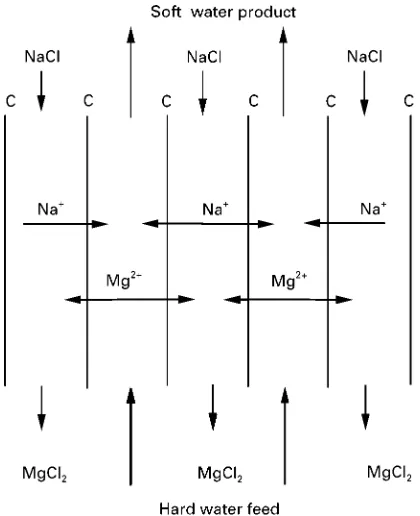
Figure 3Donnan dialysis removes Mg2#ions from hard water. C"cation.
the characteristic thickness or diameter of the con-duit, is the solution viscosity, is speciRc gravity, andVis solution velocity. The coefRcientk, and the exponentsmandnare used to correlate the data. The results of three studies are shown in Table 1, and some comments about the experiments follow.
Studies with CuSO4and NiSO4were done with the feed Sowing inside a Suoropolymer membrane tube a few millimetres in diameter and with H2SO4stripper Sowing outside the tube. The correlation parameters apply to Re(1000. The following observations were made in the studies with CuSO4and NiSO4. Increasing the stripper concentration from 1 to 5 M did not improve mass transfer. Increasing the solution velocity of the stripper solution produced minor increases in mass transfer. The mass transfer rate was propor-tional to the metal ion concentration in the feed for concentrations below 2000 mg L\1 and Re(1000. Studies of NaNO3and KNO3feeds with HNO3 strip-ping were done with aSat sheetSuoropolymer mem-brane in a stirred cell with 15'Re'400.
Since theSow rates in Donnan dialysis are normally rather low, one must be concerned with convective Sow in the dialyser caused by density changes in the solutions as their compositions change. The use of excessively high acid concentrations in the stripper exacerbates the problem of changing densities. Osmo-tic transport of water into the acid stripper solution at the top of the solution compartment can cause sub-stantial dilution of the acid, and the resulting density decrease allows the denser incoming stripper to stream downward through the diluted acid. The problem can be alleviated by mild pulsation of the solution at the top of the stripper side to improve mixing.
Applications
Although many industrial applications have been demonstrated in the laboratory and at the pilot scale, there appear to have been few industrial-scale ap-plications of Donnan dialysis. Industrial apap-plications have been mainly in recovering heavy metals from rinse waters of metal-Rnishing operations. One of the few descriptions of an industrial installation reports results of an experimental evaluation of a DuPont-made NaRonhollow-Rbre dialyser for metal
recov-ery from rinse water in a Watts nickel electroplating process with 1 M H2SO4as the stripper. With typical feed concentrations of up to 1 g L\1, Ni2# Suxes
exceeded 20 g h\1m\2and the recovered Ni concen-tration exceeded 30 g L\1.
An early application of Donnan dialysis with poly-meric ion-exchange membranes was described in 1967. Multiple AMFion C-103C cation-exchange membranes were assembled in a plate-and-frame di-alyser with solution compartments arranged so that the feed and strip streams couldSow in a pattern that was countercurrent overall. This apparatus was used to recover UO2(NO3)2 from a 0.01 M feed to aRnal concentration of 0.28 M with 2 M HNO3as the strip-per and to 0.46 M with 2 M H2SO4as the stripper. He also used a Donnan dialyser with AMFion A-104B anion-exchange membranes to remove acid from the UO2(NO3)2feed to improve the driving force for cation transport. Complexing agents, EDTA and DPTA, were used as strippers to separate Ag# and Cu2#ions. The Cu2#ions formed such strong
com-plexes that the free Cu2# ion concentration in the
stripper was low enough to maintain a driving force until virtually all of the Cu2# ions were transported
across the membrane.
The use of Donnan dialysis for water softening was reported in 1970. The process is illustrated in
brine causes a driving force for transport of Mg2#
ions from the feed into the brine. Countercurrent operation allows the large driving force to be main-tained over the length of the membrane.
A hollow-Rbre device has been used as a suppressor for ion chromatography. Compared to an ion-ex-change column that is normally used to suppress conductance in the eluant, Donnan dialysis allowed more control over the conductivity and eliminated the need to regenerate the resins. Moreover, the resolution was improved by the use of Donnan dialysis.
The use of neutralization dialysis for desalination of cheese whey has been described.
Conclusion
Donnan dialysis can be used in many applications where ion-exchange beads are currently applied. The process mightRnd a niche in water softening in a ca-pacity range between that of home water softeners and the large-scale lime-soda softeners. Capital costs are higher for membranes than for resin beads, but the use of membranes offers the advantages of steady-state operation without the need for rinse-down, which produces large volumes of water that must be discarded. The capital cost of small-scale Donnan dialysis could be reduced by the availability of more ion-exchange membranes in hollow-Rbre form that could be assembled into compact modules.
Further Reading
Bleha M and Tishchenko GA (1992) Neutralization dialysis for desalination. Journal of Membrane Science 73: 305}311.
Davis TA, Wu JS and Baker BL (1971) Use of the Donnan equilibrium principle to concentrate uranyl ions by an ion-exchange membrane process.AIChE Journal17(4): 1006}1008.
Donnan FG (1924) The theory of membrane equilibria.
Chemical Reviews1(1): 73}90.
Grot WG (1986) Ion Exchange Process and Apparatus. U.S. Patent 4,591,439.
Ng PK and Snyder DD (1981) Mass transport character-istics of Donnan dialysis: the nickel sulfate system.
Journal of the Electrochemical Society 128(8): 1714}1719.
Ng PK and Snyder DD (1983) Uranyl nitrate and nitric acid. Combined electrodialysis and dialysis for regenera-tion of chromic acid etching soluregenera-tion.Journal of Mem-brane Science13: 327}336.
Nonaka T, Ogawa H, Morikawa M and Egawa H (1992) Uphill and selective transport of uranyl ions through 2,3-epithiopropyl methacrylate-2-acrylamide-2-methyl propanesulfonic acid copolymer membranes.Journal of Applied Polymer Science45: 285}292.
Nonaka T and Fujita K (1998) Transport of ferric ions through 2,3-epithiopropyl methacrylate}dodecyl meth-acrylate}methylacrylamide propyltrimethylammonium chloride terpolymer membranes.Journal of Membrane Science144: 187}195.
Roach ET (1985) Evaluation of Donnan Dialysis for Treatment of Nickel Plating Rinse Water. Final Report to U.S. Environmental Protection Agency, NTIS PB85-200046.
Stevens TS and Davis JC (1981) HollowRber ion-exchange suppressor for ion chromatography.Analytical Chem-istry53: 1488}1492.
Wallace RM (1967) Concentration and separation of ions by Donnan membrane equilibrium.Industrial and En-gineering Chemistry,Process Design and Development
6(4): 423}431.
Electrodialysis
H. Strathmann, University of Twente, The Netherlands
Copyright^ 2000 Academic Press
Electrodialysis is a process in which ion exchange membranes in combination with an electrical poten-tial difference are used to remove ionic species from an aqueous solution. The large scale industrial utilization of the process began about 30 years ago with the development of highly selective ion exchange membranes of low electric resistance arranged in a multicell stack.
Until the mid 1970s electrodialysis stacks were operated in a unidirectional mode, that is, the
polar-ity of the electrodes was Rxed. A signiRcant step towards the efRcient application of electrodialy-sis was the introduction of a new mode of operation referred to as electrodialysis reversal. In this operat-ing mode the Sow streams and the polarity in an electrodialysis stack are periodically reversed, which reduces membrane fouling and scaling. Costly and time-consuming membrane cleaning procedures are then unnecessary.