Behavioural Equivalences for Web Services
Thesis submitted to the University of Dublin towards the degree of Doctor of Philosophy
July 2013
Declaration
This thesis has not been submitted as an exercise for a degree at this or any other university. It is entirely the candidate’s own work. The candidate agrees that the Li-brary may lend or copy the thesis upon request. This permission covers only single copies made for study pur-poses, subject to normal conditions of acknowledgement.
Antonius Block: I want knowledge! Not faith, not assumptions, but knowledge. — Ingmar Bergman,The Seventh Seal
To reduce a romantic ideal to a working plan is a very difficult thing.
Summary
This thesis is afoundationaland systematicinvestigation of the principles which ensure that a piece of communicating software can be replaced by another piece of communicating software, without hindering the operations of the pre-existing system.
By “foundational” we mean that our approach is mathematical; we define in formal terms notions such as “system correctness” and “safe software replacement”, thereby providing reasoning techniques (i.e. proof methods) for the notions themselves.
By “systematic” we mean that our results lay bare the principles which allow the replacement of software in all the roles it can take: servers, clients and peers.
The investigation presented in this thesis stems from practical questions, such as the following: Q1) if the clientris satisfied by the server p1, what relation betweenp1 and a serverp2 guarantees
that p2 satisfiesr?
Q2) if the serverpsatisfies the clientr1, what relation betweenr1 and a clientr2 guarantees thatp satisfiesr2?
Q3) if the peer p1 satisfies and is satisfied by the peer q, what relation between p1 and a peer p2 guarantees thatp2satisfies and is satisfied by q?
The questions above are motivated by the practice of software maintenance; as they stand, though, they are rather vague, and a priori it is clear neither what they really mean, nor how to answer them. Our foundational approach allows us to formulate the precise meaning of the questions above, and to answer them.
The contributions of this thesis are the following:
• we enrich the standard testing theory of [De Nicola and Hennessy, 1984] with new pre-orders, one for clients and one for peers, and present their behavioural characterisations (Theorem 4.2.37, Theorem 4.3.17);
• we introduce a compliance relation inspired to [Castagna et al., 2009; Laneve and Padovani, 2007], the pre-orders that arise from it, respectively for servers, clients, and peers; and we present the behavioural characterisations of these pre-orders (Theorem 5.1.15, Theorem 5.2.25, Theorem 5.3.26);
• we show a fully abstract model of the sub-typing `a la [Gay and Hole, 2005] on first-order session types (Theorem 6.3.4). We define the model in two alternative ways, one uses to the testing theory, and one uses to the compliance theory (Proposition 6.5.19). The model justifies and explains in behavioural terms the sub-typing relation;
Contents
Acknowledgements xi
1 Introduction 1
1.1 Must theory . . . 6
1.2 Compliance theory . . . 7
1.3 Session types . . . 8
1.4 Contributions . . . 12
I
First-order theories
15
2 First-order languages 17 2.1 The session type language . . . 172.1.1 Sub-typing . . . 21
2.2 Processes . . . 24
2.3 Session Contracts . . . 25
2.4 Related Work . . . 30
3 Client and peer satisfaction 31 3.1 Must testing . . . 32
3.2 Compliance relation . . . 34
3.2.1 Comparing satisfactions . . . 37
3.3 Syntactic characterisations . . . 38
3.3.1 Syntactic compliance . . . 38
3.3.2 Syntacticmusttesting . . . 43
3.4 Related Work . . . 48
4 Must pre-orders 51 4.1 Server pre-order . . . 52
4.2 Client pre-order . . . 63
4.3 Peer pre-order . . . 83
4.3.1 Relations between notions and pre-orders . . . 92
4.4 Related Work . . . 94
5 Compliance pre-orders 97 5.1 Server pre-order . . . 98
5.1.1 Server pre-orders on restricted LTSs . . . 107
5.2 Client pre-order . . . 110
5.2.1 Comparison with other pre-orders . . . 121
5.3 Peer pre-order . . . 122
6 Modelling first-order session types 133
6.1 Restricted server pre-order . . . 135
6.2 Restricted must client pre-order . . . 140
6.3 A behavioural model of first-order sub-typing . . . 145
6.3.1 Examples and applications . . . 148
6.4 Revisiting the restricted server pre-order . . . 150
6.5 Restricted compliance client pre-order . . . 152
6.6 Related Work . . . 159
II
Higher-order theories
163
7 Higher-Order Languages 165 7.1 Session types . . . 1667.2 Session Contracts . . . 169
7.2.1 Dependent compliance relations . . . 172
7.2.2 Dependent duality . . . 174
7.3 Transitive closures . . . 175
7.4 Related Work . . . 176
8 Modelling higher-order session-types 179 8.1 Client pre-orders . . . 180
8.1.1 Syntactic client pre-orders and transitivity . . . 183
8.2 Server pre-orders . . . 186
8.3 Client and server pre-orders . . . 188
8.4 A behavioural model of sub-typing . . . 192
8.5 Related Work . . . 194
9 Ongoing work: session contracts as types 197 9.1 Pi-calculus with session contracts . . . 197
9.1.1 Runtime errors . . . 199
9.2 Type system . . . 201
9.2.1 Conjectures . . . 207
10 Literature Review 211 11 Conclusion 219 11.1 Summary . . . 219
11.2 Open questions . . . 220 A A complete lattice of pre-orders on higher-order session contracts 223
B Necessary and sufficient conditions 227
C Monotone functionals 235
References 237
Result Index 243
Acknowledgements
My supervisor Matthew Hennessy is the person that during my PhD has influenced me most, both from a technical standpoint and a human standpoint. Matthew has incessantly given to me all the advices and explanations that I needed, and he has displayed an everlasting patience by listening to my ideas. He has also been my most constructive critic. I thank Matthew for all these things; I am grateful to have been one of his students.
One of the most remarkable people that I have met in Trinity is Vasileios Koutavas. I thank him for the time that he has spent discussing technical matters with me, and for all the pictures of the board that he has taken. His keen observations and his cheerful demeanour kept me motivated throughout the second half of my PhD, and helped me rearrange some thoughts.
As to my fellow PhD students, I thank Andrea Cerone, Colm Bhandal, and Carlo Spaccasassi. Andrea welcomed me in the fair city, and introduced me to its jolly social life. Colm and his thoughts out of the box secured us from boredom, making the office a lively place, and letting us forget the gloomy environment. Carlo supplied the office with an everlasting stock of fine coffee, and an even better mood.
I wish to thank my examiners, Andrew Butterfield and Simon Gay. Their careful review of this thesis helped in improving it, and lead to many engaging questions during my viva.
Many people filled my PhD years with good memories.
I thank the “Sunday brunch bunch”: Francesco Caiazza, Florence De Filippis, and Silvia Taddei. They made me face many rainy, gray, and windy Mondays with a smile.
I thank Brendan Dunne, Paul Hynds, Anna Madden, Andres Mori, Heather Quinn, and Carlos Rodriguez. They have been an endless source of wit, wisdom, and have provided subjects for discussion aplenty. The climbing trip to Sardinia has been a turning point in my life, and I am glad that some of these fine fellows were there, and began sharing their ideas with me; let alone mirth and mirto. Also, it is a great pleasure to be still in the position of thanking all of them for having saved my life ever so often.
The regular escapades to Fontainebleau have been a panacea for the mood. This is true also because of Fran¸coise and Bernard at the Gˆıtes des Jonquilles. Their dog Leo helped as well, for he always cheered me up, even after the most unsuccessful climbing days.
As a matter of fact, I happened to stay often in France, and not just around Fontainebleau. For this I have to thank Marion Lam´e, Federico Ulliana, H´el`ene De Pooter, and Christophe Barnier. They have been very kind, and have proven to be good companions of chats and thoughts. I can hardly count the times they hosted me, but for sure I recall the fun we had in Paris, and, with Christophe, around Hy`eres. I thank Federico also for his providential rescue at the end of a most peculiar soir´ee. Ringrazio Alessia, che oltre ad avermi definitivamente svegliato da un certo sonno dogmatico, ha deciso di unire le forze con me. Speriamo di farcela.
Ringrazio Gina e Antonio, per quello che hanno fatto, e perch`e, nonostante tutto, mandano avanti il campo base in modo egregio.
Menzione d’onore ad Antonio Bazzo; nella speranza che nella diaspora non lo abbia fatto sentire distante.
Giovanni Bernardi, Dublin, July 4, 2013
Chapter 1
Introduction
Software that relies on the Internet pervades our lives. To check e-mails, read the news on the web, interact with people on social networks, buy items on-line, look for information on wikipedia, these are almost daily routines for many of us. At present even the political life of countries can be influenced by the discussions that take place via the World Wide Web [Grillo, 2013; Hauslohner, 2011; Woodward, 2011].
Much of the computations that let us carry out the above activities amount to a series of commu-nications betweentwosoftware systems:
• to browse the web we use clients that interact with httpservers
• to read e-mails we use clients that interact withpop/imapservers
• to call a friend over the Internet, our friend and us use programs that implementsVoIP
Two scenarios emerge from the examples above, the communication takes place between a client and a server, or between two peers. In a client/server setting the overall aim of the communication is to satisfy the client. In a peer to peer setting the aim is to satisfyboth communicating parties.
The programs mentioned in the example list above follow communication protocols that are com-pletely independent from each other; consider for instance the pop3 and the http protocols. A consequence is that different programs have to be used to avail of different communication protocols. The widespread adoption of the World Wide Web has lead to a general consensus on the technolo-gies and the languages that underpin it, such as XML, CSS, javascript, and http. In turn, this has lead to a shift of paradigm in the development of applications: today much of the activities listed in our initial example can be carried out within a web browser, rather than requiring stand-alone ap-plications. Via the World Wide Web, major IT companies offer to their users services such as e-mail boxes, programs to chat, and even simple office programs. In this setting web technologies provide the backbone for the deployment of the applications, and the protocols other than thehttpare used only by the servers that provide the services.
These facts give an intuition of what web-services are. According to [w3c, 2004],
A Web-service is a software system identified by a URI [RFC 2396], whose public interfaces and bindings are defined and described using XML. Its definition can be discovered by other software systems. These systems may then interact with the Web-service in a manner prescribed by its definition, using XML based messages conveyed by Internet protocols. Web-services depend on standard and widespread web technologies such as XML. This feature is meant to help integrate the middlewares and information systems of companies connected via a network, thereby facilitating the business to business (b2b) activities. If a company runs a servicep,
and another company runs a program rthat needspto work, then via a network and thanks to the standard format of the messages,rcan interact withp, and the two programs can cooperate.
Also web-services forb2bfall into the client/server and the peer to peer scenarios that we described earlier on.
From now on we disregard the technological details and the particular aim of software, and focus only on the fundamental aspects that characterise clients, servers, peers and their correctness.
Let us think of “systems” as compositions of two programs randpthat interact with each other; we write r || p to denote the concurrent execution of the programs r and p. The systems that we normally use are correct, in the sense that when we let clients interact with servers, the clients are in some sense satisfied; and similarly for peers. The situation is analogous for companies and the services that they offer. The meaning of “correctness” of a software system, or of “satisfaction” is not clear a priori. If we want to test software, our tests are satisfied if they are passed. If we want to browse the web, the client that we use is satisfied if all its requests are answered by some web server. If we chat with a friend via a network, our programs are satisfied as long as they can keep on interacting.
It is not easy to understand when a piece of software can be changed without breaking the cor-rectness of a system. For instance, suppose that a client r1 is satisfied by a server p, that isr1 ||p1 is a correct system. If we were to replace a client r1 with a client r2 would the new system still be correct? In particular,
(Q1) what is the relation betweenr1andr2 which guarantees that r2 is satisfied byp?
We have also the dual question, ifr||p1is a correct system, and we were to replacep1with a serverp2 how could we tell whetherrwould still be satisfied? That is
(Q2) what is the relation betweenp1 andp2which guarantees that p2 satisfiesr?
If we deal with peers, then the question becomes symmetric; ifp1||qis a correct system of peers, and we want to replace p1 withp2, then
(Q3) what is the relation betweenp1andp2which guarantees that p2satisfiesqand thatqsatisfiesp2? The practice of software maintenance shows that the questions above are not mere theoretical speculation. For instance, the e-mail service of Google, Gmail, underwent a failure on the 31st of April, 2011. [Treynor, 2011] commented on the officialGmailblog as follows,
So what caused this problem? We released a storage software update that introduced the unexpected bug, which caused 0.02% of Gmail users to temporarily lose access to their email. When we discovered the problem, we immediately stopped the deployment of the new software and reverted to the old version.
In December 2012 the same e-mail service was hampered again, by a problem traced down to a bug in a routine update to the load balancing software.
As for web-services and the b2b scenarios, similar issues have taken place. On the 29th of June 2012,Amazonweb-services,AWS, underwent a service disruption. The [AWSTeam, 2012] explains in great detail what happened. One problem was due to software,
[. . . ] a small number of Multi-AZ RDS1 instances did not complete failover, due to a software bug. The bug was introduced in April when we made changes to the way we handle storage failure. It is only manifested when a certain sequence of communication failure is experienced, situations we saw during this event as a variety of server shutdown sequences occurred.
3
Both explanations remark that the issues in the software systems were due to software updates. The explanation provided by Amazon also lay bare that their problem was due to the communication sequence that the software engaged in.
These facts highlight the importance of having means to guarantee that software update can take place without hampering the existing communication patterns, and without introducing unexpected communication patterns that may disrupt the operations of a software system.
This thesis is asystematicinvestigation of five theories that let us answer the questions on software replacement that we posed earlier, (Q1), (Q2), and (Q3). By “systematic” we mean that our results lay bare the principles which allow the replacement of software in all the roles it can take: servers, clients and peers.
The aim of this thesis is largelyfoundational; we want to state in a mathematical and rigorous way what it means for a software system to be correct, and understand when a programpcan be replaced by a programqkeeping the system correct. In our thinking we focus on the characteristic features of software interaction, inputs and output operations, and we abstract away from minor details.
Our foundational approach sheds light on the design of software. To answer rigorously the questions (Q1), (Q2), and (Q3), we will have to put forth a series of mathematical notions; these notions give us design principles to write software that does not invalidate the correctness of existing systems. The design principles are correct by virtue of the mathematical treatment that they emerge from.
Our mathematical reasoning is based on set theory; we will use relations on programs, denoted bySandv, to mean that it is safe to run the clientrwith the serverp,rSp; and that if we replacep1 withp2in a correct system r||p1, then the new systemr||p2is still correct; this is denotedp1vp2. We have argued that there are different ways to think of the satisfaction of clients, and of the correctness of software systems. Thinking in terms of sets and relations, this means that we can define many relationsS on programs, to express some notion of satisfaction. As different relations
S1,S2,S2, . . .are of interest, different theories have to be investigated.
The main objects of our study are not the relations to express the satisfaction of a program. Rather, our efforts are devoted towards the understanding of the refinement relations that arise from the satisfaction relations that we pick. Let us fix a relation S, and write pvsvr q if r S pimplies thatrS q. The relationvsvrthat we obtain tells us when a serverqcan replace a serverpwithout hindering the correctness of a systemr||p. The relationvsvrembodies a principle to replaceservers. In similar ways we can define refinements for clients and for peers, so as to obtain three relations,
vsvr, vclt, vp2p
It is necessary to study all the pre-orders above. Suppose we studied only how to safely replace servers, that is vsvr, and not how to safely replace clients. Then the correctness of a system could be hampered by replacing the clients. The study ofvclt solves the problem; and similarly does the study ofvp2p for the peer to peer scenario.
The properties of the relations above depend on the notion of satisfactionS that generated them. One may wish the pre-orders to enjoy some particular properties. For instance, if two servers are related, saypvsvrq, then qmay offer to the clients more choices thanp. This property is known as “width extension” [Laneve and Padovani, 2007].
We give a more concrete example. Let ATMA denote a cash machine that allows us withdraw
cash, and then starts again,
ATMA=?withdraw.ATMA
and letATMB be a similar cash machine that allows us also to top-up mobile phones,
ATMA
?withdraw
ATMB
?withdraw
?topup
Figure 1.1: Two cash machines
Intuitively, the equalities above define two programs; the symbols ?withdraw and ?phone stand for interactions that the programs can perform with the environment. The symbol + in the definition ofATMB represents a choice,ATMB lets the environment decide which interaction to perform. The
syntax ?withdraw.ATMBmeans that after the interaction ?withdrawthe program behaves accordingly
to the definition of ATMB. The behaviours of the programs ATMA and ATMB are sketched in
Figure 1.1.
One could argue thatATMB is in some sense better than ATMA, in thatATMB satisfies all the
customers satisfied byATMA, and it also offers them more choices. So, once we have fixed a notion
of satisfactionS, we may wish that the following be true,
ATMAvsvrATMB
In general, this may or may not be the case; that is the refinement for servers given by a particularS
may or may not allow the inequality above.
If a refinement vsvr generated by a relationS does not enjoy a certain property, and we cannot change S, then other ways to vary vsvr have to be investigated. For example, a relation for satis-faction S can give rise to many different refinements for servers, clients and peers; the properties of these pre-orders depends on the language used to write programs. This introduces yet another reason to study different theories.
In this thesis we we investigate five theories. Rather than putting forth new formalisms, we examine existing ideas and deepen our understanding of them, shedding light on their implications and on the connections between them. Two theories that we investigate are due to two notions of satisfaction applied to the same general language, the well known CCS without τ’sof [De Nicola and Hennessy, 1987]. The other theories are given by applying the same notions of satisfaction to the more restrictive language ofsession contracts [Bernardi and Hennessy, 2012].
Before describing the theories that we will be concerned with, we explain how we think of interac-tions between programs.
To formalise the sequence of operations (i.e. interactions) that a program performs, we use graphs such as the ones in Figure 1.2. In that figure, the graph at the top describes a programrthat inputs two values, an integer and a boolean, and then is in a successful state, (i.e. it can perform X). Graphs such as the ones in Figure 1.2 describe the operationalsemantics of software, and they are referred to aslabelled transition systems, LTS. An LTS contains the states that a program can be in, and the transitions that lead from one state to another. The transitions are usually depicted as arrows, and are decorated with a label. Labels describe the interactions that make a program change states; that is, they explainwhya program changes state. For instance, the fact that the programrFigure 1.2 is willing to input an integer, thereby moving to stater1is represented by the following transition:
5
r r1 1 0
q
?Int ?Bool X
[image:19.595.96.541.236.379.2]τ
Figure 1.2: A program that succeeds after the input of an integer and of a boolean; and a program that loops forever
p1 p2 p3 p4
q1 q2 q3 q4
?Int ?Int
τ
!Bool
?Int ?Int !Bool
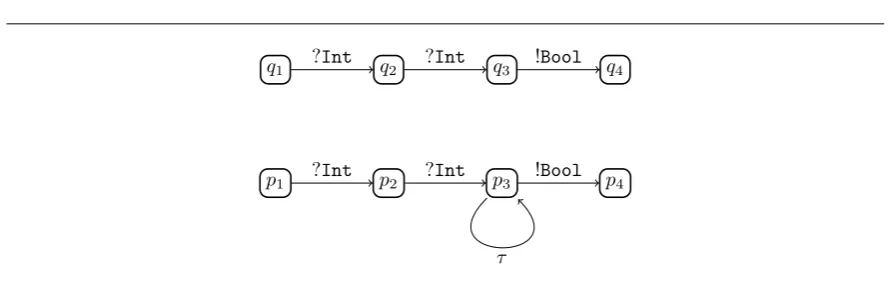
Figure 1.3: Two programs that interact according to the sequence ?Int?Int!Bool
Intuitively, interactions between r and a programq take place when we execute them concurrently, denotedr||p, and each input/output operation of one program is matched by aco-actionperformed by the other program. For instance, let the operations ofpbe described by the following LTS
p !Int 0
The action !Intrepresents the output of an integer, and it is a co-action of ?Int.
The programpis willing to output an integer, and then perform no other operations. According to the intuitions we have described, the parallel compositionr||pperforms one interaction, denotedr|| p−→τ r1||0, and then becomes stable; the system cannot proceed further.
The bottom graph in Figure 1.2 describes a programqthat performs only one transition, labelled byτ. That transition represents a computation that takes place inside ofq, and that the environment has no power over. Since the τ action represents internal computation, the program q performs an infinite sequence of internal computations,
q−→τ q−→τ q−→τ q−→τ . . .
We say thatqdiverges, whereas programs that perform only finite internal computationsconverge. If we executeqin parallel withr, then also the resulting composition diverges,
q||r−→τ q||r−→τ q||r−→τ . . .
1.1
Must theory
The theory of must testing, known also as testing theory, has been presented in [De Nicola and Hennessy, 1984], and the subsequent [Hennessy, 1985]. Testing theory is a landmark within the formalisms to assess software equivalence, and this renders it a good starting point for our research.
It is common practice to test software in order to exhibit errors. Testing can be performed also in presence of communications between programs.
By running a processpin parallel withr, denotedr||p, we can check whether in all the possible executions r reaches its successful state. This means that the interactions offered by psatisfy the testr; in other wordspmust pass the testr. Intuitively, this is the meaning of the relationmust; in particular of statements such aspmustr.
Plainly, in this setting a process qis better than a process p ifq passes more tests; andq and p
are equivalent is they pass the same set of tests.
The must testing relation has been introduced in [De Nicola and Hennessy, 1984], to define a refinement for processes described by the intuition above, the well knownmustpre-order,<∼
must.
The relation must expresses the satisfaction of tests, so the theory of must testing can be smoothly casted into a more general client/server setting. As the satisfaction is biased towards the tests, they can be seen as clients, while processes can be seen as servers.
To study peers we use a symmetric version ofmust which requires the satisfaction ofbothparties involved in a software systemr||p. To this end we have also to combine the language of processes and the language of tests; this allows us to write terms that model programs that can reach satisfaction, while testing another program.
In this thesis we will extend the standard framework by studying three pre-orders, one for servers (i.e. processes), one for clients (i.e. tests), and a pre-order for peers,
<
∼svr, <∼clt, <∼p2p
Note that it is necessary to study anew the pre-order for servers, because we allow processes to perform X, thereby extending the language of [De Nicola and Hennessy, 1984; Hennessy, 1985]; so we have to check the impact of this extension, as<∼
svrmay differ from <∼must.
Roughly speaking, the outcome of our investigation is that in this setting,
• a serverp2is better than a serverp1 if (a) all the interaction sequences ofp2 can be performed also byp1; and (b) the two servers convergealong the execution of the interaction sequences in the same manner
• a clientr2 is better than a clientr1if (a) all the interaction sequences thatr2performs without being satisfied are performed also byr1without being satisfied;(b) if an interaction leadsr1 out of a deadlock, then that interaction leads also r2out of a deadlock
• a peer qis better than a peerpifqis a better client than p, and if this is true, thenq is also a better server thanp.
As to the meaning of “converging along”, observe Figure 1.3. There the programq1 converges along the interaction sequence ?Int?Int!Bool, because all the states it reaches during the execution con-verge. On the contrary, the programp1, does not converge along that sequence, because after having performed ?Int?Int! it reaches a divergent state.
Observe that a posteriori the principles to replace servers are the same prescribed by the stan-dardmust pre-order; moreover, they imply that
1.2. Compliance theory 7
Plane
Plane0 Plane00
τ
!fln
τ
!lnd
Figure 1.4: A program for a plane
To see why Eq. (1.1) is true, consider the following LTS, Test
0 1
!topup
!withdraw
X
The only interaction thatTest can engage in withATMAis due towithdraw, andTest reports success
after that interaction. WithATMBthere exists the possibility of an interaction viatopup, which leads
Test to a deadlock state. The fact thatTest is always passed byATMAbut it may not be passed by
ATMB proves Eq. (1.1).
To extend the standard theory with new pre-orders for clients and peers has also the advantage of laying bare some fundamental notions that we will need to study the refinements of a second theory.
1.2
Compliance theory
The second formalism that we study is a theory of compliance, and it is an alternative to themust testing theory.
We motivate the investigation of the compliance theory. Recall the ATM we described earlier on,ATMA; and observe Plane in Figure 1.4. The programPlane keeps on performing some internal
computation, represented by the τ actions, whereby it decides to communicate to the environment either that it is landed (!lnd), or that it is flying (!fln). Plainly, the programPlane follows a com-pletely different communication pattern thanATMA. Nevertheless, if we compare the two programs
as clients according the the must setting, they are equivalent, ATMA hclt Plane. This may look
surprising, but indeed it is sensible. If clients are tests, then when we use<∼clt we compare software as tests. Now we see whyATMAhcltPlane; as none of these programs ever reach a successful state
(i.e. perform X), they are indeed equivalent as tests, for they are never passed.
This criterion to assess when a client can replace another client neither fits with our daily experience of the services we use on the web, nor fits with the usage of web-services at large.
This motivates the introduction of an alternative relation to formalise the satisfaction of a client, or of two peers. This is the compliance relation,a.
Roughly speaking, according to the compliance relation, a clientris satisfied by a serverp,rap, as long as the requests of the client are answered by the server, and if the interactions cannot go on, then the client has successfully completed its computation. This notion of satisfaction differs from must; the compliance relation essentially ensures that the interactions can go on, whereas the
must testing checks the presence of successful states in the computations.
The compliance relation and its symmetric version also give rise to three pre-orders in a natural fashion,
In this setting we can indeed prove thatATMA6=cltPlane. For example, the serverS=!withdraw.S
satisfiesATMA, but notPlane. Intuitively, this is true becauseATMAkeep on interacting with forever
S; whereas the compositionPlane||S enters in a deadlock, withoutPlane being satisfied:
Plane||S−→τ Plane||S
τ
6−→
Even though themusttesting and the relationaare altogether different, the reasoning techniques for the pre-orders due to the compliance are quite close to the reasoning techniques for the pre-orders due tomust.
Our investigation of the compliance theory leads to the following principles:
• a serverp2is better than a serverp1 if (a) all the interaction sequences ofp2 can be performed also by p1; and (b) the two servers convergeafterthe execution of the interaction sequences in the same manner
• a clientr2is better than a clientr1if (a) all the interaction sequences thatr2performs reaching a deadlock are performed also by r1 reaching a deadlock; (b) if an interaction leadsr1 out of a deadlock, then that interaction leads alsor2 out of a deadlock
• a peer qis better than a peerpifqis a better client than p, and if this is true, thenq is also a better server thanp.
We have already argument that the programp1in Figure 1.3 does not converge along the interaction sequence ?Int?Int!Bool; on the other hand it converges after having performed the sequence, for the state that it reaches,p4, does not diverge.
Also in this case the principles to replace servers let us prove that ATMB is not a better server
thanATMA,
ATMA6vsvrATMB
The inequality above and Eq. (1.1) ensure that neither the compliance pre-orders nor themust pre-orders that allow width extension to take place. However, by restricting the power of the programming language at hand, we can use must and a to obtain refinements that allow width extension. This brings us to the study of session types.
1.3
Session types
Most of the software we use interacts viabinarycommunication channels, the so-called sockets. These channels are binary because are made of two end-points. If we represent abstractly the channels as a, b, c, . . ., then the end-points of a channel are a+ and a−. Intuitively, at each moment in a
network, one program owns the end-pointa+, and one program owns the dual end-point,a−.
Session types, proposed first by [Honda, 1993], are syntacticannotations usually assigned to the end-points used by programs. These types describe the sequence of data input/outputs that a program is willing to perform on a given end-point.
Let the session types S be defined as follows,
S =µX.&hadd: ?[Int]; ?[Int]; ![Int];X,stop: endi (1.2)
1.3. Session types 9
If a programpuses an end-pointa+ at type S, then poperates ona+ according the this logic:p
offers a “menu” with two choices,addandstop, and waits for the program with the end-pointa− to make a choice;
• if the choice isadd, thenpproceeds as follows, 1) preads viaa+ a datum of typeInt, 2) preads viaa+ a datum of typeInt, 3) pwrite ona+ a datum of type
Int,
4) pstarts again to act ona+ as we described;
• if the choice isstop, then pdoes not interact any longer via the end-pointa+.
The notion of duality in the theory of session types is a central one. The end-points associated to a channel are “dual”, and the programs that use them are supposed to show “dual”, that is complementary, behaviours on the end-points. If a program offers some choices, then the program at the other end of the channel chooses among these choices. If one program performs an input, the other program has to perform an output, and so forth.
The duality between types expresses the notion of satisfaction in the setting of session types, for if S is the dual of S, than each communication performed on one end-point, will be matched by a communication on the dual end-point (if communications can take place at all).
The main refinement in the theory of session types is the sub-typing relation,4sbt, defined by [Gay
and Hole, 2005].2 This sub-typing adds flexibility to the overall theory, in that it allows to replace session types without breaking the correctness of a system. For instance, if S1 = &htea: endi
and S2 = &htea: end, moka:endi, then the sub-typing ensures that S1 4sbt S2. Note that this means that the refinement4sbt allows width extension.
Session types lack any semantics; they are merely syntactic entities. As a consequence, the rela-tion4sbt is inevitably defined by using the syntax of terms. This has some drawbacks:
• the definition of4sbt explains neither how the behaviours of programs are related, nor how the
behaviour of types are related
• there is a degree of arbitrariness in the definition of 4sbt. Why should we use that definition
of [Gay and Hole, 2005], rather than some other relation?
• a priori, it is not clear how to adapt the definition of 4sbt to alternative type refinements; in
particular the ones biased towards clients
To overcome the drawbacks above, in our study we explain the existing theory of session types. We do this by interpreting types into a language equipped with an operational semantics; in turn, the semantics lets us define pre-orders for servers and clients in a straightforward andnon arbitraryway; and these pre-orders let us justify the standard sub-typing via a fully abstract model. Essentially, a posteriori it turns out that if we assign a semantics to session types, and S1 4sbt S2, then the behaviours ofS1 andS2 are indeed related.
Other than the models of the sub-typing, the outcome of our investigation is that it is possible to reason about the behavioural pre-orders for session types merely by looking at the syntax of types.
First-order session types
Our investigation on session types begin with first-order types. First-order session types are types that can express inputs and outputs operations only on terms that are not session types. For instance
2In that paper the sub-typing is denoted≤
σ
σ1
1 σ2
0
σ3
σ4
τ
?stop
?add ?Int
?Int
!Int
[image:24.595.216.339.70.190.2]X
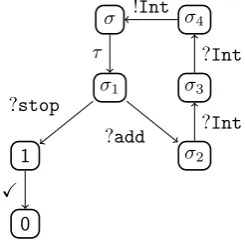
Figure 1.5: Operational semantics of the encoding of the typeS (see Eq. (1.2))
the following terms are first-order session types
?[Real];end, µX.![Bool]; ?[Int];X,
the intuition being thatReal and Intare base types, so not session types. The following terms are not first-order,
![µX.?[Bool];X];end, &hopt1: ?[end];end, opt2: ![ ?[end]; ];endi (1.3)
The input/output fields ?[−] and ![−] of the types in Eq. (1.3) contain session types, so the terms in Eq. (1.3) are higher-order.
The first task that we carry out is to assign an operational semantics to first-order session types. To this end, we adapt the semantics of the processes in CCSwτ, and define the language of session contracts. A straightforward encoding of session types into session contracts lets us associate the semantics of session contracts to session types. In Figure 1.2 we saw the operational semantics of simple processes; essentially some graphs. Intuitively, we use the same approach to describe how a type is meant to interact with the environment, thereby giving a meaning to session types.
For instance, we will associate the term S in Eq. (1.2) with the graph depicted in Figure 1.5; in that graphσis the session contract resulting from the encoding ofS.
In view of the operational semantics assigned to session types, we use the relations for satisfac-tionmust anda to study the refinements for servers and clients that arise in the setting of session types. These refinements are respectively
<
∼fosvr, <∼
fo
clt
and
vfo
svr, v
fo
clt
The definitions of the orders above follow the intuitions that lead to the definitions of the pre-orders for the general theories of testing and of compliance. Hence the relations above arenotdefined in a syntactic way, but in a behavioural way.
We do not define the refinements for peers, for we use the sub-typing on first-order types,4fosbt, as the refinement for peers (up-to the interpretation of contracts into types).
In the sequel of this discussion, let us assume that σ1 and σ2 are the encoding of two types S1 and S2. Ifσ1 is related by<∼
fo
svrwith σ2, then the way in whichσ2 interacts with the environment,
1.3. Session types 11
σ1
0
σ2
?(1).1
1
!(1).1
X
!(µx.?Bool.x) ?opt1
?opt2 !(1)
[image:25.595.225.413.61.174.2]?(1)
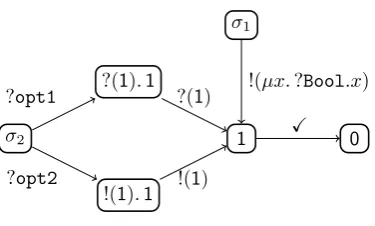
Figure 1.6: An instance of the LTS of higher-order session contracts. The higher-order session contracts appear on the transitions as well as in the states
By and large, the outcome of our study is that the behavioural pre-orders can be characterised purely in a syntactic manner, and that the intersections of these pre-orders are a fully abstract model of4fo
sbt (via our encoding):
• S14fosbtS2 if and only ifσ1(<∼
fo
svr∩<∼
fo
clt)σ2 • S14fosbtS2 if and only ifσ1(vfosvr∩ vfoclt)σ2
First-order session types have limited applications, so we extend the language of session types by allowing them to input/output also session types; and we investigate the resulting theory.
Higher-order session types
As we saw in Eq. (1.3), higher-order session types can contain session types in their input/output fields. The language of higher-order session types amounts to the session types ´a la [Gay and Hole, 2005]. In this context we study only the pre-orders due to the compliance relation,
vho
svr, v
ho
clt
The outcome of our investigation is an extension of the results proven in the first-order setting:
• the behavioural pre-orders can be characterised purely in a syntactic manner
• the intersection of those pre-orders is a fully abstract model of the sub-typing4sbt:S1 4sbtS2 if and only ifσ1(vhosvr∩ vhoclt)σ2
We do not investigate the must pre-orders in the higher-order setting, and leave this as an open problem.
The chief difficulty in unravelling the results is due to a technical issue, that we briefly comment on.
To accommodate the higher-order terms in the existing model of first-order types, we extend the language of session contracts with higher-order constructs. For example, the session contracts that represent the types in Eq. (1.3) are the following terms,
σ1=!(µx.?Bool.x).1 σ2=?opt1.(?(1).1) + ?opt2.(!(1).1)
In turn, this forces us to extend the operational semantics of session contracts; we have to allow the transition of the semantics to be labelled with higher-order session contracts themselves. The operations of the session contracts above are depicted in Figure 1.6.
In order to obtain an LTS that does not depend on any arbitrary relation B, we study certain functions, which turn out to have greatest fixed points. These fixed points are the pre-orders vho
svr
andvho
clt. Indeed, in devising the higher-order theory of compliance our efforts are principally oriented
towards the definition of the fixed pointsvho
svr andv
ho
clt.
1.4
Contributions
From a technical standpoint, the contributions of this thesis are the following ones,
(a) we enrich the standard testing theory with new pre-orders, and present their behavioural charac-terisations (Theorem 4.2.37, Theorem 4.3.17);
(b) we introduce a new compliance relation, the three pre-orders that arise from it, and we show the behavioural characterisations of these pre-orders (Theorem 5.1.15, Theorem 5.2.25, Theo-rem 5.3.26);
(c) we show a fully abstract model of the sub-typing relation on first-order session types (Theo-rem 6.3.4); the model we use can be defined in two alternative ways, one due to the testing theory, and the other due to the compliance theory (Proposition 6.5.19);
(d) we generalise the model due to the compliance so as to exhibit a fully abstract model of the sub-typing on higher-order session types (Theorem 8.4.9).
The first two contributions ((a) and (b)), i.e. the systematic study of the testing theory and the compliance theory, are a necessary step to use the formalisms themselves as foundations for software maintenance.
The last two contributions ((c) and (d)), that is the models for first-order and higher-order session types, essentially show that the theory of session types `a la [Gay and Hole, 2005] can be recovered and justified by using the must testing, or the compliance relation. The connection that we estab-lish between the different formalisms shows that the testing and the compliance theories on session contracts are more primitive than the theory of session types.
Also, our model shows that session contracts in some sense extendthe theory of session types, by virtue of a series of server pre-orders and client pre-orders.
In the first-order setting, we take the sub-typing 4fo
sbt to be the peer pre-order; themust theory
for session types amounts to the refinements
<
∼fosvr, <∼
fo
clt, <∼
fo
clt∩<∼
fo
svr
while the compliance theory amounts to the refinements
vfo
svr, v
fo
clt, v
fo
svr∩ v
fo
clt
In the higher-order setting, the pre-order for peers is the sub-typing4sbt, and the compliance theory
amounts to the following pre-orders
vho
svr, v
ho
clt, v
ho
svr∩ v
ho
clt
1.4. Contributions 13
Equivalences and pre-orders In this thesis we study the characteristic properties of a number of refinement relations; that is pre-orders. We study these relations rather than equivalences because pre-orders are more primitive than equivalences: each pre-order we study through this thesis generates an equivalence. For instance we deem two clients r1 and r2 as equivalent, r1 =clt r2, if r1 vclt r2 andr2vcltr1. The properties of the pre-ordervclt then shed light immediately on the equivalence
relation =clt.
Structure of the thesis
This thesis is divided into two parts.
The first part is devoted to the study of first-order theories; this means that the transition systems that we use as operational semantics have “basic” entities as labels, for example actions, and base types.
The second part is devoted to the extension of some results of the first part to transition systems generated by higher-order languages. Roughly speaking, in these transition systems the labels can be “programs” themselves.
We briefly describe the contents of each chapter.
In Chapter 2 we define the languages that we use throughout the first part of the thesis. While session types need little discussion and are merely syntactical entities, to define processes (i.e. CCSwτ) and session contracts we have also to introduce the operational semantics of these languages. We conclude the chapter showing how to encode session types in session contracts, thereby assigning them an operational semantics.
In Chapter 3 we use the LTS to formalise the satisfaction of clients and peers; that is to define themust testing and the compliance relation. We also show that in the restricted setting of session contracts, both relations can be faithfully described using only the syntax of terms.
In Chapter 4 we extend the standard testing theory, by investigating the pre-orders for servers, clients and peers due to must.
Chapter 5 is organised as Chapter 4, but the theory investigated is due to the compliance relation. At the end of Chapter 5 we summarise our knowledge of the pre-orders studied on the general LTS ofCCSwτ; moreover, we prove a series of results on more restrictive LTSs.
In Chapter 6 we turn our attention to the LTS of session contracts, tailoring the definitions of the refinements to it. We study both the resultingmusttheory and the resulting compliance theory, and exhibit a fully abstract model of first-order session types. This sheds light on the known theory of session types, and also show how to extend it.
In Chapter 7 we extend the languages for sessions of Chapter 2. In particular, we parametrise on a relationB the LTS that describes the interactions of higher-order session contracts. This leads to the definition of dependent compliance relations, aB. The chief result of the chapter is that the
syntactical characterisation ofastill holds true for the dependent compliances. In Chapter 8 we introduce the dependent client and server pre-orders, vB
clt and v
B
svr. By using
these pre-orders we show that there is non-arbitrary way to remove the parameter Bfrom the LTS. We do this by building the fixed points of suitable functions of the formλX.vX
clt andλX.v
X
svr. We
use these results to exhibit a fully abstract model of higher-order session types.
In Chapter 9 we outline the ongoing work and the problems that we want to tackle by means of our behavioural models of session types.
In Chapter 10 we review the relevant literature, summarising the development of the formalisms we use, and showing the state of the art.
Prerequisites
The reader is expected to be familiar with na¨ıve set theory, order theory, and first order logic. Standard references on these topics are respectively [Halmos, 1960], [Davey and Priestley, 2002], and [Mendelson, 1997].
The notation that we do not explain, for example how we define syntax languages, is standard and used regularly in the literature, for instance in [Hennessy, 2007; Milner, 1999; Pierce, 2002].
Throughout the thesis we use heavily induction and co-induction; an excellent and broad expla-nation of both techniques is [Sangiorgi, 2012]. Chapter 21 of [Pierce, 2002] is a standard reference on (co)induction, while another standard reference on induction is [Winskel, 1993, Chapters 3 and 4]. More advanced books on the matter are [Barwise and Moss, 1996] and [Sangiorgi and Rutten, 2011].
Notation We explain a few conventions on the notation that we will use.
We will use the symbolsvand<∼to denote pre-orders defined by using the operational semantics of programs. We will use the symbols and-to denote “alternative” relations, that shed light on the observable behaviour of programs.
We will use many relations defined by (co)induction; normally we will define these relations by using explicitly rule functionals, and taking their least or greatest fixed points. We use the symbolF
Part I
First-order theories
Chapter 2
First-order languages
In this chapter we formally define the languages that we will use throughout the first part of this thesis: a language of communicating processes, the language of session contracts, and the language of session types. The first two languages have an operational semantics in the form of an LTS, and their terms are really meant as handy denotations for parts of the LTS. The third language, session types, has no formal semantics.
The languages we deal with in this part of the thesis arefirst-order, in the sense that they cannot perform input/output operations on the terms of the languages themselves.
Structure of the chapter. We first introduce the language of first-order session types, which is closely related to the language of [Gay and Hole, 2005], and define a sub-typing relation on the first-order session types.
In Section 2.2 we present the language of processes, and endow its terms with a structural oper-ational semantics. Our processes are terms of infinitary ccs withoutτ’s [De Nicola and Hennessy, 1987] enriched with the special term 1, which represents success. We will use the LTS denoted by processes in two chapters of the thesis.
It will become evident that there is a natural way to map first-order session types into a sub-LTS of the one denoted by processes. To render this mapping precisely, in Section 2.3 we introduce the language of session first-ordersession contracts. This languages is a bridge between the LTS of processes and the syntax of first-order session types. In particular, (a) first-order session contracts denote a sub-LTS of the one of processes, and (b) it is straightforward to prove that there is a bijection between the syntax of session types and session contracts.
2.1
The session type language
To define the syntax of types, we presupposes three denumerable sets; a set of labelsL, ranged over byl, a set of ground typesBTranged over byt, and a set of variablesV, ranged over byX; the last set let us express recursive types.
The syntax of terms for types is given by the grammar in Figure 2.1; let us denote with LSTfo the
language given by that grammar.
The use of variables leads to the usual notion offree andbound occurrences of variables in terms in the standard manner; we say that a term isclosed if it contains no free variables. We also have the standard notion ofcapture avoidance substitution of terms for free variables. For the sake of clarity let us recall this definition: a substitutionsis a mapping from the setV to the set of terms inLSTfo.
Let
s−X=
s\ {(X,s(X))} ifX ∈dom(s)
s otherwise
R, S, T ::= Session types
end Terminated session
?[t];S Input
![t];S Output
&hl1:S1, . . . ,ln:Sni Branch
⊕hl1:S1, . . . ,ln:Sni Choice
X Type variable
µX. S Recursive session type
Wheren >0, andi6=j implies that li 6=lj.
Figure 2.1: Grammar for first-order session types
Ss=
end ifS =end
s(X) ifS =X, andX∈dom(S)
X ifS =X, andX6∈dom(S)
![t]; (S0s) ifS = ![t];S0
?[t]; (S0s) ifS = ?[t];S0
&hl1: (S1s), . . . ,ln: (Sns)i ifS = &hl1:S1, . . . ,ln :Sni
⊕hl1: (S1s), . . . ,ln: (Sns)i ifS =⊕hl1:S1, . . . ,ln :Sni
µX.(S0(s−X)) ifS =µX. S0
t ifS =t
Figure 2.2: Application of substitution to first-order session types.
The result of applying a substitution s to the term S is defined in Figure 2.2, by structural induction.
In the final clause of the definition, the application of s−X embodies the idea that in µX. S0
occurrences ofX in the sub-termS0 are bound, and therefore substitutions have no effect on them. It is easy to check that the effect of a substitution depends only on free variables; that is,Ss1=Ss2 whenever s1(X) = s2(X) for every free variable X occurring in S. We use T/X to denote the singleton substitution{(X, T)}.
In the languageLSTfo we have recursive terms, so we introduce a way to unfold them. We formalise
the notion of unfolding, which we defineinductively.
Notation IfX denotes a set, then we let P(X) denote the powerset ofX; that is P(X) is the set of subsets ofX.
Definition 2.1.1. [ Unfolding ] LetFunf:P(L2ST
fo)−→ P(L
2
STfo) be the rule functional given by the inference rules in Figure 2.3. We
denote the least fixed point ofFunf with the symbol unf, and we refer to it as the unfoldfunction.
The relationunfis a partial function, so we writeunf(S) =T in place ofSunf(T).
T unfT T 6=µZ. S; [unf-a]
T0µX. T/X unfS
T unfS T =µX. T
0; [
unf-r]
2.1. The session type language 19
T depth0 T 6=µZ. S
T0µY. T/
Y depthn
µY. T depth1 +n T =µZ. T
0
Figure 2.4: Inference rules to compute the depth ofclosedterms
Intuitively, unf(T) unfolds top-level recursive terms until a type constructor appears, which is notµ. This will be extremely useful in manipulating session types. Not all the terms can be unfolded, for instanceµX. X cannot be unfolded.
The fact that we can unfold a closed term ofLSTfo does not imply that also its sub-terms can be
unfolded.
Example 2.1.2. [ Unfolding and sub-terms ]
LetT = &hmoka:µX. Xi. On the one hand, the termT is closed and the top-most constructor in it is not a recursion, thus we can prove thatunf(T) =T. The proof of this is given by the axiom of Figure 2.3:
T unfT T 6=µZ. S
On the other hand, a sub-term ofT isµX. X, and it can not be unfolded.
We will need to deal only with types whose subterms can be unfolded. To rule out terms that do not satisfy this property we introduce guarded recursion, which we now explain formally.
Definition 2.1.3. [ Type term depth ] LetFdepth :P(L2STfo)−→ P(L
2
STfo) be the rule functional given by the inference rules in Figure 2.4.
We denote with depth the least fixed point of the rule functional Fdepth, and we refer to it as the
depthfunction.
The functiondepthfrom terms toNprovides a measure of session types over which we can perform induction. Moreover, the depth of a closed term is defined if and only if the term can be unfolded. Lemma 2.1.4. For every closed T ∈LSTfo,depth(T)∈Nif and only ifunf(T) =S for someS.
Proof. We are required to prove two implications, a) ifdepth(T)∈Nthenunf(T) =S for some S
b) ifunf(T) =S for someS thendepth(T)∈N The proof of both implications are by rule induction.
In [Gay and Hole, 2005] the function unf is definedco-inductively. This seems to contrast with our inductive definition. In Example 2.1.5 we show that a co-inductive definition does not give rise to a function. In Proposition 2.1.6 we explain how the co-inductive definition can lead to the inductive notion of unfolding: when reasoning on terms with finite depth there is no difference between the inductive and the co-inductive definitions ofunf.
Example 2.1.5. Let S = µX. X. In this example we show that the pairs (S, ?[Int];end) and (S,&hl: endi) are in the fixed point νX.Funf(X). Thanks to the Knaster-Tarski theorem all we have to do is to exhibit a prefixed point ofFunf which contains the pairs at hand.
Consider the ensuing relation
We prove thatR ⊆ Funf(R); to this aim, we have to to show that each pair in Rcan be derived by instantiating one of the inference rules in Figure 2.3. AsXS/
X =S, we have the derivations
Sunf?[Int];end
Sunf?[Int];end [unf-r]
S unf&hl: endi
S unf&hl: endi [unf-r]
ThusRis a prefixed point ofunf. The Knaster-Tarski theorem ensures that the pairs at hand are in the fixed pointνX.Funf(X).
The intuition behind the previous example is that if the depth of the first element of a pair (T, S) is not defined, then the axiom [unf-a] is not necessary to derive the pair itself.
Lemma 2.1.6. Ifdepth(T)∈Nand (T, S)∈νX.Funf(X), thenunf(T) =S.
Proof. We reason by induction ondepth(T)∈N.
Ifdepth(T) = 0, thenT 6=µX. T0, thus we can derive
T unfT T 6=µX. T
0; [
unf-a]
This proves thatunf(T) =T.
In the inductive casedepth(T) =n+ 1, thusT =µX. T0, and the hypothesis (T, S)∈νX.Funf(X) implies that there exists the derivation
T0T/
X unfS
T unfS [unf-r]
This proves that (T0T/
X , S) ∈ νX.Funf(X). Since depth(T0
T/
X ) = n, we can apply the inductive hypothesis, and state thatunf(T0T/X ) =S; this means that there exists a finite deriva-tion
.. .
T0T/
X unfS It follows that also the following derivation is finite
.. .
T0T/X unfS
T unfS [unf-r]
sounf(T) =S.
To make sure that all the sub-terms of a termsT can be unfolded, we introduce the predicategd. Definition 2.1.7. [ Guarded term ]
A termT isguarded,Tgdif every sub-term of the formµX. S satisfiesdepth(S)∈N.
In view of Definition 2.1.7, Example 2.1.2 shows that to have a depth and to be guarded are different properties. In Example 2.1.15 we will see why we need to ensure that all the sub-terms of a given term can be unfolded.
Definition 2.1.8. [ Language of first-order session types ] LetSTfo denote the set of closed guarded terms,
STfo={T ∈LSTfo | Tgd}
2.1. The session type language 21
Bounded Bool
[image:35.595.222.420.68.139.2]Int Real Num Random
Figure 2.5: A sub-type relation on a set of basic typesBT; the arrow represents the relation 4b (see Example 2.1.10).
First-order session types afford the following properties.
Proposition 2.1.9. LetT be a session type, a) the depth ofT is finite
b) the unfolding ofT is a session type
Proof. The first point follows from the definition of STfo and Definition 2.1.7. To prove the second point, we have to show that unf(T) is closed and guarded. The proof is by induction ondepth(T). It relies on the fact that each step of unfolding replaces one variable with a closed and guarded term; hence the overall unfolding is closed.
2.1.1
Sub-typing
There are three sources for the sub-typing relation over types. The first is some predefined pre-order over the base types,t14bt2, which intuitively says that all data-values of typet1may be safely used where values oft2 are expected.
Example 2.1.10. An example of sub-typing on base types is given in Figure 2.5, for the ensuing set of types,BT={Bounded,Bool,Int,Real,Num,Random}. In the figure the pre-order4bis depicted by the arrows; for instance, the arrow from typeIntto typeRealmeans thatInt4bReal.
More generally, ifJtK denotes the set of values of the base typet then we can define4b by letting
t1 4b t2 whenever Jt1K ⊆ Jt2K. The other sources for the sub-typing are two constructs of the language: thebranch construct allows sub-typing by extending the set of labels involved, while in the choice construct the set of labels may be restricted. We give two examples.
Example 2.1.11. [ Sub-typing on branch types ]
In this example we explain how the sub-typing relates the branch types. Consider the type
BarTender= &hespresso:T1i
Intuitively, theBarTenderoffers only the labelespresso, thus all the customers satisfied byBarTender, are satisfied by any other type that offersat leastthe labelespresso. Let
ItalianBarTender=&hespresso:T10,
deka:T20,
double−deka−restr:T30,
Following the intuition, TheItalianBarTenderwill satisfy all the customers satisfied by theBarTender; this is formalised by the sub-typing, which relates the two types as follows
BarTender4sbtItalianBarTender
as long as also the continuationsT1and T10 are related as well (ie.T14sbtT10).
We have shown that, intuitively, it is safe to replace a branch type with a branch type that offers more labels.
Example 2.1.12. [ Sub-typing on choice types ]
In this example we show how the sub-typing relate the choice types. LetItalianCustomerdescribe the different coffees that a process may want to order when interacting with a bar tender.
ItalianCustomer=⊕ hespresso:T10,
deka:T20,
double−deka−restr:T30,
double−espresso:T40i
All the bar tenders that are able to satisfy this range of choices, have to offerat leastthe four labels that appear inItalianCustomer. Now consider the type
Customer=⊕hespresso:T10i
Since Customerchooses among fewer options thanItalianCustomer, it is safe to use a channel at type Customer in place of a channel at type ItalianCustomer. This is formalised by the sub-typing relation as follows,
ItalianCustomer4sbtCustomer
In this example we have shown that, intuitively, it is safe to replace a choice type, with a choice type that chooses among fewer labels.
Moreover, we will have the standard co-variance/contra-variance of input/output types [Pierce and Sangiorgi, 1996], extended to both thebranch andchoice constructs.
Because of the recursive nature of our collection of types, the formal definition of the sub-typing relation is given co-inductively.
Definition 2.1.13. [ First-order sub-typing ]
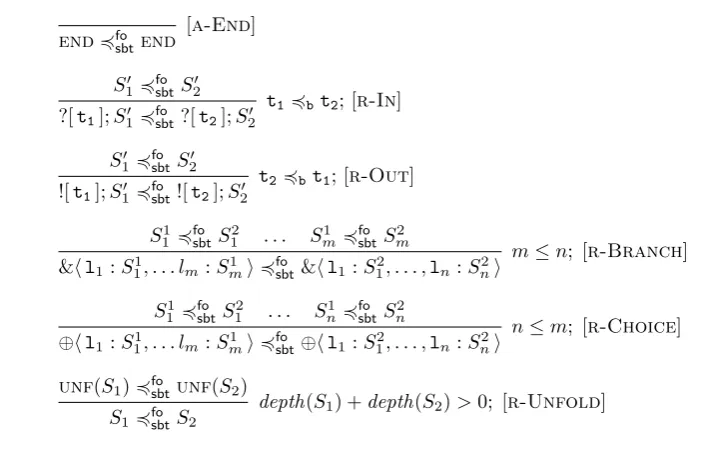
LetF4fosbt :P(STfo2)−→ P(STfo2) be the rule functional given by the inference rules in Figure 2.6.
IfX ⊆ F4fosbt(X), then we say thatX is afirst-order type simulation. Lemma C.0.17 and the
Knaster-Tarski theorem ensure that there exists the greatest solution of the equation X =F4fo
sbt(X); we call
this solution thefirst-order sub-typing relation, and we denote it 4fo
sbt. That is 4fosbt = νX.F4
fo sbt(X).
Figure 2.6 contains a schema of inference rules rather than a set of finite inference rules. This because the premises of the rules [r-Branch] and [r-Choice] depend on the cardinality of two sets, respectively I and J. The schema gives rise to an infinite amount of inference rules. An infinite set of inference rules gives rise to a rule functional as a finite set of rules does. The details of the construction are explained in [Sangiorgi, 2012, Chapter 2].
Example 2.1.14. [ Side conditions ondepth of terms ]
2.1. The session type language 23
end4fosbtend
[a-End]
S10 4fo sbtS20 ?[t1];S10 4fosbt?[t2];S20
t14bt2; [r-In]
S10 4fo
sbtS
0
2 ![t1];S10 4fosbt![t2];S20
t24bt1; [r-Out]
S1
1 4fosbtS12 . . . Sm1 4fosbtSm2
&hl1:S11, . . . lm:S1mi4sbtfo &hl1:S12, . . . ,ln:Sn2i
m≤n; [r-Branch]
S1 14fosbtS
2
1 . . . Sn14fosbtS
2 n
⊕hl1:S11, . . . lm:S1mi4sbtfo ⊕hl1:S12, . . . ,ln:Sn2i
n≤m; [r-Choice]
unf(S1)4fosbtunf(S2)
S14fosbtS2
[image:37.595.132.488.60.288.2]depth(S1) +depth(S2)>0; [r-Unfold]
Figure 2.6: Inference rules for the rule functionalF4fo sbt
depth(S2)>0. Intuitively, the side condition ensures that the rules cannot be applied vacuously, that is to terms that equal their unfoldings.
Let S1 = ![Int];end and S2 = ?[Bool];end, and let 4bad be the relation defined as 4fosbt, but
without the side condition in rule [r-Unfold]. We prove that the bad sub-typing 4bad relates S1 toS2. We have to show a prefixed point ofF4bad that contains the pair (S1, S2); letR={(S1, S2)}. To prove thatR ⊆ F4bad(R) we need to show just that (S
1, S2)∈ F4bad(R). This follows form the equalitiesunf(S1) =S1,unf(S2) =S2, and an application of rule [r-Unfold]:
unf(S1)4badunf(S2) S14badS2
Note that thanks to the side conditiondepth(S1) +depth(S2)>0 we cannot proveS14fosbtS2.
The requirement that session types be guarded is crucial for the first-order sub-typing relation to be well-defined. We explain this fact in the next example.
Example 2.1.15. [ Sub-typing and guardedness ]
In this example we show why the guardedness of terms is required in the definition of session types. Consider again the term T = &hl : µX. Xi of Example 2.1.2. Suppose we wanted to check whetherT 4fo
sbt&hl:Sifor some termS. The definition of4fosbt requires us to check whether
unf(µX. X)4fosbtunf(S)
This check, though, can not be done becauseunf(µX. X) isnotdefined at all (andunf(S) may not be defined either).
The co-inductive type simulations are closed with respect to unfolding. Lemma 2.1.16. [4fo
sbtand unfolding ]
For every co-inductive type simulationR, and everyS, T∈STfo, ifSRT thenunf(T)Runf(T). Proof. LetS RT. The argument depends on the depths ofS and T. If depth(S) +depth(T) = 0, thenunf(S) =Sandunf(T) =T, so the assumptionSRT impliesunf(S)Runf(T). Ifdepth(S)+ depth(T)>0, then recall that by hypothesisR ⊂ F4fo
assumption on the depths of the types at hand ensures that the only way to prove (S, T)∈ F4fosbt(R)
is an application of rule [r-Unfold],
unf(S)4fosbtunf(T)
S4fo
sbtT
depth(S) +depth(T)>0; [r-Unfold]
It follows thatunf(S)Runf(T).
Proposition 2.1.17. The relation4fosbt is a pre-order onSTfo. Proof. See [Gay and Hole, 2005].
In [Gay and Hole, 2005] the set of typesSTfoare used to give a typing system for the pi calculus, and appropriate Type Safety and Type Preservation theorems are proved.
In Chapter 6 our aim will be to find a pre-order isomorphic to4fosbt, which is based on the semantics of terms rather than their syntax. In particular, as session types are meant to be protocol descriptions, a natural decision is to try to map session types intoccswithoutτ’s, and use the operational semantics of this language to define a fully abstract model for4fo
sbt. We will achieve this result in Theorem 6.3.4.
In the next two sections we introduce respectively, an infinitary version of ccswithout τ’s; and then a language that lets us focus on a sub-LTS of the general one given by CCSwτ, and interpret session types via a bijection.
2.2
Processes
In this section we define an LTS of processes by means of a language and its operational semantics. The language is an infinitary version ofCCSwτ, and the operational semantics of the terms is specified by standard inference rules.
Let Act be a set of actions, ranged over by α, β, γ, . . . and let τ,X be two distinct actions not inAct; the first will denote internal unobservable activity while the second will be used to report the success of an experiment. To emphasise their distinctness we useActτXto denote the setAct∪{τ,X},
Actτ to denote the set Act∪ {τ}, and ActX to denote the set Act∪ {X}. We assumeAct has an idempotent complementation function, withαbeing the complement toα.
We let αX to range overActX,ατ range overActτ, andµrange overActτX.
Labelled Transition System A labelled transition system, LTS, consists of a triple
hP,ActτX,−→ i
where P is a set of processes and −→ ⊆ P ×ActτX×P is a transition relation between processes decorated with labels drawn from the setActτX. We use the infix notationp
µ
−→qin place of (p, µ, q)∈ −→. An LTS is finite-branching if for allp∈P and for allµ∈ActτX, the set{q | p
µ
−→q}is finite. In this thesis we will not assume that all LTSs are finite-branching.
We use standard notation for operations in LTSs. For exampleAct?τX, ranged over byt, denotes the set offinitesequences of actions from the setActτX, and for anyt∈Act?τXwe letp
t
−→qbe the obvious generalisation of the single transition relations to sequences. For an infinite sequenceu∈Act∞τXof the formµ0µ1. . .we writep
u
−→to mean that there is an infinite sequence of actionsp µ0
−→po µ1
2.3. Session Contracts 25
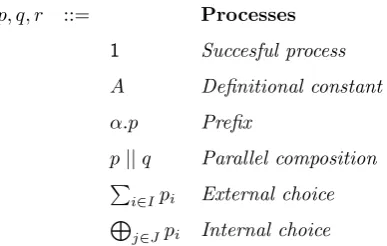
p, q, r ::= Processes
1 Succesful process
A Definitional constant
α.p Prefix
p||q Parallel composition
P
i∈Ipi External choice
L
j∈Jpi Internal choice
[image:39.595.224.418.68.191.2]whereα∈Act,I, J are countable index sets, with J 6=∅. A, B, C, . . .range over a set of definitional constants each of which has an associated definitionAdef= pA.
Figure 2.7: Syntax of infinitaryCCSwτ.
Language and semantics To describe LTSs we use an infinitary version ofCCSwithout τs, [De Nicola and Hennessy, 1987], augmented with asuccess operator,1.
Definition 2.2.1. LetCCSwτ be the set of terms defined by the grammar in Figure 2.7. We use0 to denote the empty external sumP
i∈∅pi, andp1+p2 for the binary sumPi∈{1,2}pi. Similarly the binary internal sumL
i∈{1,2}pi will be rendered as p1⊕p2.
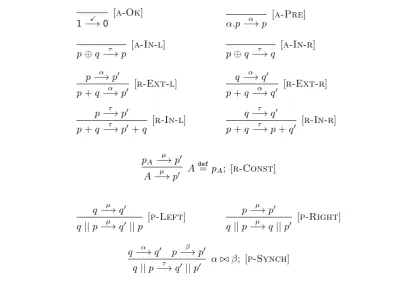
Each term in the language CCSwτ denotes an LTS; the easiest way to describe this interpretation is to define one overarching LTS, whose states are the terms inCCSwτ and where the relationsp
µ
−→q
are the least ones determined by the (standard) rules in Figure 2.8. Note the side condition in rule [p-Synch]; when reasoning on processes, we assume the relation ./ to be given by the co-action function:α ./ α.
In the next chapters we will need the following concepts. Definition 2.2.2. [ Computation ]
For every processrandpa sequence of reductions
r||p−→τ r1||p1 τ
−→r2||p2−→. . .
is called acomputationofr||pand each derivativeri||pi is astateof the computation. Definition 2.2.3. [ Convergent ]
We writep⇓ whenever there exists ak∈Nsuch that ifp−→τ n p0, thenn≤k. Ifp⇓ then we say thatpconverges.
2.3
Session Contracts
In Section 2.2 we have define a general LTS given by the terms of CCSwτ and their operational semantics.
Here we turn our attention to a sub-LTS ofhCCSwτ,ActτX,−→ i, that is denoted by the terms of yet another language, the language ofsession contracts. In this section we assume Act to be the set
{?b, !b | b∈BT} ∪ {l?,l! | l∈L}
The syntax for the languageLSCfo is given in Figure 2.9. The languageLSCfo is not a sublanguage
1−→X 0
[a-Ok]
α.p−→α p [a-Pre]
p⊕q−→τ p
[a-In-l]
p⊕q−→τ q
[