Original Research Article
Study of parenting styles, family functioning and its relation to coping
strategies in children of specific learning disorder
Enagandula Rupesh
1, Shipra Singh
2*, Alka A. Subramanyam
3, Ravindra M. Kamath
3INTRODUCTION
Specific Learning Disability (SLD) is academic under-achievements in reading (dyslexia), written expression (dysgraphia) and mathematics (dyscalculia) that is unexpected as compared to the child’s intellectual ability, potential and opportunity to learn. This is at times accompanied with motor incoordination, difficulty in understanding and expressing age appropriate communication, thereby leading to inability to understand
abstract meanings or narrate stories in an organized manner.1
SLD makes it agonizing for a child to perform in school. The persistent scholastic backwardness leads to eventual demoralization, low self-esteem, chronic frustration, and poor peer relationships. There is high association of comorbid disorders, including Attention-Deficit/Hyperactivity Disorder (ADHD), communication disorders, conduct disorders, and neurotic disorders.2 The 1Consultant Psychiatrist, Patiala, Punjab, India
2Department of Psychiatry, PGIMS, Rohtak, Haryana, India
3Department of Psychiatry, B. Y. L. Nair Hospital and T. N. Medical College, Mumbai, Maharashtra India
Received: 24 September 2019
Revised: 02 December 2019
Accepted: 09 December 2019
*Correspondence:
Dr. Shipra Singh,
E-mail: [email protected]
Copyright: © the author(s), publisher and licensee Medip Academy. This is an open-access article distributed under the terms of the Creative Commons Attribution Non-Commercial License, which permits unrestricted non-commercial use, distribution, and reproduction in any medium, provided the original work is properly cited.
ABSTRACT
Background: Families of children with disabilities otherwise experience higher stress; and relation between parenting styles and coping of children is well known. Parental factors and family functioning may play a role in shaping the child, especially having issues like SLD. The objective is to study was coping strategies of children with SLD, parenting styles of their parents, their family functioning and relation of these with each other.
Methods: It is a cross-sectional study undertaken after Institutional Ethics Committee approval, parent’s consent and child’s assent. Participants were 100 consecutive children, diagnosed with SLD, 9-13 years of age. Tools used were: Semi-structured proforma, Parenting Practices Questionnaire, Family Assessment Device and Children’s Coping Strategies Checklist Revision 1.
Results: Authoritarian parenting style was significantly was associated with less use of ‘active’ and ‘support seeking’; and increased use of ‘distraction’ and ‘avoidance’ strategies. High scores on Authoritative style was associated with ‘active’ and ‘support seeking’ strategies. Avoidance coping strategy was associated with poor (high scores) and active coping strategies with higher (low scores) on problem solving, communication, and general family functioning.
Conclusions: Parenting practices and family functioning can be pivotal in determining child’s attitude and coping. Assessment of this can be routinely included in child evaluation.
Keywords: Coping strategy, Family functioning,Parenting style, Specific learning disorder
drop-out rates in adolescents are about one and a half times more in comparison to children without SLD.
An epidemiological study in British school children in age group 8-10 years had the prevalence of 3.9%- dyslexia, 1.3% -dyscalculia and 2.3% combined (dyslexia and dyscalculia) with overall prevalence of SLD of 7.5%.3 A similar study found the prevalence rate as 7.4%,
amongst this estimated prevalence for boys was 8% and for girls 6%.4 An Asian study had a prevalence of 6.3% -
dyslexia and 12.6% - probable dyslexia with male to female ratio of 3.4:1. On an average 1 in every 6 or 7 children suffers from SLD as seen in Indian as well as other studies.5
Studies have demonstrated that families of children with disabilities experience higher levels of stress or distress when compared to the families of typically developing children.6,7 The impact of having a SLD child in specific
is also substantial. Parents of children with SLD have significantly higher stress level as compared to non-referred as shown by previous studies.8,9
These children often realize that they have a problem and have a varying understanding of its causes, treatment and effects. Intentionality in causing symptoms and causality may also be not well understood. Very often they believe that the situation is beyond them and they have no control over it. This with poor understanding of their affliction and various socio demographic and parental factors could lead eventually to psychopathology.
Thus present study focuses on exploring relation of coping strategies of children having SLD with the parenting styles of their parents and the family functioning.
METHODS
It was a cross sectional study carried out in the Child Psychiatry Clinic of a tertiary care teaching institute, after obtaining Institutional Ethics Committee approval. A total of 100 consecutive children, diagnosed with Specific Learning Disabilities according to DSM-5 criteria, but not having any acute medical or psychiatric co-morbidities, aged 9-13 years, were included in study. A written informed consent from the parents/guardians of the children and assent from the child were taken before commencing the study. Interview was conducted by a single interviewer, using a semi-structured proforma to obtain demographic, psychosocial and disorder related variables. In addition, the following scales were applied:
Parenting practices questionnaire
This questionnaire consists of 62 items used to measure characteristics of authoritative, authoritarian and permissive parenting styles.10 27 of these items relate to
authoritative parenting style with a Cronbach alpha of 0.91; 20 items relate to authoritarian parenting style with a Cronbach alpha of 0.86 and there are 15 items with a
Cronbach alpha of 0.75. This questionnaire is based on 5 point likert scale with one being “I never exhibit this behavior’ and five being “I always exhibit this behavior’.
Family Assessment Device (FAD)
It is a 60-item self-report measure of family functioning answered on a 4-point Likert scale ranging from 'strongly agree' to 'strongly disagree'.11 It contains seven subscales
designed to assess the six dimensions of the McMaster Model of Family Functioning: Problem Solving, Communication, Roles, Affective Responsiveness, Affective Involvement and Behavior Control, and contains a seventh General Functioning scale. Cut-off scores: Problem Solving: 2.20, Communication: 2.20, Roles: 2.30, Affective Responsiveness: 2.20, Affective Involvement: 2.10, Behavior Control: 1.90, General Family Function: 2.00. Greater than or equal to cut-off score equals unhealthy functioning on that scale.12 years
or older family members can respond to this questionnaire. The FAD has good construct validity, significantly correlating with the corresponding Clinical Rating Scale of the McMaster family assessments. The internal consistencies range from alpha = 0.71 to 0.92. Test re-test reliabilities at a one-week interval have been reported between 0.66 and 0.76 for the different subscales.12-14
Children’s Coping Strategies Checklist-Revision 1 (CCSC-R1)15
It contains 54 statements which all start with ‘‘If I have a problem’’ followed, for example, by a statement such as ‘‘I tell others how I would like to solve it’’. The children could choose between four reactions: never (1), sometimes (2), often (3) and always (4). Items for the CCSC-R1 are grouped by their subscales/dimensions and also by the larger factors on which they have loadings. The four major factors: Active Coping Strategies (alpha = 0 .88), Distraction Strategies, Avoidance Strategies (alpha = 0.65), Support Seeking Coping Strategies (alpha = 0.86)
Frequency counts and percentages will be used to summarize qualitative variables, while chi-square test will be used to compare categories. Analysis of variance will give comparison of different response categories.
RESULTS
Demographic data
IV of Prasad’s socio-economic class, followed by class III (19%). 43% of parents were graduates and 9% had completed their post-graduation.
Parenting practice
On Parenting Practice Questionnaire, mean scores in the ‘authoritative parenting style’ and the specific sub-factor ‘easy going’ are the highest scores among the three parenting styles (Table 1).
Table 1: Factorscores of parenting practices questionnaire.
Parenting Practice Mean SD
Authoritarian 2.09 0.536 a. Corporal punishment 2.15 0.72 b. No reasoning 1.84 0.47 c. Autocratic 2.13 0.81 d. Directiveness 2.37 0.79 e. Emotional 1.95 0.71 Authoritative 3.54 0.95 a. Warmth and involvement 3.67 0.98 b. Verbal encouragement 3.68 0.88 c. Easy going 3.91 1.10 d. Reasoning 3.21 0.96 e. Democratic discipline 3.24 1.08 Permissive 1.79 0.45 a. Ignoring misbehaviour 1.66 0.59 b. Child centered 1.89 0.46 c. Indulgent 1.81 0.50
Coping strategies of child
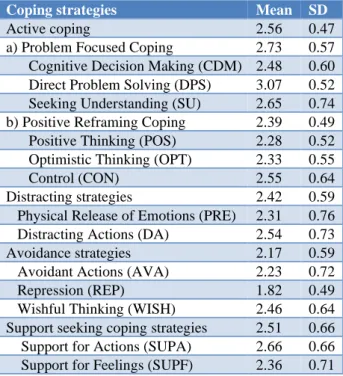
Assessment of coping strategies showed that, mean scores of active coping (2.56) and support seeking coping strategies (2.51) are relatively higher than that of avoidance (2.17) and distraction strategies (2.42). Amongst the individual subscales, direct problem-solving strategy (3.07) has the highest and repression (1.82) has the lowest score (Table 2).
Family assessment
On family assessment, scores on all the subscales are less than cut-off scores, except the Behavioral Control subscale suggesting unhealthy functioning in that domain (Table 3).
Relation of parenting style and family dynamics with child’s coping strategies
Authoritarian parenting style was associated with less use of ‘active’ and ‘support seeking’ coping strategies by the child, and increased use of ‘distraction’ and ‘avoidance’ strategies. High scores on Authoritative style was associated with increased use of ‘active’ and ‘support seeking’ strategies; and permissive parenting with
increased use of ‘avoidance’ coping strategy by the child (Table 4).
Table 2: Subscale scores of CCSC-R1 of the study sample.
Coping strategies Mean SD
Active coping 2.56 0.47 a) Problem Focused Coping 2.73 0.57 Cognitive Decision Making (CDM) 2.48 0.60 Direct Problem Solving (DPS) 3.07 0.52 Seeking Understanding (SU) 2.65 0.74 b) Positive Reframing Coping 2.39 0.49 Positive Thinking (POS) 2.28 0.52 Optimistic Thinking (OPT) 2.33 0.55 Control (CON) 2.55 0.64 Distracting strategies 2.42 0.59 Physical Release of Emotions (PRE) 2.31 0.76 Distracting Actions (DA) 2.54 0.73 Avoidance strategies 2.17 0.59 Avoidant Actions (AVA) 2.23 0.72 Repression (REP) 1.82 0.49 Wishful Thinking (WISH) 2.46 0.64 Support seeking coping strategies 2.51 0.66 Support for Actions (SUPA) 2.66 0.66 Support for Feelings (SUPF) 2.36 0.71
Table 3: Subscale scores of FAD of the study sample.
Scales of FAD Mean SD Cut-off scores
Problem solving 1.97 0.38 2.20 Communication 2.08 0.33 2.20 Roles 2.05 0.3 2.30 Affective responsiveness 2.16 0.38 2.20 Affective involvement 1.96 0.44 2.10 Behavior control 2.09 0.37 1.90 General family
functioning 1.69 0.27 2.00
Table 4: Correlation between Parenting practice (PPQ) and Child coping (CCSC).
Parenting practice
Coping strategies (Pearson’s r)
Active Distraction Avoidance Support seeking
Authoritarian -0.636** 0.305** 0.532** -0.407** Authoritative 0.750** - 0.024 - 0.716** 0.761** Permissive - 0.021 - 0.095 0.210* - 0.146
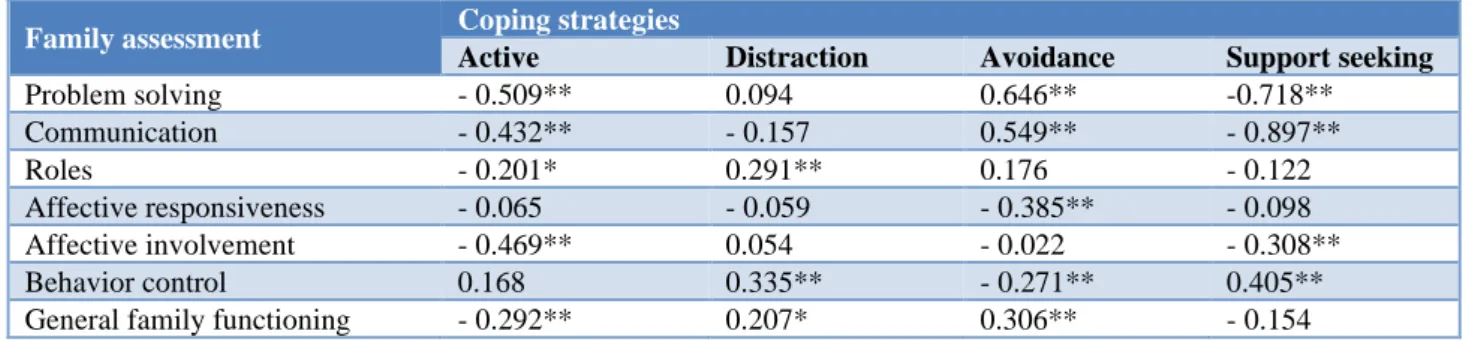
Table 5: Correlations between Family assessment (FAD) and Child coping (CCSC).
Family assessment Coping strategies
Active Distraction Avoidance Support seeking
Problem solving - 0.509** 0.094 0.646** -0.718** Communication - 0.432** - 0.157 0.549** - 0.897**
Roles - 0.201* 0.291** 0.176 - 0.122
Affective responsiveness - 0.065 - 0.059 - 0.385** - 0.098 Affective involvement - 0.469** 0.054 - 0.022 - 0.308** Behavior control 0.168 0.335** - 0.271** 0.405** General family functioning - 0.292** 0.207* 0.306** - 0.154
DISCUSSION
Increasing prevalence of SLD, and need for bridging the gaps of comprehensive research for its relation to co-morbid and associative factors created an interest and stirred the objectives of this study to be formed.
Author found that predominantly the children were from nuclear families, lower middle strata of socio-economic class with predominant parents’ education being higher secondary education to graduation. Education of the parents has been particularly proved quite important in literature. SLD children need constant stimulation and literate home environment. They run a risk of starting school with lower levels of development and basic skills if there is lower parental education.16-18 Furthermore, it
should be stressed that SLD has a strong genetic component, so that the limited education level of parents, which was identified in these subgroup of children, can be related to their own learning difficulties and thus biologically explain the deficits inherited by children.19,20
Notwithstanding these circumstances, parental learning disabilities were not verified in the sample studied, and may be a future focus of analysis.
Parenting styles in this study sample was predominantly found to be more authoritative than compared to the other two styles of authoritarian or permissive. This was in accordance to the need of the children having learning disability and also in consensus to other studies, were it has been shown that high level of authoritative parenting style providing affection, autonomy and responding in the maturity required as per norms and demands of children for better academic performances.21,22
A study in SLD children and delinquency also observed that the delinquency was less in children brought up in flexible and creative way (i.e. equivalent to authoritative style) as compared to those brought up by parents who did not believe in accommodating (i.e. equivalent to authoritarian). Further longitudinal studies have also found that authoritativeness could decrease as the disability continuous. SLD being a lifelong disorder with occasional change in minor adaptive coping of these
children over time there can bring change in the style of parenting in their parents.23
Mean scores of all the subscales of family assessment device were found lesser than the cut-off for pathological families in the study sample, except for ‘Behavior control’. Thus, showing no significant family dysfunction or conflicts as favorable for families consisting a child with SLD in majority of the domains. Studies have shown that in troubled or dysfunctional families, children receive less stimulation and of lower quality, which also affects their academic development.24,25 These factors can
also be risk factors present in homes where there are children with LD.
There was no significant association of age, gender and parental gender with coping of the SLD children in the study sample. However, earlier studies have shown mixed findings.26,27 Considering gender, results in some
studies showed that girls used more of avoidance and distraction strategies whether having disability or not, or more of support for feelings and wishful thinking. Few studies found problem solving better in boys but this result was found contradictory in others.28
In this study, SLD children predominantly used active and support seeking strategies rather than distraction or avoidance. This finding was in line with other studies in past in normal children where active and supporting seeking strategies were being used more commonly.29,30
But findings in SLD children have been contrary to these in the form that avoidance or distraction coping strategies being the predominant. The literature also found active and support seeking coping strategies as very crucial for short term long term psychological well-being.27
However, previous studies found avoidance strategies (non-productive) more commonly used in children with SLD. These distraction and avoidance strategies increase the psychopathology in children.31
non-productive/avoidance coping is essentially a defensive pattern of behaviors including learned helplessness, lack of belief in help, lack of willingness to take treatment, mainly be in denial or use repression for the situations, withdrawn to self, weeping and exaggerated dependency.33
Analysis also showed authoritative parenting style was positively correlated with ‘active’ and ‘support seeking’ coping strategies. Authoritative parenting has been seen to have better problem solving and communication skills in the families. This is in lines with the results obtained in previous studies.34-38There is evidence in studies that
‘moderately strict parenting’, characteristic of authoritative parenting is correlated to ability to self-regulate problem issues, i.e. authoritative parenting promotes adaptive (active) coping in youth which is reflected in our study.39 It has been found that children
from authoritative families had most adaptable (active) strategies in academic situations. Children from authoritarian families showed lowest adaptable strategies, high passivity, behavior problems and low self-confidence whereas children from permissive families were similar to authoritative families.40
CONCLUSION
Author found that authoritative style was related to ‘active’ and ‘support seeking’ strategies; and permissive parenting to ‘avoidance’ coping strategy of the child. Avoidance coping strategy was positively correlated and active coping strategies were negatively correlated to FAD scales of problem solving, communication, and general family functioning. On the other hand, authoritarian parenting style was negatively correlated with ‘active’ and ‘support seeking’ coping strategies of the child, and positively correlated with ‘distraction’ and ‘avoidance’ strategies. It is thus clear that family dynamics and parenting strategies significantly affect coping of a child with SLD, and thus would affect his behavior and future development of the child’s personality. Parenting practices and family functioning are also related to each other. Thus, there is a need to understand and identify such factors in a child attending a clinic, in his parents and also his or her family; and to mold them for better. Small sample size, cross sectional nature and lack of control group were the limitations of this study. In addition, questions about parenting practices were answered by only one of the parents, confounding the results. Research done with a larger sample with a control group, including responses of both parents, and of longitudinal nature would yield more accurate findings. Interventional studies in terms to bringing about change in outcome of study parameters for effective parenting styles, better family functioning and coping in SLD children can also be planned.
Funding: No funding sources Conflict of interest: None declared
Ethical approval: The study was approved by the Institutional Ethics Committee
REFERENCES
1. Specific learning disorder (In: Neurodevelopmental disorders). In: DSM-5 American Psychiatric Association. Diagnostic and statistical manual of mental disorders. Arlington: American Psychiatric Publishing; 2013:66-74.
2. Singh S, Sawani V, Deokate M, Panchal S, Subramanyam AA, Shah HR, et al. Specific learning disability: A 5 year study from India. Int J Contem Pediatr. 2017;4:863.
3. Lewis C, Hitch GJ, Walker P. The prevalence of specific arithmetic difficulties and specific reading difficulties in 9‐to 10‐year‐old boys and girls. J Psychol Psychiat. 1994;35(2):283-92.
4. Tomblin JB, Records NL, Buckwalter P, Zhang X, Smith E, O’Brien M. Prevalence of specific language impairment in kindergarten children. J Speech, Language, Hearing Res. 1997;40(6):1245-60.
5. Roongpraiwan R, Ruangdaraganon N, Visudhiphan P, Santikul K. Prevalence and clinical characteristics of dyslexia in primary school students. J Med Assoc Thailand= Chotmaihet thangphaet. 2002 Nov;85:S1097-103.
6. Bailey AB, Smith SW. Current topics in review: Providing effective coping strategies and supports for families with children with disabilities. Inter School Clin. 2000 May;35(5):294-6.
7. Kazak AE, Marvin RS. Differences, difficulties and adaptation: Stress and social networks in families with a handicapped child. Family Relat. 1984;1:67-77. 8. Konstantareas MM. Autistic, learning disabled and
delayed children's impact on their parents. Canadian J Behavioural Sci/Revue Canadienne des Sci du Comport. 1991;23(3):358.
9. Falik LH. Family patterns of reaction to a child with a learning disability: A mediational perspective. J learning disabilities. 1995;28(6):335-41.
10. Robinson CC, Mandleco B, Olsen SF, Hart CH. Authoritative, authoritarian, and permissive parenting practices: Develop New Measure. Psychol Reports. 1995;77(3):819-30.
11. Akister J, Stevenson‐Hinde J. Identifying families at risk: Exploring the potential of the McMaster Family Assessment Device. J Family Therapy. 1991;13(4):411-21.
12. Miller IW, Epstein NB, Bishop DS, Keitner GI. The McMaster family assessment device: reliability and validity. J Marital Family Therapy. 1985;11(4):345-56. 13. Skinner H, Steinhauer P, Sitarenios G. Family
Assessment Measure (FAM) and process model of family functioning. J Family Therapy. 2000;22(2):190-210.
Family Assessment Device. Family Process. 1988;27(1):97-104.
15. Alderfer MA, Fiese BH, Gold JI, Cutuli JJ, Holmbeck GN, Goldbeck L, et al. Evidence-based assessment in pediatric psychology: Family measures. J Pediatr Psychol. 2007;33(9):1046-61. 16. Marks GN. Family size, family type and student
achievement: Cross-national differences and the role of socioeconomic and school factors. J Comparat Family Stud. 2006;37(1):1-24.
17. Jordan NC, Levine SC. Socioeconomic variation, number competence, and mathematics learning difficulties in young children. Develop Disabilit Res Rev. 2009;15(1):60-8.
18. Park H. Home literacy environments and children's reading performance: A comparative study of 25 countries. Edu Res Evaluat. 2008;14(6):489-505. 19. Van Steensel R. Relations between socio‐cultural
factors, the home literacy environment and children's literacy development in the first years of primary education. J Res Reading. 2006;29(4):367-82.
20. Berninger VW, Abbott RD, Thomson JB, Raskind WH. Language phenotype for reading and writing disability: A family approach. Sci Studies Reading. 2001;5(1):59-106.
21. Monuteaux MC, Faraone SV, Herzig K, Navsaria N, Biederman J. ADHD and dyscalculia: Evidence for independent familial transmission. J Learning Disabil. 2005;38(1):86-93.
22. Snowling MJ, Muter V, Carroll J. Children at family risk of dyslexia: a follow‐up in early adolescence. J Child Psychol Sychiat. 2007;48(6):609-18.
23. Steinberg L, Elmen JD, Mounts NS. Authoritative parenting, psychosocial maturity, and academic success among adolescents. Child Develop. 1989;1:1424-36.
24. Turner EA, Chandler M, Heffer RW. The influence of parenting styles, achievement motivation, and self-efficacy on academic performance in college students. J College Student Develop. 2009;50(3):337-46.
25. Pryor-Kowalski M. Learning Disabilities, Juvenile Delinquency and the Family: The Role of' Intensive Parenting'. Michigan Family Rev. 2013;17(1). 26. Givon S, Court D. Coping strategies of high school
students with learning disabilities: a longitudinal qualitative study and grounded theory. International J Qualitate Studies Education. 2010;23(3):283-303. 27. Donaldson D, Prinstein MJ, Danovsky M, Spirito A.
Patterns of children's coping with life stress: Implications for clinicians. Am J Orthopsychiatry. 2000;70(3):351-9.
28. Rossman BR. School‐age children's perceptions of coping with distress: Strategies for emotion
regulation and the moderation of adjustment. J Child Psychology and Psychiatry. 1992;33(8):1373-97. 29. De Boo GM, Wicherts JM. Assessing cognitive and
behavioral coping strategies in children. Cognit Therapy Res. 2009;33(1):1.
30. Hampel P, Petermann F. Age and gender effects on coping in children and adolescents. J Youth Adolesc. 2005;34(2):73-83.
31. Sandler IN, Tein JY, West SG. Coping, stress, and the psychological symptoms of children of divorce: A cross‐sectional and longitudinal study. Child Develop. 1994;65(6):1744-63.
32. Firth N, Greaves D, Frydenberg E. Coping styles and strategies: A comparison of adolescent students with and without learning disabilities. J Learning Disabil. 2010;43(1):77-85.
33. Goldberg RJ, Higgins EL, Raskind MH, Herman KL. Predictors of success in individuals with learning disabilities: A qualitative analysis of a 20‐
year longitudinal study. Learning Disabil Res Pract. 2003;18(4):222-36.
34. Sideridis GD, Morgan PL, Botsas G, Padeliadu S, Fuchs D. Predicting LD on the basis of motivation, metacognition, and psychopathology: An ROC analysis. J Learning Disabil. 2006;39(3):215-29. 35. Dusek JB, Danko M. Adolescent coping styles and
perceptions of parental child rearing. J Adolesc Res. 1994;9(4):412-26.
36. Kliewer W, Lewis H. Family influences on coping processes in children and adolescents with sickle cell disease. J Pediatr Psychol. 1995;20(4):511-25. 37. Lohman BJ, Jarvis PA. Adolescent stressors, coping
strategies, and psychological health studied in the family context. J Youth Adolesc. 2000;29(1):15-43. 38. McIntyre JG, Dusek JB. Perceived parental rearing
practices and styles of coping. J Youth Adolesc. 1995;24(4):499-509.
39. McKernon WL, Holmbeck GN, Colder CR, Hommeyer JS, Shapera W, Westhoven V. Longitudinal study of observed and perceived family influences on problem-focused coping behaviors of preadolescents with spina bifida. J Pediatr Psychol. 2001;26(1):41-54.
40. Valentiner DP, Holahan CJ, Moos RH. Social support, appraisals of event controllability, and coping: An integrative model. J Personal Social Psychol. 1994;66(6):1094.
Cite this article as: Rupesh E, Singh S,