A Novel Radio Mode Identification Approach for
Spectrum Sensing in Cognitive Radios
Farrukh Javed1, Imran Shafi2 and Asad Mahmood3
1
Centre for Advanced Studies in Engineering, Islamabad, Pakistan, 2
Iqra University, Islamabad campus, Pakistan, 3
Infonet Lab, Gwangju Institute of Science and Technology, Republic of Korea [email protected], [email protected], [email protected]
Abstract: The paper suggests a radio mode identification
algorithm for spectrum sensing that utilizes time frequency analysis and digital image processing techniques to identify various transmission parameters of the primary users. Identification of the spectral holes within the frequency band under observation has been of major interest in the research on spectrum sensing techniques; however the proposed approach enables the cognitive radio to identify spectral behavior of the primary users in addition to identifying the spectrum holes with greater accuracy. The identified parameters can be utilized to decide the suitability of the detected spectrum holes and predict pattern of spectrum usage in near future.
Keywords: Cognitive radio, spectrum sensing, radio mode
identification, digital image processing, time frequency analysis.
1.
Introduction
The capability of a cognitive radio to best suit its surroundings greatly depends on the amount and accuracy of information it can acquire about its radio environment. The process by which the cognitive radio becomes aware of its surroundings is termed as spectrum sensing and is a key challenge in cognitive radio design. Radio mode identification is a comprehensive spectrum sensing algorithm that provides the cognitive radio with elaborate spectral information about the primary users. The approach has not been explored extensively due to its complexity and difficulties in real time implementation. However the recent advancements in the field of signal processing render the complexity problems negotiable if the returns are substantial as elaborated in this paper. Rapidly evolving wireless communication industry has caused an apparent spectrum scarcity whereby, the available spectrum has already been allocated to various users by governing agencies under monetary agreements. Analysis has revealed that this apparent scarcity is attributable to the inefficient fixed spectrum allocation techniques. These techniques are simple to implement but result in major portion of spectrum being underutilized. For example, federal communication commission places the spectrum usage in USA between the ranges 15% 85% at all times [18]. This has opened a new avenue in research to explore more efficient but complex dynamic spectrum access techniques. Dynamic spectrum access envisions the use of licensed spectral bands by smart unlicensed cognitive users that can exploit any opportunities that may exist in the form of temporal or spatial holes. A spectrum hole is that part of the spectrum where the primary users’ transmission strength falls below a certain regulated level termed as interference cap by federal communication commission [18]. The smart nodes that constitute the secondary users are called cognitive radios. A cognitive
radio is an evolved software defined radio that in addition to reconfiguration capability also possesses the ability to analyze its surrounding radio environment. This allows the cognitive radio to decide how best to reconfigure itself in existing radio conditions. Section 2 of this paper reviews various spectrum sensing approaches highlighting the strength and weaknesses of each. Section 3 lays down the analytical framework for the proposed algorithm and introduces the proposed radio mode identification algorithm. The simulation and results to support the analytical framework are included in section 4.
2.
Related Work
various performance metrics that could be used for comparison have also been summarized. Haykin has advocated use of multi-taper method [4] for spectrum sensing considering spatial, temporal and spectral dimensions simultaneously. Radio mode identification [2], [20] enables the cognitive radio to identify various useful parameters of primary user transmission such as modulation scheme, transmission technology, frame size and multiplexing technique etc. This can be utilized by the cognitive radio for optimizing spectrum sensing. In [13] and [14] the radio mode identification approach has been explored. The papers suggest using the instantaneous frequency and delay spread obtained through time frequency analysis. Variable reduction is carried out and neural networks are used to predict which transmission scheme is present in the received signal. However the approach is limited only to identifying the modulation scheme of the primary user. In this paper we suggest a framework that in addition to identifying the modulation scheme may also be used to detect various features of the primary user transmission.
3.
Proposed Radio Mode Identification based
Spectrum Sensing Algorithm
The proposed algorithm is a two step approach. The time frequency distribution of the received signal is subjected to image processing techniques in order to identify transmission parameters of the primary user as displayed in Figure 1. The result is simpler but accurate and elaborate spectrum estimation. Many additional transmission parameters such as modulation scheme, frame size, mean occupation time etc have been computed in addition to spectrum hole identification.
3.1 Time Frequency Analysis
The justification for use of time frequency analysis tools for spectrum sensing comes from the realization that while performing the spectrum sensing, the observation window applied to the received signals in order to localize them in terms of time also causes the smearing of the spectrum in frequency domain. This is in accordance with the phenomenon known as Uncertainty relationship which describes the trade-off between the spectral and temporal resolution. As per the uncertainty relationship the temporal window size (observation time) has to be increased to improve the resolution in frequency domain. On the other hand as the window size has a direct bearing on the time taken to identify the presence of primary user and hence has to be kept as small as possible to cause minimum interference to the primary users . A simple time frequency analysis tool Pseudo-Wigner distribution (PWD) has been
used in this paper. If the signal is assumed to be
widowed by , then its PWD is given
by .
(1)
Figure 1. TFA based Radio Mode Identification
3.2 Thresholding and Image Morphing
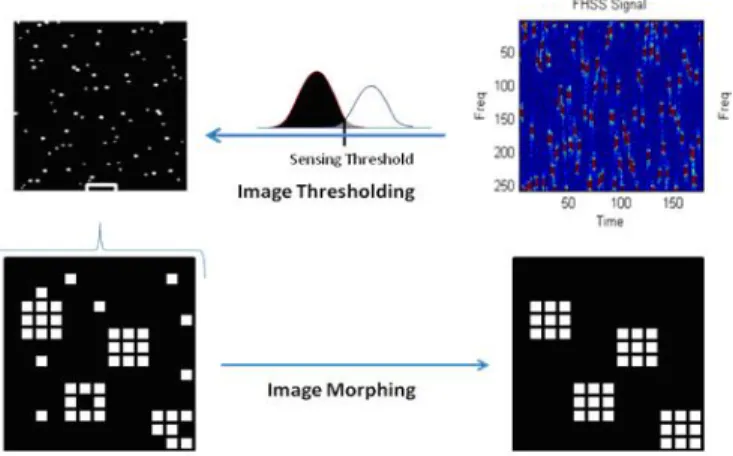
The resulting time frequency distribution is subjected to thresholding by comparison against a sensing threshold. The sensing threshold is selected assuming two overlapping distribution of signal and noise power probability density functions [19]. The choice of sensing threshold has been made so as to simultaneously minimize the false positive and false negative probabilities thereby reducing overall sensing error floor. The effects of noise are reduced from the resulting binary image by performing image morphing. The image is first dilated and then eroded to obtain finely shaped peaks and remove any individual noise pixels. Erosion implies that lowest value in a pixel’s neighborhood is selected for it while dilation chooses the maximum value. Therefore instead of complex and time taking signal processing techniques for noise removal, we have used a very simple and effective image processing tool that eliminates effects of noise from the received signal. The process is elaborated in Figure 2. The time frequency distribution of a frequency hopping spread spectrum (FHSS) signal is subjected to thresholding and the resulting binary image has been morphed to remove noise effects.
Figure 2. Image Morphing
3.3 Vertical and Horizontal Scanning
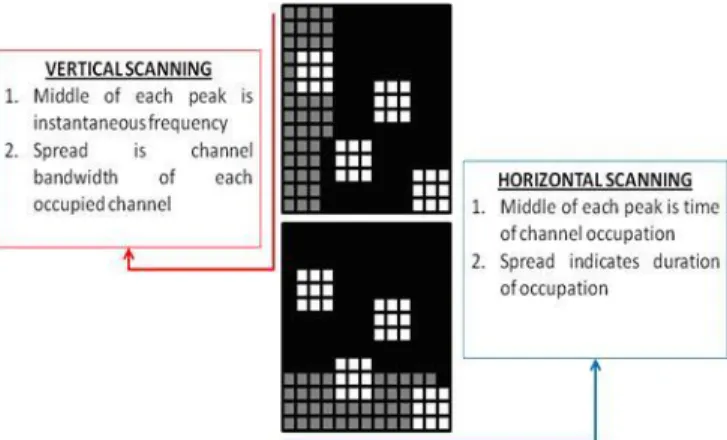
identified in this step include instantaneous frequency, bandwidth, occupation time and duration of occupation of each occupied slot. The scanning process is simplified by identifying the differences in two consecutive frames rather than scanning each frame separately. This again achieves substantial simplicity without any loss of accuracy.
Figure 3. Vertical and Horizontal Scanning
3.4 Vertical and Horizontal Projection
In the final step the binary image is projected on the horizontal and vertical axes. The aim is to identify the horizontal/vertical lines that might exist in the image due to the guard bands/ guard time in the time frequency distributions of FDMA/ TDMA based signals. In Figure 4, a TDMA based OFDM signal is subjected to this process. The peaks above a carefully selected threshold clearly show the TDMA nature of the received signal. The inter peak distance implies the time slot for each user and may be used by the cognitive radio for identifying number of primary users, frame size etc. Based on all the parameters identified, a fair estimate of the type of modulation scheme can be made and it can be decided that whether the spectrum users are licensed primary users or competing secondary users. In addition, the transmission characteristics of the various users can be utilized to predict suitability of identified spectrum holes.
Figure 4. Vertical and Horizontal Projection
4.
Simulations and Results
Two types of primary users have been simulated. One is a narrow band FHSS signal (IEEE 802.15) and other is a wide band OFDM signal (IEEE 802.11). The selection of these primary users has been done because they are from the same family of IEEE standards as the proposed cognitive radio
standard (IEEE 802.22). Selection of a narrow band and a wide band primary user allows better understanding of the proposed algorithm’s performance. These primary users co-exist in the industrial, scientific and medical radio band and any experimental implementation of cognitive radio can be suitably made. The sensing is carried out in SNR values changing from -45 to 0 dB. The reason for considering high noise levels is that for higher values of SNR, all sensing algorithms seem to work equally well. Moreover, the practical consideration of causing minimum interference to the primary users necessitates its detection even at very low values of SNR. Two TFA based techniques spectrogram and Wigner-Ville are being compared for performance against two classical spectrum sensing techniques, energy detection and cyclostationary feature detection. In all displayed results FFT stands for energy detection based spectrum sensing, SP implies spectrogram based spectrum sensing, WV means Wigner-Ville based spectrum sensing and AC (auto-correlation) implies cyclostationary based detection. Probability of false detection (PFD), probability of loss of detection (PLD), SNR and receiver operating curves (ROC) are considered as the performance metrics for comparison [5]. PFD is a measure of missed opportunities. This is important from a secondary user perspective as it indicates how many times the CR failed to identify presence of a spectrum hole, while actually it did exist. PLD is a measure of how many times the CR has failed to identify the presence of a primary user in a channel whereas it did exist. This is important from a primary user perspective. ROCs are a good criterion to judge the performance of spectrum sensing algorithm. It is the probability of loss of detection PLD plotted against probability of false detection PFD. ROCs are very useful not only in understanding the performance of a sensing technique but also to decide a suitable sensing threshold.
4.1 Simulation results for FHSS
and buffer size used is 1250 samples (a sensing time of 0.0125 milliseconds).
Fi gure 6. ROC for FHSS (AWGN)
4.2 Simulation results for OFDM
Figure 7. PFD and PLD vs. SNR (OFDM)
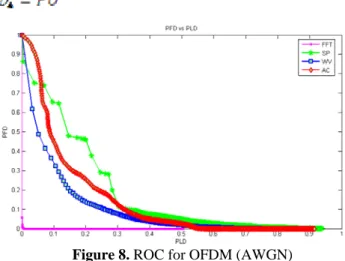
In Figure 7 we display the comparison of PFD and PLD for the various spectrum sensing techniques using OFDM primary user. The SNR changes from -45 to 0 dB. The Wigner-Ville distribution out-performs even the cyclostationarity based detectors. The buffer size is assumed as 6 OFDM symbols (relating to 0.5 microseconds). For ROC (Figure 8) the SNR is kept at -25 dB and used buffer size is of 6 OFDM symbols (relating to 0.5 microseconds). The proposed TFA based sensing algorithm performs very similar to the auto-correlation based sensing. When compared to energy detection the proposed algorithm results in slightly higher PFD but lower PLD.
4.3 Simulation results for mode identification
The cross terms are minimized by selecting the observation window so as to keep the received signal as mono-component. The sensing is carried out under AWGN with SNR values changing from 0 to 30 dBs. Four equally probable scenarios are simulated where . The presence or absence of an FHSS primary user is
represented by and respectively. Likewise presence or
absence of OFDM primary user is represented by and . The four equally likely models are represented as:
Figure 8. ROC for OFDM (AWGN)
The spectrum sensing is carried out on the simulated signals with these four scenarios alternating randomly. In order to judge the performance of the proposed algorithm, the probability of correct mode identification is considered as the performance metrics. is defined as the probability that the algorithm has successfully detected the presence or absence of a certain transmission mode whether it existed alone or overlapped. Assuming that and are the hypotheses that FHSS signal is detected in the received signal or not and that the four scenarios are equally
likely ,
(3)
(4)
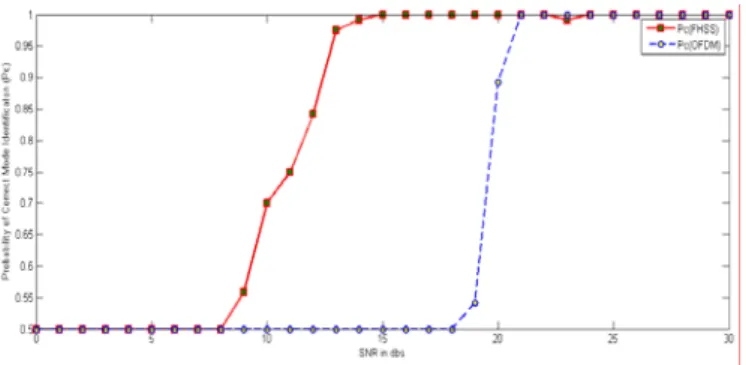
(5) The hypotheses of presence or absence of OFDM primary user has been represented as and respectively. The simulation results are shown in Figure 9. The proposed algorithm is able to detect the FHSS and OFDM primary users at low values of SNR.
4.4 Discussion on Simulation Results
However, for the narrow band primary user the algorithm achieves accurate results even at extremely low SNR values. In addition, the algorithm has successfully identified various useful parameters of the primary user transmission such as frame size, multiplexing technique, number of users at each instant, primary user bandwidth etc. These deductions are very critical for any cognitive radio to decide the suitability of the spectrum holes that have been identified and predict future behavior of the primary user.
Figure 9. Probabilities of correct mode Identification for FHSS and OFDM
5.
Conclusion
The paper discusses use of radio mode identification for spectrum sensing in cognitive radios. The focus is on identifying the spectral behavior of the primary user rather than the classical approach of identifying the spectrum holes. Time frequency analysis and digital image processing tools have been used for mode identification. The proposed algorithm outperforms the classical spectrum sensing techniques by giving improved PFD and PLD. In addition the algorithm helps in deducing various useful parameters of the primary user transmission. This gives a marked improvement in spectrum access functionality of the cognitive radio whereby the cognitive radio can decide about the suitability of the identified spectrum holes. The approach is much simpler to implement than the currently proposed radio mode identification based spectrum sensing techniques and more accurate and elaborate than classical spectrum sensing techniques.
References
[1] Linda Doyle, “Essentials of cognitive radios”, Cambridge wireless essentials series, Cambridge university press, pp. 96-105, 2009.
[2] Yucek and Arsalan, “A survey of spectrum sensing algorithms for cognitive radio applications”, IEEE Communication Surveys & Tutorials, vol. 11, no. 1, pp. 117-122, first quarter, 2009.
[3] Simon Haykin, “Cognitive radio: Brain-empowered wireless communications”, IEEE J. Selected Areas Communications, vol. 23, no. 2, pp. 201-220, Feb. 2005.
[4] Simon Haykin, “Spectrum sensing for cognitive radio”, Proceedings of the IEEE, vol. 97, no. 5, pp. 849-- 877, May 2009.
[5] Visa Koivunen, Sachin Chaudhari, Jussi Ryynanen, Marko Kosunen, Erik Larsson, Danyo Danev, Erik Axell, Aawatif Hayar, Bassem Zayen, Report of the “Sensor Network for Dynamic and Cognitive Radio
Access”, working group, Project no. European Commission -- 216076, ch. 2-3, Jan. 15, 2010.
[6] Haiyun Tang, “Some Physical layer issues of wide-band cognitive radio systems”, DySPAN, pp. 151-159, 2005. [7] Ying-Chang Liang, Yonghong Zeng, Edward C.Y. Peh,
and Anh Tuan Hoang, “Sensing-throughput tradeoff for cognitive radio networks”, IEEE Trans. Wireless Communications, vol. 7, no. 4, pp. 1326-1337, April 2008.
[8] Paul D. Sutton, Keith E. Nolan and Linda E. Doyle, “Cyclostationary Signatures in Practical Cognitive Radio Applications”, IEEE J. Selected Areas Communications, vol. 26, no. 1, pp. 13-23, Jan. 2005. [9] Danijela Cabric, Artem Tkachenko, Robert W.
Brodersen, "Spectrum Sensing Measurements of Pilot, Energy, and Collaborative Detection". Military Communication Conference (MILCOM), Oct. 2006. [10] Anant Sahai, Niels Hoven, Shridhar Mubaraq Mishra,
Rahul Tandra, “Fundamental tradeoffs in robust spectrum sensing for opportunistic frequency reuse”, IEEE J. Selected Areas Communications, 2006.
[11] Ning Han, SungHwan Shon, Jae Hak Chung, Jae Moung Kim, “Spectral correlation based signal detection method for spectrum sensing in IEEE 802.22 WRAN Systems”, ICACT 2006, The 8th International Conf. Advanced Communication Technology, pp. 1764 -- 1770 , 2006.
[12] Zhi Tian, Georgios B. Giannakis, “A wavelet approach to wideband spectrum sensing for cognitive radios”, Proc. 1st Int. Conf. on Cognitive Radio Oriented Wireless Networks & Coms. (CROWNCOM), Mykonos, 2006.
[13] Matteo Gandetto, Andrea F. Cattoni, Carlo S. Regazzoni, “A distributed approach to mode identification and spectrum monitoring for cognitive radios”, Proceeding of the SDR 2005 Technical Conference and Product Exposition, 2005.
[14] Matteo Gandetto, Carlo Regazzoni, “Spectrum sensing: A distributed approach for cognitive terminals”, IEEE J. Selected Areas in Communications, vol. 25, no. 3, pp. 546-556, Apr. 2007.
[15] Leon Cohen, “Time Frequency Analysis”, pp. 93-133. [16] Farrukh Javed, Asad Mahmood, “Use of Time
Frequency Analysis for Spectrum Sensing in Cognitive Radios”, ICSPCS 2010, pp. 1-7, Feb. 2011.
[17] Bryan S. Morse, Brigham Young University, “Lecture 4 on Thresholding”, pp. 1-5, 1998-2000.
[18] FCC, ET Docket No 03222 Notice of proposed rulemaking and order, December 2003.
[19] Boualem Boashash, “Time frequency analysis and signal processing,” Elsevier, 2003.
[20] Beibei Wang and K. J. Ray Liu, “Advances in Cognitive Radio Networks: A Survey”, IEEE J. of Selected Topics In Signal Processing, Vol. 5, NO. 1, February 2011.