Original Research Article
Evaluating the efficacy of context-focused intervention in improving
performance of functional tasks in preschool children with central
nervous system dysfunction
Anushka B. Paithankar*, Shailaja S. Jaywant
ABSTRACT
Background: Children with central nervous dysfunction should be given a variety of long-term physical and occupational therapy interventions to facilitate their self-development and to enhance functional independence in movement, self-care, play, school activities and leisure. The present study aimed to investigate the benefit of implementing context-focused intervention approach along with occupational therapy intervention in children with CNS dysfunctions.
Methods: This randomized case control study conducted in 30 children with CNS dysfunction aging between 12 months to 48 months were randomly divided into control and experimental groups consisting of 15 children in each group. Control group received conventional occupational therapy for 45 min, and experimental group received context-focused intervention approach for 30 min along with conventional occupational therapy for 15 min (thrice a week). The patients were evaluated at baseline, after 12 and 24 weeks of follow up period on Canadian occupational performance measure (COPM) to evaluate parental perception about intervention, GMFM (gross motor function measure) to study the motor ability of the patient and ICF-CY (International classification of functioning, disability and health for children and youth) for activity participation and performance with evaluation of context.
Results: Significant progress in the satisfaction score during 2nd and 3rd follow ups were noted (p <0.001) in experimental group. All the activities in GMFM score except lying and rolling showed significant improvement in experimental group (p <0.001). In experimental group a significant improvement in performance qualifier of ICF was seen during follow ups (p<0.001). The capacity qualifier scoring of ICF was improved in experimental group during 2nd follow up (p = 0.006). Progress in environmental scores of ICF during all the follow ups was noted (p <0.001) in experimental group. Significant correlation in GMFM scores and COPM performance score was noted during last follow-up in both the groups.
Conclusions: The findings of the study showed positive results with context focused therapy and thus can be inferred that new intervention approach context focused therapy along with the conventional occupational therapy is very effective in improving the performance of functional tasks in children with CNS dysfunction.
Keywords: Central nervous dysfunction, Context focused intervention, GMFM score, ICF-CY score, Satisfaction score
Department ofOccupational Therapy, LTMMC and G Hospital, Sion, Mumbai, Maharashtra, India
Received: 28 March 2018
Accepted: 14 May 2018
*Correspondence:
Dr. Anushka B. Paithankar,
E-mail: [email protected]
Copyright: © the author(s), publisher and licensee Medip Academy. This is an open-access article distributed under the terms of the Creative Commons Attribution Non-Commercial License, which permits unrestricted non-commercial use, distribution, and reproduction in any medium, provided the original work is properly cited.
INTRODUCTION
Children with central nervous system dysfunction like cerebral palsy, Downs’s syndrome, and other neurological problems have delay in development which leads to functional impairment. Neurological dysfunction is caused by damage to the motor control centers of the developing brain and can occur during the prenatal, perinatal, or early postnatal period. Resulting limits in movement and posture cause activity limitation that is attributed to non-progressive disturbances that occurred in the developing fetal or infant brain. The motor disorders are often accompanied by disturbances of sensation, perception, cognition, communication, and/or behaviour and/or by epilepsy, and accompanied by secondary musculoskeletal problems.1
The common signs and symptoms associated with central nervous system dysfunction can have a significant impact on participation in occupations. Occupation is a term used in occupational therapy that refers to all activities a person does throughout their day. These activities may be grouped into the categories of self-care, productivity and leisure activities. Impairments related to central nervous system dysfunction can impact these activities. Self-care is any activity children do to care for themselves. Self-care activities, such as eating, dressing, grooming, bathing, and toileting can be difficult for children with central nervous system dysfunction due to activity limitations and participation restrictions.2
The effects of sensory, motor and cognitive impairments not only affect self-care occupations in children with central nervous system dysfunction, but also productivity and leisure occupations. Productivity can include school, work, household chores and play.3 Leisure occupations
are any activities that are done for enjoyment. They have several positive effects on physical health, mental health, life satisfaction and psychological growth for the children with physical disabilities like central nervous system dysfunction.4
The children with central nervous system dysfunction are generally treated with occupational therapy to facilitate motor development and to enhance functional independence in movement, self-care, play, school activities and leisure activities. Now-a-days a successful new rehabilitation approach called a “context-focused intervention” is being used for treating children with neurological dysfunction, which focuses primarily on changing constraints in the environment or task as the starting point of intervention. Both the physical environment and the social environment of the child are emphasized.5 Environmental considerations are the
identification of physical, social and attitudinal influences that represent barriers to or facilitators of successful completion of the identified task or goal.6
The parental attitudes and satisfaction plays important role in successful intervention of these children. The
assessment of the effectiveness of the context focus intervention can be done using COPM (Canadian Occupational Performance Measure) by parents. This measure identifies activities that represent problems in the child’s daily life.7
The purpose of this study was to implement context-focused intervention approach in children with CNS dysfunctions and to investigate the functional outcome and participation after occupational therapy intervention.
METHODS
This was a randomized case control study conducted in children with CNS dysfunction aging between 12 months to 48 months. The study included 30 children and they were randomly divided into control and experimental groups consisting of 15 children in each group from the occupational therapy Department outpatient setting. The study was carried out at O. T. School and Training Centre, L. T. M. G. Hospital, Sion, Mumbai from October 2012 to October 2013.
Children classified in levels II-V on the gross motor function classification system (GMFCS) were also included in the study. Exclusion criteria were children with planned surgery or medical changes during the study that may affect their motor function, mentally challenged with moderate to severe mental retardation, congenital anomalies and musculoskeletal complications.
Screening tool used
The gross motor ability level of the child is classified by the GMFCS (Gross motor function classification system). The screening test was used to assess level of motor development. It should be between level II and V of gross motor function classification system. Detailed history was taken, and basic paediatric evaluation was done before starting therapy. Parents were explained about the treatment protocol. Consent forms where obtained from the parents of the subjects. Initial evaluation was done by discussing and identifying problems and goals with parents using Canadian occupational performance measure (COPM) questionnaire to assess the baseline of their child’s activities of daily living (ADL) development.7 Semi-structured interviews of care givers
Control group received conventional occupational therapy treatment for 24 weeks (thrice a week for 45 min session) and the improvement was measured using same assessment tool at 12th week and 24th week post
treatment.
Experimental group received intervention as control group for 15 min along with context focused therapy for 30 min (thrice a week for 45 min session). The improvement was measured using the same assessment tool at 12th week and 24th week post treatment.
In experimental group context therapy intervention protocol included the family and therapist prioritized goals collaboratively, based on the identified issues through COPM questionnaire. For the assessment process, the child’s performance on each goal was identified. Ideally the assessment has to be done in the natural environment relevant to the goal (e.g. home, school, backyard), but in some instances, because of family and/or therapist constraints, the assessment was completed in the rehabilitation centre. The parent and therapist identified factors within the task and the environment that were either helping or hindering a child’s performance. From this list, they identified factors that could be adapted or changed to achieve the goal as quickly as possible. Therapists used a strength-based approach, first identifying factors within the task and environment that supported a child’s attempt to complete the identified goal and then identifying task and environmental constraints. In some instances, family videotaped the child’s performance on each goal in the natural environment (e.g. home) to identify factors within the task and the environment. The conventional occupational therapy treatment included facilitation of normal movement patterns and postural control through physical handling, maintaining range of motion and joint alignment through stretching, casting and splinting, strength training, developing motor control using NDT.
Statistical analysis
SPSS Version 17 was used for analysis. All the quantitative data was represented using mean±SD and Median and IQR (Interquartile range). Analysis of Quantitative data between the two groups was done using unpaired t-test only for age and by Mann-Whitney test for the rest variables as the data was ordinal type. Analysis of quantitative data within each group was done using Friedman repeated measures analysis of variance on Ranks, with application of appropriate Post Hoc test if P-value of ANOVA comes statistically significant. Relationship between Quantitative data was assessed by Spearman’s correlation.
RESULTS
The study included 30 children with CNS dysfunction. They were randomly divided into control and experimental groups with 15 children in each group and
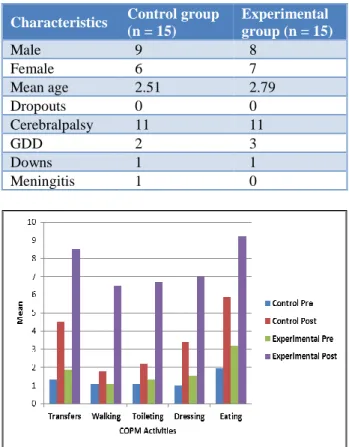
their socio demographic details were presented in Table 1.
Table 1: Socio-demographic details of study population.
Characteristics Control group (n = 15)
Experimental group (n = 15)
Male 9 8
Female 6 7
Mean age 2.51 2.79
Dropouts 0 0
Cerebralpalsy 11 11
GDD 2 3
Downs 1 1
Meningitis 1 0
Figure 1: Comparison of COPM (satisfaction score) between experimental and control group.
Figure 1 presents the comparison of COPM satisfaction score in control and experimental group. No significant difference in the baseline readings of satisfaction score for transfer, walking and toileting was observed but a significant difference in the satisfaction during the follow ups was noted (p <0.001) in experimental group.
No significant difference in GMFM summary score in lying and rolling was observed in both the groups at baseline and during all follow ups. But all other activities such as kneeling, standing, walking, etc. showed significant improvement in experimental group compared to control group (p <0.001) as in Figure 2.
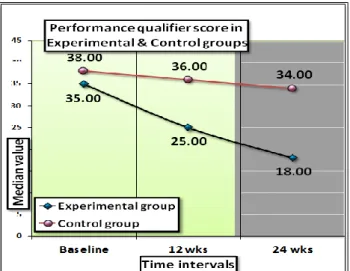
Figure 3: Comparison of performance qualifier score between control and experimental group.
As shown in Figure 3 there was no significant difference in the baseline readings of performance qualifier of ICF but in experimental group a significant difference was noted during follow ups (p <0.001).
Figure 4: Comparison of capacity qualifier score between control and experimental group.
As given in Figure 4, there was no significant difference in the baseline readings and 1st follow up of capacity
qualifier of ICF (p = 0.819 and p = 0.164 respectively) in both groups. The significant difference in the capacity qualifier of ICF in experimental group during 2nd follow
up was noted (p = 0.006).
There was no significant difference in the baseline readings of environmental scores of ICF (p = 0.834). The significant difference in the environmental scores of ICF during all the follow ups was noted (p <0.001) in experimental group.
Table 2: Correlation between GMFM and COPM performance score at 24 weeks in control group.
Variables Spearman's rho Lying and
Rolling Sitting
Crawling and
Kneeling Standing
Walking,
running, jumping
Transfers
Correlation
coefficient 0.782(**) 0.798(**) 0.633(*) 0.497 0.563(*) P value 0.00058 0.00036 0.01129 0.05973 0.02893 Walking
Correlation
coefficient 0.456 0.618(*) 0.436 0.406 0.693(**) P value 0.08749 0.01404 0.10425 0.13339 0.00421 Toileting
Correlation
coefficient 0.061 0.333 0.294 -0.065 0.369 P value 0.82766 0.22517 0.28819 0.81795 0.17527 Dressing
Correlation
coefficient -0.091 0.037 0.131 0.438 0.567(*) P value 0.7476 0.89631 0.64178 0.10255 0.02753 Eating
Correlation
coefficient 0.387 0.403 0.611(*) 0.386 0.558(*) P value 0.15408 0.13682 0.01562 0.15475 0.0306
*Correlation is significant at the 0.05 level (2-tailed); **Correlation is significant at the 0.01 level (2-tailed)
Significant correlation in GMFM scores and COPM performance score was noted during last follow-up in both the groups. Table 2 presents the correlation between
score except with standing (p = 0.059). Walking was significantly correlated with sitting, walking, running and jumping (p = 0.01 and p = 0.004, respectively). Toileting was not correlated with any of the variable of GMFM
score. Dressing and eating was correlated with only walking, running and jumping (p = 0.027 and p = 0.03, respectively).
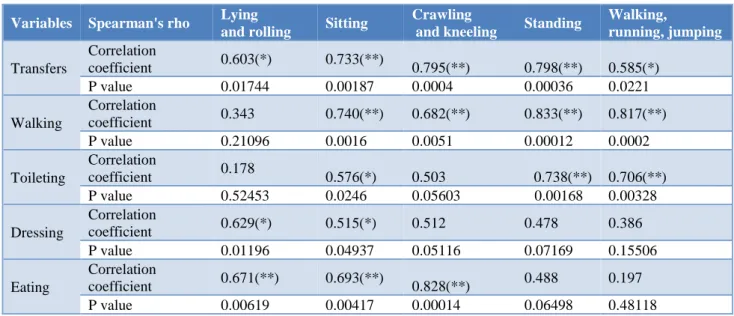
Table 3: Correlation between GMFM and COPM performance score at 24 weeks in experimental group.
Variables Spearman's rho Lying
and rolling Sitting
Crawling
and kneeling Standing
Walking,
running, jumping
Transfers
Correlation
coefficient 0.603(*) 0.733(**) 0.795(**) 0.798(**) 0.585(*) P value 0.01744 0.00187 0.0004 0.00036 0.0221 Walking
Correlation
coefficient 0.343 0.740(**) 0.682(**) 0.833(**) 0.817(**) P value 0.21096 0.0016 0.0051 0.00012 0.0002 Toileting
Correlation
coefficient 0.178 0.576(*) 0.503 0.738(**) 0.706(**) P value 0.52453 0.0246 0.05603 0.00168 0.00328 Dressing
Correlation
coefficient 0.629(*) 0.515(*) 0.512 0.478 0.386 P value 0.01196 0.04937 0.05116 0.07169 0.15506 Eating
Correlation
coefficient 0.671(**) 0.693(**) 0.828(**) 0.488 0.197 P value 0.00619 0.00417 0.00014 0.06498 0.48118
*Correlation is significant at the 0.05 level (2-tailed); ** Correlation is significant at the 0.01 level (2-tailed)
As given in Table 3, most of the variables of COPM score were correlated significantly with GMFM scores in the order transfers followed by walking, toileting, eating and dressing. Walking was not correlated with lying and rolling (p = 0.21). No significant correlation was seen between lying and rolling (p = 0.52) and crawling and kneeling (p = 0.056). Dressing and eating was not correlated with standing, walking, jumping and running (p >0.05).
DISCUSSION
The present study was conducted to evaluate the efficacy of a task/context-focused approach compared to conventional remediation approach in improving performance of functional tasks and mobility, increasing participation in everyday activities, and improving quality of life in children 12 months to 48 months of age with CNS dysfunction. The outcome measures used was COPM to evaluate parental perception about intervention. GMFM was used to study the motor ability of the patient. ICF-CY was used for activity participation and performance with evaluation of context. 30 children participated in this study considering the inclusion and exclusion criteria. Randomly they were divided into experimental and control groups consisting 15 children in each group. Control group received conventional occupational therapy and experimental group received additionally context focused therapy for 30 min (thrice a week for 45 min session). In this study, the mean age group in control and experimental group was 2.51 and
2.79 respectively. As shown in Figure 1 there was no significant difference in COPM satisfaction score in the baseline readings of performance of transfer, walking and toileting. But a significant difference in performance in all the follow ups was noted. Though dressing and eating showed significant difference in base line during follow-ups the score improved more steeply in experimental group. Therapist used contextual evaluation and used the detail analysis of environment restricting in participation of activities; intervention for reducing these barriers was planned for the subjects in experimental group.
In occupational therapy practice framework, child factors include body structure and function that are affected by disability. ADLs are performed in context of interwoven internal and external conditions. This context influences activity demands participation. Adapting task methods was recommended also by Smith.10 The method included
partial participation of therapists and caregivers when child cannot complete task independently. This method helped in improving performance and satisfaction. Adapting physical environment also improves task performance. As noted by Mary law et al in her study, in the context-focused group, therapist modifies physical characteristics of environment, task, materials or tools, practice of functional mobility activities, changing a task instruction, adding adaptive equipment, and providing education/instruction to the family and encourages the practice of functional mobility activities.7 The goal is to
strategies, and to encourage practice of tasks within the natural environment.2
While changing the environment, caregiver’s assistance was also used as a context focus therapy. In a study by Brotherson et al and Ketelaar et al, parents expressed the view that their time was used more efficiently when therapists integrated the training into activities that were part of the family’s daily routines and home environment.11,12 As therapists we need more knowledge
about how to truly integrate training into activities in home life and how to measure the effect of home interventions on family life. This was also supported by Jansen et al.13
GMFM was used to evaluate development of postural control and motor abilities ranging from lying and rolling to independent walking, running, and jumping. In the present study, no significant difference was seen in lying and rolling in both the groups during all follow ups on GMFM scale. But all other activities showed significant improvement in experimental group. At the level of the individual child, changes in scores in this study from baseline to six months represent observable functional improvement for children with CNS dysfunction. Mary Law et al in their review also noted similar observations. The context focused approach indicated that it was feasible and has potential to facilitate change in motor performance in young children with CP.
There was no significant difference observed in the baseline readings of performance qualifier of ICF. The significant difference during all the follow ups was noted. In experimental group the score has increased from 18 to 35 and in control group score increased only from 34 to 36. This difference in experimental group might be due to the special attention of the therapist more to the context in which child performs daily activities. The therapist had done active intervention in changing the context personal, attitudinal, social or physical. The above observation also goes in agreement with the concept proposed by Valvano et al. According to him, therapeutic adaptations to activities such as handling techniques during context therapy might help children to initiate and produce even difficult movements that are required during daily routine and play activities.14
Capacity qualifier is the expected level of performance in the standardized environment by child of same age. As shown in Figure 4, there was no significant difference in the baseline readings and 1st follow up of capacity
qualifier of ICF. The significant improvement in the capacity qualifier of ICF in experimental group during 2nd
follow up was noted. Recent studies have demonstrated the effectiveness of the inclusion of goal setting in the therapy process. In the current trial, the context-focused approach included a specific goal-setting strategy using the Canadian Occupational Performance Measure. It may have contributed to the overall changes in functional performance documented after the context-focused therapy intervention.In the study conducted by Ketelaar
to study the effects of a functional therapy program on motor abilities of children with cerebral palsy had stated that the family members were also involved in goal setting. Fundamental aspect of cooperation between families and others actively involved in daily care of children with CP in the formulation of specific goals for treatment was appreciated in the study, although this component of the context -focused approach was not examined separately in the present study.15
In another study conducted by King et al, it was suggested that goals can be viewed as being the ‘cement’ that can assist in avoiding fragmentation of services.16
The study recommended that by making individual goals clear, everyone involved with the children can understand them and can unite and work together with the children to achieve them. Goals that are understandable, attainable, and time-limited give the child or care giver an opportunity for active problem solving: a fundamental aspect of motor learning. The parents in this study could give betterchoice of capacity qualifier as they were also involved in changing attitudinal context.
In this study,no significant difference was seen in the baseline readings of environmental scores of ICF but a significant progress was noticed in experimental group in the environmental scores of ICF during all the follow ups.Dunn recommended using a contextual approach to the assessment is relevant to the person and addresses the person’s wants and needs.17 Fisher also advocated an
assessment process for the recognition of occupational therapy's unique perspective of function in the assessment process. She emphasized the importance of considering the meaningfulness of the measure and placing the assessment within context.18
In the present study ecological nature of disability and interdependence between the individual and environment was considered as per client/caregivers’ expectations as proposed by Mary. Her guidelines to create the suitable environment were built by proposing change in physical environment, counselling about attitudes and advice about safe mobility in the community. Skills in negotiation, communication, and conflict resolution were used to facilitate solutions considering peoples values. Environmental factors such as equipment and other modifications seek to enhance the child’s functioning in daily life.19
Harris et al in their review have noted that the use and role of assistive equipment to enhance the child’s functioning in everyday activities have received scant attention, both in clinical assessments and in research.6
Sigrid et al also presented the need for, and the family’s readiness to accept, a device between children and parents.20 Hence in the present study, the authors have
along with physical context intervention also helped in changing environment from barriers to facilitator. In this study the COPM score considers all functional activities and are measured by caregiver’s interviews. Table 2 and 3 showed correlation between COPM performance score and GMFM in control and experimental group respectively. The correlation found to be significant. This also goes in agreement with study done by Ketelaar M on effects of a functional therapy program on motor abilities of children with cerebral palsy.15
This study was conducted for short duration so limited functional activities were targeted. Most of the subjects were diagnosed as cerebral palsy so further study is needed for generalising the results for children with CNS dysfunction. The overall outcome of study may have influenced by socioeconomic status of parents. The major advantage of the present study is that it has considered participation of subjects with active participation of parents.
CONCLUSION
The approach of the context focused therapy was novel to the care-givers. ICF environmental evaluation helped therapists to identify the constraints in the environment and plan intervention which resulted in better functional outcome in the experimental group than the control group.
So, the null hypothesis context focused intervention approach along with the conventional occupational therapy is not effective in treating children with CNS dysfunction can be rejected and the new hypothesis new intervention approach context therapy along with the conventional occupational therapy is effective in children with CNS dysfunction can be accepted.
Funding: No funding sources Conflict of interest: None declared
Ethical approval: The study was approved by the Institutional Ethics Committee
REFERENCES
1. Paneth N, Leviton A, Goldstein M, Bax M, Damiano D, Dan B, et al. The definition and classification of cerebralpalsy. Developmental Med Child Neurol. 2007;49(8):8-14.
2. VanZelst B, Miller M, Russo R, Murchland S, Crotty M. Activities of daily living in children with hemiplegic cerebralpalsy: a cross-sectional evaluation using the Assessment of Motor and Process Skills. Developmental Med Child Neurol. 2006;48(9):723-5.
3. Blesedell CE, Cohn ES, Schell AB. Willard and Spackman’s Occupational Therapy. 8th edition;
2003:705-709.
4. Smith M, Sandberg AD, Larsson M. Reading and spelling in children with severe speech and physical impairments: a comparative study. International J Language Communication Dis. 2009;44(6):864-82. 5. Law M, Darrah J, Pollock N, King G, Rosenbaum P,
Russell D, et al. Family-centred functional therapy for children with cerebral palsy: an emerging practice model. Physical Occupational Therapy Pediatric. 1998;18:83-102.
6. Harris RH. Functional abilities in context. In: Lister MH, editor, Contemporary Management of Motor Problems: Proceedings of the II STEP Conference. Foundation for Physical Therapy; 1991:253-259. 7. Law M, Sue Baptiste S, Carwell A, McColl MA,
Polatajko H, Pollock N. Canadian occupational performance measure: an outcome measure for occupational therapy. Canadian J Occupational Ther.1990;57(2):82-7.
8. Rosenbaum PL, Palisano RJ, Bartlett DJ, Galuppi BE, Russell DJ. Development of the Gross Motor Function Classification System for cerebral palsy. Developmental Med Child Neurol. 2008;50:249-53. 9. World Health Organization: International
classification of functioning, disability and health version for children and youth Geneva: WHO; 2004. 10. Smith JC. Foundation for occupational therapy practice with children. Chapter No. 2. Occupational Therapy for Children. 6th edition. Mosby
Publication; 2010:22-50.
11. Brotherson MJ, Goldstein BL. Time as a resource and constraint for parents of young children with disabilities: implication for early intervention services. Top Early Child Spec Educ. 1992;12:508-27.
12. Ketelaar M, Vermeer A, Hart HT, van Petegem-van Beek E, Helders PJ. Effects of a functional therapy program on motor abilities of children with cerebral palsy. Phys Ther. 2001;8:1534-45.
13. Jansen LM, Ketelaar M, Vermeer A. Parental experience of participation in physical therapy for children with physical disabilities. Developmental Med Child Neurol. 2003;45:58-69.
14. Valvano J, Rapport MJ. Activity-focused Motor interventions for infants and young children with neurological conditions. Infants Young Children. 2006;19(4):292-307.
15. Ketelaar M, Vermeer A, Hart H, van Petegem-van Beek E, Helders PJM. Effects of a functional therapy programon motor abilities of children with cerebral palsy. Physical Therapy J. 2001;81(9):1534-45.
16. King G, McDougall J, Palisano R, Gritzan J, Tucker M. Goal attainment scaling: its use in evaluating pediatric therapy programs. Physical Occupl Ther Pediatric. 1999;19:31-52.
18. Fisher AG. Functional measures, part 2: Selecting the right test, minimising the limitations. Am J Occupl Ther. 1992;46:278-81.
19. Law M. Muriel driver lecture, the environment: a focus for occupational therapy. CJOT. 1991;58(4):171-80.
20. Ostensjo S, Carlberg EB. Everyday functioning in young children with cerebral palsy: functional skills, caregiver assistance, and modifications of the
environment. Developmental Med Child Neurol. 2003;45:603-12.
Cite this article as: Paithankar AB, Jaywant SS. Evaluating the efficacy of context-focused