KEVIN W. HANLEY. Design of a Hazard Communication Program for the National Institute of Environmental Health Sciences. (Under the
direction of DR. JOHN M. DEMENT.)
Key Words - Hazard Communication, Right To Know, North Carolina, Research Laboratory, Chemical Hazards, Material Safety Data Sheets, Container Labeling, and Employee Training.
Abstract
On November 25, 1983, the federal Occupational Safety and Health
Administration promulgated the "Hazard Communication Regulation" (29 CFR
1910.1200). The state of North Carolina amended this legislation on June 27, 1985 [North Carolina Occupational Safety and Health Hazard Communication ; 13 NCAC 7C.0101(a)(99)]. These regulations address the
issue of communicating chemical hazards to employees who are potentially
exposed to hazardous substances in the workplace. They accomplish the communication in five separate but related tasks. These are the deter¬
mination of hazards, the development of Material Safety Data Sheets, the implementation of container labeling, the training of employees, and the
writing of a Hazard Communication Program.
North Carolina has also passed the "Hazardous Chemical Right To
Know Act" on July 17, 1985 (Article 18, Chapter 95, North Carolina
General Statutes 95-173 et seq.). This legislation pertains to the com¬ munication of chemical hazards to the Fire Marshall and other Public Safety Officials as well as the North Carolina community at large.
A compliance strategy for the National Institute of Environmental
Table of Contents
page
I. INTRODUCTION... 1
An Overview of NIEHS... 1
History of the Federal Hazard Communication Regulation... 2
History of the North Carolina State Hazard Communication Regulations... 3
II. OVERVIEW OF FEDERAL AND NORTH CAROLINA OCCUPATIONAL HAZARD COMMUNICATION REGULATIONS... 5
Purpose... 5
Scope and Application of the Federal Regulation... 5
Scope of Laboratory Requi rements... 6
Total Exemptions... 7
Basic Program Elements... 7
Hazard Determi nati on... 8
Container Labeling... 10
Labeling Exemptions... 11
Other Forms of Warning... 12
Materi al Safety Data Sheets... 12
Employee Training... 14
Written Hazard Communication Program... 15
Trade Secrets... 16
Conditions for Claiming Trade Secrets... 16
Supporting Criteria for Claiming Trade Secrets... 17
Access to Trade Secrets... 18
Trade Secret Disclosure Exemptions... 20
Effective Dates... 21
North Carolina Amendments to the Federal Hazard Communication Standard... 21
III. REVIEW OF NORTH CAROLINA HAZARDOUS CHEMICALS RIGHT-TO-KNOW ACT... 24
Elements of the Act... 24
Hazardous Substance List... 25
Materi al Safety Data Sheets... 26
Container Labeling... 26
Notification of the Fire Marshall... 26
Notification of the Community... 27
Trade Secrets... 28
Access to Trade Secrets... 28
Exempti ons... 29
Effective Date... 31
IV. LITERATURE REVIEW... 32
Laboratory Hazards... 32
Description of Hazards... 32
Epidemiological Studies of Laboratory Workers... 33
Evaluation of Laboratory Worker Exposures... 34
Container Labeling... 38
Objectives of Container Labeling... 38
Basic Principles for Effective Labels... 38
IV. (cont.) page
Food and Drug Administration... 39
,^ . Consumer Products Safety Commission... 39
Environmental Protection Agency... 40
Department of Transportation... 40
United Nations... 41
National Fire Protection Association... 41
Chemical Manufacturing Association/American National Standards Institute... 42
National Institute for Occupational Safety and Heal th... 45
Review of Programs for Control of Hazardous Materials... 48
Control of Hazardous Materials in Industry... 48
Control of Hazardous Materials in Laboratories... 52
Materi al Safety Data Sheets... 55
Employee Training... 55
V. EXISTING HAZARDOUS MATERIAL CONTROL PROGRAMS AT NIEHS... 63
Hazardous Agent Protocol Reviews... 63
High Containment Laboratories... 65
Employee Training... 66
Medical Surveillance... 67
Review of Hazardous Material Purchase Requests... 67
VI. NIEHS OPTIONS FOR COMPLYING WITH HAZARD COMMUNICATION REGULATIONS... 68
Notification of Employees' Rights... 68
Hazard Determination... 69
Chemical Inventory... 70
Container Labeling... 77
Other Forms of Warning... 77
Materi al Safety Data Sheets... 78
Employee Training... 80
Written Hazard Communication Program... 84
Non-Routine Tasks... 84
Unlabeled Pipes and Vessels... 85
Contractors... 86
VII. A PROPOSED HAZARD COMMUNICATION PROGRAM FOR NIEHS... 89
Notification of Employees' Rights... 89
Hazard Determination... 91
Chemical Inventory... 91
Container Labeling... 91
Other Forms of Warning... 93
Material Safety Data Sheets... 94
Empl oyee Trai ni ng... 94
Trade Secrets... 96
Employee Requests for Material Safety Data Sheet... 97
Non-Routine Tasks... 97
Unlabeled Pipes and Vessels... 97
Contractors... 98
Written Hazard Communication Program... 98
Hazard Communication Manager... 99
VIII. IMPLEMENTAION... 100
IX. DISCUSSION... 102
Appendi ces... 109
References Cited... 169
ͣ
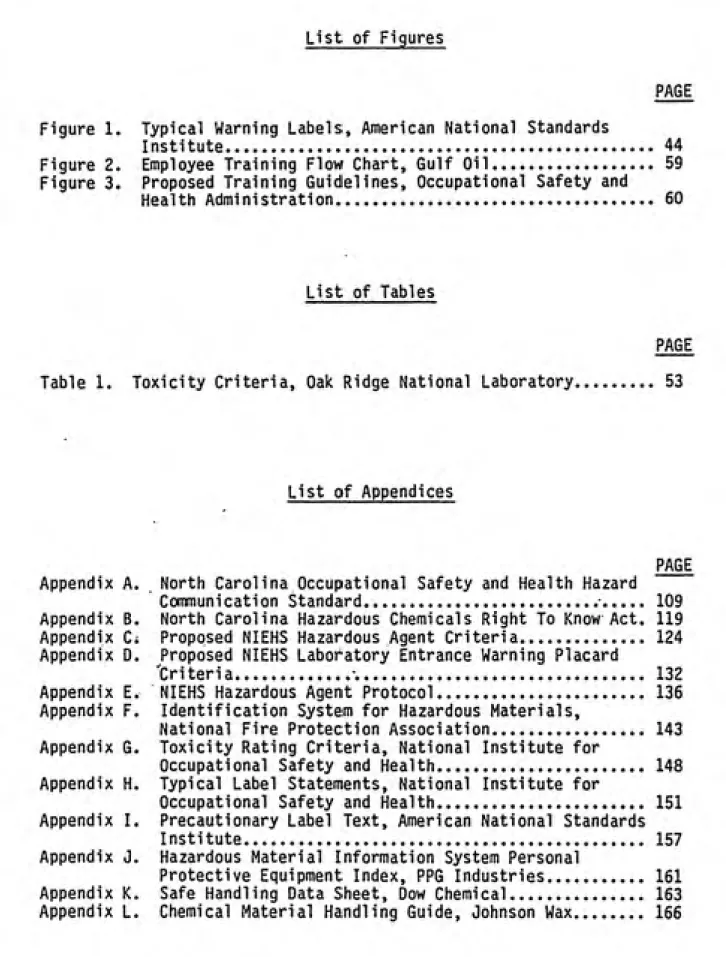
PAGE
Figure 1. Typical Warning Labels, American National Standards
Institute... 44
Figure 2. Employee Training Flow Chart, Gulf Oil... 59
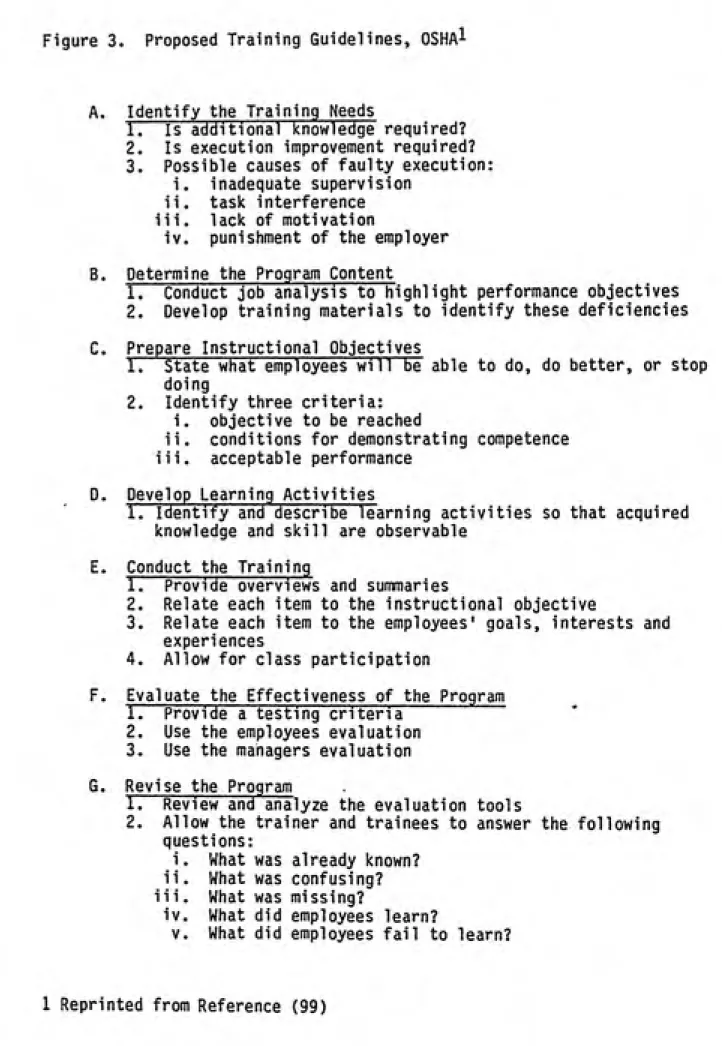
Figure 3. Proposed Training Guidelines, Occupational Safety and
Health Administration... 60
List of Tables
PAGE
Table 1. Toxicity Criteria, Oak Ridge National Laboratory. 53
List of Appendices
Appendix A. Appendix B. Appendix C. Appendix D. Appendix E. Appendix F. Appendix G. Appendix H. Appendix I. Appendix J. Appendix K. Appendix L.
PAGE
North Carolina Occupational Safety and Health Hazard
Communication Standard... 109
North Carolina Hazardous Chemicals Right To Know Act. 119 Proposed NIEHS Hazardous Agent Criteria... 124 Proposed NIEHS Laboratory Entrance Warning Placard
Cri teri a... 132
NIEHS Hazardous Agent Protocol... 136 Identification System for Hazardous Materials,
National Fire Protection Association... 143
Toxicity Rating Criteria, National Institute for
Occupational Safety and Health... 148 Typical Label Statements, National Institute for
Occupational Safety and Health... 151 Precautionary Label Text, American National Standards
I nsti tute... 157 Hazardous Material Information System Personal
Protective Equipment Index, PPG Industries... 161 Safe Handling Data Sheet, Dow Chemical... 163
ACKNOWLEDGEMENTS
I would like to thank all of the University of North Carolina, School of Public Health faculty members by whose knowledge I have
matured. I would especially like to thank my Faculty Advisor, Dr. John
M. Dement, for his guidance, support and dedication. I also wish to
express my gratitude to the other committee members. Dr. David A. Fraser and Dr. Alvis G. Turner, as well as the Safety Officer at NIEHS,
Mr. Chris Hunt Jr., for their constructive criticism and professional interest.
I am also in debt to the entire Health and Safety Office staff at NIEHS, for making my tour at the Institute both educational and
enjoyable.
Most importantly, I would like to thank my fiancee, Lisa, for her patience, support and never ending love.
This project was conducted as part of a graduate training program and was supported in part by NIOSH Traineeship Grant #
5-0-401-4630-381246571 and # 5-0-401-4630-38133-6571, and by the National Institute of Environmental Health Sciences.
An Overview of NIEHS
The National Institute of Environmental Health Sciences (NIEHS) is
a diverse laboratory facility belonging to the National Institutes of
Health, Department of Health and Human Services. The purpose of NIEHS
is to conduct biomedical and biochemical research on the health effectsof the environment (61). The three major objectives of the Institute
are the generation of data to assist in the formulation of better public
health policies, the reduction of the high cost of health care by empha¬
sizing health promotion and disease prevention, and the development of
suitable safeguards for emerging technologies (61).A broad spectrum of scientific disciplines are represented at the
Institute. A partial listing includes chemistry, physiology, bioche¬
mistry, pharmacology, biophysics, cellular biology, genetics, pathology,
and epidemiology (62). NIEHS facilities include approximately 300
laboratories and employs about 700 employees. For the purposes of
Hazard Communication the employees of concern are those who are poten¬
tially exposed to hazardous substances - scientists, technicians, shop
and maintenance personnel, animal handlers, and contractors.
Due to the nature of the research conducted at NIEHS, some
employees are potentially exposed to some toxic chemicals. Often, very
little hazard information exists for the substance under study. A large
research establishment such as NIEHS, represents one of the more
In 1974, the National Institute for Occupational Safety and Health (NIOSH) published a criteria document which recommended that the
Occupational Safety and Health Administration (OSHA) promulgate a stan¬
dard dealing with hazardous chemical communication. This document was
titled "A Recommended Standard ... An Identification System for
Occupationally Hazardous Materials," and included provisions for con¬
tainer labeling and the development of Material Safety Data Sheets
(MSDSs) (65).
Also in 1974, a Standards Advisory Committee for hazardous material labeling was established in accordance with section 7(b) of the
Occupational Safety and Health Act of 1970 (OSH Act). The purpose of this committee was to develop guidelines for the implementation of sec¬ tion 6(b)(7) of the OSH Act. A final report was submitted by the commit¬ tee on June 6, 1975. This report recommended guidelines for
characterizing and ranking chemical hazards as well as the labeling of containers, the development of MSDSs, and the training of employees.
OSHA published an Advanced Notice of Proposed Rulemaking on chemi¬ cal labeling in the Federal Register (42 FR 5372) on January 28, 1977. In this advanced notice, public comment was requested on the need for a
standard which would require employers to label hazardous materials and
to inform their employees of the hazards to which they are exposed. In general, there was an overwhelming support for the concept of hazard
communication.
On January 16, 1981, OSHA published a Notice of Proposed Rulemaking
entitled "Hazards Identification" (46 FR 4412). This notice would have
required employers to assess the hazards of the chemicals in their
workplace using a specified procedure. Also, labels were to be affixed
to all containers of hazardous chemicals within the workplace (including
pipes and vessels) as well as those leaving the site. This notice was
withdrawn by OSHA on February 12, 1981 (46 FR 12214). OSHA stated that
the purpose of the withdraw! was so that they could reconsider the regu¬
(47 FR 12092). This proposal required that chemical manufacturers
assess the hazards of the chemicals they produce in lieu of the indivi¬
dual employers. Employers in the Standard Industrial Classification
(SIC) code 20-39 were to establish a hazard communication program for
their employees. The communication was to be accomplished by labeling in-plant and downstream containers and through the availability of MSDSs and employee training. OSHA believed the proposed standard was needed
because many employees and employers were not aware of the hazards of chemicals in their workplaces and that this lack of knowledge increased
the risk of occupationally related chemical source illnesses and
injuries.
The proposed rulemaking became law with some modifications, when
OSHA added it to the final rule of the OSH Act. This standard entitled "Hazard Communication" (29 CFR 1910.1200) was published in the Federal Register (48 FR 53280) on November 25, 1983.
History of the North Carolina State Hazard Communication Regulations
North Carolina (NC) has an OSHA approved state plan for the enfor¬ cement of occupational safety and health standards, in accordance with
section 18(c) of the OSH Act. The NC Commissioner of Labor has the
authority to adopt and promulgate occupational safety and health regula¬
tions for the protection of employees in the state (NC General Statute
95-131). A condition of the state plan approval is that the state stan¬
dards must be at least as effective as the corresponding federal regula¬
tions. On February 1, 1984, NC adopted by reference the Federal Hazard
Communication Regulation (29 CFR 1910.1200) and inserted it into the NC
Administrative Code [13 NCAC 7C.0101(a)(99)].
The state adopted regulation was amended by the NC Department of
Labor on June 27, 1985. The amendments modified the federal regulation
to yield a rule which is probably more effective in achieving the
underlying objective of decreasing occupational illnesses and injuries
et seq.) which differs from the NC Occupational Safety and Health
Communication Standard [13 NCAC 7C.0101(a)(99)]. This legislation focu¬
ses on the dissemination of chemical hazard information to the Fire
Marshall (and other Public Safety Officials having jurisdiction) as well
as the NC community at large.
This report provides a foundation for developing a strategy which
can be used by NIEHS to comply with these Hazard Communication
Regulations. The regulatory requirements of the federal and state stan¬
dards are described, a literature review of relevant issues is provided, compliance options are discussed, and a Hazard Communication Program proposal for NIEHS is presented.
Purpose
The purpose of occupational Hazard Communication Regulations is to ensure that the hazards of chemicals produced in or imported to the U.S.
are evaluated and this information is transmitted to the affected
employees. The overall objective of the standard is to reduce the inci¬
dence of chemical source illnesses and injuries in the workplace through increased availability and comprehension of chemical hazard information.
Scope and Application of the Federal Regulation
The federal rule is intended to preempt any state and local law pertaining to hazard communication in the workplace. Any state which
desires to assume this responsibility may do so only under the provi¬
sions of section 18 of the OSH Act which deals with state jurisdiction and state OSHA plans (29 USC 651 et seq.).
The final rule of the Federal Hazard Communication Standard only applies to chemical manufacturers, importers and distributors, and busi¬ nesses in SIC 20-39 (the manufacturing sector). Although many busi¬ nesses outside of SIC 20-39 have significant numbers of employees
exposed to hazardous chemicals, OSHA believed the manufacturing sector
had the greatest need for hazard communication. This decision was based on the fact that approximately 50% of the reported chemical source
illnesses and injuries occured in the manufacturing sector, although
hazard information must be developed in the manufacturing sector
regardless of the scope of the regulation. OSHA expected this infor¬
mation to be available to establishments outside SIC 20-39 once the
regulation went into effect.
The scope of the federal standard was subsequently challenged in
the U.S. Third Circuit Court of Appeals [United Steelworkers of America
vs. Auchter (763 F.2d 728)]. The plaintiffs argued that employees of industries outside of the manufacturing sector should also be covered by the standard and that OSHA erroneously made a distinction between manu¬
facturing and non-manufacturing employers in terms of the protection
provided for the employees exposed to hazardous substances. On May 24, 1985, the court issued it's opinion. Although it agreed that the manu¬
facturing sector had the greatest need for this regulation, it did not
approve of covering the manufacturing sector exclusively. Because of this, OSHA subsequently published an Advanced Notice of Proposed
Rulemaking which expanded the scope of the Hazard Communication Standard (50 FR 48794 ; November 27, 1985). This proposal expands the scope of the rule to cover other industries outside of SIC 20-39 where employees are exposed to hazardous materials. It is anticipated that some form of this proposal will become an amendment to the final rule after the
public comment period.
Scope of Laboratory Requirements
Employers outside of the manufacturing sector need not comply with any of the requirements of the federal standard unless they are chemical
importers or distributors supplying hazardous substances to manufac¬ turing users. This exemption also applies to laboratories outside of
SIC 20-39. However, there are laboratory facilities within the manufac¬ turing sector - quality control labs, product development labs, and research laboratories. According to the federal rule, laboratory
employers have a 1imi ted exemption:
con-with incoming containers of hazardous chemicals and ensure that
they are readily accessible to their employees.
3. Laboratory employers shall ensure that laboratory employees are apprised of the hazards of the chemicals in their workplaces in
accordance with the training requirements of the standard.
Total Exemptions
The federal rule provides a total exemption for those substances
listed below:
1. Hazardous waste
2. Tobacco and tobacco products,
3. Untreated wood and wood products (except wood dust),
4. Foods, drugs or cosmetics intended for personal consumption by
employees while in the workplace, and
5. Articles which do not release or otherwise result in exposure to
a hazardous chemical under normal conditions of use.
Basic Program Elements
Comprehensive communication of chemical hazard and precautionary
information is accomplished by the following basic program elements:
1. Hazard Determination
2. Container Labeling
3. Other Forms of Warning
4. Material Safety Data Sheets
5. Employee Training
The determination of the hazards associated with the chemical is to
be performed by the chemical manufacturer or importer. Chemical users
do not have to evaluate chemicals unless they choose not to rely on the
hazard determination performed by the chemical manufacturer or importer.
The hazard determination must consider the available scientific evidence
concerning the hazards of the chemical. Human epidemiological studies
and case reports shall be considered when available. The toxicological testing in animal populations shall also be used to predict the health effects that may be experienced by exposed workers. The health hazard
evidence must be based on at least one statistically significant study conducted in accordance with established scientific principles.
Physical hazard determinations must also be based on valid scientific
evidence.
Evaluators must determine the hazards associated with chemical mix¬
tures according to the following options:
1. If the mixture is tested as a whole, the results of that testing
shall be used to determine if the mixture is hazardous.
2. If the mixture is not tested as a whole for health hazards, the evaluator must assume that the mixture presents the same health
hazards as the hazardous components which compromise >_ 1% of the
mixture (by weight or by volume), unless the mixture contains a confirmed or suspect carcinogen in concentrations which compro¬
mise >_ 0.1% of the mixture weight or volume. If the mixture
does contain a confirmed or suspect carcinogen in quantities
>^ 0.1% of the total mixture, then it is assumed that the mixture
presents the same hazard as the potentially carcinogenic com¬ ponent, in addition to the hazards associated with the other components compromising 1% or greater of the mixture.
3. If the mixture is not tested as a whole for physical hazards,
the evaluator must use whatever scientifically valid data that
is available to assess the physical hazard potential of the mix¬
lists to be sufficient evidence to consider the chemical as a health hazard:
1. Toxic and hazardous substances regulated by OSHA, 29 CFR 1910
subpart Z list (81)
2. Substances included in the latest edition of the American Conference of Governmental Industrial Hygienists (ACGIH)
"Threshold Limit Values for Chemical and Physical Agents in the
Work Environment" (2)
Also, the following references are to be considered as evidence
that the chemical is a confirmed or suspect carcinogen:
1. The latest edition of the National Toxicology Program's (NTP)
"Annual Report on Carcinogens," if it lists the substance as a
confirmed or suspect carcinogen,
2. The latest edition of the International Agency for Research on
Cancer (lARC) Monographs, if it lists the substance as having either "sufficient evidence," "limited human evidence," or "inadequate human but sufficient animal evidence" for car¬ cinogenicity (lARC Categories I, IIA, or IIB), or
3. The Suspect Carcinogens regulated by OSHA, 29 CFR 1910 subpart Z.
Inclusion on the above lists only allows one to simplify the proce¬
dure for determining if the chemical is exempt from the Hazard
Communication Regulation. If the substance is not on the list, it may
or may not be exempt. If a chemical (or component of a mixture >_ 1% of
the mixture volume or weight or >^ 0.1% for suspect or confirmed car¬
cinogens) is included on one of these lists, then the substance must be
considered to be a hazardous material unless it is tested as a whole and
determined to be non-hazardous. However, the manufacturer or importer
must still determine the hazards associated with the chemical in accor¬
dance with the standard. If the employer (chemical user) has evidence to indicate that a component of the mixture present in concentrations
less than 1% (or less than 0.1% in the case of carcinogens) could be
released in such quantities which would exceed an OSHA Permissible
other-wise presents a health hazard to the employees, then the mixture is also to be assumed to represent the same hazard as the component which is released. "
Furthermore, OSHA considers any chemical which is defined as a
corrosive, irritant, sensitizer, toxic, highly toxic, or a target organ
toxin to be health hazards. For physical hazards, OSHA defines com¬ bustible liquids, compressed gases, explosives, flammable materials, organic peroxides, oxidizers, pyrophorics, unstables, and water
reac-tives as those substances which require hazard communication. The spe¬
cific defintions used by OSHA for these health and physical hazards are
supplied in Appendix A.
The evaluator must describe in writing, the procedures used to determine the hazards and these written procedures must be available
(upon request) to the employees, the Assistant Secretary of Labor, the Director of NIOSH or their designated representatives.
Container Labeling
The chemical manufacturer, importer or distributor must ensure that
each container of a hazardous chemical is labeled, tagged or otherwise marked with the following information:
1. the identity of the hazardous chemical(s) 2. the appropriate hazard warnings
3. the name and address of the chemical manufacturer, importer or distributor
New labels need not be affixed by the chemical supplier, if existing
labels already convey the required information.
The party developing the label must ensure that the labeling does
not conflict with the labeling requirements of other federal regula¬
tions, especially the Hazardous Materials Transportation Act (18 USC
1801 et seq.) and any regulation issued under this Act by the DOT. They
must also ensure that the labeling does not conflict with the labeling
The employer (chemical user) must ensure that each container of
hazardous chemical in their workplace is labeled, tagged or is otherwise marked with the required information listed above. Employers are
responsible to ensure that labels are not removed or defaced from
incoming containers, unless the container is immediately marked with the
required information. Also, the employers must ensure that the following conditions are met:
1. the labels are legible and in English,
2. the labels are prominently displayed on the containers, and 3. the labels are available throughout the work area and during
each work shift.
Labeling Exemptions
Some materials while exempt from the labeling requirements of the federal and state standards, must still be included in the employer's Hazard Communication Program:
1. Pesticides as defined in the Federal Insecticide, Fungicide and Rodenticide Act (FIFRA ; 7 USC 136 et seq.) when subject to the requirements of that Act, including the labeling regulations issued under that Act by the EPA.
2. Food, food additives, color additives, drugs or cosmetics
(including materials intended for use as ingredients of
such) as defined in the Federal Food, Drug and Cosmetic Act
(21 USC 301 et seq.) when subject to the labeling require¬
ments of that Act, including the labeling provisions issued under that Act by the Food and Drug Administration (FDA).
3. Distilled spirits, wine or malt beverage intended for
non-industrial use as defined in the Federal Alcohol
Administration Act (27 USC 201 et seq.) when subject to the
labeling requirements of that Act issued by the Bureau of Alcohol, Tobacco and Firearms.
4. Consumer products as defined in the Consumer Product Safety
Act (15 USC 2051 et seq.) when subject to the labeling provi¬
sions of that Act as issued by the Consumer Product Safety
5. Hazardous substances as defined in the Federal Hazardous
Substances Act (15 USC 1261 et seq.) when subject to the
labeling provisions of that Act as issued by the Consumer
Product Safety Commission.
Also, the employer is n^t required to label "portable" containers into
which hazardous chemicals are transferred from labeled containers and
which are intended only for the immediate use of the employee who per¬
formed the transfer. "Immediate use" refers to use within the work shift
in which the transfer was performed (maximum of 8 hours).
Other Forms of Warning
The employer has the alternative to use signs, placards, batch
tickets, operating procedures or other written materials in lieu of
affixing labels to individual stationary process containers as long as
the alternative method identifies the containers to which it is appli¬
cable and conveys the required information. These alternative warning
methods are to be readily accessible to the employees in their work area
and during their work shift.
Material Safety Data Sheets
The chemical manufacturer or importer must obtain or develop a MSDS
for each hazardous chemical they produce or import. This task may be
contracted to a third party, but this does not eliminate the manufac¬
turers' or importers' responsibility for providing accurate information.
The chemical manufacturer and importer must ensure that:
1. The MSDSs are written in English.
2. For any given category of the MSDS where no relevant infor¬
mation is found, that this section is so marked to indicate
the absence of applicable information.
3. The information recorded on the MSDS accurately reflects the
scientific evidence.
manufac-turer or importer becomes newly aware of significant infor¬
mation regarding the hazards or protective measures. (Note:
If the chemical is not currently being produced or imported,
then the information must be added to the MSDS before the
chemical is marketed again.)
5. The distributors and purchasers (for the federal standard,
the purchasers need to be in SIC 20-39) of hazardous chemi¬
cals are provided with a MSDS with the initial purchase as
well as the first purchase after an update of the MSDS. The
MSDSs may be shipped with the hazardous material or may be
sent prior to or at the time of the shipment.
6. The MSDSs are readily available, upon request, to the
Assistant Secretary of Labor, the Director of NIOSH or their
designated representatives in accordance with 29 CFR
1910.20(e).
The format of the MSDS is not rigid; it may be kept in any form
providing that it contains the required information. The chemical manu¬
facturer or importer may even develop MSDSs to cover groups of chemicals
when the chemicals are complex mixtures having similiar hazards and con¬
tents, i.e., the chemical ingredients are essentially the same, but the
specific composition varies from one mixture to another.
Chemical distributors must ensure that MSDSs (and their updates)
are obtained from the manufacturer or importer for each hazardous chemi¬
cal they distribute. They must also supply these MSDSs to all of the
downstream distributors and purchasers of hazardous chemicals.
Employers must have a MSDS for each hazardous chemical they use
(and/or store) in the workplace. The employer has the option to either
obtain the MSDS from the manufacturer, importer, distributor or an out¬
side source, or develop the MSDSs internally. If the MSDS is not
supplied with the purchase, the employer must obtain the MSDS from
either the manufacturer, importer or distributor as soon as possible.
If the employer desires to develop their own MSDSs, all of the respon¬
sibilities of the manufacturers and importers listed above for deve¬
Employers may design a MSDS to cover groups of chemicals in a spe¬
cific process rather than individual MSDSs for each chemical, providing
the required information is supplied for each of the hazardous chemi¬
cals.
The MSDSs must be readily accessible to the employees throughout
their work area and during each work shift. Employers must also ensure
that the MSDSs are readily accessible, upon request, to the Assistant
Secretary of Labor, the Director of NIOSH, or their designated represen¬
tatives (or the designated representative of an employee) in accordance
with 29 CFR 1910.20(e).
The chemical manufacturer, importer or employer preparing the MSDS
must ensure that at least the following information is included on it's
MSDS:
1. Chemical and common names of the substance and it's hazardous
components
2. Physiochemical information 3. Physical hazards
4. Health hazards
5. Primary routes of entry 6. Exposure standards 7. Carcinogen listing 8. Handling precautions
9. Control measures
10. Emergency and First-Aid Procedures 11. Date of preparation or revision 12. Author
Employee Training
Employers must provide employees with information on the hazardous
chemicals in their work area at the time of their initial assignment and
whenever a new "hazard" is introduced into the workplace. All employees
exposed to hazardous materials shall be informed of:
2. any operations in their work area where hazardous chemicals are
present
3. any methods and observations that may be used to detect the pre¬
sence or release of a hazardous chemical in the work area such
as monitoring performed by the employer, continuous monitoring
devices, visual appearance or odor of the hazardous chemicals
when being released
4. the physical and health hazards of the chemicals in the work
area5. the measures employees can take to protect themselves from the
hazards including but not limited to the specific procedures the
employer has implemented to protect employees from exposure such
as appropriate work practices, emergency procedures, and per¬
sonal protective equipment6. the details of the Hazard Communication Program developed by the
employer including an explanation of the labeling system, MSDSs,
and any other forms of warning (Note: The focus of this section
should be aimed at how employees can obtain and apply the
appropriate hazard and precautionary information.)
7. the location and availability of the written Hazard
Communication Program including the list(s) of hazardous chemi¬
cals and MSDSs
Written Hazard Communication Program
It is the responsibility of the employer to develop and implement a
written Hazard Communication Program. The written program shall at
least contain explanations of how the employer will satisfy their
compliance requirements, which shall include descriptions of the
following:
1. the container labeling system
2. the other forms of warning
3. the Material Safety Data Sheets 4. the employee training
5. the methods the employer will use to inform the employees of the
16
6. the hazards associated with chemicals in unlabeled pipes or
vessels in their work area
7. the methods the employer will use to inform any contractor
employers of the hazardous chemicals their employees may be
exposed to, while performing their work at the employers busi¬
ness
The written program shall also contain a list of the hazardous che¬
micals known to be present, using the identity that is referenced on the
MSDS. This list may be compiled for the workplace as a whole or for
individual work areas.
The employer shall make the written program available, upon
request, to the employees, the Assistant Secretary of Labor, the
Director of NIOSH or their designated representatives, in accordance
with 29 CFR 1910.20(e).
Trade Secrets
A trade secret is defined to be any confidential information that
is used in the trade secret holder's business and gives the trade secret
holder an economic advantage over their competitors who do not know it.
Conditions for Claiming Trade Secrets
The chemical manufacturer, importer or employer may withhold the
specific chemical identity of a hazardous substance, providing the
following conditions are satisfied:
1. the trade secret claim can be supported
2. the information is supplied on the MSDS which contains the
properties and effects of the hazardous chemical as well as
any relevant precautionary measures
3. the MSDS indicates that the specific chemical identity is
being withheld as a trade secret
exposed employees or their representatives (for occupational
health purposes) upon the acceptable completion of the
disclosure conditions and to Physicians and/or Nurses during
medical emergencies
Supporting Criteria for Claiming Trade Secrets
OSHA will use the following generally accepted parameters for
assessing the validity of trade secret claims (3):
1. The extent to which the trade secret is known outside of the
trade secret holders business is an important condition. If the information is widely known, it is difficult to make a credible arguement for a specific chemical identity being a trade secret.
2. The extent to which the information is known by employees
inside the trade secret holders business is also important. If the chemical identity is truly a trade secret, it is anticipated that the manufacturer would provide a method of limiting access to this information within their own busi¬
ness.
3. The extent of the measures taken by the trade secret holder
to protect the confidentiality of the information is the
third criteria. If the chemical identity is a bona fide trade secret, it will be assumed that security measures will
be designed and implemented by the trade secret holder, to
protect the confidentiality. It is important to note that
the existance of a patent will invalidate a trade secret claim since the confidential information had to be disclosed
to the public record to obtain the patent, and therefore is
no longer a secret.
4. The trade secret information must give the trade secret
holder an economic advantage over their competitors. By
definition a trade secret is of value to the trade secret
holder providing it remains confidential. Without this com¬
petitive advantage, confidential information cannot be con¬
5. The amount of.effort and/or money expended by the manufac¬ turer in developing the trade secret is another factor to consider. Protection of secret information is necessary so that the trade secret holder may develop a market and regain
the cost of development. The expenditure of considerable time and money helps establish the legitimacy of a trade secret claim. However, the absence of such an effort by itself, should not warrant the rejection of a trade secret claim.
6. The difficulty with which the trade secret information could be properly acquired or duplicated by others using reverse engineering is the final evaluative criteria. A specific chemical identity cannot be a legitimate trade secret if it
can be easily identified from its component mixture by
reverse engineering. If the chemical mixture is a complex
product and extensive chemical analyses are necessary to determine its components, it is much more probable that this product would be eligible for trade secret status.
Access To Trade Secrets
When a treating Physician or Nurse determines that a medical emergency exists and the specific identity of a hazardous chemical is necessary for emergency or first-aid treatment, the trade secret holder must immediately disclose the specific chemical identity to the
Physician or Nurse, regardless of a written statement of need or a con¬ fidentiality agreement. The trade secret holder may require that the
Physician and/or Nurse sign a written statement of need and a confiden¬
tiality agreement as soon as the circumstances will permit.
Upon a request from an exposed employee, employee representative, or a health professional providing occupational health services to exposed employees in non-emergency situations, the trade secret holder
must disclose the the specific chemical identity providing the following conditions are satisfied:
2. The request describes in reasonable detail one or more of the following occupational health needs:
- to assess the hazards of the chemicals to which employees are exposed
- to conduct or assess sampling of the workplace atmosphere to determine employee exposure levels - to conduct pre-assignment or periodic medical sur¬
veillance of exposed employees
- to provide medical treatment for exposed employees - to select or assess appropriate personal protective
equipment for exposed employees
- to design or assess engineering controls or other pro¬
tective measures for exposed employees
- to conduct studies to determine the health effects of exposure
3. The request explains in detail why the disclosure of the specific identity is essential and why the health pro¬ fessional could not provide the occupational health service from the following information:
- the properties and effects of the chemical
- the measures for controlling the workers' exposure - the methods of monitoring and analyzing the workers'
exposure
- the methods of diagnosing and treating the workers' exposure
4. The request contains a description of the procedures to be used to maintain the confidentiality of the disclosed infor¬ mation.
5. The employee, employee representative, health professional,
or contractor of the health professionals services must
agree in a "Written Confidentiality Agreement," that the
health professional will not use the trade secret infor¬
mation for any other purpose other than the health need(s)
asserted in the "Request for Disclosure," and that the
disclosed information will not be released (except to OSHA)
unless authorized by the specific terms of the agreement.
legal remedies in the event of a breach of the agreement,
including the stipulation of a reasonable pre-estimate of
the likely damages.
7. The confidentiality agreement may not include requirements for the posting of a penalty bond.
8. If the health professional decides that there is a need to inform OSHA of the confidential information, the manufac¬ turer, importer, or employer who provided this information shall be notified of such, by the health professional prior
to or at the same time as OSHA is informed.
Trade Secret Disclosure Exemptions
The trade secret holder is not required under any circumstances to
disclose the manufacturing process or the specific percentages of the
mixture components which are considered to be trade secrets. Also, the
manufacturer, importer or employer claiming the trade secret is not
required to disclose the specific identity of components of the mixture
whose concentration is less than 1% of the total volume or weight,
unless the component is considered to be a confirmed or suspect car¬ cinogen (as defined in the standard). If a component is a confirmed or a suspect carcinogen, disclosure is not required if the concentration of
this component is less than 0.1% of the total volume or weight.
Furthermore, the trade secret holder is not required to disclose the identity of any component(s) which are not considered to be hazar¬ dous in accordance with the Hazard Determination section of the stan¬ dard. Finally, if the chemical mixture was tested as a whole and it was
Effective Dates November 25, 1985:
Chemical manufacturers and importers must label containers of
hazardous materials leaving their workplaces and provide the Material Safety Data Sheets with the initial purchases by this date.
Distributors must also provide the Material Safety Data Sheets to
the downstream distributors and the purchasers of the hazardous chemi¬
cals by November 25, 1985. May 25, 1986:
Manufacturing users of hazardous chemicals (employers in SIC 20-39) and state and local governments must be in compliance with all the pro¬ visions of this regulation by this date, including the initial training for all current employees exposed to hazardous chemicals.
North Carolina Amendments To The Federal Hazard Communication Standard
The state of North Carolina adopted the Federal Hazard
Communication Standard on February 1, 1984 and amended it on June 27, 1985 [North Carolina Occupational Safety and Health Hazard Communication
Standard ; 13 NCAC 7C.0101{a)(99)]. The state amendments modify the
federal standard in five areas which are discussed below. If an issue
is not discussed below, the requirements of the state and federal stan¬
dards are the same:
1. The state regulation expands the scope and application of the federal standard to include all NC employers, not just the manufacturing sector (SIC 20-39). Laboratory employers in NC
have the same limited exemption as the SIC 20-39 laboratories
have in the federal standard. NC employers outside of SIC 20-39 have until May 25, 1987 to comply with this standard.
Because of the decision by the U.S. Third Circuit Court of
728), federal OSHA has proposed to expand the scope of their
Hazard Communication Standard to include all employers (50 FR
48794 ; November 27, 1985). If this proposal is adopted, the
scope of the state and federal standards will be the same. The state regulation expands the definition of Occupational Health Professionals eligible for non-emergency access to trade secrets to include Nurses. The federal regulation defines
Occupational Health Professionals eligible for non-emergency access to trade secrets to be Physicians, Industrial
Hygienists, Toxicologists and Epidemiologists. Because of the competing balance of trade secrets, federal OSHA decided that
It was more appropriate to give non-emergency access to the
Physician to whom the Nurse would normally report. However,
federal OSHA has proposed to include Nurses as eligible for
non-emergency access to trade secrets (50 FR 49410 ; December
2, 1985). This proposed rulemaking was based on the decision of the U.S. Third Circuit Court of Appeals giving exposed
employees and their representatives non-emergency access (U.S
Steelworkers of America vs. Auchter ; 763 F.2d 728). And it was also based on the survey performed by the American
Association of Occupational Health Nurses working in industry
which revealed that 52% of these nurses do not have a Physician
to whom they report.
In addition to hazardous waste, tobacco products, untreated
wood products, consumer goods intended for employees consump¬
tion, and articles which have a total exemption, NC has added
other substances which are also totally exempt:
a. Medicines which are stored or used for direct patient care
b. Products which are subject to the packaging and labeling
provisions of the Consumer Product Safety Act or the
Federal Hazardous Substances Act providing:
i. The employer purchases the product in the same form, concentration and manner as the general public,
ii. The employees' exposure is not significantly greater
than exposure of other consumers using the same
product,
of 5 gallons or 50 pounds.
4. The NC standard allows for a 1imi ted exemption for employers
whose total storage of hazardous chemicals is below 2 gallons
or 20 pounds, providing the employer does not maintain a con¬
firmed or suspect carcinogen as defined by this regulation.
The specific compliance criteria for these employers is iden¬
tical to the compliance requirements for laboratory employers
(see page 6-7).
5. Under the NC state regulation, the employee has the explicit right to "refuse to work" with an unidentified substance if they believe the substance is a hazardous material. However,
the employee must first request that the chemical identity be
made available. If and only if the employer fails to inform
the employee of the chemical identity within 5 working days from the original request, then the employee may refuse to work
with the unidentified substance. Dissemination of the MSDS is
considered to be disclosure of the chemical identity.
The NC Occupational Safety and Health Hazard Communication Standard
[13 NCAC 7C.0101(a)(99)] is supplied in Appendix A. In this appendix,
the verticle lines in the margin denote those areas where the NC stan¬
dard differs from the federal standard.
The "Hazardous Chemicals Right To Know Act" (Article 18, Chapter 95
of the NC General Statutes, 95-173 et seq.) was passed by the NC General
Assembly on July 17, 1985. The Act provides the community (including
Public Safety Officials) an opportunity to become informed of the hazar¬ dous substances used by NC employers, relies on many of the requirements of chemical manufacturers developed in the Occupational Hazard
Communication Standard, and imposes additional measures which must be
satisfied by the chemical users (see Appendix B).
The state intends for this Act to provide uniform requirements for
the disclosure of chemical hazard information, to the general public and
Public Safety Officials in NC. Hence, all units of local government in the state are preempted from exercising their power to require direct or indirect disclosure of information regarding the use or storage of
hazardous chemicals in any manner other than that specified in the NC
"Hazardous Chemicals Right To Know Act."
Elements of the Act
The key elements of the NC "Hazardous Chemicals Right To Know Act"
are listed below:
1. Hazardous Substance List(s) 2. Material Safety Data Sheets
3. Container Labels
4. Notification of the Fire Marshall
5. Notification of the Community
Hazardous Substance List
All employers who have hazardous chemicals must compile and main¬
tain a list of each hazardous chemical normally used or stored at the
facility in quantities of 55 gallons or 500 pounds or greater. The list
may be compiled for the facility as a whole or for each area in the
facility where hazardous chemicals are present and shall contain:
1. the chemical or common name used on the MSDS and container
label
2. the approximate quantity range usually stored at the faci¬
lity using the following quantity classes:
a. Class A - less than 55 gallons or less than 500 pounds b. Class B - equal to or greater than 55 gallons but less than 550 gallons, or equal to or greater than
500 pounds but less than 5,000 pounds
c. Class C - equal to or greater than 550 gallons but less
than 5,500 gallons, or equal to or greater
than 5,000 pounds but less than 50,000 pounds
d. Class D - equal to or greater than 5,500 gallons, or
equal to or greater than 50,000 pounds
3. the area in the facility in which the hazardous chemical is
normally stored
4. the extent the hazardous chemical may be stored at altered
temperature or pressureIn order to maintain accuracy, the hazardous substance list must be
updated on a regular basis. The state specifies when the updates are
mandatory:
1. within 30 days of when a hazardous substance is added or deleted from the facility
2. within 30 days of when a quantity of a hazardous material
changes sufficiently to cause the chemical to be in a dif¬
ferent quantity class
Material Safety Data Sheets
Chemical manufacturers, importers and distributors must provide
MSDSs to all purchasers of hazardous chemicals in NC. It is the
employers (chemical users) responsibility to ensure that the most
current MSDS received from the supplier is maintained for each hazardous
chemical. The employer must respond with a written request for the MSDS
within 30 days of receiving a hazardous chemical without it's
corresponding MSDS. If the written request is unsuccessful by the end
of 30 days, the chemical purchaser must notify the NC Commissioner of
Labor and report on the supplier's negligence in providing the MSDS.
Container Labeling
Chemical purchasers must not remove or otherwise deface existing
labels on incoming containers of hazardous chemicals. Furthermore, all
containers of hazardous materials must be clearly designated as hazar¬
dous.
Notification of the Fire Marshall
Any employer who normally stores at least 55 gallons or 500 pounds
of a hazardous substance must provide, in writing, to the Fire Marshall
having jurisdiction, the following information:
1. The name(s) and telephone number(s) of knowledgeable repre¬
sentatives of the employer who can be contacted for further information or in the case of an emergency.2. If the facility is in a municipality with a population of
less than 10,000, the employer must advise the Fire Marshall
of the availability of the hazardous substance list and upon
request from the Fire Marshall, must supply a copy of the
list.
4. Any updates to the previously submitted hazardous substance
list must be sent to the Fire Marshall, when available.
5. Upon a written request from the Fire Marshall, employers
must:
a. provide a copy of the MSDS for any chemical on the
hazardous substance list
b. prepare and make available to the Fire Marshall, an emergency response plan which shall include but is not limited to facility evacuation procedures, available
emergency equipment, and any other emergency response
plan
With the employers knowledge, the Fire Marshall may use the infor¬ mation from the hazardous substance list, emergency response plans and the MSDSs to educate personnel responsible for preplanning fire, medi¬ cal, police or any other emergency response activity. The Fire Marshall may not otherwise disclose information which is not available to the
general public according to this Act. Any person receiving information
from the Fire Marshall for the sole purpose of preplanning emergency
response activities is not at liberty to disclose this information under
any circumstances. Any disclosure except as specified above, is
punishable as a misdemeanor, unless the information is a trade secret in which case unauthorized disclosure is a class J felony.
Notification of the Community
Any person residing in NC may request, in writing, the list of hazardous chemicals used or stored at a NC facility in quantities of at least 55 gallons or 500 pounds. The written request shall include:
1. the name and address of the individual(s) making the request
2. the purpose for the requested information
3. the name and business address of an organization, part¬
nership, or corporation whose behalf the person is making
the request, if one exists
4. the specific request for the relevant MSDSs, if these docu¬
5. at the option of the employer, a statement to the effect
that the information will be used solely for the purposes
stated in the request
Upon satisfaction of the above conditions, the employer shall pro¬ vide, at a fee not to exceed the cost of reproducing the materials, the
following materials within 10 working days of the date the employer
received the request:
1. the most current hazardous substance list
2. the quantity class for each chemical on that list
3. the MSDS for each chemical where available, if the requestor
specifically requests the MSDS
Trade Secrets
An employer has the right to withhold confidential information from
inclusion on the hazardous substance list, MSDSs, and the notification
requirements of this Act, based on the conditions listed below:
1. the employer claims that the information being withheld is a trade secret
2. the trade secret claim can be supported
3. the hazard information of the trade secret material is pro¬
vided to the Fire Marshall, who shall hold it in confidence
Any person who has access to trade secret information due to this
Act and who intentionally or negligently discloses this information to an unauthorized person, shall be guilty of a class J felony and may be subject to civil action for damages and injunction by the holder of the
trade secret.
Access to Trade Secrets
permitted to be withheld. A health professional is defined to be a
Physician, Industrial Hygienist, Toxicologist, Epidemiologist or a
Nurse. The request from the health professional shall:
' 1. be in writing
2. state the health related need for the confidential infor¬
mation
Furthermore, the health professional may be required to sign a
written confidentiality agreement prior to the release of the confiden¬
tial information, if the trade secret holder so desires. The confiden¬
tiality agreement may:
1. restrict the use of the confidential information to the pur¬
poses indicated in the written statement of need
2. provide for appropriate legal restitution in the event of breach of the agreement including but not limited to a sti¬ pulation of a reasonable pre-estimate of likely damages
3. not include requirements for the posting of a penalty bond
When a health care provider (Physician or Nurse) determines that a medical emergency exists and the specific trade secret identity is necessary for emergency treatment, the trade secret holder shall imme¬
diately disclose the specific chemical identity, regardless of the
existance of a written statement of need and confidentiality agreement.
The trade secret holder may require that these conditions be met after
the abatement of the emergency.
Exemptions
The NC "Hazardous Chemicals Right To Know Act" allows certain
establishments to be partially exempt. The businesses that qualify for
this 1imi ted exemption are:
1. Retail trade establishments excluding processing and repair
areas3. Laboratories under the direct supervision or guidance of a technically qualified individual
However, laboratories do not share the exact same responsibilities
as the other two types of businesses. Retail trade and small farming
operations need only inform the Fire Marshall having jurisdiction, of
the names(s) and telephone number(s) of knowledgeable person(s) who can be contacted for further information or in the case of an emergency. Laboratories have additional responsibilities besides the one listed for retail trade and small farms. The additional conditions for labora¬ tories are:
1. Labels on incoming chemicals must not be removed or defaced
2. MSDSs that are received must be maintained and made accessible to employees and students
3. The primary function of the laboratory must not be to produce bulk quantities of hazardous chemicals for commercial needs 4. The laboratory must be an independant operation not affiliated
with either a manufacturing or a non-manufacturing facility
Besides the above businesses which are exempt, the substances which
follow are also totally excluded from coverage under this Act:
1. Consumer products intended for the personal consumption by the employees
2. Any food, food additive, color additive, drug or cosmetic substances which are defined in the Federal Food, Drug and Cosmetic Act (21 USC 301 et seq.)
3. Any distilled spirits, malt beverage or wine
4. Any tobacco products
5. Any untreated wood products
6. Any medicine used directly in patient care in health care facili¬ ties and related laboratories
Effective Date
May 25, 1986:
All responsible parties must comply with the provisions of this Act
applicable to them by May 25, 1986, including the notification of the
Fire Marshall. After this date, employers must provide NC citizens with the required information, providing a written request was received from the citizen(s).
Laboratory Hazards Description of Hazards
There are a wide variety of laboratory hazards due to the diverse
nature of laboratories in function, equipment and materials (35). A
quality control laboratory may perform routine tests using common chemi¬
cal reagents while a research lab may incorporate many scientific
disciplines which may involve unique equipment and materials. Fawcett describes the following typical laboratory hazards (35):
1. fire and explosions
2. irritating and toxic materials
3. carcinogenic, teratogenic and mutagenic substances
4. ionizing radiation 5. non-ionizing radiation 6. cryogenic materials
7. chemical reactions
8. high pressure gases
9. electrical hazards
10. biological hazards
There are many underlying factors associated with laboratory inci¬
dents resulting in property damage or personal injury. The following
causes of laboratory accidents, injuries or illnesses are listed by
Robinson and Emerson (86):1. inadequte safety inspections and training programs
2. failure to properly plan or conduct the experiment
3. failure to follow instructions or read a label
4. poor housekeeping
6. failure to use protective devices
7. improper use of equipment
8. improper design and construction of facilities
9. inadequate knowledge of chemical and physical properties of
the chemicals used
10. failure to investigate accidents in order to prevent
reoc-curences
There are also many potential hazards associated with the improper
storage of chemicals. However, these hazards can be minimized by understanding the properties of the chemicals, by planning safe proce¬ dures, by constructing safe facilities, and by educating employees (19). The availability of adequate storage space is often given little con¬
sideration in the design of laboratory buildings. Insufficient storage
space creates a hazard due to overcrowding, storing incompatibles
together and poor housekeeping. Each laboratory should aim to keep the amount of chemicals stored to an absolute minimum. Storage of large quantities increases the likelihood of an accident as well as the
severity should one occur.
Epidemiological Studies of Laboratory Workers
The laboratory worker is potentially exposed to a large variety of occupational hazards which may result in many different ailments,
however, this section will concentrate on one particular family of
diseases which have caused an enormous social awareness and associated
fear - "cancer."
Li et al. investigated the cancer rates of chemists in the USA
(52). Thirty six hundred and thirty seven members of the American
Chemical Society who died between 1948 and 1967 were studied. A signi¬
ficantly higher proportion of deaths due to cancer was found among male
chemists in two age brackets, 20-64 years old and > 64 years. Compared
to other professional men in general, there was a statistical probabi¬
lity of less than 0.001 that the correlation occurred by chance. The
probability was less than 0.05 when compared to the entire elderly white
attri-buted to malignant lymphomas and carcinomas of the pancreas. Despite imperfections in the methodology, this study suggests that laboratory exposure to chemical agents may induce cancers of the pancreas and
lymphoid tissue in humans.
A study of the mortality in two cohorts of Swedish chemists was performed by 01 in (83). The causes of death among 93 chemists,
belonging to a cohort of 1857 men who graduated from two schools of che¬ mical engineering during the years 1930-1950, were evaluated. There was
a significant increase of cancer for these graduates, particularly of
leukemias, malignant lymphomas and urogenital tumors. This study suggests that chemists who continued laboratory work after graduation displayed an increased frequency of death from cancer. The study suf¬
fers from the small number of subjects.
A retrospective cohort study examined the mortality and cancer incidence of 3686 men and 75 women who were employed by DuPont as che¬ mists, was performed by Hoar and Pell (40). During the period
1964-1977, the male chemists experienced lower mortality than other salaried employees of the company. Chemists appeared to be at a
slightly higher risk for death from malignancies of the colon, cerebro¬ vascular disease, melanoma and cancer of the prostrate. However, large deficits were seen in lung cancer and arteriosclerotic heart disease and overall there was no excess mortality for cancer for all sites combined. Among female chemists, deaths due to all causes and suicide occurred more frequently than expected. All of the examined studies of chemists suffer due to the lack of specific exposure information which obscures the relationship between exposure and disease.
Evaluation of Laboratory Worker Exposures
Potential for exposure in the laboratory exists, even when standard operating procedures are respected. Hill, Gagnon, and Teass (NIOSH) described procedures for handling hazardous materials in an analytical laboratory and evaluated the effectiveness of these procedures (38).
Three model compounds were used to evaluate the safe handling procedures
toluene - a volatile liquid, and phenolphthalein - a crystalline solid.
Air s'amples did not detect the model gas or volatile liquid during
the preparation of analytical standards. Inhalation was considered to be the most significant route of exposure for these classes of chemi¬ cals. However, in the case of a more viscous, less volatile liquid, skin exposure through surface contamination or direct contact was
thought to be more important. This condition was not evaluated by this NIOSH investigation. For the solid chemical, respiratory exposure was not observed, but surface contamination was determined to be a signifi¬ cant problem. This was demonstrated by spraying the white bench paper,
protective gloves and the chemical container with a sodium hydroxide solution which caused the solid phenolphthalein to develop its charac¬
teristic pink color (38).
The authors concluded that the exposure and surface contamination
observed would accurately represent those that would occur by the
majority of chemists following similiar procedures. The results
revealed that the procedures provided adequate protection against expo¬
sure to gases and non-viscous liquids, but surface contamination was a
major problem when working with solids. It appears that highly toxic or
carcinogenic solids pose a much greater risk than many chemists realize
due to potential surface contamination.
Chemicals are frequently tested for toxicity and carcinogenicity by
administering them, mixed with feed, to experimental animals. Feed pre¬ paration involves a number of material handling operations. An investi¬ gation was performed by Sansone, Losikoff and Pendleton, to assess the potential risk to.personnel preparing feed for cancer research (90). In this study, a tracer (sodium fluorescein) was mixed with a meal diet to
yield ten kilogram batches of 100, 3000 and 5890 ppm of the tracer by
weight.
' Wipe samples were obtained from horizontal and vertical surfaces, equipment and personnel before operations began, after they were
contamination of clothing and equipment. Cleaning did not remove all of
the contamination. Traces of fluorescein were even obtained from inner
layers of clothing, the inner layer of gloves and in a cotton plug
placed in one worker's nostril while a respirator was being worn. These results, obtained in a well controlled environment in which highly
trained and well protected personnel were working, suggest that a higher level of control may be required for adequate protection of personnel
handling potential carcinogens.
A program was established at the Frederick Cancer Research
Institute of the National Cancer Institute (NCI) to evaluate the con¬
tamination potential of common laboratory procedures employed by investigators working with chemical carcinogens (91). This program applied microbiological safety information to laboratory work with car¬ cinogens. The majority of laboratory-borne infections were attributed to subtle exposures related to the production of aerosols during routine
laboratory procedures. Surveys of the frequency of laboratory-borne microbial infections indicate that less than 20% result from overt acci¬ dents (97). Aerosols can also be produced when handling chemical
reagents. The production of aerosols generally occurs unnoticed because the minute amounts of material involved are often odorless, tasteless and invisible (93). The laboratory procedures which tend to produce aerosols are lypholization, centrifugation, skin painting,
grinding/blending, pipetting, weighing, preparing solutions, feeding animals, injecting animals, handling animals, using ampoules for con¬ taining chemicals and even the opening of containers.
The handling of experimental animals and their maintenance pose potential hazards for those involved. In the animal laboratory, three
basic hazards may exist (56):
1. biohazards in the form of infectious agents
2. chemical hazards due to the use of carcinogens and toxins 3. radiation hazards due to the use of radiolabeled compounds
routes of administration (56)
Route Risk
Feeding High
Inhalation High
Skin painting Moderate
Gavage Moderate
Parenteral Low
Rectal Low
Nature of Hazards
Aerosols, Cross contamination
Inhalation, Skin absorption
Cage and animal contamination
Regurgitation Spillage
Cage and animal contamination
The hazard associated with the collecting and disposing of excre¬
tory products (and cage bedding) that may be contaminated with chemical
toxins or carcinogens must not be overlooked. In fact, the greatest
hazard presented to animal care personnel occurs during the emptying and
cleaning of animal cages (56). However, the assessment of the hazards
of excretory products is very difficult because:
1. there may be a large number of suspect agents to evaluate
2. each agent is converted into a unique series of metabolites
which may or may not be innocuous
3. metabolites may be more carcinogenic than the parent com¬
pound
4. detoxified forms may be converted into active carcinogens by
the animal handlers
5. excess substrate (i.e. solvents) may be excreted in an
unaltered form
6. one cannot predict the relative hazard solely on the basis
of the molecular structure