The Informed Patient:
A Curriculum to Improve Adolescent Health Literacy
By
Jennie Hurwitz, MD
A Master‟s Paper submitted to the faculty of
the University of North Carolina at Chapel Hill
in partial fulfillment of the requirements for
the degree of Master of Public Health in
the Public Health Leadership Program.
Chapel Hill
2011
_____________________________
Advisor:
_ _____________________________ Date
________________________________________
Second Reader:
2
Table of Contents
Abstract 3
Introduction 4
Systematic Review 8
Introduction 8
Methods 8
Summary of Programs 9
Analysis 18
Conclusions 21
Table: Summary of Similar Programs to TIP 22
Program Plan 23
Overview 23
Context 24
Theoretical Model 29
Goal and Objectives 31
Implementation 32
Sustainability 34
Evaluation Plan 36
Rationale for Evaluation 36
Evaluation Approach 36
Evaluation Study Design 38
Evaluation Methods 39
Evaluation Planning Tables 41
Dissemination Plan 44
Discussion 45
Acknowledgements 48
References 49
Appendix 52
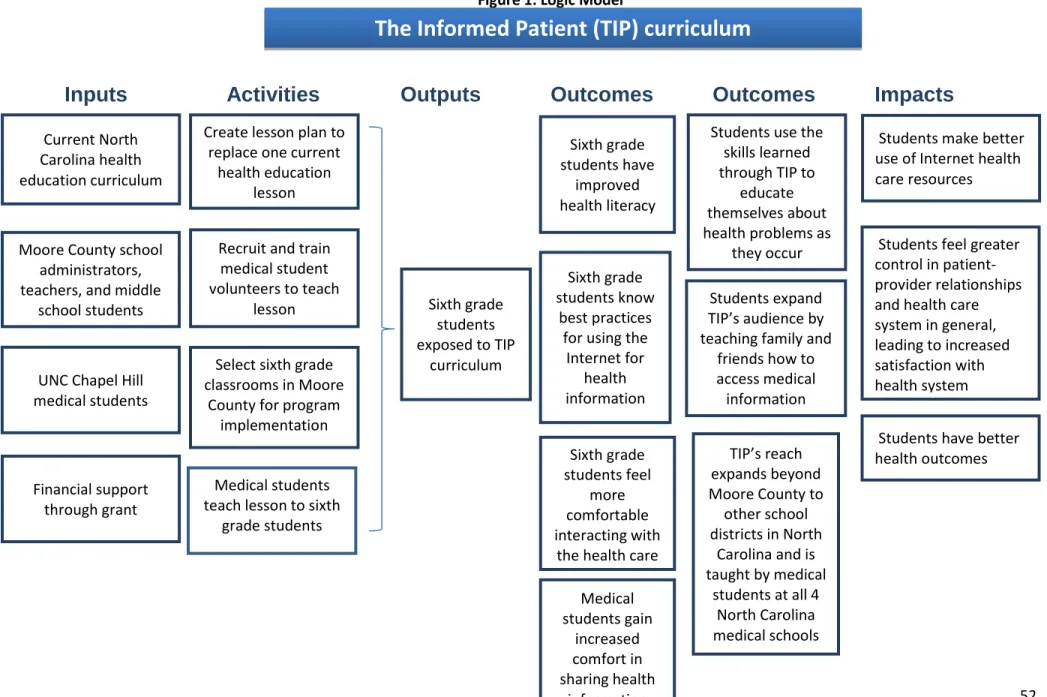
Figure 1: Logic Model 52
Figure 2: Estimated Budget 53
3
ABSTRACT
4
INTRODUCTION
Studies in health literacy show that the average patient‟s knowledge and understanding of his or her health and medical problems is often limited.1 Misunderstanding and confusion in health care is concerning because it can lead to patient dissatisfaction and poor health
outcomes when the patient is unable to follow the plan of care. Research on pediatric health literacy has focused on parents‟ abilities to interpret information regarding their children‟s medical conditions and care.2 Poor health literacy is an issue in adults who care for their
children, even though the effects on health outcomes are not fully understood in the parent-child relationship.2,3 Studies suggest that approximately 90 million adults in this country, about half of the population of the United States, have limited health literacy as defined by the US
Department of Health and Human Services as “the degree to which individuals have the capacity to obtain, process, and understand basic health information and services needed to make appropriate health decisions."4 When Yin, Johnson, Mendelsohn, et al. specifically examined parents, through the National Assessment of Adult Literacy (NAAL), they found limited health literacy with the potential for dangerous consequences for children.3 In dosing their children‟s medication, for example, 46% of parents tested could not execute at least one of two tasks correctly and over 48% could not perform at least one of two immunization-related activities. Parents‟ difficulty in understanding and following medical instructions can negatively affect their children‟s health, but solutions need to look beyond parents and include the children as well. As children grow into adolescents, they become responsible for their own health and need to know as much or more about it than their parents do. As future primary caregivers, for themselves and others, adolescents would benefit from an intervention to improve their health literacy.
5 successfully navigate the health care system” (p.11).1 Children and adolescents, like many adults, often do not understand health information and generally are unprepared to interact successfully with the health care system.5 Compounding this problem is that adolescents often do not visit physician offices, so they are potentially missing valuable opportunities for
healthcare instruction from their pediatricians.6 As they are not learning about healthcare in physician offices, some experts believe health literacy skills should be incorporated into school curriculums from kindergarten through twelfth grade.7, 8 Adolescents who are not interacting with physicians are not learning how to communicate with health professionals, and Post, Cegala, and Miser contend that health benefits ensue when patients are taught to communicate more effectively with their medical providers (as-opposed to the more typical focus on trying to make physicians better communicators).9
Adolescents with health concerns or questions are turning to the Internet for answers.10 Although they are generally the most technically savvy age group in society, issues arise because of the youths‟ lack of ability to discern which sites are reliable.6, 10 Gray, Klein, Noyce, et al. claim that improved health literacy would help adolescents use the Internet for health-related information as Internet use challenges a variety of skills including basic literacy and spelling, critical evaluation of the worth of the articles, and the ability to actually use the information in real life. Through focus group discussions, Gray, Klein, Noyce, et al. identified self-reported deficiencies in adolescents‟ use of the Internet, including difficulty with assessing a site‟s credibility, and the authors suggest that Internet use should be taught in the health
curriculum as a way to increase health literacy. Additionally, they note that physicians who do see children and adolescents should direct them toward credible sources of information on the Internet.
6 search for and appraise medical information on the Internet would also help them to engage in their own health and ideally make better decisions regarding health behaviors. Prior to entering sixth grade, students must receive a tetanus booster vaccine, and this is the last routine visit for many children.11 Middle school aged children may not be regular patients in a doctor‟s office, but they are required to attend school. As students are an accessible, captive audience, it is ideal to create a school-based program for reaching out to students and providing them with some basic health knowledge to make them more comfortable with their own health and with interacting with the healthcare system. Middle school students are an ideal target audience for several reasons. Pediatricians are taught to start spending time alone with patients around the age of eleven or twelve years, so that the patients will start taking ownership of their health without relying on a parent for patient responsibilities, such as providing history and
remembering medication instructions.6 This time alone with the patient also shows the child that he can have a confidential relationship with his provider and feel comfortable being honest about his lifestyle or any problems that he may be having. The American Academy of Pediatrics‟ Committee on Adolescence notes that even when teenagers do come to a pediatrician‟s office, they may not have an opportunity for time alone with their doctor and they often do not receive anticipatory guidance or information about prevention.6 A classroom intervention would give children in the class an opportunity to spend time with a health professional and learn the same things about interacting with doctors that they are supposed to learn during time alone with their doctor at a routine visit. In addition to helping themselves, children are a good focus for such an intervention because they can share what they learn with their parents, siblings, and friends so that the effect of the intervention will spread beyond the initial audience.
7 the program‟s relevance and potential for school administrators to welcome it, program design must keep the existing health education curriculum in mind and compliment it as a valuable supplement. An intervention, designed to increase students‟ confidence in interacting with the healthcare system and their ability to find reliable health information on the Internet, which enhances the current educational standards would prove a valuable tool in the health literacy field.
To address deficiencies in health literacy among adolescents, I propose a course that teaches the basics of being a patient. Given the time pressures imposed on our schools to cover material covered on standardized tests, the most feasible intervention would be a one-time, school-based course. The Informed Patient (TIP) program is designed as a one-time educational intervention, taught by medical student volunteers to teach sixth-grade students about best practices for using the Internet for health-related information and to increase student confidence in healthcare settings. As all of the desired material about being a patient and navigating the health care system cannot possibly be covered in one lesson, and adolescents are known for using the Internet for health information, TIP makes the best use of the available class time by teaching best practices for using the Internet for health information. By covering this important material and through the use of medical students as instructors, TIP also strives to increase adolescents‟ ability to be active, engaged patients in their future healthcare
8
SYSTEMATIC REVIEW
Introduction
This review identifies programs in the published literature with similar goals to The Informed Patient (TIP) curriculum. Information about these programs will guide the planning and evaluation of the TIP program. TIP is designed to increase health literacy, defined here as increased ability to search for health information on the Internet and increased ability to act as an active patient in healthcare encounters, in middle school students in a public school system. Planning and evaluation techniques used for the programs identified through the literature search are examined for applicability to the TIP curriculum. This review concludes by summarizing the utility of these other programs for implementing and evaluating TIP.
Methods
9
Summary of Programs
What’s HEALTH Got To Do with TRANSITION?
One of the programs most similar to TIP is a health care transition curriculum designed for adolescents and young adults with special health care needs in Tampa, Florida. The curriculum, titled “What‟s HEALTH Got To Do with TRANSITION?”, is a school-based intervention that aims to prepare youth with special needs for the transition to adulthood.13 Although the American Academy of Pediatrics (AAP) advocates for pediatricians to play an active role in their patients‟ transitions to adult care, many pediatric patients are in fact not prepared when the time comes to start seeing adult providers. This is especially an issue in those with special health care needs, such as chronic illness, physical disability, or
developmental disability. In a pediatric practice, parents and providers typically are responsible for patients‟ health outcomes. The project in Florida recognizes that these youth must take ownership of their health as they transition to adulthood, and need preparation and knowledge to be able to make the transition successfully.
10 The actual curriculum was written by professionals in special education, social work, and health care. It was then reviewed by content experts, including several physicians and an
advisor from the Transition Center at the University of Florida. The final product consists of eight lessons, or about forty hours of total instruction. It was piloted in thirteen classrooms, located in five different high schools, as part of an already required course (science, health, or life
management course). Students in these classes held a variety of classifications including Educable Mentally Retarded, Language Impaired, and Emotionally Handicapped, and all were expected to earn a special, rather than standard, diploma at graduation. The lessons cover the importance of self-advocacy, rights and responsibilities of adults, interacting with adult
providers, basics of health insurance, understanding medications, sexual health, and injury prevention. Lessons include interactive activities such as crossword puzzles. Additionally, students complete a journal rather than discussing personal health topics in class. Teachers prepared for using the curriculum with a teacher‟s guide and a six-hour training session.
When the entire curriculum had been covered, the researchers held focus groups (students and educators, separately) to evaluate the project. Students and educators felt the course was highly valuable and almost half said that it should be offered to all high school students (regardless of ability level). One criticism of the curriculum, which was written at a seventh grade reading level, was that it was too difficult for some students. Educators
acknowledged that, although challenging, students needed to be exposed to this material and that additional time for covering the curriculum could help. Regarding content, students most valued the sexual health information and felt the insurance information was not interesting. They suggested adding guest speakers (one student said he would like a doctor or pharmacist to come), field trips, and more role playing activities. They also suggested adding a course for parents (online or in the evening) to run simultaneously with student instruction.
11 for teachers to implement with some training. The curriculum covers several relevant content areas, but many school systems currently would not be able to allocate the time necessary to complete all of the lessons, especially in regular education settings. According to focus groups, the curriculum was well received and teachers enjoyed implementing it, but the evaluation was limited by small limited group involvement. Although 137 students participated in the pilot program, only 15 were involved in the focus groups. Teachers were better represented. Of the twelve teachers who participated, five attended focus groups (with two support staff) and five other teachers who could not attend the focus groups completed questionnaires on focus group topics.
Tar Wars
The Tar Wars curriculum was first created in 1988 by a physician and a health educator in Denver, Colorado.18 Now taught in 50 states and 14 countries, Tar Wars continues to
discourage children from using tobacco products by focusing on short-term consequences.14 The article by Cain, Dickinson, Fernald, et al. is one of several articles evaluating the
effectiveness of this program. Their study used a grant from the Colorado State Tobacco Education and Prevention Partnership (STEPP) to examine the program in fifth grade students in 68 elementary schools in Colorado in the 2001-2002 school year.
Tar Wars has three components: 1) a pre-activity students that complete with their classroom teacher the day prior to the presentation, 2) a classroom presentation led by
volunteers (volunteers are typically physicians, health educators, or medical students), and 3) a poster contest after the presentation. Training simply consists of providing a program guide, including a lesson plan, instructions, and suggested comments, to teachers and volunteers. In the pre-activity, teachers emphasize to students that tobacco use is not as common as they might think. In the volunteer-led lesson, five coordinated activities discourage students from using tobacco: learning about short-term effects (such as bad breath, yellow teeth),
12 of tobacco use (per week, month, and year), examining reasons people give for using tobacco, and analyzing tobacco advertisements. Finally, students have the opportunity to demonstrate what they have learned and a chance for recognition and a reward through the program‟s poster contest.
For quantitative evaluation, students completed pre- and post-tests with knowledge items from the Tar Wars lesson plan. The test consisted of 14 knowledge questions and some demographic items. Students completed pre-tests about one week prior to the intervention and post-tests 2 to 4 days after the presentation. Pre- and post-tests were identical with the
exception of a free-response item on the post-test (“How did the Tar Wars session change your ideas about tobacco?”). Students‟ tobacco knowledge increased from pre- to post-test
(p<0.0001), even after controlling for student-reported age, gender, race, and ethnicity, whether the student lived with a tobacco user, and whether the student used tobacco. The average score increased from 8.95 correct answers (out of 14) on the pre-test to 10.23 correct answers on the post-test.
This study also examined the program qualitatively with focus groups and interviews. Participating teachers and presenters were interviewed by telephone. Students who had heard a Tar Wars presentation participated in focus groups about their experiences. Telephone
interviews were audiotaped, focus groups were not. Teachers and presenters said that students responded well to the material and to “having someone from outside the school (especially physicians) present the information” (p. 586). The activities engaged the students, and the length of the presentation was appropriate. Students reported that the presentation differed from any other anti-tobacco education that they had experienced. They reported that many of the activities taught them new information, even though they already knew that tobacco was harmful. They valued the emphasis on the short-term effects as motivation for not smoking.
13 consequences of this intervention. Additionally, as no control group was used, it is unknown whether knowledge scores would have increased without exposure to the program.
Ebm@school
Ebm (or evidenced based medicine) @school is a school-based intervention developed and piloted in Germany in response to trends of increased patient involvement in medical
decision making.15 Study authors felt that many patients are not adequately prepared to share in the decision making process because they lack critical health literacy (i.e., they likely do not understand the study statistics that go into treatment recommendations). The Ebm@school curriculum aims to prepare secondary school students to interpret medical evidence so that they will be able to make medical decisions about their own health without having to rely on experts.
Study authors had previous experience developing curricula on evidence-based medicine for people with less academic background (such as dieticians and patient
representatives) using already established curricula for those with perhaps a stronger academic background. They used their experiences and Klafki‟s five questions (a theoretical model for curriculum development) to design a program of study felt to be feasible for high school students. Student surveys about health topics they were interested in and concerned about informed the selection of topics to include in the lessons.
14 Student learning was measured with the CHC test, which measures understanding of medical concepts, literature, statistics, and experimental design, and by evaluating the work that students put into their group projects. Additionally, student feedback solicited regarding the curriculum and researcher observations of curriculum implementation assisted in the evaluation process. Student feedback regarding the course was generally positive and students exposed to the curriculum scored higher on the CHC test compared to those unexposed to the curriculum.
At first glance, this study seemed to have much information to contribute to the TIP curriculum as it is a school-based, health literacy intervention. The critical health literacy skills taught in Ebm@school however seem very ambitious for most public school audiences. Students often have little to no exposure to the most basic healthcare concepts, and this
curriculum seeks to provide analytical skills commonly taught to graduate and medical students. A benefit of the curriculum is perhaps that, even if students do not fully grasp all of the concepts, they have a better appreciation for the science of research analysis and are prepared to think more critically about medical evidence. Little is said about the instrument (CHC test) used to measure critical health literacy (details are found in another publication) except that it is a 72 item test, requiring approximately ninety minutes to complete. The authors‟ concluded in a separate study that the instrument is valid and reliable with use in secondary school and college students.19 The CHC test, however, only measures critical health literacy and the length of the test would make it difficult to use in many settings or with disinterested participants.
It’s Your Game: Keep It Real
15 Study authors piloted IYG in low-income, urban middle schools in Texas. Of ten schools in one school district that were able to participate in the study, five were randomly assigned to the intervention and the other five served as controls, receiving regular health classes rather than the IYG intervention. The randomization protocol considered location of the schools, as well as size and ethnic composition of the student body. Students received monetary incentives first for returning a parental consent form and then for completing initial and follow-up surveys. The intervention started in seventh grade and followed students through ninth grade. Many were lost to follow-up (58% of the original intervention group completed ninth grade surveys) and this was attributed to high transience and student withdrawal rates from school in this population.
The curriculum, based in social cognitive theory, social influence models, and the theory of triadic influence, was created using Intervention Mapping and extensive feedback from stakeholders. IYG is comprised of 12 seventh grade lessons and 12 eighth grade lessons, each approximately 45 minutes in length. Lesson format varies, consisting of group activities,
journaling, and computer-based individual activities. Topics covered include healthy friendships, personal limits, puberty and reproduction, STIs, healthy dating, HIV/STI/pregnancy testing, and training in contraceptive and condom use. There are also homework assignments that students complete with their parents which are intended to open dialogue about these sensitive topics.
16 the intervention group reported feeling more positive about abstinence until marriage, increased knowledge about HIV and STIs, increased confidence with contraceptive methods, and less participation in high-risk sexual behavior compared to the comparison group.
Although the intervention did have significant attrition, the demonstration that students retained and those lost to follow-up were relatively similar strengthens the authors‟ conclusions. While the study population used may limit the external validity of the findings, the authors increased internal validity by accounting for potentially confounding variables, such as gender, ethnicity, and parents‟ educational attainment, in their analysis. Unfortunately, the survey instrument is not described in detail, but several articles are referenced that have used the same measure. One potential weakness is that the survey measures outcomes through self-report, which is subject to social desirability bias. Students could either over- or under-represent their sexual activity, depending on which they view as a more appropriate response.
Making an IMPACT
Poor nutrition, decreasing physical activity, and increasing rates of obesity led Muth, Chatterjee, Williams, et al. to create a program targeting these problems in North Carolina school children.17 IMPACT (Improving Meals and Physical Activity in Children and Teens) is a school-based curriculum where high school students are trained in nutrition and physical activity and then teach these skills to elementary school classes. The intervention, which fits into the existing health education curriculum, is based on Social Cognitive Theory and the belief that positive peer influence (from high school students to the elementary students) would inspire the younger students to improve their health behaviors.
17 homework assignments for students to complete with their parents. High school (HS) students attended a rural North Carolina high school and elementary school (ES) classes were from a nearby elementary school. HS students in a health occupations course applied to participate in this program and nine were selected. The HS students obtained membership to a nearby athletic club, for the duration of the intervention, as an incentive for their participation. Muth, Chatterjee and medical students taught the HS students the curriculum, as well as leadership skills, in a 15-hour training session. Although the randomization scheme is not explained, the fourth grade classes in the elementary school were randomized to receive either the
intervention (2 classes, 38 students total) or the usual curriculum (2 classes, 37 students total). Medical students and high school students taught the curriculum with the regular classroom teacher and study authors present.
IMPACT sought to improve knowledge, attitudes, and behavior about nutrition and physical activity in both HS and ES students. The Texas School Physical Activity and Nutrition (SPAN) questionnaire was used as a pre- and post-test to measure these constructs. Body mass index (BMI), measured before and after the intervention, was the secondary outcome of interest. Intervention and control groups were similar at baseline with the exception of a higher average BMI (70th percentile compared to 60th percentile) in the intervention group. Dropout was low (1 student in each group was absent when follow-up data were collected) and data was analyzed with an intention to treat model. Elementary students in the intervention group described increased intake of fruits, vegetables, calcium-rich foods, and whole grain compared to the comparison group, after controlling for gender, age, BMI percentile, and baseline
18 sweetened beverages, sweets, french fries and chips. Attitudes, beliefs, and physical activity did not significantly change in either group of students. Although BMI was a secondary outcome, authors did not report post-intervention BMIs.
Study authors accounted for many potential confounders (such as gender, age, and baseline behaviors) in their analysis, strengthening the internal validity of their findings. They bring up concerns, however, that the instrument (SPAN) may not have accurately measured some of the changes they were hoping to see. Additionally, it is a self-report measure, allowing for potential social desirability bias or recall bias (as students had to report numbers of servings of various types of foods). The small number of participants, all from a single rural area in North Carolina, limits the ability to detect small differences and limits the generalizability of these findings. This is especially concerning for the very small number of HS students who notably were also all female and 89% were white. Study authors report trying to obtain additional data from the HS students about their experience through student report, but that this attempt was unsuccessful.
Analysis
19 volunteers, but they are often medical students, physicians, or health educators. In an interview about the Tar Wars program, one student said „you could tell she [the doctor] knew what she was talking about…she was speaking from experience‟ (p. 587).14 Further, study authors note that “use of health professionals as presenters is perceived very positively, providing an authoritative outside source of information that adds to the impact of the session” (p.588). Regardless of the background of the guest speaker (older students, medical students, or others), students tend to enjoy a break from their usual classes by having a different instructor and an opportunity to interact with someone that they might not otherwise talk to. Because of positive sentiment toward healthcare providers as teachers, TIP will use volunteer medical students as instructors to provide students with a different perspective and a chance to interact with a healthcare professional.
IYG and IMPACT give students assignments to complete with their parents to improve the parent-child relationship and to increase parents‟ knowledge, respectively. Students in the health care transition curriculum intervention suggested adding a supplemental course for parents to increase their familiarity with the process of transitioning to adult care. Health literacy is a problem in all ages, and a parent-child activity to complement the TIP classroom lesson could be a great way to improve adult health literacy and allow children to share what they have learned with their parents. Another activity that several of these programs feature is journaling. Students in both IYG and the transition intervention used journals to process their classroom lessons and write about personal health topics. This is also something to consider when designing the TIP curriculum.
20 teaching the lesson and what activities to include, but does not include actual training time for the presenters. Ebm@school does not provide details about what would be required for implementing the curriculum, only saying that the two pilot classes were led by two of the study‟s authors. IYG only describes the teachers as “trained facilitators,” and does not comment on how much training they received or what would be required to implement this program in other settings (p.170).16 Finally, IMPACT authors trained high school students in the curriculum and in classroom leadership in a fifteen-hour course, and the trained students taught elementary school students with students from medical school. Authors note several difficulties with using high school students as teachers, including availability, as they had to miss their own classes to teach in the elementary school, and a general lack of skill and comfort in teaching. For ease of implementation, TIP will likely follow the Tar Wars model the most, providing a brief orientation session and a specific lesson plan to presenters.
Evaluation methods were mixed among the five programs. The transition curriculum only used qualitative methods as they conducted student and teacher focus groups. Tar Wars and Ebm@school used both qualitative and quantitative methods. This study of Tar Wars
21 group and a comparison group, both evaluated with pre- and post-intervention tests. Interviews could also be a valuable way to gain more information about the value of the intervention.
Conclusion
Undoubtedly, the implementation and evaluation of TIP can benefit greatly from the experiences of these five programs. The programs are similar in that they all teach health-related topics to students in a classroom setting. Student characteristics (including age and ability level) and methods for implementing and evaluating the programs are the most prominent of several differences between these interventions. Combining the best aspects of the various programs will likely provide TIP with the best chance of success.
TIP has several reasons for featuring medical students as instructors, including relative ease of access and the ability to expose students to a piece of the health care system. Findings that medical students and other health care professionals are highly valued and desired in other programs only contribute to this group‟s importance as guest lecturers. When trying to find methods to engage students in the lesson, TIP can look to all of these programs for ideas from journaling and group activities to parental involvement and a poster contest.
22
Table.Summary of Similar Programs to TIP
Program Goal Implementation Evaluation Outcomes
What‟s HEALTH Got To Do with TRANSITION? curriculum13
Prepare
adolescents and young adults (ages 14-22) with special health care needs for transition to adult health care.
8 lesson curriculum piloted in 13 classes (in 5 different high schools) Student and educator focus groups Focus groups
revealed that students and educators viewed the lessons as highly relevant and
interesting, although the reading level was too high for some Tar Wars14 Prevent tobacco
use in children.
Lesson
evaluated in 68 Colorado elementary schools
Pre- and Post- Knowledge tests; Teacher and guest lecturer telephone interviews, student focus groups Increased knowledge scores on post-test; positive comments from teachers, presenters, and students
Ebm@school15 Train secondary students to interpret medical literature.
Curriculum piloted in two eleventh grade classrooms in Germany
CHC test and student feedback
Students exposed to curriculum scored higher on CHC test and had generally positive feedback It‟s Your Game:
Keep It Real16
Pregnancy, HIV, STI prevention
Curriculum taught in 5 middle schools in a low-income school district in Texas, 5 middle schools in same district serve as comparison group Students survey on laptop computer after intervention Students in intervention group were less likely to initiate sexual
behavior by 9th grade and had more positive feelings toward abstinence Making an IMPACT17 Improve knowledge, attitudes and behavior about nutrition and physical activity in high school (HS) and elementary school (ES) students
Curriculum and leadership taught to HS students by medical students and study authors, then curriculum taught by medical students and HS students to 2 fourth grade
Texas School Physical Activity and Nutrition (SPAN) questionnaire pre- and post-intervention for HS and ES students; BMI was a secondary outcome
23 classrooms (two
other classes served as controls)
PROGRAM PLAN
Overview
The Informed Patient (TIP) will be a health literacy curriculum targeting sixth grade public school students in Moore County, North Carolina. Moore County was chosen as a target for this intervention because of its proximity to the University of North Carolina (UNC) at Chapel Hill and also because of supportive leadership in that district. TIP uses medical student
volunteers to teach the middle school students a lesson plan that enhances current objectives in the North Carolina Healthful Living health education curriculum. By having health professionals, such as medical students, share information consistent with the current health curriculum, sixth graders will not only learn useful information, but will hopefully also feel more comfortable interacting with clinicians. Ideally, they will feel more comfortable in their future health care encounters.
In the general population, many youth lack adequate knowledge or exposure to basic health care principles, leading to poor decision making with potentially negative health
24
Program Context
Students as Patients
During my pediatric residency, I saw many patients who did not understand even basic health maintenance behaviors, and often what they thought they did understand about their bodies was misinformation from poorly informed peers. Compounding this problem is that adolescents often do not visit physician offices, either ignoring health problems or somehow self-treating for concerns that arise. Although adolescents are generally healthy, they do sometimes experience problems that need to be addressed, and any patient could benefit from a greater understanding of basic healthcare.
Parents are generally good about getting their infants and young children into physician offices. As children age, they often stop receiving routine care even though yearly physicals are still recommended. Some children without ongoing health problems may come sporadically for required sports physicals. Middle school aged children may not be regular patients in a doctor‟s office, but they are required to attend school. School is an ideal location for an intervention as students are an accessible, captive audience.
Political Environment
25 also demonstrated how much Americans value good health. The TIP curriculum shows that health education is so important that it is worth augmenting current programs with additional resources.
Consistency with Local, State, and National Priorities
Standards for health and physical education in the North Carolina public school system are based on the state‟s Healthful Living curriculum.12 The current curriculum, last revised in 2006, seeks to instill “behaviors that contribute to a healthful lifestyle and improved quality of life for all students” (p.2). Specifically, TIP shares goals with the Personal and Consumer Health strand present in the current North Carolina curriculum. Some of the goals that characterize this strand and are in line with TIP‟s goals are health risk identification, illness prevention, and appropriate use of health resources. Revisions to the 2000 curriculum reflect changes to our society that students need to be prepared for, including “necessary 21st Century skills” (p.5). TIP meets this goal by teaching students about using the Internet for finding health-related
information. Appropriate Internet usage also achieves some of the targeted health skills the curriculum seeks to impart, including “the ability to access valid health information,” the ability to “analyze…internal and external influences on health and behaviors,” and “the ability to use effective decision-making skills to enhance health” (p. 7). Teaching when to seek medical advice demonstrates another desired health skill, self-management. Finally, having the lesson taught by someone from the health professions, such as a medical student, will also help with the goals of accessing information (previously mentioned) and of using “interpersonal
communication to enhance health,” as this encounter will make students more comfortable interacting with medical professionals (p.7). The Healthful Living Standard Course of Study recognizes that its guidelines represent “minimum competencies” that need augmentation to be maximally successful and TIP is an ideal enhancement for this current curriculum (p.10).
26 the curriculum covers grades kindergarten through twelve, state policy only mandates health education for students in kindergarten through eighth grade.21 Middle school students are supposed to spend 225 minutes per week throughout the entire school year in health education (which includes classroom instruction and physical activity education) with teachers specially trained and certified for this purpose. Additionally, students in kindergarten through eighth grade should have at least thirty minutes of at least moderate activity daily, losing recess can never serve as a form of punishment, nor can extreme physical activity. Moore County Schools also mandate health education in their policy, which is consistent with state standards except that the county requires health education through at least ninth grade, with reproductive health
education beginning in seventh grade.22
North Carolina‟s commitment to its students‟ health education appears to reflect a nationwide effort to improve health knowledge to improve health outcomes. Healthy People 2020 recognizes the importance of stronger health education in its “Educational and
Community-Based Programs” (ECBP) objectives.23 Specifically, TIP addresses several components of objective ECBP 3, which also echo many of the North Carolina curriculum objectives. These goals seek to provide students with the knowledge and skills in the National Health Education Standards (NHES). Developed by the Joint Committee on National Health Education Standards, the NHES seek to create “a framework for „world class‟ health education in this country”(p.1).8
NHES standards focus on improving health literacy and define a health literate person as someone who is “a critical thinker and problem solver, a responsible, productive citizen, a self-directed learner, [and] and an effective communicator” (p. 5). By teaching students to question the health material that they find on the Internet, TIP encourages critical thinking and problem solving. By preparing students to successfully find health
27 threats to academic success, and indeed, success in life. Increasing students‟ awareness of good health practices at an early age gives them an opportunity to create healthy habits for lifelong fitness and achievement. Healthy People 2020 takes this one step further by saying that school health programs should be evaluated for their effect on promoting student retention, and see the evaluation of health education as an “emerging public health issue.”23 This appreciation for health education as something more than just another set of classes indicates that now is the time to enhance current school programs, with plans and expectations for far-reaching results.
Acceptability to Providers and Recipients
Accountability is paramount in schools and standardized testing has taken on greater importance in several states, including North Carolina where students take End-of-Grade tests (EOGs). The demand to cover a wide range of subject matter in a short period leaves little flexibility in the school day for additional programming. To increase my program‟s relevance and potential for school administrators to welcome it, my program design must keep the existing health education in mind and compliment it as a valuable supplement. This is possible by designing a lesson to replace a current lesson in the Healthful Living Standard Curriculum, and ensuring that required objectives are still covered. Additionally, teachers must feel that the program is unobtrusive and not wasteful of their limited classroom time. Currently in Moore County, two health teachers travel to all of the schools, teaching the same health lessons for consistent coverage of the curriculum. By replacing just one lesson taught by these teachers with the TIP curriculum, no additional time is spent on health education. Students will likely enjoy the program as it will be a break from their routine classes and will give them an opportunity to interact with a health professional in a non-threatening manner.
Medical students are ideal teachers for TIP. These “student doctors” have a lot of information to share, and many have great enthusiasm for teaching. Especially for first or
28 classrooms to spend time with others is often welcomed. Medical schools are increasingly encouraging community service and outreach, and teaching the middle school students would be a great way to meet this goal. Distance may prove an obstacle as the schools in Moore County are approximately an hour away from the medical school at the University of North Carolina (UNC) at Chapel Hill. This should not be a problem, as students and residents from UNC routinely travel as far or further to clinical sites, but incentives such as reimbursement for mileage and possibly lunch on the day of the class would help ease any potential burden.
Stakeholders
Occasionally with health education, parents are concerned that material will be covered that they see as objectionable or that they themselves would rather teach to their children. The TIP curriculum purposely avoids controversial topics such as reproductive health and sexually transmitted infections. Although these are important for this age group to hear about, it is more beneficial to cover general strategies for seeking health information. The students can then apply this information to a variety of health concerns and problems that they may encounter. School administrators and the general community can also feel good about the benign nature of the curriculum, as well as the fact that it does not take away from other courses or subject areas. Still, to help avoid potential difficulties, this curriculum is being developed with the help of the Moore County Superintendent‟s Office. Additionally, community meetings with parents and other stakeholders could help address potential concerns as the curriculum is being developed.
Financial Resources
By using volunteer medical students as teachers and the already existing school
structure as a classroom, the TIP curriculum, a one-time intervention, should be able to operate with relatively few costs. The program manager however, could seek grant support from an organization such as the Centers for Disease Control and Prevention (CDC) through their support and encouragement of health literacy initiatives and education programs.24
29 Using a school system that is already in place greatly assists the TIP curriculum.
Participants do not need to travel or spend any extra time to receive this intervention. It is also free to participants. From the school system‟s perspective, there is the challenge of allowing time for many competing priorities, including preparing for EOGs and health is not a tested content area. Health education is mandated and valued however, and TIP uses time already allotted for health education, augmenting the existing health curriculum. Additionally, students may be able to apply their increased understanding, communication, and critical thinking in health care to other subject areas such as English and the social sciences.
Theoretical Model
TIP is an educational intervention to improve health literacy in middle school students. With increased knowledge and comfort with the health care system, students will have improved methods of seeking both health information and health care. For the curriculum to be
successful, it will need to be accepted by the school system (students, teachers, administrators, parents, etc.) and the larger community. The Diffusion of Innovations Theory is a theory of change that examines the adoption of new practices in a community.25 In the model, five attributes of the intervention predict an intervention‟s acceptance, and “diffusion,” within a community: relative advantage, compatibility, complexity, trialability, and observability. The TIP program initially will spread throughout Moore County Schools, and then throughout the state after appropriate evaluation and necessary alterations have taken place.
Relative Advantage To be adopted, a new curriculum needs to show some advantage over what it is replacing. As previously stated, the current North Carolina Healthful Living Standard Course of Study acknowledges that its objectives address minimum competencies and additional material is needed to augment the students‟ learning experience in health
30 interaction with their medical student guest teacher and a lesson that is slightly more focused on obtaining health information and learning when, and how, to seek medical care.
Compatibility The curriculum is designed with sixth grade students and the current North Carolina Standard Course of Study objectives in mind. It also is designed with input from the superintendent‟s office for Moore County Public Schools, the district that it is intended for.
Complexity The TIP curriculum is designed to be easy to implement. School teachers do not need additional training as medical students will actually teach the lesson. No additional time is demanded of students or teachers as the lesson is designed to take place during a time slot regularly scheduled for health education. Medical students are often eager to be involved in the community, and their participation can be facilitated through incentives.
Trialability As it is designed as a one-lesson intervention, relatively low commitment is required to adopt TIP. Still, curriculum will be provided for review prior to expecting full
cooperation from the participating school system. After successful implementation in one district, the curriculum could be provided to additional districts considering TIP.
Observability Pre- and post-testing of students receiving the curriculum as well as of a comparison group of students will demonstrate the effects on knowledge and intended
31
Goal and Objectives
Goal: Increase the ability of sixth grade students in Moore County, NC to effectively search for reliable health information on the Internet and activate the students as confident, engaged patients in the healthcare system.
Short term objectives:
By month four, identify and train at least 20 medical student volunteers to teach TIP
curriculum to sixth grade students.
By month six, implement curriculum in all five middle schools in Moore County.
By month twelve, at least 50% of students taught the curriculum will report increased ability to search for reliable health information on the Internet.
Long term objectives:
By two years after the receiving the intervention, at least 50% of students taught the
curriculum will report increased confidence in medical encounters (e.g., increased confidence in seeking care, relating to clinicians, asking questions).
By five years into the program, implement the curriculum in at least 3 additional county school systems in North Carolina.
By five years into the program, involve students from all four North Carolina medical schools in teaching the curriculum in school systems local (within a one hour drive) to their
respective medical schools.
32
Implementation
The Moore County Public School System will pilot the TIP program, which volunteer medical students will teach under the supervision of a program manager. The curriculum, taught by the medical students in multiple sixth grade classrooms during the school year, is preceded and followed by pre- and post-test surveys, respectively. These tests are administered by the program manager near the beginning and end of the school year (not close to when the intervention takes place). Before implementation begins, a lesson plan must be created, by review of similar lesson plans and with input from experts in curriculum development, that addresses the program‟s goals as well as the objectives of the North Carolina health education curriculum. Objectives from the sixth grade Healthful Living curriculum that TIP readily
addresses include:
Objective 1.01: Use a structured thinking process to make decisions and solve problems.
Objective 2.09: Evaluate claims made for health products and services for accuracy and credibility.(pp.43-44)12
33 medical students, that the sixth graders will become more confident with health care providers and feel more prepared to interact with the health care system when necessary.
Classrooms will be selected with the help of Moore County school administration. Ideally, sixth graders at all five middle schools will participate, with some classes serving as a delayed intervention control group (a comparison group that will receive the intervention at a later time). UNC IRB approval will be necessary for this program, as well as obtaining consent from parents and assent from students. The program manager will recruit medical student volunteers at the University of North Carolina at Chapel Hill. Interested students will participate in an active learning orientation, where they will obtain a copy of the lesson plan and use role play to gain skills and confidence in teaching the lesson. Preferably, there will be enough volunteers to have the students team teach the sixth grade classes and the regular classroom teacher will stay in the room to supervise and assist as needed. Medical students will be
reimbursed for their travel to and from the schools. A benefit of using sixth grade classes is that travel is not required for the program participants and the classroom environment is already available.
34 PROGRAM ONE-YEAR TIMELINE (Fig. 3)
Sustainability
While successful implementation of the TIP curriculum in sixth grade classrooms in the first year of the program would be considered an achievement, ideally Moore County schools will continue to use the curriculum and other school systems will want to start using it. TIP operates on very small operating costs, without a need for participant travel, acquisition of sites for implementation, or a paid workforce. Medical student turnover is a concern, as new student volunteers will need to be continually recruited. Additionally, more resources will be needed to increase the reach of the program to other school systems. TIP can attain at least a moderate level of sustainability because only limited funding is needed to sustain the curriculum‟s use. Some of this depends, of course, on teacher and school administrator acceptability and willingness to have the program as part of their classes.
Vision
All stakeholders in the TIP program must believe in the importance of improving health literacy and acknowledge that this education should start with young students. This vision will encourage school administrators to adopt the curriculum, parents to become excited about their children learning the curriculum, and medical students to teach the curriculum. All of these stakeholders must view TIP as a worthwhile adjunct to current health education classwork that will help students have better health outcomes in the future.
Results Orientation
35
Strategic Financing Orientation
TIP makes excellent use of existing resources so that relatively few expenses arise. Additional support can be sought in grant money from sources such as the CDC and other organizations that fund health literacy initiatives. Additionally, with increasing community support, money may be available from local organizations and private donations.
Broad-Based Community Support
TIP gains support from the school system by involving administrators in the design and implementation of the curriculum. Health literacy is a relatively new idea that is gaining
increasing importance and support. Stakeholders in the local community, such as parents, physicians, and educators, need to learn about the goal of the TIP curriculum and understand the importance of health literacy to the public. Media campaigns and presentations at town council meetings can increase awareness about the program.
Key Champions
Moore County was selected as a pilot site for the TIP curriculum largely because of a key champion living in that area. Dr. David Bruton, a retired pediatrician and former North Carolina Secretary of Health and Human Services, recognizes the importance of improving health literacy. He also identified school leadership in Moore County as supportive of innovative programming. Dr. Bruton‟s history as a respected pediatrician and child advocate make him an ideal key champion for TIP. Seasoned pediatricians in other areas could also serve as key champions, as well as school administrators or anyone with a strong interest in child advocacy.
Adaptability to Changing Conditions
36 changed, and it should change according to developments in best practices for Internet-derived health information searches.
EVALUATION PLAN
Rationale for Evaluation
TIP would benefit from an evaluation for many reasons. First, it is essential to assess whether the program curriculum as initially designed and implemented is accomplishing the desired objectives. That is, in the short-term, is the program achieving the reach that it hoped for and has students‟ health literacy improved? If these objectives are successfully met in Moore County, the evaluation will help to justify continuation of the program to stakeholders in this district and dissemination of the program to other parts of the state.
Conversely, if the program is not successful in Moore County, an evaluation can help reveal the issues with the original program design and assist in adjustments to increase chances for success in a future, revised model. To best examine where deficiencies lie, the program needs to be evaluated from multiple dimensions, including teacher and administrator feedback as well as actual measurable student outcomes. Additionally, the program needs to be evaluated from beginning to end.
Although TIP has relatively low operating costs, it will need some monetary resources to operate and evaluation will provide evidence to funders that continuing financial support is worthwhile. If the program achieves widespread support from stakeholders and has a valuable effect on student health literacy, funders will likely see value in continuing their support and additional support will be more readily accessible through grants.
Evaluation Approach
As a new program, TIP would benefit the most from an internal evaluator because of his or her vested interest as a stakeholder in the program with a detailed knowledge of the
37 removed from the program‟s origins, would help balance out possible biases and bring
additional experiences and evaluation ideas to the project.
As the program occurs in a public school setting with a wide-range of ethnicities
(particularly once it is statewide), the ideal evaluators would exhibit cultural sensitivity and show flexibility toward different perspectives and viewpoints. As the evaluators would need to
successfully engage a wide range of stakeholders, from teachers and administrators, to parents and members of the community, they need to be good listeners who can unite people under a common focus, ensuring that everyone feels heard and valued. Finally, they would need to be flexible enough to change with the program as needed and comfortable enough with the program to present evaluation findings in a variety of situations (e.g., community meetings, media events).
Several stakeholders should be involved in the evaluation. Perhaps the most important are the school administrators because without their support, the program will not be allowed into their schools. They would likely want to ensure that the program does not detract from required content areas on standardized tests and would also be interested in seeing measurable
outcomes as a result of the intervention. They need to see the curriculum and lesson plan for approval before it is implemented and will want to communicate with teachers whose classes receive the intervention to hear about how it was received. Medical student volunteers are also important stakeholders because without them the program would not run. They will want an easy to teach, interactive lesson where they feel they are positively affecting the middle school students, making this effort a worthwhile use of their time. Evaluators should constantly check in with the medical student volunteers after they teach a class to see how it went and what difficulties or obstacles they may have encountered. Also, medical student feedback should be sought as to how they feel the program could be improved.
38 constructs of increased ability to use the Internet for health-related information and increased confidence in medical encounters. At best, we can approximate these through survey
instruments and interviews. Also, student attendance traditionally makes measurement difficult as some will miss the pre-test, others will miss the intervention, and still others will miss the post-test. Participation may also be a problem if parents are not eager to consent to their child‟s involvement in the lesson.
Evaluation Study Design
The evaluation study design will use a mixed methods approach as this is often considered the best way to thoroughly examine a program.28 According to Bamberger, Rugh, and Mabry, mixed methods are ideal because they allow the evaluator to use a variety of tools to better understand the context in which the program operates. In addition, mixed methods may increase the legitimacy of the evaluation‟s findings as results are obtained through at least two different and independent methods (a process referred to as triangulation). In this evaluation, a mixed methods approach will be used to capture both subjective attitudes (such as satisfaction with the program) and objective information (such as improved knowledge). Two qualitative tools that will be used, open-ended interviews and surveys, allow participants to share their feelings and opinions and are ideal for assessing the implementation process. Conversely, the quantitative methods are better suited for examining the outcomes of the program, and will be combined with some qualitative techniques for this purpose.
Qualitative methods will assess implementation of the TIP curriculum. Open-ended interviews will obtain information from the program manager regarding implementation challenges and successes. Additionally, the program manager‟s records will be reviewed to further examine the implementation process. School administrators will also be interviewed about implementation of the curriculum.
39 regarding perceived utility and other attitudes toward the lesson plan. Medical student
volunteers will be interviewed about their experiences being recruited for the program and then with teaching the lesson. Teachers in classes that implement the lesson will be asked to fill out open-ended surveys.
The quantitative methods component will employ a quasi-experimental design, with a middle school student pre- and post-test for the intervention and comparison groups. This design will allow for examining the association between the intervention and post-test results as students who were not taught the lesson will also complete tests. Additionally, the use of a pre-intervention evaluation allows for comparison of knowledge before and after the lesson.
Evaluation Methods
The primary qualitative methods used will be open-ended interviews and document review. Interviews with the program manager, medical student volunteers, and middle school administrators will examine the implementation process. Questions and prompts will focus on whether the program was implemented as planned, challenges in the implementation process, and suggestions for future implementation at other sites. Middle school students will also be interviewed, but these discussions will focus more on outcomes of the intervention. Medical student volunteers will be interviewed regarding their views of the implementation process, including whether they felt they received adequate training or had any difficulty in teaching the lesson. Medical students will also have the opportunity to share suggestions for improving the program in the future. Document review will reveal whether objectives were met regarding number of schools and classrooms involved in the intervention and number of medical student volunteers teaching the curriculum.
Pre- and post-tests will be the predominant method of evaluating the effectiveness of the intervention. Once the sixth grade classes are divided into intervention and comparison groups, the pre-test will be administered. Later in the school year, the students will receive the
40 to show whether the intervention‟s effects were enduring. The tests will asks students about some of the key questions suggested by the NIH for evaluating medical information on websites and will also include the eHEALS, an “eHealth Literacy Scale” (e27).20 The eHEALS is an 8-item questionnaire found to reliably measure electronic health literacy in a sample of high school students. The eHEALS serves as a valuable adjunct to the knowledge questions previously alluded to as it provides a more subjective measure of student confidence in electronic health literacy, asking students to rate constructs such as their ability to find health information on the Internet and their ability to evaluate the information that they find. Finally, students will be given a health topic to explore, and their ability to successfully find accurate information about the topic on the Internet will be examined. There will also be a delayed post-test, administered at one and two years after the intervention. The pre-test and the delayed post-test will ask
41
Evaluation Planning Tables
Short Term Objectives
Short Term Objective 1: By month four, identify and train at least 20 medical student volunteers to teach TIP curriculum to sixth grade students.
Evaluation Question Participant Evaluation Method
Were at least 20 medical students recruited to teach TIP by the fourth month?
Program manager Review manager‟s records
Were at least 20 medical students trained to teach TIP by the 4th month?
Program manager Review manager‟s records
How were medical students recruited/how did they learn about this volunteer
opportunity?
Medical student volunteers Program manager
Open-ended interview Open-ended interview
Did medical student
volunteers feel confident in their ability to teach TIP to sixth grade students?
Medical student volunteers Open-ended interview
How could the medical
student recruitment have been improved?
Medical student volunteers Program manager
Open-ended interview Open-ended interview How could the medical
student training have been improved?
Program manager
Medical student volunteers Classroom teachers
Open-ended interview Open-ended interview Paper survey
Short Term Objective 2: By month six, implement curriculum in all five middle schools in Moore County.
Evaluation Question Participant Evaluation Method
Was the curriculum
implemented in all five Moore County middle schools by month six?
Program manager Review manager‟s records
How many classrooms received the intervention?
Program manager Review manager‟s records How many student volunteers
taught the curriculum?
Program manager Review manager‟s records Did student volunteers
encounter any difficulty in teaching the curriculum?
Medical student volunteers Open-ended interview
How well was the curriculum received?
42 What could have been
improved in implementation of the curriculum?
Classroom teachers Medical student volunteers
Paper survey
Open-ended interview
Short Term Objective 3: By month twelve, at least 50% of students taught the curriculum will report increased ability to search for reliable health information on the Internet.
Evaluation Question Participant Evaluation Method
Did at least 50% of students taught the curriculum report an increased ability to search for reliable health information on the Internet?
Sixth grade students Pre- and Post-Test
What percentage of students in the comparison group report comfort in searching for reliable health information on the Internet?
Sixth grade students Pre- and Post-Test
What percentage of students can demonstrate the ability to effectively search for accurate health information on the Internet?
Sixth grade students Pre- and Post-Test
Do students report sharing what they learned with peers and/or family members?
Sixth grade students Open-ended interviews
Do students report using what they learned to search for information on a health topic?
Sixth grade students Open-ended interviews
How could more students feel comfortable using the Internet for health information?
Sixth grade students Open-ended interviews
Long Term Objectives
Long Term Objective 1: By two years after the receiving the intervention, at least 50% of students taught the curriculum will report increased confidence in medical encounters (e.g., increased confidence in seeking care, relating to clinicians, asking questions).
Evaluation Question Participant Evaluation Method
Did at least 50% of students taught the curriculum report increased confidence in medical encounters?
Sixth grade students Pre- and Post-Test
What percentage of students in the intervention group report increased comfort in relating to clinicians?
Sixth grade students Pre- and Post-Test
43 in the intervention group
report increased confidence in asking questions in a medical encounter?
What percentage of students in the comparison group report confidence in medical encounters?
Sixth grade students Pre- and Post-Test
Do students report using what they learned to seek medical advice or care?
Sixth grade students Open-ended interviews
How could more students feel confident in medical
encounters?
Sixth grade students Open-ended interviews
Long Term Objective 2: By five years into the program, implement the curriculum in at least 3 additional county school systems in North Carolina.
Evaluation Question Participant Evaluation Method
Was the curriculum
implemented in at least three additional county school systems by five years into the program?
Program manager Review manager‟s records
What were obstacles in implementing the curriculum in additional school systems?
Program manager School administrators Classroom teachers Open-ended interview Open-ended interview Paper survey
Do the additional school systems value the program?
School administrators Open-ended interview What would ease
implementation in other school systems?
School administrators Program manager
Open-ended interview Open-ended interview
Long Term Objective 3: By five years into the program, involve students from all four North Carolina medical schools in teaching the curriculum in school systems local (within a one-hour drive) to their respective medical schools.
Evaluation Question Participant Evaluation Method
Did medical students from all four North Carolina medical schools teach the curriculum in local school systems by five years into the program?
Program manager Review manager‟s records
What were obstacles in
involving students from all four North Carolina medical
schools in teaching TIP?
Program manager Medical students
Open-ended interview Open-ended interview
Do medical students feel the incentives for participation are adequate?
44 What would improve
recruitment of medical student volunteers?
Medical students Open-ended interview
Dissemination Plan
The Informed Patient program has many stakeholders who will be interested in the results of the evaluation. School administrators will likely be most interested in the results as they are held to high standards regarding accountability for covering the state‟s health
curriculum objectives and will want to know whether the program they allowed in their schools met its goals. For this audience, a formal report would be best to demonstrate, with data, the outcomes of the intervention. For interested teachers, parents, and other community members, a presentation at a community forum or open school board meeting would provide an
opportunity to present findings in an atmosphere conducive to questions and further discussion. Medical students who volunteered their time to teach the program would be interested in whether their efforts positively affected the sixth grade students. For this audience, a
presentation at the medical school would be most effective. This way, students who participated as well as other potentially interested students could attend, and this could help recruit
additional students for future iterations of the program.