• No results found

1216.pdf

N/A
N/A
Protected

Academic year: 2020

Share "1216.pdf"

Copied!
146
0
0

Loading.... (view fulltext now)

Full text

(1)

Abstract...i

Acknowledgments...ii

I. Introduction...1

II.Literature Review...6

III.Materials and Methods...17

A. Equipment and Experimental Setup...17

A.1. Measurement of Dmax versus Field Size...17

A.2. Measurement of Isodose Curves...19

B. Methods of Comparison...24

IV.Results...27

A. Open Fields...27

A.1. Comparison of Measured and Calculated Percent

Depth Doses at Fixed Depths...28

A.2. Comparison of Depth of Occurrence for Measured

and Calculated Percent Depth Doses...29

B. Wedged Fields...29

B.1.a. 15° Wedge - Comparison of Measured and

Calculated Percent Depth Doses at Fixed Depths...30

B.2.a. 15° Wedge - Comparison of Depth of Occurrence

for Measured and Calculated Percent Depth

Doses...31

B.1.b. 30° Wedge - Comparison of Measured and

Calculated Percent Depth Doses at Fixed Depths...32

(2)

at Fixed Depths...34

B.2.C. 30° Wedge and 20° Obliqued- Comparison of

' Depth of Occurrence for Measured and Calculated

Percent Depth Doses...35

B.1.d. 45° Wedge - Comparison of Measured and

Calculated Percent Depth Doses at Fixed Depths...35

B.2.d. 45° Wedge - Comparison of Depth of Occurrence

for Measured and Calculated Percent Depth Doses...36

B.I.e. 60° Wedge - Comparison of Measured and

Calculated Percent Depth Doses at Fixed Depths...38

B.2.e. 60° Wedge - Comparison of Depth of Occurrence

for Measured and Calculated Percent Depth Doses...39

0. Blocked Fields...40

0.1.a. Central Inplane Comparison of Measured and

Calculated Percent Depth Doses at Fixed Depths...40

0.2.a. Central Inplane Comparison of Occurrence for

Measured and Calculated Percent Depth Doses...42

0.1.b. Off-axis Crossplane Comparison of Measured and

Calculated Percent Depth Doses at Fixed Depths...43

0.2.b. Off-axis Crossplane Comparison of Occurrence

for Measured and Calculated Percent Depth Doses...44

V. Discussion and Conclusions...45

References...49

Appendix!...52

(3)

A.2. Comparison of Occurrence for Measured and

Calculated Percent Depth Doses...66

B. Wedged Field Tables...80

B.1. Comparison of Measured and Calculated Percent

Depth Doses at Fixed Depths...80

B.2. Comparison of Occurrence for Measured and

CalculatedPercentDepth Doses...98

C. Blocked Field Tables...116

C.1. Comparison of Measured and Calculated Percent

Depth Doses at Fixed Depths...116

0.2. Comparison of Occurrence for Measured and

CalculatedPercent Depth Doses...120

Appendix II...124

A. Open Fields*...124

B. Wedged Fields*...131

C. Blocked Fields*...136

* Note: Original measured and calculated isodose curves have been

reduced. The original measured data are the transparencies, and the

original calculated data are the photocopies.

(4)

A 3D differential scatter model for calculation of dose from

(5)

Acknowledgements

I would like extend a gracious thank you to my research

advisor and boss, Edward Chaney, for knowing that I would complete

this project even when I had reservations. To my coworkers, Sigrun,

Sha and Jesse, thanks for laughs when most needed and for computer

assistance when frustration levels were high. To Dr. James Watson,

thanks for the wonderful smile when I walked into your office to

announce my defense. I would like to thank my family (Jacquey

Carey, Gene Carey and Annette McMurray) and my friends for just

(6)

I. Introduction

Radiation therapy treatments are complex procedures which

require a considerable amount of preplanning. Treatment planning

refers to the procedures and decisions to be made prior to treating a

patient with radiation2. Two dimensional treatment planning

consists of: 1) simulation, 2) patient data acquisition and 3) dose

calculation. At simulation (1) the treatment fields are set up. A

simulator, a sophisticated diagnostic x-ray unit constructed to

simulate the geometrical, mechanical and optical properties of a

treatment machine is used to set-up the fields. During set-up the

target volume (tumor and microscopic disease) is localized, the

number of beams and their angulation are determined, and field size

and shape defined. With simulation, the exact treatment fields and

patient position are determined prior to treatment on a therapy

machine. Patient data (2) acquired includes a contour of the patient

(7)

the central transverse plane. Although this two dimensional

absorbed dose distribution has been used in treatment planning for

many years, it gives an incomplete picture. To make better informed

treatment decisions, more information is needed. Thus, a major goal

of investigators who are developing new radiation therapy treatment

planning methods is to determine the complete three dimensional

absorbed dose distribution in a patient.

New imaging techniques such as computed tomography and

magnetic resonance imaging have created the ability to accurately

determine the 3D relationships between the tumor and surrounding

normal tissue and organs as well as tissue absorption

characteristics. With combined computing advances in interactive

computer graphics and speed for computing dose, three dimensional

treatment planning and dose calculation have become realities.

Even though in the routine clinical setting two dimensional

treatment planning dominates, three dimensional treatment planning

and dose calculation are becoming more commonly used in the

research oriented clinical setting. In contrast to two dimensional

treatment planning, CT slices in a volume containing tumor and

surrounding tissue and organs replace the central transverse contour

of the patient and the simulation radiograghs for the transfer of

tumor and anatomy^^. a three dimensional graphical model of the

patient anatomy and target volume is constructed. The treatment

fields which include number of beams and their angulation, and field

(8)

interest.

New technology enabling fast calculation of a three

dimensional dose distribution has created pressure to improve dose

algorithms. Algorithms for two dimensional dose calculations have

several limitations. Some important limitations are: 1) they do not

take into account the inhomogeneities or patient shape out of the

plane of calculation, 2) for irregularly shaped fields the algorithms

lack the ability to calculate dose accurately in the shadow of a

narrow section of these fields, and 3) two dimensional algorithms

do not accurately calculate the dose from multiple beams unless all

central rays lie in the plane of calculation^. True three dimensional

algorithms, as opposed to generalizations of two dimensional

algorithms, are able to largely overcome these limitations.

A three dimensional differential scatter model for calculation

of dose from photon beams has been developed by George Sherouse as

part of the a three dimensional treatment planning software system

being investigated at the University of North Carolina. As is common

practice with any treatment device, aid, or tool that affects patient

safety or treatment outcome, dose calculation models also need

performance evaluation prior to use. Evaluation protocols have been

developed for evaluating many treatment aids and devices. The

American Association of Physicist in Medicine Task Group 23 is in

the process of completing a protocol for verifying two dimensional

dose calculation programs. However little has been done to develop a

(9)

acceptable starting point in developing such a protocol for three

dimensional dose calculation models.

The purpose of this project is to quantify the accuracy of

Sherouse's 3D differential scatter program for calculating dose from

photon beams in a homogeneous water phantom. Complete

verification would include: 1) correctness analysis of the

constituent software modules, and 2) comparing the calculated dose

distributions from the model with measured dose distributions. This

project addresses only (2) of the verification process using

measurements in a homogeneous water phantom. Direct

measurements of single beam isodose curves in a variety of planes

were performed for various open, wedged, and blocked fields.

Computed isodose curves were compared to the direct

measurements. Table I lists the test cases. These test cases were

(10)

A. Open Fields:

Square - 5x5, 10x10, 15x15, 20x20, 25x25, 30x30, 35x35, 40X40

cnn2; Inplane; Central axis percent depth dose.

-10X10 cm2, 2.5 cm off central axis.

Rectangular - 10x4, 8x12, 15x10, 30x10 cm2; inplane; Central axis

percent depth dose.

Oblique - 15x15 cm2; gantry 340°; Crossplane; Central axis percent

depth dose.

B. Wedged Fields:

Large field wedges

15°, 30°. 45° and 60°; 15x15 cm2; Inplane;

Central axis percent depth dose.

15°, 30°, 45° and 60°; 15x15 cm2; collimator

320°; Inplane, Central axis percent depth

dose

- 30°, 15x15 cm2; gantry 340°; Crossplane;

Central axis percent depth dose

C. Blocked Fields:

Mantle Block - 35x33 cm2; Inplane; Central axis percent depth dose

(11)

Since three dimensional treatment planning systems and

individually developed software for treatment planning are

increasingly being used in research oreinted clinics, it is necessary

to have some form of acceptance/performance testing to insure

quality and accuracy. However, there is no general agreement as to

what are suitable tests for determining the quality and accuracy of

these 3D systems and software. Work has been published on

correctness analysis of the constituent software modules^, but

there has not been any published work on protocols for comparison

of doses calculated to doses measured for 3D systems.

(12)

versions of the same treatment planning system.

For this comparison of the treatment planning systems, the

following procedure was accepted by the group. First, the user must

state the kind, range and format of radiation field data necessary

for use by the system. Second, identical beam data was provided to

all the institutions. The data were measured from a single treatment

unit. Each institution calculated dose for the following situations:

1) Single square and rectangular fields with the beam incident

perpendicular to the surface of a plane phantom.

2) Single fields with the beam incident at 45° to (a) a plane

phantom surface, and to (b) a cylindrical phantom for study of

tangential situations.

3) Single fields with the beam incidence at 45° to a

sinusoidal surface to study correction for irregular surfaces.

4) Four field dose distribution on a patient-shaped phantom to

study a multifield stationary irradiation technique.

5) 360° rotational irradiation on a cylindrical phantom.

6) A biaxial arc technique on a patient-shaped phantom.

The calculated dose distributions from the treatment planning

systems were compared to actual measured dose distributions for

situations 1 and 2a. Measurements using the cylindrical phantom

(2b) were performed using film dosimetry and compared to

calculated dose distributions. Measurements using the

(13)

calculations. No measurements were available for situation 3,

therefore calculations between systems were compared.

In the evaluation, questions were raised on how to describe

and quantify the differences seen between calculated and measured

dose distributions and what deviations could be tolerated. The

working group agreed on a preliminary, maximum tolerance limit of

a displacement of an isodose line by more than 5 mm or a deviation

in the relative dose of more than 5% of the maximum dose to be

critical, while deviations of 3 to 4 mm or 3% to 4% were tolerable,

and 2 mm or 2% and less were acceptable. To alleviate difficulties

in quantifying the deviations seen in the comparisons, the use of

"test-lines" was introduced. Test-lines were defined as straight

lines placed through areas of interest in the dose distribution.

Examples of test-lines are the central ray, giving relative depth

dose; lines running across the distribution, giving cross beam

distribution, or a line at 80% of half field width, describing the

penumbral area.

The report by Rosenow and Burmester was not intended to give

detailed results of the intercomparison of the systems; however, a

few examples were described. They intended to demonstrate the

usefulness of the methods described for program intercomparison

and quality control of single programs in radiation therapy

treatment planning, and the results indicated that the methods

described were well suited for the project. The intercomparison also

proved to be helpful to the participants in identifying limitations

and inaccuracies in their programs. Another important discovery was

(14)

general use a primary dose computation in a grid inside a patient or

phantom and a following interpolation procedure for the generation

of the isodose curves. This interpolation procedure contributes to

the overall uncertainty of the generated isodose curves. In

conclusion, the report provided suitable test situations and methods

to quantify deviations seen between calculated and measured dose

distributions for the quality control of programs for radiation

therapy treatment planning.

Rosenow^s again reported on an intercomparison of

commercial treatment planning systems using standardized field

data and prescribed treatment plans. For this intercomparison, the

method described previously was used. Other areas studied were the

input and display of necessary patient and machine data. As in the

above mentioned study, accuracy was lost in the display of computed

isodose curves due to the interpolation routine for the generation of

the isodoses. This intercomparison also found the methods suitable

for confirming the accuracy of treatment planning systems.

In 1984 Rosenow, Nusslin and Wendhausenl2 reported on

establishing a beam data and treatment planning library for the

quality assurance of treatment planning machines. The library of

data was formed according to the methods developed by the working

group of The German Association of Medical Physicists. Basic beam

data was measured for a soco unit and a 16 MV linear accerator. A

(15)

measurements with calculations was considered the best method of

quality assurance when the measurements were known to be

accurate. Otherwise the comparison should be made with approved

calculations from systems with known accuracy. It was concluded

that the beam data set and treatment plan library dedicated for the

purpose of quality assurance be limited to basic and restricted

examples. Otherwise the amount of data measured, space for storage

and the time necessary to perform the checks would be too large.

Another intention of the authors was to keep the data set as general

as possible so practically any treatment planning systems could use

it.

In 1987 Rosenow">0 and several other physicists reported on

the usefulness of the quality assurance methods and the collected

library of basic data developed by the previously mentioned working

group of German medical physicists. Their evaluation involved a test

run through five commercial and individually developed treatment

planning systems. As before, pecularities for specific systems were

found. For example, for systems which displayed or computed

dosimetric figures in integer numbers only, uncertainties as high as

.5% were introduced for the rounding algorithms used, and 1% for

truncating. Their study again confirmed the validity and usefulness

of the quality assurance methods and data library developed.

In 1989, Rosenow, Gaballa, Islam and Rashidii reported on

their experience of implementing a quality control protocol for their

treatment planning system. Their protocol consisted of: 1) initial

(16)

intermediate system checks for program revisions. Two and three

are subsets of the initial system performance tests.

Treatment planning systems can be no more accurate than the

beam data directly measured and entered into the computer. In

quality control of a planning system, a level of confidence is

obtained by checking out clinically revelant tests such as comparing

calculated with measured dose distributions. Special test situations

are added when testing an unusual system performance.

Similar to the quality assurance methods developed by the

German working group, the initial performance protocol consisted of

single beam measured distributions compared to calculated

distributions for open and wedged fields. Off-axis calculated dose

distributions are compared to measured dose points along the same

line at a specified distance off-axis. Calculated half-blocked field

dose distributions for various versions of the treatment planning

system are compared to a calculation where appropriate weighting

is used to simulate a half-blocked field. Inhomogeneity corrections

are tested by applying a correction factor representing the ratio of

tissue maximum ratio for the inhomogeneity and the

water-equivalent portion of the irradiated volume which in turns shifts the

location of the isodose line due to the inhomogeneity.

It was shown that their system reproduced open beams

accurately while there was a larger deviation between measured and

calculated wedged fields. No level of acceptability was given. The

accuracy of calculated off-axis distributions, particularly in the

penumbra, was poor beyond the depth of normalization, and therefore

(17)

inadequate. For the half-blocked field test, two improved versions

of their treatment system demonstrated a dose distribution near the

central axis as would be expected by the calculation where

weighting was used to simulate the half-beam block; except for

strange cut-off edges approaching the blocked penumbra region.

Again, a very important feature of a quality control protocol is the

fact that system limitations can be identified, be it a software

problem or insufficient description of the physical models or

algorithms used by the system.

A group of Dutch investigators { Westermann, Mijnheer and van

Kleffens)''^ at the Netherlands Cancer Institute tested computer

planning systems by comparing point dose calculations using local

beam data and computer facilities with measurements at local

institutions. Measured relative absorbed dose was determined in a

water phantom for various photon energies ranging for soco to 25

MV. Three clinically relevant situations were studied: 1) oblique

fields, 2) tangential beams and 3) wedged fields. In some of the

studies mentioned above, the same beam data was supplied to the

participants in the study. For this study the participants used their

local beam data so no additional data needed to be entered, however

no comparison could be made between the different computer

planning systems.

In analysis of the results the investigators chose 2% as an

indication of the accuracy of the planning system. Histograms

displayed the frequency distribution of the ratio of the calculated to

measured relative absorbed dose. For oblique fields, large

(18)

deviation appeared to result from the algorithm used to correct for

the obliquity of the beam. In tangetial beam arrangements, where

approximately one-half of the beam irradiates the phantom and the

other half passes thru air, it was observed that the absorbed dose

calculated close to beam axis, located near the phantom edge, was

overestimated by more than 2%. The planning systems did not take

into account the lack of scattering material which would reduce the

absorbed dose. As the distance from the beam axis increased this

tangential effect on the absorbed dose decreased. For the wedged

fields, large differences were seen between the calculated and

measured absorbed dose, especially for the oblique incidence,

wedged field. One possible explanation for these differences was the

use of a mean wedge factor value applied to different treatment

machines with the same energy and introduced into the planning

system instead of a machine specific wedge factor. Again the

determination of the accuracy of the computing systems was

considered very helpful and, the authors recommended that this type

of quality assurance be performed for each radiation quality used at

an institution.

McCullough and Krueger^, at the Mayo Clinic, developed a

performance evaluation protocol for 2D treatment planning systems.

They presented a protocol more extensive than previous ones.

Similar to the Dutch group discussed above, their protocol involved

the comparison of dose values measured in a phantom to dose values

calculated by the treatment planning systems. The beam data used by

these investigators was supplied by the vendor. Therefore, the

(19)

planning system's performance. The protocol consisted of

perpendicular incidence for open and wedged fields, oblique

incidence for open and tangential fields; inhomogeneities; blocked

fields; parrallel opposed fields; and rotational and arc treatment

techniques.

These investigators established acceptance criteria of 3% for

ionization measurements and 4% for TLD measurements when

comparing computed data with measured data. They considered the

possible errors and inaccuracies in measuring equipment and the

computer system. For example, the linearity of the measurement

equipment was checked and found to be better than 1%. Through a

series of measurements of 100 monitor units (1 monitor unit is

equal to 1 cGy for a 10x10 cm2 field at the depth of maximum dose

for that specific photon energy), the uncertainty of any reading was

determined to be less than 1%. When using TLD measurements they

found a standard deviation of 1.5% at the dose levels measured.

Their report discussed a few preliminary results of the use of

the protocol for performance evaluation. Comparison of measured

ionization chamber profiles with calculated dose profiles showed

that dose values greater than or equal to 90% of the dose value on

the central axis were well within 3%. Oblique incidence beams were

studied, and measured values taken with an ionization chamber

across a 10x10 cm^ field at depths of .6 cm and 1 cm and deeper

were compared to calculated values. For points deeper than 1 cm,

agreement was well within 3%, indicating inaccurate dose

computation in the build-up region. As the angle of obliqueness of

(20)

decreased. For blocked fields, dose measurements at various

locations were compared to calculations at the same points.

Calculations in the shadow of a block agreed with meaurements

within 5%, and calculations not in the shadow of a block agreed

within 4%. The larger discrepancy seen in the shadow of the block

resulted from the treatment systems not allowing for partial

transmission through a block. Results for a parrallel opposed,

tangential field were similar to the findings of the Dutch group

which found that dose points at greater distances from the phantom

edge were less affected by the lack of scattering material than dose

points near the phantom edge. For this study the measurements were

considerably less than the calculations.

The American Association of Physicists in Medicine formed a

task group (Task Group 23)3 to prepare a protocol for the

verification of 2D treatment planning systems. Their protocol

consists of three sections: 1) standard beam data to be entered into

the treatment planning system; 2) test case work sheets for

comparing calculated with measured point doses, and 3)

supplementary information such as measured dose profiles and depth

dose curves for test cases. The test case work sheets contain

measured dose points for the various conditions:

1. Square and rectangular fields with beam incidence

perpendicular to the phantom surface.

2. Source-to-Surface Distance (SSD) variation where the

standard

(21)

3. Wedged fields with the beam incidence perpendicular to the

phantom surface.

4. A lead block placed in the central axis and centered within a

given field size.

5. Dose measurements taken in a plane 4 cm away but parrallel

with the central axis plane and beam incidence perpendicular

to the phantom surface.

6. Blocked field with the measurement plane orthogonal to one

of the blocked sides of the field and through the central axis.

7. Inhomogeneities suspended in a water phantom and dose

measurements taken on the central axis at various depths and

at specified distances off-axis but in the central plane.

8. Oblique incidence beams with the beam entry in the phantom

at a 45° angle.

(22)

III. Materials and Methods

A. Equipment and Experimental Set-up

To perform the comparison analysis of the computed and

measured isodose curves both sets of the curves were calculated and

measured using various pieces of equipment including a graphics

computer, and a computer-controlled detector with accompanying

electronics, water phantom, and an accelerator.

A.1 Measurement of Dmax versus Field Size

The computer used to perform the 3D dose calculations was a

Stellar Graphics GS 1000 Super Computer with 32 megabytes of RAM

and running under the UNIX operating system. The beam data needed

for dose calculations consists of relative dose profiles at several

depths for a variety of fields sizes covering the range from smallest

to largest field size, tissue-phantom ratios (TPRs), and geometric

and physical descriptions of beam modifiers placed in the beam. The

TPR is the ratio of the dose at a given depth in a phantom to the dose

at a reference depth, with the distance from the source to the point

of measurement kept constant. The TPR is used in dose calculations

(23)

(SSD); therefore a single table of TPRs for various field sizes can be

used for all SSDs^.

To insure that the TPR table was determined from a

self-consistant set of data, Dmax was carefully determined for square

field sizes ranging from 6x6 cm2 to 40x40 cm2- Each edge was

increased by 2 cm up to 20x20 cm^, and then by 5 cm up to 40 x 40

cm2. A 30x30x30 cm^ polystyrene phantom, Memorial

Sloan-Kettering parallel plate chamber and Keithley electrometer were

used for the measurements. The parallel plate chamber was used

because the exact point of measurement is well defined. By adding 1

mm layers of polystyrene on top of the chamber window the

variation in dose as a function of depth at shallow depths is

observed and dmax determined.

The parallel plate chamber was placed on top of the

polystyrene phantom and the chamber centered in the middle of

radiation field. A source-to-chamber distance of 100 cm was set,

and with a .4 cm window thickness the initial source-to-point of

measurement was 100.4 cm. To keep a constant source-to-chamber

distance, the .1 cm polystyrene sheets were placed on top of the

chamber This technique eliminated the error associated with

resetting the SSD. For each thickness of polystyrene starting at .4

cm and ending at 1.8 cm, three output readings were collected and

the average output reading calculated for each field size. Since

water is the reference medium for measuring data needed for dose

calculations, all polystyrene thickness including the .4 cm chamber

window were converted to depth in water using a conversion factor

(24)

measurement in the parallel plate chamber using an inverse square

factor ( 100.4/(100 + depth in water))2.

The corrected readings for each field size were normalized to

the maximum reading, obtaining a relative dose for each depth in

water, with 100% occurring at Dm ax- The data for each field size

was fit to a curve using a regression program that employed the

least squares method. A fourth order polynomial best described the

data. The Dm ax value for each field size was calculated using the

bisection method for finding the root of a polynomial equation. Dmax

ranged from 1.56 cm for a 6x6 cm2 field to 1.41 cm for a 40x40 cm2

field. Based on these results a reference depth of 1.5 cm was chosen

for the calculation of the TPRs.

A.2 Measurement of Isodose Curves

Single beam isodose curves were measured for a 6MV photon

beam from a Siemens MD Mevatron accelerator. This energy was

chosen because of the challenge in modeling the "horns" that appear

In isodose curves near the phantom or patient surface. "Horns" are

due to the flattening filter which causes an increase in x-ray

intensity away from the central axis. Isodose curves for unmodified

megavoltage x-ray beams are strongly peaked in the direction of the

x-ray beam along the central axis. The function of the flattening

filter is to modulate the x-ray intensity so that the isodose curves

are essentially flat in shape at depth corresponding to the "typical"

treatment depth for that energy. Since flatness cannot be

accomplished at all depths, the flattening filter is designed to

(25)

Measurements for the single beam isodose curves were taken

in a Wellhofer 50x50x50 cm3 lucite water phantom (Figure 1). For

measurements of isodose curves, ionization chambers are preferred

due to their relatively flat energy response and precision. The

sensitive volume of these chambers need to be .150 cm3 or less so

measurements can be made in regions of high dose gradient such as

near the beam's edge^. Two Wellhofer ionization chambers were used

for the measurements. One of the ionization chambers was the

scanning chamber which was submerged in the water and measured

the dose. The other was the reference chamber which was placed

above the water tank in a corner of the irradiated field. Any

fluctuation in beam output is seen by both chambers and is removed

by taking a ratio of both signals. Both these chambers have nominal

active volumes of .147 cm3, wall thickness of .04 cm and are made

of Shonka tissue equivalent plastic. They are waterproof, thimble

chambers suitable for photons in the radiotherapy range^. The

linearity of the chambers was tested and both chambers had a linear

response.

In Figure 2 the placement of the scanning and reference

chambers and the x, y and z axis frame units are shown. The

measurement chamber moves across the x axis unit, while the x axis

unit moves up and down the z axis unit, and the z axis unit moves

across the y axis unit. DC stepping motors connected to each axis

unit provided driving motion through a gear and belt system to the

scanning chamber. Scans in any plane were possible. Three ten turn

potentiometers connected to each axis unit provided the coordinate

(26)

t

%

r^

§

fea&iL^^fAjfayiA

Figure 1 - Siemens MD Mevatron accelerator and Wellhcfer

(27)

y-axis

<--->

x-axis

^

reference

chamber

z-axis

measurement

chamber

Figure 2 - Water phantom with measurement and

reference chambers.

All the motor drives and potentiometers were connected to a

control panel attached to the side of the phantom. Through this

control panel the motor drives and potentiometers were connected

to the Wellhofer wp 408 electronic drive control unit where the

position of the scanning chamber on each axis is controlled and

digitally displayed in millimeters.

Accuracy and reproducibility of chamber movement was

checked by repeated positioning of the scanning chamber in the

empty phantom. The chamber was moved 5, 10 and 15 cm on the x

and y axes according to readings on the drive control unit, then the

(28)

moved to within ±.0.05 cm of the specified distance. On the z axis

the chamber was moved to nominal depths of 5, 10, 15, 20 and 25 cm

to cover the range of depths to be scanned. Measurements showed

that the chamber moved to within ± .15 cm of the specified position

over the whole range. It was observed that at greater depths the

disagreement between readout and measurement increased. The 1.5

mm difference was observed at 25 cm depth. This increasing

difference indicated that the chamber motion along the z axis was

slightly out of calibration. The percent error was constant (<1%) at

each depth. To estimate the resulting error in the measured percent

depth doses, the slope from a central axis percent depth dose scan

was calculated for the region of greatest dose gradient beyond the

build-up region. The greatest slope occurred between 2 cm and 8 cm

and was determined to be 4%/cm. By multiplying .15 cm by the

calculated slope, the maximum error in percent depth dose over the

range from Dm ax to 25 cm was estimated to be .6%. This is the

largest possible error since the slope was calculated in the greatest

dose gradient region and .15 cm was the maximum deviation between

the depth displayed at the control console and the measured depth.

Therefore the error in the isodose curve measurements due to

miscalibration of the z-axis drive is less than .6%.

Signals from the two ionization chambers are input to a

(29)

eliminated since both chambers experience the same variation. The

signal from the WP 5005 is input to a Wellhofer 5002

Isodose-Contour-Module which traces isodose curves directly using feedback

curcuitry to guide the movement of the measurement chamber along

the preselected isosignal contours. Isodose curves to be scanned are

set by thumb switches on the WP 5002 and stored in memory for

automatic scanning. The plane in which a scan will occur is selected

using rotator switches to select the axes defining the desired plane.

The position output signals of the WP 408 drive controls for the

axes defining the scan plane are fed to a Hewlett-Packard 7004B X-Y

recorder for isodose curve plotting,

isocentric set-up was used for all isodose curve

measurements. This technique places the point of normalization, i.e.,

the point where the relative dose is defined to be 100%, at the

isocenter. The isocenter is the point of intersection of the

collimator axis (vertical) and the gantry rotation axis (horizontal)^.

The isocenter for the accelerator studied was at a nomimal distance

of 100 cm from the x-ray target. Inplane scans were in planes

parallel to the plane defined by the gantry rotation axis and the

collimator rotation axis. This plane contains the accelerator

waveguide. Crossplane scans were taken in planes defined by the

collimator rotation axis and the axis perpendicular to the gantry

rotation axis.

For all scans, the center of the measurement chamber was

first positioned on the central axis at the water surface. Using the z

axis potentiometer of the drive control unit, the chamber was driven

(30)

to avoid the uncertainties associated with dose measurement around

the build-up region. With the chamber at 5 cm depth, the

corresponding SSD was 95 cm. At this point in the phantom, the

relative dose was set to be 100%. For scans in planes that did not

include the central axis, the normalization was performed as

described on the central axis, then the measurement chamber was

moved to the plane of the scan.

Inplane scans were performed for all the open and wedged

fields. Crossplane scans were performed for the obliquely incident

fields. For blocked fields one central axis inplane scan and one off

central axis crossplane scan was measured.

The reproducibility of the equipment set-up and accelerator

performance was checked for each data run by measuring the central

axis percent depth dose for a 10x10 cm2 field. These curves were

compared to the curves measured during acceptance testing of the 6

MV photon beam. All compared, central axis curves agreed well. The

percent depth dose at 10 cm was within ±.-2% of the 67.5% value

determined at acceptance.

B. Methods of Comparison

Measured isodose curves were superimposed on the computer

generated isodose curves, and the two sets of curves were aligned

so that the central axes overlapped and the 100% isodose points

coincided. Ray lines projected from the x-ray target were drawn on

the measured isodose curves along the central axis and off axis at

(31)

t

t

^

V

/

I

BD 7D GD 5D 4D 3D

3D 4D 5D GD7D BD

(32)

These ray lines were defined as such because they represent the

target area where the tumor would be located, and where it is most

critical for the 3D dose calculation to be accurate. The depths that

each isodose line intersected each ray line was determined and

entered into a computer for subsequent analysis using a statistical

software package called Statview 512+.

The analysis of the data consisted of plotting percent depth

dose (PDD) versus depth along each ray line for both computed and

measured isodose curves. A polynomial regression was performed on

every plot and a quadratic equation decribing the fit was obtained.

The best fit was found to be a second degree polynomial. These

equations were used to calculate the PDD along the seven ray lines

at fixed depths of 5, 10, 15, 20 and 25 cm. This method was

considered superior to "manual" analysis which would involve human

judgemant and interpolation. If a depth point was out of the range of

measurement, which defined the range over which the curve fitting

was performed, then the point was not considered. The percent

differences in the calculated PDDs at these fixed depths and seven

rays were determined. The results of the analysis are displayed in

Tables 2 - 16 for open fields, Tables 30 - 38 for wedged fields, and

Tables 48 and 49 for blocked fields..

Next the depths at which specific PDDs ranging 100% to 30%

were calculated using the quadratic formula. The percent

differences between the depths for the computed and measured

(33)

47 for wedged fields, and Tables 50 and 51 for blocked fields. All

the tables are presented in Appendix I.

Agreement of the penumbra (beam's edge) for computed and

measured isodose curves is represented by showing the actual

isodose curves for the various fields (Appendix II). The penumbra

model used to calculate dose at the beam's edge is known to be

inadequate, therefore no further analysis was done.

For Tables 34 and 43, a 30° wedged and 20° obliqued field, in

which the 30%, 40%, 50%, 60%, 70% and 80% ray lines on the right

side of the central axis have some data points in the off-axis region

and some points in the penumbra. The second order polynomial

equation best describes the fit of the data points of the central axis

and off-axis, but does not accurately describe the data points which

are in the penumbra. To present this data the actual PDD and depths

for both computed and measured were taken directly from the

(34)

IV. Results

The results of this project are presented in the following

sections. Calculated isodose values which fall within and outside

the acceptable level of accuracy are discussed and trends and

observations in the data are noted. First the open fields are

discussed in two sections: 1.a.) comparison of measured and

computed percent depth doses (PDDs) at fixed depths, and l.b)

comparison of the depth of occurrence for specific values of

measured and computed PDDs. Next the wedged fields are

discussed in a similar manner to the open fields. Each wedge is

discussed separately. Finally the mantle-block results are

discussed in the same manner as the open fields.

A. Open Fields

Percent depth doses were compared along ray lines

emanating from the source of radiation. The ray lines were

divided into two regions: 1) the central axis, and 2) 30%, 40%,

50%, 60%, 70% and 80% off the central axis, expressed as a

percent of half the field width. Agreement within ±.3% between

measured and calculated values was considered acceptable. Tables

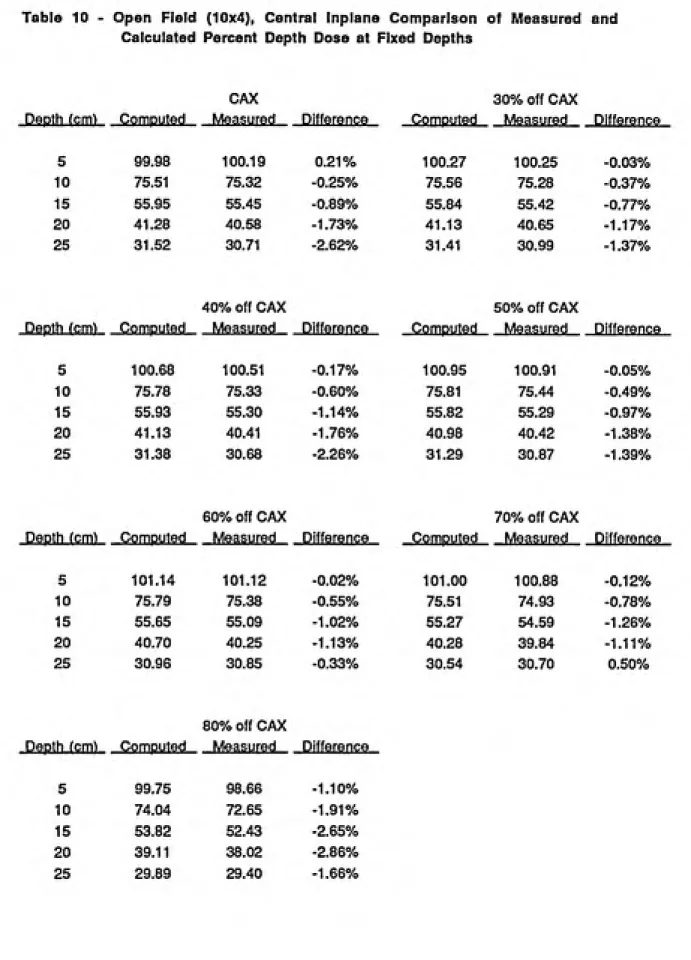
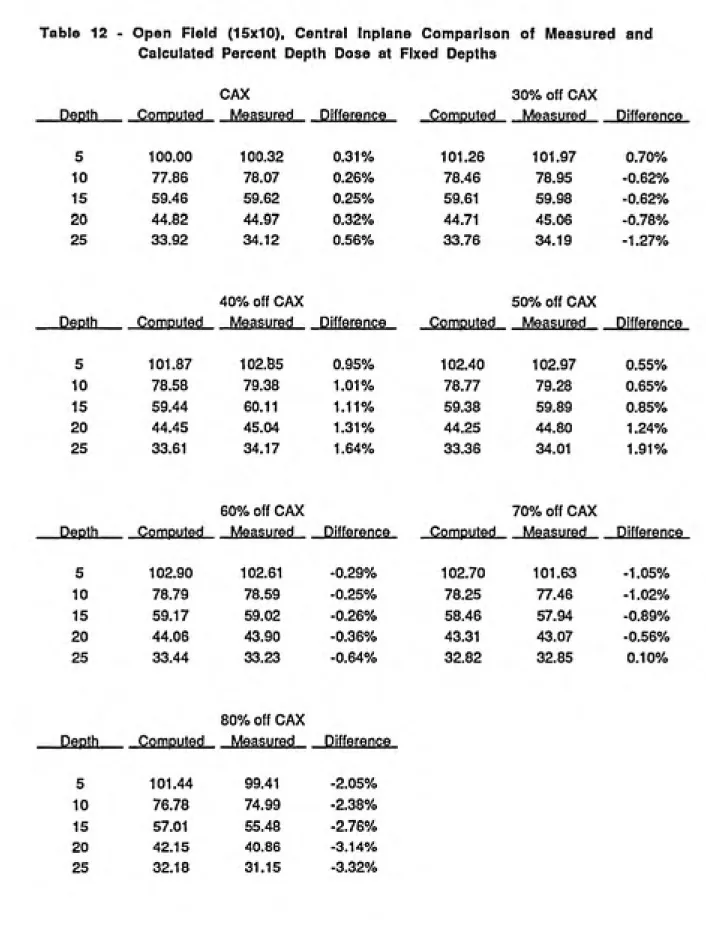
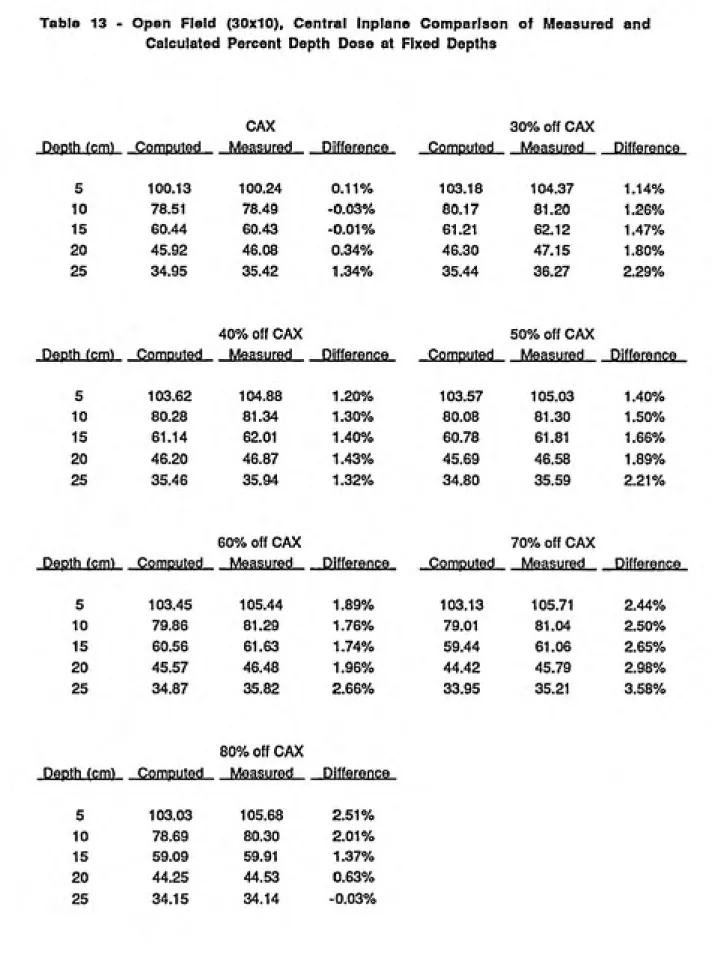
2 through 15 contain the comparisons of open-field measured and

(35)

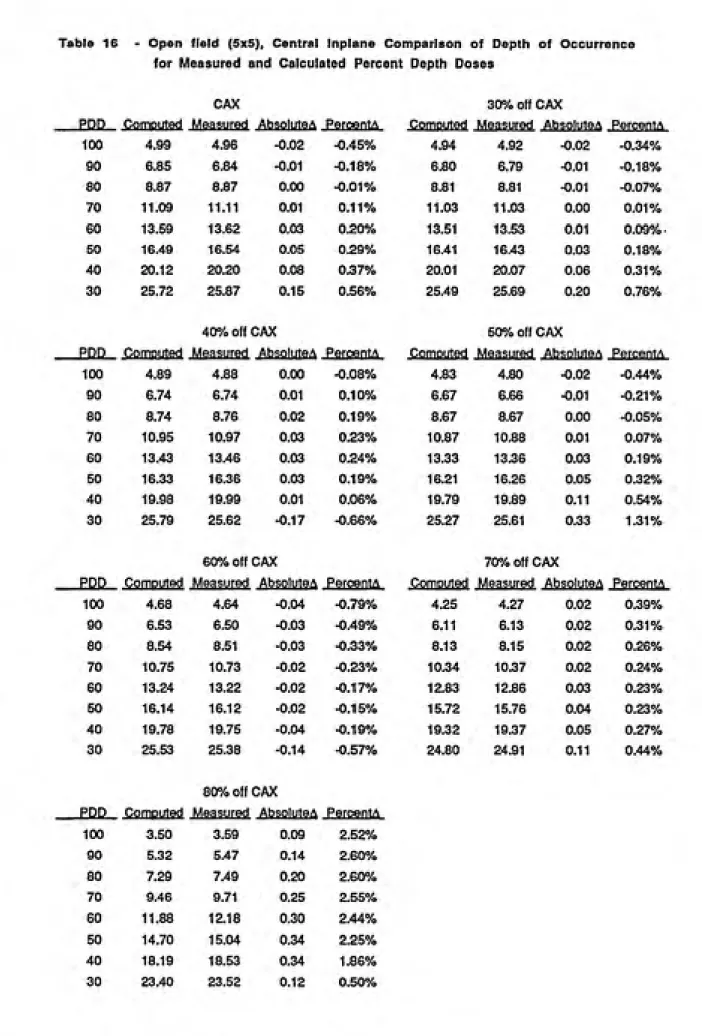
16 through 29 contain comparisons of the depth of occurrence for

measured and computed PDDs ranging from 30% to 100%.

A.1. Percent Depth Dose at Fixed Depths

Comparison of calculated open-field PDD values with

measured values shows acceptable agreement for 97.5% of the

sampled data points. Along the central axis all compared values

are within ±.3%. A general trend appears to be that as depth

increases, the percent difference between calculated and

measured values increases. This observation should be interpreted

relative to the point of normalization. That is, agreement is best

near the point of normalization.

At distances 30% - 80% off axis, the calculated and

measured values for 97% of the sampled points are within ±.3%.

Similar to results on the central axis, as depth increases the

percent difference increases for smaller field sizes (Tables 2, 3,

10 and 11). For Tables 2 and 11 as the lateral distance from the

central axis increases the percent difference also increases.

However as field size and lateral distance from the central axis

increases, the percent difference decreases as a function of depth

(36)

A.2. Depth of Occurrence of Selectd Percent Depth Values

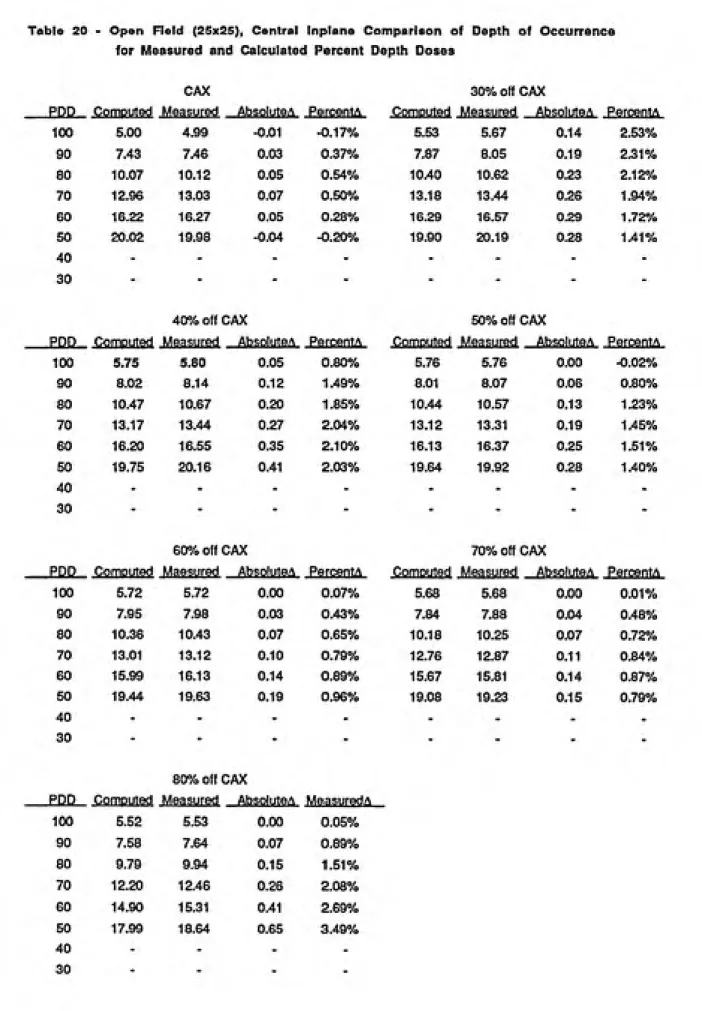
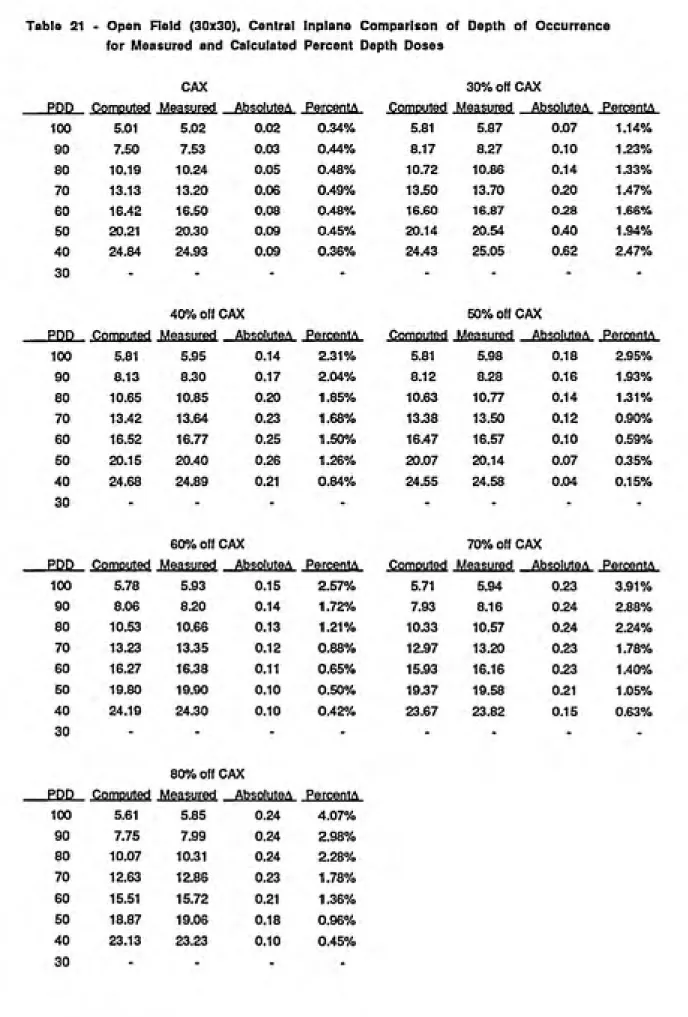
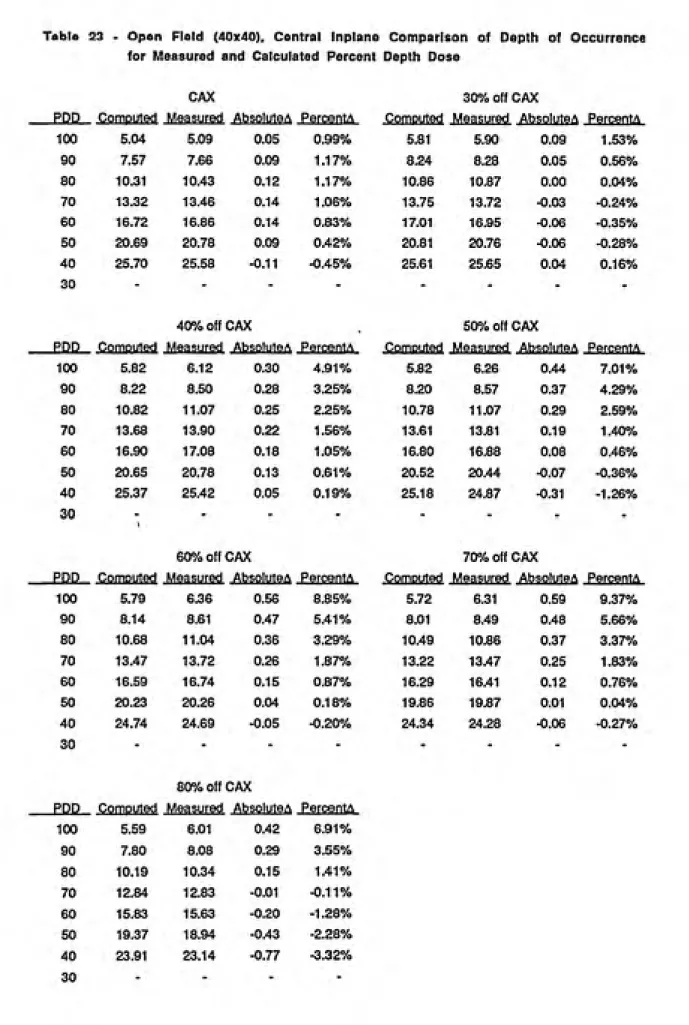
Tables 16-29 compare the depth of occurrence of selected

isodose values. The depths of occurrence for the selected isodose

values agree for 88.5% of the sampled points. Comparison is

stated as the absolute and percent difference between measured

and computed depths. Along the central axis all of the compared

values are within ±3%, and all the absolute differences are less

than ±J mm. As the depth increases, the absolute difference

increases. However the percent difference does not necessarily

increase, as seen in tables 16 and 29.

In the 30% - 80% off-axis region, 87% of the compared

values are within ±.3%. As observed in the tables there is an

Increase in absolute and percent difference as field size

increases. This trend occurs for higher PDDs and as lateral

distance from the central axis increases (Tables 19, 22, 23 and

27). The greatest absolute difference between compared depths is

observed for an 8x12 cm2 Table 25 at 80% off-axis.

B. Wedged Fields

Tables 30 - 38 compare measured and calculated PDD at

fixed depths for 15x15 cm2 wedged fields, and Tables 39 - 47

compare the depth of occurrence for selected PDD values. There is

a 40° collimator rotation for diagonal scanning of the wedged

fields in Tables 31, 33, 36, 38, 40, 42, 45 and 47. The comparison

(37)

the wedged fields have been further classified according to

whether or not ray lines are under the thick portion or the thin

portion of the wedge.

B.I.a. 15° Wedges - Percent Depth Doses at Fixed Depths

Comparison of the measured and calculated PDD values for

the 15° wedge (Tables 30 and 31) show that the calculation and

the measurement agree within ± 3% for 93% of the sampled points.

Along the central axis 90% of the compared values are within ±

3%. In general, as depth increases the percent difference between

measured and computed values increases.

In the 30% - 80% off-axis region, overall 86% of the

compared values are within ± 3%. Under the thick portion of the

wedge, 88% of the sampled points agree, and under the thin

portion of the wedge 83% agree within ± 3%. Under both the thick

and thin portions of the wedge and along the 30%, 40%, 50% and

60% off-axis ray lines, the general trend is an increase in percent

difference with depth. As seen from Table 30 for a 15 x 15 cm2

field along the 70% and 80% off-axis ray lines, the percent

difference decreases with depth down to 15 cm and then

increases beyond 15 cm. For a 40° collimator rotation (Table 31),

along the 70% off-axis ray under thick portion of the wedge, and

along the 80% off-axis rays under both the thick and thin portion

of the wedge, a decrease in percent difference with increasing

depth is observerd. However along the 70% off-axis ray under the

(38)

B.2.a. 15° Wedge- Depth of Occurrence of Selected

Percent Depth Dose Values

Comparison of the depth of occurrence (Tables 39 and 40) of

selected depth dose values shows that 78% of the sampled points

are within ±. 3%. Along the central axis 94% are within ±. 3%. As

seen in Table 39, the percent difference increases with increasing

PDD. Table 40 shows that the percent differences remain

relatively constant with PDD. For both fields however the

absolute difference increases with PDD and the absolute

difference does not exceed 1 cm.

In the 30% - 80% off-axis region, 77% of the sampled points

agree within ±. 3%. For both field sizes under the thick portion of

the wedge, 74% of the sampled points are within ± 3%, and under

the thin portion 80% are within ±. 3%. Along the 30% - 50%

off-axis ray lines of Table 39 and under both portions of the wedge,

there is an increase in absolute and percent differences with

decreasing PDD. As seen along the 80% off-axis ray of the same

table and under both portions of the wedge, a decrease in absolute

and percent differences is observed until the 50% depth dose, then

the differences increase. In Table 40 under both portions of the

wedge and along the 30% - 50% off-axis ray lines an increase in

the absolute difference with decreasing PDD is seen, however the

percent difference does not increase. An absolute difference of no

(39)

B.1.b. 30° Wedges - Percent Depth Doses at Fixed Depths

Comparison of measured and computed PDD values for the

30° wedge (Tables 32 and 33) show that the calculations and

measurements agree within ±. 3% for 76% of the sampled points.

Along the central axis 90% of the compared values are within ±

3%. In general, as the depth increases the percent difference

increases.

In the 30% - 80% off-axis region for both fields, 75% of the

compared values are within ±. 3%. Under the thick portion of the

wedge 69% of the sampled points agree, and under the thin portion

80% of the compared values agree within ± 3%. In Table 32 the

percent difference between compared values under the thick

portion increases with depth. Under the thin portion and along 40%

thru 70% off-axis rays, there is a decrease in the percent

difference down to 15 cm, then the percent difference increases.

Along the 30% - 60% off-axis rays under the thick portion of the

wedge in Table 33, the percent difference decreases down to 15

cm then increases. For the thin portion of the wedge the percent

difference increases with depth along the 30% - 70% off-axis ray

lines.

B.2.b. 30° Wedge - Depth of Occurrence of Selected

Percent Depth Dose Values

Comparison of the depth of occurrence (Table 41 and 42) of

(40)

are within ±. 3%. Along the central axis 94% of the compared

values are within ±. 3%. In Table 39 the absolute and percent

difference increases with depth, and in Table 42 (40" collimator

rotation) there is a decrease in absolute and percent difference

with depth.

In the 30% - 80% off-axis region, 64% of the sampled points

agree within ± 3%. Fifty percent and 79% under the thick and thin

portion of the wedge, respectively, for the compared values agree.

There is an increase in absolute and percent difference with

decreasing FDD along the 30% - 60% off-axis ray lines under the

thick portion of the wedge in Table 41. Note that for the position

of occurence of the 100% FDD on the 60% ray line, the absolute

difference is less than 1 mm, but the percent difference is close

to 3%. Under the thin portion of the wedge for Table 41, there is

an increase in absolute and percent differences with decreasing

FDD along the 30% and 40% off-axis ray lines. Along the 50% and

60% off-axis rays the measured depths become increasing greater

than the calculated depth. This change is reflected in the absolute

and percent differences. Decrease of absolute and percent

difference with decreasing FDD is seen along the 70% and 80%

off-axis rays.

Table 42 shows that under the thick portion of the wedge

the measured depth is initially less than the calculated depth,

then becomes increasingly greater than the calculated depth. Note

the FDD where the change occurrs is lower for each subsequent

ray line. Under the thin portion of the wedge, the absolute and

(41)

-60% off-axis ray lines. As seen along the 70% and 80% off-axis

rays the absolute and percent differences decrease then increase

due to the measured depths becoming greater than the calculated

depths.

B.1.C. 30° Wedges and 20° Obliqued Beam - Percent Depth

Doses at Fixed Depths

Measured and calculated PDDs were compared in Table 34

for a 30° wedged and a 20° obliqued beam field. Along the central

axis only 40% of the sampled points were within ±.3% of each

other. Higher PDDs for measured points than for calculated points

at each depth compared.

In the off-axis region 68% of the compared points agreed

within ±.3%. At shallow depths under the thick portion of the

wedge the measured PDDs were greater than the calculated PDDs,

and as depth increased the calculated became greater the

measured PDD. Under the thin portion of the wedge and for ray

lines 30%, 40% and 50% at a depth of 5 cm the calculated PDD was

greater than the measured. As depth increased the percent

(42)

B.2.C. 30° Wedge and 20° Obliqued Field - Depth of

Occurrence of Selected Percent Depth Dose Values

Measured and calculated PDD values were compared in Table

43 and the overall agreement within ±.3% was 52%. Along the

central axis the absolute and percent differences increased with

decreasing PDD. Only two out of eight sampled points were within

±3%.

Under the thick portion of the wedge in the off-axis, as the

PDD decreased the absolute and percent differences improved for

ray lines 30 - 50%. Better agreement was seen at the 60% and 70%

ray lines, however more compared points fell into the penumbra

and therefore were disregarded. For the 80% ray line poor

agreement within ±3% was seen. Several compared points fell in

the penumbra and could not be considered. For the ray lines which

fell under the thin portion of the wedge, the absolute and percent

differences generally worsened with decreasing PDD. The overall

agreement within ±3% for the off-axis region was 54%.

B.1.d. 45° Wedges - Percent Depth Doses at Fixed Depths

Comparison of measured and calculated PDD values for

the 45" wedge (Table 35 and 36) show that the calculations and

measurements agree within ±. 3% for 60% of the sampled points.

Along the central axis, 60% of the compared values are within ±

3%. As the depth increases the percent difference between

(43)

At distances 30% - 80% off-axis, 80% of the compared

values are within ± 3%. Under the thick portion of the wedge 48%

of the sampled points, and under the thin portion 73% agree within

±.3%. For the 45° wedged field with 0° collimator rotation and

under the thick portion of the wedge, the measured PDD values are

greater than calculated values. The percent difference increases

with depth. Under the thin portion of the wedge, the measured PDD

becomes greater than the calculated value at a specific depth for

each ray. The percent difference improves then worsens as the

depth increases. With a 40" collimator rotation (Table 36) and

under the thick portion of the wedge, a similar pattern is

observed as under the thin portion of the wedge in Table 35. Note

that there is an increase in the measured values which are

smaller than calculated as the off axis distance increases. Under

the thin portion and along 30% - 50% rays the percent difference

increases with depth. For the 60% - 80% rays the measured PDD

values initially are less than the calculated values, then exceeds

them, creating a fluctuation in the percent difference.

B.2.d. 45° Wedges - Depth of Occurrence of Selected

Percent Depth Dose Values

Comparison of the depth of occurrence (Tables 44 and 45) of

the selected depth dose values show that 46% of the sampled

points are within ±, 3%. Along the central axis 44% of the

(44)

differences increase with lower PDDs. The greatest absolute

difference is 2 cm at the 30% depth dose in Table 45.

In the 30% - 80% off-axis region 46% of the sampled points

agree within ±. 3%. Under the thin portion of the wedge for Table

44 the measured depth approaches the calculated value then

exceeds it. The absolute and percent differences improve then

worsen as the measured depth becomes greater than the

calculated value. Under the thick portion of the wedge all the

measured depths are greater than the calculated values. Notice at

the 70% off-axis ray and the 80% depth dose, the absolute

difference is the smallest but the percent difference is the

greatest. No absolute difference is greater than 2 cm.

In Table 45 under the thin portion of the wedge, it is seen

that the measured depths at the greater lateral distances off the

central ray are less than the calculated values then gradually

proceed to become greater than calculated values. Because of this

trend the percent difference improves until a specific depth dose

then worsens. Under the thick portion of the wedge in Table 45 the

same trend is observed. An overall 22% and 69% of the compared

values under the thick and thin of the wedge, respectively, are

(45)

B.1.e. 60° Wedges - Percent Depth Doses at Fixed Depths

Comparison of measured and calculated PDD values for the

60° wedged field (Table 37 and 38) show that the calculated and

measured depths agree within ±. 3% for 50% of the sampled points.

Along the central axis, 80% of the compared values are within ±_

3%. The general trend is increasing percent difference with

increasing depth.

At distances 30% - 80% off-axis, 46% of the compared

values agree. Under the thick portion of the wedge, 29% of the

sampled points are within ±. 3%, and under the thin portion 66%

agree. The same trends are seen for the 60° wedged field as in the

45° wedged field with 0 degree collimator rotation (Table 35). As

seen In Table 37 for the thick portion of the wedge, the percent

difference increases with increasing depth, and under the thin

portion the percent difference improves then worsens as the

depth increases.

For the 60° wedged field with a 40° collimator rotation

(Table 38) the percent difference increases with increasing depth

under the thin portion. The percent difference fluctuates as the

measured percent depth dose becomes greater than the calculated

(46)

B.2.3. 60° Wedges - Depth of Occurrence of Selected

Percent Depth Dose Values

The depth of occurrence of selected depth dose values for

calculated and measured ( Tables 46 and 47) show that 38% of the

compared values are within i.3%. Along the central axis only 25%

of the compared values were within ±3%. In Table 46 none of the

measured and calculated values are within ±3%. The general trend

is an increase in absolute and percent differences with decreasing

PDD. The greatest absolute difference is 2.1 cm at the 30% depth

dose in Table 46.

At distances 30% - 80% off axis, 40% of the sampled points

agreed within i3%. Poor agreement (18%) of sampled points is

observed under the thick portion of the wedge for both tables.

Under the thin potion of the wedge 56% and 60% of the compared

values agreed within ±.3% for Table 46 and 47, respectively. In the

0° collimator rotation field (Table 46), the measured depth values

initially are less than the calculated values. As the PDD

decreases, the measured depth becomes greater than the

calculated value thereby creating the fluctuation in the absolute

and percent differences. As the distance off axis increases more

measured depths are less than the calculated values. Under the

thin portion of the wedge for Table 47 a similar trend is seen as

(47)

C. Blocked Fields

Tables 48 and 49 compare measured and computed PDD at

fixed depths for 35 x 33 cm^ mantle block field and Tables 50 and

51 compare the the depth of occurrence for selected PDD values.

One inplane scan was measured on the central ray (Tables 48 and

50) and one crossplane scan was measured 14.4 cm off the x-axis

and 1.7 cm off the y-axis of the central ray (Tables 49 and 51).

Figure 4 is an illustration of the mantle block. The comparison

analysis is the same as with open fields except that the data for

the mantle block field has been further divided according to the

right and left of the central axis of the assymmetric field.

C.1.a. Inplane Mantle Block Field - Percent Depth Dose at

Fixed Depths

Comparison of the computed inplane mantle block field PDD

values with the measured values shows acceptable agreement for

90% of the sampled data points. Along the central axis all of the

compared values are within ±. 3%. In general the percent

(48)

^l7"

+H-H-I

i| n it I ( u 111 III] +< < t {n 11 [ff++fM^ fH-H

Figure 4 - Crossplane, off-aKis, mantle field measurement

point (k).

At distances 30% - 80% off-axis the calculated and

measured values for 89% of the sampled points in Table 48 are

within ±. 3%. On the left of the central ray the measured PDD

generally is lower than the calculation for the specific depth and

(49)

30% off the central axis to the left and at 25 cm depth the

measured PDD is greater than the calculation. As the depth

decreases the measured PDD becomes increasingly less than the

calculation with the largest percent difference occurring at 5 cm.

On the right side of the central axis the measured PDD initially is

greater than the calculation for the ray lines closest to the

central axis. As the ray line distance increases laterally from the

central axis the measured PDDs are less than the calculations. The

percent differences show this fluctuation then they stablize and

remain relatively constant for the ray line 80% off the central

axis.

C.2.a. Inplane Mantle Block Field - Depth of Occurrence of

Selected Percent Depth Dose Values

In Table 50 there was an overall 78% agreement for all

compared values. Along the central axis 75% of sampled points

were within ±3%. The general trend was an increase in absolute

difference with a decrease in percent difference as the PDD

decreased.

At distances 30% - 80% off axis, 78% of the compared

values agreed. On the left of the central axis the measured depths

were within ±3 mm of the computed depths at the 30% ray line,

(50)

increased the measured depths became less than the computed. All

the compared values were in dL3% agreement. Because of the

asymmetry of the field only the 30% - 70% ray lines could be

traced and analyzed.

C.1.b. Crossplane Mantle Block Field - Percent Depth Dose

at Fixed Depths

Comparison of the computed mantle block field PDD values

with the measured values showed agreement within ±3% for 69%

of the sampled points. All compared points had acceptable

agreement along the central axis of the scan. There was an

increase in percent difference between compared points with

depth. At distances 30% - 80% off the central axis of the field

67% of the computed and measured values were within ±3%. On the

left side of the central axis of the scan, measured PDDs are at

shallower depths than the computed PDDs. At the 70% ray line to

the left the measured PDD is considerably less at 5 cm, but

approaches the computed PDD as the depth increases. Also note at

the 80% ray line to the left the measured PDD initially is much

less than the computed but becomes larger than the computed at

15 cm.

For the 30% - 80% ray lines on the right side of the central

axis of the scan 100% of the compared values agreed within ±.3%.

The trend is the measured PDDs are at shallower depths than the

computed PDDs, and the percent difference between compared

(51)

C.2.b. Crossplane Mantle Block Field - Depth of

Occurrence of Selected Percent Depth Dose Values

There was an overall 53% agreement within ±3% for all the

compared values of Table 51. Along the central axis all the

sampled points were within ±. 3%. The absolute differences

remained fairly constant with the percent difference decreasing

with lower PDDs.

In the off-axis region 49% of the compared calculated and

measured depths were within i. 3%. On the right side of the

central axis of the scan agreement within ±. 3% was seen for ray

lines 30% through 70%. At the 80% ray line the absolute

difference between compared depths increased but remained

fairly constant as PDD decreased. On the left side of the central

axis of the scan poor agreement was observed between the 30%

-80% ray lines. As the PDD decreased the percent difference

Figure

Table 4    - Open  Field  (15x15),  Central  Inplane Comparison  of Measured and Calculated Percent Depth Dose at Fixed Depths
Table  10  - Open  Field  (10x4),  Central  inplane Comparison  of Measured  and Calculated Percent Depth Dose at Fixed Depths
Table 11   - Open  Field (8x12),  Central Inplane Comparison of Measured and Calculated Percent Depth Dose at Fixed Depths
Table  12 - Open  Field  (15x10),  Central  Inplane Comparison  of Measured  and Calculated Percent Depth Dose at Fixed Depths
+7

References

Related documents

of Trade and Industry or the National Consumer Commission or WASPA, to alter any aspect of the Competition, then to the full extent permitted by law, the Promoter reserves the right

With the authorities' rank of objective importance known, evaluation of the flood factors commences with the basic outline of objectives, criteria and indicators

who have relevant training and experience within community drug services will weaken Prison Officers are insiders in the prison system, whose responsibilities reflect the dual

ния величин , измеренные на первой по ходу движения оси экипажа ( среднее по трем макси -. мумам с предварительным

Because these genes undergo ligand- activated PPAR α -dependent DNA demethylation during the suckling period that persists into adulthood, it could be possible that some of

We wish to examine the optimal investment in product development for a software publisher under two different licensing schemes: the traditional way of licensing with

As can be seen, the estimated increase in the Sensex following the scrapping of dividend tax, ranges from about 4% to 11% for the three values of the effective dividend tax rate..