Knowledge about Sustainability:
SSM as a Method for Conceptualising
the UK Construction Industry’s
Knowledge Environment
Will Venters, Tony Cornford and Mike Cushman
Department of Information Systems, London School of Economics and Political Sciences, London, UK
This paper proposes a sociology of knowledge ap-proach as a basis for understanding the potential of knowledge management for the work of a complex inter-organisational domain – the UK construction industry and has the specific aim of increasing the sustainability of the processes and products of this industry. To this end, soft systems methodology is introduced as a method of conceptualising the industry’s knowledge environment and thus moving towards technological interventions which aim to increase sustainability in construction industry practice.
Keywords: Soft Systems Methodology, sustainability, knowledge management, methodology, construction in-dustry, social constructivism.
1. Introduction
The construction industry is concerned with the planning, design, production, alteration, main-tenance and demolition of the built environ-ment. In the contemporary world this industry is facing pressure to increase the sustainability of its practice 1]. This pressure is understood to require significant change in the industry’s understanding of the demands of society and of its clients, as well as change to its own sense of corporate social responsibility. This in turn im-plies major changes in the industry’s work prac-tices. Kibert 2]summarises the aims of such a sustainable practice in construction through the following principles:
1. Minimisation of resource consumption. 2. Maximisation of resource reuse.
3. Use of renewable and recyclable resources. 4. Protection of the natural environment. 5. Creation of a healthy and non-toxic
environ-ment.
6. Pursuit of quality in creating the built envi-ronment.
Within the industry’s own discourse addressing these issues is seen to require the adaptation of present practice(e.g. the need to design and construct buildings in different ways, for ease of demolition as well as ease of construction) and the creation and application of new knowl-edge within new practices (e.g. the adoption of new sustainable ideas and concepts) 3] 4]. But, sustainability is still seen as a novel and contestable concept within the construction in-dustry, with no settled definition or operational-isation, and thus has no settled body of existing practice or processes. It is as much a philosophy of construction as a prescribed method. In the face of this, the industry conceives it necessary to develop new understandings to lead to new sustainable practices and processes. It believes that this might be achieved through attention to innovation and through dialogue. Such inno-vation and dialogue often take the form of un-dertaking pilot sustainable construction projects
(often high profile or prestige), learning from these pilots and then applying this learning to general construction; an approach, which if taken na¨vely, seems to offer little prospect ofı
then starts with an agenda that seeks to prob-lematise such dialogue and innovation in terms of a need for what the industry perceives as knowledge management.
1.1. The C-SanD Project
This paper is concerned with the choice of methodology to address such a situation and is motivated by involvement in a joint academic-industry research project focused on creating, sustaining and disseminating knowledge for sus-tainable construction across multiple stakehold-ers involved in construction projects – the C-SanD project1. The project focuses on
identi-fying and supporting emerging sustainable con-struction practices both within companies and between companies engaged in construction pro-jects(including clients). The research project aims to apply principles from construction man-agement, knowledge management and informa-tion systems to devise a technology or interven-tion which may aid the industry in achieving sustainability goals.
One particular aspect of this work is the fo-cus of this paper, the application of a specific methodology, soft systems methodology(SSM) in order to gain an understanding of the issues associated with knowledge within the construc-tion industry. Our chosen stance with regard to knowledge management is based on a socio-logical approach to knowledge, suggesting that knowledge is a consequence of social interac-tion. Consideration is given here to the features required of a methodology to develop know-ledge management systems for the construction industry. The following section discusses our chosen stance for knowledge management and knowledge creation. This is followed by discus-sion of the role of ICTs and information systems development methods in knowledge manage-ment. The final section introduces and seeks to justify our choice of SSM as an appropriate methodology and describes how the methodo-logy is applied within the C-SanD project. The paper concludes with a discussion of the general appropriateness of SSM to Knowledge Manage-ment interventions.
2. Knowledge Management?
Knowledge management is a broad and expand-ing topic 5]. In reviewing the theory and litera-ture of this field, and applying it to the challenge of sustainable construction, it is necessary to commit to an identifiable epistemic flavour of approach. Many such approaches have been identified, and have been categorised in various ways 6–9]. Schultze 9] engages Burrell and Morgan’s 10] framework in order to identify a two fold typology of knowledge within the debate: objectivist and subjectivist. An objec-tivist approach views knowledge as an object to be discovered 11]. Identifying the existence of knowledge in various forms and locations, tech-nology is then employed in the codification of such knowledge objects 12]. In contrast, a sub-jectivist approach suggests that knowledge is inherently identified and linked to human ex-perience and the social practice of knowing, as seen, for example, in the work of Tenkasi and Boland 13] and Brown and Duguid 14]. In adopting such a stance, it is contended that knowledge is continuously shaped by the social practice of communities and institutions and far less amenable to codification.
Such an objectivist versus subjectivist account, if taken too literally, may indeed be too bi-nary. We thus recognise a third, constructivist approach, suggesting that a position of either absolute subjectivity or absolute objectivity is untenable; rather, these become relative posi-tions in the intersubjective social consciousness 15] 16]. Subjectivity and objectivity are inter-locked in a reciprocal relationship and both are always necessary 15]. In adopting such a po-sition to knowledge, it is accepted that society
(and thus knowledge processes within it) are both a subjective and objective reality. Social reality is to be understood in terms of an on-going dialectical process composed of an indi-vidual simultaneously externalising their being into the social world, and internalising the so-cial world as objective reality; “to be in society is to participate in this dialectic” 16]. Taking such a broad approach, Demarest(1997)argues
that knowledge is embedded within the organi-sation, not just through individual actors or ex-plicit programmes, but also through social inter-change. This, however, may still tend to suggest that knowledge is an object that can be embed-ded and distributed, rather than as a change in the perceptions of individual actors who can institute practices that embody and perpetuate their increased understanding. For us it is these new practices that are disseminated, and other actors encountering these new practices may learn from them and develop their knowledge. Having identified this third constructivist ap-proach, the rest of this section explores this di-alectic of knowledge, and, in particular, how a methodology may be employed to build such a picture of such a reality. Thus, in contrast to ap-proaches which “map-knowledge” 17, 18], our approach to analysis aims to explore the social and individual activities and the interchange in the social setting, which constantly re-creates knowledge in new forms.
2.1. Knowledge Creation?
As identified in the introduction, sustainability is seen within the construction industry to re-quire the creation and dissemination of new un-derstanding and knowledge. In line with the position outlined above, such creation of new knowledge is not simply a codification effort 19], nor one driven only by personal explo-rations, but it involves the ability to interact with and convince others. The construction com-munity within which such knowledge might be shared and communicated thus forms an impor-tant component of the knowledge process we study.
Adopting such a perspective, our interest shifts from supporting, mapping, storing and dissem-inating knowledge as object, to supporting(and creating or shaping) many possible activities undertaken by individuals engaged in social ac-tion. We can still, however, argue that human knowledge is capable of some degree of ob-jectification; that is, manifested as products of human activity, available to producer and others as elements of their intersubjective world. But, we suggest that such objects do not “possess” knowledge, as would be argued by codification of tacit knowledge into explicit knowledge 19],
nor does technology simply act as a conduit by which knowledge may the shared. Rather, such elements may contain, express and inscribe ac-cumulations of meaning and experience 16]. An act of objectivation, for example an answer to a request for information on a company in-tranet, may make an individual’s subjectivity appear to have greater reality, not only for the receiver, but also for the producer 16]. Equally, an architect’s production of design documents acts as both communication(to demonstrate the design to a client)and as individual subjective tool – the architect is not simply codifying a pre-conceived picture but making real a subjec-tive thought see 20 for further discussion]. In Weick’s 21]terms, the individual makes sense of their world by interacting within it.
2.2. Knowledge Only Makes Sense in Context:::
Such a sociology of knowledge suggests that knowledge(and knowledge practices)may only be made sense of fully within the situation that it was generated and by the actors involved in its creation. And, yet, the aim of know-ledge management is to enable the relocation of knowledge. Any abstraction of knowledge from that context removes it(to some degree) from the chain of because-ofs and in-order-tos that brought an insight to the focal awareness of the individuals concerned 22]: knowledge being what made action appropriate in that sit-uation at that time – what emerges as the obvi-ous next step 23]. Shared experience is what makes an informed actor able to infer some of the surrounding context on hearing or reading an account of the insight and relate it ( appro-priately) to his/her own practice. This maybe through a local(or virtual)community of prac-tice 24], where much of the context is visible; it maybe through a shared professional training and practice; or it maybe through an organisa-tional affiliation, where ways of doing things are shared.
reasons that go beyond a lack of understanding of technical terminology. It is the apprentice-ship and induction process of becoming a ser-vices engineer or an architect that enables an increasing ability to translate communications into appropriated knowledge, rather than a re-ceived instruction. Being a services engineer or an architect means not just having a qualifica-tion, but more it means being a respected mem-ber of a community where judgements are re-garded as knowledgeable by others. In this way Dreyfus 26] describes the process of develop-ing mastery and practical wisdom in a field and the possibilities and limitations of ICTs in en-abling such a knowledge process, while Prusak and Cohen 27]explore this at an organisational level, describing the ability to share understand-ings as the social capital of a firm.
Thus, a key problematic of this current re-search is the investigation of how individuals and groups within the construction industry can be assisted to make knowledgeable interpreta-tions for sustainability within company and pro-fessional structures and, crucially, in an indus-try based on multi-firm and multi-professional projects, across these boundaries. The later sec-tion of this paper on the applicasec-tion of soft sys-tems methodology describes our approach to this issue. However, given the contested con-cept and evident challenge of sustainability to the status quo, such structures of institution-alised practice may lead an individual to ha-bitualisation of action, where a given approach is embedded in routine 16]. Such institution-alised practice is reciprocated by others in the social structure as products of history 16, 28, 29]; to the individuals concerned, they appear as objective reality. Within the construction in-dustry we see that professional engineers and managers often remain with the same organisa-tion for extended periods and their professional identity often lasts throughout their career, ac-quiring the approaches and adopted practices of their profession and their firm, creating a set of dispositions for how they encounter the world, in Bourdieu’s 30]framework ahabitus. A concern for sustainability needs to success-fully challenge such institutionalised sets of dis-positions governing practice. If ICT-based sys-tems are to be a part of this, then they must be built on an understanding of individuals’ actions
and habitualised practices, rather than on the espoused theories which may attempt to ratio-nalise such habitualisation through theory 31]. This study focuses upon practice across an in-dustrial sector, rather than intra-organisationally, so comparisons between practices will be re-quired. A methodology is thus required which can capture and challenge such habitualised practice, and explore the social structures within which the activity occurs. We have thus sought a methodology that allows us to focus upon the shared social context of the parties involved in knowledge processes and which can serve our attempt to develop a picture of the creation and use of artefacts, and identify the knowledge perceived to be contained within them. The selected sociology of knowledge approach sug-gests that knowledge is only fully applicable within the context in which it was created by the creators of the knowledge. However, we are working against such an assertion by at-tempting to move knowledge through ICT. The paper further identifies that habitualised struc-tures and routines limit the ability to challenge existing practice. On this basis, ICT for know-ledge management presents difficult challenges. The next section explores such challenges in the context of the C-SanD project’s attempt to de-velop a technology to challenge existing prac-tices within the UK construction industry in or-der to promote sustainability practice.
3. Knowledge and ICTs
small specialist firms, and their technology plat-forms may be at best modest. We therefore have to ask what role ICTs have in supporting know-ledge work 7, 35], and in the creation, dissemi-nation and application of knowledge within and between organisations? This simple question remains a contentious issue 5, 36, 37]. Initial approaches to employing ICT within knowledge management attempted to marry the capabili-ties of technology with the generic features of knowledge management, for example consid-ering the Internet as a knowledge repository or data mining as knowledge discovery 33]. How-ever, such approaches imply conformity among activities and essentially the objectivist episte-mology. Other approaches have attempted to “map” the knowledge existent within an or-ganisation, devising pictures of communication which may be translated(in whole or in part) into ICT solutions 18]. But, as Hendricks notes “:::no ICT(information and communica-tion technology)application deserves the label of a knowledge management tool purely because of its own characteristics. It is essential when valuing ICT applica-tions as knowledge management tools to consider the situation in which they are used” 38].
Further criticism of ICT-driven knowledge man-agement approaches preface the objectivist ap-proach to knowledge while ignoring the subjec-tivist dimension 38–40]. In contrast to such ap-proaches, we argue that for the development of effective knowledge management systems there is a need to build an understanding of the know-ledge environment and context
“Knowledge is analysed as an active pro-cess that is mediated, situated, provisional, pragmatic and contested. The approach suggests that attention should be focused on the systems through which people achieve their knowledge and on the pro-cesses through which new knowledge may be generated.” 40]
Responding to Blackler’s call, we conceptualise such systems not as instrumental artefacts, but as purposeful human activity systems. Rather than focusing on ICTs as driven by concern for what people know (or want to know), which in any case proves elusive to describe 19],
we adopt an approach which focuses on what people do and how others interpret this 41]. Thus, we can accept a potentially important role for ICT in knowledge management activity, which leads us to explore the relevance of infor-mation systems methodologies to aid the task of understanding the knowledge environment, as guides to the establishment of relevant inno-vations/interventions of a technological char-acter. Our interest in the application of infor-mation systems development methods to know-ledge systems is still, however, based on the be-lief that, while the claims of knowledge manage-ment systems may be the creation, dissemina-tion and applicadissemina-tion of knowledge, a computer-based system is only capable of processing data 42]. Exploring techniques seen as effective in developing data processing machines which support information systems is understood as relevant, but not the whole answer. We are thus mindful of McDermott’s 34]comment that
“the great trap in knowledge management is using information management tools and con-cepts to design knowledge management sys-tems,”as such systems often ignore the cultural issues and become little more than(or even less than)information systems.
In summary, the paper thus identifies a need for a methodology which can problematise existing practices (sustainable or otherwise) of the UK construction industry in order to develop new ICT tools which effectively support the develop-ment and dissemination of sustainability prac-tice. Such a methodology should be relevant to the adopted social constructivist stance towards knowledge and it should seek to explore the social and individual activities and interchange conjunct with the social setting in which they are practiced.
4. Soft Systems Methodology
The discussion so far suggests a need to ex-plicitly recognise and incorporate technical, or-ganisational and social modalities within any approach to designing and introducing know-ledge management technologies. This implies, among other things, that a selected methodology needs to be able to retain and combine such as-pects. On this basis, our selected methodology is soft systems methodology (SSM) 43, 44]. Soft systems methodology is founded on the analysis of a hierarchy of models(systems)of purposeful activity. By employing systems con-cepts in the exploration of organisational know-ledge behaviour, this work also contributes to the debate begun by Galliers who suggested that systems thinking be introduced within trans-disciplinary research into organisational theory
45].
The complexity and unbounded nature of the sustainability issue, the implied need to do some-thing new, faced by the construction industry, leads this research to see beyond supporting knowledge processes within thestatus quo. In-stead, our research aims to explore and sup-port emergent, innovatory sustainable practice. SSM considers social reality as continuously socially constructed and reconstructed by indi-viduals and groups, and is thus in keeping with our stance. Within the SSM, systemic think-ing is employed as a method of makthink-ing sense of this world. The systems outlined through the method(known as relevant human activity systems)provide a lens through which to make sense of this complex and changing world, not representations of systems existing in or pro-posed for the world. By applying such sys-temic thinking to the issue of sustainability we can apprehend the evident confusion and doubt. We can elicit models of how individuals within the industry conceptualise and approach sus-tainability concepts and sussus-tainability problems and possibly offer innovations in support of this.
4.1. Expressing the Problem Situation
In the SSM, so-called rich-pictures are drawn as a method of capturing the problem situa-tion, while recognising that different parties in-volved in the construction conceptualise their
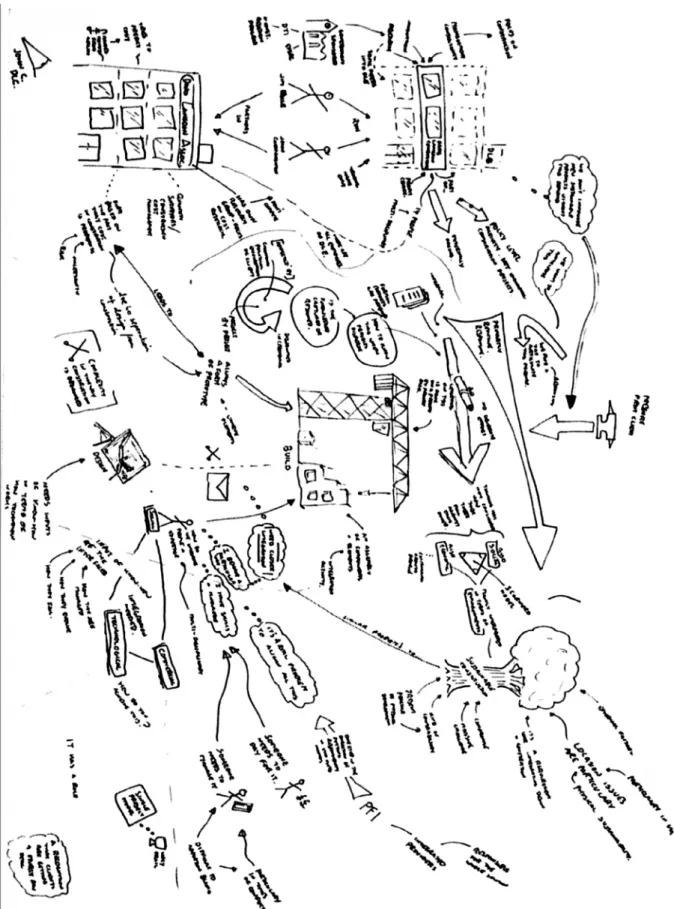
work(including issues of sustainability) differ-ently 44]. For instance: to a client, sustainabil-ity may consist of a public-relations exercise; to an architect, it may be a method of achieving competitive advantage by differentiation; for an engineer, meeting the requirements of the building regulations; for a contractor, it may be a tiresome interference in “getting the job done”. Since rich pictures “are a better means for recording relationships and connections than is linear prose” 43], they provided this project with a tool to effectively express such problem situations. Initial interviews and meetings were thus undertaken with around 17 key individuals across 10 different UK construction firms and from these, research officers drew around 16 different rich pictures to represent the sustain-ability domain identified (see Figure 1 for an example of one of these rich pictures).
From these rich pictures the researchers then attempted to highlight different world-views
(Weltanschauungen) held by various parties. The pictures also attempted to express the de-gree of social interaction and began to draw out the activity which was considered purpose-ful from among the uncertainty, disagreement and conflict associated with the sustainability issue. Existing information systems were also included within these pictures, in as far as they are involved in such conceptualised purposeful activity.
4.2. Identifying Human Activity Systems
Fig. 2.Photograph of Oval Mapping used to discuss the rich pictures.
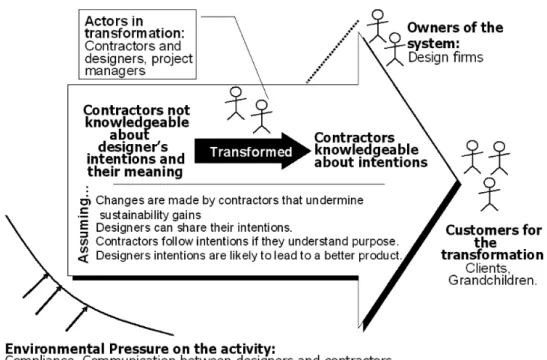
Relevant human activity systems were then ex-pressed as root definitions which “express the core or essence of the perception to be mod-elled” 43] – the core purpose of the human activity system.
These were presented to the industry partners in diagrammatic form (as introduced by Peter Checkland 44]), such that industry participants might discuss them without specific knowledge of SSM. An example of such root definitions is shown in Figure 3. Having identified such mo-dels of human activity systems, a second round
of interviews was undertaken to explore their relevance to individual work practices.
The identified human activity systems began to raise and identify institutionalised practices, and enabled an exploration of the social struc-tures in which the activity occurs, for instance identifying the role of “chartered surveyor” or of some “community of practice” in a design office. The rich pictures encouraged a holistic rather than reductionist approach to apprehend-ing the social context of the organisation, an approach to thinking, necessary for our adopted stance on knowledge management 47]. This consideration of the social and institutional struc-ture, roles and opinions, separately from more formalised structures such as organisations or projects, was of further value, given the dis-tributed nature of the construction industry. Through developing such an understanding we were able to propose and develop prototype ICTs as part of human activity systems that aim to improve sustainable practice.
To this end, SSM was employed in devising technological systems which ostensibly only process data, but with a clear ambition of im-proving/supporting/moving/sharing know-ledge practices within this community. Since sustainable construction practice is constantly emerging, such interventions needed to be con-ceived in a flexible and emergent manner. The
Fig. 4.Example Conceptual Model expressed as a root definition.
SSM, as an action research methodology, em-bodies such flexibility, allowing an iterative ap-proach to development. Through various cycles of iterative intervention, models of purposeful activity were developed and adapted to chang-ing knowledge practice. In this, SSM directed us towards achieving the change which was not just systemically desirable(change that im-proves performance against certain agreed pa-rameters), but also to identify change which might be culturally feasible (change is mean-ingful and commands assent within the sense-making environment) (Checkland 44]). At-tention paid to these twin concerns made SSM particularly appropriate for exploring and con-textualising this problem domain as we sought to identify potential technical interventions.
4.3. Moving from Soft Systems Methodology to IT Systems Development
Through such SSM analysis we could identify both responsible actors and transformations for
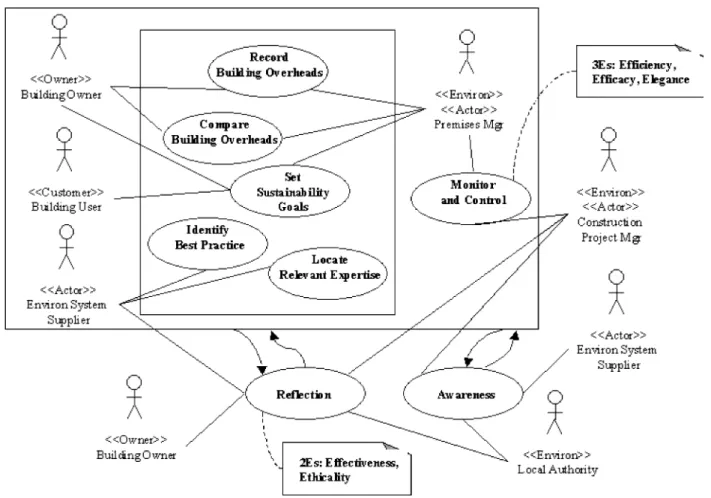
which they were(potentially)responsible. But, in order to build or establish new ICT-based sys-tems, we still needed to translate these contex-tually rich understandings into the sparse lan-guage of modelling tools and the even sparser language of programming. How to achieve these transformations so as to build the tools that are appropriate to at least partially described hu-man activity systems, was the next task of this research. For this purpose we employed UML
5. Conclusions
The research reported here focuses on how knowledge processes and environments can be understood and modelled as the construction industry addresses the issue of sustainability. This unbounded, complex and emergent domain is seen as requiring some technological inter-vention. We address such intervention through a consideration of both established and poten-tially new practices. Through our epistemologi-cal stance on knowledge management(a sociol-ogy of knowledge)we identify a need to engage with the social environment and the interaction that people are engaged upon. Leaving behind notions of identifying knowledgeper se, we in-stead focus on the task of understanding “what people do” or might do, and the complex envi-ronment in which they operate, and we identify SSM as an appropriate methodology to aid this task.
Our research is concerned with supporting the development and introduction of an ICT system into the practice of the UK construction indus-try, yet aware of the fact that the issue within which we aim to intervene is contested, emer-gent and changing. Thus our use of SSM as an approach to develop tools to support existent and new knowledge practices, is a learning and action research approach.
This final section of the paper critically reviews the benefits of SSM (as a learning and action research approach)within this research and ex-trapolates this research’s experience to present a general set of points regarding the use of SSM within knowledge management.
SSM presents an approach focused on the on-going practice of individuals and the Weltan-schauungenby which such practice is deemed sensible. The approach thus identifies social structures neither from the espoused views of individuals, nor from the legitimized view of organisational hierarchy, but rather from ex-ploring the social interactions inherent to the doing of work. The methodology thus avoids a deterministic identification of social structures, for example where Communities of Practice are identified simply because “community” is a de-ceptive and warmly persuasive word 51]to use in describing poorly understood social struc-tures 52]. Furthermore, such a focus on practice enables the research to focus on the actions and
activities of individuals rather than on their es-poused views of knowledge needs and expecta-tions of what a knowledge management system might do.
SSM is thus a process of enquiry 53] involv-ing participants in reflexively discussinvolv-ing their working practices. Such discussion and de-bate helps focus the development of technology on the practice of the UK construction indus-try rather than on the basis of how technology might be generically used in Knowledge Man-agement. It avoids focusing on what people want, rather focusing on what people do. Finally, the cyclical nature of SSM and its action research approach aligns well with iterative and incremental software development processes. It thus allows the technology to be introduced into the practice and the changes in this practice to be observed. This further allows a focus on how the industry is able to innovate new sus-tainable practices and then to further shape the technology to better reflect such new practice.
6. Acknowledgements
We would like to thank our academic collabo-rators at Loughborough University and the Uni-versity of Salford and our industrial collabo-rators for their support in this research. The C-SanD project is funded by the EPSRC.
References
1] PARKIN, S., Context and Drivers for
Operationa-lizing Sustainable Development. ICE November,
(2000), pp. 9–15.
2] KIBERT, C., Introduction, in Reshaping the Built
Environment: Ecology Ethics and Economics, C. Kibert, Editor.(1999), Island Press: Washington
DC. pp. 378.
3] EGAN, J.,Re-Thinking Construction: Report of the
Construction Industry Task Force, 1998, DETR: London.
4] Movement for Innovation, Environmental
per-formance indicators for sustainable construction,
(2001), Movement for Innovation. pp. 19.
5] SCARBROUGH, H., J. SWAN, AND J. PRESTON,
6] EARL, M.,Knowledge management strategies:
To-ward a taxonomy, Journal of Management Informa-tion Systems,(2001), 18(1): pp. 215–233.
7] ALAVI, M.ANDD. LEIDNER, Review: Knowledge
Management and Knowledge Management Systems: Conceptual Foundations and Research Issues, MIS Quarterly,(2001), 25(1): pp. 107–136.
8] MCADAM, R.ANDS. MCCREEDY, A critical review
of knowledge management models, The Learning Organisation, 6(3)(1999), pp. 91-100.
9] SCHULTZE, U., Investigating the Contradictions in
Knowledge Management, IFIP WG8.2 & WG8.6 Joint Working Conference on Information Sys-tems: Current Issues and Future Changes,(1998),
Helsinki, Finland: Omnipress, Wisconsin, USA. 10] BURRELL, G. AND G. MORGAN, Sociological
Paradigms and Organisational Analysis, (1979),
London: Heineman.
11] HEDLUND, G., A Model of Knowledge Management
and the N-form Corporation,Strategic Management Journal, 15(1994), pp. 73–90.
12] HANSEN, M.T., N. NOHRIA,ANDT. TIERNEY,What’s
your strategy for managing knowledge? Harvard Business Review,(1999), pp. 106–116.
13] TENKASI, R.ANDR. BOLAND, Exploring knowledge
diversity in knowledge intensive firms: a new role for information systems,Journal of Organizational Change Management, 9(1)(1996), pp. 79–91.
14] BROWN, J.ANDP. DUGUID., Organizing knowledge,
California Management Review, 40(3)(1998), pp.
90–112.
15] SCHULTZE, U., A confessional account of an
ethno-graphy about knowledge work, MIS Quarterly, 24(1)(2000), pp. 3–41.
16] BERGER, P.ANDT. LUCKMAN,The social
construc-tion of reality,(1966), London: Penguin Books.
17] SEEMANN, Real-world Knowledge Management:
What’s Working for Hoffman-LaRoche, (1996),
Centre for Business Innovation - Ernst & Young. 18] VAIL, E., Knowledge Mapping: Getting started
with knowledge management,Information Systems Management,(1999)(Fall), pp. 16–23.
19] NONAKA, I. AND H. TAKEUCHI, The
knowledge-creating company: how Japanese companies create the dynamics of innovation, (1995), New York:
Oxford University Press. xi, 284.
20] SCHON¨ , D.,The Reflective Practitioner: How
Pro-fessionals Think in Action, (1982), Basic Books.
374.
21] WEICK, K., Sensemaking in Organisations,
Founda-tions For Organisational Science, ed. D. Whetten.
(1995), London: Sage Publications. 231.
22] CIBORRA, C.,Information Complexities:
Challeng-ing the Wisdom of Systems,(2002), Oxford: Oxford
University Press.
23] INTRONA, L., Management, Information and Power,
Macmillan Information Systems Series, ed. I.O. Angell.(1997), Basingstoke: Macmillan.
24] WENGER, E., Communities of practice : Learning,
meaning and identity, 1st ed.Learning in Doing: Social, Cognitive and Computational Perspectives, ed. R. Pea, J.S. Brown, and J. Hawkins. (1998),
Cambridge: Cambridge University Press.
25] WITTGENSTEIN, L., Philosophical investigations,
(1967), Oxford: Blackwell. viii, pp. 250.
26] DAVENPORT, T. AND V. GROVER, Special Issue:
Knowledge Management (editorial), Journal of
Management Information Systems, 18(1) (2001),
pp. 3–4.
27] PRUSAK, L.ANDD. COHEN, How to invest in Social
Capital,Harvard Business Review,(2001)(June),
pp. 86–93.
28] LATOUR, B.,Science In Action,(1987), Cambridge
MA: Harvard University Press, 274.
29] KUHN, T., The Structure of Scientific Revolutions.
3 ed.(1996), Chicago: The University of Chicago
Press, 212.
30] BOURDIEU, P., Outline of a theory of practice,
Cam-bridge studies in social anthropology, 16(1977),
Cambridge: Cambridge University Press. viii pp. 248.
31] ARGYRIS, C., Action Science and Organizational
Learning,Journal of Managerial Psychology, 10(6)
(1995), pp. 20–26.
32] BHATT, C., Knowledge management in
organisa-tions: examining the interaction between technolo-gies, techniques, and people,Journal of Knowledge Management, 5(1)(2001), pp. 68–75.
33] DAVENPORT, T.AND L. PRUSAK, Working
Know-ledge: how organisations manage what they know,
(1998,)Boston: Harvard Business School Press.
34] MCDERMOTT, R., Why information technology
in-spired but cannot deliver knowledge management,
California management review, 41(4)(1999).
35] BACON, C.J.ANDB. FITZGERALD,The Field of IST:
a Name, a Framework, and a Central Focus,(1999),
ESRC.
36] GALLIERS, R., Towards the integration of e-business,
knowledge management and policy considerations within an Information Systems Strategy Frame-work, Journal of Strategic Information Systems, 9(3)(1999).
37] MILTON, N., et al., Towards a knowledge technology
for knowledge management,International Journal of Human Computer Studies, 51(3)(1999).
38] HENDRIKS, P., Many rivers to cross: from ICT to
knowledge management systems,Journal of Infor-mation Technology, 16(2001), pp. 57–72.
39] TSOUKAS, H., The firm as a distributed knowledge
system: A constructionist approach,Strategic Man-agement Journal, 17(Winter Special) (1996), pp.
40] BLACKLER, F., Knowledge, Knowledge Work and
Organizations: An Overview and Interpretation, Or-ganization Studies, 16(6)(1995), pp. 1021–1046.
41] BLACKLER, F., M. REED,ANDA. WHITAKER,
Epi-logue: An agenda for Research, Journal of Man-agement Studies, 30(6)(1993), pp. 851–862.
42] GALLIERS, B.ANDS. NEWELL, Back to the future:
From knowledge management to data manage-ment,The 9th European Conference on Information Systems,(2001. Bled), Slovenia: Moderna
Organi-zacija.
43] CHECKLAND, P. AND J. SCHOLES, Soft Systems
Methodology in Action,(1990), Chichester: John
Wiley & Sons Ltd.
44] CHECKLAND, P., Systems Thinking, Systems
Prac-tice,(1981), Wiley. 330.
45] GALLIERS, R. AND M. JACKSON, Organisational
Theory and Systems Thinking: The benefits of Partnership, Organisation, 4(2) (1997), pp. 269–
278.
46] EDEN, C. ANDF. ACKERMANN, Making Strategy:
The Journey of Strategic Management, (1998),
Sage Publications, 528.
47] CHECKLAND, P., Soft Systems Methodology: a
30-year retrospective,(1999), Chichester: John Wiley
& Sons, Ltd.
48] SCOTT, K.,UML Explained,(2001), Boston:
Addi-son-Wesley.
49] APICELLA, M., UML simplifies project notation,
InfoWorld, 22(13)(2000), pp. 69–70.
50] BOEHM, B., A Spiral Model of Software
Develop-ment and EnhanceDevelop-ment, Computer IEEE,(1988),
pp. 61–72.
51] WILLIAMS, R., Keywords, (1976), New York:
Oxford University Press.
52] BROWN, J.S.ANDP. DUGUID, Knowledge and
Or-ganization: A Social-Practice Perspective, Organi-zation Science, 12(2)(2001), pp. 198–213.
53] CHECKLAND, P.B.ANDM.G. HAYNES, Varieties of
systems thinking: the case of soft systems method-ology,(1994).
Received:July, 2004
Revised:August, 2004
Accepted:August, 2004
Contact address:
Will Venters Department of Information Systems London School of Economics and Political Sciences Houghton Street London WC2A 2AE UK e-mail:[email protected]
WILLVENTERSis a lecturer at the London School of Economics. His research interests include knowledge management, IT systems devel-opment; software engineering and information systems development methodologies.
TONYCORNFORDis a senior lecturer at the London School of Eco-nomics. His research interests include alternative concepts of IS use and implementation; IT in the health domain; Sociotechnical approaches to IS and information systems in the construction industry.