International Journal of Research in Engineering & Applied Sciences Email:- [email protected], http://www.euroasiapub.org
An open access scholarly, online, peer-reviewed, interdisciplinary, monthly, and fully refereed journals
1
EXPLORING DIFFERENT DATA MINING TECHNIQUES FOR PROTEIN AND FOREST FIRE DATA
VRATNAKUMARI1, DR. ARVIND KUMAR SHARMA2
Department of Computer Science and Engineering
1,2OPJS University, Churu (Rajasthan) – India
ABSTRACT
In recent years, data mining has been worn in many areas of knowledge and industrial, such as bioinformatics, medicine, health care, physics and environment. In the study of human genetics, genetics, sequence mining helps tackle the very important goal of accepting. Data mining idea and physical model from data has open for centuries. Early methods of identifying patterns in data comprise regression analysis and Bayes' theorem. The proliferation, ubiquity and growing power of computer technology has improved strategy gift, thought, data group and storeroom. Data mining concepts build up more facility for study. As data sets have adult in size has more and more been increased with indirect, mechanical data processing, aided by other discoveries in information technology and computer science such as neural networks, cluster analysis, genetic algorithms.
1. INTRODUCTION
1.1 Distributed data mining
Data mining algorithms deal
predominantly with simple data formats (typically flat files); there is an increasing amount of focus on mining complex and advanced data types such as object-oriented, spatial and temporal data. Another aspect of this growth and evolution of data mining systems is the move from stand-alone systems using centralized and local computational
resources towards supporting
increasing levels of distribution [2]. As data mining technology matures and moves from a theoretical domain to the practitioner’s arena there is an
emerging realization that distribution is very much a factor that needs to be accounted for. Databases in today’s
information age are inherently
distributed. Organizations that operate in global markets need to perform data mining on distributed data sources (homogeneous / heterogeneous) and
require cohesive and integrated
knowledge from this data. Such
organizational environments are
characterized by a geographical
International Journal of Research in Engineering & Applied Sciences Email:- [email protected], http://www.euroasiapub.org
An open access scholarly, online, peer-reviewed, interdisciplinary, monthly, and fully refereed journals
2
data and computational resources is
inadequate when dealing with
distributed environments. The
development of data mining along this dimension has lead to the emergence of distributed data mining. The need to address specific issues associated with the application of data mining in distributed computing environments is the primary objective of distributed data mining. Broadly, data mining environments consist of users, data, hardware and the mining software (this includes both the mining algorithms and any other associated programs) [4]. Distributed data mining addresses the impact of distribution of users, software and computational resources on the data mining process. There is general consensus that distributed data mining is the process of mining data that has been partitioned into one or more
physically/geographically distributed
subsets.
2. ALGORITHMS
2.1 K-means algorithm
We are using k-means algorithm in clustering K-means clustering is a partitioning method. K-means treats explanation in your data as matter having locations and distance from each other.
2.2 Fuzzy c-means (FCM)
Fuzzy C means algorithm is a method of clustering technique. FCM allows one piece of data to belong to two or more
clusters. It’s method perfection on earlier clusters method. Its method explored by Jim Bezdek in 1981 [5].
2.3 Bagging
Bagging works as a method of increasing accuracy. Bagging was produced by Breiman and it is also called Bootstrap aggregating and Bootstrap is based on random sampling with replacement. Bagging is a machine learning ensemble algorithm [6].
2.4 Stacking
Stacking is also called stacked
generalization. Stacking involves
training a learning algorithm. Stacking is combining to the predictions of several other learning algorithms. It is complicated. It performance is good other single one of the trained model [7].
2.5 Random Subspace algorithm
This research we also include Random Subspace. RSM is the combining technique. It is introduced by TK. An ensemble is a collection of base learners. Ensemble is also called base classifier. RSM described in WEKA tool [8].
2.6 Extra work
International Journal of Research in Engineering & Applied Sciences Email:- [email protected], http://www.euroasiapub.org
An open access scholarly, online, peer-reviewed, interdisciplinary, monthly, and fully refereed journals
3
similarity while they differ from the elements in a different group.
2.7 Gaussian mixture model-
Gaussian mixture model is multivariate distribution. It is a mixture of one or
more multivariate Gaussian
distribution component. Gaussian
component is defined by a vector of mixing proportions in Gaussian mixture
model for each multivariate
distribution [10].
2.8 Objective
The objective of the present research is to explore different data mining techniques for the protein, and forest fire data.
3. METHODS OF THE RESEARCH
3.1 Tools
In this research we are using MATLAB
(matrix laboratory) R2007b. It’s is a
numerical computing surroundings. MAT LAB allows smanoeuvrings of
functions,algorithms, matrix
manipulation s creation of user
interfaces, and interfacing with
programs written in other languages. MATLAB based on fourth generation programming language. MATLAB is involving C, C++, Java, and FORTRAN.
We use WEKA manual version 3-6-9 tool. WEKA says that it is a decision tree based classifier which constructs multiple trees in randomly selected
feature subspaces. However, WEKA allows the base classifier for the ensemble to be any algorithm (not necessarily trees). These are called Classifiers in WEKA. We use forest fire data set in WEKA with classification algorithm.
4. FCM ALGORITHM USING FUZZY LOGIC TOOLBOX AND K-MEANS ALGORITHM USING
4.1 MATLAB on protein data set
In the ancient times several types of data breakdown task and various types of data in environment tended to handle rather small data sets. Very huge quantity of data has been cool from genetic knowledge remedial, strength care and in surroundings. The database is increased even quicker and starts more density and hitches in data. Data Mining is a awareness detection from Data.
International Journal of Research in Engineering & Applied Sciences Email:- [email protected], http://www.euroasiapub.org
An open access scholarly, online, peer-reviewed, interdisciplinary, monthly, and fully refereed journals
4
research MEROPS online tool for protein data set, FCM algorithm, Fuzzy logic toolbox, K-means algorithm, MATLAB, bioinformatics toolbox in MATLAB.
4.2Implementation of k-means
algorithm
We are implementing K-Means
algorithm in MATLAB software.
Performance measures in this algorithm such as No. of iterations, Create Clusters and establish division, Determine the exact Number of Clusters, Avoid Local Minima, Silhouette validity index Accuracy. K-means first loads data idx =
k-means (data, n), which partitions the
direct in the n-by-p statistics medium statistics into n clusters. We are analyzing the result in different clusters.
4.3 Comparative Analysis of bagging, stacking and random subspace methods on forest fire dataset using WEKA tool
Data mining is a powerful new technology and its tools predict behaviors and future trends. Data mining techniques is very important in the analysis of real environmental data. Forest fire is important to the forest ecosystem. Only few researchers work on scientific data. Analyzing the scientific data is very different task. This research includes Data Mining concepts and methods. We present a Data Mining technique to analyze and improve accuracy of the forest fires data set and
comparative study is done between Bagging, Stacking and Random subspace algorithms into WEKA tool. In our research we introduce how data mining technique works. We present an integration of the algorithm on analysis forest fire data set in to WEKA data mining suite and we compare better results of these methods. We are using bagging, stacking and random subspace algorithms with two classifiers. First classifier is decision stump and second classifier is decision table. Decision stump is a machine learning model. Decision stump is also called single rules.
Decision table like a decision trees algorithm. Presentation marks explain that the classifiers built. These classifiers are more accurate than that produced by the classification methods. Many researchers used different methods in this experiment. We are using Bagging, random subspace and stacking. Bagging works as a method of increasing accuracy of classifier models. It’s generating random. Its independent bootstrap replicates. Bagging is example of ensemble methods. Stacking is called learning algorithm and it is used to combine the predictions. Random
Subspace ensembles (RSE) base
classifiers as the highly
accurateclassification method. Random Subspace Method (RSM) says that it is a decision tree based classifier in WEKA.
International Journal of Research in Engineering & Applied Sciences Email:- [email protected], http://www.euroasiapub.org
An open access scholarly, online, peer-reviewed, interdisciplinary, monthly, and fully refereed journals
5
techniques. These methods are useful for improving weak classifiers and improving accuracy. Decision tree based classifier is useful highest accuracy on training data. Decision Table algorithm classifier is useful to summarizes the dataset. It is useful to find subset of attributes. We are taking the decision table algorithm with bagging, stacking and random subspace algorithm. In this research we are using regression analysis in WEKA tool. Regression analysis is a statistical tool. It is a relationship between variables
5. ANALYSIS
In experiment we take an intuitive look at how increasing accuracy. In all experiments evaluated are using 20-fold cross validation. Performance result is depends on the classification error because data set isregression task. In regression task lowest mean error of data set predict the higher accuracy.
We are using bagging, stacking and random subspace algorithms with two classifiers. First classifier is decision stump and second classifier is decision table. Decision table like a decision trees algorithm. The experimental results are created using WEKA 3-6-2, open source software.We are these 3 algorithms using with MATLAB software.
First is means algorithm second is k-means algorithm with Gaussian mixture model and third is fuzzy c means algorithm. Firstly, we are taking data points through k-means algorithm and
allows k-means algorithm. Secondly, we are taking data points through Gaussian mixture model and allows k-means algorithm also lastly, we are taking data point through fuzzy c means algorithm and allows fuzzy c means algorithm. The performance evaluated on the forest fire dataset. We are taking data set from UCI machine learning. Firstly we have compared means algorithm and k-means algorithm with Gaussian mixture model.
6. RESULTS
6.1 Result and discussion in MATLAB
In experiments, In table 1and 2 results presented, classification errors are using 20-fold cross validation the
performance results of stacking
International Journal of Research in Engineering & Applied Sciences Email:- [email protected], http://www.euroasiapub.org
An open access scholarly, online, peer-reviewed, interdisciplinary, monthly, and fully refereed journals
6
data to belong to two or more clusters. We used different clusters in our research. Results based on different clusters in both algorithms. K-means is the centroid based technique. We are also compared k-means and FCM results in this research. Comparison results show that the k-means is better than FCM.Bagging, stacking and random subspace algorithms are implemented using WEKA and experiments are conducted and results are evaluated based on performance. Finally, we compared performance of bagging,
stacking and random subspace
algorithm. On the basis of experiments, we have found that using 20-fold cross validation then performance of the stacking with decision stump and decision table improve the prediction
accuracy of classifier. So stacking is better and straightforward to interpret other. Stacking algorithm built accurate classifier model and consuming less time.When we used data points through k-means algorithm then k-means gives better solutions, but when we used data points through fuzzy c means then FCM algorithm is not able to improve better performance. This research is useful to found the quality of k-means algorithm. This algorithm suitable for increases the accuracy in future. K-Means will also be modified using the other methods in future.
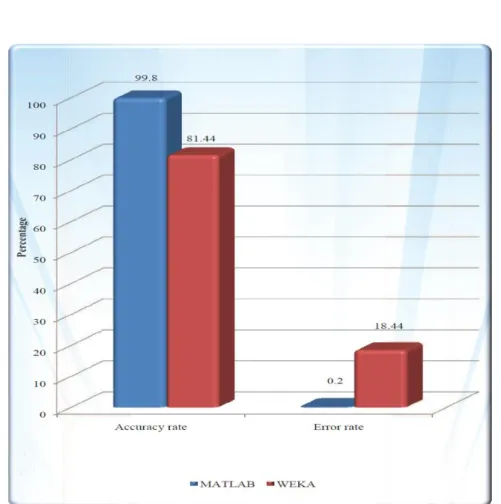
The finding comparison result in between MATLAB and WEKA tool explore that the accuracy rate is high in MATLAB as compared to WEKA tool.
Table 1: Bagging, Stacking, and Random subspace algorithm with Decision Stump result on forest fire data set
Comparison field Bagging with Stacking Random subspace
DS with DS with DS
Mean absolute error 19.05 16.33 18.51
Root mean squared error 41.97 39.42 40.64
Relative absolute error 102.95 84.23 99.70
Root relative squared error 112.40 94.41 104.62
Time 0.04 0.02 0.03
Table 4.17: Evaluation of bagging, stacking and random subspace algorithm with decision table on forest fire data set
Comparison field Bagging with DT Stacking with DT Random subspace with DT
Mean absolute error 18.56 18.57 18.60
Root mean squared error 40.34 40.05 40.10
International Journal of Research in Engineering & Applied Sciences Email:- [email protected], http://www.euroasiapub.org
An open access scholarly, online, peer-reviewed, interdisciplinary, monthly, and fully refereed journals
7
Root relative squared error 101.30 99.86 100.29
Time 5.4 0.02 2.37
Figure 4.23: Graph representing the comparison between the accuracyrate and error rate of WEKA and MATLAB.
7. CONCLUSION
Data mining is very useful technology in future. This research is useful for analysis typical data. Researcher can easily remove complexity from data sets in future. K-means algorithm may be suitable for clusters are “similar” to one another. Clusters are “dissimilar” to object in other clusters and it’s may found the similarity and dissimilarity in
between the other data set.In
International Journal of Research in Engineering & Applied Sciences Email:- [email protected], http://www.euroasiapub.org
An open access scholarly, online, peer-reviewed, interdisciplinary, monthly, and fully refereed journals
8
REFERENCES
[1] Yu Poh Yong, Omar Rosli, Harrison
D. Rhett, Sammathuria Kumar Mohan, Nik Rahim Abdul (2011), “Pattern clustering of forest fires based on meteorological variables and its classification using hybrid data mining methods”, Journal of
Computational Biology and
Bioinformatics Research 3(4): 47-52.
[2] Zeng, L., Li, L., Duan, L., Lu, K., Shi, Z.,
Wang, M., Wu, W., Luo, P. (2012), “Distributed data mining: a survey”,
Information Technology and
Management, 13(4): 403-409.
[3] Verbeek, J.J., Vlassis, N., Krose, B.
(2003), “Efficient Greedy Learning of
Gaussian Mixture Models”,
Published in Neural Computation, 15(2): 469-485.
[4] Trees”, Proc European Conference
on Machine Learning, 9 :323-334.
[5] Smith Dave, SAS, Marlow, UK (PUSH
2007) Data Mining in the Clinical Research Environment.
[6] Raut A. B, Nichat A. A. 2017.
Students Performance Prediction Using Decision Tree Technique
International Journal of
Computational Intelligence
Research ISSN 0973-1873 Volume 13 pp. 1735-1741
[7] Poddar, Sudip and Mukhopadhayay,
Anirba (2012), “Cluster: A MATLAB GUI Package For Data Clustering. International Technology Research Letters”, 1 (1): 33-48.
[8] Mrs. Sujatha B. and Akila C., (2012),
“Prediction of Breast Cancer Using
Data Mining”, International Journal
of Computer Science and
Management Research, 1 (3): 384-389.
[9] KaurSumit, Bansal R. K. 2016.
Mixed Pixel Clustering and
Classification Techniques: A Review
International Journal on Recent and Innovation Trends in Computing and Communication Volume: 2 Issue: 5 1054 – 1059
[10]Efron B. and Tibshirani R., (1993)