With the evolution of the World Wide Web, online teaching and learning has gained a tremendous amount of popularity. New Web teaching and learning tools are created at a fast pace to help better address the multitude of teaching and learning styles. Liu and Thompson (1999) found that faculty members are more likely to use a wider variety of educational tech-nologies when exposed to online teaching and learning tools and thus teach to a broader array of learning styles. The increasing diversity of learning strategies is a growing challenge for teachers. One way to address this challenge is to incorporate online learning tools into the traditional classroom. Such a combination may benefit both students and teachers if those tools provide quality teaching and learning opportuni-ties and outcomes. However, little research exists on how learning environments can be cre-ated that successfully combine online teaching and learning with traditional classroom environ-ments to enhance student learning.
This article introduces a model that addresses how an effective combination of online and traditional classroom teaching can be obtained. The article shows how learning out-comes and preferences as well as the awareness of student characteristics and student feedback such as the perception of classroom environ-ment can be used to enhance the quality of a combined learning environment.
Students’ perceptions of the classroom envi-ronment are indicators of successful learning. Cheung (1998) stated that student feedback is essential for improving the academic quality of online learning. Sherry, Fulford, and Zhang (1998) discussed the positive relationships between students’ satisfaction with instruction and their subsequent success in a course. Fitzelle and Trochim (1996) found that enjoy-ment and control of pace were significant factors in student success with online instruction. It fol-lows that assessing students’ perceptions of their preferred instructional environment is an integral role in developing instruction that motivates stu-dents to achieve desired learning outcomes.
When considering the replacement of one teaching method or tool with another, it should
be assured that the quality of the learning expe-rience is not diminished. It is important to not simply accommodate students’ preferred ing styles, but also to expand on students’ learn-ing strategies by exposlearn-ing them to other viable and interesting ways of learning. The combina-tion of online learning with tradicombina-tional class-room instruction could diversify teaching and learning alike, and as a bonus enhance techno-logical literacy of both the faculty and students.
Literature identifies various models of combining online learning with traditional classroom learning and assessing the quality of such combinations (Eberling, 2000; Grasha & Yangarber-Hicks, 2000; Simon, 2000; Spoon & Schell, 1998). In general, students participating in entire classes online have demonstrated no significant differences in learning when com-pared to students taking classes in traditional classroom settings (Benbunan-Fich & Hiltz, 1999; Johnson, Aragon, Shaik, & Palma-Rivas, 2001; LaRose, Gregg, & Eastin, 1998; Swan & Jackman, 2000). Wheeler and Jarboe (2001) added that a combination of online and tradi-tional classroom instruction has become the most popular way to use Internet teaching and learning tools. LaRose et al. (1998) discussed the potential of online learning to enhance indi-vidual student learning. Furthermore, Ester (1994-95), Goldberg (1997), and Wheeler and Jarboe (2001) found that students with access to both traditional lectures and an online envi-ronment faired better academically than stu-dents instructed either entirely in the traditional classroom or entirely via the Internet. Sanders and Mirrison-Shetlar (2001) found that includ-ing Web-based components in an otherwise tra-ditional college level biology course increased student learning and enhanced problem-solving skills.
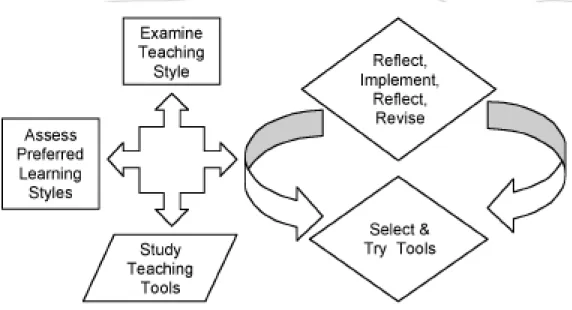
The model presented in Figure 1 suggests five considerations that may be useful when cre-ating a quality mix of online and traditional classroom teaching and learning. The steps Examine Teaching Style, Assess Preferred Learning Styles, and Study Teaching Tools can occur simultaneously or in any order. It is rec-ommended that the instructor fully understands and completes the first three steps prior to
The Jour
nal of T
echnology Studies
A Model to Integrate Online Teaching and Learning
Tools Into the Classroom
Klaus Schmidt and Dan Brown
86
The Jour
nal of T
echnology Studies
moving on to Select and Try Tools and then Reflect, Implement, Reflect, and Revise. The entire process is ongoing and iterative. Each step is explained in more detail on the following pages.
Step 1: Examine Your Teaching Style Assessing the preferred personal teaching style is one of the first steps a teacher should take prior to selecting and implementing online teaching and learning tools. Understanding one’s personal teaching style can help to determine which traditional course components can be best enhanced with online teaching and learning tech-nology and which tools will most comfortably match the teacher’s personal teaching style. Preferred teaching style may be identified through careful personal reflection or through use of any of a number of available
instruction/teaching styles inventories. Two com-mon instruments designed to assess teaching styles are the Canfield Instructional Styles Inventory (ISI) and Grasha’s 5 Teaching Styles Inventory. The ISI categorizes teaching styles along two basic dyads: social or independent, and conceptual or applied. For example, if the identified teaching style is social, a teacher wishing to incorporate online instructional com-ponents might consider which available online tools could effectively replace or supplement tra-ditional social instructional techniques such as group discussion and team activities. Online chat rooms or discussion tools designed to create a social learning environment and a sense of com-munity between teacher and students might be
helpful. Conversely, if after consideration it is determined that the existing online tools do not meet these particular needs, the teacher might refrain from using online chat rooms or discus-sion tools to supplement classroom teaching in this instance.
Grasha’s 5 Teaching Styles Inventory describes teaching styles within five major cate-gories: facilitator, formal authority, expert, per-sonal model, and delegator. If a teaching style is predominantly the role of a facilitator, the teacher should identify tools that help to support the facilitator role.1On the other hand, if the teaching style is identified as expert, the teacher might include video or audio enhanced presenta-tions and lectures.
With respect to identifying the teaching style, this model does not give preference to any particular teaching style or teaching styles assessment tool. The teacher is free to choose whichever approach he or she is comfortable with. It might even be helpful to choose multiple instruments or approaches as each addresses dif-ferent elements of teaching styles. Nevertheless, being aware of teaching styles alone does not guarantee that student learning takes place. In order to facilitate student learning, a teacher also needs to consider and be aware of his or her stu-dents’ preferred learning styles.
Step 2: Assess Your Students’ Preferred Learning Styles
Understanding how students learn is
imper-87
The Jour
nal of T
echnology Studies
ative.This is especially true when considering the incorporation of a greater variety of teach-ing tools, as is the case when combinteach-ing online and traditional classroom teaching. Several stud-ies (Ayersman & Reed, 1995-96; Ester, 1994-95; Ross, Drysdale, & Schultz, 2001) have found relationships between learning styles and stu-dent perceptions of and/or learning successes with online instructional components. In a study designed to decrease the levels of stu-dents’ computer anxiety, the highest level of computer anxiety was demonstrated by students identified as divergers and the lowest levels were demonstrated by students identified as convergers using the Kolb Learning Styles Indicator (Ayersman & Reed, 1995-96).
Literature discusses a wide array of instru-ments to assess learning styles (Crowe, 2000; Dunn & Griggs, 2000; Miller, 2001). Four commonly used instruments are the Myers-Briggs Type Indicator (MBTI), the Kolb Learning Style Indicator, the Canfield Learning Styles Instrument (LSI), and the Dunn, Dunn, and Price Productivity Environmental Preference Survey (PEP). While the MBTI focuses on the four dimensions of extroversion versus introversion, sensing versus intuition, thinking versus feeling, and judging versus per-ceptive, the Kolb Learning Style Indicator col-lects student information on four scales includ-ing preference for concrete experiencinclud-ing, abstract conceptualization, reflective observa-tion, and active experimentation. The Canfield LSI places learning styles into categories such as social, independent, applied, and conceptual. The PEP profiles student learning preferences in such learning related factors as noise and light levels, temperature, motivation, persist-ence, structure, authority, senses, time of day, etc. However, it might not always be necessary to formally assess students’ learning styles. Information about students’ preferred learning styles may be collected informally through dis-cussions with students or observations of stu-dents in the classroom.
Once a teacher has identified his or her teaching style and is able to identify students’ learning styles, an appropriate mix of online and traditional teaching and learning tools may be identified. For example, if the LSI is used and
students identify themselves as social learners, it will be beneficial to incorporate online and traditional teaching and learning tools such as online chat rooms or discussion tools. If the social learning style cannot be adequately met using only online tools for a particular course, the instructor might decide to emphasize the social learning style more heavily using tional classroom tools or a combination of tradi-tional and online tools. If a teacher’s teaching style is learner centered but the students prefer the teacher centered environment, students may obtain lower learning outcomes due to a mis-match of teaching and learning styles. In such a scenario, the teacher could identify and apply or supplement learner-centered instruction with tools that enhance a teacher-centered learning style. This approach would not only widen stu-dents’ learning strategies but also a teacher’s portfolio of teaching techniques. Matching the teaching style with the learning style of students may not solve all issues related to learning in the college environment, but it could help to identify Internet technologies for a better inte-gration of traditional and online teaching and learning tools and thus address a wider variety of learning styles.
Step 3: Study Online and Traditional Teaching and Learning Tools
A good command of both online and tradi-tional teaching and learning tools is important for the development of a successful combination of those tools. The following section focuses on online teaching and learning tools and on how these tools can be incorporated into the classroom.
A broad array of online teaching and learning tools are available. Almost all aspects of classroom teaching can be enhanced or replaced with online technology in some contexts. To obtain a broader overview of enhancing the classroom with Web technology, the classroom environment can be categorized into four components: administration, assess-ment, content delivery, and community (Schmidt, 2002b). Various online tools exist to help in these components. Appropriate selection of online tools will depend not only on the instructional content but also on the quality of the available tools and the level of technical ability of teacher and students. For example, if
The Jour
nal of T
echnology Studies
both teacher and students have mastered a spe-cific content delivery tool, it can be beneficial to deliver content online rather than in the classroom. Similarly, if the teacher has found ways to meaningfully incorporate synchronous communication tools (such as chat), students might also benefit from the added community component. The following discussion of each component will demonstrate how Web tools could be incorporated to meet certain aspects of a course to enhance student learning.
The administrative component is the foun-dation for the organization of a course and allows a teacher to spend more class time inter-acting creatively with students rather than on mundane activities. For example, activities such as turning in or returning graded assignments during class time can be replaced with Internet technology. The time “gained” during class can then be used for other higher order thinking and learning activities. The assessment component addresses student performance. Using online assessment tools such as online quizzes to pro-vide instant feedback and repeated testing opportunities for practicing purposes may help students learn the subject matter more thorough-ly. This method also leads to more class time for student-student and student-teacher interaction (Schmidt, 2002b). Sanders and Morrison-Shetlar (2001) found that students were com-fortable tracking quizzes and tests online and liked having online access to their individual grades to assess how well they were doing in the coursework.
The content delivery component focuses on the communication of course content and learn-ing activities. Research shows that a significant amount of learning can take place outside the traditional classroom if students have access to and are motivated to study the material at their own pace. Ryan, Hodson Carlton, and Ali (1998) found that students enjoy using the Internet for the structured presentation of course material and prefer traditional class time to be used for informal interaction and the develop-ment of advanced thinking skills.
The community component addresses development of a community of learners, the sense of community among students and
between teachers and students. Online teaching and learning tools can help to create a commu-nity of learners that is no longer limited to just one teacher and his or her students in the class-room. Depending on teaching and learning styles, a community (including experts and experienced practitioners) from outside the classroom can be introduced to the classroom and benefit both the teacher and the learners. Numerous academic and educational online communities can be accessed and included in the learning process.2It takes careful planning to help students deal effectively with the many challenges of online interaction and community building. Sanders and Morrison-Shetlar (2001) reported that students had mixed perceptions about the value of being required to access and participate in chat rooms and bulletin boards as the primary community components of classes. Students generally preferred asynchronous tools to synchronous tools.
Once the first three steps are completed, the challenge is to balance the identified preferred learning and teaching styles against the advan-tages and disadvanadvan-tages of available online instructional technology. This should be viewed as a problem-solving challenge with many potentially correct solutions.
Step 4: Select Online Teaching and Learning Tools
Considering the adoption of online instruc-tional delivery methods may present opportuni-ties to achieve learning objectives beyond the basic acquisition of content knowledge and/or skills such as enhancing students’ levels of com-puter literacy. However, unless very carefully designed and implemented, different forms of instructional tools may favor students with some learning styles and technical expertise at the expense of others. Ross et al. (2001) found that sequential learners studying computer applica-tions using some computer-based instructional tools performed significantly better in acquisi-tion of both skills and knowledge than did stu-dents identified as random learners. Stustu-dents identified as abstract sequential in learning style performed significantly better in this study than students with any other style. Students in this study who failed the courses or withdrew were overwhelmingly identified as abstract random in
The Jour
nal of T
echnology Studies
style. Similarly, in another study Ross and Schulz (1999) reported that there was signifi-cant interaction between learning styles and learning outcomes. In this study students identi-fied as abstract sequential averaged an 18% gain in learning, students identified as concrete sequential and concrete random averaged a 10% learning gain, while students identified as abstract random averaged a 10% decrease in learning. When exploring the relationships between learning styles and learning outcomes in a course instructed using computer-based instructional tools, Davidson and Savenye (1992) identified positive significant correla-tions between learning outcomes and abstract sequential learning styles and negative signifi-cant correlations between learning outcomes and abstract random learning styles.
Khalili and Shashaani (1994) found in their meta-analysis of computer applications for instruction that different types of computer-based instructional tools have different effects on students’ learning outcomes. Carefully selected and/or designed online delivery meth-ods may enhance learning outcomes in general but also students’ levels of computer literacy and sense of efficacy when using computers as learning tools. In an age of burgeoning adoption of e-mail, e-meetings, and e-teams in the work-place, these expanded computer-based experi-ences may help to better emulate the new work-place. Additionally, if content is delivered in parallel forms both through traditional means and through using online tools such that stu-dents have the opportunities to learn in their preferred modes, some students may become more aware of their own cognitive processes and begin to expand the range of learning environ-ments that they will happily work in.
The two primary indicators of the quality of instructional tools implemented into the class-room are students’ perception of the learning environment and students’ learning outcomes. Using student feedback and the results from analyses of the learning outcomes enables a teacher to make decisions on what online learn-ing activities best contribute to student learnlearn-ing and what framework best addresses pedagogical and technological issues. In addition, the student feedback helps to decide which online
compo-nents are less liked and do not result in a posi-tive learning experience.
One tool to help assess the effectiveness of the online tools and the quality of the combined learning environments is classroom action research. Classroom action research helps a teacher to try out new online tools, implement those that are successful, and gather student feedback, reflect, and revise to further improve and develop the course (Schmidt, 2002a). Step 5: Reflect, Implement, Reflect, and Revise
Because this model suggests an iterative and continuous process, it will be imperative to continuously reflect, implement, further reflect on the outcomes of the implementation, and revise again the mix of online and traditional teaching and learning tools. Due to the changing nature of the online environment, only a dynam-ic approach to teaching and learning will maxi-mize success.
Students’ learning style preferences impact upon the quality of their attitude toward a par-ticular instructional tool, but an instructor’s con-sciousness of the importance of learning style preferences may help him or her to adapt tools for teaching that address the learning needs of students with multiple learning style prefer-ences. Ross et al. (2001) recommended that one important alternative consideration when designing online instructional tools is to teach students to use strategies that will succeed in learning situations that do not favor their pre-ferred learning style.
Conclusions
As mentioned previously, the model sug-gested in this article is iterative in nature. It is not intended to be a linear process leading to selection of the best combination of instruction-al methods because the best combination of methods is constantly in flux. This model is rather intended to encourage continuous experi-mentation with both new and traditional instruc-tional tools and methods to achieve ongoing improvement based on trial assessment and reflection of outcomes. The goal here is to attempt to improve student learning while also promoting enhanced student satisfaction levels
The Jour
nal of T
echnology Studies
with the learning experiences and environment. Because this model is dynamic, it is expect-ed that teachers will neexpect-ed to be open to continu-ous change. Students’ learning styles may vary widely from student to student, new online teaching and learning tools will continue to be developed, and an increased awareness of one’s teaching style will lead to modifications within the composition of online tools and classroom interaction. Only by considering these variables can a teacher continue to address students’ changing learning needs in a creative, flexible, and dynamic teaching and learning environment.
Finding the right combination of online and traditional teaching and learning tools to meet the broad array of learning styles remains one of the greatest challenges in today’s teaching envi-ronment. Considering teaching and learning styles when incorporating online teaching and learning tools can help a teacher to better address student learning needs. Student learning is strongly impacted by the teacher’s ability to communicate the subject matter. Creating a
suc-cessful learning environment therefore heavily depends on the creativity of the teacher. It will be important to decide which course compo-nents can be enhanced most effectively via the Internet and which can be done more effectively in the traditional classroom. Only a continuous assessment of learning and teaching styles and Internet tools will help to appropriately address these issues and best meet student learning needs. We believe that in a world where lifelong learning is essential for students’ long-term suc-cess, only students who experience learning in positive learning environments are likely to con-tinue their journeys toward becoming successful lifelong learners.
Dr. Klaus Schmidt is an assistant professor in the Department of Technology at Illinois State University.
Dr. Dan Brown is an associate professor in the Department of Technology at Illinois State University, Normal. He is a Member at large of Epsilon Pi Tau.
91
References
Ayersman, D. J., & Reed, W. M. (1995-96). Effects of learning styles: Programming and gender on computer anxiety. Journal of Research on Computing in Education, 28(2), 148-160. Benbunan-Fich, R., & Hiltz, S. R. (1999). Educational application of CMCS: Solving case studies
through asynchronous learning networks. Journal of Computer Mediated Communication, 4(2). Retrieved July 11, 2002, from http://www.ascusc.org/jcmc/vol4/issue3/benbunan-fich.html Cheung, D. (1998). Developing a student evaluation instrument for distance teaching. Distance
Education, 19(1), 23-41.
Crowe, R. (2000). Know your student’s learning style: The missing link in the lecture. (ERIC Document Reproduction Service No. ED445728)
Davidson, G. V., & Savenye, W. C. (1992). How do learning styles relate to performance in a computer applications course? Journal of Research on Computing in Education, 24(3), 348-357.
Dunn, R., & Griggs, S. (Eds.). (2000). Practical approaches to using learning styles in higher education.
Westport, CT: Greenwood.
Eberling, D. (2000). Adapting your teaching to any learning style. Phi Delta Kappan, 82(3), 247-248. Ester, D. P. (1994-95). CAL, lecture, and student learning style: The differential effects of instructional
method. Journal of Research on Computing in Education, 27(2), 129-140.
Fitzelle, G. T., & Trochim, W. M. K. (1996). Survey evaluation of Web site instructional technology:
Does it increase student learning? Retrieved May 9, 2002, from
http://trochim.human.cornell.edu/webeval/webques/webques,htm
Goldberg, M. (1997, June). WebCT and first year computer science: Student reaction to and use of a
Web-based resource in first year computer science. Paper presented at the ITiCSE conference on
integrating technology into computer science education, Upsalla University, Upsalla, Sweden. Grasha, A., & Yangarber-Hicks, N. (2000). Integrating teaching styles and learning styles with
The Jour
nal of T
echnology Studies
Johnson, S. D., Aragon, S. R., Shaik, N., & Palma-Rivas, N. (2001). Comparative analysis of online
vs. face-to-face instruction. Retrieved August 1, 2002, from http://www.hre.uiuc.edu/online/
comparison.pdf
Khalili, A., & Shashaani, L. (1994). The effectiveness of computer applications: A meta-analysis.
Journal of Research on Computing in Education, 27(1), 48-61.
LaRose, R. L., Gregg, J., & Eastin, M. (1998). Audiographic telecourses for the Web: An experiment.
Journal of Computer Mediated Communication, 4(2). Retrieved July 11, 2002, from
http://www.ascusc.org/jcmc/vol4/issue2/larose.html
Liu, Y., & Thompson, D. (1999). Teaching the same course via distance and traditional education:
A case study. Commerce, TX: Texas A & M University.
Miller, P. (2001). Learning styles: The multimedia of the mind (Research report). (ERIC Document Reproduction Service No. ED 451140)
Ross, J. L., Drysdale, M. T. B., & Schulz, R. A. (2001). Cognitive learning styles and academic performance in two postsecondary computer application courses. Journal of Research on
Computing in Education, 33(4), 400-412.
Ross, J., & Schulz, R. (1999). Can computer-aided instruction accommodate all learners equally?
British Journal of Educational Technology, 30(1), 5-24.
Ryan, M., Hodson Carlton, K., & Ali, N. (1998). Evaluation of traditional classroom teaching methods versus course delivery via the World Wide Web. Journal of Nursing Education, 38(6), 272-277.
Sanders, D. W., & Morrison-Shetlar, A. I. (2001). Student attitudes toward Web-enhanced instruction in an introductory biology course. Journal of Research in Computing in Education, 33(3), 251-262 . Schmidt, K. (2002a). Classroom action research: A case study to assess students’ perceptions and
learning outcomes of classroom teaching versus on-line teaching. Journal of Industrial Teacher
Education, 40(1), 45-59.
Schmidt, K. (2002b). The Web-enhanced classroom. Journal of Industrial Technology, 18(2). Retrieved August 1, 2002, from http://www.nait.org
Sherry, A., Fulford, C., & Zhang, S. (1998). Assessing distance learners’ satisfaction with instruction: A quantitative and a qualitative measure. The American Journal of Distance Education, 12(3), 4-25. Simon, S. (2000). The relationship of learning style and training method to end-user computer
satisfaction and computer use: A structural equation model. Information Technology, Learning, &
Performance Journal, 18(1), 41-59.
Spoon, J., & Schell, J. (1998). Aligning student learning styles with instructor teaching styles. Journal
of Industrial Teacher Education, 35(2), 41-56.
Swan, M. K., & Jackman, D. H. (2000). Comparing the success of students enrolled in distance education courses vs. face-to-face classrooms. The Journal of Technology Studies, 26(1), 58-63. Wheeler, B., & Jarboe, G. (2001). New poll shows faculty prefer Web-enhanced courses to either
classroom-only or distance-only courses: Student learning maximized with Web-enhanced class-room instruction; online-only rivals classclass-room-only instruction. Retrieved May 9, 2002, from http://www.webct.com/service/ViewContent?contentID=3522772
Endnotes
1 The Grasha 5 Teaching Styles Inventory can be accessed online at http://fcrc.indstate.edu/tstyles3.html.
2 Visit http://www.webct.com/wyw or http://www.akiva.com/solutions/community.cfm