WHITE PAPER
The Extended Supply Chain
Sponsored by: SAP
Simon Ellis
September 2015
IDC OPINION/EXECUTIVE SUMMARY
Manufacturing supply chains are experiencing levels of change heretofore unprecedented in their history. Significant shifts in consumer preferences and behaviors, along with the emergence of a whole new set of enabling technologies, are conspiring to create both massive opportunities and equally massive challenges for the traditional supply chain. It comes as no surprise, then, that supply chains are
transforming themselves to meet these opportunities and challenges. It is a journey, of course, with some manufacturers further ahead than others. The key points and areas of discussion in this white paper are:
The most compelling opportunity, the one driving the most change, is that of "customer centricity" and the transforming role of the consumer. Most manufacturing supply chains have been designed for the mass market reseller, moving full pallets on full trucks, and have operated as such throughout much of their history. Yet these businesses are now facing the challenge of smaller cases or even units, LTL or parcel shipments, and high levels of customization — all things that the current supply chain is poorly equipped to manage.
The future of the supply chain is one of an outwardly networked and collaborative organization that fully integrates supply chain with design, manufacturing, and asset management into an "extended" supply chain that is able to respond quickly and accurately to a broad set of customers and consumers as well as their evolving requirements and expectations.
The evolution from a "traditional" supply chain to an "extended" supply chain is not something that can happen overnight. At IDC Manufacturing Insights, we would suggest that it's a journey (one that many companies have begun and that others have yet to begin), but it's a necessary journey if the supply chain is going to effectively meet its role in the modern, digitalized
business environment. The challenges are not small, including the key question of how to best integrate internal domains with the external world of demand, supply, and innovation. But, equally, the benefits are not small.
Technology is a key enabler, specifically the presence of cloud-based business-to-business (B2B) platforms. Cloud is perhaps most germane to this discussion of the networked supply chain, though mobility, social business, and analytics have a role to play in terms of not just consuming/disseminating data and information but also turning data and information into timely insight.
We see data generation from any source, both internal and external to the manufacturer, comprehensive and fast analysis, and then ubiquitous consumption (initially with on-premise access as significant but declining over time). If we think of the broader networks, they simply won't work efficiently and effectively without this "information loop."
CURRENT SITUATION
The manufacturing industry competes in a highly dynamic, evolving marketplace, and supply chains must be able to both adapt to changes that are happening or have happened and anticipate changes that will happen. That the market is dynamic comes as no surprise to students of the supply chain, though the way forward generates much debate. Rather than repeat the litany of current challenges, we highlight here a handful of challenges that we believe are the most compelling:
Consumer/customer centric. There seems little question that supply chains are much more aware of the consumer/customer than ever before, and the questions of how to personalize products; manage "mass customization" from facilities that are not well suited for that very purpose; ensure the highest level of product quality from increasingly distributed, global supply networks; and provide consistently high levels of customer service are central to discussions of strategy and competency.
Demand awareness. While there has been a decade-long discourse on the relative merits of being "demand driven," there is little question that supply chain organizations can benefit from greater visibility into the cadence of demand. While some businesses will never use demand signals to influence factory-run strategies, the ability to better manage service performance and late-stage assembly/postponement through enhanced insight into demand patterns and more accurate supply chain forecasts is quite apparent.
Data driven. Repurposing the old saying that "you cannot improve what you don't measure" into "you cannot respond to what you don't see" speaks volumes for the many manufacturers that are wrestling with massive, and constantly growing, amounts of data. If we put the terminology of "big data" aside for the moment, the reality is that the requirement for supply chain organizations to broaden their "supply chain intelligence" is paramount, and it is increasingly unacceptable to "not know" — particularly when consumers are increasingly empowered with "ubiquitous visibility."
Digitally executed. Whether adopting modern document management processes and technologies, mobile tools, demand signal repositories, the Internet of Things (IoT), or emerging technologies like 3D printing, just to name a few, the world is going digital and the supply chain is not to be spared. Nor would we want it to be! Although not the exclusive purview of the supply chain, managing B2B (and potentially B2C) networks is part of what we at IDC Manufacturing Insights see as the central driver of the next generation of supply chains. Increasingly, manufacturers across industry are participating in complex, extended, and overlapping value chains. Dynamic change because of increasing product complexity, customer demand, and service efficiency has become the norm rather than the exception. Therefore, manufacturers need to build a level of agility, risk mitigation, and resilience into their value chains that enables rapid
response, aligning resources with market demands before and after product launch in as close to real time as possible. At the same time, manufacturers are also engaged in an ongoing search for business improvement, seeking new market opportunities in the face of these constantly shifting markets.
KEY DRIVER OF CHANGE: A LOT SIZE OF ONE
Yet, of all the challenges articulated in the prior section, the most compelling — the one driving the most change — is that of "customer centricity" and the transforming role of the consumer. Most manufacturing supply chains have been designed for the mass market reseller, moving full pallets on full trucks, and have operated as such throughout much of their history. Yet these businesses are now
facing the challenge of smaller cases or even units, LTL or parcel shipments, and high levels of customization — all things that the current supply chain is poorly equipped to manage.
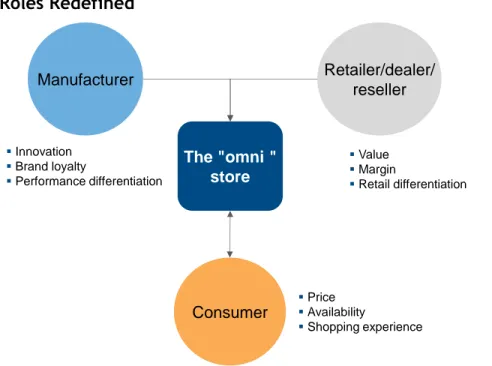
So there is little question that the bar is being raised for the manufacturing supply chain in terms of greater expectations both from traditional customers like retailers and resellers and from consumers who increasingly expect flexibility and transparency in their purchasing experiences. Indeed, the "empowered" consumer has a profound impact on the supply chain — in some cases, directly with manufacturers and, in other cases, indirectly through retail. These consumers have ubiquitous access to information, they are less brand loyal, they have an omni-channel perspective — buy anywhere, return anywhere — and they exhibit more of a "value" orientation — they are happy to not spend! For the supply chain, these consumers may eventually be direct customers (D2C), or they may be indirect with their expectations "channeled" through retail. Regardless, this is a sea change for the manufacturing supply chain and is redefining and will redefine roles — or at least make them more clearly defined with attendant expectations for performance and force companies to think in terms of a "lot size of one."
Figure 1 illustrates how this dynamic is playing out around the omni "store" — not a store in the traditional sense, but wherever the consumer chooses to make a purchase and across most of the manufacturing segments like consumer products, high tech, and automotive, just to name a few. Whether the manufacturing supply chain is fulfilling to an intermediary point or directly to the consumer is dependent upon the preferred purchase experience. In this document, we address what this means for the supply chain, but suffice it to say that most manufacturing supply chains are not ready for this.
FIGURE 1
Roles Redefined
Source: IDC Manufacturing Insights, 2015
Manufacturer
Retailer/dealer/
reseller
The "omni "
store
Consumer
Innovation Brand loyalty Performance differentiation Value Margin Retail differentiation Price Availability Shopping experienceIn addition to customers and consumers being more informed and connected, they also don't want to wait. At IDC Manufacturing Insights, we have talked about the notion of speed for some years, but we believe that it is central to the future of supply chains, which simply must operate faster. Supply chains must be not only accurate but also timely, whether we are talking about the time it takes to bring new products to market, the time it takes to process and deliver an order, or the time it takes to manage returns. And this is true whether one considers traditional B2B, where reducing order lead times is critical, or emerging B2C, where consumers have come to expect two-day or even next-day delivery.
BUSINESS NETWORKS AND COLLABORATION IN THE EXTENDED SUPPLY CHAIN
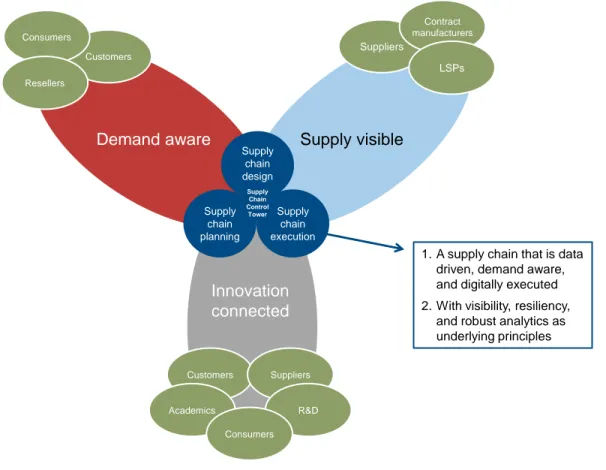
At IDC Manufacturing Insights, we believe the future of the supply chain is one of an outwardlynetworked and collaborative organization that fully integrates supply chain with design, manufacturing, and asset management into an "extended" supply chain that is able to respond quickly and accurately to a broad set of customers and consumers as well as their evolving requirements and expectations. Figure 2 shows a graphical representation of the networked supply chain.
FIGURE 2
The Networked Supply Chain
Source: IDC Manufacturing Insights, 2015
We believe that the supply chain will sit at the center of three lobes — a demand network ("demand aware"), a supply network ("supply visible"), and a product network ("innovation connected"). Given the challenges articulated previously, this extended and connected supply chain is the most promising way for
Demand aware
Supply visible
Innovation
connected
1. A supply chain that is data driven, demand aware, and digitally executed 2. With visibility, resiliency,
and robust analytics as underlying principles Supply chain design Supply chain execution Supply chain planning Supply Chain Control Tower Customers Consumers Suppliers Contract manufacturers LSPs Resellers Customers Suppliers R&D Academics Consumers
manufacturers to provide the level of visibility, speed, and efficiency that the market is demanding. A disconnected set of "best in class" functions and applications simply won't work for the future marketplace. The ubiquitous connectivity and the analytics-enabled customer, supplier, and consumer allow us to do things today that were not previously possible. Point-to-point relationships must give way to dynamic networks, where latency and cost are not tolerable. It is also fair to characterize this emerging supply chain as a "data platform" that connects all aspects of the supply chain, including design, manufacturing,
planning, execution, and service. As we noted at the outset of this white paper, the importance of being a data-driven supply chain cannot be overstated. Supply chains make and move products certainly, but increasingly, the best supply chains are the ones that best leverage full data for insight:
Supply visible — the supply network. At IDC Manufacturing Insights, we have argued for some years about the importance of supply chain resiliency, particularly the ability of the supply side of the organization to respond to unanticipated business changes. As noted previously in this white paper, we suggest that you "cannot respond to something you don't see"; consequentially, the notion of supply visible is central to the future supply chain — and not just to tier 1 supply. But the upstream supply chain is also about value creation processes driven via integrated design, manufacture, and service processes to enable a product supply network. This is particularly important in the context of modern consumers, who are both more demanding of the products that they buy and more aware of adjacent impacts like sustainability. Although the recyclability of a product, for example, may not be a significant purchase contributor today, there is reason to believe that it will be more important to successive generations of consumers who are likely to be more environmentally aware. The ability, therefore, to integrate product design, manufacturing process, and post-sale service capabilities is critically important.
Demand aware — the demand network. While many manufacturing companies are demand driven, many are not — at least not in the sense that consumption of an item in the marketplace triggers the manufacture of a replacement. But all businesses must be demand aware and be building downstream demand signals into their business forecasting process. The distinction between demand driven and demand aware may be subtle, but we believe it is important. The business must understand demand and be aware of potential demand shifts, but it may or may not be using those signals across the full breadth of the supply chain. But, as with supply, the downstream supply chain is also about value delivery processes driven via synchronized demand planning and fulfillment execution to provide a customer demand network. Customers and consumers are increasingly intolerant of service failures, and this is likely to become tougher and tougher particularly as the availability of information makes "I didn't know" a less and less acceptable answer. Understanding demand across a broad set of data sources and translating this to fulfillment excellence are increasingly "table stakes," and companies that do it poorly will suffer customer de-stocking or substitution from an increasingly brand-disloyal consumer.
Innovation connected — the product network. The notion of innovation connected is the third element we believe will both take from and inform the process of developing new products and the key role that the supply chain must play. In years past, research and development was the key generator of new ideas, which clearly is no longer true. With a network of diverse sources for potential innovation, companies that do not leverage these diverse sources will not be successful in the longer term. The next-generation innovation network will manage innovation on multiple fronts, with both internal and external engagements, soliciting input and ideas across suppliers, contract manufacturers, customers, and consumers. This "open" innovation notion is not necessarily new in concept, but the rapid evolution of social networking tools has made it practical today and into the future, whereas it was perhaps just conceptual in the past.
Managing these three "lobes" as true extended networks (where customers, resellers, and consumers are part of the demand arm; suppliers and logistics service providers are part of the supply arm; and everyone is part of the innovation arm) enables speed, efficiency, and insight in ways not previously possible. We see tantalizing hints of the power of the business network and believe the future supply chain will fully embrace these lobes. Integration across the three domains will be critical, although for many manufacturers, the ability to fully integrate capabilities within — let alone across — the domains, still remains a challenge. We expect that this integration will take the form of a centralizing "supply chain control tower" that will function as the strategic, tactical, and operational coordinating and governance body that helps identify priorities and provision resources.
However, there are a number of enabling capabilities. The first one obviously is technology and, specifically, the presence of cloud-based business-to-business platforms. Cloud is perhaps most germane to this discussion of the networked supply chain, though mobility, social business, and analytics have a role to play in terms of not just consuming/disseminating data and information but also turning data and information into timely insight. Figure 3 suggests how this interaction of technologies might work for the extended supply chain, though it is meant as illustrative rather than comprehensive.
FIGURE 3
3rd Platform Interplay for the Supply Chain
Source: IDC Manufacturing Insights, 2015
Essentially, we see data generation from any source, both internal and external to the manufacturer, comprehensive and fast analysis, and then ubiquitous consumption (initially with on-premise access as significant but declining over time). If we think of the broader networks, they simply won't work
efficiently and effectively without this "information loop."
Then, of course, there is the need for collaboration. Much has been written on the subject of collaboration over the years, and two points seem to be universally true. First, better collaboration, both internally within the business and externally with suppliers or customers, invariably yields positive results, and
ERP
IoT (sensors)
Social
(both internal and external)
Data
collection and
analytics
Cloud
Mobile
On-premise
second, when queried on the topic, companies invariably believe that their collaborative efforts can be improved upon. Both of these things appear to be even more important in a networked world.
While collaborating within one's company may seem easier than collaborating externally, many
businesses have a rather rigid functional barrier, so internal collaboration can be a challenge. Indeed, in the IDC Manufacturing Insights 2014 Supply Chain Survey, when we asked what aspect of collaboration was a priority, the largest response was to focus on collaboration "within our business" (see Figure 4). Over the course of many conversations with manufacturers on the topic of intracompany collaboration, three priorities bubbled to the surface: improve customer service, increase the performance of the new product development and introduction (NPDI) process, and of course reduce costs.
As shown in Figure 4, over half of the respondents (all working in the supply chain) said that
collaboration either within the supply chain or across functions within the business was the focus for their collaboration efforts. Intercompany collaboration is very important as well — particularly as companies continue to outsource capabilities to external partners. What may have been an internal collaboration one year can well be an external collaboration the next. Indeed, we see that external collaboration is important based on the survey results. 23% of supply chain respondents said that upstream collaboration with suppliers was the focus, and clearly, there are opportunities to improve communication, visibility, and business alignment. Fewer respondents said "downstream with customers" in part because most businesses have already invested in downstream collaboration and it's more mature and in part because supply disruptions have become more prevalent in recent years.
FIGURE 4
Business Collaboration
Q. From a business collaboration perspective, what will be the key area of focus in the supply chain?
n = 299
Source: IDC Manufacturing Insights' Supply Chain Survey, 2014
0 5 10 15 20 25 30 35
Other With external logistics providers
Downstream with customers (i.e., sell-side B2B collaboration)
Within the supply chain
(i.e., between planning and execution) Upstream with suppliers (i.e., buy-side B2B collaboration) Within our business (i.e., between supply
chain and marketing or sales)
THE FUTURE OF THE EXTENDED SUPPLY CHAIN
Moving from an external perspective of the supply chain (suppliers, customers, and innovation partners) to a more internal view — or, more accurately, the internal implications from external requirements — we see some potentially profound changes for supply chain, manufacturing asset management, and design and the way that they align and integrate to form this "extended" supply chain.
Traditional Supply Chain
The elements of the traditional supply chain remain critical to the success of the manufacturing organization. Within this supply chain, encompassing supply chain planning, supply chain execution, and supply chain design, we expect to see greater alignment and integration.
In terms of supply chain planning, it is the view of IDC Manufacturing Insights that by 2018, 75% of manufacturers will be coordinating enterprisewide planning activities under the umbrella of rapid integrated business planning (rIBP) where IBP is the holistic business process that connects all of the various planning functions.
Similarly, for supply chain execution, we expect that by 2017, 50% of manufacturers will explore the viability of micrologistics networks to enable the promise of accelerated delivery for select products and customers. One of the consequences of increasing customer centricity and the reality of reducing order lead times is that the traditional large, regional distribution center (DC) may have seen its peak. While we believe there is still a role for the million-square-foot facility, we are expecting that
manufacturers will begin to explore and transition in part to smaller, local warehouses that will make up a "micrologistics" network.
But it doesn't stop there; it has been the view of IDC Manufacturing Insights that in addition to the articulated changes to both planning and execution, by the end of 2015, half of all manufacturers will be actively employing supply chain design and modeling technologies as a way to dynamically assess both the
demand side and the supply side of their supply chains. In fact, we would argue that the supply chain is now three foundational domains — supply chain planning, supply chain execution, and supply chain design. The aggregation of the three domains becomes the manufacturing supply chain organization that is illustrated in Figure 5. This supply chain sits at the center of the outwardly facing networked notion (refer back to Figure 2).
FIGURE 5
Vision for the Three Domains of the Supply Chain
Source: IDC Manufacturing Insights, 2015
Most important, though, is the need for these three supply chain "domains" to be tightly aligned and integrated and not a collection of disparate functions, processes, or applications. Whether those domains are aligned around a centralized supply chain "control tower" or not, the need for the traditional supply chain to operate as a cohesive whole should not be underappreciated.
Product Design, Production, and Service
Beyond what we have referred to as traditional supply chain (or supply chain management in application language), a number of areas within the manufacturing enterprise make up key adjacencies — the elements of the extended supply chain if you will.
This isn't about departmental process enablement or even enterprise enablement; rather, it's about extended enterprise process enablement — enablement that can serve role-based needs yet crosses traditional organizational and system boundaries to support processes that span multiple organizations and roles:
Product life-cycle management (PLM) adoption is also expanding beyond its traditional discrete manufacturing industries and being applied to many different product and service type companies.
The traditional focus on design and manufacturing development is also being expanded, with the inclusion of idea generation and management at the front end of the process; the greater inclusion of "make and service" process development activities such as supply chain
management and design for service; the modeling of customer interaction with the product, process, and service; and finally, the linkage of the planned process with the actual reality.
Supply chain design Supply chain execution Supply chain planning Supply chain control tower Supply network optimization Inventory optimization Scenario/what if Factory-run strategies LSP network optimization Transportation Order management Warehousing Global trade Demand forecasting and sensing Supply planning S&OP Production planning
For the domain of product innovation, this extended process enablement must meet the requirements of modern markets and operating models. First and foremost, this means that the innovation process must be calibrated to customer requirements rather than simply be a product-centric process calibrated to research and development.
As a result, the platform must integrate with a host of organizational disciplines outside the traditional engineering and program management disciplines. These disciplines include compliance (e.g., sustainability and safety), ideation, manufacturing, supply chain, service (both assets and products), and marketing. Further, the innovation platform should natively support visualization, closed-loop decision making, and intellectual property protection, among other capabilities.
The product innovation platform is PLM integrated with manufacturing for concurrent engineering, modeling, MES analytics, and quality; supply chain for planning and collaboration; customers, partners, and extended development team members for open innovation and product improvement; and service for better-quality products and an excellent customer experience. It is also optimized by the 3rd Platform — analytics, social, mobile, and cloud — to enhance product innovation and product quality, speed time to market, and better service the customer. The 3rd Platform provides a foundation for business process and business model transformation that affects how you interact with your customers, the speed at which products are brought to market, how you innovate, the reliability of operations, and overall company resiliency. The product innovation platform framework, as depicted in Figure 6, leverages PLM as its core and integrates all necessary data and workflow from inside and outside the enterprise in part by leveraging 3rd Platform technologies.
FIGURE 6
The Product Innovation Platform
Alignment and Integration
Taking the traditional supply chain and the broader notion of the product innovation platform, we start to see an opportunity to bring them together in way that offers a much more seamless and transparent "extended" supply chain that better serves the needs of the digital consumer. If we view the processes that enable design, manufacturing, supply chain, and service as connected and interrelated, then the way forward becomes clear. Forward-thinking manufacturers, competing in the digital age, will manage an extended supply chain that is fully aligned and functionally integrated across all the elements of designing, manufacturing, fulfilling, and servicing their products.
Achieving a supply chain that is deeply aligned with product design (PLM), manufacturing, and service will require work in terms of both business process redesign (or alignment) and the applications that facilitate activity and performance. Although not meant to be exhaustive, the breadth of this aligned and integrated extended supply chain would encompass the following:
Product design — R&D, product stage-gate process, and engineering and supplier management
Manufacturing — procurement, factory scheduling, and production planning MES and asset management/maintenance
Supply chain — supply and demand planning, S&OP, warehousing, and transportation and global trade management
Service — post-sale support, spare parts management, and warranty and product quality management
Translating the vision of the extended supply chain into practical implementation will mean different levels and "tightness" of integration between these elements. Processes that span the organization more broadly will demand higher levels of alignment (for example, the product innovation process or procure to pay); processes that are more "contained" will require less alignment. The extended supply chain will certainly progress differently in different industries — and possibly in different companies. But the essential characteristics of an aligned and integrated cross-process supply chain will be shared.
ESSENTIAL GUIDANCE
In this white paper, we have discussed the various challenges facing the manufacturing supply chain. We have also highlighted the importance of networks, collaboration, and supply chain visibility as they pertain to the supply chain's role relative to the external environment and then the evolution that must occur in the internal supply chain environment to meet these external requirements while meeting internal business objectives. The evolution from a "traditional" supply chain to an "extended" supply chain is not something that can happen overnight. At IDC Manufacturing Insights, we would suggest that it's a journey (one that many companies have begun and that others have yet to begin), but it's a necessary journey if the supply chain is going to effectively meet its role in the modern, digitalized business environment. The challenges are not small, including the key question of how to best integrate internal domains with the external world of demand, supply, and innovation. But, equally, the benefits are not small.
Some of the building blocks for this vision for the extended supply chain are already in place in many companies, and of course, not all business will make the same choices at the same time. Yet so many of the things we see in early levels of implementation have the potential to be transformative, whether the broad use of business networks or the role that cloud and mobility will have in both disseminating and consuming key information "at the speed of the customer."
We have included guidance throughout the body of this white paper, so we will not repeat it here other than to ask the central question: What are the steps that manufacturing supply chain organizations ought to be taking?
Actions to Consider
Not all manufacturers will experience the challenges and opportunities that we have articulated in this white paper in the same way or to the same degree — and they will not make the same strategic choices. But not many companies would disagree that the things we have articulated in this white paper aren't things worth understanding and pursuing. In terms of actual activities, it's important to be internally clear about how your business approaches business process change and technology adoption. Are you a leader, a fast follower, or a laggard, and what is the role of the supply chain within the strategic context of your business? Not every company is going to be a leader, nor is it necessary to be, but it is important to at least do the groundwork so that when the time comes, you can be a fast follower or a rapid adopter. At IDC Manufacturing Insights, we would suggest that every business should be able to answer the following questions across a handful of critical areas:
Am I using commerce networks within my supply chain today, and if so, what have been the early insights?
Are collaboration efforts, either internally across supply chain domains, more broadly across my business, or externally with suppliers and customers, productive? If they are not, why not?
What kind of transparency do I have in my supply chain? Do I at least have visibility into key functions and activities?
Are the supply chain domains integrated — either within each one or across the breadth of the supply chain?
Are the design, manufacturing, or service processes aligned with the supply chain, or do they operate completely separately?
Do all supply chain employees have access to the information they need when they need it? If not completely, is this mostly true?
Do I have the right analytics, and am I analyzing the right things to meet my key supply chain metrics?
Am I encouraging or discouraging the use of mobile tools in my business? (Are they viewed as key capabilities for solving business problems or as opportunities for employees to "goof off"?)
Have I considered the technical ramifications (e.g., privacy/security, a BYOD policy, or the implications of different generations of employees)?
At IDC Manufacturing Insights, we'd suggest that the answer to many of these questions today is either "no" or "sort of" for most manufacturers. Yet three to five years hence, it will be "yes" for the leaders and "oops" for the laggards. Don't be a laggard. Our vision for the extended supply chain will not be a perfect one, but it will be directionally correct, and many of the things we have articulated here will be difference makers.
About IDC
International Data Corporation (IDC) is the premier global provider of market intelligence, advisory services, and events for the information technology, telecommunications and consumer technology markets. IDC helps IT professionals, business executives, and the investment community make fact-based decisions on technology purchases and business strategy. More than 1,100 IDC analysts provide global, regional, and local expertise on technology and industry opportunities and trends in over 110 countries worldwide. For 50 years, IDC has provided strategic insights to help our clients achieve their key business objectives. IDC is a subsidiary of IDG, the world's leading technology media, research, and events company.
Global Headquarters
5 Speen Street Framingham, MA 01701 USA 508.988.7900 Twitter: @IDC idc-insights-community.com www.idc.com Copyright NoticeCopyright 2015 IDC Manufacturing Insights. Reproduction without written permission is completely forbidden. External Publication of IDC Manufacturing Insights Information and Data: Any IDC Manufacturing Insights information that is to be used in advertising, press releases, or promotional materials requires prior written approval from the appropriate IDC Manufacturing Insights Vice President. A draft of the proposed document should accompany any such request. IDC Manufacturing Insights reserves the right to deny approval of external usage for any reason.