Research Article
July
2017
Computer Science and Software Engineering
ISSN: 2277-128X (Volume-7, Issue-7)
Multiple Sensor Application Using Secure Data
Aggregation
Sasikala.G
Assistant Professor Department of Computer Science Adhiparasakthi college of Arts and Science,
Kalavai, Tamil Nadu, India
Vinodhkumar.S
Research Scholar Department of Computer Science Adhiparasakthi college of Arts and Science,
Kalavai, Tami lNadu, India
DOI: 10.23956/ijarcsse/V7I7-0155
Abstract— For wireless sensor networks, data aggregation scheme that reduces a large amount of transmissionis the most practical technique. In previous studies, Homomorphic encryptions have been applied to conceal communication during aggregation such that enciphered data can be aggregated algebraically without decryption. Since aggregators collect data without decryption, adversaries are not able to forge aggregated results by compromising them. However, these schemes are not satisfy multi-application environments. Second, these schemes become insecure in case some sensor nodes are compromised. Third, these schemes do not provide secure counting; thus, they may suffer unauthorized aggregation attacks. The problem of present study entitled as “MULTIPLE SENSOR APPLICATION USING SECURE DATA AGGREGATION”. Therefore, a new concealed data aggregation scheme is proposed to extended from Homomorphic public encryption system. The proposed scheme has three contributions. First, it is designed for a multi-application environment. The base station extracts application-specific data from aggregated cipher texts. Next, it mitigates the impact of compromising attacks in single application environments. Finally, it degrades the damage from unauthorized aggregations. To prove the proposed scheme’s robustness and efficiency, we also conducted the comprehensive analyses and comparisons in the end. I also include the timer which is used to the base station can detect the attacker entering into the system and sends the indication message to sensor node.
Keywords— Secure data aggregation, DOTNET C-SHARP, Data mining.
I. INTRODUCTION
Data mining (sometimes called data or knowledge discovery) is the process of analyzing data from different perspectives and summarizing it into useful information - information that can be used to increase revenue, cuts costs, or both. Data mining software is one of a number of analytical tools for analyzing data. It allows users to analyze data from many different dimensions or angles, categorize it, and summarize the relationships identified. Technically, data mining is the process of finding correlations or patterns among dozens of fields in large relational databases.
A. Data mining works
While large-scale information technology has been evolving separate transaction and analytical systems, data mining provides the link between the two. Data mining software analyses relationships and patterns in stored transaction data based on open-ended user queries. Several types of analytical software are available: statistical, machine learning, and neural networks
Data mining consists of five major elements:
Extract, transform, and load transaction data onto the data warehouse system.
Store and manage the data in a multidimensional database system.
Provide data access to business analysts and information technology professionals.
Analyse the data by application software.
Present the data in a useful format, such as a graph or table.
B. The .net framework
The .NET Framework is designed for cross-language compatibility, which means, simply, that .NET components can interact with each other no matter what supported language they were written in originally. So, an application written in Microsoft Visual Basic .NET might reference a dynamic-link library (DLL) file written in Microsoft Visual C#, which in turn might access a resource written in managed Microsoft Visual C++ or any other .NET language. This language interoperability extends to full object-oriented inheritance. A Visual Basic .NET class might be derived from a C# class, for example, or vice versa.
ISSN(E): 2277-128X, ISSN(P): 2277-6451, DOI: 10.23956/ijarcsse/V7I7-0155, pp. 163-171 C. Introduction to C-Sharp
C# (pronounced "see sharp") is a multi paradigm programming language encompassing imperative, declarative, functional, generic, object-oriented (class based), and component-oriented programming disciplines. It was developed by Microsoft within the .NET initiative and later approved as a standard by Ecma (ECMA-334) and ISO (ISO/IEC 23270). C# is one of the programming languages designed for the Common Language Infrastructure.
C# is intended to be a simple, modern, general-purpose, object-oriented programming language.[7] Its development team is led by Anders Hejlsberg. The most recent version is C# 4.0, which was released on April 12, 2010
D.Objective
The Main objective of this project to aggregate for multi application data and provide security using PH( Privacy Homomorphic ).
II. RELATED WORK
Chien-Ming Chen, Yue-Hsun Lin, Ya-Ching Lin, and Hung-Min Sun IEEE transactions on parallel and distributed[1] describes Recently several data aggregation techniques based on symmetric key encryption mechanism have been proposed on wireless sensor networks (WSNs).These types of data aggregation methods result better security compared with the traditional aggregation mechanisms. In this proposed Recoverable Concealed Data Aggregation approach, Cluster Head (CH) can directly aggregate the cipher texts of an individual nodes present on that particular cluster.Based on symmetric schemes, the provider can conduct aggregation queries without decryption. Here, a Concealed Data Aggregation (CDA) technique is extended with the symmetric key encryption. Cipher Block Chaining (CBC) algorithm is used to encrypt the sequence of bits into a single block or unit.
M. Abbasi Dezfouli, S. Mazraeh, M. H. Yektaie World Academy of Science, Engineering and Technology[2]
explained that Wireless sensor networks (WSN) consists of many sensor nodes that are placed on unattended environments such as military sites in order to collect important information.Implementing a secure protocol that can prevent forwarding forge data and modifying storage is very important. Introduce a new protocol for concealed data aggregation (CDA).
A.Perrig, J. Stankovic, and D. Wagner, Comm. ACM[3] describes Wireless Sensor Network (WSN) is an
emerging technology that shows great promise for various futuristic applications both for mass public and military.The sensing technology combined with processing power and wireless communication makes it lucrative for being exploited in abundance in future.The inclusion of wireless communication technology also incurs various types of security threats.
The intent of this paper is to investigate the security related issues and challenges in wireless sensor networks.
R. Min and A. Chandrakasan , Proc. Conf. Record of the 35th asilomar Conf. Signals, Systems and Computers[4] describes Wireless Sensor Networks are widely used in Civil and Military applications. One of the drawbacks of wireless sensors is that the energy that is been consumed. Energy consumption is indirectly proportional to the capability of the sensor nodes. In conventional networks as only one node is act as aggregator, the particular node should feed with more energy. In LEACH (Low energy Adaptive clustering Hierarchy) it is been addressed. It is not suitable for large number of nodes.In order to mitigate the above drawback round robin fashion is been introduced for the sensor node.
Networks B.Przydatek, D.Song, and A.Perrig, proc. First Int’1 Conf.Embedded Networked Sensor Systems[5]
explained in most applications, sensors are deployed in open environments which are vulnerable to physical attacks, potentially compromising the sensor’s cryptographic keys. One of the basic and indispensable functionalities of sensor networks is the ability to answer queries over the data acquired by the sensors which makes more transmission traffic and in turn it is more vulnerable.
III. ALGORITHM USED
A. CDAMA
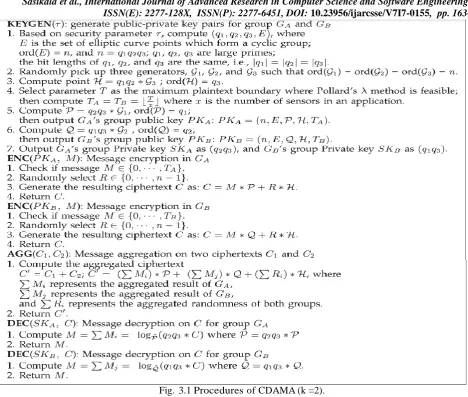
Assume that all Sensor Nodes(SN s) are divided into two groups, GA and GB. CDAMA contains four procedures: Key generation, encryption, aggregation, and decryption, listing in Fig. 3.1 As we can see, CDAMA (k = 2) is implemented by using three points P; Q, and H whose orders are q1 ; q2 , and q3 respectively.
The scalars of the first two points carry the aggregated messages in GA and GB , respectively, and the scalar of the third point carries randomness for security. As shown in the DEC functions, by multiplying the aggregated ciphertext with q2 q3 (i.e., the SK in GA ), the scalar of the point P carrying the aggregated message in GA can be obtained.
Similarly, by multiplying the aggregated cipher- text with q1 q3 (i.e., the SK in GB ), the scalar of the point Q carrying the aggregated message in GB can be obtained. In this way, the encryptions of messages of two groups can be aggregated to a single ciphertext, but the aggregated message of each group can be obtained by decrypting the ciphertext with the corresponding SK.
ISSN(E): 2277-128X, ISSN(P): 2277-6451, DOI: 10.23956/ijarcsse/V7I7-0155, pp. 163-171
Fig. 3.1 Procedures of CDAMA (k =2).
B. Aggregation with secure counting
The main weakness of asymmetric CDA schemes is that an\ AG can manipulate aggregated results without encryption capability. An AG is able to increase the value of aggregated result by aggregating the same ciphertext of sensed reading repeatedly, or decrease the value by selective aggregation. Since the BS does not know the exact number of ciphertexts aggregated (here, we call “count”), repeated or selective aggregation may happen. To avoid this problem, we adopt CDAMA (k = 2) scheme to provide secure counting for single application case, i.e., the BS exactly knows how many sensed readings are aggregated while it receives the final result. As shown in Fig. 3.2, the BS obtains the aggregated result M and its count. If a malicious AG launches unauthorized aggregations, such as repeated or selective aggregation, s value would be changed to a bigger or smaller value than the reference count (e.g., the number of deployed sensors). Since the AG does not know the base points P and Q, unauthorized aggregations have to alter the values of and M simultaneously; it is impossible to alter M without changing . Meanwhile, the BS knows the number of deployed sensors through gathering topology information, the BS can detect unauthorized aggregation .
ISSN(E): 2277-128X, ISSN(P): 2277-6451, DOI: 10.23956/ijarcsse/V7I7-0155, pp. 163-171
IV. TESTING
4.1 UNIT TESTING
Sensors: To test never sensor will be detecting the changes in the temperature ambience smoke etc. Aggregator: To test whether aggregator is summing and aggregating the data that is in input in the aggregator. Base Station: To test whether Base station is processing the data appropriately and perform the action accordingly.
4.1.1 White Box Testing
White box testing assumes that the specific logic is important and must be tested to guarantee the systems proper functioning.
There are two types of path testing:
Statement testing coverage: where every statement in the objects method is covered by executing it at least once. Branch testing coverage: It is to perform enough tests to ensure that every branch alternative is executed at least once.
4.1.2 Note
In Unit testing all the above component will be tested separately mostly White Box testing is prepared for unit testing of the above mentioned components.
4.2 SYSTEM INTEGRATION TESTING
The purpose of testing is to discover errors. Testing is the process of trying to discover every conceivable fault or weakness in a work product. It provides a way to check the functionality of components, sub-assemblies, assemblies and/or a finished product. There are various types of test. Each test type addresses a specific testing requirement. Testing is a part of Verification and Validation.
4.2.1 Black Box Testing
The concept of black box testing is used to represent the system whose inside workings are not available for inspection. In black box testing, we try various inputs and examine the resulting outputs.
4.2.2 Note
In system integration all the above method components will be connected each other and will be tested of mentioned above here system testing is not needed of doing system integration testing directly.
V. RESULT
Base Station Form:
ISSN(E): 2277-128X, ISSN(P): 2277-6451, DOI: 10.23956/ijarcsse/V7I7-0155, pp. 163-171
Sub Aggregator Opening Panel:
Sub Aggregator Form:
Sensor Opening Panel and Choose the Sensor and click Activate Sensor
ISSN(E): 2277-128X, ISSN(P): 2277-6451, DOI: 10.23956/ijarcsse/V7I7-0155, pp. 163-171
Sensor get aggregator info and Sensor choose their cluster head
Cluster head receive their Group sensors
ISSN(E): 2277-128X, ISSN(P): 2277-6451, DOI: 10.23956/ijarcsse/V7I7-0155, pp. 163-171
Sensor choosing aggregator to add with that cluster and encrypt the reading with their key scheme:
Receive sensor value in sub aggregator (cluster head):
Attacker choose aggregator send fake node to sub aggregator (cluster head):
ISSN(E): 2277-128X, ISSN(P): 2277-6451, DOI: 10.23956/ijarcsse/V7I7-0155, pp. 163-171
Main aggregator receives the value and aggregate that text:
Base station receive the aggregated text and sensor’s information and then it decrypt the aggregated text and show their average .If average value higher than maximum value mean it send notification to the sensor’s
Sensor node starts the alarm:
VI. CONCLUSION AND FUTURE ENHANCEMENT
6.1 CONCLUSION
ISSN(E): 2277-128X, ISSN(P): 2277-6451, DOI: 10.23956/ijarcsse/V7I7-0155, pp. 163-171 6.2 FUTURE ENHANCEMENT
In the future, we wish to apply CDAMA to realize aggregation query in Database-As-a-Service (DAS) model . In DAS model, a client stores her database on an un-trusted service provider. Therefore, the client has to secure their database through PH schemes because PH schemes keep utilizable properties than standard ciphers. Based on PH schemes, the provider can conduct aggregation queries without decryption. The most important of all is that we do not have to consider the computation cost and the impact of compromising secret keys (i.e., compromising a client in DAS model is harder than compromising a sensor). Those drawbacks will no longer be issues in CDAMA.
REFERENCES
[1] Akyildiz, W. Su, Y. Sankarasubramaniam, and E. Cayirci, “A Survey on Sensor Networks,” IEEE Comm.
Magazine, vol. 40, no. 8, pp. 102-114, Aug. 2002.
[2] R. Min and A.Chandrakasan, “Energy-Efficient Communication for Ad-Hoc Wireless Sensor Networks,” Proc.
Conf. Record of the 35th Asilomar Conf. Signals, Systems and Computers, vol. 1, 2001.
[3] B. Przydatek, D. Song, and A. Perrig, “SIA: Secure Information Aggregation in Sensor Networks,” Proc. First
Int’l Conf. Embedded Networked Sensor Systems, “pp. 255-265, 2003.
[4] Perrig, J. Stankovic, and D. Wagner, “Security in Wireless Sensor Networks,” Comm. ACM, vol. 47, no. 6, pp.
53-57, June 2004.
[5] L. Hu and D. Evans, “Secure Aggregation for Wireless Networks,” Proc. Symp. Applications and the Internet
Workshops, pp. 384-391, 2003.
[6] H. Cam, S. O ¨ zdemir, P. Nair, D. Muthuavinashiappan, and H.O. Sanli, “Energy Efficient Secure Pattern
Based Data Aggregation for Wireless Sensor Networks,” Computer Comm., vol. 29, no. 4, pp. 446-455, 2006.
[7] H. Sanli, S. Ozdemir, and H. Cam, “SRDA: Secure Reference-based Data Aggregation Protocol for Wireless
Sensor Networks,” Proc. IEEE 60th Vehicular Technology Conf. (VTC ’04-Fall), vol. 7, 2004.
[8] Y. Wu, D. Ma, T. Li, and R.H. Deng, “Classify Encrypted Data in Wireless Sensor Networks,” Proc. IEEE 60th
Vehicular Technology Conf., pp. 3236-3239, 2004.
[9] D. Westhoff, J. Girao, and M. Acharya, “Concealed Data Aggregation for Reverse Multicast Traffic in Sensor
Networks: Encryption, Key Distribution, and Routing Adaptation,” IEEE Trans. Mobile Computing, vol. 5, no.
10, pp. 1417-1431, Oct. 2006.
[10] J. Girao, D. Westhoff, M. Schneider, N. Ltd, and G. Heidelberg, “CDA: Concealed Data Aggregation for Reverse Multicast Traffic in Wireless Sensor Networks,” Proc. IEEE Int’l Conf. Comm. (ICC ’05), vol. 5, 2005.
[11] E. Mykletun, J. Girao, and D. Westhoff, “Public Key Based Cryptoschemes for Data Concealment in Wireless Sensor Networks,” Proc. IEEE Int’l Conf. Comm. (ICC ’06), vol. 5, 2006.